Is CBG Legal? The Answer Is About the Bottle, Not the Molecule
The federal definition of hemp has never named a cannabinoid. It names a plant and a THC number. That is why whether CBG is legal turns on the bottle in your hand: on two 2026 dates, and on a 0.4 milligram per container ceiling that does not currently count CBG at all.
Type "is CBG legal" into a search box and nearly every result gives you the same two sentences: CBG is federally legal if it comes from hemp containing no more than 0.3% delta-9 THC, and you should check your state. That answer has a structural problem. The federal definition of hemp does not name CBG. It does not name CBD either, or any other cannabinoid. It defines a plant by a THC number and then sweeps in everything derived from that plant, which means the status of the CBG in your cabinet has always been decided by the material in the bottle rather than by the molecule on the front label. As of September 9, 2026, that bottle has two new dates on it.
This page is written for one specific reader: someone holding a tincture with CBG printed on it, who wants to know what the federal text actually says. It will refuse two things page one hands out freely. It will not give you a bare yes, because a definition carrying two 2026 amendment dates does not support one. And it will not print a 50-state table, for reasons set out at the end. If what you want is the general stack of federal, FDA and state rules, our page on where CBD stands legally is the hub, and this is the CBG branch of it.
Is CBG legal under the 2018 definition? It never named a single cannabinoid
Start with the text everyone is paraphrasing. The definition of hemp that governs today lives at 7 U.S.C. 1639o, as printed in the 2024 edition of the United States Code, and it was added by section 10113 of the 2018 Farm Bill. Read it once and notice what is missing: there is no list of permitted cannabinoids, and no cannabinoid is named at all.
“The plant Cannabis sativa L. and any part of that plant, including the seeds thereof and all derivatives, extracts, cannabinoids, isomers, acids, salts, and salts of isomers, whether growing or not, with a delta-9 tetrahydrocannabinol concentration of not more than 0.3 percent on a dry weight basis.”
That is the whole mechanism. A plant qualifies on one number, and once it qualifies, its derivatives, extracts and cannabinoids ride along with it. CBG never needed its own permission, which is why asking whether the molecule is legal has always been the wrong shape of question. The definition also does work you cannot see from here: 21 U.S.C. 802(16)(B) says the terms marihuana and marijuana "do not include (i) hemp, as defined in section 1639o of title 7", so marijuana is defined as cannabis minus hemp, and moving the hemp line moves the other one automatically. Our page on how the law splits hemp from marijuana covers that pair properly.
One page-one sentence needs correcting before we go further, because it is the load-bearing error in this whole search result. A result we read on September 9, 2026 states that the 2018 Farm Bill "legalized all cannabinoids in the United States as long as they are derived from hemp." The statute does not say that, and the DEA has published the opposite twice, in language we quote further down. What the Farm Bill did was define a material. Everything else follows from that, including everything Congress changed in 2026.
Where CBG sits: the plant makes it, and that phrase is now load bearing
CBG is not an exotic addition to cannabis chemistry. Its acid form is where the rest of the cannabinoids come from. A 1998 paper in FEBS Letters isolated the hemp enzyme that starts the pathway, and the title says it plainly: prenylation of olivetolate by a hemp transferase yields cannabigerolic acid, the precursor of tetrahydrocannabinol. Two years earlier, a Journal of Biological Chemistry paper had purified the enzyme that converts cannabigerolic acid into cannabidiolic acid. Both are in vitro plant biochemistry, not human evidence, and neither says anything about what CBG does in a person. If you want the molecule itself explained, what CBG is and why it is scarce and the acid form the plant actually builds first are the pages for that.
The plant can also be bred to make CBG in bulk. A 2021 paper in Genes measured a CBG-dominant hybrid industrial hemp cultivar at 7.78% total CBG in diploid plants and 11.23% in tetraploids, with total THC at 0.137% to 0.141%. Treat those numbers with the caution they deserve: seven plants per group, grown indoors, one cultivar, and six of the seven authors employed by the hemp seed company that bred it. That is enough for one narrow fact, and the fact is now load bearing, because the 2026 amendment turns on whether a cannabinoid is "capable of being naturally produced" by the plant and points the FDA at peer reviewed literature to decide it. For CBG, that literature exists. Whether an agency reads it the way you would is a separate question. For the molecular comparison people usually want next, see CBG next to CBD.
Two dates in 2026, and only one of them reaches a cannabinoid the plant makes
On November 12, 2025 Congress enacted Public Law 119-37, whose section 781 rewrites the definition of hemp effective 365 days later. Then, in September 2026, a single sentence inside a funding bill split that date in two. Section 2019 of the enrolled text of H.R. 6500 runs under the heading SECTION 781 EXTENSION and is a single sentence. It begins "Until December 11, 2026" and limits the section 781 amendments to "products described in paragraphs (1)(C)(ii)(I) and (1)(C)(iv)(I)" of the amended definition. The official bill status record, updated September 8, 2026, shows it became Public Law 119-103 on September 2, 2026, though GovInfo had not posted the slip law as of September 9, so the enrolled bill is still where the words live. We covered how one sentence moved the deadline when it happened.
| Date | What is in force on that date | Where it comes from |
|---|---|---|
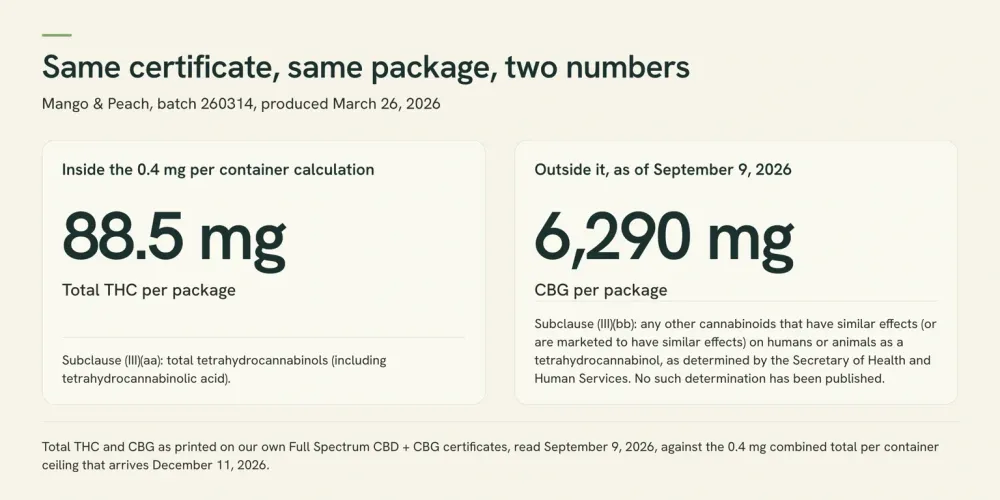
| November 12, 2026 | Subclause (I) only: intermediate and final hemp-derived cannabinoid products containing cannabinoids that are not capable of being naturally produced by a Cannabis sativa L. plant are excluded from the definition of hemp. | Paragraphs (1)(C)(ii)(I) and (1)(C)(iv)(I) of 7 U.S.C. 1639o as amended by section 781. Section 2019 names these two subclauses and no others. |
| December 11, 2026 | Everything else in section 781: the total THC standard including THCA, subclause (II) for cannabinoids capable of being naturally produced but synthesized or manufactured outside the plant, the 0.4 milligram combined total per container ceiling, and the new definitions including container. | Section 781 in full. The limiting sentence in Section 2019 runs only until December 11, 2026, so from December 12 the whole section applies on its own terms. |
| Neither date moved | Section 781's own effective date, fixed at 365 days after the November 12, 2025 enactment of Public Law 119-37. | Section 2019 does not amend section 781. What it changed for 29 days is scope, not the date. |
Here is the distinction almost every write-up flattens, and it is the whole CBG question. Paragraph (1)(C)(iv) of the amended definition has three subclauses. Subclause (I) covers "cannabinoids that are not capable of being naturally produced by a Cannabis sativa L. plant." Subclause (II) covers cannabinoids that "are capable of being naturally produced" but "were synthesized or manufactured outside the plant." Subclause (III) is the 0.4 milligram ceiling. What Section 2019 preserves on November 12 is subclause (I), in the intermediate-product paragraph (1)(C)(ii) and in the final-product paragraph (1)(C)(iv), and nothing else. So the exclusion that arrives first is written for cannabinoids the plant cannot make, and CBG is a cannabinoid the plant makes. That is a description of which subclause is which. It is not a statement that any product is safe, exempt or unaffected, and we are stopping there on purpose. The Congressional Research Service, the nonpartisan research arm of Congress, describes the same split in version 4 of its In Focus brief on the changed hemp definition, glossing the surviving tranche as "certain synthetic cannabinoids." That version is dated August 17, 2026 and speaks in the conditional, because it was written while the extension was still a bill.
The 0.4 milligram ceiling is written against the container, so we ran it on our own CBG bottle
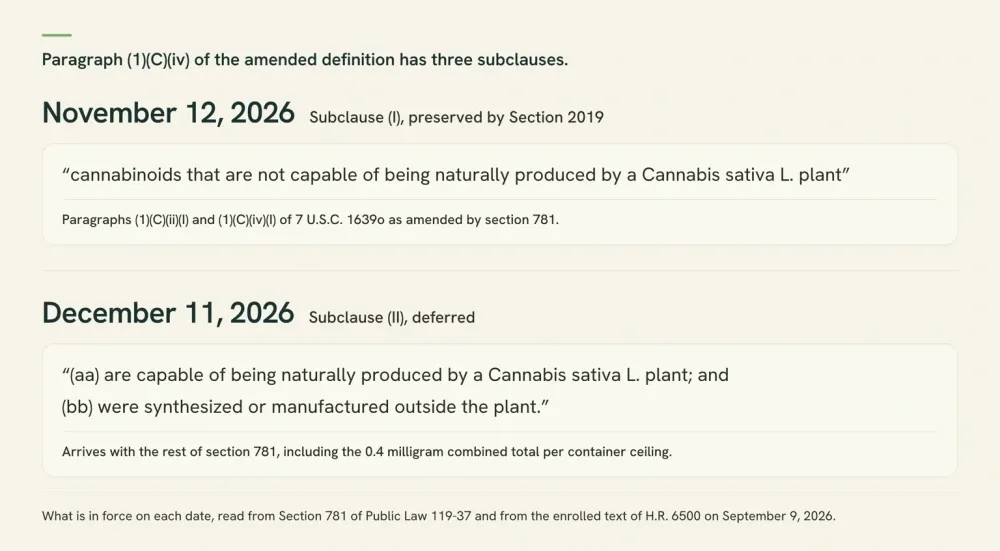
Section 781 excludes from hemp any final product containing more than 0.4 milligrams combined total per container of total tetrahydrocannabinols and certain other cannabinoids. The statute defines container itself, at paragraph (3)(C), as "the innermost wrapping, packaging, or vessel in direct contact" with the product for retail sale, listing a jar, a bottle, a bag, a box, a packet, a can, a carton or a cartridge. So the unit of measurement is the bottle, not the serving, and our explainer on section 781 and the per-container method works that arithmetic through in general. What nobody has done is run it on a CBG product, so we ran it on ours. The figures below are read straight off our published third-party certificates, in milligrams per package, exactly as the lab prints them. If you want to do this with a certificate of your own, finding the right row on a COA is the method.
| Flavor and batch | Total THC printed | CBG printed | Multiple of 0.4 mg |
|---|---|---|---|
| Mango & Peach, batch 260314, produced March 26, 2026 | 88.5 mg per package | 6,290 mg per package | 221.25x |
| Lemon & Raspberry, batch 260315, produced April 23, 2026 | 90.2 mg per package | 6,520 mg per package | 225.5x |
| Natural, batch 260313, produced March 26, 2026 | 80.5 mg per package | 6,520 mg per package | 201.25x |
Now the reframe, and this is the part page one has no version of. Read the ceiling closely. It counts "(aa) total tetrahydrocannabinols (including tetrahydrocannabinolic acid); and (bb) any other cannabinoids that have similar effects (or are marketed to have similar effects) on humans or animals as a tetrahydrocannabinol (as determined by the Secretary of Health and Human Services)." The (bb) half is a pointer to a determination, and that determination is one of the lists section 781 ordered from the FDA. As of September 9, 2026 it does not exist. So on the certificate above, the number inside the calculation today is 88.5 milligrams of total THC. The 6,290 milligrams of CBG on the same page is outside it entirely. Whether the CBG line ever enters that calculation depends on a document nobody has published, and we are not going to model a determination that has not been made. One way to feel the scale, and this arithmetic is ours rather than the lab's, run on the certificate's delta-9 line rather than on its total THC line: the same certificate prints delta-9 THC at 1.45 mg per milliliter, so it would take roughly 0.28 mL of this oil to carry 0.4 mg of delta-9 THC. The bottle holds 60 mL.
A disclosure, because you should not have to dig for it. We sell the product in that table. It is our Full Spectrum CBD + CBG tincture, 60 mL of coconut MCT oil carrying 9,000 mg of CBD and 6,000 mg of CBG, listed as sold out on our own catalog as we write this. The lab is Infinite Chemical Analysis Labs in San Diego, the packages are 56.7 g, and every certificate is published in full on our lab results page so you can check the rows we just quoted. The number is adverse to us and we printed it anyway, because a page that runs a statutory limit against everyone else's products and not its own is not worth reading. What we will not do is tell you what happens to that bottle after either date. Nobody can say that yet, and a company saying it about its own product would be the least trustworthy version of the sentence.
The clause nobody has resolved: synthesized or manufactured outside the plant
Subclause (II) is the one written about cannabinoids the plant can make, and it is the one no consumer page mentions. Here is what it covers, in the statute's own words.
“Cannabinoids that (aa) are capable of being naturally produced by a Cannabis sativa L. plant; and (bb) were synthesized or manufactured outside the plant.”
Two conditions, and CBG plainly meets the first one. The second is a question about origin, not identity. Some CBG is grown, from the CBG-dominant chemovars measured in the 2021 breeding paper above. A cannabinoid can also be produced outside a plant, and that is the category subclause (II) describes. Nothing in the statute tells you how it treats CBG in that second case, and neither the FDA nor the DEA has published anything that names cannabigerol at all. This is genuinely unresolved, and anyone selling you a confident answer to it is filling in a federal document that does not exist. The bodies that would have to answer it are named in the statute itself: the FDA, through the list of cannabinoids capable of being naturally produced and the list of cannabinoids with similar effects, and the Secretary of Health and Human Services, through the similar-effects determination that the 0.4 milligram ceiling depends on.
What the DEA has published about synthesis, and what it has not
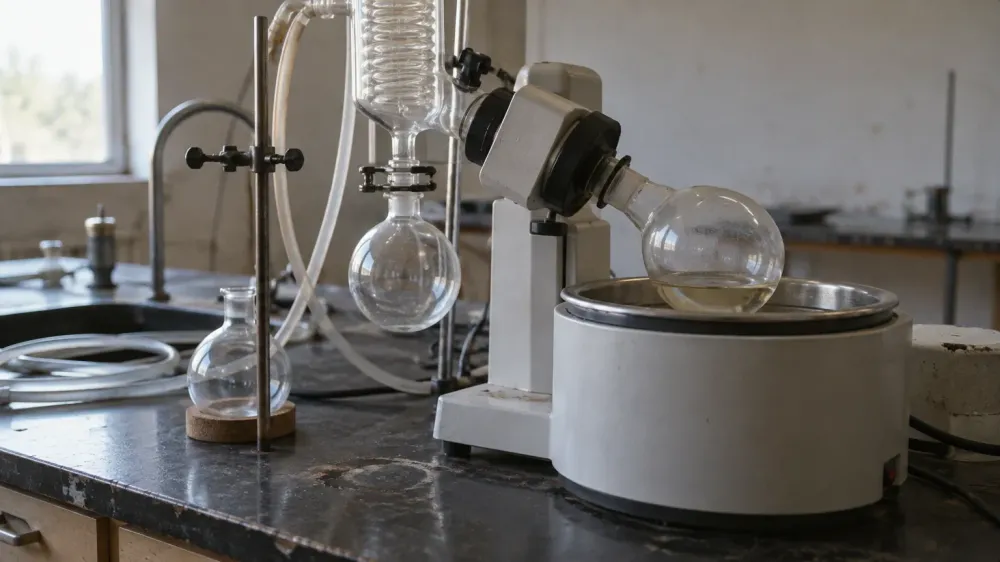
The DEA has a settled position on cannabinoids made outside the plant, and it is narrower than most people quote it as being. In an interim final rule published August 21, 2020 the agency wrote that the 2018 Farm Bill "does not impact the control status of synthetically derived tetrahydrocannabinols", that for those compounds "the concentration of delta-9-THC is not a determining factor", and that "all synthetically derived tetrahydrocannabinols remain schedule I controlled substances." That is the sentence that contradicts the page-one claim about the Farm Bill legalizing all hemp-derived cannabinoids. It is also, six years later, still an interim rule: comments closed on October 20, 2020, and when we searched the Federal Register on September 9, 2026 for a DEA final rule superseding it, we did not find one.
The agency said it again in 2026. A final rule effective May 4, 2026 giving hexahydrocannabinol its own Schedule I drug code states that "only tetrahydrocannabinols in or derived from the cannabis plant, not synthetic tetrahydrocannabinols, are excluded from control" as what the rule calls tetrahydrocannabinols in hemp, and that tetrahydrocannabinols "produced through chemical conversion, even when hemp derived are considered synthetically produced for purposes of the CSA." Read the noun in both rules. Every sentence is about tetrahydrocannabinols, and CBG is not a tetrahydrocannabinol, so by its own terms that reasoning does not reach CBG. Saying so describes the scope of two documents. It is not a conclusion that converted CBG is lawful, and we are not extending the DEA's logic in either direction. Our page on where HHC actually stands covers that rule, and how total THC became the operative number covers the measurement it turns on.
- Cannabigerol appears in 7 documents in the entire history of the Federal Register, on a full-text query we ran on September 9, 2026. None is an FDA document, and none of the seven places cannabigerol on a controlled-substance schedule.
- In the 2016 DEA rule establishing a drug code for marihuana extract, the word appears only inside a comment submitted to the agency, not in the DEA's own text.
- The other six are two rescheduling petition denials from August 2016, an exempt chemical preparations notice, two Federal Trade Commission matters, and the 2024 DEA proposed rule on rescheduling marijuana.
- Cannabigerol appears in 0 sections of the Code of Federal Regulations. So does cannabigerolic acid. The federal schedule at 21 CFR 1308.11 reaches tetrahydrocannabinols and names no other cannabinoid.
- For scale, from the same search on the same day: cannabidiol appears in 9 CFR sections, cannabinol in 2, cannabichromene in 2, hexahydrocannabinol in 7 and tetrahydrocannabinols in 203. Hemp appears in 265.
- None of that is a permission. A cannabinoid that no federal document names is a cannabinoid whose status is decided entirely by the material it sits in, which is where this article started.
The schedule itself carries the carve-out that closes the loop. 21 CFR 1308.11(d)(31) lists tetrahydrocannabinols under drug code 7370, then says the term "does not include any material, compound, mixture, or preparation that falls within the definition of hemp set forth in 7 U.S.C. 1639o." So the controlled-substance question routes straight back to the hemp definition, and the hemp definition is the thing with two 2026 dates on it.
The FDA layer is separate, unchanged, and does not name CBG
Whether something is hemp under the Farm Bill and whether it may be sold as a dietary supplement are two different questions with two different answers, and the second one belongs to the FDA. On its regulatory question and answer page for cannabis-derived products, the agency answers whether THC or CBD products can be sold as dietary supplements with a flat "No", on the ground that both are excluded under section 201(ff)(3)(B) of the FD&C Act, and states separately that adding either to food in interstate commerce is prohibited. That mechanism is substance-specific: it turns on whether a substance is an active ingredient in an approved drug, or has been authorized for investigation as a new drug with substantial public clinical investigations. Which is exactly why the FDA's answer names THC and CBD, and why the word cannabigerol appears nowhere on that page. Our page on what the FDA has actually said about CBD is the fuller version of this layer.
The pattern repeats in the agency's Dietary Supplement Ingredient Directory, which the FDA now publishes on a page titled Information on Select Dietary Supplement Ingredients and Other Substances, and whose footer read "Content current as of: 05/01/2026" when we checked it on September 9, 2026. Cannabidiol is listed there in Category 4, which the page defines as "excluded from the dietary supplement definition under section 201(ff)(3) of the FD&C Act." There is no cannabigerol row at all. Before you read anything into that, read the directory's own disclaimer, which sits on the same page: it "is not intended to be a comprehensive list of all ingredients used in dietary supplements and may not include all actions the agency has taken with respect to a particular ingredient." Absence from a list that says it is not a list is not permission, and it would be irresponsible of us to present it as one.
Two more things date this layer. In a January 2023 statement the FDA concluded that existing frameworks for foods and supplements are not appropriate for CBD and asked Congress for a new pathway, while denying three citizen petitions on the same day. That statement is about CBD and mentions no other cannabinoid. And the trigger the supplement exclusion runs on is not hypothetical for CBG: on September 9, 2026, ClinicalTrials.gov listed 14 registered studies with cannabigerol as an intervention against 535 for cannabidiol, and PubMed returned 574 titles or abstracts mentioning cannabigerol against 8,477 for cannabidiol. Those are counts and nothing more. We are not describing a single result from any of them, because this is a legal page and none of that would belong here.
Which brings us to the gap under all of it. Section 781 required the FDA, within 90 days of the November 12, 2025 enactment, to publish four things: a list of the cannabinoids capable of being naturally produced by the plant as reflected in peer reviewed literature, a list of the THC-class cannabinoids naturally occurring in the plant, a list of other cannabinoids with similar effects to that class, and additional specificity about the term container. Ninety days after November 12, 2025 is February 10, 2026. As of September 9, 2026, 211 days past the deadline, none of them has been published. We checked five ways on that date: the Federal Register for FDA hemp documents since January 1, 2026; for any hemp document since August 20, 2026; for any cannabinoid document since September 1, 2026; for the phrase "capable of being naturally produced" across the publication's whole history; and the FDA's own cannabis page, which still quotes the 2018 delta-9 definition and whose footer still reads "Content current as of: 07/16/2024." Every one of those Federal Register searches returned nothing, and the CRS brief says the same thing in its own words. We can show non-publication, and that is all we are claiming.
The state layer, and why there is no 50 state table on this page
The mechanism is more useful to you than a matrix, so here is the mechanism. States write their own definitions, and they regulate the container and the label rather than the molecule, exactly as the federal definition does. Virginia is a clean example. Its regulations define an industrial hemp extract by THC concentration and intended human consumption, naming no cannabinoid at all, and then require that if a manufacturer labels a product as containing a specific cannabinoid, the number of milligrams of that cannabinoid must be declared on the label. A related section forbids selling from a batch that does not contain the cannabinoid concentration the label claims. That is one state, cited to show how the layer works and not as a survey of anywhere else.
Some states have already written synthesis into their own text, ahead of the federal amendment. Florida's statutory definition of hemp extract, as it stood in the 2025 statutes when we read it on September 9, 2026, says the term "does not include synthetic cannabidiol." Note the noun: synthetic cannabidiol, not CBG. And CRS records stakeholders reporting that states "have altered or aligned their laws and regulations with the new definition." So the layer is moving, in different directions, at different speeds. A responsible 50-state answer is a matrix maintained by counsel and dated to the week, not a table in a blog post that goes stale in a month and that a reader may act on. We are not going to publish one. Here is what to do instead.
- 1Start with your state department of agriculture or your state department of health. Those offices license and inspect hemp products where you live, and they answer this question for a living.
- 2Ask about the product category, not the cannabinoid. State rules attach to extracts, tinctures, edibles, beverages and inhalables, and they often set different limits and different age rules for each.
- 3Read your own label against your own certificate. Several states require that any cannabinoid a label names be tested and found in that batch, in milligrams, which makes the certificate the document that settles it.
- 4For a decision with consequences attached, ask a lawyer who practices in your state. We can tell you what the federal text says and when. Nobody can responsibly tell you which side of an undefined line a specific product sits on.
Questions people are asking
Answer it by layer and by date; a bare yes is not supportable. Through November 11, 2026 the federal definition of hemp turns on delta-9 THC at or below 0.3% on a dry weight basis and names no cannabinoid at all, so CBG's status follows the material rather than the molecule. Two amendments land after that, on November 12 and December 11, 2026. The FDA layer is separate and your state is a third. Federal law as of September 9, 2026, and not legal advice.
What arrives that day is one exclusion, written for a specific thing. Section 2019 preserves only subclause (I), covering cannabinoids that are "not capable of being naturally produced by a Cannabis sativa L. plant." CBG is a cannabinoid the plant produces, and its acid form is the precursor the others are built from. That is what the subclause says, and that is where we stop. It is not a statement that any product containing CBG is exempt, safe or unaffected, and the FDA's list of naturally producible cannabinoids is still unpublished.
The federal schedule at 21 CFR 1308.11 reaches tetrahydrocannabinols under drug code 7370 and names no other cannabinoid. Our full-text checks on September 9, 2026 found cannabigerol in zero sections of the Code of Federal Regulations and in no federal action that places it on a schedule, against 203 sections for tetrahydrocannabinols. Absence from a schedule is not a positive permission. The material's status still runs through the hemp definition, which is the thing carrying two 2026 dates.
As of September 9, 2026, no. The ceiling counts total tetrahydrocannabinols including THCA, plus any other cannabinoids with similar effects to a tetrahydrocannabinol "as determined by the Secretary of Health and Human Services." No such determination has been published, so the second half of the clause has nothing to point at. On our own certificates that means the 80.5 to 90.2 milligrams of total THC per package is the number inside the calculation and the 6,290 to 6,520 milligrams of CBG is outside it. We are not going to compute a hypothetical combined total against a list that does not exist.
This is the open question on the page, and we are labeling it open rather than answering it. Subclause (II) covers cannabinoids capable of being naturally produced by the plant that "were synthesized or manufactured outside the plant." It takes effect December 11, 2026. The DEA's published reasoning about chemical conversion is written about tetrahydrocannabinols only, and CBG is not one. Resolving it would take the two cannabinoid lists section 781 required from the FDA, and neither exists.
The FDA has published that answer for THC and CBD and has not published one for CBG. The exclusion runs on section 201(ff)(3)(B) of the FD&C Act and is substance-specific, triggered by a substance's own drug-approval or public investigational status. The agency's Dietary Supplement Ingredient Directory lists cannabidiol in Category 4 as excluded and has no cannabigerol row, and the same page says it "is not intended to be a comprehensive list." Silence in a document that calls itself incomplete is not permission.
We will not answer that as a yes, and we are not publishing a 50-state table. State hemp law changes faster than any blog page can track, and states regulate by product category and by label rather than by cannabinoid: Virginia requires a declared milligram figure for any cannabinoid a label names, and Florida's definition already excludes synthetic cannabidiol. Your state department of agriculture or your state department of health is the office that can answer for where you live.
No. Section 781 required four publications within 90 days of the November 12, 2025 enactment, which made them due February 10, 2026. As of September 9, 2026 that is 211 days, and none has appeared. We checked the Federal Register four ways that day, including a full-text search for the phrase "capable of being naturally produced" across the publication's entire history, which returns zero documents. The FDA's own cannabis page still quotes the 2018 delta-9 definition. We can show non-publication. We are not offering a reason for it and we are not predicting what the lists will say.
Two questions people arrive with that this page deliberately does not answer. Whether CBG shows up on a drug test is a detection question rather than a legality question. Whether CBG is intoxicating is a pharmacology question, and it belongs on the page comparing CBG with CBD rather than in a piece about statutory text. For the general federal, FDA and state layering, where CBD stands legally is the evergreen hub and will outlast both of the dates above. For the statute's own mechanics and the per-container method worked in general, that is our section 781 explainer. And to run this article's arithmetic on a certificate of your own, ours are published in full at our lab results archive.
Writing about hemp, wellness and the small rituals that keep us balanced.