Can You Mail CBD? What USPS Publication 52 Actually Says
USPS Publication 52 lets you mail hemp CBD inside the United States under two conditions, and neither is a form in the box. Records are kept for three years, not the two years most guides still print, and a CBD vape is governed by a different chapter entirely.

Can you mail CBD? Inside the United States, yes, for hemp-derived CBD, and the rule that says so is one paragraph long. USPS Publication 52, section 453.37, permits it when the tetrahydrocannabinol concentration does not exceed 0.3 percent and the mailer does two things: complies with applicable law, and retains the records that show it. Neither of those two things is a piece of paper inside the parcel. That distinction, retain rather than enclose, is the whole operational answer, and it is where most of the internet gets this wrong.
Can you mail CBD? Start with the one document that decides it
The document is Publication 52, Hazardous, Restricted, and Perishable Mail. It is the Postal Service's own rulebook for everything it will carry with conditions attached, and it is public, free and searchable. We downloaded all 211 files of it on September 7, 2026, and the word hemp appears in exactly two of them. One is section 122, the definitions section, where the list of restricted matter reads: "Restricted matter includes intoxicating liquors, firearms, construction materials, certain liquids, powders, controlled substances, hemp products, sharp objects, tobacco products, and unsolicited promotional items." The other is section 453.37, which is the paragraph that actually answers the question.
Restricted matter is a useful category to understand before you read anything else. It does not mean approved, endorsed or recommended. It means mailable with conditions, in the same legal family as liquor and firearms. And the conditions are yours to satisfy, not the Postal Service's to check. Section 412, Mailer Responsibility, is one sentence long and it is worth reading whole: "The mailer is responsible for ensuring that all Postal Service requirements, as well as any applicable federal and state laws and local ordinances applicable to the shipment of restricted matter, have been met."
One framing point before the text itself. A postal mailability standard is not a verdict on whether a product is lawful to sell, to possess or to receive. It answers a narrow question: will the Postal Service carry this. Our guide to how federal and state CBD law fit together covers the possession and use side, which is a different question with a different answer. This page is about transport.
What section 453.37 actually says, word for word
Here is the operative text of Publication 52 section 453.37, Hemp-Based Products, read on September 7, 2026. It is reproduced below word for word, and two other parts of the same section are quoted separately further down: the opening sentence, which defines what hemp means for the section's own purposes, and the paragraph on international mail. The edition it sits in is dated August 2026: the transmittal letter for the current edition carries "Issue Date August 2026" and says the policy "supersedes the February 2026 edition of Publication 52, Hazardous, Restricted, and Perishable Mail". The two changes that edition lists are about day-old poultry and international dangerous goods, so the hemp section was not touched by it.
“Hemp and hemp-based products, including cannabidiol (CBD) with the tetrahydrocannabinol (THC) concentration of such hemp (or its derivatives) not exceeding a 0.3 percent limit are permitted to be mailed domestically only when the mailer: Complies with all applicable federal, state, and local laws, including U.S. Department of Agriculture approved plans for hemp production, processing, distribution, and sales (7 CFR Part 990). Retains records establishing compliance with such laws and plans, including laboratory test results, licenses, or compliance reports, for no less than 3 years after the date of mailing.”
Two conditions, and a third rule that most consumer pages skip entirely. Read the section closely and notice what it does not say: it says "tetrahydrocannabinol (THC) concentration", not delta-9 and not total THC, so do not translate that number into a metric the section itself does not name. The table below sorts the whole section into what is required, what is not, and what is prohibited outright.
| Item | Status under section 453.37 | How the section handles it |
|---|---|---|
| Comply with applicable federal, state and local law, including USDA-approved hemp plans | Required | "Complies with all applicable federal, state, and local laws, including U.S. Department of Agriculture approved plans for hemp production, processing, distribution, and sales (7 CFR Part 990)." |
| Retain records of that compliance, including laboratory test results, licenses or compliance reports | Required, for no less than 3 years after the date of mailing | "Retains records establishing compliance with such laws and plans ... for no less than 3 years after the date of mailing." |
| THC concentration of the hemp or its derivatives | Must not exceed 0.3 percent | "not exceeding a 0.3 percent limit". The section says tetrahydrocannabinol concentration and names neither delta-9 nor total THC. |
| A signed self-certification statement inside the parcel | Not a requirement | The string self-certification does not appear anywhere in the online Publication 52 we read on September 7, 2026. |
| A special label, form or declaration on the outside of the parcel | Not a requirement in this section | Not found in our read of section 453.37. |
| A signature, or presenting the parcel face to face at a counter | Not a requirement in this section | Not found in section 453.37. It is a requirement in the separate rules for inhalables at section 473.1, which is a different regime. |
| International mail, and delivery to APO, FPO or DPO addresses | Prohibited | "Shipments of hemp and hemp-based products, including CBD, are prohibited in international mail, including items for delivery to overseas Army Post Office, Fleet Post Office, and Diplomatic Post Office addresses (APO/FPO/DPO)." |
The fourth row is the one worth dwelling on, because a signed self-certification statement is the single most repeated claim about mailing CBD online, and we could not find it. We searched the same 211 files for it, in every spelling, and zero of them contain it. The control search matters as much as the result, so here it is: all 211 of those same files contain the string Publication 52, which proves the search was working. The word certification on its own does occur 9 times across the publication, spread over 8 files including the firearms and cigarette sections, and not once in section 453.
USPS also said this in plain English when it created the rule. The Postal Bulletin that introduced section 453.37 in 2019 explains the new obligation in its preamble and then adds, verbatim: "A mailer is not required to present the documentation at the time of mailing, but such documentation may be requested either at that time or on a later date if there is doubt about the item's mailability or the addressee's ability to legally receive it." That is the answer to the paperwork question, from the agency, in writing, in the bulletin that created the rule. Note the last clause too, because we come back to it: the addressee's ability to legally receive it.
Why almost every guide online says two years
Because two years was true, and then it was not. The number is not invented and the pages repeating it are not lying. They are quoting the 2019 version of a paragraph that was rewritten in 2021, and they never went back. This is the most checkable claim on this page. Open the section, search it for the word years, and there is exactly one number attached to that word. The number is 3.
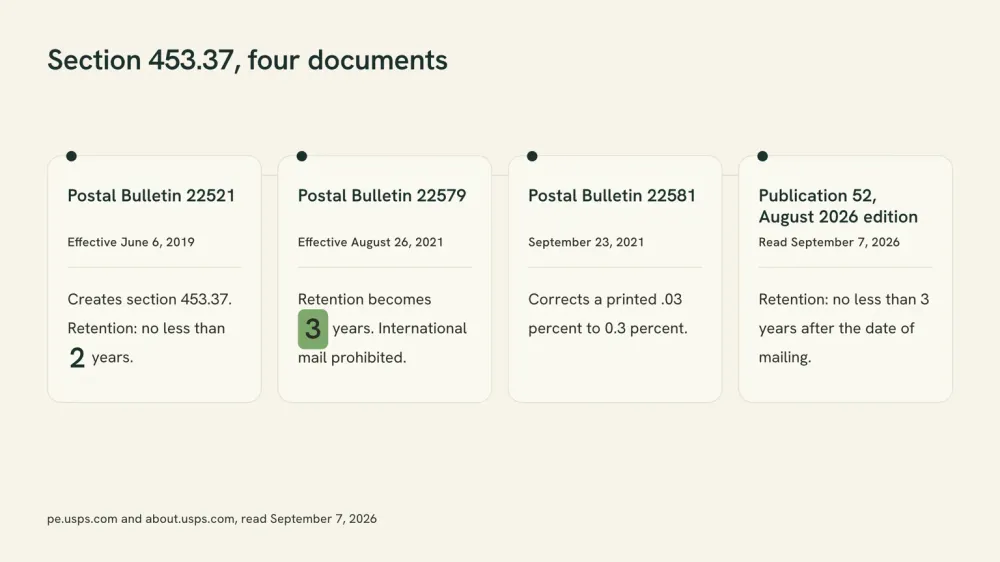
| Document | Effective | What it did | Retention period it set |
|---|---|---|---|
| Postal Bulletin 22521 | June 6, 2019 | Created section 453.37. No USDA-plan clause and no international prohibition in this version. | "no less than 2 years after the date of mailing" |
| Postal Bulletin 22579 | August 26, 2021 | Revised 453.37 to "update the hemp mailer laboratory test result records retention period" and to add the prohibition on international mailings, aligning with USDA's Domestic Hemp Production Program. | 3 years after the date of mailing |
| Postal Bulletin 22581 | September 23, 2021 | Corrected the August bulletin, which had printed the mailable THC limit as ".03 percent". USPS states the correct limit "is 0.3 percent". | Unchanged at 3 years |
| Publication 52, August 2026 edition | Current at our read | Supersedes the February 2026 edition. Its two listed changes cover day-old poultry and international dangerous goods, neither of which touches hemp. | 3 years after the date of mailing |
The middle two rows are the interesting ones. The 2021 revision is what raised the retention period and what added the international ban, and it says why: to align Postal Service policy with the U.S. Department of Agriculture's Domestic Hemp Production Program. Four weeks later, a second bulletin corrected a typo in the first. The August article had printed the mailable THC limit as .03 percent, a tenfold error, and USPS published a correction stating that the concentration limit "is 0.3 percent". We are reporting that as what it is, a documented correction, and it is a useful reminder that even a primary source gets a second read.
The practical consequence for a small shipper is small but real. If you built your file-keeping around a two-year rule, you are a year short of what the current text asks for. The retention clock runs from the date of mailing, not from the date of the lab report, so a certificate you were about to throw away may still be attached to a parcel that went out last winter.
A CBD vape is not a tincture, and Publication 52 treats them differently
Every consumer page we read treats CBD as one shipping class. Publication 52 does not. If the thing in the box is designed to be inhaled, section 453.37 is not the rule that governs it, and the rule that does is much harder. Section 471 defines an Electronic Nicotine Delivery System as "Any electronic device that delivers nicotine, flavor, or any other substance through an aerosolized solution", lists vape pens and refillable personal vaporizers among the examples, and then widens it: "Any reference to ENDS includes any component, liquid, part, or accessory of an ENDS device, regardless of whether they are sold or provided separately or contains or is used with nicotine."
Read those two phrases together, because they are doing all the work. Any other substance. Regardless of whether it contains or is used with nicotine. The word cannabis does not appear in section 471 at all, and it does not need to: the definition reaches by its own terms. We are describing the mechanism of a definition here, not reporting that USPS has issued a ruling about any particular CBD product, and that distinction is worth keeping straight.
What follows from being a covered product is the part that changes the answer. Section 472 makes covered products generally nonmailable. Section 472.21 says the Postal Service "will not accept, forward, or deliver packages it knows, or reasonably believes, to contain nonmailable covered products", and adds that where it reasonably suspects a mailer is tendering them, "the mailer bears the burden of proof in establishing eligibility to mail". Section 472.22 provides that nonmailable covered products deposited in the mail "are subject to seizure and forfeiture", and 472.24 lists penalties including criminal fines and imprisonment under 18 U.S.C. 1716 and civil penalties. The recordkeeping for covered products at 472.5 runs six years, not three, which on its own tells you these are two different regimes rather than two readings of one.
There are narrow exceptions at section 473, and none of them is available to a consumer. They cover intra-Alaska and intra-Hawaii mail, business and regulatory shipments between licensed entities, consumer testing and federal public-health testing. On top of that, 473.1 requires the mail to be presented in a face-to-face transaction with a Postal Service employee at a retail or business mail acceptance location, and expressly excludes the convenient ways of handing over a parcel.
- Pickup on Demand
- Package pickup
- An Approved Shipper location or other third-party acceptance location
- A Contract Postal Unit
- A Village Post Office
- Placement in a customer mailbox, collection box, or Postal Service lobby drop
This split matters most for the cannabinoid categories that arrived through vape hardware first. If that is the corner of the market you are in, our explainer on how delta-8 differs from CBD covers why that category sits at the intersection of carrier policy and a federal definition that is about to move.
UPS and FedEx are contracts, not law
A private carrier is not bound to carry anything, and it is not obliged to explain itself. Its policy is a term of a commercial agreement, which means three things. It can prohibit something federal law permits. It can change without notice and without a bulletin. And only the version in force on the day you ship is the one that binds you. A blog post about a carrier's policy, including this one, is a description of a moving object.
UPS publishes its position on a support page at ups.com covering hemp, CBD and marijuana. That page will not open to an automated client from here, so we read the copy of it archived on July 4, 2026 and quote only from that dated snapshot. It opens with the shape of the arrangement: "If you're shipping hemp or CBD products, you'll need to open a dedicated account and provide us with licenses and a signed UPS agreement." It requires that "All shipments within the U.S. containing hemp or hemp derivatives must use UPS Adult Signature Required service". It states that "UPS prohibits the shipment of any synthetic or lab-made cannabinoid compound and their derivatives". And it reserves the right to discontinue service to a shipper who tenders a non-compliant package.
Two details in that snapshot are worth more than the rest. First, on inhalables UPS lands exactly where Publication 52 does: "Hemp derivatives intended for consumption through an aerosolized solution are prohibited in the U.S. network including import and export." Two carriers, two entirely independent rulebooks, one line. Second, UPS tells shippers to comply with state law and picks a worked example to show what it means, naming "potency limitations such as those found in the regulations amending Part 114 (Cannabinoid Hemp) of Title 9 of the New York Codes, Rules and Regulations". A carrier citing a single state's potency rule inside a national policy is the cleanest evidence available that carrier compliance runs through state law rather than around it.
| Carrier | What kind of rule it is | Where the rule lives | What we could verify on September 7, 2026 |
|---|---|---|---|
| USPS | A published federal standard, revised through Postal Bulletins | Publication 52, sections 122, 412, 413, 453.37 and 471 to 474, at pe.usps.com | Read in full. Hemp CBD mailable domestically under two conditions; international and APO/FPO/DPO prohibited; inhalables governed separately. |
| UPS | A contract. Dedicated account, licenses and a signed UPS agreement | The hemp, CBD and marijuana page in the UPS shipping-support section at ups.com | The live page would not open to us. Every quotation here comes from the July 4, 2026 archived copy of that address, and the snapshot date is printed beside each one. |
| FedEx | A contract, on the same principle as UPS | The prohibited and restricted items page of the FedEx service guide at fedex.com | Nothing. On September 7, 2026 that address returned an access-denied interstitial to us, so we report no FedEx policy content at all. Open it in a browser yourself. |
That last row is not a gap we are apologising for, it is the most useful thing we can tell you about FedEx. We tried the service guide page and every other likely path on fedex.com on September 7, 2026, and each one returned the same short access-denied page rather than a policy. So we are not going to tell you what FedEx's terms say, we are not going to repeat what a logistics blog said they said in 2019, and you should treat any page that quotes them without a date the same way. Go to the carrier's own service guide, read the current version, and if you are shipping commercially, ask your account representative in writing. The same logic applies to selling platforms rather than carriers, which is why Amazon's CBD policy is a private rule too, and why a cruise line's ticket contract can ban a product no statute bans.
A lawful shipment is not a lawful receipt
This is the part the shipping guides skip, because they are all written for the sender. Federal law has something specific to say about hemp crossing state lines, and it is narrower than it is usually reported. Section 10114 of the Agricultural Improvement Act of 2018 is headed Interstate Commerce, and its operative subsection reads: "No State or Indian Tribe shall prohibit the transportation or shipment of hemp or hemp products produced in accordance with subtitle G of the Agricultural Marketing Act of 1946 ... through the State or the territory of the Indian Tribe, as applicable."
The operative word is through. That is a rule about goods in transit across a state, and it is not a right to buy, to sell, to possess or to take delivery. The same statute is explicit that it does not sweep state law aside. The no-preemption clause it adds says: "Nothing in this subsection preempts or limits any law of a State or Indian tribe that (i) regulates the production of hemp; and (ii) is more stringent than this subtitle." Note the scope of that clause carefully: it is about production. Federal hemp law is largely silent on retail sale and on possession, and that silence, rather than any grant of state authority, is why the answers diverge so much once a parcel stops moving and gets opened by somebody who lives somewhere.
So instead of a fifty-state table, which would be out of date before you finished reading it, here is the structure of the variation. States differ along four axes, and knowing which axis your state uses tells you what to search for.
- 1Whether the state restricts the product category at all. Some restrict specific consumable forms rather than cannabinoids as such, so the question is what kind of product it is before it is what is in it.
- 2Whether it caps THC by a different number or a different metric. A state may use a per-serving or per-container limit, or a total-THC calculation, where the federal definition uses a concentration.
- 3Whether it regulates the sale rather than the substance: direct-to-consumer delivery rules, age verification at the door, and licensing or registration of the seller shipping in.
- 4Whether it treats inhalables separately from ingestibles. This is the most common split and the one that catches people, because a state can permit a tincture and restrict a vape in the same paragraph.
The method is duller than a table and it actually works: read your own state's department of agriculture or health pages for the product category, then read the state code section they cite, and check the date on whatever you find. Do not rely on a table in a blog post, including one of ours. A page that tells you your state is fine, without naming the code section it read and the date it read it, has told you nothing you can act on.
One federal list is worth knowing about, because section 453.37 points at it. USDA publishes a list of approved state and tribal hemp plans, updated February 17, 2026 and read by us on September 7, 2026. Counting the rows on that page: 38 states have a USDA-approved plan and the other 12 operate under a USDA-issued producer license instead, 3 territories have approved plans (Guam, Puerto Rico and the US Virgin Islands), and 57 Tribal plans are approved with 8 more Tribes operating under a USDA license. We are deliberately not printing which 12 states those are, because a list of state names on a shipping page invites exactly the inference the next paragraph exists to block; the page itself names them if you want them. USDA also states it has 60 days to approve or disapprove a plan once it is formally submitted.
Now the limit, in the same breath, because this list is misread constantly. That is a map of how hemp production is regulated. It is not a map of consumer legality. A state with an approved plan may still restrict retail sale of a finished product, and a state operating under a USDA license is not thereby more permissive. The list tells you which authority licenses a grower, and nothing at all about whether a package may be delivered to your door.
Publication 52 itself acknowledges the receive side, which surprised us. Section 413, Rulings provides that where mailability of a restricted-matter article is in question, "a postmaster may require the mailer or addressee, as applicable, to furnish a written explanation", and that the explanation "must include the article mailability and addressee's eligibility". This is a procedure that may be used, not one that routinely is, and nothing in the section suggests parcels are commonly opened or recipients commonly questioned. But it is the clearest evidence in the rulebook that the postal standard contemplates two people, not one.
The definition this whole rule points at changes on two dates
Here is the sharpest sentence in the section, and it is the first one. Section 453.37 opens: "For purposes of this section, 'hemp' refers to the definition provided under federal law, including Section 10113 of the Agricultural Improvement Act of 2018, Pub. L.115-334 (7 U.S.C. 1639o), or any successor provision." The last four words are the ones that matter: or any successor provision. The mailability rule is a pointer. It does not carry its own definition of hemp, so when the statute it points at is rewritten, the pointer moves on its own and USPS does not have to publish anything for that to happen. Only one of the seven page-one results we read on September 7, 2026 even names Publication 52, so none of them gets as far as this clause, and it is sitting in the section's first line.
The statute is being rewritten, and the change arrives on two dates rather than one. Section 781 of Public Law 119-37 amends 7 U.S.C. 1639o effective 365 days after enactment, which lands on November 12, 2026. Then, on September 2, 2026, H.R. 6500 was signed, and its section 2019 limits how much of that amendment applies until December 11, 2026. Here is section 2019 in full, from the enrolled text of the bill.
“SEC. 2019. SECTION 781 EXTENSION. Until December 11, 2026, the amendments made by section 781 of division B of Public Law 119-37 (7 U.S.C. 1639o note) shall only apply with respect to products described in paragraphs (1)(C)(ii)(I) and (1)(C)(iv)(I) of section 297A of the Agricultural Marketing Act of 1946 (7 U.S.C. 1639o) (as amended by such section 781).”
Read that as a scope limiter and not as a postponement. November 12 still arrives; what changes is how much of section 781 is in force for the 29 days after it. The piece that lands on November 12 covers cannabinoids that are, in the statute's words, not capable of being naturally produced by a Cannabis sativa L. plant. Everything else the new definition reaches waits until December 11. If you print only one of those dates you have printed the wrong article, and if you attach the wrong provision to the wrong date you have printed something a reader could act on. We are not going to re-derive any of it here: our dedicated piece on the two dates and what sits behind each one has the enactment, the section, the split and the vote record.
One part of the new definition is genuinely about shipping, and it is the part everyone misreads. Section 781 of Public Law 119-37 excludes from hemp any final hemp-derived cannabinoid product containing greater than 0.4 milligrams combined total per container of total tetrahydrocannabinols and other cannabinoids with similar effects. The word container is defined in the statute itself, and it is not the parcel: it means "the innermost wrapping, packaging, or vessel in direct contact with a final hemp-derived cannabinoid product ... enclosed for retail sale to consumers, such as a jar, bottle, bag, box, packet, can, carton, or cartridge", and it expressly "excludes bulk shipping containers or outer wrappings that are not essential for the final retail delivery or sale to an end consumer". In other words the container is the retail vessel a product is sold in, not the parcel it travels in, which is the opposite of what a shipping page would assume. We are stating the standard and stopping there: our explainer on the hemp definition and total-THC math is where that arithmetic belongs, and there is no version of it that belongs on a page about parcels.
If you are the one sending the package
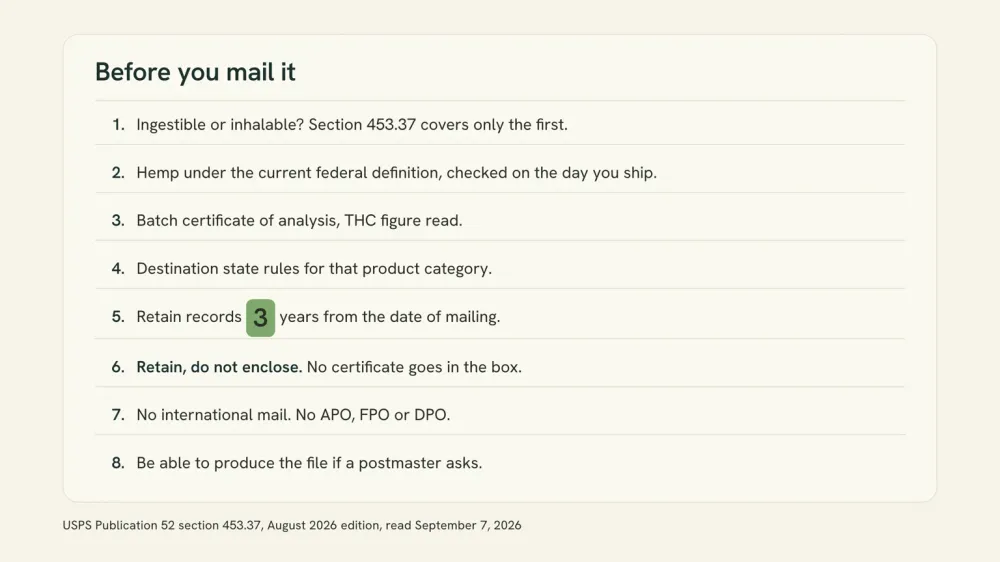
This is the checklist that falls out of the sections above, in the order the questions actually arise. It is written for a person sending a parcel, not for a licensed operator running a fulfilment line.
- 1Work out which rulebook applies before anything else. An ingestible hemp product is handled by section 453.37. Anything designed to deliver a substance through an aerosolized solution is not, and the answer there is very different.
- 2Confirm the product is hemp under the current federal definition, and check that definition on the day you ship rather than from memory. Section 453.37 follows the statute and any successor provision to it.
- 3Get the batch certificate of analysis and read the THC figure printed on it. That certificate is one of the exact documents the section names as a record to retain.
- 4Check the destination state's own rules for that product category. The federal transit protection is about movement through a state and settles nothing about delivery into one.
- 5Keep the lab results, licenses and any compliance reports for no less than 3 years after the date of mailing. Three, not two.
- 6Keep them somewhere you could actually produce them from. Retention is the requirement; enclosing a copy in the box is not, and never was.
- 7Do not mail it internationally, and do not mail it to an APO, FPO or DPO address. Section 453.37 prohibits both, with no exception written into the section.
- 8If a postmaster raises a question, expect it to cover both mailability and the addressee's eligibility, and answer it from the file rather than from memory.
Two of those steps lean on the same document, and it is the one most people never look at. The laboratory test result that section 453.37 tells a shipper to retain is the same certificate a buyer should be reading before ordering. If you have never worked through one, our guide to reading a certificate of analysis line by line covers what the potency table is telling you, and what third-party testing actually means explains why who ran the test matters as much as what it says. This page is not legal advice, and if you are shipping as a business rather than sending one parcel to a friend, the right next step is a lawyer who works on hemp compliance, not a blog post.
If you are the one waiting for the package
Every guide on this topic is written for the shipper. Nobody writes for the person refreshing a tracking page, which is odd, because that is who is actually searching. Here is what a recipient can control and what a recipient cannot.
- Know your own state's position on the category you are ordering. The federal transit rule protects goods moving through a state and settles nothing about whether you may take delivery.
- Expect no signature requirement from USPS for an ingestible hemp product. Section 453.37 does not impose one, and no form travels with the parcel.
- Expect an adult signature if the shipper used UPS. Its policy, as archived on July 4, 2026, requires UPS Adult Signature Required service on US shipments containing hemp or hemp derivatives.
- Ask the seller for the batch certificate of analysis before you order. It is the same document a compliant shipper has to retain, so a seller who cannot produce it for you may not have it to produce for anyone.
- Read "it shipped" as a fact about a parcel, not as a legal opinion about where you live. A carrier accepting a package is not a ruling on anything.
- If a question is ever raised about a package, Publication 52 contemplates it covering both mailability and the addressee's eligibility. The answer to that lives in documents, not in a phone call.
That fourth item is also the honest answer to "can I order CBD online", which is really this question wearing different clothes. Ordering is not the hard part. The hard part is that the seller's obligations and your state's rules are two separate things, and only one of them is visible on a checkout page. A seller that publishes per-batch lab reports is showing you the document that sits at the center of the postal rule as well; ours are posted on our lab results page for exactly that reason. What we cannot do, and what no brand can honestly do for you, is tell you what your state permits you to receive.
What this page does not settle
Six limits, stated plainly, because a page about a rule should be as checkable as the rule. We could not read FedEx's policy. On September 7, 2026 every path we tried on fedex.com returned an access-denied page, so nothing here describes FedEx's terms and you should be suspicious of any page that quotes them without a date. We did not read every carrier. DHL, regional carriers and courier services are not covered at all, and the fact that USPS and UPS converge on inhalables says nothing about anyone else. There is no state-by-state table here on purpose. Fifty-state matrices go stale silently and are exactly the kind of content that should be read at the source.
The USDA list is about production, not retail. It tells you which authority licenses a grower and nothing about delivery. Publication 52 changes. The section discussed here has been created, revised and corrected since 2019, and the edition we read is dated August 2026; a version of this page read a year from now may be describing a paragraph that has moved. And section 471 does not name cannabis. Our reading of how that definition reaches an inhalable is a reading of the definition's own words, not a report that USPS has ruled on a particular product. Everything above carries the section number and the date of our read so you can check each of these for yourself.
Yes, for hemp-derived CBD at or under the 0.3 percent THC limit, domestically, when the mailer complies with all applicable federal, state and local law including USDA-approved hemp plans, and retains the compliance records. That is Publication 52 section 453.37 in the August 2026 edition, read on September 7, 2026. It does not apply to international mail or to APO, FPO and DPO addresses, which the same section prohibits.
No. Section 453.37 requires the mailer to retain records, not to enclose them, and USPS said so in writing in the 2019 Postal Bulletin that created the section: "A mailer is not required to present the documentation at the time of mailing, but such documentation may be requested either at that time or on a later date if there is doubt about the item's mailability or the addressee's ability to legally receive it." The string self-certification does not appear anywhere in the online Publication 52 we searched on September 7, 2026, across all 211 files of the publication.
Three. The current text says "for no less than 3 years after the date of mailing". The two-year figure that most shipping guides still print is the 2019 version of the same sentence; Postal Bulletin 22579 raised it to three effective August 26, 2021, at the same time as it added the international prohibition. The clock runs from the date of mailing, not from the date on the lab report.
They are not covered by the hemp section at all. An inhalable falls under Publication 52's rules for covered products, where section 472 makes them generally nonmailable, the recordkeeping runs six years rather than three, and the narrow exceptions at section 473 require a face-to-face transaction with a Postal Service employee and exclude lobby drops, package pickup, Contract Postal Units and Village Post Offices. UPS separately prohibits hemp derivatives intended for consumption through an aerosolized solution in its US network.
Federal law bars a state from prohibiting the transportation or shipment of hemp through it, and says nothing that makes a product lawful to sell, possess or receive there. States differ on whether they restrict the category, on which THC metric they use, on direct-to-consumer delivery and age verification, and on whether they treat inhalables separately. Check your own state's department of agriculture or health and the code section it cites. Do not rely on a table in a blog post, including one of ours.
Indirectly, and by design. Section 453.37 defines hemp by reference to the federal statute "or any successor provision", so the postal rule follows the definition rather than being rewritten. Two dates apply: November 12, 2026 for the tranche covering cannabinoids not capable of being naturally produced by a Cannabis sativa L. plant, and December 11, 2026 for everything else the new definition reaches, including the 0.4 milligrams combined total per container standard. Both dates and the provision behind each one are documented on our page about the December 11 extension.
If you take one thing from this page, make it the difference between retain and enclose, because it is the difference between a filing habit and a piece of theater. And if what you actually came for was the bigger question underneath the shipping one, our guide to where CBD stands under federal and state law is the place to go next: it covers possession, use and the parts of this subject a postal rulebook was never going to answer.
Writing about hemp, wellness and the small rituals that keep us balanced.