A Trial Tested CBD Ads. The Control Group Is the Story
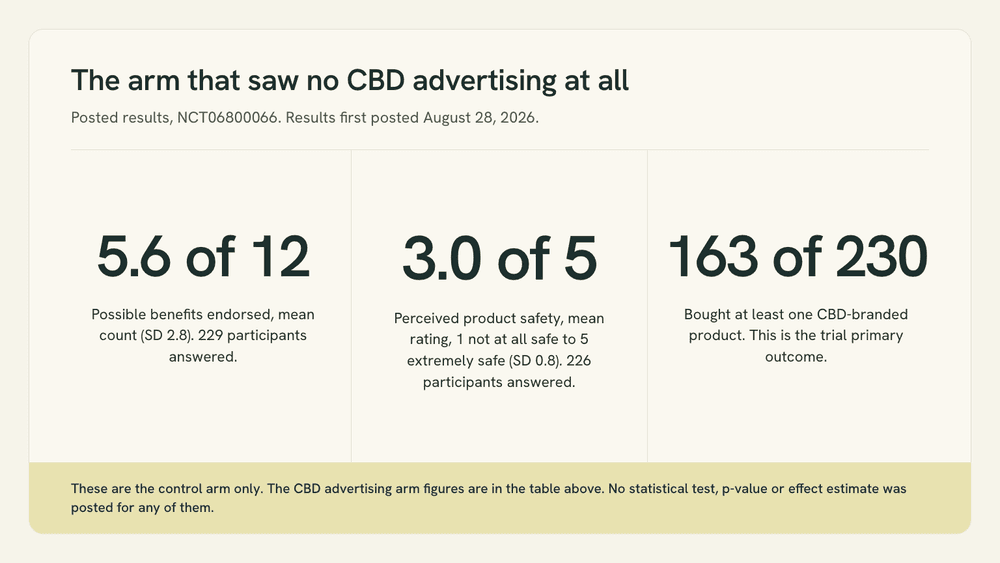
On August 28, 2026 results were posted for a randomized trial that put 460 shoppers through a simulated mini mart. In the room with no CBD advertising at all, shoppers endorsed 5.6 of 12 listed benefits and 163 of 230 bought a CBD-branded product anyway.

On August 28, 2026, results were posted to the federal clinical trials registry for a study that did something unusual: it built a store. Researchers put 460 adults, one at a time, into a 245 square foot replica of a mini mart, gave each of them a $75 debit card, and asked them to pick out three items. Half the shoppers walked into a room carrying 18 CBD advertisements and a CBD product display box. The other half walked into the same store with 18 public service announcements on the walls instead, none of them about anything on the shelves. In that second room, the one with no CBD advertising in it at all, 163 of 230 shoppers bought a CBD-branded product anyway.
Everything below is read off the public record as it stood on September 7, 2026. It is a description of what a registry document says, not a verdict on advertising and not a claim about what CBD does. Two ground rules make the rest of this page readable, and they are not decoration. First, no statistical test was posted with any of these numbers, so we report them as counts and averages, we print the two arms' figures side by side, and we never subtract one from the other or describe the gap between them. Second, where this trial measured what shoppers thought, we say thought, believed or endorsed, because an item someone selects on a questionnaire is a belief and not a benefit, and this page never lets one become the other.
What was posted on August 28, 2026, and what posted means
The record is the ClinicalTrials.gov entry for NCT06800066, registered under the title "The Impact of Cannabidiol (CBD) Health Claims at Point-of-Sale on Consumer Perceptions and Behavior: Mini Mart Randomized Control Trial (RCT)". The lead sponsor is Wake Forest University Health Sciences, the collaborator is the National Institute on Drug Abuse, the principal investigator is Kimberly Wagoner, DrPH, MPH, and the review board number is IRB00115825. The study was first posted on January 29, 2025, ran from January 8 to August 15, 2025, and is marked COMPLETED. Results were submitted on July 29, 2026, cleared the registry's quality control on August 21, and were first posted on August 28, 2026. The money is NIH grant R01DA051542, and this trial is one aim of that multi-year project rather than the whole of it, which becomes important later.
Now the part that decides how much weight any of this can carry. These are results posted to a federal trial registry, and they are not a peer-reviewed publication. We checked three ways on September 7, 2026. A PubMed search on the registration number NCT06800066 returns zero records, and PubMed does index registry numbers, so a published report of this trial would normally surface there. A PubMed author search across the principal investigator's CBD work returns six papers, and none of them is this trial. And the registry record itself carries no references section at all, so it lists no publication of its own. Registry results are a real public record: a sponsor submits them, the registry runs a quality-control review, and the posting is dated. They are also the earliest legitimate form a trial result takes, and they have not been through external peer review. Almost nobody outside research reads one, which is the second reason this page exists.
How you build a store to test a CBD advertisement
The design is a randomized, parallel, single-masked trial, which here means the participant did not know which room they had been assigned to and the research team did. Enrollment was 460 adults, 230 randomized to each arm, with zero participants recorded as not completing in either. Eligibility ran from ages 18 to 79, and recruitment deliberately spanned three groups: people who had used CBD in the past 30 days, people who had last used it more than 12 months ago, and people who had never used it but were open to it. The shopping happened at the UNC Mini Mart in Chapel Hill, North Carolina, a 245 square foot store replica, run under a Wake Forest University School of Medicine protocol. Here is what a visit looked like.
- 1A participant arrives for a single visit of about an hour and is randomized to one of the two rooms.
- 2The control room carries 18 public service announcement style advertisements, unrelated to any product in the store. The other room carries 18 CBD advertisements plus one CBD product display box.
- 3The participant is handed a $75 electronic debit card and told to choose three items in total.
- 4One item comes from the blue shelf or the refrigerator, which hold food and drink. One comes from the red shelf, which holds personal-use items such as oils, lotion, lip balm and soap. The third can come from either.
- 5A research assistant logs and photographs the three chosen items on an iPad.
- 6The participant answers the questionnaires that produce the study's outcome measures.
- 7The participant keeps nothing, receives $75 for taking part, and is given a debrief document explaining the deception protocol, with links to the FDA and to SAMHSA.
And now the detail that reframes the entire study. The trial's protocol and statistical analysis plan, version 8, dated June 25, 2025, says it in two places. The fuller of the two reads:
“No products in the Mini-Mart will contain CBD; products will only be branded as containing CBD.”
The molecule was taken out of the experiment. Nobody ingested anything, and the safety module reflects it: 0 deaths, 0 serious adverse events and 0 other adverse events, with 230 participants at risk in each arm over a one hour time frame. What was on trial was the label, the shelf and the wall. That is also, as it happens, the exact object the Federal Trade Commission's guidance already treats as advertising, which is where this article ends up.
The four numbers that were posted
Four outcome measures have posted results. Only the first of them has 230 people behind it on both sides: three have smaller denominators, because a few participants skipped an item and one item was asked of a subset only. The registry prints a population note for each, and those notes matter more than they look, because a summary that flattens every row to 230 is quietly wrong on the three rows that are not.
| Posted outcome | Control arm, no CBD advertising | CBD advertising arm | Participants who answered | What the number counts |
|---|---|---|---|---|
| Purchase of at least one CBD product, the registry's primary outcome | 163 | 171 | 230 and 230 | A count of participants who bought at least one CBD-branded item |
| Number of benefits of CBD, out of 12 listed | 5.6, SD 2.8 | 5.7, SD 2.7 | 229 and 230 | A mean count of beliefs selected from a list, not a count of effects |
| Perceived product safety, 1 to 5 | 3.0, SD 0.8 | 3.0, SD 0.7 | 226 and 229 | A mean rating, 1 not at all safe to 5 extremely safe |
| Willingness to try CBD, 1 to 5, asked only of participants who were not current users | 3.7, SD 1.3 | 3.8, SD 1.3 | 149 and 154 | A mean rating, 1 extremely unlikely to 5 extremely likely |
Read those with the denominators attached. On the primary outcome, 163 of 230 is 70.9% and 171 of 230 is 74.3%, each percentage computed against the exact pair printed beside it. On the benefits item, the registry notes that one participant did not answer, which is why the control column runs out of 229. On perceived safety, four people in the control arm and one in the CBD advertising arm did not answer. The willingness item was asked only of people who had never used CBD or had last used it more than a year ago, and it was answered by 303 of the 460 participants. And then the sentence that has to travel with every one of these figures: no statistical test, p-value, confidence interval or effect estimate was posted for any of them. Two numbers side by side with no test attached is a description, and we are going to leave it as one.
The control group is the story
The instinct with a trial like this is to look at the treatment arm. Look at the other room instead, the one with no CBD advertising on the walls. In that room, shoppers endorsed a mean of 5.6 of the 12 listed possible benefits of CBD. They rated a CBD-labeled product 3.0 on the 1 to 5 safety scale, which is the midpoint of the scale the registry printed, and the registry offers no interpretive anchor beyond its two endpoints. Among those who were not current users, willingness to try came out at 3.7 of 5. And 163 of the 230 of them put a CBD-branded product in the basket. None of that was supplied by the walls of that room, because there was no CBD advertising on them. In the control arm, the beliefs, the rating and the purchases arrived with the shopper.
It is worth setting one other number beside 5.6 without evaluating a single one of the twelve items. The number of CBD uses with an approved indication in the United States is one, and it belongs to a prescription medicine for specific seizure conditions rather than to anything on a retail shelf, as the FDA's page on cannabis and cannabis-derived products sets out; the agency has not approved CBD as a dietary supplement. The National Center for Complementary and Integrative Health's summary of what the research on cannabis and cannabinoids currently supports is similarly narrow. Working out which specific uses have human evidence behind them and which do not is a real job, and it is not this page's job: it belongs to our guide to what the human research on CBD does and does not show. What this page reports is a count of beliefs, and the fact that the count was already 5.6 before a single CBD advertisement went up.
What the registry did not post
A results posting is a structured document with named fields, and the interesting thing about this one is which fields are empty. The full structured record was searched for every key the registry uses to carry a hypothesis test: analyses, pValue, statisticalMethod, ciLowerLimit, paramValue, nonInferiority. Not one of them appears anywhere in the record. Every posted outcome carries group means, participant counts and standard deviations, and nothing else.
- No p-value, confidence interval, effect estimate, odds ratio or hypothesis test appears anywhere in the posted results.
- The trial's registered analysis plan specifies an analysis that the posted results do not contain.
- Two outcomes registered in advance are marked not posted: an eleven-item agreement measure about possible outcomes of CBD, and a one-item rating of how appealing a CBD-labeled product looked. They were planned. They are not public.
- Enrollment came in at 460, against a plan that described up to 480 participants for the main study.
The second of those is the one worth reading closely, because the plan is public too. Under its Analytic Plan heading, the statistical analysis plan says this.
“Logistic regression models will be used to test differences in the probability of purchasing at least one CBD product between participants that were randomized to the CBD claims condition compared to those in the no CBD claims condition. Models will adjust for age, sex, race/ethnicity, chronic medical conditions and use of CBD and marijuana products.”
The same document says all tests will be two-sided at a 0.05 significance level and run in SAS 9.4. That is a plan, not a result. We are not going to tell you what it would have shown, because nobody outside the study can, and a plan reported as though it were an outcome is a different claim from the one the record supports. The honest statement is narrow, dated and checkable: the adjusted analysis exists on paper, the public results are the unadjusted group numbers, and no test has been attached to them as of September 7, 2026. All of which raises a question worth being able to answer about any trial you read about anywhere. How do you tell a registry results posting from a published paper? Three checks, about a minute.
- 1Find the line that says Results First Posted and read its date. That is the posting event on the registry, and it is not a publication date.
- 2Search PubMed for the NCT number itself. PubMed indexes registry numbers as secondary identifiers, so a published report of that trial normally surfaces. Zero results means no indexed paper is linked to it.
- 3Open the record's publications or references section. A trial with a paper usually lists it there. On this record there is no references section at all.
The same team measured the shelf, and then the country
The mini mart trial is one aim of a larger project, and the same research group has already published a peer-reviewed measurement of what is actually on the walls of real stores. Between November 2021 and April 2022, trained data collectors photographed point-of-sale advertising in 150 CBD retailers across Colorado, Maryland and North Carolina, 50 per state, split between CBD shops (36%), vape shops (49.3%) and dispensaries (14.7%), and content-analyzed 1,090 CBD-specific advertisements. That audit, published in Preventive Medicine Reports in April 2026 (PMID 42088991, doi 10.1016/j.pmedr.2026.103472), reports that 61.8% of those advertisements carried at least one claim prohibited under FDA rules, that 80% of the retailers displayed at least one, and that 985 prohibited claims were documented across 674 advertisements, covering 125 different health conditions. We are printing the count of conditions and not the list, because an enumerated list of conditions somebody claimed reads exactly like a list of benefits, which is the confusion this page exists to avoid. Note also what that study is: an audit of advertisements, not of products and not of effects.
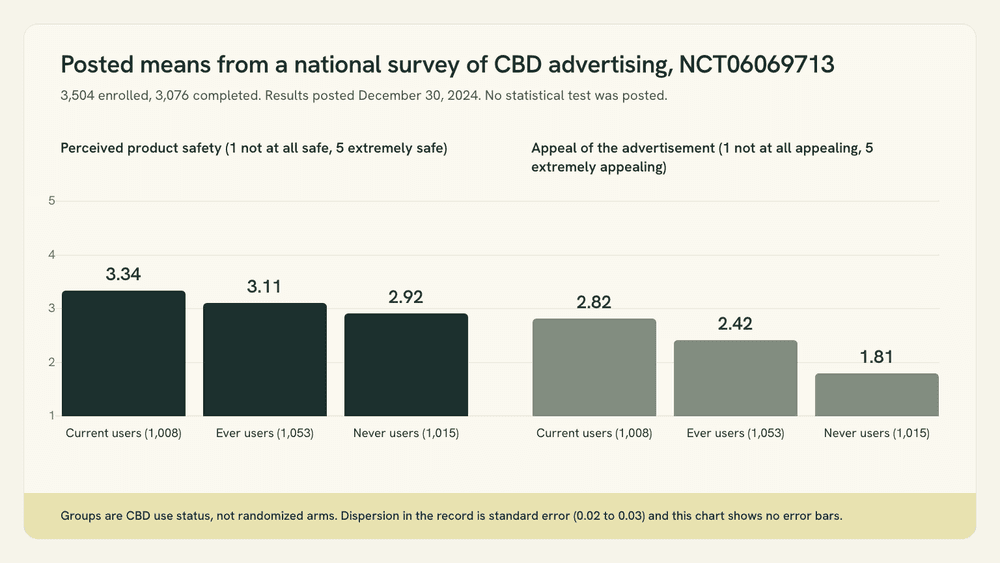
The same NIDA grant produced a second registry record with posted results that nobody appears to have connected to the mini mart trial. Registry record NCT06069713 is a cross-sectional online survey of a nationally representative probability-based sample of US adults aged 18 to 65, run from October 9 to November 20, 2023, with results first posted on December 30, 2024. Enrollment was 3,504 and 3,076 participants completed. Each was randomly assigned to one of 11 panels holding 5 real CBD advertisements, 55 documented advertisements in total. The groups in the results are not treatment arms: they are CBD use status, 1,008 current users, 1,053 people who had used it before but not in the past month, and 1,015 who never had. Dispersion is reported as standard error rather than standard deviation.
| Posted measure, 1 to 5 scale | Current users (1,008) | Ever users (1,053) | Never users (1,015) |
|---|---|---|---|
| Perceived product safety, 1 not at all safe to 5 extremely safe | 3.34, SE 0.02 | 3.11, SE 0.02 | 2.92, SE 0.03 |
| Appeal of the advertisement, 1 not at all appealing to 5 extremely appealing | 2.82, SE 0.02 | 2.42, SE 0.02 | 1.81, SE 0.02 |
Read that table across rather than down. Everyone in it saw advertisements from the same pool of 55; what separates the columns is whether the person had used CBD before. Five of the six perceived-claim sub-scales the record also posts fall in the same order, current users highest and never-users lowest. The sixth does not: a false-and-misleading measure about youth comes out at 2.68, 2.55 and 2.57, and we are printing the exception rather than rounding it away. No statistical test was posted with any of it either, and a cross-sectional survey cannot tell you what causes what. What the two registry records share is a shape: the numbers move with prior experience of the product, not with exposure to the advertisement. Three exploratory outcomes on that record are also marked not posted.
What the law already requires of an ad like this
Put the trial down for a moment and pick up the rulebook, because a shopper is almost never shown it. In December 2022 the Federal Trade Commission published its Health Products Compliance Guidance, a 32-page document drawn from more than 200 of the agency's own cases since 1998, replacing its 1998 advertising guide for dietary supplements. Three of its principles do most of the work.
- In the guidance's words, "[b]efore disseminating an ad, advertisers must have adequate substantiation for all objective product claims." The evidence is supposed to exist first, not after a complaint.
- Health-benefit claims require what the FTC calls "competent and reliable scientific evidence", which is a defined standard and not a figure of speech.
- In the FTC's words, "substantiation of health-related benefits will need to be in the form of randomized, controlled human clinical testing".
Three things about that document are worth saying out loud. It treats advertising broadly enough to include packaging and labeling, brochures, websites and social media, which means the shelf tag, the box and the display in that mini mart are advertising in exactly this sense: the trial put the regulated object on a shelf and watched people respond to it. And it is staff guidance, which the FTC says "doesn't have the force or effect of law" and which creates no safe harbor. The FTC is also not the FDA. They are different agencies working from different standards, and the FDA side of this, including how the agency treats CBD products and the claims made for them, is covered in our explainer on where the FDA currently stands on CBD.
What a shopper can actually check
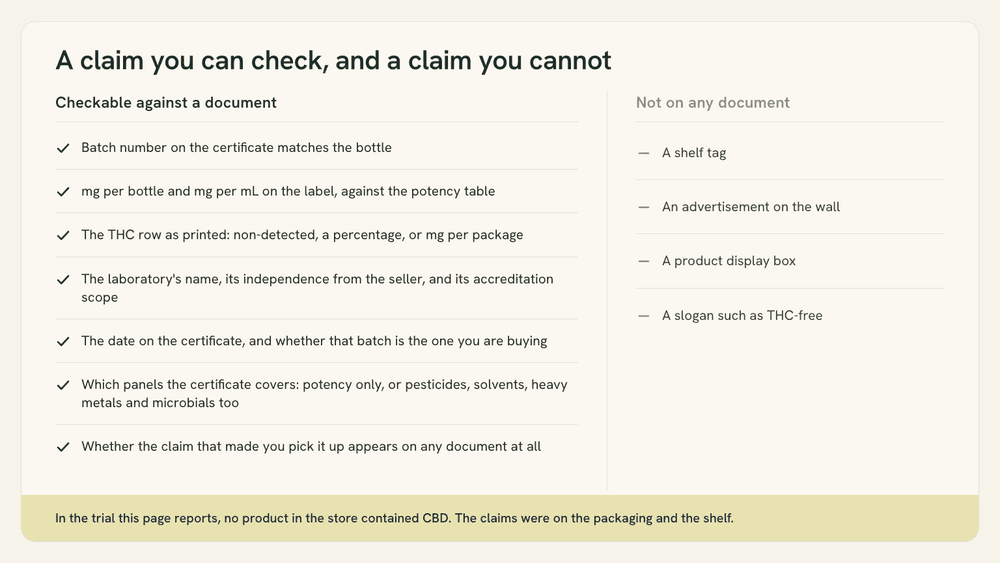
The useful response to a trial about belief is not to trust less. It is to move your attention from claims to documents. A claim is a sentence somebody wrote. A document is a record with a batch number, a date and a laboratory's name on it, and it either says what the seller says it says or it does not. Here is the short version of that check, the part you can do standing in a store with a phone.
- A certificate of analysis for the specific batch, matched by batch number to the bottle you are holding, not a sample certificate for the product line.
- The cannabinoid content on the label in mg per bottle and mg per mL, set against the measured figure in the certificate's potency table. Two numbers that should agree.
- The THC row, read as printed: non-detected, a percentage, or mg per package. A printed result is information. A slogan such as THC-free is not a row on any report.
- Who ran the test: the laboratory's name, whether it is independent of the seller, and what its accreditation actually covers.
- The date on the certificate, and whether that date and batch belong to the product you are about to buy.
- What the certificate does not cover. Many report potency only, and pesticide, solvent, heavy metal and microbial screens are separate tests that a potency report does not include.
- Whether the claim that made you pick the product up appears on any of those documents at all. A shelf tag, an advertisement and a display box are none of them.
One worked example, so the difference is concrete rather than rhetorical. Our own Broad Spectrum and Full Spectrum tinctures are labeled at 250 mg/mL in a 60 mL bottle, which is 15,000 mg of CBD per bottle, and a per-batch certificate either agrees with that figure or it does not; the THC row on Broad Spectrum reads non-detected on the mango and natural batches and a 0.019% trace on lemon, which is a printed result rather than a slogan. That is not an argument that our numbers are better than anyone else's, and this page is not the place for that argument. It is an argument that a number attached to a batch and a date is a different kind of object from a claim on a wall. The full buyer's version of this check is in our guide to choosing a CBD oil, the label and listing red flags are in how to spot a fake CBD oil, and what third-party testing does and does not guarantee is in what third-party tested actually means.
The honest limits
Every document above has limits, and the limits belong on the page rather than in a footnote nobody reads.
- One site, one visit, about an hour, inside a 245 square foot replica store in North Carolina. Nobody consumed anything and nobody took anything home.
- The sample is not the country. Of the 460 participants, 317 were female, 304 were white and 34 were Hispanic or Latino, with a mean age of 44.0 years.
- Enrollment reached 460 against an analysis plan that described up to 480 participants for the main study, so the trial came in under its own target.
- No statistical analysis was posted. Nothing on this page is a test of anything, in either direction, and the two arms' numbers should not be read as a measured difference or as the absence of one.
- This is a registry results posting rather than a peer-reviewed paper, and two outcomes the team registered in advance are marked not posted on the record.
What a peer-reviewed paper would add is not drama. It is arithmetic and scrutiny: the adjusted analysis the plan describes, a test attached to each outcome, the two outcomes that are currently missing, and reviewers asking questions nobody outside the study can ask. Until that exists, this record supports description and not much else. It is still worth reading, because a registry results posting is free, dated, complete and almost entirely unread, and because the description it supports is the interesting part.
In the posted results, 171 of 230 shoppers in the CBD advertising room bought at least one CBD-branded item, and 163 of 230 did in the room with no CBD advertising. No statistical test, p-value or effect estimate was posted with those counts, so the honest answer is those two numbers and nothing more. The team's registered analysis plan called for an adjusted logistic regression, and that analysis is not in the public results. Anyone telling you the trial proved advertising works, or that it proved advertising does nothing, is reading something the record does not contain.
No. They are results posted to ClinicalTrials.gov, the federal trial registry, on August 28, 2026. As of September 7, 2026, a PubMed search on the trial's registration number returns no linked publication, a search across the principal investigator's CBD papers finds none that is this trial, and the registry record itself lists no citations. Registry results are a real, sponsor-submitted, quality-controlled public record. They are not a journal article that has been through external review.
No. The study protocol states that no product in the mini mart would contain CBD and that products would only be branded as containing it. Participants chose three items with a $75 debit card, kept nothing, and received a debrief document explaining the deception protocol with links to the FDA and SAMHSA. The safety module records 0 deaths, 0 serious adverse events and 0 other adverse events. This was a trial of advertising and packaging, not of a substance.
No, and this is the most important sentence on the page. It is the average number of items a shopper endorsed by selecting them from a list of 12 possible benefits, so it counts beliefs recorded on a questionnaire, not effects established in research. The trial did not test whether any of the 12 items is supported. What human research does and does not support is a separate question, answered separately in our guide to the benefits of CBD.
FTC staff guidance published in December 2022 says that before running an ad, an advertiser must already hold adequate substantiation for every objective product claim, that health-benefit claims require competent and reliable scientific evidence, and that substantiation of health-related benefits will need to be in the form of randomized, controlled human clinical testing. That guidance treats packaging and labeling as advertising too. It is staff guidance, which the FTC says does not have the force or effect of law. The FDA's rules are separate and are covered in our FDA explainer.
In a peer-reviewed 2026 audit from the same research group, trained data collectors documented 1,090 CBD-specific advertisements across 150 retailers in Colorado, Maryland and North Carolina between November 2021 and April 2022. They report that 61.8% of those advertisements contained at least one claim prohibited under FDA rules and that 80% of retailers displayed at least one. That is an audit of what is on the walls, not a measurement of any product or any effect.
Because we are inside the finding rather than outside it. We sell CBD, this trial is about what advertising like ours does to shoppers, and pretending otherwise would be the least credible thing we could do with it. The one useful move available to a seller here is to hand you the documents and the checks you would use to test a claim, including ours, which is what the checklist above is for.
If you arrived here without the basics of the molecule itself, a plain definition of what CBD is is the place to start, and everything on this page will read differently afterwards. Nothing here changed a law, a rule or a product. What changed on August 28, 2026 is that a claim the category makes without ever saying it out loud, that advertising is what puts these beliefs in a shopper's head, now has a randomized measurement sitting next to it in a public record that anyone can open.
Writing about hemp, wellness and the small rituals that keep us balanced.