The FDA GRAS Proposal: How a New Ingredient Reaches a Shelf, and Why It Names Delta-8 THC
On August 11, 2026 FDA proposed making GRAS notification mandatory, and it names Delta-8 THC foods among its five examples. It is a proposal: comments close December 9, 2026, two days before the federal hemp-definition change takes effect.
On August 11, 2026 the Food and Drug Administration published a proposed rule that would change how a new ingredient gets into the American food supply. Today a company can decide on its own that an ingredient is safe for the way it intends to use it, start selling it, and never tell FDA. The status that lets it do that is called GRAS, generally recognized as safe, and FDA has proposed to require that it be told. In explaining why, the agency works through five ingredients it has had trouble with, and one of them is Delta-8 THC in food. None of this has taken effect. It is a proposal, comments close on December 9, 2026, and no final rule exists.
Everything below describes one document, read on September 6, 2026. The first page of search results for it is written for companies that have to comply: client alerts from law firms, trade press for ingredient suppliers. This page is written for the other reader, the one holding a hemp seltzer or a gummy and wondering who checked what is in it. Two things follow from that. First, we explain what GRAS actually is, because not one of the pages we read bothers to define it. Second, we quote the document instead of interpreting it. Where FDA characterizes an ingredient, the characterization is FDA's, in quotation marks, with its date attached, and we neither endorse it nor argue with it. This is a description of a rulemaking. It is not legal advice, and it is not a safety claim about any substance.
What FDA actually published on August 11, 2026
The document is a proposed rule titled "Substances Generally Recognized as Safe". It appears in volume 91, number 153 of the Federal Register, Part II, dated Tuesday, August 11, 2026, and it runs from page 51834 to page 51881, which is 48 pages. The standard citation is 91 FR 51834. Its docket number is FDA-2025-N-3262 and its regulatory identification number is RIN 0910-AJ02. It would amend parts 170 and 570 of title 21 of the Code of Federal Regulations, which are the human food and animal food sides of the same question, and it is signed by Robert F. Kennedy, Jr., Secretary of Health and Human Services. Under the heading ACTION, the document says: "Proposed rule." One practical note before anything else, because it will save you an hour. The Federal Register's own web page for this document does not serve its text to an automated reader, and can return an access page instead of the rule. Search that access page for a word and you get nothing, which looks exactly like the word not being in the document. So throughout this article we link the government's GovInfo mirror of the proposed rule, which carries the identical text and opens for anyone.
| The date | What it is | Whose clock it runs on | Status on September 6, 2026 |
|---|---|---|---|
| August 11, 2026 | Publication of the proposed rule at 91 FR 51834, pages 51834 to 51881 | FDA, Docket FDA-2025-N-3262, RIN 0910-AJ02 | Done. This is the document everything on this page describes. |
| December 9, 2026 | The close of the comment period. Electronic comments are accepted until 11:59 p.m. Eastern at the end of that day | Set by FDA in the DATES section of this proposal | Open. The docket holds this one document and no extension. |
| 60 days after a final rule | The proposed effective date of a final rule | Would run from the publication of a final rule | Not started. No final rule has been published. |
| 18 months after that effective date | The proposed compliance date for the notification sections, 170.205 and 570.205 | Would run from the effective date in the row above | Not started, for the same reason. |
| One year from that effective date | The proposed subpart F window for a streamlined submission covering substances already in interstate commerce | Would run from the effective date two rows above | Not started, for the same reason. |
Two more things about the document itself. First, the Office of Information and Regulatory Affairs determined that this is an "economically significant regulatory action under section 3(f)(1) of Executive Order 12866", and FDA's own preliminary estimate puts the cost at a present value of about $89.6 million over ten years at a 3% discount rate in 2024 dollars, with a range of $34.9 million to $210.0 million, or about $82.3 million at a 7% rate. Annualized, that is $10.5 million at 3% and $11.7 million at 7%. Those are preliminary estimates attached to a proposal, and FDA also finds a significant economic impact on a substantial number of small entities. Second, we checked what has happened since publication rather than assuming nothing had. On September 6, 2026 the docket, FDA-2025-N-3262, holds exactly one document, and it is this one. A search of Federal Register documents mentioning "generally recognized as safe" from FDA since August 12, 2026 returns one unrelated notice about botanical drug products. The list of documents filed for public inspection but not yet published held 77 items that day, with zero matches. So the supportable sentence is the narrow one: as of September 6, 2026, no final rule has been published, and the comment period is open.
What GRAS is, and why an ingredient can be on a shelf before FDA looks at it
GRAS stands for generally recognized as safe. It is a legal status, not a label claim, and you will never see the word on a package. It comes from the 1958 Food Additives Amendment, which required FDA to approve food additives before they are used and then carved out a category that does not count as a food additive at all. Section 201(s) of the Federal Food, Drug, and Cosmetic Act, as the proposal restates it at page 51845, excludes from the definition of a food additive a substance that is "generally recognized, among experts qualified by scientific training and experience to evaluate its safety, as having been adequately shown through scientific procedures (or, in the case of a substance used in food before January 1, 1958, through either scientific procedures or experience based on common use in food) to be safe under the conditions of its intended use." We are quoting the statute rather than construing it, because what counts as an expert, and what counts as generally recognized, is the entire argument.
FDA puts the consequence in one sentence on its own site. The agency's explainer page on how the GRAS notification program works, which is a reprinted trade-journal article FDA hosts and maintains, says this:
“Put simply, substances that are GRAS under conditions of their intended use are not food additives and do not require premarket approval by FDA.”
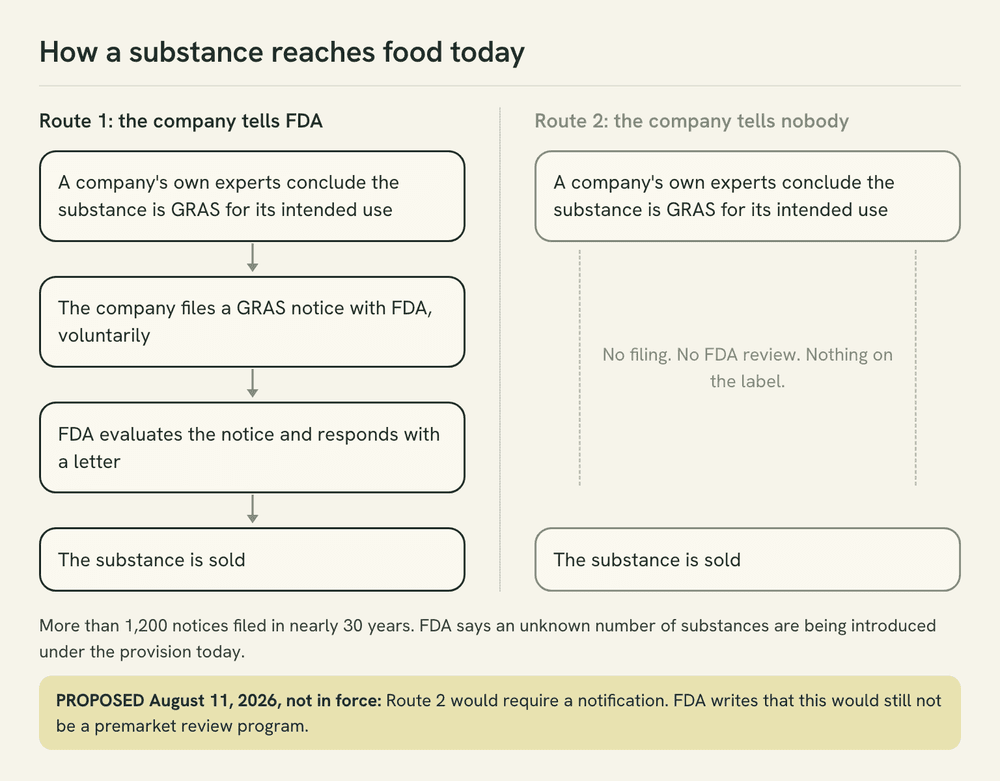
That is the door. A company whose experts conclude that a substance is GRAS for the use it has in mind may sell it. Under the current regulations it may tell FDA about that conclusion, and it may decline to. Notification is voluntary. FDA's own term for the alternative is an "independent conclusion of GRAS status", which is careful and neutral. The blunter phrase belongs to the Department of Health and Human Services: the rule's reference list cites, as Ref. 1 at page 51872, an HHS release titled "HHS Secretary Kennedy Directs FDA to Explore Rulemaking to Eliminate Pathway for Companies to Self-Affirm Food Ingredients Are Safe", from March 2025, and the preamble records that on March 10, 2025 the Secretary directed FDA to explore that rulemaking. We are citing that title as it appears inside the reference list of the proposed rule, because the HHS page itself does not open to an automated reader.
So how large is the category nobody has to report? FDA does not know, and says so in the document. The preamble cites an estimate that as of January 2011, more than 10,000 additives were in use in food, including an estimated 1,000 human food substances for which firms had claimed independent conclusions of GRAS status. Those are outside estimates FDA is repeating and citing to two references, not a count of FDA's own, and the difference matters. What is FDA's own, and is the sharper figure, is the phrase it uses for the present day: an "unknown number of substances" is being introduced under the GRAS provision. Set against that, the voluntary program has produced more than 1,200 GRAS notices filed in nearly 30 years. A notice filed is not a substance approved. FDA's response to one is a letter.
Where Delta-8 THC appears in the document, and exactly what FDA wrote
Turn to page 51841 of the proposed rule. In section III.B.1.a, under the first of the problems FDA says the current program creates, the agency works through a run of ingredients it has dealt with before. One of them is Delta-8 THC in conventional foods, and FDA writes it up as a full paragraph rather than a passing mention. Here it is in FDA's words, with the middle omitted and the omission marked. So that you know what sits inside the gap: the omitted sentences are FDA's summary of what its 2024 letters said about potential harm, and its note that the letters cited adverse event reports. Those are the agency's characterizations from 2024, and the adverse event figures behind them are unpacked, attributed and dated two paragraphs below.
“We have drawn similar insight from our more recent experience involving human food products containing Delta-8 tetrahydrocannabinol (THC). In 2024, we sent warning letters to several firms for selling human food products that were represented as containing Delta-8 THC (Ref. 21). We stated that no food additive regulation authorizes the use of Delta-8 THC and that the use of the substance was not prior sanctioned. . . . The letters concluded that, based on FDA's review, the use of Delta-8 THC in conventional foods did not meet the criteria for GRAS status in FDA's regulations and that these products contained an unsafe food additive rendering them adulterated under section 402(a)(2)(C)(i) of the FD&C Act.”
Look at how the paragraph opens: "We have drawn similar insight". Similar to what? To the paragraph immediately above it, about caffeinated alcoholic beverages, where FDA writes that the episode "yielded a valuable insight into our GRAS notification program", a sentence that then runs on into the reason. Across the run of five examples on pages 51840 to 51842, those are the only two paragraphs FDA frames as an insight into its own notification program. So of the five ingredients FDA names in this part of the preamble, Delta-8 THC is one of two the agency writes up as a lesson about the notification program itself, rather than as an example of a problem it once handled. That is an observation about how the text is built. It is not a claim about what FDA intends to do next, and we are not making one.
Ref. 21, the citation FDA hangs on that second sentence, is a dated announcement you can read yourself. On July 16, 2024, FDA and the Federal Trade Commission announced a joint effort against companies selling copycat Delta-8 THC food products: the two agencies issued warning letters jointly to five companies, and FDA issued one independently to a sixth. The same announcement states that from January 1, 2021 to December 31, 2023, FDA received over 300 adverse event reports involving children and adults who consumed delta-8 THC products; that nearly half of those involved hospitalization or an emergency department visit; and that approximately two thirds followed ingestion of delta-8 THC-containing food products such as candy or brownies. Read the verbs, because they are the content of the sentence. FDA says it received reports. An adverse event report is a report to a surveillance system. It is not a demonstration that a substance caused what was reported, and FDA does not claim otherwise there.
That is FDA's characterization, quoted and dated, and we are adding nothing to it in either direction. What delta-8 THC actually is as a molecule, how it is made from CBD and what its own research record looks like are a separate subject with its own page: our comparison of delta-8 and CBD covers the chemistry. This page is about a rulemaking, and the only reason Delta-8 appears in it is that FDA put it there.
The other four ingredients FDA names, and why two are already on this blog
FDA's argument in this part of the preamble is built from examples, and the examples are the most readable thing in the document. Page one of the search results does not print them: of the two law-firm alerts we read on September 6, 2026, one names three of the five and the other names none, and neither names stevia or ashwagandha. Here are all five, with FDA's dates and the page each sits on.
| The example FDA names | FDA's date for it | What FDA says it did, in FDA's account | Where it appears |
|---|---|---|---|
| Stevia leaves and crude stevia extracts | Import alert first issued 1991, most recently updated 2025 | An import alert covering the leaves and crude extracts. FDA notes that high-purity steviol glycosides, at 95% purity or above, are a separate and well-established case. | Page 51840 |
| Caffeinated alcoholic beverages | 2009, the date FDA prints | FDA acted on the category and the firms ceased distribution. FDA writes that the episode "yielded a valuable insight into our GRAS notification program". | Page 51841 |
| Delta-8 THC in conventional foods | 2024 | Warning letters to several firms. FDA opens the passage with "We have drawn similar insight from our more recent experience", and quotes its own letters. | Page 51841 |
| Tara flour | 2022 | A voluntary recall that FDA associates with roughly 400 adverse event reports. FDA determined there are not enough data to consider tara flour GRAS. | Page 51841 |
| Ashwagandha | 2023 | Placed on Import Alert 99-45 after FDA inspectors raised questions about its regulatory status. FDA states it has not been the subject of a voluntary GRAS notice. | Page 51842 |
The ashwagandha entry is worth slowing down on, and not only because we have a page on the ingredient. FDA's account is that in 2023 it placed ashwagandha, "an evergreen shrub whose extracts were identified in some human food products", on Import Alert 99-45, after inspectors raised questions about its regulatory status and deemed it an unsafe food additive. Be precise about what that reaches: FDA may detain, without physical examination, shipments of certain identified food products containing ashwagandha from firms on the Red List of that alert. It is not a ban on the ingredient. The import alert is public and names its firms; its ashwagandha entries are dated June 23, 2023 and October 6, 2023, and the page carries its own publication date of September 4, 2026, which is to say it is a living document and our read of it is September 6, 2026. FDA adds one more sentence that matters for this rulemaking: ashwagandha "has not been the subject of a voluntary GRAS notice." If what you want is the evidence side of that ingredient rather than the regulatory side, we have written up what is actually known about taking CBD and ashwagandha together.
One more FDA document belongs beside that table, because the rule cites it as Ref. 23. FDA maintains a public inventory called Post-market Determinations that the Use of a Substance is Not GRAS. On our read it lists Delta-8-tetrahydrocannabinol, CAS 5957-75-5, with scientific memoranda dated 12/2/2021 and 1/31/2024, and cannabidiol, CAS 13956-29-1, with memoranda dated 11/13/2019 and 1/19/2022, alongside caffeinated alcoholic beverages and tara flour. The page's own footer reads "Content current as of: 05/08/2025". Why cannabidiol sits on that list is a question about a different and older part of the Federal Food, Drug, and Cosmetic Act, and this page deliberately does not reopen it: it belongs to our account of what the FDA has actually said about CBD, and when it said it.
What would change if it is finalized, and what would not
This is a proposal, so everything in this section is conditional and none of it is in force on September 6, 2026. If a final rule were published in the form proposed, here is what the text would do.
- Notification would become mandatory. Proposed section 170.205(a) would require any person who introduces a substance into interstate commerce under the GRAS provision of section 201(s) to notify FDA of the basis for that conclusion.
- It would reach what is already on the shelf. The proposal covers, in its own words, substances already in the food supply and those being marketed for food use for the first time.
- The section's own title would change, from "Opportunity to submit a GRAS notice" to "Submission of a GRAS notice".
- Seven exceptions would exist, at proposed section 170.205(b)(1) through (7). They are enumerated in the paragraph below this list.
- A one-year streamlined route would open. Proposed subpart F would give firms one year from the effective date to make a shorter submission for substances already in interstate commerce, and FDA proposes to post those on a public list.
- The streamlined route would have limits. Proposed section 170.305(b) would not allow it for conditions of use that are the subject of an insufficient-basis letter, or of an FDA determination that the substance is not GRAS.
- The clocks would be long. A final rule would take effect 60 days after it publishes, and the notification requirement at sections 170.205 and 570.205 would not apply until 18 months after that.
The seven proposed exceptions, in the order the proposal sets them out at section 170.205(b), are these: a substance that already has a "no questions" letter from FDA; a substance listed or affirmed as GRAS in parts 182, 184 or 186 of title 21, which FDA's overview page for GRAS names and which carries its own note that its content is current as of 08/10/2026; substances covered by section 170.30(d) or by proposed section 170.30(i)(1); a use that went through an established FDA premarket-consultation process which did not flag a need for a notice; a granted threshold-of-regulation exemption under section 170.39; an effective food contact notification; and the subpart F streamlined submission. FDA gives its own reason for that last one in the preamble: requiring a full notice for every use already in commerce "would likely overburden the administrative resources we have to evaluate and respond to GRAS notices." We are describing a proposed list. Nothing here tells you, or tells a company, that any particular ingredient falls inside any of these.
That is what would be added. Now the other half, which is the part that keeps getting lost whenever this proposal is summarized in a headline.
- It would not create premarket approval. FDA says so in the document itself, in the sentence quoted at the end of this section.
- It would not stop a company from selling while it waits. FDA writes that a company may keep marketing a purported GRAS substance before submitting a notice, and after submitting one while FDA has not yet filed it.
- It would not make FDA the party that decides an ingredient is safe. The conclusion would still be the company's, reached with its own experts under section 201(s). What would change is that FDA would have to be told about it.
- It would not reach outside food. The proposal is about substances introduced into interstate commerce for use in human or animal food, and about food-contact uses. Whether a given product is in that category is a question about that product.
“the proposed GRAS notification program generally, and proposed Sec. 170.205(a), do not establish a premarket review program for purportedly GRAS substances . . . a company may continue marketing a purported GRAS substance before submitting a GRAS notice or after submitting a GRAS notice before it is filed by FDA.”
Two days apart: December 9 and December 11
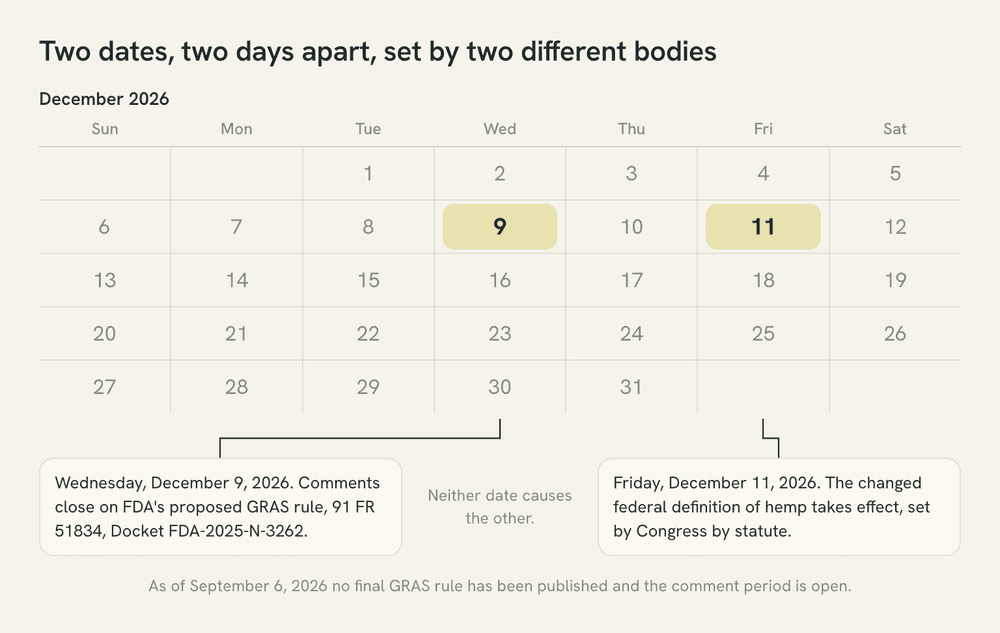
Here is something nobody printed. The comment period on this proposal closes on Wednesday, December 9, 2026. Two days later, on Friday, December 11, 2026, the changed federal definition of hemp takes effect. Two dates, one week, one product category underneath both of them.
| The date | Who set it | What kind of thing it is | What happens on that day |
|---|---|---|---|
| Wednesday, December 9, 2026 | FDA, in this proposed rule, Docket FDA-2025-N-3262 | The close of a comment period on a proposal | The docket stops taking comments. No rule takes effect, nothing becomes lawful or unlawful, and nothing on a shelf changes. |
| Friday, December 11, 2026 | Congress, by statute | A statutory effective date for a changed federal definition of hemp | The changed definition takes effect. We cover the mechanism and the date on a separate page and re-derive neither here. |
Now say the obvious part out loud, because a coincidence in a calendar is exactly the kind of thing that gets read as a plan. Neither date causes the other. One is a comment deadline FDA set inside this proposal, on a rulemaking that may or may not produce a final rule, on a schedule of the agency's own choosing. The other is a statutory effective date written by Congress, which arrives whether or not anyone comments on anything. Different bodies, different instruments, and nothing in either record connects them. What they share is a subject: a hemp-derived cannabinoid that ends up in something a person swallows. We wrote up the December 11 date and the law behind it when it moved, in our report on how Congress split the hemp deadline in two, and the arithmetic that decides which hemp extracts sit on which side of a federal line is in our page on hemp-derived THC. Neither is re-derived here.
What this proposal does not do
It is easy to read a 48-page rulemaking as bigger than it is, so here is the list of things it is not.
- It does not ban anything. No substance is prohibited by this document, and none is approved by it.
- It does not make CBD lawful in a food or a drink. That question sits under a different provision of the Federal Food, Drug, and Cosmetic Act, and this rulemaking is not about it.
- It does not answer a safety question about any cannabinoid, or about any other ingredient. It is a proposal about who files what, and when.
- It does not create premarket approval. FDA writes that the proposed program does not establish a premarket review program for purportedly GRAS substances.
- It does not do anything yet. It is a proposal. Comments close December 9, 2026, and no final rule had been published as of September 6, 2026.
What it would change is narrower than a ban, and more interesting: who has to show FDA their homework, and when. Today a company can conclude an ingredient is GRAS for its intended use, sell it, and file nothing. Under the proposal it would have to file, including for substances already on shelves, and the streamlined submissions would land on a list FDA proposes to publish. Nobody has to approve the homework for that to matter, because a public list of what is being sold on a company's own conclusion is information that does not exist today.
How to read the record yourself
The whole document is public, and it is not hard to navigate once you know where the pieces are. This is the route we took, in order.
- 1Read it on GovInfo, not on federalregister.gov. The Federal Register's own document page does not serve its text to an automated reader and can return an access page instead of the rule. GovInfo carries the identical text.
- 2For the Delta-8 paragraph, go to page 51841. It sits in section III.B.1.a, in the run of examples FDA uses to argue that the current program does not tell it enough.
- 3For what would not change, go to page 51851. That is where FDA writes that the proposed program does not establish a premarket review program.
- 4For the dates, go to page 51867, Section VII. The 60-day effective date, the 18-month compliance date and the one-year window are all there.
- 5Any comment has to carry Docket No. FDA-2025-N-3262 and the title "Substances Generally Recognized as Safe".
- 6Electronic comments go through regulations.gov, and the proposal states they are posted to the docket unchanged and made public. Treat anything you put in one as published.
- 7Confidential material has to go on paper, in two copies, one of them marked "THIS DOCUMENT CONTAINS CONFIDENTIAL INFORMATION", to Dockets Management Staff (HFA-305), 5630 Fishers Lane, Rm. 1061, Rockville, MD 20852.
Two more things are easy to miss. First, the Providing Accountability Through Transparency Act requires a plain language summary of the proposed rule of not more than 100 words, and the proposal says that summary is in the docket. Second, in Section VI of the rule itself, FDA asks for comment on alternatives that would reduce the burden, offering as its own example "allowing streamlined submissions for all substances purported to be GRAS". That is the agency saying, inside the document, that the shape of this is not settled. If you would rather read the paginated original than the HTML, the same document is posted as a PDF. We name regulations.gov in plain text rather than linking it, because its docket page does not serve its contents to an automated reader and we do not link a page we could not read. All of this is a description of a process. It is not advice about whether to use it.
Questions people are asking
No. As of September 6, 2026 this is a proposed rule and none of it is in force. FDA published it on August 11, 2026 and comments close on December 9, 2026. If a final rule were published, the proposal says it would take effect 60 days after that, and the main notification requirement at sections 170.205 and 570.205 would not apply until 18 months after the effective date. There is also a proposed one-year window for streamlined submissions. That is three clocks, and none of them has started, because the document they would all run from does not exist.
Nothing, because it does not appear on a label. GRAS means generally recognized as safe, and it is a status under section 201(s) of the Federal Food, Drug, and Cosmetic Act rather than a claim a package makes. FDA's own explainer page puts it in one sentence: substances that are GRAS under conditions of their intended use "are not food additives and do not require premarket approval by FDA." The status is a conclusion reached by qualified experts about a specific substance used in a specific way, and under the current regulations telling FDA about that conclusion is voluntary.
No, and FDA says so inside the document. At page 51851 the agency writes that the proposed notification program and proposed section 170.205(a) "do not establish a premarket review program for purportedly GRAS substances", and that a company may continue marketing a purported GRAS substance before submitting a notice, or after submitting one while FDA has not yet filed it. It would be a requirement to notify, not a requirement to be approved. That distinction is the single most under-reported thing in the coverage we read.
No. The proposal does not ban or approve any substance. Delta-8 THC appears in the preamble, at page 51841, as one of five examples FDA uses to argue that the current voluntary system does not give it the information it wants. In that passage FDA quotes its own 2024 warning letters, which it says concluded that the use of Delta-8 THC in conventional foods did not meet the criteria for GRAS status in FDA's regulations. That is FDA describing letters it sent in 2024, inside a proposal published in 2026. We report it and add nothing to it.
No. Whether cannabidiol may lawfully be added to a conventional food is a separate question under a different provision of the Federal Food, Drug, and Cosmetic Act, and this proposal does not touch it. FDA's public inventory of post-market determinations that a use is not GRAS lists cannabidiol with scientific memoranda dated 11/13/2019 and 1/19/2022, and that inventory is a different document from this rulemaking. The full account of what FDA has said about CBD, and when, is on our page about that, and it is deliberately not repeated here.
Because two of them land in the same week and they are unrelated in law. The comment period on this proposal closes on Wednesday, December 9, 2026, a deadline FDA set in this document. The changed federal definition of hemp takes effect on Friday, December 11, 2026, a date Congress set by statute. Two different bodies, two different instruments, no connection between them in the record we read, and one product category underneath both. We print the juxtaposition because it is real and verifiable, not because it implies coordination. It does not.
The docket is public and the proposal describes how submissions are made. Any comment must carry Docket No. FDA-2025-N-3262 and the title "Substances Generally Recognized as Safe". Electronic comments go through regulations.gov and, per the proposal, are posted to the docket unchanged and made public, so treat anything in one as published under your name. Confidential material has to go on paper, in two copies, one marked "THIS DOCUMENT CONTAINS CONFIDENTIAL INFORMATION", to Dockets Management Staff (HFA-305), 5630 Fishers Lane, Rm. 1061, Rockville, MD 20852. Comments close December 9, 2026. This is a description of the process and not advice about whether to use it.
One note about our own archive, because a newsroom item is only worth publishing if it says what it changes. We re-read our two closest pages on September 6, 2026, and neither becomes wrong because of this proposal. Our page on the FDA and CBD contains a single mention of GRAS, and it is the accurate one: hulled hemp seed, hemp seed protein powder and hemp seed oil have cleared FDA's GRAS notification process. A completed notice is not touched by a proposal to require future ones. Our report on the December 11 hemp date contains no GRAS claim at all, and its one December 9 reference is to December 9, 2025, an unrelated date. So there is no correction to make here, which we would rather say plainly than dress up: the only thing this item adds to the archive is a pointer, and the page that should carry it is the hub where the federal and state layers are stacked, our guide to whether CBD is legal and how those layers fit together.
Writing about hemp, wellness and the small rituals that keep us balanced.