DEA Scheduled Three Kratom Analogs on August 26. It Did Not Schedule 7-OH
On August 26, 2026 DEA placed three kratom-derived analogs in Schedule I by temporary order: mitragynine pseudoindoxyl, MGM-15 and MGM-16. It did not schedule 7-hydroxymitragynine and it did not name kratom leaf. The HHS comment window closes September 10, 2026.

On August 26, 2026 the Drug Enforcement Administration placed three substances in schedule I by temporary order. Much of the coverage that followed reported it as DEA scheduling 7-OH. The order does not schedule 7-OH. It names mitragynine pseudoindoxyl, MGM-15 and MGM-16, and it does not name 7-hydroxymitragynine, does not name mitragynine and does not name kratom leaf. On the same day, in a separate document on a separate docket, the Department of Health and Human Services reopened a comment window on the 7-OH proposal and set it to close on September 10, 2026. Two federal documents, published the same morning, pointing in two different directions. This page is about telling them apart.
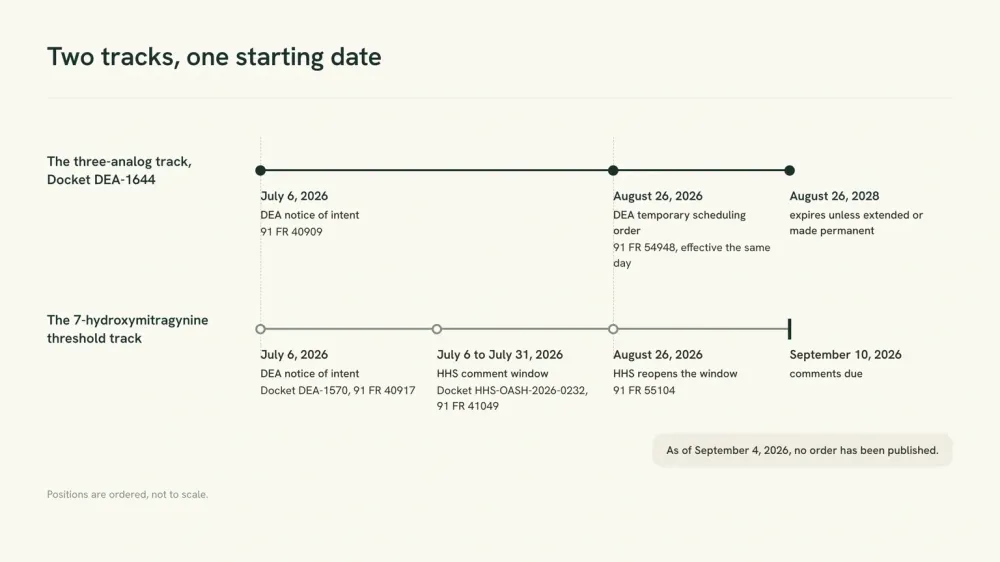
There are two tracks here, and almost all of the confusion comes from collapsing them into one. Docket DEA-1644 is the three-analog track. It produced a notice of intent on July 6, 2026 and an order on August 26, 2026, and that order is in force. Docket DEA-1570 is the 7-hydroxymitragynine threshold track. It produced a notice of intent on July 6, 2026, on the same day, and nothing since. On September 4, 2026 we read the first page of search results for this event. Four of the six items on it would not open to an automated reader at all, so what we can report is what the headlines say, and the headlines do not agree with each other about the most basic fact in the story. Some of them state or imply that 7-OH was banned or brought under federal control. It was not. Every date, docket number and quotation below comes from a federal document we read on that same day, and each of those documents is linked here to a government mirror you can open yourself. The published papers we cite are linked too, to whichever open record actually serves them. We describe what the documents say. We do not characterize kratom, mitragynine or 7-OH in our own voice, in either direction, anywhere on this page.
What DEA did on August 26
The document is a temporary scheduling order, published at 91 FR 54948 under Docket No. DEA-1644. The Federal Register's own document page is the canonical citation, but it does not serve its text to automated clients, so throughout this article we link the government's govinfo mirror of the August 26 order, which carries the same text and opens for anyone. Its SUMMARY places three substances in schedule I: mitragynine pseudoindoxyl, MGM-15 and MGM-16, "including their isomers, esters, ethers, salts, and salts of isomers, esters, and ethers." That last clause is doing real work, because it extends the order to chemical variants nobody has named yet. DEA describes the three as produced through "synthetic modifications of purified mitragynine isolates or 7-hydroxymitragynine", and says that is "unlike the indole alkaloids mitragynine and 7-hydroxymitragynine, which are naturally occurring in the plant."
“DEA bases this action on a finding that placing mitragynine pseudoindoxyl, MGM-15, and MGM-16 in schedule I is necessary to avoid an imminent hazard to public safety.”
That is DEA's stated finding, in DEA's words, and we are reporting it as such rather than restating it in our own voice. Under the heading DATES, the order says: "This temporary order is effective August 26, 2026, until August 26, 2028. If this order is extended or made permanent, DEA will publish a document in the Federal Register." The Federal Register's metadata record for the document gives a publication date and an effective date that are the same day, which is ordinary for this instrument and would be unusual for a normal rule. Administrator Terrance C. Cole signed it on August 24, 2026 and it was filed for public inspection at 4:15 p.m. that day. On the bookkeeping side, the order adds three paragraphs to 21 CFR 1308.11, numbered (h)(89) through (h)(91), and assigns DEA drug codes 9672 to mitragynine pseudoindoxyl, 9673 to MGM-15 and 9674 to MGM-16. Drug codes are administrative identifiers and nothing more. Hold on to 9674 anyway, because the number that comes after it turns up further down.
The order also spells out what it requires of people and businesses registered with DEA. Under a heading titled Requirements for Handling it lists eleven items: registration, disposal of existing stocks, security, labeling, inventory, records, reports, order forms, import and export, quota, and liability, with 30-day compliance windows for registrants and a 90-day path under 21 U.S.C. 822(h) for researchers already registered to handle other schedule I substances. We are describing the contents of a document and nothing more. Nothing in this article is legal advice, and nothing in it is a statement about what any individual may lawfully do.
What a temporary scheduling order actually is
Most federal scheduling happens by rulemaking: a proposed rule, a comment period, a final rule, and a record a court can review. A temporary scheduling order is a different instrument, and its authority is section 811(h) of Title 21 of the United States Code. It lets the Attorney General, acting through DEA, put a substance in schedule I by order rather than by rule, on a finding that doing so is necessary to avoid an imminent hazard to public safety. The trade for that speed is a clock. DEA reaches schedule I in more than one way, and the differences matter: in May 2026 it gave hexahydrocannabinol its own schedule I drug code, 7220, under Docket DEA-1632, which we cover in our page on where HHC stands with federal regulators. That was a different kind of document from this one, and telling the kinds apart is the whole point of this section.
- It is issued as an order, not as a rule. DEA writes in the August 26 order that the notice-and-comment requirements of the Administrative Procedure Act do not apply to a temporary scheduling order. That is DEA's stated position.
- It cannot arrive without warning. The statute requires a notice of intent published in the Federal Register and transmitted to HHS, and the order cannot issue sooner than 30 days after that.
- HHS gets a look first. DEA notified the Assistant Secretary for Health by letter on December 15, 2025, and received a reply on January 20, 2026.
- That reply stated that no investigational new drug applications or new drug applications exist for the three substances, and that HHS had no objection. It is a procedural step and nothing more.
- The statute narrows what DEA weighs. For a temporary order it points to the factors numbered (4), (5) and (6) in 21 U.S.C. 811(c), rather than to the full set that governs permanent scheduling.
- It expires. This order runs to August 26, 2028, and the statute allows an extension of up to one year while permanent scheduling proceedings are pending.
- It is hard to challenge. DEA writes in the order that temporary scheduling orders are not subject to judicial review, citing 21 U.S.C. 811(h)(6).
“shall expire at the end of 2 years from the date of the issuance of the order”
Two years is the outer edge of what this order does on its own. For the placement to outlast August 26, 2028, DEA has to begin a permanent scheduling proceeding under 21 U.S.C. 811(a)(1), and the statute allows the temporary order to be extended by up to one year while that is pending. DEA published its notice of intent for these three substances at 91 FR 40909 on July 6, 2026, and the order followed on August 26. The order's own DATES line says that if it is extended or made permanent, DEA will publish a document in the Federal Register. That sentence is worth remembering, because it means the next move on this track will be a published document with a date on it rather than an announcement.
What the order did not do
Here is the sentence the coverage got wrong. The August 26 order does not schedule 7-hydroxymitragynine. It also does not name kratom leaf, and it does not name mitragynine, which DEA's July notice labels the major alkaloid of the plant while calling 7-hydroxymitragynine the minor one. Those are three separate absences and none of them is a technicality. The 7-OH action is a different document on a different docket, and it is still a notice of intent: DEA published that notice of intent on July 6, 2026 at 91 FR 40917 under Docket No. DEA-1570. In its own text, discussing law enforcement encounters, DEA writes that "7-hydroxymitragynine is not federally controlled under the CSA." That sentence is dated July 6, 2026 and it is about federal control only. State and local law are a separate layer this article does not cover.
| Document | Docket and date | What it proposed | Status on September 4, 2026 |
|---|---|---|---|
| DEA notice of intent, three analogs, 91 FR 40909 | Docket DEA-1644, July 6, 2026 | Temporary schedule I placement of mitragynine pseudoindoxyl, MGM-15 and MGM-16, with 21 CFR 1308.11 paragraphs (h)(88) through (h)(90) proposed for them | Carried out. The order published at 91 FR 54948 on August 26, 2026 and took effect the same day, at paragraphs (h)(89) through (h)(91). |
| DEA notice of intent, 7-hydroxymitragynine above a threshold, 91 FR 40917 | Docket DEA-1570, July 6, 2026 | Temporary schedule I placement of 7-OH above a specified threshold, with paragraph (h)(91) and drug code 9675 reserved for it | No order has been published. Three separate Federal Register searches run on September 4, 2026 returned none, and drug code 9675 has never been assigned. |
| HHS request for information on the threshold, 91 FR 41049 | Docket HHS-OASH-2026-0232, July 6, 2026 | Asked for comments, data and information on the proposed 7-OH threshold, with a window closing July 31, 2026 | Reopened on August 26, 2026 by 91 FR 55104. Comments due September 10, 2026. |
A negative claim on a legal page has to be proved, so here is how we proved this one. On September 4, 2026 we ran three checks whose failure modes do not overlap. A Federal Register term search for documents mentioning hydroxymitragynine, restricted to a publication date on or after January 1, 2026, returns five documents, and all five are accounted for on this page: the three notices of July 6, 2026 in the table above, and the two documents of August 26, 2026. A docket search on DEA-1570, which catches a document that never uses the molecule's name in its title, returns one, the July 6 notice of intent. And the Public Inspection list, which shows documents filed but not yet published, carried 86 documents that day with zero matches for mitragynine or kratom. So the supportable sentence is this one, and only this one: as of September 4, 2026, no temporary scheduling order for 7-hydroxymitragynine has been published in the Federal Register. Not rejected. Not abandoned. Not expected. Not published.
There is one more piece of evidence and it sits in the numbering, which is why the drug codes were worth holding on to. The July 6 notice of intent for 7-OH reserved paragraph (h)(91) of 21 CFR 1308.11 and drug code 9675 for it. The August 26 order occupies (h)(89) through (h)(91) with the three analogs, so the paragraph the July notice had set aside for 7-OH now belongs to MGM-16. Before anyone reads that as a decision, it is not one: the July notice for the analogs had proposed (h)(88) through (h)(90), and an unrelated August 12 order covering O-desmethyltramadol took (h)(88), which pushed the analogs up one slot each. That is routine housekeeping and it means nothing about anyone's intentions. The durable observation is the narrower and checkable one: no order has ever assigned drug code 9675.
The threshold that was proposed, and has not been enacted
The 7-OH action is not a proposal about a plant and it is not a proposal about a product category. It is a proposed threshold, which is a different kind of legal object, and the numbers in it are the reason the docket exists at all. As proposed on July 6, 2026 and not enacted, it would reach the following.
- 1Proposed: botanical material from Mitragyna speciosa containing more than 0.050 percentage of 7-hydroxymitragynine on a dry weight basis.
- 2Proposed: any alternative article that is synthetic and contains 7-hydroxymitragynine at more than 0.050 percentage by weight, by volume or volume per volume, or that contains more than 1.00 milligram of 7-OH in the article.
- 3Proposed: any alternative article derived from Mitragyna speciosa and further processed into an extract, a concentrate, a processed edible or a pressed pill that reaches those same limits.
Notice what kind of instrument that is. It is not a list of plants and it is not a list of products. It is a concentration and a quantity, and everything turns on which side of them a given article falls. DEA says the definition was adapted from one HHS supplied in a letter of July 28, 2025, transmitted with a scientific and medical evaluation. We did not obtain that evaluation, so we are citing it as DEA describes it and not as a document we read. The notice also explains why a threshold is the shape the question took: DEA writes that in its natural botanical form 7-hydroxymitragynine "makes up less than two percent of the total alkaloid content or occurs in trace amount", and that it "can be synthesized from mitragynine through a one-step chemical reaction, and it also exists as an active oxidized metabolite of mitragynine in vivo." Those are DEA's characterizations inside a scheduling document, not measurements we made, and as of September 4, 2026 none of it is in force.
The consultation step happened on this track too. DEA wrote to the Assistant Secretary for Health on February 24, 2026 and received a reply on March 6, 2026 stating no objection. As of September 4, 2026 no order has followed it. We are stating both dates and we are not offering a reason for the gap, because the record does not contain one.
What the record actually contains, in counts
DEA's stated basis for the August 26 order is an imminent hazard finding, and a finding rests on a record. That record is worth reading closely, because most of it is surveillance data, and surveillance data counts reports rather than people. Here is what is in it, with what each figure is and is not.
| What was counted | Reported figure | Where it is reported | What it does not measure |
|---|---|---|---|
| Kratom exposure reports to US poison centers, 2015 to 2025 | 14,449 over eleven years, rising from 258 in 2015 to 3,434 in 2025, an increase of about 1,200% | CDC Morbidity and Mortality Weekly Report 2026;75(11):139-145, from National Poison Data System records | Confirmed harm. An exposure report is a call to a poison center, reporting is passive and voluntary, and rising awareness inflates counts on its own. |
| Kratom-associated deaths within those reports | 233 in the period, of which 184 involved more than one substance | The same MMWR analysis | Cause. A kratom-associated death is not a death attributed to kratom, and an association recorded in a passive reporting system is not an attribution at all. |
| Forensic laboratory identifications of mitragynine pseudoindoxyl | 19 records across four states: Arkansas 15, New York 1, Ohio 1, Wyoming 2 | DEA's August 26 order, citing the National Forensic Laboratory Information System | How many people use anything. NFLIS counts drug chemistry results from law enforcement casework, and DEA notes its own reporting was limited while these substances were uncontrolled. |
| Overdose cases in which mitragynine pseudoindoxyl was detected | At least 56 cases, 48 of them fatal, February 2025 to May 2026 | DEA's August 26 order, citing its own DEA TOX program | What caused the case. DEA TOX collects submitted samples rather than a representative sample, and a detection is not an attribution. |
| Overdose cases in which MGM-15 was detected | 17 cases, 16 of them fatal, February to April 2026 | DEA's August 26 order, citing DEA TOX | The same. A detection is a detection. |
| Toxicology specimens and seized drug materials | Mitragynine pseudoindoxyl in 103 specimens and 12 materials; MGM-15 in 21 specimens and 3 materials | DEA's August 26 order, citing Center for Forensic Science Research and Education trend reports for the first quarter of 2026 | A population. We did not obtain the underlying CFSRE reports, so this is DEA's order citing CFSRE rather than CFSRE speaking for itself. |
The poison center figures come from a CDC analysis published in the Morbidity and Mortality Weekly Report of March 2026, which is where the eleven-year series and the 233 kratom-associated deaths are reported. DEA's order also carries an exposure figure of its own, for January to July 2025. We are not printing it, and the reason is worth saying out loud: in the order, that sentence carries no footnote, while the sentence immediately after it does, and the footnoted source is the MMWR. When a sourced number and an unsourced number sit in the same paragraph of the same document, print the sourced one.
Beyond the surveillance databases, the peer-reviewed record on these three specific compounds is small enough to name piece by piece. There is one published case report, in Cureus in 2026 (PMID 41982589), describing a single 34-year-old patient who had escalated from powdered kratom to 7-OH tablets to mitragynine pseudoindoxyl tablets, and who presented with a Clinical Opiate Withdrawal Scale score of 31, a blood pressure of 168/107 and a heart rate of 115, managed supportively over 72 to 96 hours. One patient. A case report establishes that something happened once. It establishes no rate, no risk and no dose response, and we are deliberately not printing the intake figures it records.
There is also a 2025 descriptive survey of 51 products sold as containing mitragynine pseudoindoxyl (PMID 40568898). It found that 71% were marketed as also containing 7-OH, that 69% carried a flavor or scent the authors classed as child-appealing and 63% used bright colors, and that only 18% of the websites disclosed that the products stimulated opioid receptors while 45% disclosed that they could cause intoxication, tolerance, dependence, withdrawal or addiction. That study assessed product listings and marketing copy, not laboratory assays, so its percentages describe what sellers said rather than what was in anything.
On the two MGM compounds the record is older and thinner. They came out of a 2014 medicinal chemistry paper in the Journal of Pharmacology and Experimental Therapeutics (PMID 24345467), in which MGM-16 bound the mu opioid receptor with a Ki of 2.1 nM and produced antinociception in a mouse tail-flick test about 240 times more potent than morphine. That is mice and receptor assays. It is a preclinical finding, not a human measurement, not a human dose and not a statement about what happens to a person. Eleven years later, an analysis in Drug Testing and Analysis (PMID 40936282) measured commercially sold MGM-labeled tablets at a mean of 10.9 plus or minus 0.2 mg of MGM-15 per tablet, with no naturally occurring kratom alkaloids detected in them at all. The authors write that the compound is sold as a research chemical in tablet form "even though there is an absence of this being studied in humans."
And then there is the literature itself, which is easy to count if you print the query. We ran five searches on PubMed on September 4, 2026. Searching mitragynine pseudoindoxyl returns 26 records, none of them carrying the clinical trial publication type, 10 of them indexed to humans, the oldest from 1999. Searching 7-hydroxymitragynine returns 191 records; two are tagged as randomized controlled trials, and both of those are pharmacokinetic studies of oral kratom leaf rather than trials of a concentrated 7-OH product. MGM-15 AND mitragynine returns 2. Kratom returns 1,171, of which 4 carry the randomized controlled trial tag. For a sense of scale, on the same database on the same day, cannabidiol returns 9,049. A record count measures how much has been published and nothing else. DEA makes a related point in its July notice, in its own words: "To date, the safety profile of these concentrated products in humans remains unknown because no controlled clinical trials have been conducted to establish safe consumption limits or standardized dosing."

The one document with a live date on it: September 10
Of everything on this page, exactly one item has a live date attached to it. On August 26, 2026, the same day DEA's order published, the Department of Health and Human Services published a short notice at 91 FR 55104 through its Office of the Assistant Secretary for Health. You can read the extension notice on the government mirror; it runs to a single Federal Register page. Its DATES line reads: "Submit either electronic or written comments, data, or information by September 10, 2026." Its SUMMARY says the office is taking the action "in response to a request for an extension" to allow interested persons additional time.
The word extension undersells what happened, because the window was not extended from an open state. The original request for information, published July 6, 2026 at 91 FR 41049, set a window that closed on July 31, 2026. The August 26 notice reopened a docket that had been shut for 26 days. The docket number is HHS-OASH-2026-0232. We are naming it in plain text rather than linking it, because the regulations.gov docket page does not serve itself to automated clients and we do not link a page we could not read.
“Note that OASH is not soliciting comments on any permanent scheduling decision, the general safety or utility of kratom-derived products, or other policy questions outside the scope of the threshold determination for temporary scheduling.”
That sentence tells you exactly what the open docket is and is not for, and it did not appear in any of the coverage we could read on September 4, 2026. Both notices also state where the comments go: "Public comments submitted to this docket will be provided by the Secretary for Health and Human Services for consideration by the Attorney General." So it is a two-step path, and the office collecting the comments is not the office that decides at the end of it. That is the whole of what we have to say about September 10. The window exists, it is open until that date, its scope is the sentence above, and this page takes no position on it and is not asking you to do anything.

Which molecule, at what threshold, under which instrument
“the chemical structures of synthetic and naturally occurring 7-hydroxymitragynine are identical. Consequently, the intrinsic pharmacological profile, receptor affinity, and mechanism of action of 7-hydroxymitragynine molecule remain unchanged regardless of its source.”
That is a federal agency saying, inside a scheduling document, that where a molecule came from is not the variable. The question in this whole episode was never whether something is natural. It was which molecule, at what concentration, under which instrument, and on which docket. In the August 26 order DEA writes of certain product marketing that "the branding creates a false sense of safety for unknowing consumers who may equate the term 'botanical' with lower risk", which is DEA's assessment of the specific products in front of it and not a general statement about botanical labeling, ours included. If the shape of that reasoning feels familiar, it is because it is the same set of questions that decides the hemp cannabinoids we usually write about: how the federal rule and the state exceptions stack on top of each other turns on definitions rather than on origin, and the law that split the 2026 hemp deadline into two dates turns on a threshold, an instrument and a calendar. Different substances, different agencies, same shape of question. That is the entire lesson and we are leaving it there.
What is still open
- The two-year clock. The order runs to August 26, 2028. For the placement to outlast that date DEA has to begin a permanent scheduling proceeding under 21 U.S.C. 811(a)(1). The statute allows a one-year extension while that is pending.
- The 7-OH track. A notice of intent published July 6, 2026 on Docket DEA-1570, and as of September 4, 2026 no order after it. The record supports that sentence and no forecast beyond it.
- The comment window. Docket HHS-OASH-2026-0232 closes on September 10, 2026, and the notice does not say what happens after that. Neither will we.
- The human evidence. DEA states in its July notice that no controlled clinical trials have been conducted on these concentrated products. What fills that gap, and when, is in none of these documents.
Questions people are asking
The August 26, 2026 order does not schedule 7-hydroxymitragynine. It schedules three related substances: mitragynine pseudoindoxyl, MGM-15 and MGM-16. A separate DEA notice of intent published July 6, 2026 at 91 FR 40917, under Docket DEA-1570, proposed placing 7-OH above a specified threshold in schedule I, and as of September 4, 2026 no order carrying that out has been published in the Federal Register. In that same July notice DEA wrote that 7-hydroxymitragynine is not federally controlled under the CSA. State and local law are a separate layer this article does not cover, and this is not legal advice.
The August 26, 2026 order does not name kratom leaf and does not name mitragynine, the alkaloid DEA's own July notice labels the major one. It names three substances that DEA describes as produced through synthetic modifications of purified mitragynine isolates or 7-hydroxymitragynine, and it distinguishes them in its own text from the alkaloids that occur naturally in the plant. Whether any particular product falls inside or outside a federal schedule is a question about that product, and it is not one we can answer for you.
It is an instrument under 21 U.S.C. 811(h). It lets the Attorney General, acting through DEA, place a substance in schedule I by order rather than by rulemaking, on a finding that doing so is necessary to avoid an imminent hazard to public safety. It cannot issue until 30 days after a notice of intent is published in the Federal Register and transmitted to HHS. The statute says the placement shall expire at the end of 2 years from the date of the issuance of the order, and allows an extension of up to one year while permanent scheduling proceedings are pending. This order runs to August 26, 2028. DEA also writes in the order that temporary scheduling orders are not subject to judicial review, citing 21 U.S.C. 811(h)(6), and that the notice-and-comment requirements of the Administrative Procedure Act do not apply to it.
Three compounds DEA describes as chemically derived from kratom's alkaloids rather than extracted as they are from the leaf. MGM-15 and MGM-16 came out of a 2014 medicinal chemistry program published in the Journal of Pharmacology and Experimental Therapeutics, where MGM-16 bound the mu opioid receptor with a Ki of 2.1 nM and was about 240 times more potent than morphine in a mouse tail-flick test. That is a preclinical animal finding, not a human measurement. A 2025 analysis of commercially sold MGM-labeled tablets measured about 10.9 mg of MGM-15 per tablet and found no naturally occurring kratom alkaloids in them; its authors write that there is an absence of the compound being studied in humans. DEA's order assigns the three drug codes 9672, 9673 and 9674.
As proposed on July 6, 2026, and not enacted: botanical material from Mitragyna speciosa containing more than 0.050 percentage of 7-hydroxymitragynine on a dry weight basis, or an alternative article, synthetic or further processed into an extract, concentrate, processed edible or pressed pill, containing more than 0.050 percentage by weight or volume or more than 1.00 milligram of 7-OH in the article. DEA says the definition was adapted from one HHS supplied in a letter of July 28, 2025. It is a proposal inside a notice of intent. It is not in force, and as of September 4, 2026 no order carrying it out has been published.
September 10, 2026 is the close of the comment window on the request for information run by the HHS Office of the Assistant Secretary for Health, Docket HHS-OASH-2026-0232. That window originally ran from July 6 to July 31, 2026 and was reopened on August 26, 2026 by a notice at 91 FR 55104. OASH states that it is not soliciting comments on any permanent scheduling decision, the general safety or utility of kratom-derived products, or other policy questions outside the scope of the threshold determination, and that comments submitted to the docket will be provided by the Secretary for Health and Human Services for consideration by the Attorney General. The record does not say what happens after that date, and we are not going to guess. We will update this page when a document appears.
One note about our own archive, because we would rather flag it than have you find it. Our page on what the research on kratom and CBD together actually measured carries a table headed "Federal actions on kratom, each dated to its own document and to our read of August 13, 2026", and two of its rows were overtaken by the documents on this page. One says the HHS comment window closed on July 31, 2026, which was true on August 13 and was undone on August 26. One says no temporary scheduling order had been published as of that date, which was also true on August 13 and stopped being true thirteen days later. Both were corrected on September 4, 2026, and a dated read is not the same thing as a correct row. What that page keeps, and what this one deliberately does not repeat, is the co-ingestion research, the enzyme layer and the harm surveillance. And if the question you actually have is what a federal agency will allow a substance to be sold as, rather than which schedule it sits in, what the FDA says about CBD covers that distinction: scheduling and marketing authority are two different determinations, made by two different agencies, under two different statutes.
Writing about hemp, wellness and the small rituals that keep us balanced.