CBD and Kratom: One Animal Study, and No Human Data
The pages that do discuss combining CBD and kratom call it generally safe, with no citation. The one experiment built to test it, in male rats, found 24-hour mitragynine exposure 2.8-fold higher with cannabidiol. Nobody has measured the pair in a person.
Search for CBD and kratom and you will get confident answers. That taking them together is generally safe. That they do not interact. That they share a liver enzyme, so they build up. None of those sentences comes with a citation, and the one experiment built to test the question points the other way. This page is about what has actually been measured, in whom, and what has not been measured at all.
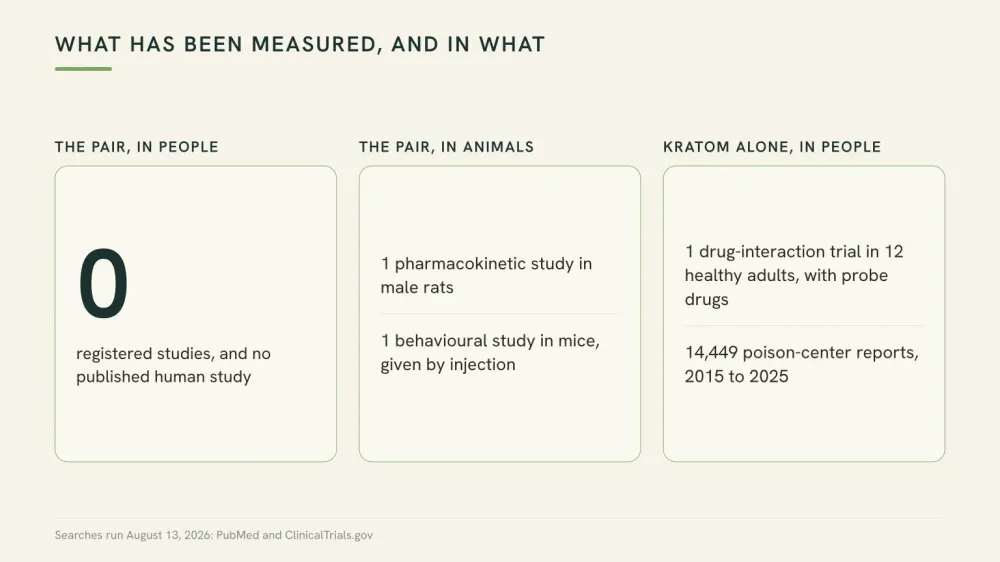
Here is the boundary, stated before anything else. This article will not tell you how to combine cannabidiol and kratom, because there is nothing to build that instruction out of. Searching PubMed on August 13, 2026 for coadministration pharmacokinetics of the two returned exactly one record, and it is an animal study. A search of the federal trials registry the same day returned zero registered studies of the pair, under four different phrasings. So you will find no amount, no order, no waiting interval and no start-low rule anywhere on this page. Any page that gives you one is inventing it. What you will find instead is every number that does exist, with the species it came from attached to it.
CBD and kratom: what one study actually measured, and in whom
The experiment is Pharmacokinetic Interaction of Kratom and Cannabidiol in Male Rats, published in the journal Pharmaceutics in 2024 by a group at the University of Florida. It gave male Sprague-Dawley rats, weighing 250 g plus or minus 25 g and fitted with jugular vein catheters so blood could be sampled repeatedly from the same animal, a kratom product with and without cannabidiol, then measured what appeared in plasma over the following 24 hours. The combination group was five animals. The paper is blunt about why it exists: its abstract states that there are no studies on coadministration of these products, and its conclusions describe the work as the first to examine the potential pharmacokinetic interactions when cannabidiol and kratom are coadministered. Two and a half years later, that sentence is still true of people.
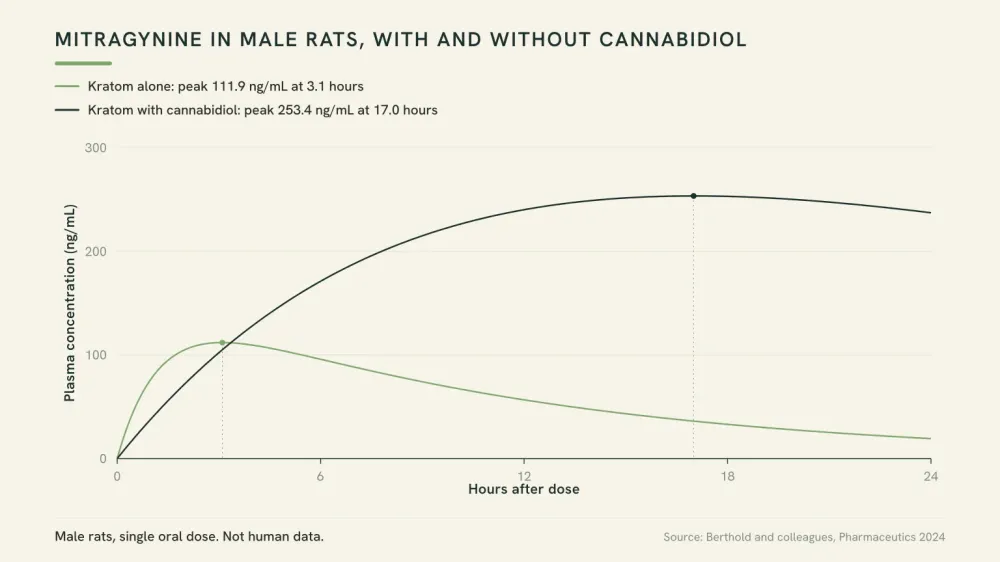
Three separate measurements moved, and they are three separate claims. In those male rats, total 24-hour exposure to mitragynine, the most abundant alkaloid in kratom leaf, rose 2.8-fold, with a 90% confidence interval of 1.6 to 3.7. In the same male rats, the peak plasma concentration rose 2.3-fold, 90% confidence interval 1.6 to 2.7. And in those same male rats the time to that peak moved from about three hours to about seventeen. Pages that quote a single number out of this study almost never say which measurement it belongs to, and the three answer different questions: how much got in over the day, how high the concentration went, and when it arrived. A page that says exposure rose 2.8 times without naming the measure or the species has told you something that sounds like a fact and is not yet one.
| Measurement | Kratom alone (n = 4, earlier published arm) | Kratom with cannabidiol (n = 5) | Fold change (90% CI) |
|---|---|---|---|
| Mitragynine, peak concentration (Cmax) | 111.9 ± 15.6 ng/mL | 253.4 ± 68.3 ng/mL | 2.3 (1.6 to 2.7) |
| Mitragynine, time to peak (Tmax) | 3.1 ± 1.7 hours | 17.0 ± 4.6 hours | The two means are the finding; the paper's ratio cell for this row cannot be read as an interval, so none is quoted |
| Mitragynine, 24-hour exposure (AUC 0-24) | 1,306.8 ± 126.1 ng/mL x h | 5,354.9 ± 1,145.5 ng/mL x h | 2.8 (1.6 to 3.7) |
| Speciociliatine, 24-hour exposure (AUC 0-24) | 222.7 ± 22.2 ng/mL x h | 989.7 ± 93.7 ng/mL x h | The paper's Results and Discussion give two different ranges for the minor alkaloids, so no range is printed here |
| Cannabidiol, 24-hour exposure (AUC 0-24) | Not applicable | Measured in the same animals | 1.0 (0.8 to 1.1) |
Why a bigger number here is a risk signal, not a benefit
Mitragynine acts at mu-opioid receptors, and so does 7-hydroxymitragynine, the metabolite the body makes from it. The FDA's own kratom page puts the relationship plainly: 7-hydroxymitragynine (7-OH) is a naturally occurring alkaloid in the kratom plant, but only a minor constituent that comprises less than 2% of the total alkaloid content in natural kratom leaves. However, 7-OH demonstrates substantially greater mu-opioid receptor potency than kratom's primary alkaloid constituent mitragynine, as well as other classical opioids such as morphine. So when an experiment reports that exposure to those compounds went up, the finding is that more opioid-receptor-active material reached the bloodstream than the same dose delivered on its own. Every page currently citing this study reads that as an efficiency. The authors did not.
“The results of this study are concerning, as individuals concurrently using kratom and cannabidiol may have increased exposure of all of the alkaloids found in a complex kratom product, most of which have little to no safety data to support their use.”
The rise was not confined to mitragynine. Speciociliatine, a minor kratom alkaloid the paper notes binds mu-opioid receptors more tightly than mitragynine does, went from an average 24-hour exposure of about 223 to about 990 ng/mL x h in the same male rats. Two things about the size of all this. First, in interaction pharmacology a fold change is usually treated as real when its 90% confidence interval sits outside the 0.80 to 1.25 no-effect band, and both mitragynine intervals sit entirely above that band. Second, the traffic ran one way. Cannabidiol's own 24-hour exposure in those animals came back at a fold change of 1.0, with a 90% confidence interval of 0.8 to 1.1, an interval that comfortably includes no change at all. Kratom alkaloid exposure went up; cannabidiol exposure did not. Whatever this is, it is not a mutual arrangement.
Five things that study does not establish
This is the part nobody quoting the 2.8-fold from those male rats has printed, and it is the part that decides how much weight the number can carry. The most important limitation is the comparison group. The kratom-alone arm was not dosed alongside the combination arm: it is four animals from the same laboratory's earlier published work, reused as a control, and the two arms did not receive an identical amount of mitragynine. That is a legitimate way to run a pilot experiment and a poor way to settle a safety question, and every one of the five limitations below belongs in any sentence that repeats the finding.
- 1It is male rats. One sex, one species, one route. Nothing in it tells you what happens in a woman, in a man, or in anyone taking a product by mouth in the amounts people actually take.
- 2The control arm was not concurrent. Four animals from earlier published work, at a mitragynine amount that was not identical to the combination arm's, is a historical comparison rather than a control group.
- 3The cannabidiol amount scaled to the prescription range. The paper says it corresponds to a human-equivalent dose within the range recommended for the FDA-approved cannabidiol prescription drug, not to what a consumer hemp product describes.
- 4It is not symmetric. Cannabidiol exposure did not move, so this is not a finding about what kratom does to cannabidiol, and it cannot be quoted in that direction.
- 5The mechanism is unresolved by the paper's own data. The authors expected blocked metabolism and did not find the fingerprint of it, which is the subject of the next section.
The enzyme explanation everyone repeats, and what was measured in people
The most common sentence on this topic online runs roughly: both are broken down by CYP3A4, and when the same enzyme handles two substances they accumulate over time to potentially toxic concentrations. That is a mechanism-shaped sentence rather than a mechanism. Being a substrate of an enzyme, meaning the enzyme processes you, is not the same as inhibiting it, meaning you slow the enzyme down for everything else. Sharing an enzyme is ordinary; most of what you swallow shares CYP3A. What matters is whether one of the two slows the enzyme, by how much, and where in the body. And accumulating over time is not how either process works. If you want the general version of that framework, it lives on the framework for CBD and prescription medications, and this page does not re-derive it.
The rat study is the one place the simple story was directly testable, and it did not survive. If the parent alkaloid rose because its metabolism was blocked, the ratio of metabolite to parent should have collapsed. It barely moved: the 7-hydroxymitragynine to mitragynine exposure ratio was 3.1% without cannabidiol and 3.5% with it, in the same male rats. The authors say so themselves. Because exposure to the parent compound rose, they write, it was expected that this would be due to a decrease in metabolism, but this was not the case for 7-hydroxymitragynine, despite it being primarily metabolized by CYP3A and cannabidiol being a competitive inhibitor of CYP3A. Their conclusions then ask for further studies to better understand the mechanism of the pharmacokinetic interaction as well as its pharmacodynamic significance, and state that caution must be exercised when administering cannabidiol and kratom products because the clinical relevance of the interactions described here is unknown. That is worth sitting with: the study everyone cites for the enzyme explanation is the study that tested it and could not confirm it.
There is a human enzyme measurement here, and it points the other way round. A 2023 clinical study, the first to clinically evaluate the pharmacokinetic drug interaction potential of kratom in the authors' own words, gave 12 healthy adults a single low dose of kratom tea alongside two standard probe drugs. Midazolam, the probe for CYP3A, showed a geometric mean ratio for exposure of 1.39 (90% confidence interval 1.23 to 1.57) and for peak concentration 1.50 (1.32 to 1.70). Dextromethorphan, the probe for CYP2D6, was untouched at 0.99 (0.83 to 1.19). Midazolam's half-life did not change, 1.07 (0.98 to 1.17), which the authors read as inhibition happening in the intestine rather than the liver. So in the human enzyme experiment that does exist, kratom is the substance doing the acting, the effect is modest, and it looks like a gut effect. Nobody has run that experiment with cannabidiol as the partner.
How many people are actually doing this
This is not a hypothetical pairing, and the best evidence on how common it is comes from a 2024 paper by NIDA-affiliated researchers, Use of Cannabinoids by People Who Consume Kratom in the United States. Read the figures carefully, because they belong to two different surveys and to a substance that is not CBD.
- In the 2022 National Survey on Drug Use and Health, 92.81% of adults who had ever used kratom had also used cannabis at some point (95% confidence interval 90.31 to 95.31). That figure is about cannabis, not about CBD.
- In a separate NIDA online sample of adults who use kratom regularly, the figure was 92.16% (89.37 to 94.95). Different survey, different group of people, and again cannabis rather than CBD. The two are not averaged, here or anywhere.
- In the full adult sample of that same 2022 national survey, 49.69% reported ever using cannabis, 34.09% reported ever using a cannabidiol-only product and 1.93% reported ever using kratom.
- A 2026 analysis of the 2021 to 2023 national surveys (139,524 adults) put past-year kratom use at 0.68% (95% CI 0.60 to 0.77). Past-year and lifetime are different questions over different windows, so 0.68% and 1.93% are not two points on a trend.
- An online survey of 5,152 people who use kratom, run between July 2019 and July 2020, lists cannabidiol by name among the substances most often taken before or alongside kratom.
The prevalence paper's own conclusion is the reason this article exists: co-use might result in herb-herb interactions that may impact research findings and clinical outcomes for people who use kratom. That is a hypothesis inside a prevalence study, not a measurement, and the authors present it as one. The kratom motivations survey is a self-selected online sample rather than a population estimate, and the past-year figure is a different question from the lifetime one above it. What these surveys agree on is that a large share of people who use kratom also use something from the cannabis family, and that nobody has measured what that does.
Where the measured harm actually is
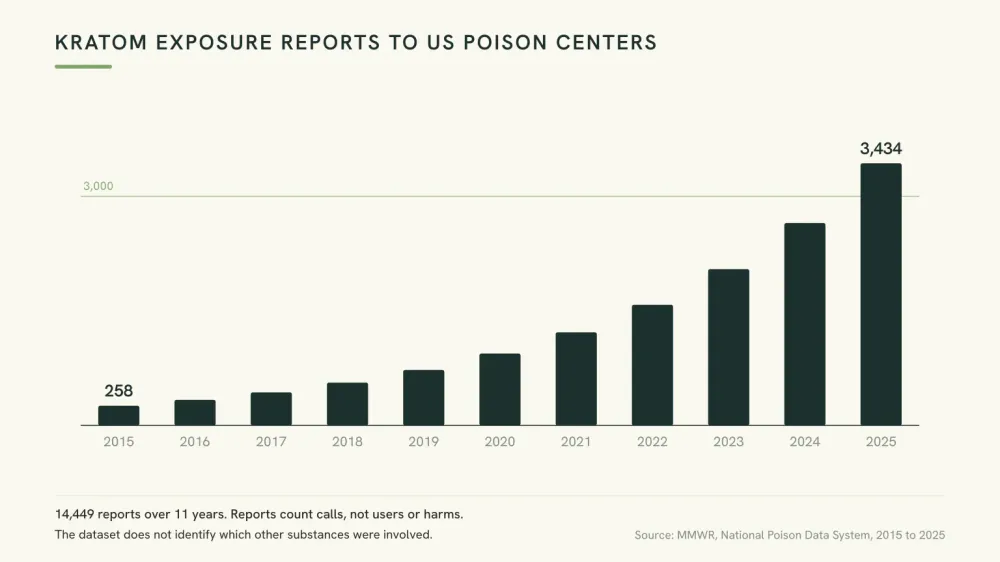
Those figures come from a 2026 MMWR report on kratom exposures reported to US poison centers, covering 2015 through 2025. The pattern inside them is the point. Single-substance reports were 62% of the total, so most kratom calls involve kratom alone. But the reports involving more than one substance are where the bad outcomes cluster: annually across the period, hospitalization ran at 44% to 56% for multiple-substance reports against 24% to 29% for single-substance ones, and serious medical outcomes at 57% to 66% against 41% to 49%. Now the limits, and they matter as much as the numbers. Poison-center reports are voluntary, they count calls rather than users or harms, and part of an eleven-year rise reflects growing awareness and a changing product market. Crucially, this dataset does not identify which co-substances were involved, it does not identify cannabidiol as one of them, and an association between multiple substances and worse outcomes is not proof that any particular substance caused anything.
The same shape shows up whenever that database is analyzed. An earlier analysis covering 2011 to 2017 found multiple-substance exposures had 2.80 times the odds of admission to a health care facility (95% confidence interval 2.21 to 3.55) and 2.25 times the odds of a serious medical outcome (1.77 to 2.85), against single-substance exposures, and recorded 11 deaths of which 2 followed a kratom-only exposure. A third analysis, of January 2016 through July 2025, counted 219 deaths, 43 single-substance and 176 polysubstance. These are three readings of one national system, not three independent confirmations, and they should be described that way. The same limitation applies to all three: none of them identifies which other substances were involved, none of them names cannabidiol, and an association between multiple substances and worse outcomes does not establish that any substance caused anything. Federal agencies say it in plainer language. NIH's National Center for Complementary and Integrative Health states that fatal overdoses from kratom alone appear to be extremely rare, that the use of kratom in combination with other drugs has been linked to deaths and severe adverse effects such as liver problems, and that more research is needed on drug interactions involving kratom. NIDA's kratom page states that a very small number of deaths have been linked to kratom products, and nearly all cases involved other drugs or contaminants. We read both pages on August 13, 2026.
What a lab report can and cannot tell you here
Readers who have learned to check a certificate of analysis often assume it settles a question like this one. It does not, and the reason is worth stating precisely: a certificate of analysis tells you what a laboratory found in the container it was written for, on the batch it was written for. It says nothing about a second product from a different supply chain, and it cannot describe what the two do together, because no laboratory tested that. If certificates are new to you, what an independent test report actually certifies and how to read a certificate of analysis line by line are the two pages that cover the mechanics. On the kratom side of this question, two measured findings are worth knowing before you trust either the label or the person selling it.
- Labels and contents often disagree. A 2026 analysis of commercial kratom tablets, films and liquid shots found substantial variability in alkaloid composition and frequent inconsistencies between labelled and actual contents.
- The advice at the counter has been measured. In a secret-shopper study of 100 Texas smoke shops, kratom was stocked at 94% of them and 81% of employees made at least one health claim about it.
- The most common kratom claims those employees made were about drug withdrawal or cravings (76%) and pain (69%). When shoppers specifically asked about adverse effects, 24% named no risks at all.
- That is two Texas cities at one point in time and not a picture of the whole country. It is still a measurement of the advice environment rather than an impression of one.
Those two studies, on kratom product labelling and on what retail staff tell shoppers, matter for a specific reason on this page. The labelling analysis reports that products often contained additional unreported alkaloids or lacked those listed on the label, and its authors set that against a market that has moved toward kratom-derived semisynthetic products rather than plain leaf. The rat experiment, by contrast, measured a kratom product with a known alkaloid composition. If what is in the package is not reliably what the label says, then the exposure that pharmacology is trying to predict is itself uncertain before anything else is added to it.
Where kratom stands with US regulators, as of August 13, 2026, corrected September 4, 2026
This section states federal agencies' position on kratom, in their own verbs, with our read date attached. It says nothing about the regulatory status of CBD, which is a separate question covered on our page on what the FDA says about CBD. Two things get confused constantly here, so separate them now: whether a substance is a scheduled controlled substance, and whether it can be lawfully sold as a supplement, food or drug. Those are different determinations made by different agencies, and kratom sits in a different place on each.
Correction, September 4, 2026. Two rows in the table below were accurate when we wrote them on August 13, 2026 and were overtaken by two Federal Register documents published on the same day, August 26, 2026. The row recording that the HHS comment window closed on July 31 no longer stands on its own: that window was reopened, and comments are now due September 10, 2026. The row recording that no temporary scheduling order had been published stopped being true thirteen days after we wrote it. We have corrected both rows and added the two documents rather than deleting what we published, so the original read date stays visible. The full account of what the two August 26 documents did and what they left untouched sits on its own page, including which molecule each one names and which instrument each one used.
| Date | Document | What it says, in the agency's own words | Status |
|---|---|---|---|
| August 31, 2016 | DEA notice of intent | Proposed temporarily placing mitragynine and 7-hydroxymitragynine into Schedule I | Superseded by the withdrawal below |
| October 13, 2016 | DEA withdrawal notice, Federal Register | DEA is withdrawing the August 31, 2016 notice of intent, after numerous comments from members of the public challenging the scheduling action, pending an FDA scientific and medical evaluation | In force; this is why kratom leaf is sold openly today |
| July 29, 2025 | FDA press announcement | Recommending a scheduling action to control certain 7-hydroxymitragynine (7-OH) products under the Controlled Substances Act, and specifically targeting 7-OH, not focused on natural kratom leaf products | A recommendation, not a rule |
| Standing position, re-read August 13, 2026 | FDA and Kratom | Kratom is not appropriate for use as a dietary supplement, and kratom is not lawfully marketed in the U.S. as a drug product, a dietary supplement, or a food additive in conventional food | In force. We quote it from our own read rather than from a page-footer date we could not re-verify |
| July 6, 2026 | DEA notice of intent, Federal Register | Notice of intent to publish a temporary order to schedule 7-hydroxymitragynine above a specified threshold in Schedule I; the document states the order will not be issued before August 5, 2026 | A notice of intent is not the order |
| July 6 to July 31, 2026, reopened August 26, 2026 | Parallel HHS notice, Federal Register | Opened a 30-day public comment window on the same proposal | Corrected September 4, 2026: the window closed on July 31, 2026 and was reopened by 91 FR 55104 on August 26, 2026, with comments now due September 10, 2026 |
| August 13, 2026 | Our own Federal Register search | A query for documents mentioning mitragynine published after July 6, 2026 returned one document, and it concerns an unrelated substance | Corrected September 4, 2026: true on August 13, 2026, and superseded on August 26, 2026 by the temporary scheduling order in the row below |
| August 26, 2026 | DEA temporary scheduling order, 91 FR 54948, Docket No. DEA-1644 | Placed mitragynine pseudoindoxyl, MGM-15 and MGM-16 in schedule I, including their isomers, esters, ethers, salts, and salts of isomers, esters, and ethers, on a finding that placing them in schedule I is necessary to avoid an imminent hazard to public safety | Added September 4, 2026. Effective August 26, 2026, until August 26, 2028 unless extended or made permanent. The order does not name kratom leaf and does not name mitragynine |
| August 26, 2026 | HHS notice, request for information, extension of comment period, 91 FR 55104, Docket No. HHS-OASH-2026-0232 | Submit either electronic or written comments, data, or information by September 10, 2026, an action taken in response to a request for an extension | Added September 4, 2026. The 7-hydroxymitragynine threshold is still a proposal and the docket is open until September 10, 2026 |
Read as a whole, the FDA's kratom page is more direct than most summaries of it. It states that FDA has warned consumers not to use kratom because of the risk of serious adverse events, including liver toxicity, seizures, and substance use disorder (SUD), and on deaths it says, in one sentence that should always be quoted whole, that in these cases, kratom was usually used in combination with other drugs, and the contribution of kratom in the deaths is unclear. The same page notes that there are few published reports from well-designed scientific studies where kratom was administered to humans, and that a well-designed human abuse potential study has not been conducted. On the scheduling side, NCCIH's page states that the DEA has listed kratom as a drug of concern, but kratom and kratom compounds are not listed in the U.S. schedule of controlled substances, and that remains accurate for kratom leaf: the July 2025 announcement and the July 2026 notice of intent both concern concentrated 7-OH products, not leaf, and neither is a scheduling order. The present situation traces back to the 2016 withdrawal. One more sentence from FDA, and then this page stops: states may have their own regulations or prohibitions for kratom products, and state health and law enforcement agencies are the best resource concerning applicable state laws. We are not listing states, because that list changes and this article does not own it.
What nobody has measured
Run these searches yourself, because a claim about an entire literature should be reproducible. On August 13, 2026, a PubMed search for cannabidiol AND (kratom OR mitragynine) returned 15 records. Five of those 15 are successive annual editions of one living systematic review on plant-based treatments for chronic pain; two are chemistry papers; the interaction-relevant set is four papers, and the rest mention cannabinoids in passing. Narrowing to (kratom OR mitragynine) AND cannabidiol AND (pharmacokinetics OR drug interactions) returned exactly one record, the male-rat study above. Broadening to (kratom OR mitragynine) AND (cannabidiol OR cannabis OR cannabinoid) returned 112 records, and restricting that to human studies returned 60, none of which gives a person both substances and measures either one. On ClinicalTrials.gov, the phrases kratom cannabidiol, kratom AND cannabidiol, cannabidiol kratom and mitragynine cannabidiol all returned zero studies. Those zeroes are not a broken query: cannabidiol alone returned 607 studies that day and kratom alone returned 14.
There is one more preclinical study of the pair, and it is worth stating precisely. A 2023 experiment in male and female mice with chemotherapy-induced neuropathy gave mitragynine and cannabidiol by injection rather than by mouth, and its own isobolographic analysis of the neuropathy endpoint describes the 1:1 and 3:1 mixtures as additive rather than more than additive. Read that narrowly: it is one endpoint's result in one model, and the paper's own title calls the effects across its three endpoints differential. In those mice, cannabidiol alone did not decrease the animals' rate of working for food, and every mitragynine-plus-cannabidiol mixture did. The paper's background is the interesting part for a reader arriving from a retail page: the claim that cannabidiol makes kratom's pain relief stronger appears in the scientific literature explicitly labelled as an anecdotal report, which is precisely what the mouse experiment was built to test. And notice what the registry gap is not. Human co-administration research on kratom is actively being funded: a trial at Washington State University is measuring a kratom and oxycodone interaction in 16 people, and a study of kava plus kratom in 18 people began in May 2026, sponsored by a company that sells a kava-kratom tonic. A commercial sponsor is paying to measure kava with kratom. Nobody, commercial or academic, has registered cannabidiol with kratom.
Red flags, and what to do instead
Two honest sentences before the list. First, the reading of the evidence on this page partly argues against a combination that includes our own product category, which is the point: we are describing what has been measured, not defending a use. Second, cannabidiol and kratom are not interchangeable, neither one is a treatment for anything, and this page will not rank them against each other, because nobody has run the study that would let anyone do that. What follows is about recognizing trouble, not about optimizing anything.
- Slow or shallow breathing, blue or grey lips, or a person who cannot be woken. Call 911. Do not wait to see whether it passes.
- Confusion, agitation, severe drowsiness, repeated vomiting or a seizure after taking anything. Poison Control, 1-800-222-1222, is free and staffed 24 hours a day.
- Yellowing of the skin or eyes, dark urine, pain under the right ribs or unexplained exhaustion. FDA names liver toxicity among the serious adverse events it warns about with kratom, and that warrants medical attention rather than a wait-and-see.
- A reaction after taking two or more things, including alcohol or a prescription medicine, where you cannot tell which one is responsible. Bring everything you took, in its packaging, to whoever you speak to.
- Needing kratom to feel normal, or taking it mainly to avoid withdrawal. That is a clinical conversation, and the SAMHSA National Helpline at 1-800-662-4357 is free, confidential and open 24 hours a day.
- Any plan that starts with reading a dose off a website. No published human study of this combination exists, so no website has an interval, an amount or a sequence to give you, whatever it prints.
A few practical routes out, all of them free. Poison Help runs the national poison-center line and an online triage tool. FindTreatment.gov is the federal locator for substance use treatment, and the SAMHSA National Helpline on 1-800-662-4357 does the same job over the phone. If your real question is whether CBD itself carries a dependence or withdrawal risk, that belongs to what the evidence says about dependence and CBD and this page publishes no claim about it. If your question is about combining sedating things generally, the same framework is worked through on the page on CBD and alcohol, on CBD alongside trazodone and on the same question asked about gabapentin. And if you are trying to work out which substance is causing a symptom, start from the side effects CBD itself reports, then take the list to a clinician rather than to a search box. If cannabidiol is new to you altogether, start with what cannabidiol actually is.
No human study has measured what happens when a person takes both, so nobody can answer that question from evidence. What exists is one experiment in male rats, in which adding cannabidiol raised 24-hour exposure to mitragynine 2.8-fold, and the authors of that experiment describe their own result as concerning. That is a reason to ask a clinician about your specific situation. It is not a reason to be reassured by a page that says it is generally safe and shows you no source for the claim.
In male rats it moved both measurements: peak concentration 2.3-fold higher, 24-hour exposure 2.8-fold higher, and time to peak moving from about three hours to about seventeen. Retail pages present that as a feature. Read the direction honestly and it is a warning: what rose was exposure to the alkaloids that act at mu-opioid receptors, in rats, at a cannabidiol amount the authors scaled to the prescription range rather than to a consumer product. Nothing has measured either effect in a person.
Both have been linked to CYP3A, but sharing an enzyme is not by itself an interaction, and they build up over time is not how it works. The one place the simple version was testable, it failed: in the male-rat study, the 7-hydroxymitragynine to mitragynine exposure ratio moved only from 3.1% to 3.5%, which is not what a purely blocked enzyme looks like, and the authors close by asking for further studies to understand the mechanism. In the human enzyme study that does exist, kratom itself was the substance doing the acting on two probe drugs, and the effect looked like it happened in the intestine. Nobody has run that experiment with cannabidiol as the partner.
Nothing in the human literature supports any interval, and this page will not invent one. The wait four to six hours figure circulating online has no study behind it, and no study of this pair has ever measured a spacing interval in a human being. It is worth noticing why: in the male-rat experiment, the time to peak mitragynine concentration moved from about three hours to about seventeen. A delay measured in most of a day is not a number anyone can build a schedule out of.
As of our read on August 13, 2026, kratom leaf is not a federally scheduled controlled substance. The DEA has an open notice of intent, published July 6, 2026, to temporarily place concentrated 7-hydroxymitragynine above a specified threshold into Schedule I, and a notice of intent is not the order; a Federal Register search on our read date returned no such order. Separately, FDA states that kratom is not appropriate for use as a dietary supplement and is not lawfully marketed in the U.S. as a drug product, a dietary supplement, or a food additive in conventional food. FDA also notes that states may have their own regulations or prohibitions. Nothing here is FDA approved.
That is not a question this article answers, and it is not a question with a published answer. A PubMed search on August 13, 2026 for kratom or mitragynine together with cannabidiol, cannabis or cannabinoids, restricted to human studies, returned 60 records, and not one of them gives a person both substances and measures either one. Nothing on this site should be read as suggesting one substance to manage another. If kratom is being used to get through withdrawal, cravings or pain, the SAMHSA National Helpline is 1-800-662-4357: free, confidential, 24 hours a day, in English and Spanish, and it will connect you to local treatment options.
Writing about hemp, wellness and the small rituals that keep us balanced.