CBD and Trazodone: What the Label Says, What Nobody Measured
Five PubMed records name cannabidiol and trazodone, two of them in dogs, and none gave both to a person. Here is what trazodone's label says about strong CYP3A4 inhibitors, what a real one did in ten volunteers, and where cannabidiol sits.

If you take trazodone, there is a good chance it was prescribed to help you sleep, and a good chance you are here because you are about to add a CBD product on top of it. Nothing about CBD and trazodone has been measured in people: on August 12, 2026 a PubMed search for cannabidiol and trazodone returned five records, two of them studies in dogs, and not one gave both substances to a person. Trazodone's own FDA label does contain a dosing section written for this kind of question, and the word in that section's title is strong. Your job is not to do that arithmetic. It is to tell the prescriber or the pharmacist what is in the other bottle.
Three things are true at once. A mechanism exists on paper: trazodone is broken down to an active metabolite by CYP3A4, a liver enzyme, and cannabidiol has measurable effects on several liver enzymes. Its size in this pair has never been measured in anybody. And the label's instruction about that enzyme is written about strong inhibitors, a regulatory category with a published numerical definition that cannabidiol has not been placed in. The general framework lives on our guide to CBD and prescription medications, and what cannabidiol is and is not is the place to start if the compound is new to you.
What has actually been measured about CBD and trazodone
Before anyone can tell you how big this interaction is, somebody has to have measured it. On August 12, 2026 we ran the query cannabidiol AND trazodone against PubMed, the National Library of Medicine's index of biomedical literature, and it returned five records. Restricting the search to randomized controlled trials returned zero, and restricting it to the drug-interactions subject heading also returned zero. A count without its query and its date means nothing.
We opened all five, because what they are is the state of the evidence. One is a 2024 retrospective chart review of adverse events involving cannabinoids and psychotropic drugs, which returns at the end of this article and does not say what the internet will tell you it says. One is a digest of the previous year's top papers for primary-care physicians, and one is a review of drugs for Dravet syndrome, a severe childhood epilepsy. Two are veterinary: a trial of a hemp extract for pain after knee surgery in dogs and a study of how dogs respond to a noise-induced fear test. Those are dogs, and nothing in them transfers to a person.
One sentence has to travel with those numbers, and it cuts both ways: absence of a study is not evidence of no effect, and it is not evidence of an effect either. When a page hands you a risk rating or a number of hours to wait, it is filling that gap with something other than data about these two substances.
Trazodone's label already has a section for this, and the word is strong
Trazodone has no brand label on the US market, so we read a manufacturer's full prescribing information on DailyMed and cross-checked every string here against two other manufacturers' versions. Section 2.5 is titled Dosage Recommendations for Concomitant Use with Strong CYP3A4 Inhibitors or Inducers, and its first sentence reads: consider reducing trazodone dose based on tolerability when trazodone is coadministered with a strong CYP3A4 inhibitor. Read who that sentence is addressed to. It is written for a prescriber, about a named list of drugs, and it is not an instruction for you to act on at home. Section 7.1 names those drugs, itraconazole, ketoconazole, clarithromycin and indinavir, and warns that with a potent CYP3A4 inhibitor the risk of adverse reactions, including cardiac arrhythmias, may be increased. That, plus section 5.3's instruction to avoid combining trazodone with CYP3A4 inhibitors because trazodone prolongs the QT interval, is where the arrhythmia claim circulating on consumer CBD pages actually comes from.
Where does the CYP3A4 story come from? Section 12.3 says it plainly and carefully: in vitro studies in human liver microsomes show that trazodone is metabolized, via oxidative cleavage, to an active metabolite, m-chlorophenylpiperazine, by CYP3A4. In vitro means in laboratory glassware, using tissue preparations rather than a living person. The label then adds a sentence almost nobody quotes: other metabolic pathways that may be involved in the metabolism of trazodone have not been well characterized. The primary papers underneath it are the same kind of experiment. A 1998 in-vitro study found that of eight individually expressed human enzymes, only CYP3A4 produced that metabolite, and a 2000 in-vitro study of the same reaction put the inhibition constants near 0.12 micromolar for ketoconazole and 0.14 for ritonavir. Neither experiment involved a person, and neither involved cannabidiol.
Now the part that should change how you read every page about this drug. The label says strong CYP3A4 inhibitors increased the exposure of trazodone, and it never says by how much. We read the whole document, from the boxed warning through the end of the patient Medication Guide, on three manufacturers' versions, and it contains no half-life, no clearance value, no peak concentration and no bioavailability figure. That is a limit of the document, not a fact about the drug: it does not mean trazodone leaves the body quickly and it does not mean it lingers, it means the official label does not tell you. It is also why this article will not hand you a number of hours to leave between trazodone and anything else, because there is nothing official to calculate one from.
What a genuinely strong CYP3A4 inhibitor did to trazodone in people
The magnitude exists once, in the literature rather than the label. In a blinded four-way crossover study published in 2003, ten healthy volunteers each received a single 50 mg dose of trazodone or matching placebo, with or without low-dose ritonavir given as four 200 mg doses. Ritonavir is an antiretroviral and a strong CYP3A4 inhibitor, and a drug from its class, indinavir, is on trazodone's own label list. With ritonavir on board, trazodone's apparent oral clearance fell from 155 to 75 mL/min, its elimination half-life rose from 6.7 to 14.9 hours, and peak plasma concentrations rose from 842 to 1,125 ng/mL. That 6.7 hour figure is the control arm of one 2003 study in ten healthy people after a single dose, not a number the label endorses and not a spacing rule for anybody's medicine cabinet.
The study also measured how the volunteers felt. Coadministration of trazodone with ritonavir increased sedation, fatigue and performance impairment compared with trazodone plus placebo, although the difference reached significance only on the digit-symbol substitution test. Three of the ten had nausea, dizziness or hypotension on the combination, and one of those three also fainted. Hold the limits in the same hand as the finding: ten healthy volunteers, a single dose, published in 2003, one significant endpoint out of several, and ritonavir is an antiretroviral drug rather than cannabidiol. This is what trazodone's label means by the word strong; it says nothing about a hemp extract.
Where cannabidiol actually sits on that scale
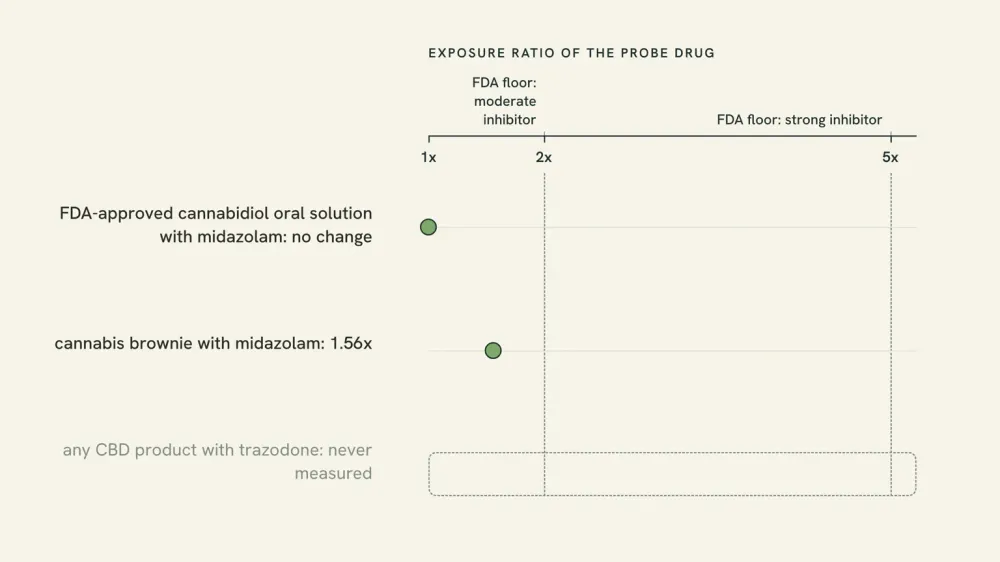
The word strong is not a matter of opinion, because FDA publishes the arithmetic. In its table of substrates, inhibitors and inducers, the agency states that strong and moderate inhibitors are drugs that increase the AUC of sensitive index substrates of a given metabolic pathway 5-fold or more, and 2-fold to under 5-fold, respectively. AUC is total exposure over time. For CYP3A the sensitive index substrates are midazolam and triazolam, and the strong index inhibitors are clarithromycin and itraconazole, so two of the four drugs trazodone's own label names are the two the regulator uses to define the category. FDA's separate clinician table of drugs and substances that interact with CYP enzymes classifies grapefruit juice as a moderate CYP3A inhibitor and St. John's wort as a strong CYP3A inducer; we searched it on August 12, 2026 and cannabidiol is not on it in any category, although FDA says on that page that the examples are a guide and not a comprehensive list of all possible drugs and other substances.
Cannabidiol has been measured against that probe drug twice, and the two results disagree. The FDA-approved cannabidiol medicine, an oral solution prescribed for severe childhood epilepsy, calls cannabidiol a moderate inhibitor of CYP2C19 and a weak inhibitor of CYP1A2, never a strong inhibitor of anything, and its own human test found that gram-scale pharmaceutical dosing did not change midazolam's plasma concentrations at all. That is a prescription medicine dosed far above anything a consumer product delivers, and a null result is not a safety finding.
In a randomized crossover trial in 18 healthy adults, a cannabis brownie carrying a research dose of cannabidiol together with THC, far above what a consumer serving delivers, raised midazolam exposure by 56%, while the brownie with THC and no cannabidiol inhibited none of the enzymes tested. A 56% rise is a 1.56-fold increase, below the 2-fold floor for moderate and nowhere near the 5-fold that defines strong; that comparison is our arithmetic against FDA's published thresholds, not an FDA classification of cannabidiol. Neither result used trazodone. The rest of the cocktail's numbers live on our page about CBD alongside blood pressure medication.
| What was given | What was measured | Result | Against FDA's bands | Measured against trazodone? |
|---|---|---|---|---|
| Low-dose ritonavir, an antiretroviral | Trazodone clearance and half-life, 10 volunteers, 2003 | Clearance 155 to 75 mL/min, half-life 6.7 to 14.9 h | Strong CYP3A4 inhibitor | Yes, single 50 mg dose |
| Clarithromycin, itraconazole | Nothing: these are FDA's index inhibitors | The reference standard for a 5-fold rise | Strong, by definition | No, named in the label as examples |
| Cannabidiol oral solution, gram-scale dosing | Midazolam, the CYP3A4 probe, in the label's own study | No change in midazolam levels | Below the 2-fold moderate floor | No |
| Cannabis brownie: research dose of cannabidiol plus THC | Midazolam AUC in 18 healthy adults | 56% higher, a 1.56-fold ratio (our arithmetic) | Below the 2-fold moderate floor | No |
| Any consumer CBD product | Trazodone levels in a person | Never measured | No classification exists | No, zero studies as of August 12, 2026 |
Trazodone is not a sleeping pill, and its label says so by omission
Here is what almost nobody asking this question has been told. Section 1 of trazodone's label, the indication, is a single sentence about major depressive disorder in adults, and section 14, clinical studies, is also a single sentence naming only depression trials. We extracted the whole label as plain text, patient Medication Guide included, and searched it case-insensitively on August 12, 2026, on all three manufacturers' versions. Insomnia appears three times, and every one is a problem rather than a purpose: a discontinuation symptom, a post-marketing psychiatric adverse reaction, and an entry in the Medication Guide's list of symptoms to report to a healthcare provider right away. Sleep appears seven times, all seven in that same Medication Guide. Hypnotic and sedative appear zero times. And the only bedtime instruction in the document is in section 2.1, where it exists to manage an adverse effect: occurrence of drowsiness may require the administration of a major portion of the daily dose at bedtime, or a reduction of dosage.
“Trazodone hydrochloride tablets are indicated for the treatment of major depressive disorder (MDD) in adults.”
None of that means your prescription is wrong: off-label prescribing is legal, common and a clinical judgement your prescriber is entitled to make. What it means is that the professionals disagree in public. The American Academy of Sleep Medicine's clinical practice guideline on chronic insomnia suggests that clinicians not use trazodone as a treatment for sleep onset or sleep maintenance insomnia, a recommendation it grades as weak while stating that weak should not be construed as an indication of ineffectiveness. A systematic review of trazodone for insomnia published the same year is favorable about low-dose use and notes that off-label use of this medication for insomnia has surpassed its usage as an antidepressant. This page will not pick between them for you. What is not in dispute is the scale: a 2026 analysis of US prescribing data found trazodone was the most commonly prescribed hypnotic medication in the country, at more than double zolpidem's numbers by 2023.
Which changes who is asking this question. If your trazodone is for depression, you are asking about a supplement alongside treatment for a serious illness; if it is a low dose at bedtime, you are asking about a supplement alongside an antidepressant used off-label, below the 150 mg a day its own label starts at. What CBD research does and does not show about sleep is a separate question with its own page, our review of the human sleep evidence, and the melatonin version lives on our page about CBD and melatonin.
The sedation question, which is the one both labels answer
Strip out the cytochromes and you are left with what most people actually mean: will taking both make me groggy? Trazodone's label answers half of it. Section 7.1 says trazodone may enhance the response to CNS depressants and instructs that patients be counseled about alcohol, barbiturates and other CNS depressants; no cannabinoid is named in that row, and cannabidiol, cannabis, cannabinoid and marijuana appear nowhere in the document. Section 5.9 is blunter: trazodone may cause somnolence or sedation and may impair the mental or physical ability required for potentially hazardous tasks, with patients cautioned about operating hazardous machinery, including automobiles. The framework for stacking two sedating things is the one we set out for CBD alongside gabapentin, and its best-documented version is CBD with alcohol.
The numbers that give this teeth are in the label's own Table 2, and they describe trazodone by itself. In its controlled trials, drowsiness was reported by 24% of trazodone-treated inpatients against 6% on placebo, and by 41% of treated outpatients against 20% on placebo. The label's preamble adds that rates from one drug's trials cannot be directly compared with another's and may not reflect the rates observed in practice. From the other direction, in one clause: the FDA-approved cannabidiol label warns that other CNS depressants, including alcohol, could potentiate its own somnolence and sedation. What that leaves is an attribution problem rather than a risk number. If you feel foggier or unsteadier after adding a second product, nothing on this page can tell you which one did it, and neither can the labels, because drowsiness is on both. That is the reason the person who prescribed the trazodone needs to know the other bottle exists. For the baseline from the other side, see the side effects CBD actually reports.

The serotonin syndrome claim, checked
One claim dominates the consumer pages here: that combining CBD with trazodone raises the risk of serotonin syndrome, a rare and potentially dangerous reaction to excessive serotonin activity. It is stated as fact with no citation attached, and when we read the results on August 12, 2026, the page stating it most forcefully was about dogs. Both halves of the honest answer have to be said. First half, which this page will not soften: section 5.2 of trazodone's label states that SNRIs and SSRIs, including trazodone, can precipitate serotonin syndrome, and that the risk is increased with concomitant use of other serotonergic drugs, naming triptans, tricyclic antidepressants, fentanyl, lithium, tramadol, tryptophan, buspirone and St. John's Wort, and with drugs that impair metabolism of serotonin, namely MAOIs, which section 4 makes an outright contraindication. If any of those names is on your list, the label is talking to you, and that conversation is with your prescriber. Second half: no cannabinoid is on that list, and no cannabinoid word appears anywhere in the document.
Then we searched the literature instead of the search results. On August 12, 2026 the PubMed query cannabidiol AND serotonin syndrome returned exactly one record, and it is not about trazodone. It is a 2020 case report of a hyperkinetic reaction to dihydrocodeine in a man in his 30s taking paracetamol and dihydrocodeine daily for pain who, in the authors' words, other than topical cannabidiol oil for eczema used no other medications; his symptoms resolved within 48 hours of stopping the opioid. The authors applied the Hunter criteria retrospectively, wrote that this may have been a case of serotonin toxicity, and called the cannabidiol link an alternative, hypothetical explanation, proposing short-term CYP3A4 inhibition rather than any serotonin mechanism. One patient, a different drug, a skin cream, and the authors' own word is hypothetical.
Widen the query to any cannabinoid and it returns 13 records, of which three are genuinely about a cannabinoid and this syndrome, and all three are about cannabis rather than cannabidiol: a case report of serotonin syndrome and cannabis, a report titled as a misdiagnosis in a patient who used a cannabis dab pen, and a paper on distinguishing serotonin syndrome from cannabis toxicity in the emergency department. Two of the three exist to describe how cannabis intoxication gets mistaken for this syndrome rather than how it causes it.
The rest of this label, and the one report that names trazodone beside a cannabinoid
The internet's risk list for this question is short and speculative; the label's own is long, specific and not about CBD. Two of its rows are worth a sideways glance if you also take something over the counter. Section 5.5 says aspirin, NSAIDs, other antiplatelet drugs, warfarin and other anticoagulants may add to trazodone's own bleeding risk, which is why CBD with ibuprofen and CBD alongside anticoagulants are their own questions. And the published case of low blood sodium in a patient who added a CBD product to an antidepressant involved sertraline, which is covered on our page about CBD and sertraline rather than here. Section 8.7 adds that trazodone has not been studied in patients with hepatic impairment, one more reason liver questions get their own treatment in is CBD bad for your liver.
Now the correction that makes this page worth your time. Of those five PubMed records, exactly one is a clinical report that puts trazodone in the same case series as a cannabinoid, and it is the 2024 chart review from the top of this article. Its authors evaluated 1,586 adverse-event reports, found 52 involving a cannabinoid preparation and graded 20 as high probability. Of those 20, eighteen involved medical marijuana at approximately 18% to 22% THC with about 1% CBD, and trazodone appears inside that high-THC group. Only two of the twenty involved a CBD oil, and both of those patients were taking sertraline, not trazodone. So the paper that will eventually be quoted at you as evidence about CBD and trazodone is a cannabis paper, and transferring its findings to a CBD product is not a cautious reading, it is a different claim. The review has no denominator, so it supports no rate, and it measured no drug concentrations in anybody.
What to do before you take both
Every step below is disclosure or observation. None involves changing an amount, adding a gap between doses, or starting or stopping anything, because nothing on this page supports that; amounts belong in a conversation with your prescriber, and the general question of how much people take is a separate topic on our dosage page. The instruction is not ours either. FDA states that CBD can affect how other drugs you are taking work, potentially causing serious side effects, and that it is concerned about the safety of taking other medicines with CBD when not monitored by a healthcare provider. The National Institute of Mental Health's page on mental health medications tells patients to tell a health care provider about all other medications, vitamins, and supplements you are already taking. And trazodone's own section 17 instructs prescribers to advise patients to disclose any prescription or over-the-counter medication they take or plan to take. The request is already in the label.
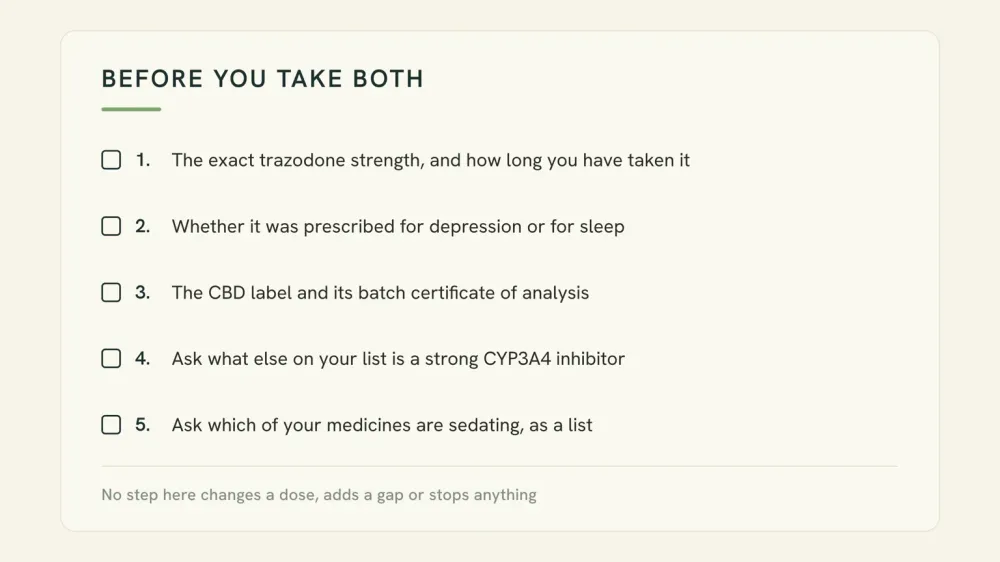
- 1Write down the exact trazodone strength on your bottle, how long you have taken it, and whether it was prescribed for depression or for sleep.
- 2Bring the CBD product itself, or a photo of its label and its batch certificate of analysis. The word CBD is not a dose.
- 3Say it in plain words to the prescriber or the pharmacist, and ask them to note it on your list.
- 4Ask whether anything else you take is a strong CYP3A4 inhibitor, because that is the category trazodone's dosing section is written about.
- 5Ask which of the things you take are sedating, and agree in advance what you would do if the warning signs above appear.
If step 2 is where you stall, our walkthrough of a certificate of analysis shows what a batch report should contain and where the numbers a pharmacist would ask for live. A pharmacist can work with a concentration and a batch number; nobody can work with the words CBD oil.
What nobody knows, stated plainly
The list of things this page cannot tell you is longer than the list of things it can. Nobody has given a person cannabidiol and trazodone and then measured either substance in blood, so there is no dose-response curve, no exposure ratio and no threshold for this pair, and no waiting interval either, which is why we published none; when people take CBD, without reference to any medicine, is handled on our page about timing. The two human numbers for cannabidiol and CYP3A4 disagree with each other, and consumer CBD products vary in what they contain, a variable that sits in front of the pharmacology rather than inside it.
Research on cannabis or cannabinoids for conditions other than the few with approved medicines is, as NIH's National Center for Complementary and Integrative Health puts it, in its early stages, and this article has taken no position on what CBD does or does not do for anything, because everything reviewed here is metabolism and labels rather than outcomes. And the sentence that travels with every count on this page: absence of a study is not evidence of no effect, and it is not evidence of an effect either.
No study has given both to a person, at least none indexed in PubMed when we searched on August 12, 2026, so no page can answer that for your body. What exists is a label section written about strong CYP3A4 inhibitors, one human study of trazodone with a genuinely strong inhibitor, and no measurement of cannabidiol against this drug. A mechanism on paper and a measured effect are different things, and only the first exists here. The supported step is disclosure: tell the prescriber or the pharmacist, and bring the CBD label.
Not by any published classification. FDA defines strong as raising a sensitive probe drug's exposure at least 5-fold, and moderate as 2-fold to under 5-fold. The approved cannabidiol medicine reported no change in that probe at gram-scale pharmaceutical dosing, and the largest human figure we found for a CBD-containing product was 1.56-fold. FDA's clinician table of CYP-interacting substances does not list cannabidiol, though FDA says that table is a guide rather than a comprehensive list.
Serotonin syndrome is real, and trazodone's label names what raises the risk: MAOIs, which are contraindicated outright, plus triptans, tricyclic antidepressants, fentanyl, lithium, tramadol, tryptophan, buspirone and St. John's Wort. No cannabinoid is on that list. In PubMed on August 12, 2026, cannabidiol and serotonin syndrome appeared together in exactly one record, a reaction to an opioid in a man whose only other product was a topical CBD cream, and the authors called the cannabidiol link hypothetical.
No interval has been studied, and this page will not invent one. There is also nothing official to calculate one from: trazodone's label states no half-life, no clearance value and no peak-concentration figure anywhere, on three manufacturers' versions. That is a limit of the label rather than a statement about how quickly trazodone leaves the body. Timing questions about your own prescription belong to the prescriber.
No. Its label indicates it for major depressive disorder in adults, in one sentence, and its clinical-studies section names only depression trials. Insomnia appears three times in that document, never as a reason to take the drug, and the words hypnotic and sedative appear zero times. Off-label prescribing is legal and common: a 2026 analysis found trazodone was the most commonly prescribed hypnotic medication in the United States. An absent indication is not a safety finding.
Nobody has measured it. What is documented is that trazodone's own controlled trials reported drowsiness in 24% of treated inpatients against 6% on placebo and 41% of outpatients against 20%, and that its label says trazodone may enhance the response to CNS depressants and may impair the ability to perform hazardous tasks including driving. The practical problem is attribution: if you get drowsier, nothing on this page can tell you which product did it.
Writing about hemp, wellness and the small rituals that keep us balanced.