What Is THC-O? The Acetate Ester, the Delay, and the Heat
THC-O acetate is not something the hemp plant makes. It is THC with one chemical group attached in a reaction, and almost everything confusing about it follows from that group: the delayed onset, the ketene question, and why it is named in a formula no potency panel measures.
What is THC-O? It is not a cannabinoid the hemp plant makes. THC-O, short for THC-O-acetate, is ordinary THC with one small chemical group attached to it in a reaction, and nearly everything confusing about the compound follows from that one group. It is why people describe waiting a long time for anything to happen. It is why heating it is a different question from swallowing it. And it is why the name can sit inside the Total THC formula printed on a hemp certificate while the same certificate's potency panel never measures it.
Here is the short version, up front. An acetate ester is a molecule whose reactive OH group has been capped with an acetyl group, the way you would put a lid on a jar. THC-O-acetate is THC wearing that lid. The lid has to come off before the molecule behaves like THC at all, and there are two ways it can come off: your liver takes it off with an enzyme, quietly, or heat takes it off and releases the cap as a gas called ketene. Those two routes are why chemists and sellers talk about this molecule so differently, and why a question like "is THC-O safe" has no single answer. This page follows the whole chain: what the molecule is, what it is made from, what the body does with it, what the published research actually measured, what our own laboratory certificates say about it, and what named federal documents say about its status.
What is THC-O? An acetate ester, and that is the whole story
Chemists call it by a longer name, THC-O-acetate, and the long name is the definition. Delta-9-THC has a free phenolic OH group hanging off one end of its ring system. On the PubChem record for delta-9-THC, the systematic name ends in -1-ol, which is chemical shorthand for exactly that OH. On the PubChem record for THC-O-acetate, the same systematic name ends in -1-yl acetate. One suffix is the entire difference between the two molecules. The formula goes from C21H30O2 to C23H32O3, and the molecular weight goes from 314.5 to 356.5 g/mol, because an acetyl group has been bolted onto that oxygen.
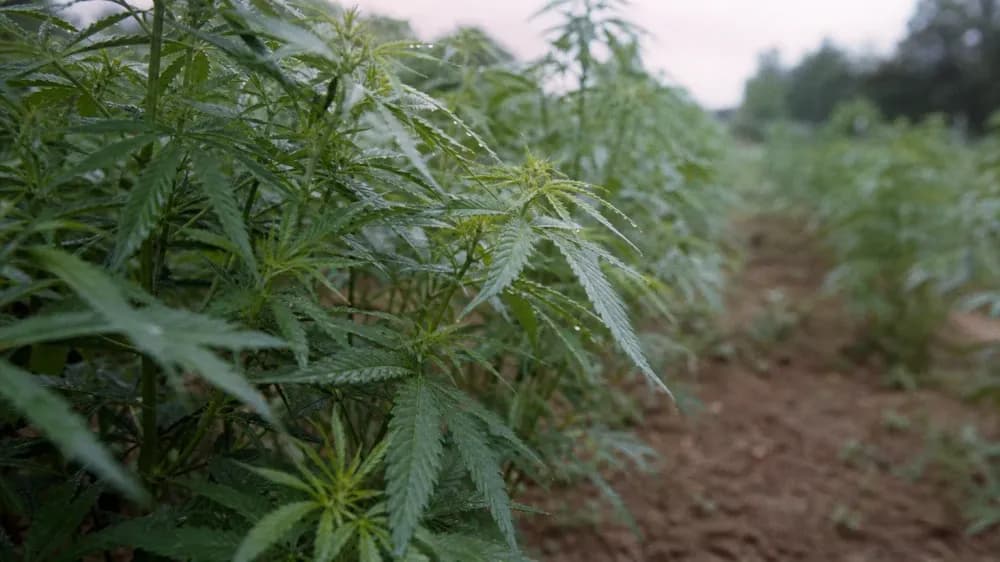
The plant does not do this. Cannabis builds its cannabinoids in acid form, and heat drives off carbon dioxide to give the neutral forms, which is how THCA becomes THC. Nothing in that pathway attaches an acetate group. DEA put the same point in one sentence in a letter dated February 13, 2023, quoted further down this page: delta-9-THCO and delta-8-THCO "do not occur naturally in the cannabis plant and can only be obtained synthetically." Whatever you make of the legal argument built on top of that sentence, the chemistry half of it is not in dispute. It is also worth saying plainly here, since we are about to spend several thousand words on an intoxicant: Planntz sells CBD tinctures and no THC-O, no delta-8 and no HHC. We have nothing to sell you at the end of this page.
| Molecule | Formula | Molecular weight (g/mol) | What it is on this page |
|---|---|---|---|
| Delta-9-THC | C21H30O2 | 314.5 | The parent. Its systematic name on PubChem CID 16078 ends in -1-ol, the free phenolic OH group |
| THC-O-acetate | C23H32O3 | 356.5 | The same molecule with that OH capped as an acetate ester. The name on PubChem CID 198013 ends in -1-yl acetate |
| Ketene (ethenone) | C2H2O | 42.04 | What the cap becomes when it is heated hard enough. PubChem CID 10038 |
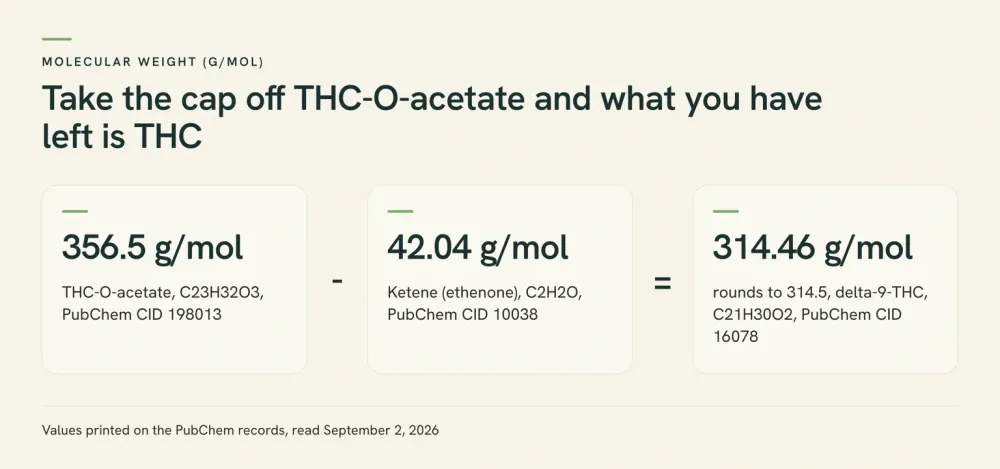
Hold on to that third row, because ketene is where this article ends up. For now the useful thing is the arithmetic sitting in the middle column, and you can check it on a calculator: 356.5 minus 42.04 is 314.46, which rounds to the 314.5 on the delta-9-THC record. Take the cap off THC-O-acetate and what you have left is THC. That subtraction happens two different ways, with two very different byproducts, and most of this page is about the difference between them.
What THC-O is made from, and what the reagent is
The reagent that attaches the acetate group is acetic anhydride. That is the only part of the process this page will name, and we are naming it because the reagent's regulatory status is a fact about THC-O that no consumer page seems to mention. Acetic anhydride is a DEA List II regulated chemical. You can read the entry yourself at 21 CFR 1310.02(b)(1), where it is the first item on the List II table, carrying DEA chemical code 8519. The same section sets its reporting thresholds: 250 gallons or 1,023 kilograms for imports, exports and domestic sales.
Read that precisely, because "regulated chemical" is easy to over-read in both directions. List II status means transactions above those thresholds get reported to DEA. It does not make the reagent contraband, it is an ordinary industrial chemical used for many things that have nothing to do with cannabinoids, and it says nothing at all about the legal status of any finished product. What it does tell you is the category the molecule belongs to. THC-O is not extracted from anything. It is manufactured, and a listed chemical is part of the manufacture.
There is a second, stranger consequence of the same fact, and it comes from a forensic laboratory rather than a regulator. When researchers at Virginia Commonwealth University analyzed four commercial products labeled as delta-8-THC or THC acetate, they found delta-8-THC, delta-8-THC-O-acetate, delta-9-THC-O-acetate and CBD di-O-acetate in them. To identify those compounds they had to build their own comparison standards: primary reference materials were not available for delta-8-THC-O-acetate, delta-10-THC-O-acetate or cannabidiol diacetate, so the team prepared standards by derivatizing delta-8-THC, delta-9-THC, delta-10-THC and CBD with acetic anhydride. Read that again. In 2022, an accredited laboratory had to synthesize its own reference material, with the same reagent that makes the products, in order to name what was in them. The same paper states that "minimal clinical/pharmacological data is available for these emerging synthetic cannabinoids." That is four products in one laboratory, not a market survey. Presence is not prevalence.
Nothing happens until your body takes the acetate back off
A prodrug is a molecule that is inactive until the body converts it into something else. That is the best-supported description of THC-O, and the evidence for it is recent. In a 2025 study in Forensic Toxicology, researchers incubated acetylated cannabinoids with pooled human liver microsomes and recombinant human enzymes and watched the acetate come off. The acetylated form hydrolyzed time-dependently, with almost no acetylated product remaining after 60 minutes, and only the deacetylated form present once hydrolysis was complete. The enzymes doing the work were carboxylesterases, CES1c and CES2, and the reaction was blocked by the esterase inhibitor BNPP, which is how the authors knew it was the esterases doing it.
Two limits matter as much as the finding. First, this is human tissue in a tube, not a person. No human pharmacokinetic study of THC-O exists, and the authors chose their verb carefully: their conclusion is that the work "provides scientific support for the metabolism of newly regulated acetylated cannabinoids to cause the parent compound in vivo." Supports is not shows. Second, and this is the sentence most pages get wrong: 60 minutes in a microsome incubation is not an onset time for a human being. It is how long an enzyme mixture took to finish a reaction in a controlled experiment. Do not carry that number into your evening, or into anyone's advice.
What people report is consistent with a prodrug, and it is worth being exact about how thin that evidence is. A 2023 content analysis in the journal Cannabis coded 3,437 Reddit posts from 974 unique members of a THC-O discussion community, posted between June and November 2021. "Lengthy onset" was coded in 53 posts, 1.5% of the corpus and 10.2% of the posts about effects. "Lack of any effects" appeared in 95, "lengthy duration" in 39. A handful of posts, three of them, describe taking more before the first amount arrived. Three posts is not a harm pattern, an incidence or a rate, and nobody should report it as one. It is three posts in a self-selected forum over six months of 2021, and it is what the record contains.
The only published human case report of THC-O describes one person. Clinicians writing in Neuropsychopharmacology Reports described an 18-year-old man with no psychiatric history who had a sudden panic attack about 20 minutes after his first inhalation of THC-O from an e-cigarette device; it lasted about two hours and did not recur over six months of follow-up. One case cannot establish that THC-O causes panic attacks, and it cannot establish that it does not. One further consequence of the prodrug step is worth a line here, because it is the question everybody asks next: since the acetate comes off and leaves ordinary THC, the metabolites a confirmation test looks for are the familiar ones, while the screening step is a separate question with its own numbers. In a 2022 cross-reactivity study using a THC direct ELISA in whole blood, THC-O-acetate cross-reacted at 3% against 200% for delta-8-carboxy-THC. That was a forensic blood kit, not a workplace urine screen. Our THCP page publishes that figure alongside the rest of the cross-reactivity panel, and our walk-through of how a screen differs from a confirmation explains the two-step process better than we could repeat here.

Where three times stronger and psychedelic came from
Two claims sell THC-O, and neither one has a measurement behind it. The National Capital Poison Center, a poison center staffed by clinical toxicologists, wrote both claims down and then answered them in a consumer article we read on September 2, 2026. The page states that "online sellers of THC-O-acetate claim that it is 3 times more potent than delta-9-tetrahydrocannabinol" and that it also has psychedelic actions. Then, in a separate sentence, it answers them.
“The few published studies that have looked at its effects have not produced results that would support either of these claims.”
One study has tested the psychedelic half directly. In 2024, in the Journal of Psychoactive Drugs, a research group surveyed THC-O-acetate consumers recruited through an online user forum and put them through the Mystical Experience Questionnaire, the instrument used in psilocybin research. Participants reported few visuals or hallucinations. Their responses fell significantly below the threshold for a complete mystical experience on all four MEQ dimensions. 79% said that using THC-O-acetate is "not at all" or "a little" of a psychedelic experience, and participants who had used classic psychedelics rated it lower than those who had not. The authors note that some reports of psychedelic experiences may be due to expectations or contaminants. The paper's own title is the finding: scarce evidence for a psychedelic cannabinoid.
That study has real limits and we are not going to hide them. It is an online survey of people who found it through a forum, so the sample selects itself, and every answer is self-reported. The full text is paywalled and the sample size is not in the openly available record, so we are not going to print an n we cannot verify. What is fair to say is narrow and still useful: it is the only study that has tested the claim at all, and it did not support it.
The potency half has no study at all. Not a negative result, not a small result: nothing. Our dated literature search, printed later on this page, returns no clinical trial of THC-O of any kind, and we found no controlled human comparison of THC-O with delta-9-THC in the published record we searched. That is what "three times stronger" is resting on. Notice what we are not doing here, because it matters: we are not offering a corrected multiplier, a smaller number, or a ranking in the other direction. A made-up smaller figure would be exactly as unsupported as the made-up bigger one, and it would travel just as far.
The hazard that belongs to this molecule and to no other cannabinoid: heat
Esters do something specific when they get hot enough. They can eliminate the acetate group as ketene, also called ethenone, a small and very reactive gas. This is the part of the THC-O story that is chemistry rather than opinion, and it was missing from every consumer page we read on the first screen of Google.
In 2022, a group publishing in Chemical Research in Toxicology vaped cannabinoid acetates on the bench and looked for ketene in the condensate. They found it consistently, in all three cannabinoid acetates they tested (delta-8-THC acetate, CBN acetate and CBD acetate) and in a commercial delta-8-THC acetate product they bought online. That was a bench experiment under laboratory vaping conditions. It measured what came off a device, not what went into a person, and it did not report anybody's exposure.
In June 2026, a group in the Department of Environmental Toxicology at UC Davis ran the controlled version, and it settles what the older bench work could only suggest. They vaped five O-acetylated cannabinoids and, crucially, their paired non-acetylated analogues in a commercial cannabis e-cigarette, then measured the products by mass spectrometry. Their result sentence is the whole argument: "The acetyl group decomposed into ketene during vaping with nearly quantitative efficiency (>99%)." And the control group came back empty: "no ketene was observed in the unvaped distillates" or during vaping of the non-acetylated analogues. Yields ran from 1% to 4% ketene by cannabinoid mass, and the authors' own interpretation is that vape users can be exposed to yields of toxicants that far exceed safety limits for pulmonary effects. Two things follow from the control group. The hazard belongs to the acetate group specifically, not to cannabinoids in general. And it is created by heat: it is not sitting in the unheated material waiting for anyone.
A third paper connects that chemistry to a real cartridge and to a number you can check yourself. In 2023, toxicologists writing in the Journal of Medical Toxicology analyzed a commercial THC-O vape cartridge and found its major component, about 84% of the material, consistent with THC-O-acetate, confirmed by saponification. When it was heated, they recorded "the ketene molecular weight (42 amu) loss from the molecular ion of 356 amu." Do that subtraction and you get 314. Now do it with the exact weights printed on the PubChem records in the table above: 356.5 minus 42.04 is 314.46, which rounds to 314.5, the molecular weight of delta-9-THC. Heating THC-O-acetate hands back THC and releases the cap as a gas. Your liver performs the same subtraction with an enzyme, at body temperature, and produces no gas at all. That contrast is why "is THC-O dangerous" has two different answers depending on what is being done to it.
Why the ketene result drew attention is the comparison in that paper's own title, which uses the words "Potential for Another EVALI Epidemic." Their calculations put the activation energy for ketene elimination at 63.7 kcal/mol for delta-8-THC-O-acetate, against a previously reported 65.9 kcal/mol for vitamin E acetate, the additive at the center of the 2019 to 2020 vaping lung-injury outbreak, and they describe ketene's toxicology as broadly equated to that of phosgene. Here is what that outbreak was, in CDC's own numbers, from its archived outbreak page: as of February 18, 2020, a total of 2,807 hospitalized EVALI cases or deaths had been reported to CDC from all 50 states, the District of Columbia and two US territories, and 68 deaths had been confirmed in 29 states and the District of Columbia.
Now the limits, and they are not decoration. CDC's own wording is that vitamin E acetate is "strongly linked" to the outbreak, not that it caused it, and in the same paragraph CDC writes that "evidence is not sufficient to rule out the contribution of other chemicals of concern." THC-O has never been linked to an outbreak of anything. The Journal of Medical Toxicology authors state their own limits just as plainly: "generation of ketene during experimental conditions does not guarantee production during actual use", and "only a few commercial products have been confirmed to contain THC-O." So the honest summary is narrow and still worth knowing: two different acetates release the same gas when they are heated hard, one of them is associated with a documented outbreak of lung injury, the other has been shown to release it on a bench with a proper control group, and nobody has measured what a person inhaling the second one is actually exposed to.
The gap between who is heating this material and who has heard any of the above is itself measurable. In a survey of THC-O consumers distributed through the same social media platform, 74.9% said they vaped it and 24.3% said they dabbed it, while 12.0% reported any concern about ketene risk. In the 3,437-post corpus described earlier, ketene risk was coded in 8 posts, 0.2% of the total. Both figures come from self-selected online samples with no verification of what anyone actually used. That survey also records the temperatures people say they use, and the 2026 bench paper reports how yields shift with device airflow. We are deliberately printing neither: a temperature or a setting turns a hazard explanation into a technique, and this page will not do that.
It is named inside the formula on our certificate and it is on none of the tests
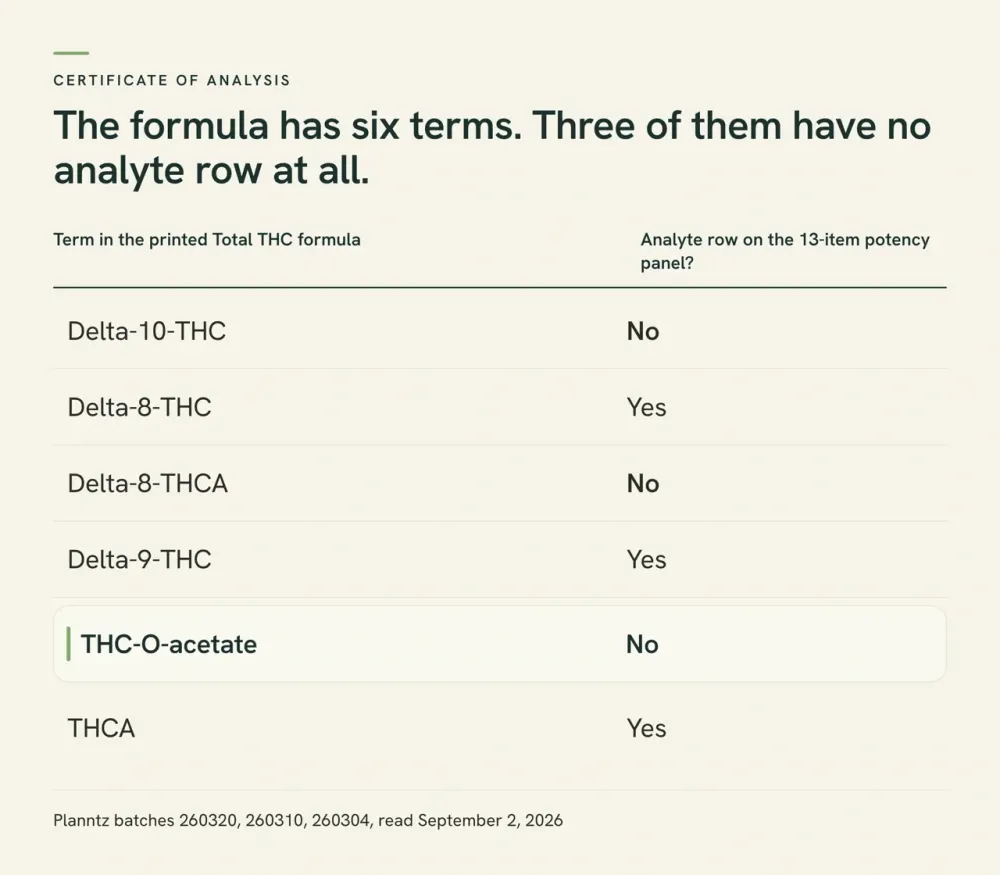
Here is where this stops being somebody else's molecule. Every Planntz certificate of analysis prints the same definition of Total THC at the head of the potency section, and THC-O-acetate is one of its terms. On the certificates for Broad Spectrum Mango & Peach batch 260320, Full Spectrum CBD Mango & Peach batch 260310 and Full Spectrum CBD+CBN Natural batch 260304, all read on September 2, 2026, that definition reads: Total THC = Delta-10-THC + Delta-8-THC + (Delta-8-THCA x 0.877) + Delta-9-THC + THC-O-acetate + (THCA x 0.877). The multiplication signs are written here as x. Every one of those three batch reports prints the identical formula.
Now count what the panel actually measures. The potency panel on those same certificates, run by Infinite Chemical Analysis Labs in San Diego by UHPLC-DAD, reports exactly 13 analytes: CBC, CBD, CBDA, CBDV, CBG, CBGA, CBL, CBN, CBT, delta-8-THC, delta-9-THC, THCA and THCV. The formula has six terms. Three of them have no analyte row at all.
| Term in the printed Total THC formula | Is there an analyte row for it on the 13-item potency panel? |
|---|---|
| Delta-10-THC | No |
| Delta-8-THC | Yes |
| Delta-8-THCA | No |
| Delta-9-THC | Yes |
| THC-O-acetate | No |
| THCA | Yes |
This is not an accusation about anybody's product, including ours, and it is important to say exactly what it does and does not mean. A targeted potency panel answers one question: how much of these specific named compounds is in this sample, measured against a purchased reference standard for each one. It is silent about everything it does not name, and silence is not a finding. The absence of a THC-O-acetate row is not evidence that THC-O-acetate is present, absent, or anything else. It means the laboratory did not test for it, which is the normal design of a hemp compliance panel, and there is a supply-chain reason as well as a regulatory one: as the Virginia Commonwealth team found, primary reference materials for several of these acetates were not available at all. What the table above does prove is a structural point most buyers have never been told, which is that a compound can sit inside the legal formula and outside every test on the report. If you want to learn to read one of these documents line by line, our guide to reading a certificate of analysis walks through the panel, the limits of detection and the batch number, and every Planntz batch report is public if you would like to check the formula and the analyte list against what we just wrote. Our page on HHC makes the neighbouring version of this argument for a cannabinoid that is not even a term in the formula.
The legal shape: a letter, a court that would not follow it, and a judge who thought the agency was right
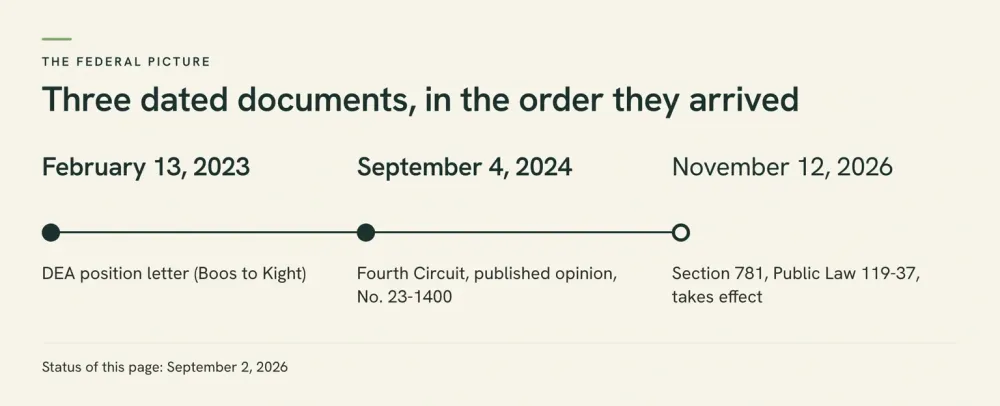
The document everybody is paraphrasing is a letter. On February 13, 2023, Terrence L. Boos, PhD, chief of DEA's Drug and Chemical Evaluation Section, replied to an attorney who had written to ask about delta-8-THC-O-acetate and delta-9-THC-O-acetate. DEA does not publish these letters; the copy we read is archived as a PDF by the Office of Research at Washington State University, and we read it on September 2, 2026. The operative passage runs two sentences.
“Delta-9-THCO and delta-8-THCO do not occur naturally in the cannabis plant and can only be obtained synthetically, and therefore do not fall under the definition of hemp. Delta-9-THCO and delta-8-THCO are tetrahydrocannabinols having similar chemical structures and pharmacological activities to those contained in the cannabis plant.”
The same letter assigns both compounds the DEA controlled substance code number 7370 with a conversion factor of 1.00. Be clear about what kind of object this is. It is an agency's answer to one lawyer's question, dated and signed, replying to a letter of August 17, 2022 and a follow-up email of February 7, 2023. It is not a rule. It went through no rulemaking, no comment period and no publication in the Federal Register, and it says nothing about whether any particular product is lawful for any particular person anywhere. We have written about exactly this distinction before: what a DEA position letter is worth is a recurring question in this corner of the market, and the answer does not change with the molecule.
Then a federal appeals court declined to treat that letter as settling the question. In a published opinion issued September 4, 2024 in Anderson v. Diamondback Investment Group, LLC, No. 23-1400, the US Court of Appeals for the Fourth Circuit wrote: "we reject Diamondback's contention that the DEA's interim final rule or letter mandates a finding that THC-O is illegal." The court's reasoning was that NIDA's and DEA's own definitions of "synthetic cannabinoid" describe compounds manufactured entirely out of synthetic materials, so the statute "is subject to this other reasonable (and, we think, better,) interpretation."
Three things stop that from being permission, and they belong in the same paragraph as the quotation. First, Anderson lost. The court said so itself: "Our ruling though is of no help to Anderson because she offered no evidence about the delta-9 THC concentrations of the purportedly lawful products she used such that we could determine whether those products were legal under state or federal law." Second, a judge on the same panel refused to join that section. Judge Richardson wrote that he was pleased to join all but that part of the majority opinion, that "there is some reason to think the DEA has the better of this debate", and that "whether synthetic derivatives like THC-O count as excepted hemp is a difficult question" he would leave for another day. Third, it is an employment case, in one circuit, construing the pre-2026 statute, and the holding on this point is narrow: that the agency's rule and letter do not mandate a finding of illegality, which is not the same thing as a finding that any product on any shelf is lawful. Read together, the honest description of the federal picture is this: the agency's stated position is that these are schedule I tetrahydrocannabinols, one appellate court has declined to treat that position as controlling, a judge on that same court thought the agency was probably right, and not one of those three is a green light.
For background, DEA's general position that chemical conversion makes a tetrahydrocannabinol synthetic goes back to its 2020 interim final rule implementing the 2018 Farm Bill, at 85 FR 51639, which states that all synthetically derived tetrahydrocannabinols remain schedule I controlled substances. The Ninth Circuit read the 2018 statutory text the other way for delta-8 in AK Futures LLC v. Boyd Street Distro, and our delta-8 explainer covers that case and the isomerisation chemistry behind it. Notice the difference, because it is the cleanest distinction in this whole family of compounds: the delta-8 argument is genuinely contested, since delta-8 occurs in the plant in trace amounts, while THC-O does not occur in it at all. One more federal date is on the calendar. Section 781 of Public Law 119-37, enacted November 12, 2025, takes effect 365 days later, on November 12, 2026, and rewrites the federal definition of hemp. Among the things it excludes from that definition are hemp-derived cannabinoid products containing cannabinoids "not capable of being naturally produced by a Cannabis sativa L. plant"; our page on that law covers it in detail. And if you would rather check a cannabinoid's federal status yourself than take anybody's word for it, we published the five-minute procedure for doing exactly that.
What is actually known about THC-O, in counts
It is worth seeing how small this literature is in numbers rather than adjectives. On September 2, 2026 we searched PubMed for the exact phrase "THC-O acetate" and got 6 records. Widening to the union of four spellings, "THC-O-acetate" or "THC-O acetate" or "tetrahydrocannabinol-O-acetate" or "tetrahydrocannabinol acetate", returned 13 records, and we resolved all 13 by title. Of those 13, 7 carry the humans MeSH tag, 0 are tagged as clinical trials and 0 as randomized controlled trials. The same search run the same day for cannabidiol returned 9,044 records. Two caveats travel with those numbers. They are keyword searches rather than MeSH-controlled ones, so they are a floor and not a census. And at least two clearly on-topic papers sit outside that phrase set because of spelling, including the forensic product analysis and the journal letter already cited above.
US poison centers have a code for it, and the counts are dominated by something else. A retrospective analysis of the National Poison Data System covering January 1, 2021 to December 31, 2022 found 5,022 cases with delta-8, delta-10 or THC-O acetate as the primary substance, with the rate per 100,000 population rising 89.1%, and delta-8 accounted for 98.1% of them. That is not a THC-O number and it must never be quoted as one. Our delta-8 article publishes that stat block in full, with the age distribution and the outcome severity. Separately, the National Capital Poison Center article cited earlier describes an October 2021 episode in Oklahoma: the state medical marijuana authority saw increased reports of dangerous effects, including difficulty speaking, vomiting and seizures, and testing of one medical marijuana product, "Platinum OG Sugar", revealed the presence of THC-O-acetate. That is a contamination report. It carries no case count, no denominator and no causal attribution, and it is a reason products get tested rather than a measurement of what THC-O does.
Outside the US, it is turning up in seized material at a rate worth noticing. Researchers who profiled 151 cannabis-derived products seized in Northern Italy in 2024 and 2025 found semi-synthetic cannabinoids above the limit of quantification in 93% of them, and delta-9-THC-O-acetate was the most frequently identified semi-synthetic cannabinoid, in 85%, ahead of THCP at 61% and delta-8-THC at 18%. Seized material is selected by law enforcement, so this is not a market prevalence estimate and it is not a description of a US shelf. What it is evidence of is that the molecule circulates inside products where it is not necessarily declared.
One widely repeated fact does not survive checking, and it is worth correcting here because it is the answer people reach for when they ask whether any of this is new. The story in circulation is that the US Army studied THC-O acetate as EA-2233 in the Edgewood Arsenal program. The National Library of Medicine's own controlled-vocabulary record for that code, supplementary concept C043813, identifies EA-2233 as the acetate ester of dimethylheptylpyran, CAS 39624-99-2: a different synthetic cannabinoid, whose side chain is a branched seven-carbon chain rather than THC's straight five-carbon pentyl. So the military did study a cannabinoid acetate ester as an incapacitating agent, and it was not this one. We found no primary Army or Veterans Affairs document identifying THC-O-acetate itself as EA-2233, and we are not going to repeat the anecdotes that usually travel with the claim.
- Anything containing THC of any kind belongs where children cannot reach it. In the poison center series above, 30.1% of the 5,022 cases were children under 6, with a mode at age 2, and 94.2% of exposures were ingestions.
- Unexplained breathing symptoms after inhaling any product are a reason to seek medical care, not to wait and see. In the US, Poison Control is 1-800-222-1222, free and confidential, 24 hours a day.
- A product being on a shelf is not a legal finding, and a seller's confidence is not a document. The named documents in the previous section are what actually exists on this question.
- A certificate that does not list a compound has not cleared it. Check which analytes the panel actually reports before reading anything into a Total THC line, on any brand's report.
- Labels and contents are not the same thing. In the one forensic analysis of four of these products, items sold as one cannabinoid contained several, including acetates the label did not name.
The honest answer has the shape of the documents rather than the shape of a verdict. DEA's stated position, in a letter dated February 13, 2023, is that delta-8-THCO and delta-9-THCO are tetrahydrocannabinols that do not occur naturally in the cannabis plant and can only be obtained synthetically, and therefore do not fall under the definition of hemp. That was a letter answering one lawyer's question, not a rule that went through rulemaking. In a published opinion of September 4, 2024, the US Court of Appeals for the Fourth Circuit declined to treat that letter as mandating a finding that THC-O is illegal, and a judge on the same panel wrote separately that there is some reason to think DEA has the better of the debate. The plaintiff in that case still lost her appeal. State law is a separate layer this page does not cover, and the federal definition of hemp changes on November 12, 2026. We are not going to write that THC-O is legal or that it is illegal, and none of this is legal advice.
It depends on which test and which step. A cannabinoid immunoassay is an antibody calibrated to a THC metabolite, and different molecules trigger it to very different degrees. In one 2022 cross-reactivity study using a THC direct ELISA in whole blood, THC-O-acetate cross-reacted at 3%, against 200% for delta-8-carboxy-THC. That was a forensic blood kit in a laboratory, not a workplace urine screen, and one kit in one matrix does not describe every test. The confirmation step is a different question again: because the body cleaves the acetate and leaves ordinary THC behind, the metabolites a confirmation looks for are the familiar ones rather than exotic ones. No product and no article can guarantee a drug-test result.
It is not made by the plant. It is made in a reaction, from a cannabinoid the plant does make, by attaching an acetate group using acetic anhydride. That distinction is the hinge of the entire legal argument, and it is cleaner here than anywhere else in this family of compounds: the fight over delta-8 is genuinely contested because delta-8 occurs in cannabis in trace amounts, while THC-O is not produced by the plant at all. DEA's February 2023 letter turns on exactly that sentence.
The one study that tested the claim did not support it. Surveying THC-O-acetate consumers recruited through an online forum with the Mystical Experience Questionnaire, researchers reported few visuals or hallucinations, responses significantly below the threshold for a complete mystical experience on all four MEQ dimensions, and 79% of participants saying it was not at all or a little of a psychedelic experience. Participants who had used classic psychedelics rated it lower than those who had not. The authors note that some reports of psychedelic experiences may be due to expectations or contaminants. It is one self-selected online survey, published in 2024, and it is also the entire evidence base on the question.
Nobody has measured that. The claim circulates on seller pages; the National Capital Poison Center answers it directly, writing that the few published studies that have looked at THC-O's effects have not produced results that would support either the potency claim or the psychedelic claim. Our own dated PubMed search on September 2, 2026 found no clinical trial of THC-O of any kind, and we found no controlled human comparison of THC-O with delta-9-THC in the published record we searched. We are not going to offer a replacement number or a ranking in the other direction, because an invented smaller multiplier would be exactly as unsupported as the invented bigger one.
This one is worth correcting, because the story is everywhere. The version in circulation is that the Army studied THC-O acetate as EA-2233 in the Edgewood Arsenal program. The National Library of Medicine's own controlled-vocabulary record for EA-2233, supplementary concept C043813, identifies it as the acetate ester of dimethylheptylpyran, CAS 39624-99-2, which is a different synthetic cannabinoid: its side chain is a branched seven-carbon chain, where THC's is a straight five-carbon pentyl. So the military did study a cannabinoid acetate ester as an incapacitating agent, and it was not this molecule. We found no primary Army or Veterans Affairs document identifying THC-O-acetate itself as EA-2233.
No. Planntz sells CBD tinctures, and we do not sell THC-O, delta-8 or HHC. THC-O appears in our world in exactly one place: as a term inside the Total THC formula our laboratory prints at the head of every certificate of analysis, which is the reason this page exists at all. Our batch reports are public, and the potency panel on them reports 13 named analytes, none of which is THC-O-acetate.
If you arrived here from a legal question rather than a chemistry one, the parent page for all of this is our guide to what federal law actually says about CBD and hemp, which sets out the definitions the arguments above are fighting over. And if you would rather have the method than the answer, the step-by-step way to check a cannabinoid's federal status yourself takes about five minutes and will outlast this page, which is the point of publishing it.
Writing about hemp, wellness and the small rituals that keep us balanced.