THCA vs CBD: Two Different Molecules and One Legal Deadline
THCA is the acid form of delta-9 THC, not a form of CBD, and heat is the difference. This page opens the federal documents the sellers cite: what USDA's rule measures, where the agency says its own rule stops, and what changes on November 12, 2026.
THCA and CBD get compared as though they were two grades of the same thing. They are not. One is the acid form of delta-9 THC, the compound a federal regulation calls the intoxicating component of cannabis. The other is cannabidiol, a separate molecule with its own acid form and no path to becoming anything intoxicating. The reason the comparison keeps coming up is not chemistry. It is a legal argument about which federal document gets applied to what, and that argument has a date on it.
Here is the short version. THCA is tetrahydrocannabinolic acid, the form the living plant mostly makes, and heat removes a carboxyl group and turns it into delta-9 THC. CBD is cannabidiol, a different molecule whose own acid form is CBDA, and heating CBD gives you CBD. A federal agency has described THCA in the Federal Register as non-psychoactive, and THCA is also the direct precursor of the compound that is psychoactive, which is why the honest answer to "does THCA get you high" is a question about a product rather than about a molecule. On the law, as of August 8, 2026: the statute in force measures delta-9 THC, USDA's crop regulation measures total THC and counts THCA in, and a new federal definition that names tetrahydrocannabinolic acid in its own text takes effect on November 12, 2026. None of what follows is legal advice. If you want the consumer side of the legal question, our guide to where CBD stands legally covers possession, travel and the state layer.
THCA and CBD are not two versions of the same molecule
Start with the atoms, because that is where most of the confusion ends. Tetrahydrocannabinolic acid is C22H30O4, with a molecular weight of 358.5. Delta-9 THC is C21H30O2, molecular weight 314.5. Cannabidiol is also C21H30O2, molecular weight 314.5, which makes CBD and delta-9 THC isomers: the same atoms, in the same numbers, arranged differently. CBD has its own acid form, cannabidiolic acid, usually written CBDA. So THCA is not a form of CBD, does not convert into CBD, and CBD does not convert into it. If you want the molecule-against-molecule comparison of CBD and delta-9 THC, that is a separate page and it goes deeper than this one will.
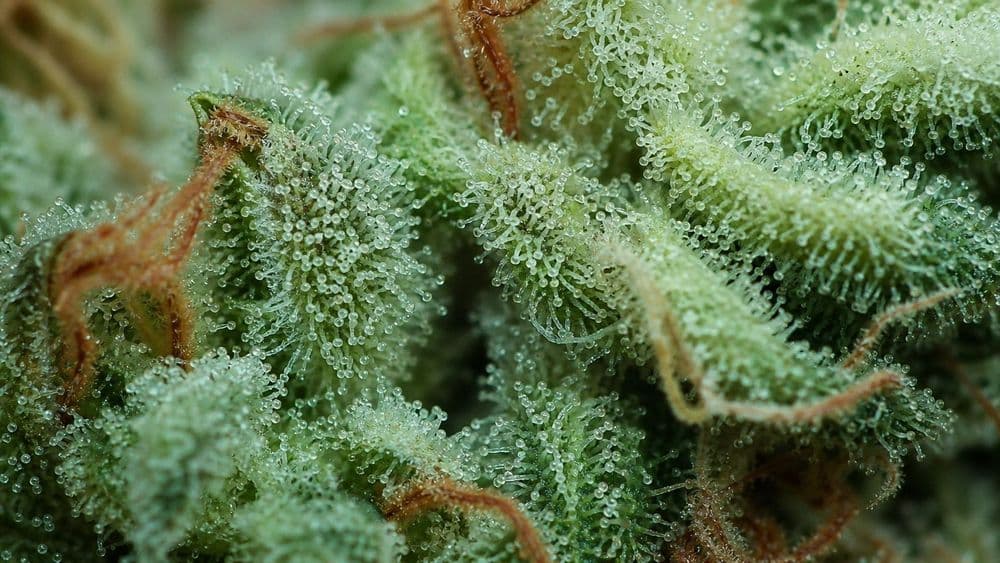
Most of what a living cannabis plant makes is the acid, not the neutral compound. A 2016 critical review in Cannabis and Cannabinoid Research describes THCA accumulating in the glandular trichomes on flowers and leaves, where it can represent up to 90 percent of the total THC contained in the plant. That figure is one narrative review's characterization rather than a survey of today's market, and it should be read that way. It is still the reason a flower can be advertised by its THCA number, and the reason the acid gets its own line on a laboratory potency panel. Cannabinoids in general arrive from the plant as acids, and our overview of the cannabinoid family treats that class as a whole.
| Compound | Formula and molecular weight | Acid or neutral | What heat does to it | Its row on a potency panel |
|---|---|---|---|---|
| THCA (tetrahydrocannabinolic acid) | C22H30O4, 358.5 | Acid | Loses carbon dioxide and becomes delta-9 THC | Listed separately from delta-9 THC |
| Delta-9 THC | C21H30O2, 314.5 | Neutral | Already the neutral form | The row the 0.3 percent conversation is about |
| CBD (cannabidiol) | C21H30O2, 314.5 | Neutral | Already the neutral form | Usually the largest number on the panel |
| CBDA (cannabidiolic acid) | The acid form of CBD, not of THC | Acid | Loses carbon dioxide and becomes CBD | A separate row on a full panel |
Decarboxylation is the conversion, and the rulebook defines it
Federal regulation does not leave decarboxylation to interpretation. USDA's hemp rule at 7 CFR 990.1 defines it in one sentence: "Decarboxylated. The completion of the chemical reaction that converts THC-acid (THCA) into delta-9 THC, the intoxicating component of cannabis." That is a federal agency, in a binding regulation, stating both halves at once: THCA becomes delta-9 THC, and delta-9 THC is the part that intoxicates. That is a definition, and this article quotes it as one: there are no temperatures, times, methods or equipment anywhere on this page.
The arithmetic underneath the conversion is small and exact. THCA weighs 358.5 and delta-9 THC weighs 314.5, and the 44 mass units of difference are one molecule of carbon dioxide leaving. Divide 314.5 by 358.5 and you get 0.877, which is exactly the ratio of the two molecular weights and exactly the coefficient the regulation uses. USDA's rule computes Total THC = (0.877 x THCA) + THC, which is why a flower advertised at 20 percent THCA computes to roughly 17.5 percent total THC, about fifty-eight times the 0.3 percent line. We work that formula through in full on hemp vs marijuana, including a sample calculation, and it does not get re-derived here.
Conversion is also not a switch that flips. In a 2023 forensic-chemistry paper testing the UN Office on Drugs and Crime's laboratory decarboxylation condition, THCA converted to delta-9 THC at 83.2 percent, and the authors note that even with an additive intended to help, the reaction did not reach 100 percent. Two other conditions in the same paper produced 10.1 percent and 53.4 percent. Those are vials in a controlled assay built for forensic quantitation, not a description of anything a person does. The reason it matters here is narrow and useful: because the conversion is partial, the intact acid can still be measured in people who have used cannabis, which comes back at the end of this article.
"Non-psychoactive" is true about the molecule and incomplete about the product
Writing in the Federal Register on January 16, 2025, in a rule updating the analytes on the federal workplace drug-testing panel, the Department of Health and Human Services described delta-9 tetrahydrocannabinolic acid as "a non-psychoactive cannabinoid in the cannabis plant" and as "an important precursor integral to the growth, definition, and production of legal hemp". That is a federal agency saying it plainly, though it is worth holding at its real weight: an aside inside a drug-testing rule, not a pharmacology determination. It is true of the molecule as it sits in the plant. It is also true, in the same breath, that THCA converts to delta-9 THC when it is heated, which is exactly what USDA's regulation says decarboxylation is. Both sentences describe the same compound. Which one is the relevant sentence depends entirely on what happens to the material after somebody buys it.
So "is THCA psychoactive" is a question about a product rather than about a molecule, and a page that prints only the first of those two sentences is doing work it does not show. If you want intoxication handled as its own subject, including what people actually mean by the word, that lives on does CBD get you high.
The asymmetry has been measured. A 2025 study in the Journal of Psychoactive Drugs read the product descriptions on the twenty most-trafficked online retailers of hemp-derived intoxicating products and found that every compound on offer was described as psychoactive or intoxicating except two, one of which was THCA. A related 2024 assessment in Cannabis and Cannabinoid Research catalogued 804 products across three of the most-trafficked US retail sites and counted 26 distinct intoxicating compounds, with 54 percent of the products blending between two and eight of them in a single item. Both are snapshots of a handful of websites in May 2023, and neither is a market share. What they do show is that THCA sits on a long menu of compounds sold for their effect, and it is one of the two whose page says it has none.
What THCA does at cannabinoid receptors, and what nobody has shown
Read on August 8, 2026, page one of this search says, almost word for word, that THCA cannot directly interact with CB1 and CB2 receptors because of its carboxyl group. The first half of that sentence is contradicted by the primary literature. In a 2020 study in Scientific Reports, THCA partially displaced a reference ligand at both human CB1 and CB2 receptors expressed in cell lines, with a CB1 binding estimate of about 620 nanomolar (95 percent confidence interval 180 to 970) against delta-9 THC's 36 nanomolar (17 to 62) in the same assay. On those two point estimates that is roughly seventeen-fold weaker, which is a long way from absent. The authors also describe it as a weak partial agonist at CB1 in a downstream signaling measure. That is binding, in a dish. It is not intoxication, in a person.
Two other laboratories reached the same starting point by different routes. A 2020 paper in the British Journal of Pharmacology reported that THCA can act as an agonist at the CB1 receptor's orthosteric site and, in the presence of another cannabinoid, as a positive allosteric modulator. A 2021 paper in Pharmacological Research measured binding at CB1 and CB2 in living cells using a homogeneous assay and reported differential bias in the signaling. All three are cell systems, and two of them also used mice. None of them is a human being, and none of them says THCA is intoxicating. The point is narrower and more interesting than the SERP's version: the popular explanation is not just unsupported, it is pointed the wrong way.
The carboxyl group does matter, but not for the reason the sentence gives. The 2016 review quoted earlier raises the idea in the context of whether the molecule gets into the brain, not whether it fits a receptor: adding a polar group such as a carboxyl to a molecule handled by the efflux transporters that guard the blood-brain barrier "markedly decreases CNS penetration, which could be the case for THCA-A". Read the hedge, because it is the author's own. The same review states that THCA's ability to bind cannabinoid receptors "remains controversial", and that its ability to access the brain after systemic administration "remains unknown". That framing, hedged twice by its own author, is the honest place to leave the question, and it is a better answer than the confident version because it tells you which part is still open.
- Established, in cell lines: THCA binds both cannabinoid receptors and produces measurable signaling, with a weaker CB1 binding estimate than delta-9 THC in the same assay.
- A published hypothesis, hedged by its own author: a polar group such as a carboxyl may reduce how much of the molecule crosses into the central nervous system.
- Unknown: whether THCA reaches the human brain after systemic administration, which the 2016 review says plainly remains unknown.
- Not supported by any of the papers above: the claim that the carboxyl group prevents THCA from binding CB1 or CB2 at all.
Which federal document gets applied to what
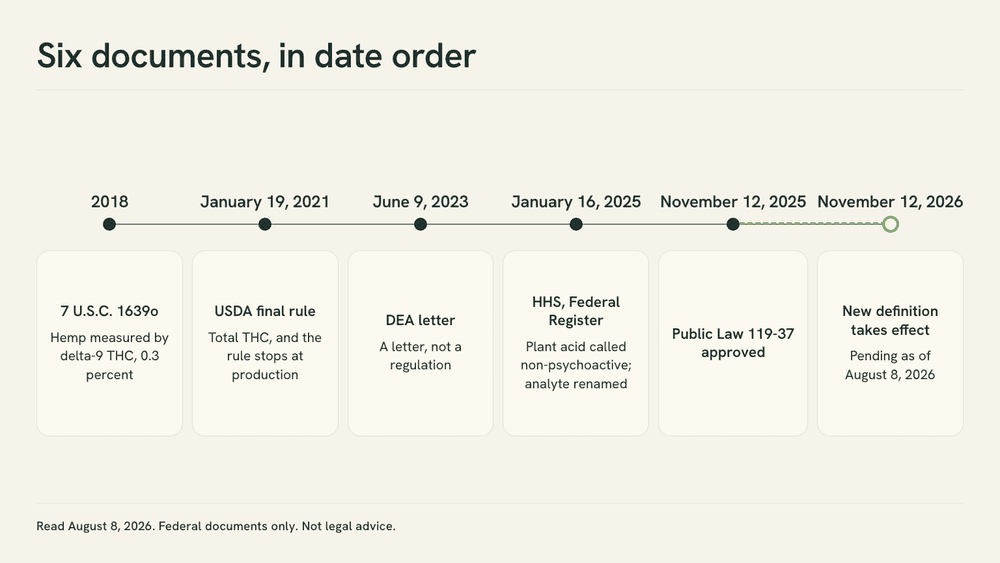
The statute in force as of August 8, 2026 is 7 U.S.C. 1639o. It defines hemp as the plant and "any part of that plant, including the seeds thereof and all derivatives, extracts, cannabinoids, isomers, acids, salts, and salts of isomers, whether growing or not, with a delta-9 tetrahydrocannabinol concentration of not more than 0.3 percent on a dry weight basis". Two things in that sentence are worth pausing on. The word "acids" is in the list of things the definition covers. And the measure is "a delta-9 tetrahydrocannabinol concentration". The word "total" is not in it. That absence is what the entire online argument for the category is built on.
The same statute does not leave the test method open, though. It requires every state and tribal hemp plan to include "a procedure for testing, using post-decarboxylation or other similarly reliable methods, delta-9 tetrahydrocannabinol concentration levels", and the identical command appears again for the USDA plan. Now read the object of that verb. What gets tested is "hemp produced in" the state or the territory of the Indian tribe. Congress ordered a post-decarboxylation test, which is a test that counts the acid, and it ordered that test on the crop.
Put USDA's regulation beside the statute and one word is different. 7 CFR 990.1 defines hemp as the plant "with a total delta-9 tetrahydrocannabinol concentration of not more than 0.3 percent on a dry weight basis". Congress wrote "a delta-9 tetrahydrocannabinol concentration". The agency implementing that sentence wrote "a total delta-9 tetrahydrocannabinol concentration". One word, and it is the word the whole THCA category turns on. The same body of rulemaking also records where the 0.3 percent figure came from, which is not a neutral footnote: USDA writes that in the original research the threshold "is based on total available delta-9 THC, which is the sum of THCA and delta-9 THC in the plant material".
USDA says why it wrote that word, and then says where its rule stops. In the 2021 final rule establishing the domestic hemp production program, the Agricultural Marketing Service wrote that it is "requiring that the total THC, which includes the potential conversion of tetrahydrocannabinolic acid (THCA) into THC, be reported and used for purposes of determining the THC content of a hemp sample", and, after extensive comment against it, that "AMS is retaining this requirement". Then, in the same document, answering different commenters, the agency wrote that "the IFR and this final rule do not cover hemp or its products beyond production", that the rule "does not cover cannabinoid products", and that it does not cover "processing or the licensing of processors". That part rarely gets quoted. The federal test that counts THCA is a rule about a crop in a field, sampled before harvest, and the agency that wrote it says in its own preamble that it was not written to reach a jar on a shelf. Those are comment responses in a preamble rather than regulatory text, and they are the agency's own description of the scope of its own rule.
| Document | What it measures | What it applies to | Status |
|---|---|---|---|
| 7 U.S.C. 1639o (2018 Farm Bill definition) | Delta-9 THC concentration, 0.3 percent dry weight | The plant and its parts, derivatives, extracts, cannabinoids, isomers, acids and salts | In force as of August 8, 2026; replaced November 12, 2026 |
| 7 U.S.C. 1639p and 1639q | Orders testing by post-decarboxylation or other similarly reliable methods | Hemp produced in a state or tribal territory | In force as of August 8, 2026 |
| 7 CFR 990.1 (USDA hemp rule) | Total delta-9 THC, 0.3 percent dry weight | USDA's hemp production program; AMS states the rule does not reach hemp or its products beyond production | In force as of August 8, 2026 |
| DEA letter, June 9, 2023 | Reads the statute as requiring that any delta-9 THCA be accounted for | One private inquiry about five named compounds; no force of law | A letter, not a regulation |
| P.L. 119-37 section 781 | Total tetrahydrocannabinols, including tetrahydrocannabinolic acid, 0.3 percent dry weight | The federal hemp definition, plus limits on finished products | Enacted; effective November 12, 2026 |
What DEA has said, and what a letter is worth
DEA has said where it stands, in a letter rather than in a rule. On June 9, 2023 the chief of the agency's Drug and Chemical Evaluation Section answered a private request about the control status of five compounds and wrote, in a signed three-page letter, that "cannabis-derived delta-9-THCA does not meet the definition of hemp under the CSA because upon conversion for identification purposes as required by Congress, it is equivalent to delta-9-THC". The reasoning is the statute in the section above: Congress said test post-decarboxylation, so, in the letter's words, "the delta-9-THC level must account for any delta-9-THCA in a substance".
Now the limits, which matter as much as the quotation. That document is a letter, not a regulation and not a Federal Register notice, and it carries no force of law. It answers one person's question about five named compounds, and it says nothing about whether any particular product is lawful anywhere for anyone. It is dated more than two years before the law it interprets was amended. And DEA does not publish these letters, so the copy we read is the signed scan archived by the UNC School of Government, three pages, read in full on August 8, 2026. With every one of those caveats attached, it is still the most direct statement of the agency's reading we were able to verify, and any page that tells you the federal position is settled in either direction is telling you more than the documents do.
A federal appeals court has touched the adjacent question. In January 2025 the Fourth Circuit held, in a published opinion, that the plaintiffs before it had not shown that federal law preempts a state standard defining hemp by total THC, a standard that state writes as the weight of tetrahydrocannabinol plus the weight of tetrahydrocannabinolic acid. That appeal came from the denial of a preliminary injunction, on the record then available, and what it decides is whether federal law blocks a state from writing its own rule. It is not a ruling about whether anything is legal where you live, and this article is not legal advice.
November 12, 2026
Public Law 119-37 was approved on November 12, 2025. Its section 781 opens "Effective 365 days after the enactment of this Act", which is November 12, 2026, and it replaces the federal hemp definition with one measured by "a total tetrahydrocannabinols concentration (including tetrahydrocannabinolic acid) of not more than 0.3 percent on a dry weight basis". The acid is named inside the text of the definition itself, which is the change that matters for this article. The same section also sets limits on finished products, a subject we keep on the page that owns the statutory definition rather than splitting it across two articles.
What that will mean in practice is not knowable from the text alone. The Congressional Research Service wrote in December 2025 that it remains unclear if and how federal law enforcement will enforce the new prohibitions when the new definition goes into effect, and that both FDA and DEA may lack the resources to enforce broadly. The change also reaches further than THCA: delta-8 THC sits in a similar position, made from hemp material and captured by a definition written around total tetrahydrocannabinols. As of August 8, 2026 all of this is a text on the books with a date attached, not a settled practice.
The THCA line on a certificate of analysis
Our own reports are a fair place to see what that line looks like, and since we sell no THCA product there is nothing here for us to flatter. On Full Spectrum CBD in Mango and Peach, batch 260310, the THCA row reads ND, with a limit of detection of 0.0654 mg/mL and a limit of quantitation of 0.196 mg/mL printed beside it. ND means the laboratory did not detect the compound above that limit. It does not mean the number is zero, and the printed limits are the whole reason that distinction is visible at all. The same report prints its own total-THC calculation, which multiplies the THCA figure by 0.877 before adding it in, which is why the acid row is there even on a product built around cannabidiol. Our batch reports are posted on our lab results page, and how to read a certificate of analysis walks through the rest of the panel.
- 1Find the THCA row. On a potency panel it is reported separately from delta-9 THC, and a report that lists only delta-9 has not told you what the acid row says.
- 2Find the delta-9 THC row, and note which units it is in: mg/mL, mg per package, a percentage, or all three. Reports disagree about which they lead with.
- 3Check whether the report prints its own total-THC calculation. Ours does, and it folds the THCA row into that total instead of reporting delta-9 on its own.
- 4Check whether every ND has a detection limit printed beside it. ND with no limit is a claim. ND with a limit is a measurement.
- 5Check the date and the batch number against the product in your hand. A report for a different batch is a report about a different product.
THCA and a workplace drug test
There is a second molecule abbreviated THCA, and it is the one a federal workplace panel is actually looking for. Until July 2025 the federal workplace drug-testing guidelines used THCA as the abbreviation for delta-9-tetrahydrocannabinol-9-carboxylic acid, a metabolite the body makes after delta-9 THC. HHS says so itself: the department "previously used the abbreviation THC for delta-9-tetrahydrocannabinol and THCA for delta-9-tetrahydrocannabinol-9-carboxylic acid", and that is the usage running through the 2017 edition of the guidelines. In the January 2025 rule quoted earlier, HHS renamed its own analyte to delta-9 THCC, stating that the new abbreviation distinguishes the marijuana metabolite from the non-psychoactive plant cannabinoid also commonly abbreviated THCA. Two different molecules, one abbreviation, in federal documents, and the panel is looking for the metabolite of the compound that heat produces from the other one.
The plant acid itself is not a marker of impairment. Because decarboxylation is only partial, the intact acid can be measured in people who have used cannabis, and in a 2014 analysis of 58 authentic samples from drivers, researchers reported no correlation between tetrahydrocannabinolic acid concentration and the degree of impairment recorded. Those are forensic driver samples handled in an analytical method paper, not consumers of any product category, and the useful conclusion is a modest one: the acid is evidence that plant material was involved, not evidence of how affected somebody was. What a panel measures, at what level, is a different subject, and it is what a drug test actually looks for rather than this page.
No, and they are not even in the same family. CBD is cannabidiol, a neutral cannabinoid whose own acid form is cannabidiolic acid, or CBDA. THCA is the acid form of delta-9 THC. Heat converts THCA into delta-9 THC. Heat applied to CBD gives you CBD. Nothing in the plant turns CBD into THCA, and THCA is not a version, grade or stronger form of CBD. They share a naming convention and almost nothing else.
Two things are true at once, and pages that quote only one of them are the reason this question keeps getting asked. Writing in the Federal Register on January 16, 2025, HHS described delta-9 tetrahydrocannabinolic acid as a non-psychoactive cannabinoid in the cannabis plant. THCA is also the direct precursor of delta-9 THC, and USDA's regulation defines decarboxylation as the reaction that converts THCA into delta-9 THC, which the same regulation calls the intoxicating component of cannabis. So a statement about the molecule at rest is not a statement about a product sold in a form that will be heated.
Because a potency panel reports the acid form and the neutral form of each cannabinoid on separate rows, and because the total-THC figure at the bottom of the report is computed from both. On the Planntz batches published as of August 8, 2026 the THCA row reads ND, with the laboratory's own limit of detection printed beside it. ND means the lab did not detect the compound above that limit. It does not mean the number is zero, and a report that prints ND without a detection limit has told you less than it appears to.
Start by noticing that two different molecules are abbreviated THCA. The one a federal workplace panel confirms is delta-9-tetrahydrocannabinol-9-carboxylic acid, the metabolite the body makes from delta-9 THC, and HHS renamed its own analyte in 2025 specifically so it would stop being confused with the plant acid. Heat converts the plant acid into delta-9 THC, and delta-9 THC is what produces that metabolite. What a panel measures, at what level and for how long is a separate subject with its own page, and no article and no product can promise you a test result.
That is not a question this article answers, and it is worth being careful with any page that answers it in one word. What can be said, as of August 8, 2026, is what the documents say. The federal statute in force measures delta-9 THC and orders the test run using post-decarboxylation or other similarly reliable methods, on hemp produced in a state. USDA's regulation measures total THC, and in the same rulemaking the agency wrote that the rule does not cover hemp or its products beyond production. DEA wrote in a June 2023 letter, which is not a regulation and carries no force of law, that cannabis-derived delta-9-THCA does not meet the CSA definition of hemp. And state law is a separate layer that varies and can be stricter. This is not legal advice.
Public Law 119-37 was approved on November 12, 2025. Its section 781 opens with the words Effective 365 days after the enactment of this Act, which is November 12, 2026, and it replaces the federal hemp definition with one measured by a total tetrahydrocannabinols concentration, including tetrahydrocannabinolic acid, of not more than 0.3 percent on a dry weight basis. The same section also adds limits on finished products. As of August 8, 2026 that is pending rather than settled: the Congressional Research Service wrote in December 2025 that it remains unclear if and how federal law enforcement will enforce the new prohibitions when the new definition goes into effect.
Writing about hemp, wellness and the small rituals that keep us balanced.