THCV vs CBD: What Ten Human Studies Measured, and What the Label Says
Tetrahydrocannabivarin is sold as the interesting minor cannabinoid, and its entire human record is ten clinical trials. Here is what each one measured, why the two isomers are different molecules, and what the THCV row prints on twelve batch certificates.
Tetrahydrocannabivarin, THCV, gets sold as the interesting minor cannabinoid, described as if it sits somewhere between CBD and THC. Chemically it does not sit between them at all. It is built on the THC scaffold, and the entire human record behind it is ten clinical trials.
Here is the short version, before the detail. THCV and CBD are not two versions of the same idea: THCV's systematic name differs from delta-9 THC's by one word, while cannabidiol's differs by a whole ring. In cell assays the two molecules sit at opposite ends of the CB1 receptor, thousands of nanomolar apart. In people, almost nothing has been measured. Searched on August 30, 2026, PubMed returns 9,039 records naming cannabidiol and 195 naming tetrahydrocannabivarin, of which exactly ten are clinical trials, and only five of those ten actually gave THCV to a person. And on the twelve batch certificates we publish, the THCV row prints a number on three of them and reads non-detected on the other nine.
THCV vs CBD: read the two chemical names first
The fastest way to settle this comparison is to read the systematic names side by side, and you can do that yourself in the NIH chemical database. Tetrahydrocannabivarin, PubChem record CID 93147, is (6aR,10aR)-6,6,9-trimethyl-3-propyl-6a,7,8,10a-tetrahydrobenzo[c]chromen-1-ol. Delta-9 THC is that same name with one word changed: 3-pentyl instead of 3-propyl. Cannabidiol's entry ends somewhere else entirely, in benzene-1,3-diol, an open ring carrying two hydroxyl groups. THCV is built on the THC scaffold and CBD is not. That is a fact about atoms, and on its own it predicts nothing at all about how anything feels.
| Molecule | PubChem CID | Formula | Weight (g/mol) | Side chain | Core the name ends in |
|---|---|---|---|---|---|
| Tetrahydrocannabivarin (THCV) | 93147 | C19H26O2 | 286.4 | 3-propyl (3 carbons) | tetrahydrobenzo[c]chromen-1-ol |
| Delta-9 THC | 16078 | C21H30O2 | 314.5 | 3-pentyl (5 carbons) | tetrahydrobenzo[c]chromen-1-ol |
| Cannabidiol (CBD) | 644019 | C21H30O2 | 314.5 | 5-pentyl (5 carbons) | benzene-1,3-diol (open ring) |
| Cannabidivarin (CBDV) | 11601669 | C19H26O2 | 286.4 | 5-propyl (3 carbons) | benzene-1,3-diol (open ring) |
Read the table down the middle and the varin family gives itself away. THC is 314.5 g/mol and THCV is 286.4, a difference of 28.1 g/mol, which is two carbons and four hydrogens, roughly 8.9% of the molecule. Cannabidiol and cannabidivarin are separated by exactly the same amount, which is why the two carbons that separate CBDV from CBD are the best analogy for what THCV is to THC. One caution before anyone builds on that symmetry: the propyl-versus-pentyl chemistry people cite when they talk about shorter side chains was largely worked out on THC analogues, so it does not silently transfer to the CBD side of the plant. If you want the two majors instead, our comparison of CBD and THC molecule by molecule does that job, and the classes all of these fall into are the subject of our overview of what a cannabinoid is.
Delta-9 THCV and delta-8 THCV are not the same molecule
Before any claim about THCV can be evaluated, it has to say which isomer it means, and most claims do not. Delta-9 THCV and delta-8 THCV are two separate records in the same chemical database with two separate CAS registry numbers, 31262-37-0 and 31262-38-1. Both are C19H26O2 at 286.4 g/mol. Their systematic names differ by a single set of position numbers: 6a,7,8,10a for the delta-9 form and 6a,7,10,10a for the delta-8 form. That is the same class of difference that separates delta-8 THC from delta-9 THC, and here it matters for a very practical reason. Of the ten clinical-trial records counted further down this page, the only one that varied the dose of a THCV in people used the delta-8 isomer, while the molecule that appears on a hemp certificate of analysis is the delta-9 one. A trial run on one is not evidence about the other. The wider story of converted and isomerised cannabinoids sits in our comparison of delta-8 and CBD.
Where CBD and THCV sit at CB1 and CB2, in numbers
The most useful set of numbers in this whole comparison comes from a single paper. A 2015 systematic review and meta-analysis in the British Journal of Pharmacology collected the published binding and efficacy assays for cannabidiol and tetrahydrocannabivarin at the CB1 and CB2 receptors and averaged them. A Ki is a binding-affinity constant measured in nanomolar, and lower means tighter binding. Two things to hold before you read the table: every one of these figures comes from transfected cells or tissue membranes rather than from people, and the review's first author worked for GW Pharmaceuticals, the same company whose staff appear on the diabetes trial further down this page.
| Molecule | Receptor | Preparation | Pooled Ki in nanomolar |
|---|---|---|---|
| Cannabidiol | CB1 | pooled across published assays | 3,245 (SD 803, 6 assays) |
| Cannabidiol | CB2 | pooled across published assays | 3,612 (SD 1,382, 6 assays) |
| THCV | CB1 | human receptor in CHO cells | 5.47 (SD 4.02, 2 assays) |
| THCV | CB1 | mouse brain | 61.0 (SD 14.40) |
| THCV | CB1 | rat brain | 286 (SD 43) |
| THCV | CB2 | human receptor | 124.7 (SD 64.55, 3 assays) |
The review's own summary of the difference comes in two halves, and both of them matter. Cannabidiol, it says, 'is a very low-affinity CB1 ligand that can nevertheless affect CB1 receptor activity in vivo in an indirect manner', while THCV 'is a high-affinity CB1 receptor ligand and potent antagonist in vitro and yet only occasionally produces effects in vivo resulting from CB1 receptor antagonism'. It also reports that THCV 'has also high affinity for CB2 receptors and signals as a partial agonist, differing from both CBD and rimonabant', measuring a half-maximal effect at 74.2 nanomolar. That CB2 sentence is the one line from this paper you will find copied across the search results. The sentence that comes next, and closes that abstract, is the one that gets dropped: these cannabinoids 'illustrate how in vitro mechanistic studies do not always predict in vivo pharmacology'. The two sentences are consecutive, and shipping one without the other is how a result in a dish becomes a promise. For the longer argument about why a receptor number is not a strength rating, see why a binding figure is not a potency rating.
Ten human studies, sorted by what they measured
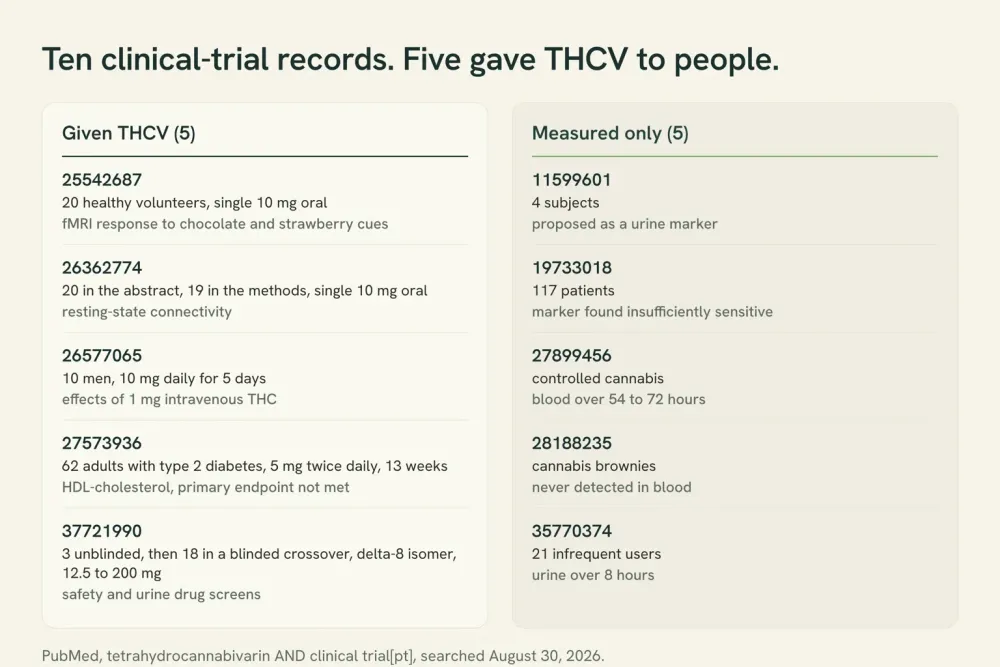
Now the part nobody on this search does. Searched on August 30, 2026, PubMed returns 195 records for tetrahydrocannabivarin. Adding the humans filter leaves 97. Adding the clinical-trial publication type leaves exactly ten, and all ten are human. For scale, the same database returns 9,039 records naming cannabidiol on the same day. Those ten records are the whole clinical record for this molecule, and the interesting thing is that they do not all say what a reader would assume. Five of the ten gave THCV to a person. The other five gave people cannabis or a prescription THC and then went looking for THCV in their blood or urine. That split is the single most useful fact on this page, so here are both halves.
| Record (PMID) | Participants | What they were given | What was measured |
|---|---|---|---|
| 25542687 (2014) | 20 healthy volunteers, aged 20 to 36 | a single 10 mg oral dose of delta-9 THCV | brain blood-oxygen response to chocolate and strawberry images and tastes |
| 26362774 (2015) | 20 in the abstract, 19 in the methods section | a single 10 mg oral dose of delta-9 THCV | resting-state functional connectivity between brain networks |
| 26577065 (2016) | 10 men who had used cannabis fewer than 25 times | 10 mg oral delta-9 THCV daily for 5 days, then 1 mg intravenous THC | THC-induced cognitive, psychological and physiological effects |
| 27573936 (2016) | 62 adults with non-insulin-treated type 2 diabetes | delta-9 THCV 5 mg twice daily for 13 weeks, one of five arms | HDL-cholesterol as the primary endpoint, plus glycaemic and lipid parameters |
| 37721990 (2023) | 3 unblinded, then 18 in a blinded crossover | single oral doses of delta-8 THCV from 12.5 mg to 200 mg | safety, subjective and cognitive effects, urine drug screens |
| Record (PMID) | Participants | What they were given | THCV's role |
|---|---|---|---|
| 11599601 (2001) | 4 subjects, three sessions each | Marinol 15 mg, smoked THC 16.88 mg, and smoked cannabis at 2.11% THC and 0.12% THCV | proposed as a urine marker that could tell the plant from the prescription |
| 19733018 (2010) | 117 cannabis-dependent patients in a dronabinol trial | no THCV administered | that marker tested at scale, and found insufficiently sensitive |
| 27899456 (2016) | controlled smoked, vaporized and oral cannabis | no THCV administered | candidate marker of recent use, tracked in blood for 54 to 72 hours |
| 28188235 (2017) | controlled cannabis brownies | no THCV administered | measured in blood and oral fluid, where it was never detected in blood |
| 35770374 (2022) | 21 infrequent cannabis users, 11 men and 10 women | no THCV administered | urinary excretion profile over 8 hours |
Two of those ten already have a home on this site, and this page will not re-argue them. The five-day pilot in ten men, whose dosing is in the table above, reported THCV 'well tolerated and subjectively indistinguishable from placebo', and its authors asked that the result be read cautiously because of the sample size. The delta-8 dose-ranging trial is the only one that varied the dose at all, it used an isolated compound rather than an extract, and it was sponsored by Canopy Growth Corporation. Both are worked through in more detail in our comparison of major and minor cannabinoids, and the question of what 'high' means as a measured outcome is handled on our page about whether CBD gets you high.
The two brain scans the biggest THCV claim rests on
Almost every page on this search converges on the same claim, and it is a claim about food. We are not going to repeat it, rate it, or replace it with a more careful version of itself. What we can do is open the two experiments it usually traces back to and tell you exactly what each machine in those experiments was pointed at. Both come from the same laboratory, both used a single 10 mg oral dose, and both were double-blind crossover trials in healthy volunteers in their twenties and thirties.
The first is a 2014 trial that put twenty healthy volunteers aged 20 to 36 into an MRI scanner, gave them a single 10 mg oral dose of delta-9 THCV or a placebo a week apart, and showed them pictures and tastes of chocolate, plus pictures of moldy strawberries and a less pleasant strawberry taste as the aversive comparison. The instrument was blood-oxygen signal in the brain. It did not measure eating and it did not measure anyone's body. The volunteers' own ratings of pleasantness, wanting and intensity did not differ between the drug and the placebo, and the paper says so plainly: there were 'no significant differences between groups in subjective ratings'. What did change was the imaging signal, and the direction is the opposite of the retail story: responses to the chocolate stimuli went up, in the midbrain, anterior cingulate cortex, caudate and putamen, and responses to the aversive stimuli went up as well. The work was supported by GW Pharmaceuticals.
The second is a 2015 resting-state connectivity study from the same group, same single 10 mg oral dose, same age range, same design. It reported that connectivity between the amygdala and the default-mode network went down while connectivity between the amygdala and the dorsal anterior cingulate went up, and a further decrease involving the lateral occipital cortex that, in the paper's own words, did not meet the Bonferroni correction. This is the study behind the line about alertness and focus that several sellers print. Its own abstract says something different: 'as expected, no significant differences in the subjective experience with a single dose of THCv'. One detail for anyone counting participants, because it tells you how carefully these numbers travel: the abstract says twenty volunteers and the methods section says nineteen.
What about animals? The same 2015 systematic review catalogues that literature, and it does not agree with itself: THCV suppressed food consumption in non-fasted mice in a 2009 study, did not reduce food intake or body weight in obese mice in a 2013 study, and did not reduce food-deprivation-induced food intake in mice in a third. Those are mice, in three experiments pointing in different directions, and rodent feeding results do not transfer to people. Across all ten human clinical-trial records, not one reported food intake or body weight as a result. If it is the cannabidiol half of this question you came for, we take it apart separately in what the one trial that measured real eating found, which also covers what the CBD arm of the trial below reported on body measurements.
The diabetes trial, and what page one says it found
The other study the marketplace leans on is not about food at all. It is a 62-person pilot published in Diabetes Care in 2016: randomized, double-blind, placebo-controlled, parallel-group, in adults with non-insulin-treated type 2 diabetes, run for 13 weeks across five arms.
- Cannabidiol 100 mg twice daily
- Delta-9 THCV 5 mg twice daily
- A 1 to 1 combination, CBD 5 mg with THCV 5 mg twice daily
- A 20 to 1 combination, CBD 100 mg with THCV 5 mg twice daily
- Placebo
The primary endpoint was a change in HDL-cholesterol, and the paper reports that plasma HDL was unaffected. In other words, the trial did not meet the thing it was designed to test. The results it does report as statistically significant, for the THCV arm against placebo, are lower fasting plasma glucose (an estimated treatment difference of 1.2 mmol/L), a change in pancreatic beta-cell function, and changes in adiponectin and apolipoprotein A. None of the combination arms had a significant impact on endpoints. Body weight, liver triglyceride content and adipose tissue distribution sat among the secondary and tertiary measures. Now the correction, because it is the reason this section exists: one prominent page on this search cites this trial as evidence of weight loss and reduced abdominal girth, and neither result appears in the paper's abstract. What the paper reports is a set of laboratory values in patients with a diagnosis, from roughly a dozen people per arm, with a GW Pharmaceuticals author on the byline and its own primary endpoint unmet. That is not a finding anyone should carry over to themselves, and it is certainly not a finding about a hemp product.
The thread nobody on page one mentions: THCV as a forensic marker
Here is the part of the THCV story with actual consequences for a reader, and on August 30, 2026 not one of the pages we read on this search mentioned it. Because pharmaceutical THC and the plant's THC are the same molecule, a urine test cannot tell them apart. In 2001, a study in which four subjects each took Marinol, smoked synthetic THC and smoked cannabis in three separate sessions went looking for THCV's urinary metabolite at a detection limit of 1.0 ng/mL. It turned up after the plant and not after the capsule, because THCV occurs naturally in most cannabis and, as the authors put it, 'does not exist in Marinol'. THCV was proposed as the analyte that could tell a plant from a prescription.
Nine years later the marker was tested on 117 cannabis-dependent patients enrolled in a dronabinol trial. All 117 produced a positive urine for THC's metabolite, and 50% had an undetectable THCV metabolite below 1 ng/mL. The authors concluded that THCV 'may not be a sensitive enough measure' to detect recent cannabis use in all heavy users, and the reason they proposed is the variability of the cannabis available in community settings. Two later controlled-administration studies fill in the shape of the analyte, and the second of them is worth reading twice. After cannabis brownies, delta-9 THCV and cannabigerol were never detected in blood at that study's 0.3 microgram per liter cutoffs. In 21 infrequent cannabis users studied at Johns Hopkins, the abstract lists THCV among the urinary analytes that peaked around five to six hours after an oral dose and about four hours after vaping, while the paper's own Results section says something different: THCV was one of five analytes 'not detected in any specimens' and was excluded from the analysis for that reason. The compound its laboratory actually quantified in urine is THCV's carboxylic acid metabolite, which is also the molecule the 2001 and 2010 marker studies were looking for. The distinction between a parent cannabinoid and its metabolite is the whole game here, and one paper can print both answers in two different sections.
Two things follow from that thread, and neither of them is a promise. The first is that whether a molecule shows up depends on the analyte, the matrix, the cutoff and the method, which is exactly why nobody can tell you in advance what a test will do. The second comes from the delta-8 dose-ranging trial's own stated conclusion, that oral THCV-containing products could lead to positive urine drug screens for THC; that is a property of an isolated compound given at 12.5 to 200 mg in a 21-person trial, not a statement about any tincture, and the screening numbers behind it are set out in our guide to the minor cannabinoids. Workplace testing is a subject of its own, and we take it apart in what a laboratory actually looks for. If you compete under an anti-doping code, note that the rules carve out exactly one cannabinoid by name and it is cannabidiol. THCV is not cannabidiol, and what the anti-doping codes actually list is worth reading before you assume anything.
Our certificates report THCV only on the line where THC is remediated
Now the document you can actually hold. We publish a per-batch certificate for every product, and on August 30, 2026 we read the THCV row on all twelve of them. The row prints a number on exactly three of the twelve, and those three are the Broad Spectrum batches, the line where THC is remediated. Remediated is not the same word as absent: two of those three report Total THC as non-detected, and the third, batch 260321, prints 10.7 mg per package. The THCV row reads non-detected on the nine full-spectrum certificates, including the three that report the most delta-9 THC. That is the opposite of what most people expect, and we are going to report it rather than explain it. Batch, cultivar and processing chemistry could all plausibly contribute, and these certificates do not settle which.
| Product, flavour and batch | Collected | THCV per package | THCV mg/mL | THCV LOD / LOQ (mg/mL) | Total THC per package |
|---|---|---|---|---|---|
| Broad Spectrum, Mango & Peach, batch 260320 | Mar 27, 2026 | 17.7 mg (0.0312%) | 0.291 | 0.0213 / 0.172 | Non-detected in the potency panel; the overview box prints 0.000 mg per package |
| Broad Spectrum, Lemon & Raspberry, batch 260321 | Mar 30, 2026 | 20.1 mg (0.0355%) | 0.336 | 0.0216 / 0.174 | 10.7 mg (0.0189%) |
| Broad Spectrum, Natural, batch 260319 | Mar 27, 2026 | 19.1 mg (0.0337%) | 0.319 | 0.0213 / 0.173 | Non-detected in the potency panel; the overview box prints 0.000 mg per package |
| Full Spectrum CBD, Mango & Peach, batch 260310 | Mar 11, 2026 | Non-detected at the stated limit | Non-detected | 0.0221 / 0.179 | 136 mg (0.239%) |
| The other eight certificates: Full Spectrum CBD 260309 and 260303, CBD+CBG 260314, 260315 and 260313, CBD+CBN 260311, 260312 and 260304 | Not reproduced here | Non-detected at the stated limit | Non-detected | Printed in each report's own THCV row | Quantified on each report |
One more detail earns a sentence, because it tells you how the laboratory itself files this molecule. On our reports THCV sits in the right-hand column of the potency panel, between delta-8 THC, delta-9 THC and THCA on one side of it and Total THC on the other. The lab files it with the THC analytes, not with the CBD ones. If you want to find that row on any certificate and read the limits printed beside it, our guide to reading a certificate of analysis walks the panel line by line, and every report we publish is on the lab results page. None of this is a reason to buy anything. A composition figure describes what one instrument measured in one batch on one day, and nothing on any of these reports says what the molecule does in a person.
What nobody has measured
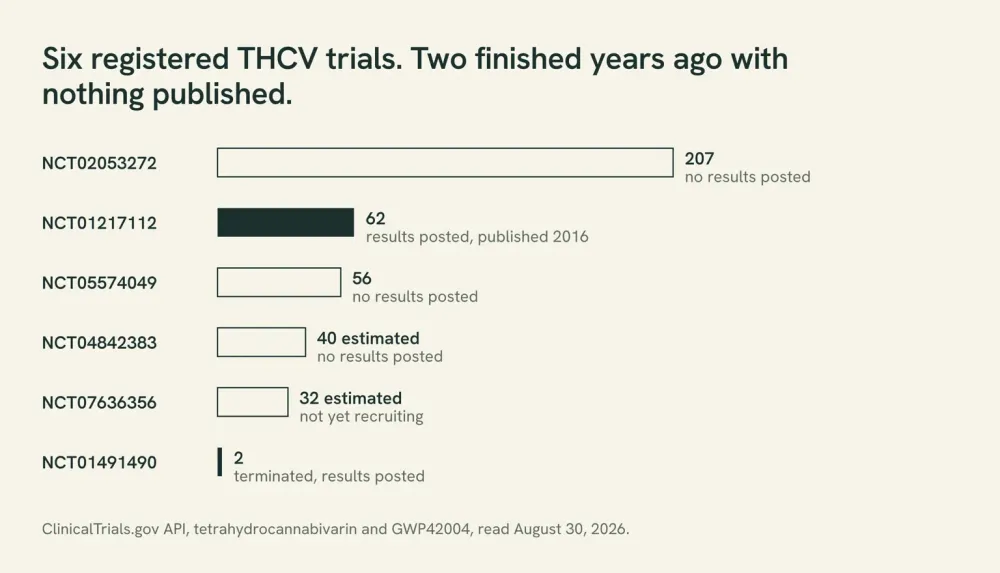
The most useful fact about THCV is not what has been measured. It is what has been registered and then never reported. On August 30, 2026 we queried the ClinicalTrials.gov API for the molecule and for GWP42004, the development code the chemical database lists as a synonym for delta-9 THCV, and the union of the two searches is six records.
| Registry record | Status | Participants | What it set out to measure | Results posted |
|---|---|---|---|---|
| NCT01217112 | Completed September 2012 | 62 actual | cholesterol, body weight and liver fat in type 2 diabetes | Yes; published in 2016 |
| NCT02053272 | Completed February 2016 | 207 actual | HbA1c, THCV added to metformin, phase 2 | No, and no PubMed record exists |
| NCT01491490 | Terminated October 2012 | 2 actual | olanzapine-associated weight gain, 40 to 1 CBD to THCV | Posted; stopped over enrolment |
| NCT05574049 | Completed May 4, 2022 | 56 actual | weight loss, blood sugar and blood lipid effects of THCV mucoadhesive strips, in its registered title's own words; early phase 1 | No |
| NCT04842383 | Unknown, estimated completion October 2021 | 40 estimated | androgenetic alopecia, topical varin and CBD hemp oil | No |
| NCT07636356 | Not yet recruiting, estimated start October 2026 | 32 estimated | a delta-9 THCV oral gummy, phase 2, at UCLA | Not applicable |
Read the third column against the last one. The largest of the six, NCT02053272, enrolled 207 people, finished in February 2016 and has posted no results; searching PubMed for that registry number, or for GWP42004, returns nothing. The one whose registered title promises the outcome most of this marketing rests on, NCT05574049, finished with 56 participants on May 4, 2022 and has posted no results either; the table above gives that title's own description of what the trial set out to measure. A third was terminated with two participants enrolled, and the record's stated reason is that the chief investigator and the sponsor concluded it would not be possible to complete enrolment in any meaningful timeframe. This is a dated statement about a database rather than a claim about a molecule, and it is the honest answer to most questions people bring to this search.
One more count from the same day. Searched on August 30, 2026, the FDA's approved-drug database returns one cannabidiol product, Epidiolex, and no tetrahydrocannabivarin product at all. None of this is evidence that the molecule does nothing; an empty results table measures how much work has been finished and published, not what is true. It is a measure of how little there is to read.
One paragraph on the law, and it carries its date. As of August 30, 2026, the federal test is a delta-9 test: 7 U.S.C. 1639o defines hemp as the plant and its derivatives with a delta-9 tetrahydrocannabinol concentration of not more than 0.3 percent on a dry weight basis, and THCV is not counted in that number. From November 12, 2026, section 781 of Public Law 119-37 replaces that phrase with total tetrahydrocannabinols and adds a 0.4 milligram combined cap per container, and the same section directed the FDA to publish lists of THC-class and THC-like cannabinoids. Whether a THC-family molecule like THCV lands inside those lists is a question those lists would decide, and we are not going to guess. State law varies, none of this is legal advice, and the definition and the date are worked through on our pages about hemp-derived THC and what changes in November 2026.
How to check any THCV claim in five steps
- 1Ask which isomer the claim is about. Delta-9 THCV and delta-8 THCV have different CAS registry numbers, 31262-37-0 and 31262-38-1. A claim that does not name its isomer is not a claim about anything.
- 2Ask what was measured. Brain connectivity, fasting plasma glucose and food intake are three different things, and only two of them have ever been measured in a person who was given THCV.
- 3Ask how many people. Every trial that gave THCV to people had fewer than 65 participants, and the two most-quoted count about twenty, one of them printing twenty in its abstract and nineteen in its methods.
- 4Find the row on the certificate. THCV sits in the potency panel beside delta-9 THC and THCA, and its detection and quantitation limits are printed in the same row.
- 5Read that limit before you read the result. A printed number close to its quantitation limit and a non-detect on a different batch can be less than a factor of two apart.
THCV vs CBD: frequently asked questions
No, and yes in the way that matters for reading a label. They are different molecules: THCV is C19H26O2 at 286.4 g/mol and delta-9 THC is C21H30O2 at 314.5. But their systematic names differ by exactly one word, 3-propyl against 3-pentyl, and both end in the same tetrahydrobenzo[c]chromen-1-ol core. THCV is built on the THC scaffold. Cannabidiol is not: its name ends in benzene-1,3-diol, an open ring. That is a structural fact and nothing more, because structure on its own does not predict an effect.
The honest answer depends on which isomer and which experiment, and almost nobody selling it says which. Of the ten clinical-trial records, the only one that varied the dose used the delta-8 isomer, as an isolated compound, at single doses of 12.5 to 200 mg in 21 people, and it reported euphoric mood as the most common adverse event, with ratings of feeling and liking a drug effect elevated at the 100 and 200 mg doses. A separate five-day trial of the delta-9 isomer at 10 mg a day in ten men found it, in the authors' words, well tolerated and subjectively indistinguishable from placebo. Different isomer, different dose, different answer, and neither result transfers to a hemp product.
No product can guarantee a drug-test result in either direction, and anyone who tells you otherwise is not describing a laboratory. What the literature says is narrower and more interesting. After cannabis brownies, THCV itself was never detected in blood at that study's cutoffs, and a separate controlled-administration study reports in its Results section that THCV was not detected in any urine specimen either; what its laboratory quantified in urine was THCV's carboxylic acid metabolite. And the delta-8 THCV dose-ranging trial concluded that oral THCV-containing products could lead to positive urine screens for THC. Whether anything is detected depends on the analyte, the matrix, the cutoff and the method, and a parent cannabinoid and its metabolite are not the same target. Workplace testing is worked through on our CBD and drug tests page.
Nobody has compared the two at comparable amounts, so the honest answer is that nobody knows. Among the ten clinical-trial records, the single trial that gave people both molecules gave them at very different amounts, cannabidiol 100 mg twice daily against THCV 5 mg twice daily, in 62 patients with type 2 diabetes split across five arms, which cannot answer a question about strength. In cells the numbers are far apart: a 2015 systematic review that pooled the published assays put cannabidiol's affinity for the CB1 receptor at about 3,245 nanomolar and tetrahydrocannabivarin's at about 5.47 nanomolar in human receptors expressed in hamster ovary cells, where lower means tighter binding. That same review closes its abstract by warning that in-vitro mechanistic studies do not always predict what happens in a body, and it notes that THCV's potent antagonism in a dish only occasionally produces effects in a living animal. A binding constant is not a strength rating.
On our twelve published batch certificates that is exactly the pattern: THCV prints a number on the three Broad Spectrum batches and reads non-detected on the nine full-spectrum ones. Batch, cultivar and processing all plausibly contribute and the certificates do not settle which, so we report it rather than explain it. Read the limits in the same row before you read the result. On Broad Spectrum Mango & Peach batch 260320 the printed 0.291 mg/mL sits about 1.7 times above that row's quantitation limit, and a non-detect on Full Spectrum CBD Mango & Peach batch 260310 means below 0.179 mg/mL, not zero. Our guide to reading a certificate of analysis explains that floor.
As of August 30, 2026, the federal test is a delta-9 test: hemp is defined by a delta-9 THC concentration of not more than 0.3 percent on a dry weight basis, and THCV is not counted in that number. From November 12, 2026 the definition becomes total tetrahydrocannabinols plus a 0.4 milligram cap per container, and the same law directed the FDA to publish lists of THC-class and THC-like cannabinoids. Whether a THC-family molecule like THCV falls inside those lists is for the lists to decide, and we are not going to predict it. State law varies, and none of this is legal advice.
Nothing on this page is medical or legal advice, and nothing here says what any product does. THCV is a heavily marketed molecule with a very thin literature: ten clinical trials, five of which put it into a person, none of them large, and the biggest one on the public registry has been finished for a decade without publishing a result. If your next question is what a laboratory looks for in a workplace sample, start with what a drug test is actually measuring. If you compete, the one cannabinoid the anti-doping codes exempt by name is worth knowing before you assume anything about the rest. And if you would rather read a THCV row yourself than take anyone's word for it, the five-step check above works on any certificate, whoever printed it.
Writing about hemp, wellness and the small rituals that keep us balanced.