Major vs Minor Cannabinoids: What the Labels Really Mean
Minor cannabinoids are named for how little of the plant they account for, not for how weak, safe or new they are. Three published definitions disagree, a dataset of 89,923 samples flips the abundance order, and the human trial counts follow a third order.
Search minor cannabinoids and you get a list of molecules with a promise attached to each one. The word does not carry a promise. Minor is a statement about how much of a plant a molecule accounts for, and nothing else: not strength, not safety, not novelty, not how much research exists. This page does the four things the ranking pages skip. It shows you that the published definitions disagree, it puts numbers on the abundance, it counts the human trials one molecule at a time, and it shows you the rows where these things appear on a real lab report.
Here is the short version. Major and minor are abundance labels. They say how much of the plant a given cannabinoid accounts for, and they were never built to rank importance, potency or risk. Three separate orderings get confused with each other on this topic, and none of them matches the other two: there is abundance in the plant, there is prominence in the market, and there is the volume of human evidence. CBG, a minor cannabinoid, cleared 1% by weight in about six times as many commercial cannabis samples as CBD did in one 89,923-sample dataset. The molecules with the largest completed randomized trials named on this page, CBDV and THCV, are the two almost nobody sells. And the largest measured minor cannabinoid row on our own nine full-spectrum certificates belongs to cannabitriol, which no brand markets at all.
What minor cannabinoids actually means, and who decides
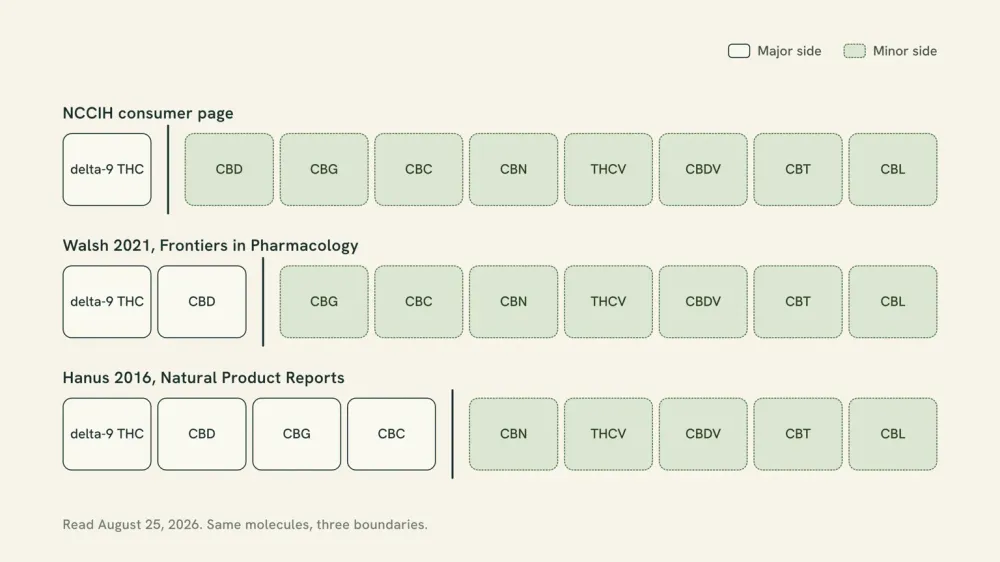
Start with the most authoritative page an American reader is likely to land on. The National Center for Complementary and Integrative Health's consumer page on cannabis and cannabinoids says several NCCIH-funded studies are investigating substances in cannabis, 'including minor cannabinoids (those other than THC) and terpenes'. Read the parenthesis carefully. Under that usage CBD is a minor cannabinoid, because the only thing on the other side of the line is THC. That is not a formal definition and should not be treated as one: it is a scope note describing what a federal research program funds. NCCIH does not name CBG, CBN, CBC, THCV or CBDV anywhere in that page's body text.
Now the source most consumer pages are paraphrasing without saying so. A 2021 review in Frontiers in Pharmacology draws the line one molecule further out: 'In addition to the major phytocannabinoids, delta-9 THC and CBD, cannabis produces over 120 other cannabinoids that are referred to as minor and/or rare cannabinoids.' Same word, different boundary, and the difference is CBD itself. That review also does something the retail pages never do, which is sort the group rather than list it: minor cannabinoids, it says, divide into neutral, acidic and varinic forms. Hold on to that last word. The varins turn out to change the arithmetic on a lab report, and almost nobody mentions it.
| Source | Where it draws the line | The count it gives | What that makes CBD |
|---|---|---|---|
| NCCIH consumer page | Minor cannabinoids are 'those other than THC', written as a scope note for its own research program | Says the cannabis plant contains about 540 chemical substances; gives no cannabinoid count | A minor cannabinoid |
| Walsh, McKinney and Holmes 2021, Frontiers in Pharmacology | Everything other than delta-9 THC and CBD | Over 120 other cannabinoids, sorted into neutral, acidic and varinic | A major cannabinoid |
| Hanus and colleagues 2016, Natural Product Reports | Treats CBG, CBD, delta-9 THC and CBC plus their acid forms as 'a limited set of major constituents' | Gives no count; argues part of the diversity may not be enzymatic at all | A major cannabinoid, and one of only four |
| Camma and colleagues 2025, European Neuropsychopharmacology | Follows the review convention, other than THC and CBD, applied to psychiatric conditions | Approximately 120 minor cannabinoids identified | A major cannabinoid |
So before anyone tells you what a minor cannabinoid does, notice that the category has no agreed edge. Under the federal research agency's usage there are two buckets and CBD is in the small one. Under the pharmacology review's usage there are two majors and everything else. Under the 2016 chemical inventory there are four majors. You are not confused for finding this confusing: the word is doing informal work in three literatures at once, and the only thing all three agree on is the direction of the claim, which is that these molecules are present in smaller amounts. If you want the family map underneath all of it, that is the family this word is trying to sort.
Major cannabinoids, and why the count keeps moving
NCCIH's page also says the cannabis plant contains about 540 chemical substances. Keep that number in the right box: it is not a cannabinoid count, it is everything, and cannabinoids are a subset of it. Then the cannabinoid counts themselves. The 2021 review says over 120 besides THC and CBD. A 2025 systematic review writes that 'approximately 120 minor cannabinoids from the cannabis plant have been identified'. Retailer and supplier pages usually round down to over 100. Our own certificates test for 13 of them by name. None of those figures is wrong. They are counting different things, at different dates, under different inclusion rules, and not one of the pages quoting them prints the rule.
There is also a reason the count could be soft at the source. A 2016 critical inventory of phytocannabinoids in Natural Product Reports, the same paper our page on how cannabinoids differ from terpenes uses for the structural definition, argues that 'the startling diversity of cannabis phytocannabinoids might be, at least in part, the result of non-enzymatic transformations induced by heat, light, and atmospheric oxygen on a limited set of major constituents (CBG, CBD, delta-9 THC and CBC and their corresponding acidic versions)'. Keep both of the authors' hedges: might be, and at least in part. If they are right, part of that long list is not a catalogue of things the plant builds on purpose. It is a catalogue of what happens to four molecules and their acids in a warm, bright, oxygen-rich world. Where those four come from in the first place, and why one precursor produces different branches, is the subject of our page on the acid the plant builds before any of them.
The abundance argument, measured on 89,923 samples
Almost nobody quantifies the abundance they are naming. One paper does it at a scale worth citing. A 2022 analysis in PLOS ONE pulled state-compliance laboratory data on 89,923 cannabis flower samples from six US states (Alaska, California, Florida, Michigan, Oregon and Washington) and six laboratories, and reported that 'in all regions, total THC levels were much higher compared to levels of all other cannabinoids' and that 'other minor cannabinoids were usually present at very low levels'. 96.5% of those samples were the THC-dominant chemotype. That is the abundance claim measured rather than asserted, and it is the strongest support the word minor has anywhere in this article.
Then the same paper prints a pair of numbers that quietly undoes the ranking the word implies. In its authors' words, '3.9% and 23.1% of samples, respectively, had total CBD or total CBG of 1% by weight or higher'. Read that twice. In this dataset CBG, the minor cannabinoid, cleared the 1% mark in about six times as many samples as CBD, the major one. Now the limits, because they are large. This is adult-use cannabis flower, not hemp and not a tincture, and percent by dry weight of flower does not convert into milligrams in an oil. The paper's own tables report that the 89,923 samples came from 3,319 unique cultivators and 3,087 unique cultivar names, so these are not independent observations of a plant. They are observations of a market, and markets grow what sells.
Abundance is not evidence
Abundance is one ordering. Human evidence is a different one, and it is easy to measure badly. Searching PubMed for a molecule's name returns records that mention it, which is not the same as trials that gave it to somebody. So the table below carries both. The middle column is the raw record count, run on August 25, 2026 against the title and abstract fields, with the number in brackets being how many of those records are indexed as randomized controlled trials. The next column is the trials we could find that actually administered the molecule to people. Where a molecule has its own page on this site, the findings live there and this page carries only the design, because a taxonomy article that starts summarizing results has quietly become a set of profile pages wearing a table.
| Cannabinoid | What it is | PubMed records naming it (RCT-indexed) | Trials that gave it to people | On a Planntz certificate |
|---|---|---|---|---|
| CBD (cannabidiol) | The molecule our tinctures are built on | 8,437 (345) | Hundreds, including the trials behind the FDA-approved prescription CBD medicine | Every certificate, 8,160 to 16,600 mg per package |
| CBG (cannabigerol) | The decarboxylated form of the plant's precursor acid | 568 (8) | A small number; the designs and findings sit on our CBG pages | ND up to 6,520 mg per package, depending on the product |
| CBN (cannabinol) | Forms as THC-containing material ages | 929 (11) | Several placebo-controlled sleep trials; designs and findings sit on our CBN pages | ND or below the quantitation limit, up to 4,480 mg per package |
| CBC (cannabichromene) | A third branch off the same precursor acid | 294 (4) | None of its own that we found. One secondary pharmacokinetic analysis inside a 43-person trial of an oil that also contained CBD and THC | ND on all twelve certificates read, and its reporting floor is about twice that of the other neutral rows |
| THCV (tetrahydrocannabivarin) | A varin: two fewer carbon atoms than THC | 186 (8) | Yes. A dose-ranging trial at 12.5 to 200 mg (n = 18 in the blinded phase) and a five-day pilot at 10 mg (n = 10) | ND, or 17.7 to 20.1 mg per package on Broad Spectrum |
| CBDV (cannabidivarin) | A varin: two fewer carbon atoms than CBD | 158 (5) | The two largest completed randomized trials named on this page, and both read null: n = 162 in focal epilepsy, n = 32 in HIV-associated neuropathic pain | 39.6 to 77.1 mg per package on every certificate read |
| CBT (cannabitriol) | Barely characterized in the literature | Not counted in this run | None found in our search | 57.3 to 111 mg on all nine full-spectrum certificates; ND on all three broad-spectrum ones |
| CBL (cannabicyclol) | A light-degradation product | 40 (RCT count not run) | None found in our search | ND on all twelve certificates read |
One row deserves its own sentence, because CBC appears on nearly every top-minor-cannabinoids list you will read. We found no trial that gave cannabichromene to people on its own. The only human pharmacokinetic data comes from a secondary analysis inside a 43-person trial of an oral oil containing 20 mg CBD, 0.9 mg THC and 1.1 mg CBC per milliliter, dosed every 12 hours for seven days, and that paper's own opening line is that CBC's 'acute post-dose pharmacokinetics have not been examined in humans'. Its authors suggest CBC 'may have preferential absorption over CBD and THC when administered together', hedged, inside a multi-ingredient product. Pharmacokinetics describes where a molecule goes, not what it does.
Two more numbers put the whole table in context. The 2025 systematic review of minor cannabinoids in psychiatric conditions, which its authors describe as the first to evaluate preclinical and clinical studies together in that field, searched substance use, anxiety, depressive, trauma, psychotic, neurodevelopmental and eating disorders, and included 22 preclinical studies and one clinical study, describing 'heterogeneous results and the moderate to high risk of bias in several articles'. That is psychiatric indications only, so it is not a census of the whole literature, but the shape it shows is the shape of the field. Separately, a 2026 bibliometric analysis identified 1,516 eligible articles published between 1969 and 2024, with exponential growth starting in 2017, and still called the research 'fragmented and underrepresented'. A publication count measures activity, not quality, and that search deliberately captured papers that merely co-analyze major and minor cannabinoids, so 1,516 overstates the dedicated literature. The 2021 review is blunter about its own field: 'much of our current knowledge of the medicinal benefits of minor cannabinoids has come from subjective and anecdotal patient reporting, rather than through rigorous clinical trials.' For the per-molecule detail, go to the pages that own it: what CBG is and what has been tested, what CBN is and what has been tested, and the head-to-head with CBD.
Minor is not a synonym for milder
The cleanest demonstration on this page uses one molecule at two doses. In a placebo-controlled crossover pilot published in 2016, ten male cannabis users took 10 mg of oral THCV daily for five days, and the authors reported that THCV 'was well tolerated and subjectively indistinguishable from placebo', while asking readers to interpret that cautiously given the small sample size. Seven years later, a two-phase dose-ranging trial gave single oral doses of 12.5, 25, 50, 100 and 200 mg of the delta-8 isomer of THCV (a different molecule from delta-8 THC) to three participants in an unblinded phase and 18 in a blinded, within-participant crossover. Most adverse events, 55 of 60, were mild, and euphoric mood was the most common one. The 100 and 200 mg doses 'showed elevations on ratings of feel a drug effect and like the drug effect'. Two trials, two isomer designations of the same molecule, opposite readings, and the variable that moved by an order of magnitude was the dose, not the major-or-minor label.
That trial reported one more result worth stating precisely, because it is exactly the kind of thing the word minor gets used to make people stop worrying about. Almost all urine drug screens, 78 of 79, taken eight hours after dosing in the active THCV conditions tested positive for THC, and the authors concluded that 'oral THCV-containing products could lead to positive urine drug screens for THC'. Look at what that finding is attached to: the delta-8 isomer of THCV, given as an isolated compound, in single oral doses of 12.5 to 200 mg, in a trial with 3 participants in the open phase and 18 in the blinded one. It is a property of that trial. It does not transfer to a Planntz tincture, where THCV appears as one row among many in a mixture and our Broad Spectrum certificates report 17.7 to 20.1 mg for the whole package. Nothing on this page says or implies that any product we sell will or will not produce a positive test. If that is your real question, it has its own page: what a drug test looks for, and why cannabinoid products complicate it.
One more pair, in date order, because the field moved between them. The 2021 review wrote that 'to date, none of the minor cannabinoids have been clinically demonstrated to act as psychotropic drugs'. The 2023 dose-ranging trial is precisely the sort of result that qualifies it: THC-like drug-effect ratings at 100 and 200 mg oral doses, which its own authors described as mild and not associated with impairment. Neither sentence is a safety reassurance, and neither should be read as one. Together they say something narrower and more useful. The answer depends on the dose, on the isomer, and on which year you asked.
One place the phrase does not appear: the federal code
If minor cannabinoid were a real category, you would expect it to appear where categories carry consequences. It does not. A full-text search of the electronic Code of Federal Regulations run on August 25, 2026 returns no section containing the phrase minor cannabinoid, no section containing minor cannabinoids, and no section containing the word cannabigerol at all. Cannabidiol appears in nine sections. Cannabinol appears in two, both of them inside 21 CFR 862.3870, the classification for cannabinoid test-system devices. So the molecule most brands put first on a minor-cannabinoid list is, as a word, absent from the federal code, while cannabidiol and cannabinol each appear in it. Notice that the code's vocabulary does not track the major-minor split in either direction: it names one molecule every review on this page calls major, one that every review calls minor, and none of the others.
Now the honest limit, because a string search is not a legal analysis. That query finds exact words. A rule written with different wording would not be caught, and the search does not cover statute, state law or FDA guidance. It also does not mean minor cannabinoids are unregulated: hemp-derived cannabinoids sit inside the federal definition of hemp regardless of what a marketer calls them, and these counts move, so anyone reusing this should re-run the search and re-date it. What the result does establish is narrower and more useful than either overreach. When a brand tells you a cannabinoid is minor, that word is coming from marketing or from a review paper, not from a regulator. No agency assigned it, and no agency is checking it.
How to read a minor cannabinoid row on a certificate
This is the part that turns a definition into a skill. Every Planntz potency panel, run by Infinite Chemical Analysis Labs in San Diego under California licence C8-0000047-LIC, names 13 cannabinoid analytes: CBC, CBD, CBDA, CBDV, CBG, CBGA, CBL, CBN, CBT, delta-8 THC, delta-9 THC, THCA and THCV, plus three calculated rows for total THC, total CBD and total cannabinoids. Of those thirteen, only delta-9 THC counts as major under all three definitions above, and CBD under two of them; the 2016 inventory would move CBG, CBC and the acid rows to the major side as well, and everything left over is what the market calls minor. The same panel sorts differently depending on which definition you brought to it. So the first move is to count the panel. A report that tests for four cannabinoids and a report that tests for 13 are not the same document, and a molecule that was never on the panel cannot be non-detected. It is simply unmeasured, which is a different and much weaker statement.
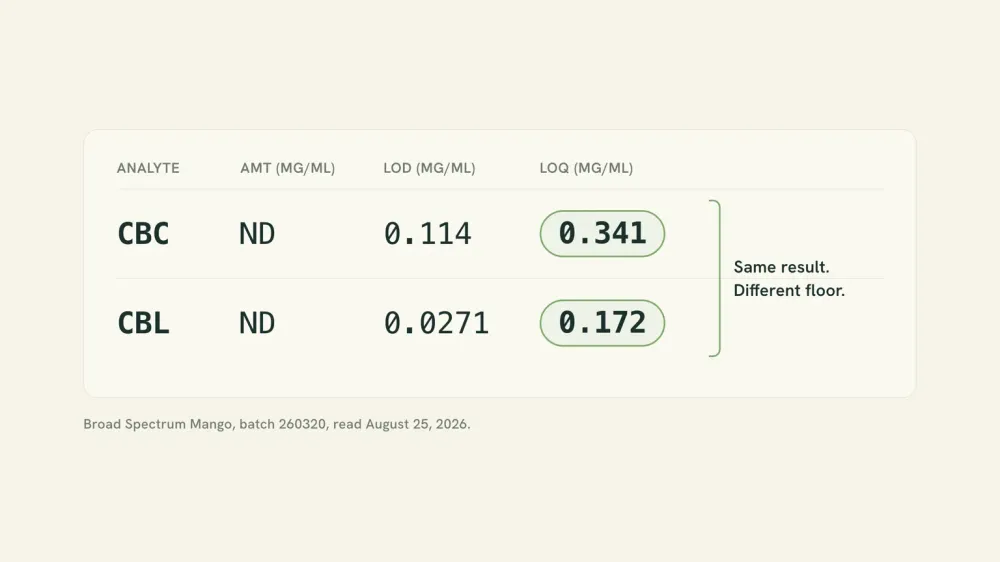
The second move is the one almost nobody makes. A non-detect is not a zero. It is a result below the limit that particular report can print, and that limit is set per analyte, not per page. Our guide to how to read a certificate of analysis covers what ND, LOD and LOQ mean; what this page adds is that the floor moves from row to row. On Broad Spectrum Mango batch 260320, the CBC row cannot quantify anything below 0.341 mg/mL, while CBDV, CBG, CBN, THCV, CBL and CBT all quantify down to 0.172 mg/mL. That roughly two-to-one gap held on every certificate we read. Look at what it does to the non-detects on that one page. CBC and CBL both read ND, but the CBC result only rules out 0.341 mg/mL and above, while the CBL result rules out 0.172 and above. Two ND results printed on the same page are therefore not equally informative, and one of them is hiding about twice as much room as the other.
| Analyte on batch 260320 | LOD (mg/mL) | LOQ (mg/mL) |
|---|---|---|
| CBC | 0.114 | 0.341 |
| CBDV | 0.0276 | 0.172 |
| CBG | 0.0392 | 0.172 |
| CBN | 0.0392 | 0.172 |
| THCV | 0.0213 | 0.172 |
| CBL | 0.0271 | 0.172 |
| CBT | 0.0493 | 0.172 |
| CBD | 0.0347 | 0.172 |
| Delta-8 THC | 0.0278 | 0.172 |
| Delta-9 THC | 0.0460 | 0.172 |
| CBDA | 0.0831 | 0.249 |
| CBGA | 0.0613 | 0.184 |
| THCA | 0.0632 | 0.190 |
Three findings came out of reading all twelve of our non-delta-8 certificates. First, CBC and CBL read ND on all twelve. For CBC that lines up with the 89,923-sample paper, whose authors noted 'there are numerous CBC-related genes but we observe very low levels of CBC', hedged as a hypothesis about whether the relevant enzyme is selective. Keep the three things separate, though: a population measurement in flower, a reporting floor on our report, and a non-detect are three different statements, and none of them lets you infer a process, a temperature or a production step. Second, the largest measured minor cannabinoid row on our nine full-spectrum certificates belongs to cannabitriol, CBT, quantified between 57.3 and 111 mg per package. On Full Spectrum CBD Mango batch 260310 it reads 107 mg, larger than every non-CBD row except delta-9 THC at 136 mg, with CBDV at 75.4 mg. There is essentially no human evidence for CBT, which is why this page describes it instead of praising it, and those are nine production runs, not a rule about the category. Third, check the unit header before you compare anything. Ten of our twelve certificates print the amount column as mg/mL and two print it as mg/g, so the 279 on Full Spectrum CBD Lemon and Raspberry batch 260309 and the 267 on Full Spectrum CBD Mango batch 260310 are not on the same scale and must not be read against each other. That is a units observation, not a quality one.
One more row-level trap, and it is specific to the varins. Certificates convert acid forms into neutral equivalents using a molecular-weight factor, and our page on CBDA and CBD works through the familiar one, 0.877. The 2022 PLOS ONE methods state that 0.877 applies to THC, CBD, CBG, CBC, CBN, CBT and delta-8 THC, and that 'the equivalent formula, with the scaling factor of 0.8668, was used to calculate total cannabinoid levels for THCV and CBDV'. The reason is structural. As the 2021 review puts it, varin compounds such as CBDV and THCV 'contain two fewer carbon atoms than their non-varin counterparts'. Two carbons fewer means a different molecular weight, which means a different factor. Our own certificates print only the 0.877 footnote and report THCV and CBDV as neutral rows, so nothing here says our lab uses the varin factor. What it says is that if you ever see a varin acid totaled with 0.877 on somebody's report, the number is off.
- 1Count the analytes on the potency panel first. Ours names 13 cannabinoids plus three calculated totals. A molecule that is not on the panel was not measured, which is a much weaker statement than being absent.
- 2Check the unit header on the amount column. Ten of our twelve certificates print mg/mL and two print mg/g, and a number in one unit cannot be read against a number in the other.
- 3Read the reporting-limit columns beside the row you care about, not the ones at the top of the page. On batch 260320 the CBC row stops at 0.341 mg/mL while CBDV stops at 0.172.
- 4Treat ND as below this report's limit, never as zero, and never as evidence about how the product was made or what temperature it saw.
- 5Look at the whole-package column, not only the concentration, and notice the order of magnitude. Tens of milligrams and thousands of milligrams tell two different stories about the same panel.
- 6Separate the acid rows from the neutral ones, and remember that THCV and CBDV convert with a different factor (0.8668) from everything else on the panel (0.877).
- 7Match the batch number on the certificate to the batch printed on the bottle in your hand. A report for a different run tells you nothing at all about the one you bought.
What changes when a minor is formulated instead of found
Everything above is about what a plant happens to contain. A finished product is a different question, because a manufacturer can add a purified minor cannabinoid at any level it likes. On our own shelf that is the difference between the Full Spectrum CBD tincture at 15,000 mg CBD, 250 mg/mL in 60 mL, and the CBD + CBG tincture at 9,000 mg CBD plus 6,000 mg CBG (150 and 100 mg/mL), or the CBD + CBN tincture at 8,000 mg CBD plus 4,000 mg CBN (133 and 67 mg/mL). Those are label figures. The batch-by-batch reconciliation between label and measured belongs to the page that compares CBG and CBN directly, and the two-batch comparison of which minors survive full-spectrum versus broad-spectrum processing is already printed on our page on the entourage effect, which is also where the one question this page will not argue lives: whether a mixture behaves differently from its parts. If what you actually want is which spectrum to buy, that is the spectrum guide. The only point that belongs here is this one. Once a minor cannabinoid is formulated at gram scale, the word minor has stopped describing the bottle in your hand. It is still describing the plant it originally came from, which is a fact about botany, not about the dose you are holding.
What this page cannot tell you
Four limits, stated plainly. Percent by dry weight of cannabis flower is not milligrams in an oil, so the 89,923-sample figures describe a market this product line is not part of. A publication count measures activity, not quality, and a systematic review restricted to psychiatric conditions is not a census of what has been studied. Our certificates describe our batches on the dates they were run; they are our own paperwork, not independent evidence about any cannabinoid, which is why every figure above carries a batch number. And the two largest completed randomized trials named on this page were run at doses no consumer product contains. A phase 2 trial of cannabidivarin as add-on therapy titrated 162 adults with inadequately controlled focal seizures to 800 mg twice daily for eight weeks; seizure frequency fell 40.5% on CBDV and 37.7% on placebo, a treatment ratio of 0.95 at p = 0.648, with adverse events at 72.8% against 48.1%. A randomized crossover trial in HIV-associated neuropathic pain gave 400 mg a day to 32 patients and found mean pain intensity 0.62 points higher under CBDV than placebo (P = 0.16), concluding that CBDV 'was safe but failed to reduce neuropathic pain in patients with HIV'. Both are disease trials in patient populations at pharmaceutical doses. Neither tells you anything about a wellness tincture in either direction, and neither means CBDV does nothing. They mean that these two trials, at these doses, in these patients, read null against placebo.
Questions people ask about minor cannabinoids
Cannabinoids the plant makes in smaller amounts than its dominant ones. Beyond that, the published definitions disagree. NCCIH writes minor cannabinoids as those other than THC, which makes CBD one of them. A 2021 pharmacology review defines them as the over 120 cannabinoids that are neither THC nor CBD. A 2016 chemical inventory treats four molecules, CBG, CBD, delta-9 THC and CBC, plus their acid forms, as the majors. The word describes quantity in a plant. It does not describe strength, safety, or how much research exists.
The number depends on the inventory, and nobody prints the counting rule they used. NCCIH says the cannabis plant contains about 540 chemical substances, which counts everything, not only cannabinoids. The 2021 review says over 120 cannabinoids besides THC and CBD. A 2025 systematic review says approximately 120 minor cannabinoids have been identified. Retail and supplier pages usually round to over 100. Our own lab panel tests for 13 of them by name plus three calculated totals.
The label says nothing about strength. The clearest demonstration is one molecule, in two isomer designations, at two very different doses. Oral THCV at 10 mg a day for five days was described as subjectively indistinguishable from placebo in ten men in a 2016 pilot. In a 2023 dose-ranging trial, single oral doses of 100 and 200 mg of the delta-8 isomer of THCV produced elevated ratings of feel a drug effect and like the drug effect in 18 blinded participants. The dose did the work, not the major-or-minor label.
That question does not have an evidence base yet in either direction, and this page will not answer it for you. A 2025 systematic review of minor cannabinoids in psychiatric conditions included 22 preclinical studies and one clinical study, and reported heterogeneous results with moderate to high risk of bias in several articles. Fewer studies is not the same as fewer risks. If you take prescription medication or have a health condition, talk to your doctor before adding any cannabinoid product.
Use the table above. In short: CBDV has two completed randomized trials in patients and both read null, at pharmaceutical doses. THCV has several, including a dose-ranging trial and a five-day pilot. CBN has placebo-controlled sleep trials, covered on our CBN pages. CBG has a small number, covered on our CBG pages. CBC has none of its own that we found, only a secondary pharmacokinetic analysis inside a 43-person trial of a multi-ingredient oil. We found no human trial of CBT or CBL.
Every definition on this page files CBG as minor except the 2016 inventory, which lists it among four major constituents. The abundance data complicates it further: in 89,923 commercial cannabis samples, 23.1% cleared 1% by weight total CBG against 3.9% for total CBD. And in a formulated product the question dissolves, since our CBD + CBG tincture carries 6,000 mg of CBG on the label. The word is describing a plant, not a bottle.
Yes, and reading those rows is the most useful thing to take from this page. Our potency panel names 13 cannabinoid analytes plus three calculated totals, and each row carries its own detection and quantitation limits. On Broad Spectrum Mango batch 260320 the CBC row cannot quantify anything below 0.341 mg/mL while the CBL row quantifies down to 0.172, and both of those rows read ND, so two non-detects printed on the same page are not equally informative. ND means below this report's limit, never zero.
If you want to test any of this yourself, the fastest route is our own paperwork. Every batch certificate we publish is a PDF carrying the full potency panel with the reporting-limit columns printed beside each row. Open one, find the CBC row, then find the CBL row, and notice that the two non-detects sitting in them are not saying the same thing, because the limits printed beside them are not the same number. That single observation is worth more than any list of minor cannabinoids you will find ranked by promise.
Read the panel, not the adjective
Every Planntz tincture ships with a per-batch certificate that names 13 cannabinoid analytes and prints the detection and quantitation limits beside each row. Composition, in the lab's own units, batch by batch.
See the tinctures and their certificatesWriting about hemp, wellness and the small rituals that keep us balanced.