CBDV vs CBD: One Propyl Chain Apart, and a Clinical Record That Was Never About Wellness
Cannabidivarin is CBD with a three-carbon side chain instead of five. Six human trials name it, every one in a named disease, and the two largest read null against placebo. Here is what each measured, and what the CBDV row says on our certificates.
Search CBDV vs CBD and Google hands you six patent PDFs, a paper about a different homolog entirely, and a trial in children that has not finished. That is not a failure of the search. It is an accurate picture of where cannabidivarin sits: a molecule with one of the most advanced human research programs of any minor cannabinoid, and almost none of it aimed at anything you would recognize as wellness. This page opens all six of those human trials and says who was in each one, draws the consequence of the propyl side chain that the consumer pages describe and then abandon, and prints the cannabidivarin row from our own twelve laboratory certificates.
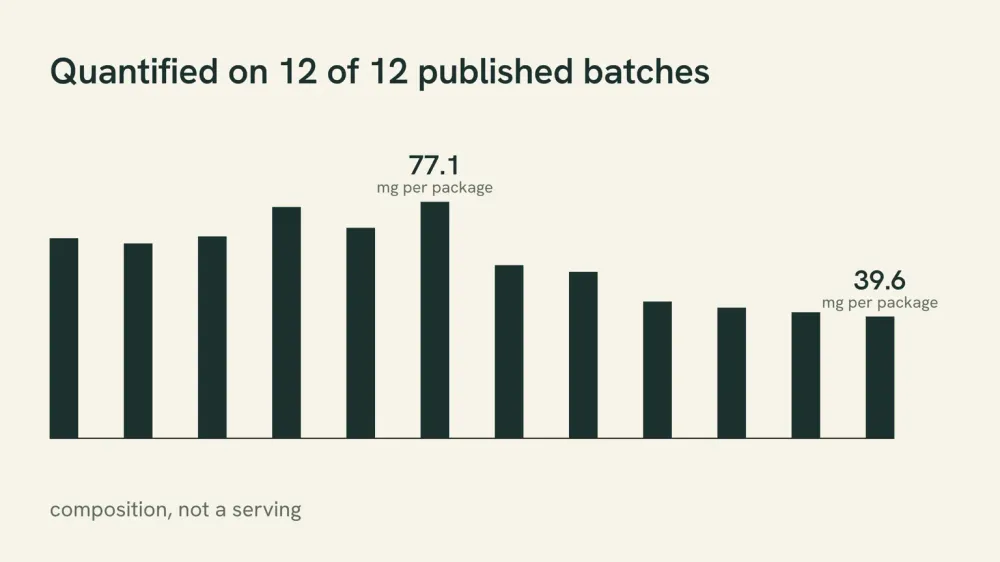
Here is the short answer, up front. CBDV is not a weaker CBD. It is a different molecule, built by the plant from a different starting unit, and the part that differs, a three-carbon propyl side chain where CBD carries a five-carbon pentyl one, is the exact region that structure-activity chemistry names as decisive for how these molecules bind. Six human trials of cannabidivarin are indexed on PubMed and every single one is about a named disease or about drug testing: focal epilepsy, Rett syndrome, autism, HIV-associated neuropathic pain, and one study of what turns up in urine. The two largest randomized ones both read null against placebo. And the line most pages get backwards: cannabidivarin is not rare on a certificate. On the twelve batch certificates we publish, it is quantified on all twelve, from 39.6 to 77.1 mg per package. That is a composition fact, not a dose and not a benefit.
CBDV vs CBD: what actually differs
Cannabidivarin, usually shortened to CBDV, is the propyl homolog of cannabidiol. Homolog is the chemist's word for a molecule in the same series that differs by a repeating unit, and here the unit is two carbons. Put the two database records side by side and the entire difference is visible. PubChem's record for cannabidiol gives the formula C21H30O2, a molecular weight of 314.5 g/mol, and a five-carbon pentyl chain hanging off position 3. The record for cannabidivarin gives C19H26O2, 286.4 g/mol, and a three-carbon propyl chain in the same place. Both rings are the same. Both hydroxyl groups are the same. Both stereocenters are the same. The two IUPAC names are identical strings right up to the last word, where one says pentyl and the other says propyl. If you want the wider family this pair belongs to, the cannabinoid atlas is the map.
| What the record says | CBD (cannabidiol) | CBDV (cannabidivarin) |
|---|---|---|
| PubChem compound ID | 644019 | 11601669 |
| Molecular formula | C21H30O2 | C19H26O2 |
| Molecular weight | 314.5 g/mol | 286.4 g/mol |
| Side chain at position 3 | n-pentyl, five carbons | n-propyl, three carbons |
| Rings, hydroxyl groups, stereocenters | Two rings, two hydroxyl groups, two stereocenters | The same two rings, the same two hydroxyl groups, the same two stereocenters |
| End of the IUPAC name | 5-pentylbenzene-1,3-diol | 5-propylbenzene-1,3-diol |
| Common shorthand | The pentyl cannabinoid, the one everything else is named against | A varin, the propyl homolog of the one on the left |
Subtract one from the other and the whole difference between these two molecules is C2H4: two carbons and four hydrogens, 28.1 g/mol. That subtraction is ours, but both weights are printed by PubChem. Against CBD's 314.5 g/mol it comes to about 9% of the mass. Consumer pages reach exactly this point, note the propyl chain, and stop. Stopping here is what produces the two mistakes that follow from it: that CBDV must be a milder version of CBD, and that whatever CBD is understood to do, CBDV does a little less of. Neither follows. The reason is the next section, and it is the part of this comparison that nobody on page one writes.
Why a shorter side chain is not a smaller dose of the same thing
Start with where the chain comes from, because the plant does not make CBDV by trimming CBD. Chain length is decided upstream, at the fatty-acid starter unit the pathway begins from. The cleanest demonstration is a 2019 paper in Nature in which engineers rebuilt the whole cannabinoid pathway inside brewer's yeast and, among other products, made cannabidivarinic acid. Feeding the engineered strains different fatty acids produced a series of cannabinoid analogs that the authors describe as modified in "the part of the molecule that is known to alter receptor binding affinity and potency". That is engineered yeast, not a cannabis plant and not a person, so take exactly one thing from it: the side chain is set at the beginning, by the starter molecule, not by a later shortening step. If the branching itself is what interests you, the acid that every cannabinoid in the plant starts as has a page of its own.
Now the part that makes the chain worth caring about. A 2005 review in Life Sciences, summarizing decades of structure-activity work, names the C-3 side chain as the key pharmacophore for ligand affinity and selectivity at the known cannabinoid receptors and for pharmacological potency, and notes that the plant prefers a five-carbon chain while three-carbon versions occur in smaller quantities. Carry the limit in the same breath, because it matters: that structure-activity literature is built on delta-9-THC analogs, not on CBD analogs, and it is a review from 2005. It does not tell you what shortening the chain does to cannabidiol specifically, and nobody should transfer it silently. What it does tell you is that two carbons here are not a rounding error. They sit in the one region medicinal chemists spent decades identifying as the region that decides how a cannabinoid binds.
Two laboratory results make the same point from the other end. In cultured mouse neurons, CBDV and THCV both dampened cannabinoid signaling but did it at different points in the synapse: the 2021 paper reports THCV inhibiting the CB1 receptor presynaptically while CBDV acted post-synaptically, perhaps by inhibiting production of the body's own 2-AG. And in a 2013 rodent study, the CB1 affinity of a CBDV-rich botanical extract was accounted for by its THC and THCV content rather than by cannabidivarin itself, which is another way of saying that purified CBDV binds CB1 poorly. Both of those are preclinical: cultured mouse neurons in one case, rodents at mg/kg amounts no consumer product delivers in the other. Neither says anything about what either molecule does in a person, in either direction. They earn one conclusion and no more, and it is the conclusion this section exists for: CBDV behaves like a different ligand, not like a diluted CBD. Poor CB1 binding is also why the intoxication question has a boring answer, which is a separate subject worked through on what actually makes a cannabinoid intoxicating. For the closest precedent of one small structural change producing a genuinely different molecule, the acid form of cannabidiol sits one carboxyl group away from CBD and behaves differently too.
Every completed human trial of CBDV, by who was in it
Here is the search, so you can run it yourself. On August 29, 2026, a PubMed query for cannabidivarin AND clinical trial[pt] returned six records. On the same day the bare term cannabidivarin returned 161 records, and cannabidivarin AND randomized controlled trial[pt] returned five. Counts move, which is why the date is printed. We opened all six and wrote down the design, the population and the result for each, because a record that mentions a molecule is not a trial of that molecule. The pattern that comes out is the article: not one of the six studied a healthy person taking a supplement for general wellbeing. Every one is about a named disease or about what shows up in urine.
| Record | Design and what it gave | Who was in it | What it found |
|---|---|---|---|
| Brodie and colleagues, 2021, Cannabis and Cannabinoid Research (PMID 33998885) | Phase 2 randomized controlled trial, cannabidivarin added on top of existing medication, titrated from 400 to 800 mg twice daily across 8 weeks of treatment | 162 adults whose focal seizures were inadequately controlled, 81 per arm | Null. Seizure frequency fell 40.5% on CBDV against 37.7% on placebo, treatment ratio 0.95 (95% CI 0.78 to 1.17), p = 0.648. No seizure subtype and no secondary endpoint separated. |
| Hurley and colleagues, 2022, Epilepsia (PMID 35364618) | Phase 1, open label, no control group and no blinding, a pharmaceutical cannabidivarin oral solution titrated to a weight-based 10 mg/kg per day | 5 female children with Rett syndrome caused by an MECP2 variant, and drug-resistant epilepsy | Median 79% fall in monthly seizure frequency, from 32 to 7.2 per month, 3 of the 5 above 75%. No significant EEG change and no change in the non-epilepsy symptoms of Rett syndrome. |
| Pretzsch and colleagues, 2021, Molecular Autism (PMID 34210360) | Single dose, double-blind, placebo-controlled crossover pilot, one 600 mg oral dose, outcome read by functional MRI | 28 adult men, 13 autistic and 15 not | Resting-state striatal connectivity in the autistic group shifted toward the pattern seen in the non-autistic group. No symptom endpoint was measured. |
| Pretzsch and colleagues, 2019, Translational Psychiatry (PMID 31748505) | Single dose, randomized-order crossover, one 600 mg oral dose, outcome read by magnetic resonance spectroscopy | 34 adult men, 17 autistic and 17 not | Glutamate-related signal rose in the basal ganglia of both groups. No effect in the prefrontal region measured, and no effect on GABA in either region. |
| Eibach and colleagues, 2021, Clinical Pharmacology and Therapeutics (PMID 32770831) | Randomized, double-blind, placebo-controlled crossover, 400 mg a day, four weeks per phase | 32 patients with HIV-associated neuropathic pain | Null. The authors conclude that cannabidivarin was safe but failed to reduce neuropathic pain in these patients. |
| Gillham and colleagues, 2026, Medicine and Science in Sports and Exercise (PMID 40920736) | 10-week daily supplementation study with an exercise bout, using a broad-spectrum CBD product at 150 mg a day | 36 healthy adults, 31 on the product and 5 on placebo | Cannabidivarin was detected in 68% of pre-exercise urine samples and 84% of post-exercise samples. No THC or THC metabolites at any timepoint. |
Two things fall out of that table that no consumer page on this search will tell you. The first is that the two largest randomized, placebo-controlled trials of cannabidivarin, in the two indications with the most funding behind them, both failed to separate from placebo. The second is that the only result in the whole set that looks impressive is the one with five participants and no control group. Those two facts sitting next to each other are a lesson about how trials are built, not a lesson about CBDV, and the next two sections take them one at a time. For where cannabidivarin sits among the low-abundance cannabinoids, and for the full numbers from the crossover trial in 32 patients with HIV-associated neuropathic pain, go to our page on major and minor cannabinoids, which already carries both. This page publishes no amount to take at all; if amounts are what you came for, how CBD quantities are actually worked out is the right page.
The most important CBDV result was a negative one
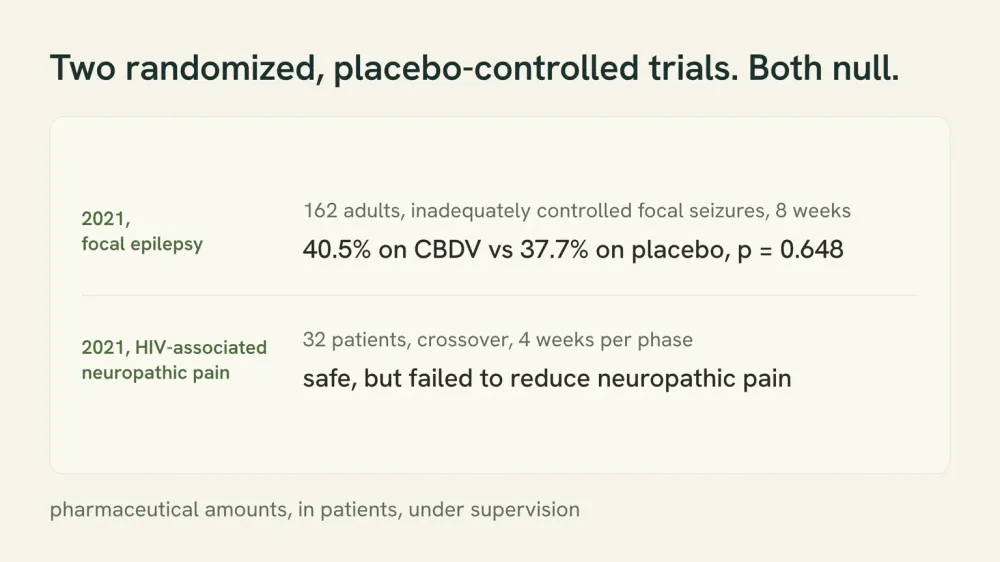
The single most decision-relevant paper on this molecule is a trial that did not work, and it is absent from every consumer page we read on this search. A Phase 2 randomized controlled trial published in 2021 added cannabidivarin to the existing medication of 162 adults whose focal seizures were inadequately controlled, 81 to CBDV and 81 to placebo, titrating from 400 up to 800 mg twice daily and holding it for eight weeks of treatment. Seizure frequency fell 40.5% in the cannabidivarin group. It fell 37.7% on placebo. The treatment ratio was 0.95, with a 95% confidence interval running from 0.78 to 1.17, and the p-value on the primary endpoint was 0.648. No seizure subtype separated. No secondary endpoint separated either.
Print the rest of it too, because a null result is not the same thing as a clean one. Treatment-emergent adverse events were reported in 72.8% of the cannabidivarin group against 48.1% on placebo, and liver transaminases rose above three times the upper limit of normal in three participants taking cannabidivarin, two of whom stopped, against one participant on placebo. Now the honest reading of the headline number, in both directions. This does not show that cannabidivarin does nothing. It shows that this trial, at this amount, in these patients, over these eight weeks, did not separate from placebo, and the authors themselves note the high placebo response it had to beat. It is also not a safety statement about anything you can buy, because a pharmaceutical formulation given at that scale to patients already taking anti-seizure medication is not a hemp tincture and cannot be read as one.
There is a dating problem attached to this result, and it is worth showing you, because it explains why the internet is still optimistic about a program that ended. The trial ran under the development code GWP42006, and its registry record, NCT02365610, lists 162 participants actually enrolled, a status of completed, and an actual completion date of September 2017. The result was published in 2021. Yet a well-known cannabis publisher's CBDV page, read live on August 29, 2026, still describes the sponsor as actively developing a CBDV-based drug, in the present tense. That is a 2018 press narrative which a 2021 paper closed, still running eight years later on page one of this search. We are not going to speculate about why the program stopped or whether it stopped. The registry records the status; the paper records the outcome; those are the two things that can be checked.
The one positive result, and why it is weaker evidence than the negative one
A phase 1 study published in Epilepsia in 2022 gave a pharmaceutical cannabidivarin oral solution, titrated to a weight-based 10 mg/kg per day, to five female children with Rett syndrome caused by an MECP2 variant and with drug-resistant epilepsy. Median monthly seizure frequency fell 79%, from 32 seizures a month to 7.2, and three of the five fell by more than 75%. That is the number that gets quoted when this study is quoted at all. Here is the rest of the same paper. It was open label, so everybody knew what everybody was taking. There was no control group, so there is no placebo response to subtract. There were five participants. EEG did not change significantly. The non-epilepsy symptoms of Rett syndrome did not change. Hypersomnolence and drooling were attributed to the drug.
Now set the two results beside each other, because this is the part that transfers to every health claim you will ever read. The uncontrolled study with five participants looks like a success. The blinded study with 162 looks like nothing. The blinded study is the stronger evidence of the two, and the reason is sitting in its own numbers: the placebo group in the focal-seizure trial improved 37.7%. Seizure counts fall when people enroll in a trial, get monitored weekly, and expect something to happen. A study with no control group has no way to measure that and no way to subtract it, so a 79% median fall in five children is a real observation about five children rather than a measurement of what the drug did. Phase 1 studies are not designed to answer efficacy questions and this one does not claim to. Reading an uncontrolled positive as proof, and a controlled null as a disappointment, is the most common mistake in cannabinoid coverage, and it is the mistake this whole section exists to name. Anything involving children and cannabinoids is its own subject with its own boundaries, handled separately on CBD and children.
What the autism trials measured, and what they did not
Two of the six records are autism studies, and both are brain-imaging experiments in adult men. The 2019 one used magnetic resonance spectroscopy in 34 adult men, half of them autistic, after a single 600 mg oral dose of cannabidivarin. Glutamate-related signal rose in the basal ganglia of both groups. There was no effect in the prefrontal region measured, and no effect on GABA in either region, and how much a participant's signal moved varied with where their baseline chemistry started. The 2021 one was a single-dose, placebo-controlled crossover pilot in 28 adult men, 13 of them autistic, which reported that resting-state connectivity in the striatum shifted, in the autistic group, toward the pattern seen in the non-autistic group.
“restricted to male adults, which limits the generalizability”
Notice what is missing from both of those descriptions: a symptom. Neither study measured irritability, repetitive behavior, communication, anxiety, sleep, or anything else a person or a parent would notice. They measured a brain-chemistry marker at one timepoint after one dose, and a connectivity pattern at one timepoint after one dose, in adult men. The 2021 authors call their study a small pilot and a preliminary proof of concept and say the sample was restricted to male adults. The 2019 paper says outright that future work should examine the effect of cannabidivarin on behavior. So the sentence sitting on the highest-ranking consumer page for this comparison on August 29, 2026, that CBDV may support patients with autism spectrum disorder by helping with irritability and repetitive behaviors, is not a summary of these trials. Neither trial measured either of those things. The study designed to test symptoms is a Phase 2 trial of cannabidivarin against placebo in children with autism, NCT03202303, run at Montefiore Medical Center with 100 participants estimated. As of August 29, 2026 it is still recruiting, with an estimated completion date of February 2027. It has not reported. Google's top non-patent result for a commercial search term is an unfinished trial in children, and the honest thing to say about it is not that it looks promising. It is that the answer does not exist yet.
CBDV on our own certificates: the cannabinoid that is always there
The most repeated line on this search is that cannabidivarin is rare, and therefore hard to find. As a statement about how much of it the plant makes, that is fair. As a statement about whether it is in the bottle you already own, it is usually wrong, and a seller who reads its own laboratory reports can say so with numbers instead of adjectives. Every Planntz tincture ships with a batch certificate from Infinite Chemical Analysis Labs in San Diego, run by UHPLC with diode-array detection against a package size of 56.7 g. The potency panel looks for thirteen individual cannabinoids and prints a result for each one, including the ones that come back ND. On the twelve batch certificates we currently publish, cannabidivarin has a number on every single one.
| Product and batch | CBD (mg per package) | CBDV (mg per package) | CBDV as a share of the CBD on the same page |
|---|---|---|---|
| Broad Spectrum, Mango and Peach, batch 260320 | 16,300 | 65.2 | 0.400% |
| Broad Spectrum, Lemon and Raspberry, batch 260321 | 16,000 | 63.5 | 0.397% |
| Broad Spectrum, Natural, batch 260319 | 16,600 | 65.8 | 0.396% |
| Full Spectrum CBD, Mango and Peach, batch 260310 | 15,900 | 75.4 | 0.474% |
| Full Spectrum CBD, Lemon and Raspberry, batch 260309 | 15,800 | 68.6 | 0.434% |
| Full Spectrum CBD, Natural, batch 260303 | 15,900 | 77.1 | 0.485% |
| CBD + CBG, Mango and Peach, batch 260314 | 9,640 | 56.4 | 0.585% |
| CBD + CBG, Lemon and Raspberry, batch 260315 | 9,580 | 54.2 | 0.566% |
| CBD + CBG, Natural, batch 260313 | 9,410 | 44.5 | 0.473% |
| CBD + CBN, Mango and Peach, batch 260311 | 8,680 | 42.5 | 0.490% |
| CBD + CBN, Lemon and Raspberry, batch 260312 | 8,390 | 41.0 | 0.489% |
| CBD + CBN, Natural, batch 260304 | 8,160 | 39.6 | 0.485% |
There are two readings of that table, and the second matters more than the first. The narrow one: cannabidivarin runs from 39.6 mg per package on the CBD + CBN Natural batch 260304 to 77.1 mg on the Full Spectrum CBD Natural batch 260303, and against the CBD printed on the same page it sits between 0.40% and 0.59%. The wider one is the presence census, and it is the fact that undoes the scarcity line. Of the thirteen individual cannabinoids the panel names, CBD and cannabidivarin are the only two that return a number on all twelve certificates. Delta-9 THC is quantified on ten of the twelve, cannabitriol on nine, CBG on eight, CBN on six and THCV on only three, while CBC, CBDA, CBGA, CBL and THCA read ND on all twelve. The cannabinoid that is always there is the one nobody markets.
Two guardrails on that, because it would be easy to read it as a boast and it is not one. None of this makes our oil better, and it is not evidence about the category either: it is one laboratory, one method, and twelve batches of our own product, which is internal ground truth and nothing wider. And ND is not zero. It means the compound was not detected at the quantitation limit that certificate prints on the same line, which is a statement about the instrument's floor as much as about the jar, and the floor moves from row to row and from batch to batch. What the table actually does is replace a vague scarcity story with a checkable number, which changes the question from "should I buy CBDV" to "here is exactly how much of it is already in this bottle, and here is why that figure cannot be set beside a trial". Every certificate is posted in full at the batch reports page; if the ND rows, the quantitation limits and the unit headers are the part you want to understand, how to read the minor rows on a certificate is the page for it. And for the exact mirror image of this result, cannabichromene reads ND on all twelve of the same documents.
How to check whether a CBDV product actually contains CBDV
CBDV products are starting to appear, and the certificate is the only thing that settles what is in one. Seven checks, in the order they are worth doing, and none of them requires any chemistry.
- 1Look for cannabidivarin as a named analyte on the potency panel. A panel is a list of what the method looked for, so if CBDV is not on it, that certificate cannot tell you either way.
- 2If the CBDV row prints a number, read the unit in the column header. Certificates print mg per package, mg/mL and mg/g, and the three are not interchangeable.
- 3If the row reads ND, read the limit of detection and limit of quantitation printed beside it. ND means not detected at that number, not zero, and the number differs by row and by batch.
- 4Match the batch code on the certificate to the batch code on the bottle. A certificate for a different batch is a document about a different jar, however good its numbers look.
- 5Compare the CBDV figure with the CBD figure printed on the same page. Tens of milligrams beside thousands of milligrams is a normal minor-cannabinoid result for a hemp extract.
- 6Ask where a gram-scale CBDV figure came from. Concentrated minor cannabinoids generally arrive by selective breeding, synthesis or fermentation rather than by ordinary extraction.
- 7Treat any claim that CBDV helps a condition as a claim about a study you can open. Every indexed human trial of it is about a named disease or about drug testing, and none used consumer amounts.
What nobody has measured yet
Here is the honest inventory, because on this molecule the gaps are larger than the findings and every consumer page skips them. None of what follows is a criticism of cannabidivarin. It is a description of what the public record contains as of August 29, 2026.
- No human trial has given cannabidivarin at the amounts a consumer hemp product contains. Every published human study used a pharmaceutical formulation at pharmaceutical amounts.
- There is no published bioavailability study of cannabidivarin in an MCT-oil tincture. How much is absorbed from that format, and over what time, has not been measured.
- There is no head-to-head trial of cannabidivarin against cannabidiol in healthy adults, on any outcome. The comparison people search for has never been run.
- The FDA's approved-drug database returns no cannabidivarin product at all. That is a database result on a date, not a verdict on the molecule.
- The trial designed to test whether CBDV changes autism symptoms has not reported. Its estimated completion is February 2027, and until then the answer does not exist.
- Nothing on this page is an amount to take. Every milligram figure here is either what a study protocol gave under supervision or what a laboratory measured in a package.
Two of those deserve their sources. The approved-drug result comes from the FDA's Drugs@FDA database, searched by active ingredient on August 29, 2026: it returns one cannabidiol product, Epidiolex, and no cannabidivarin product at all. The honest way to state that is what the search returned, not why, and never as "not approved because it does not work". More broadly, the National Center for Complementary and Integrative Health's summary of cannabis and cannabinoids is the plainest government statement that human evidence for most consumer cannabinoid uses is limited or preliminary, and cannabidivarin is a sharper case of exactly that. On the legal side nothing about CBDV is special: hemp-derived cannabidivarin sits inside the federal hemp definition the same way CBD does, which is worked through on whether CBD is legal in the United States and on the change coming to that definition.
One last record from the six, and it is a different kind of study altogether: a 2026 paper in Medicine and Science in Sports and Exercise had 36 adults take a broad-spectrum CBD product at 150 mg a day for 10 weeks and detected cannabidivarin in 68% of pre-exercise urine samples and 84% of post-exercise samples, with no THC or THC metabolites found at any timepoint. What that means for any particular testing program is a separate question with its own pages: anti-doping rules and cannabinoids and workplace drug testing. We are not going to tell you what any product will or will not do to a test result, because nobody can.
CBDV vs CBD: questions people ask
Two of the published trials describe cannabidivarin, in their own words, as non-intoxicating, and the laboratory evidence points the same way. In a 2013 rodent study the CB1 affinity of a CBDV-rich botanical extract was traced to its THC and THCV content rather than to cannabidivarin itself, which is another way of saying that purified CBDV binds the receptor most associated with intoxication poorly. Two limits travel with that. Those are two research papers' characterizations plus one animal study, not a guarantee about any product you can buy. And a full-spectrum hemp product contains trace THC by design, below the 0.3% federal limit, so what a whole product does is a different question from what one molecule in it does.
There is no head-to-head trial of cannabidivarin against cannabidiol in people, on any outcome, so the question has no measured answer. It is also not quite a well-formed question. Stronger is not a property a molecule carries on its own: it needs an amount, an outcome and a population before it means anything, and cannabidivarin has those three only inside rare-disease trials, two of which read null against placebo. What can be said is narrower and more useful. They are different ligands. The two carbons sit in the region structure-activity chemistry identifies as decisive for receptor binding. And in cultured neurons the two behave differently rather than one behaving weakly.
The federal hemp definition covers the plant and all of its derivatives, extracts, cannabinoids and isomers at no more than 0.3% delta-9 THC, so a hemp-derived cannabidivarin sits inside that definition the same way CBD does. Two caveats, and they are the whole answer. That statutory text is in force only through November 11, 2026. And state law varies a great deal and moves faster than federal law does. We do not adjudicate any particular state here; the two legal pages linked in the section above carry the current picture with its dates.
Check the certificate for the batch code on your bottle. On our twelve published batches cannabidivarin is quantified on all twelve, from 39.6 to 77.1 mg per package, which works out to between 0.40% and 0.59% of the CBD printed on the same page. On somebody else's product the answer depends on two things: whether cannabidivarin is a named analyte on their panel at all, and what that row prints. If it is not on the panel, the report cannot tell you either way. And read all of that as composition. It is what the laboratory measured in the package, not an amount to take.
No. Searched on August 29, 2026, the FDA's approved-drug database returns one cannabidiol product, Epidiolex, and no cannabidivarin product at all. The program that got closest was registered as NCT02365610, enrolled 162 adults whose focal seizures were inadequately controlled, completed in September 2017, and published a result in 2021 in which cannabidivarin did not separate from placebo. Two things are worth holding together there. A database search on a date is not a verdict on a molecule, and a null trial is not proof that a molecule does nothing. Both are simply what the public record currently says.
One 2026 study had 36 adults take a broad-spectrum CBD product daily for 10 weeks and detected cannabidivarin in 68% of pre-exercise urine samples and 84% of post-exercise samples, with no THC or THC metabolites found at any timepoint. That is a published finding about the product used in that study. What any given testing program looks for, at what cutoff, and how it treats a cannabinoid that is not on a prohibited list, is a different question, covered on our anti-doping and workplace-testing pages. No product and no article can tell you what a specific test will return.
It changes the part of the molecule that structure-activity chemistry identifies as the key pharmacophore for receptor affinity, selectivity and potency, and that chain arrives from a different fatty-acid starter unit rather than from trimming CBD. In cultured mouse neurons, cannabidivarin and THCV both dampen CB1-based signaling but do it at different points in the synapse. Carry the limits with all of it: the structure-activity literature was built on delta-9-THC analogs rather than CBD analogs, and the neuron work is in vitro. None of it shows what either molecule does in a person taking a tincture, in either direction.
If there is one habit worth taking from this page, it is asking what a study actually measured, and in whom, before asking what it means for you. On cannabidivarin that gap is unusually wide, and nothing joins a pharmaceutical trial in patients with a rare disease to a number on a supplement label. The argument for why an approval, or a failed one, is not evidence about what sits on a shelf is worked through in full on one approved CBD medicine and what it does not prove. Our own certificates are posted batch by batch at our published lab results: open the one matching the code on your bottle, find the cannabidivarin row, and read the number beside it. That habit works on our documents, and it works on everybody else's.
Writing about hemp, wellness and the small rituals that keep us balanced.