CBDA vs CBD: The Acid the Plant Makes, and the Math Inside Total CBD
The living hemp plant makes almost no CBD. It makes CBDA, and CBD is what is left after the acid loses a molecule of carbon dioxide. That one reaction explains the 0.877 on your certificate of analysis, and why our twelve batch reports read ND.
The hemp plant in the field barely makes any CBD. It makes CBDA, cannabidiolic acid, and CBD is what is left behind after that acid loses one molecule of carbon dioxide to heat and time. That single reaction explains most of what is confusing about CBDA: why "raw" products exist, why the potency claim you have read is really about a laboratory dish and a shrew, and why the number 0.877 sits in a footnote at the bottom of your lab report.
Here is the short version before the detail. CBDA is not an upgraded CBD and it is not a watered-down CBD. It is the molecule the plant actually builds, and CBD is the molecule that remains once the acid group comes off. In 2024, a team that drew the contents of living glandular trichomes out of a hemp flower with glass microcapillaries reported a CBD to CBDA ratio close to 1:99 by weight, with CBDA making up 86.4% of the cannabinoids in that fluid. Everything else on this page follows from that one fact: the arithmetic printed on your certificate of analysis, the studies people are quoting when they say CBDA is "more potent", and the honest answer to whether your own bottle contains any.
What CBDA is, and why the plant makes it instead of CBD
CBDA stands for cannabidiolic acid. Structurally it is CBD carrying one extra piece: a carboxyl group, a single carbon atom holding two oxygens, attached to the ring. The plant does not build CBD directly. It builds the acid, using an enzyme called CBDA synthase, purified from Cannabis sativa in 1996 and described there as a 74 kDa single polypeptide that catalyzes, in the paper's own words, the oxidocyclization of cannabigerolic acid to cannabidiolic acid. The precursor side of that story, cannabigerolic acid and what else it turns into, belongs to CBGA and the cannabinoid the plant builds first, and the wider family tree of acid and neutral forms sits in our map of the cannabinoid family.
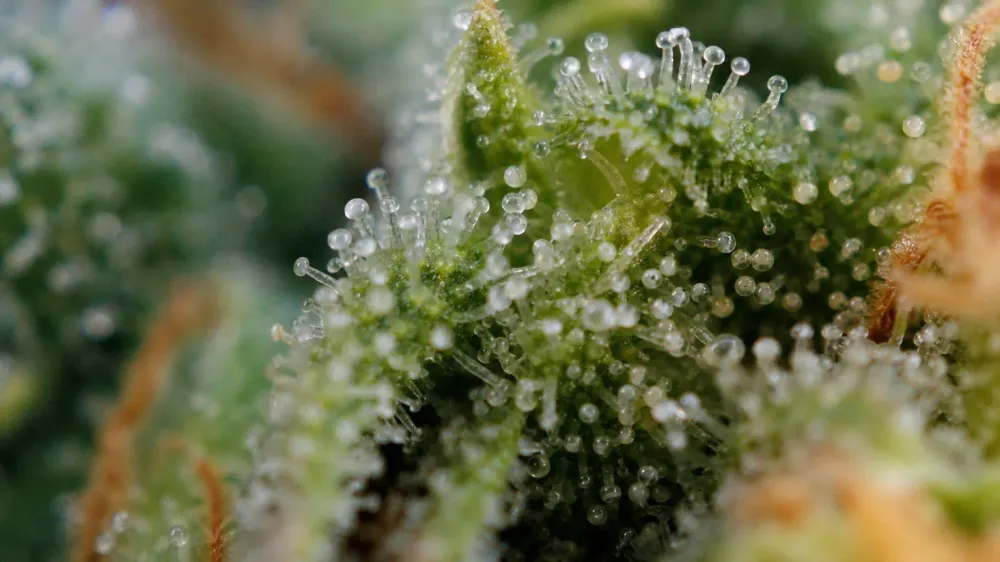
The 2024 trichome measurement is worth being precise about, because the rest of this page rests on it. Researchers sampled the secretory cavity contents of capitate-stalked glandular trichomes with glass microcapillaries and ran the fluid on HPLC. In that fluid CBDA was 86.4% of the total cannabinoids, THCA 6.5%, CBCA 4.3%, CBGA 1.4% and CBDVA 0.6%, and the CBD to CBDA ratio came out close to 1:99 by weight. The limits matter as much as the numbers. This is one CBD-rich cultivar, 'Cherry Wine', in one laboratory, sampled from inside the resin glands rather than from any finished product. It is not a survey of hemp and it says nothing about what is in a bottle on a shelf. What it does show is the direction, and the direction is stark: in the living plant, the acid is the cannabinoid and CBD is the trace.
Chemically, the two molecules differ by exactly one carboxyl group. PubChem's record for cannabidiolic acid gives the formula C22H30O4 and a molecular weight of 358.5, while the record for cannabidiol gives C21H30O2 and 314.5. The difference is one carbon and two oxygens, which is a molecule of carbon dioxide. Hold onto that, because in two sections it becomes a number printed on your lab report.
The one reaction between them, measured on CBDA instead of THCA
Decarboxylation is the name for the acid shedding its carboxyl group as carbon dioxide. A 2026 review of acidic cannabinoids puts it plainly: it is "a non-enzymatic thermal process in which the carboxyl group (-COOH) is cleaved as carbon dioxide (CO2), yielding neutral cannabinoids". Most pages stop there. Two things are worth adding. The first is that the reaction starts long before anybody applies deliberate heat. In the same 2024 experiment, an inflorescence air-dried for 15 days in darkness at room temperature moved from a CBD to CBDA ratio near 1:99 to roughly 1:20, and every acid's share of the total came out lower in the dried sample, by 0.5% for CBGA up to 2.4% for CBDA. Nobody heated anything. The sample sat and dried, and the balance moved by an order of magnitude.
The second is that almost everything the internet knows about decarboxylation was measured on THCA, and CBDA does not behave the same way. In a 2016 kinetics study that heated dried cannabis extracts in a vacuum oven at 80, 95, 110, 130 and 145 degrees C for up to 60 minutes, the Results section reports that the rate constants for THCA-A "were twice those of the cannabidiolic acid (CBDA) and cannabigerolic acid (CBGA)". Their activation energies say the same thing from the other direction: 88 kJ/mol for THCA-A against 112 for CBDA. CBDA is the slower acid, not the quicker one. It is also the messier one. The paper's conclusions describe THCA-A's decarboxylation as "essentially stoichiometric with no side reactions", while the reactions for CBDA and CBGA were "more complex with undetermined side reactions". At 130 degrees C, CBDA in the extract showed a total molar loss of 25.2% on completion, material the authors could not account for and did not claim to explain.
The most interesting result in that paper is almost never quoted. The team also heated 1.0 mg of pure CBDA standard in the same oven, alongside the extracts, and at 110 degrees C the pure standard converted roughly five times slower than the CBDA sitting inside an extract: a first-order rate constant of 0.16 against 0.83, in units of ten to the minus three per second. Same molecule, same oven, same temperature, different surroundings. The authors describe this as the first investigation of such matrix effects, which is their 2016 claim about their own experiment rather than a settled fact, and they offer no mechanism for it. The practical reading is narrow and useful: a decarboxylation temperature quoted without saying what the acid was sitting in is an incomplete number. Whether the same holds in a liquid product is a separate question, and it has been asked. A 2018 method paper on 13 commercial hemp seed oils ran CBDA decarboxylation kinetics in both an open and a closed reactor specifically to look at storage stability. Its full text is paywalled, so we are citing the design and attributing no number to it.
If you want the surrounding context rather than the kinetics: for where heat enters commercial processing, see how CBD is extracted and what each step does. For what warmth does to a finished oil, the lower-temperature rate constants from this same 2016 paper are already published beside the flavor question. And for the same reaction told from THCA's side, including the legal arithmetic it produces, the sibling acid has its own page.
Why the factor is 0.877, and what it is doing to your label
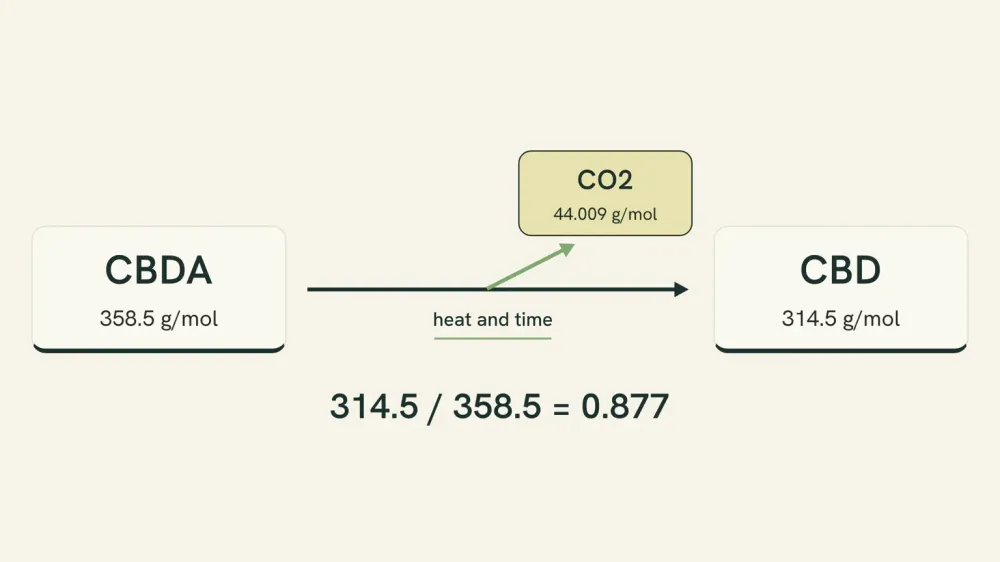
Now the arithmetic, because CBDA is already inside a number you have read. Every Planntz batch report carries this footnote under its potency table: Total CBD = CBD + (CBDA x 0.877). Most explanations treat 0.877 as a convention somebody agreed on. It is not. It is a mass ratio, and you can derive it in one step from the two PubChem records linked above. Carbon dioxide has a molecular weight of 44.009. Subtract that from CBDA's 358.5 and you are left with 314.491, which is CBD's 314.5. Divide what survives by what you started with, 314.5 over 358.5, and you get 0.8773, printed on lab reports as 0.877. The factor is not a discount or a correction. It is the fraction of the acid's mass that is still there after the carbon dioxide leaves.
| Step | The arithmetic | Where the number comes from |
|---|---|---|
| Start with the acid | CBDA = 358.5 g/mol | PubChem CID 160570, formula C22H30O4 |
| Remove the carbon dioxide | CO2 = 44.009 g/mol | PubChem CID 280 |
| See what is left | 358.5 - 44.009 = 314.491 | CBD is 314.5 g/mol, PubChem CID 644019 |
| Express it as a fraction | 314.5 / 358.5 = 0.8773 | Rounded to 0.877 on the report |
| Read the report's own footnote | Total CBD = CBD + (CBDA x 0.877) | Printed on all twelve Planntz batch reports |
| Apply it to a real batch | 16,300 + (0 x 0.877) = 16,300 mg/pkg | Broad Spectrum Mango and Peach, batch 260320, CBDA ND |
So Total CBD is not an addition, it is a forecast. It tells you how much CBD you would have if every CBDA molecule in the sample lost its carboxyl group. One consequence is worth carrying to every product page you visit: when a report shows CBDA, its CBD line and its Total CBD line are two different quantities, and comparing one product's CBD figure against another product's Total CBD figure compares two different things. Working out what you are paying per milligram is where that mismatch does the most financial damage. The same 0.877 turns up in the total-THC formula for exactly the same reason, one carboxyl group and one molecule of carbon dioxide, and that side of the arithmetic is covered in the legal dry-weight threshold and how it is calculated. If you want the guided tour of the document itself, how to read a certificate of analysis walks through every section of it.
What our own certificates actually say in the CBDA row
The question most people are really asking is whether their own oil contains CBDA. The common answer online is that a full-spectrum oil "likely contains at least some". That is a guess about a process, and the real answer is printed on a document you already have access to. We read all twelve published batch reports for the products we sell, from the PDFs on our lab results page, on August 21, 2026. Every one of them reads ND, Not Detected, in the CBDA row. On the same twelve reports, THCA and CBGA also read ND. Because the second term of the formula is therefore zero on every one, the CBD line and the Total CBD line print the same number twelve times out of twelve.
| Product and flavor | Batch | CBD (mg/pkg) | CBDA | Total CBD (mg/pkg) | CBDA LOD and LOQ (mg/mL) |
|---|---|---|---|---|---|
| Broad Spectrum, Mango and Peach | 260320 | 16,300 | ND | 16,300 | 0.0831 / 0.249 |
| Broad Spectrum, Lemon and Raspberry | 260321 | 16,000 | ND | 16,000 | 0.0842 / 0.253 |
| Broad Spectrum, Natural | 260319 | 16,600 | ND | 16,600 | 0.0833 / 0.250 |
| Full Spectrum CBD, Mango and Peach | 260310 | 15,900 | ND | 15,900 | 0.0861 / 0.258 |
| Full Spectrum CBD, Lemon and Raspberry | 260309 | 15,800 | ND | 15,800 | 0.0876 / 0.263 |
| Full Spectrum CBD, Natural | 260303 | 15,900 | ND | 15,900 | 0.0854 / 0.256 |
| CBD + CBG, Mango and Peach | 260314 | 9,640 | ND | 9,640 | 0.0530 / 0.159 |
| CBD + CBG, Lemon and Raspberry | 260315 | 9,580 | ND | 9,580 | 0.0848 / 0.254 |
| CBD + CBG, Natural | 260313 | 9,410 | ND | 9,410 | 0.0812 / 0.243 |
| CBD + CBN, Mango and Peach | 260311 | 8,680 | ND | 8,680 | 0.0839 / 0.251 |
| CBD + CBN, Lemon and Raspberry | 260312 | 8,390 | ND | 8,390 | 0.0837 / 0.251 |
| CBD + CBN, Natural | 260304 | 8,160 | ND | 8,160 | 0.0891 / 0.267 |
Two readings of that table are wrong, in opposite directions. The first is that ND means zero. It does not. It means below the limit that method could see on that batch, and the report prints the limit in the next column: across these twelve reports the CBDA limit of detection runs 0.0530 to 0.0891 mg/mL and the limit of quantitation 0.159 to 0.267 mg/mL. For scale, the CBD line on the Broad Spectrum Mango and Peach report reads 269 mg/mL. The second wrong reading is that ND means the instrument was not looking hard enough. On that same batch, 260320, the same analysis detected CBDV at 65.2 mg per package, CBG at 145, CBN at 31.0 and THCV at 17.7. A run that finds 17.7 mg of THCV in a package is not missing a meaningful quantity of CBDA.
If the report you are holding and the front of the box you bought seem to disagree about what is inside, that is a common and fixable confusion rather than a scandal, and why a label and a lab report can print different numbers walks through the usual causes.
More potent than CBD: what was measured, in what, and in what year
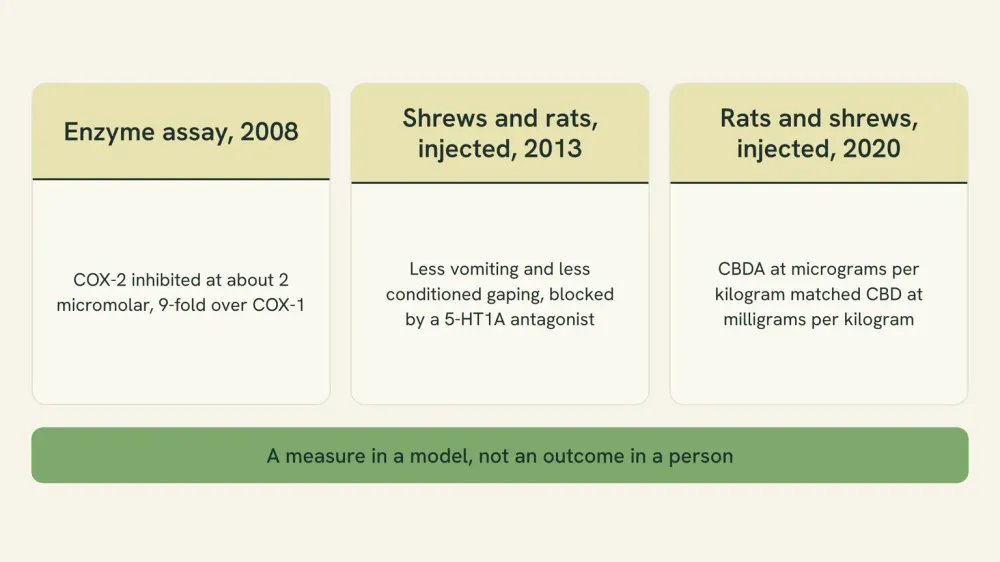
The sentence that recurs across CBDA pages, in various wordings, is that research has shown CBDA may be more potent than CBD. It was not invented, but it is repeated with no measure, no model and no year attached, and those three things are the entire content of the claim. Here are the three studies it usually traces back to, each with its model named in the same sentence. In 2008, a laboratory assay of cyclooxygenase enzyme activity found that CBDA selectively inhibited COX-2 with an IC50 around 2 micromolar and roughly 9-fold selectivity over COX-1, while THCA was a much weaker inhibitor at above 100 micromolar. Methylating CBDA's carboxylic acid abolished the selectivity, which is the genuinely interesting part: the acid group itself is doing the work, so this is a property CBD does not have to give up, it is one CBD never had. There were no animals and no people in that experiment, and a concentration in a dish is not a dose.
In 2013, a study in house musk shrews and in rats gave CBDA by intraperitoneal injection, meaning directly into the abdominal cavity. In shrews, 0.1 and 0.5 mg/kg reduced toxin-induced and motion-induced vomiting. In rats, 0.01 and 0.1 mg/kg suppressed conditioned gaping, a rodent behavior researchers use as a proxy measure. The effect was blocked by WAY100635, a 5-HT1A receptor antagonist, and left untouched by the CB1 antagonist SR141716A, which points at a serotonin receptor rather than at the cannabinoid receptors. The authors' own comparison is that CBDA "displays significantly greater potency at inhibiting vomiting in shrews and nausea in rats" than cannabidiol, and at enhancing 5-HT1A receptor activation. Read that sentence with its subjects intact: shrews and rats, injected.
In 2020, a follow-up in male and female rats and in shrews used subcutaneous injection, with both acute and 7-day repeated administration. Subcutaneous CBD at 5 mg/kg, CBDA at 1 microgram/kg and the CBDA methyl ester HU-580 at 1 microgram/kg similarly reduced lithium-chloride-induced conditioned gaping, and the effects were again blocked by 5-HT1A receptor antagonism. That is the sharpest version of the potency gap on this page: in that model, by that route, the two amounts are separated by a factor in the thousands. It is also a rodent injection study. Those amounts are not servings, they are not recommendations, and nothing about them transfers to a person or to a product on a shelf.
- 2008, in a dish: CBDA inhibited COX-2 enzyme activity at around 2 micromolar, roughly 9-fold over COX-1. That is a mechanism of interest. It is not a symptom, a person or a product.
- 2013, house musk shrews and rats, intraperitoneal injection: less toxin-induced vomiting and less conditioned gaping, blocked by a 5-HT1A antagonist. Conditioned gaping is a proxy behavior in a rodent.
- 2020, rats and shrews, subcutaneous injection: microgram-per-kilogram CBDA matched milligram-per-kilogram CBD on the same rodent measure. A potency difference in that model, by that route.
- Across all three: as of our August 21, 2026 reading we found no human trial comparing the two purified molecules head to head, so "more potent" here is a statement about a measure in a model.
The absorption difference is real, and it is not the same as a benefit
Human data on CBDA does exist, and it is thin. A PubMed search we ran on August 21, 2026 for CBDA pharmacokinetics, bioavailability or plasma concentrations in study participants returns eight records: four in animals, covering parrots, beagles and rabbits, and four in people. The newest of those four human records appears on none of the six cannabis results on page one of the search. In 2025, researchers published a double-blind, placebo-controlled, within-subjects human laboratory study of an oral soft gel containing a botanical hemp extract at roughly a 1:1 ratio of CBD to CBDA and of THC to THCA. Fifteen healthy adults completed four sessions at least a week apart, in ascending order, with plasma sampled through 8 hours plus 24 and 48 hours. The headline result, verbatim: "Across all doses, Cmax for CBDA and THCA was 19-25-fold higher and Tmax was up to 2-fold earlier compared with CBD and THC, respectively." In plain English, the acid forms reached much higher peak blood concentrations and got there sooner. Metabolites were often still detectable at 48 hours.
Now the caveat that carries this entire section: every molecule arrived in the same capsule. This is a study of a product, not a head-to-head of two molecules, and it cannot tell you what CBDA on its own would have done. It is fifteen people, acute exposure, healthy adults, one patented formulation. The authors also report that the highest condition "elicited several adverse events and produced moderate cognitive impairment and subjective intoxication, despite containing a relatively low dose of THC", which is a useful reminder that a formulation delivering more of everything delivers more of the intoxicating part too. We are deliberately not printing the amounts that study used, because amounts belong on a dosage page and none of them is a serving recommendation for anybody.
Two older human records sit alongside it, and neither says quite what a raw-is-better page would want it to say. In 2012, a double-blind, randomized, three-period crossover in nine healthy male volunteers compared a heated and an unheated Cannabis sativa extract against synthetic THC. The unheated extract, the acid-rich one, produced a median CBD plasma exposure over 24 hours almost twice that of the heated extract. It also produced the higher median THC exposure, 6.59 against 2.84 pmol h/mL, while the summed metabolite exposure ran the other way and was higher after the heated extract. The authors read that pattern as a possible tolerability advantage for unheated preparations. That is an inference from a metabolite profile in nine men given two whole extracts rather than two purified molecules, and this page does not carry it further. Then in 2021, in fourteen healthy people given vaporized medical cannabis, the acids showed lower serum concentrations than the neutral forms, because vaporizing decarboxylates part of them on the way in. Route changes the answer, which is why the swallowed and the inhaled results are not in conflict.
The cleanest separation of the two molecules in the studies on this page is not in people at all. In a 2026 crossover study, horses received CBD and CBDA separately at the same dose, with a one-week washout and a placebo arm. Observed CBDA plasma concentrations ran up to 67 times higher than CBD's, and the area under the plasma concentration-time curve up to 36 times larger, with median terminal half-lives of 7.8 hours for CBD and 5.3 hours for CBDA. The authors suggest greater intestinal uptake or lower first-pass metabolism for the acid. Horses are not people, and equine gut physiology is its own subject. Pointing the same way, a 2025 paper reported CBDA reaching plasma concentrations roughly two orders of magnitude higher than CBD in a mouse model, with Caco-2 cell monolayers used for the laboratory half of the same work.
Read all of that as what it is. More of a molecule in the blood is an exposure result. It is not an effect and it is not a benefit. The 2025 study did measure subjective effects and cognitive performance alongside those plasma concentrations, and it reported dose-orderly increases in measures of drug effect and abuse liability, with impaired working memory at its highest condition. What it cannot do is attribute any of that to CBDA, because every molecule in the soft gel arrived together. Peak concentration, total exposure and time to peak are three separate claims about three separate things, and a product page that hands you a multiplier without saying which one it measured has not yet told you anything. The gap in the human evidence is not a measurement of how people feel. It is a measurement that separates what CBDA did from what the rest of the extract did.
Stability, as chemistry rather than as a sales point
CBDA is the reactant and CBD is the product. The reaction gives off a gas, and it does not run backwards: you cannot re-acidify CBD into CBDA in a kitchen, in a bottle, or anywhere else outside a synthesis laboratory. That asymmetry is the real reason a "raw" product has a problem a converted one does not have. "Raw" is a claim about what was not done to the material, and the material carries on doing it anyway, slowly, at room temperature, which is exactly what fifteen days of air-drying in darkness demonstrated. Nothing about that makes a raw product bad. It makes it a product whose composition is a moving target, and the field says so about itself.
“A major challenge is their chemical instability. Both compounds readily undergo decarboxylation into their neutral forms (THC, CBD) when exposed to heat, light, or prolonged storage, which can significantly alter pharmacological activity.”
That passage comes from the Limitations section of the 2026 review linked earlier. The original joins its first two clauses with a dash; we replaced it with a period and changed nothing else. The same section adds that this instability "complicates dosing accuracy and standardization, particularly in botanical preparations". Note whose voice that is. It is not a competitor's marketing and it is not ours: it is a review arguing that acidic cannabinoids are worth studying, listing the reasons they are hard to study. One thing that review is not being used for here: it contains a section on companies selling acidic cannabinoids that repeats a vendor's absorption figure, and none of its benefit summaries appear anywhere on this page. If your practical question is how long a bottle stays what the label says, how long CBD oil actually lasts is the page for that.
One correction while we are here, because the wrong version circulates widely and it is easy to repeat. CBD does not age into CBN. CBN is what THC becomes through oxidation, and as a 2021 review of cannabinol and sleep states plainly, "unlike other phytocannabinoids, CBN is not biosynthesized in an acid form by the plant". There is no CBNA in your flower, and there is no CBDA to CBD to CBN chain. There is one arrow, from CBDA to CBD, and a separate unrelated arrow from THC to CBN. The CBN story and where it actually comes from covers that second arrow in full, and this page will not extend the argument any further than one sentence.
How a lab looks for CBDA, and how a method can hide it
A CBDA row is a statement made by an instrument, and the instrument is named on the report. Ours print UHPLC-DAD, a liquid chromatography method that leaves the acids intact and gives CBDA its own line. That detail is not decorative. In a 2025 comparison of analytical methods, gas chromatography-mass spectrometry run without derivatization decarboxylated the acids inside its own hot injector, and that conversion was incomplete, at roughly 50 to 60%, so total THC and total CBD came out understated. LC-MS, and GC-MS with derivatization, recovered the full amount. In the six real cannabis oils the same team tested, the deviation stayed under 10%, which the authors attribute to the low content of acidic forms in those particular preparations. This is a finding about methods, not an accusation about any specific report, and the six oils were pharmacy preparations rather than consumer tinctures.
Partial conversion shows up even when a protocol is built to complete it, and the acid this page is about is the one that lags. In a 2023 forensic method study, THCA and CBDA were heated in 2 mL vials at 150 degrees C for 12 minutes under four conditions. With no solvent and the vial left uncapped, production of the neutral forms stayed at 10.1% or less. Capping the vial lifted THC production to 53.4% while CBD production reached only 11.7%. Under the UNODC condition, with tribenzylamine added, THC reached 83.2% and CBD 71.0%. In both conditions where that paper prints the two side by side, the CBDA side converted less completely than the THCA side, which is the same direction the 2016 kinetics found by an entirely different method. The authors' conclusion is the sentence to keep: "even in the presence of TBA, their production did not reach 100%". How THCA becomes THC, and what that does to a legal limit carries the THC half of this experiment. Complete conversion is an assumption, not a default, and it is an assumption that lives inside a lot of confident sentences about what is in a jar.
- The instrument line. A liquid method such as UHPLC or LC-MS reports the acid as its own row. A gas method without derivatization converts it in the injector and may report only the neutral form.
- The CBDA row itself, and whether it prints a number, ND, or nothing at all. A report with no CBDA row is not evidence of no CBDA. It is evidence that nobody looked, or that nobody printed it.
- The detection and quantitation limits printed beside the result, in the same units as the result. ND means below that limit, on that batch, by that method, and never means zero.
What is still unknown, and how to read a CBDA product page in a minute
The honest state of the evidence is available in the field's own words. That same 2026 review closes by describing acidic cannabinoids as "promising but experimental therapeutic agents, with applications that are not yet ready for broad medical adoption". That is a fair summary of everything this page has walked through: a mechanism in a dish, a receptor pathway in two rodent species by injection, pharmacokinetics in horses and mice, and a handful of small human studies, every one of them of a mixture rather than of CBDA by itself. It is a real research program. It is not a set of answers about what anything does for anybody, and anyone selling you the second thing is ahead of the literature.
So here is what our August 21, 2026 reading did not turn up: a human trial of CBDA on its own, a comparison of the two purified molecules in people, or any human measurement that separates what CBDA does from what the rest of an extract does. Anything you read that fills those three gaps is filling them with a mechanism, an animal, or an assumption. The checklist below is how to tell which one you are looking at, and it takes about a minute per page.
- A potency claim with no species attached. "More potent than CBD" without a model, a route and a year is a sentence, not a finding, and the three studies behind it are all in this article.
- An absorption multiple with no measure named. Peak concentration, total exposure and time to peak are three different claims and they do not substitute for one another.
- "Raw" used as a benefit rather than as a description. Raw states what was not done to the material, and drying alone already moves the balance a long way.
- A product advertising CBDA whose certificate of analysis has no CBDA row, or which has no certificate at all. The row is the claim; the marketing is not.
- A result from a dish or a rodent written in the language of relief, symptoms or conditions. That translation has not been made in people for this molecule.
- A page that tells you what CBDA does for a specific health condition. No human trial supports that answer today, and confidence there should send you to close the tab.
Questions people actually ask about CBDA
Read your batch report rather than the product category. A lot of pages say full-spectrum oils "likely contain at least some" CBDA, which is a guess about a manufacturing process rather than a measurement. All twelve Planntz batch reports we read on August 21, 2026 print ND in the CBDA row, so on those batches the answer is no, below the limit the lab could detect. Yours is answerable in about ten seconds: open your product's certificate of analysis, find the row labeled CBDA in the potency table, and read what is printed next to it.
The comparison exists and it is much narrower than it sounds. A 2013 study reported greater potency at inhibiting vomiting in house musk shrews and at suppressing a nausea-related behavior in rats, both by injection, plus greater enhancement of 5-HT1A receptor activation in binding assays. A 2008 laboratory assay found selective COX-2 inhibition at around 2 micromolar. Those are measures in models. As of our August 21, 2026 reading we found no human trial comparing purified CBDA against purified CBD for any outcome, and every human study described in this article gave the two molecules together.
Not Detected, which means below the limit that method could see on that batch. It is not the same as zero. The report prints the limit, usually as LOD and LOQ in the same units as the result: on our twelve batch reports the CBDA limit of detection runs 0.0530 to 0.0891 mg/mL and the limit of quantitation 0.159 to 0.267 mg/mL. A different laboratory using a different method prints different limits, which is why the limit belongs in the same glance as the result.
Because Total CBD adds what the CBDA in the sample would become if it converted. The formula printed on the report is Total CBD = CBD + (CBDA x 0.877), and 0.877 is the fraction of CBDA's mass that survives after a molecule of carbon dioxide leaves. When CBDA reads ND, that second term is zero and the two lines are identical, which is why ours are. When CBDA reads a number, the two lines separate, and comparing one product's CBD against another product's Total CBD compares two different quantities.
Roughly, yes, in the sense that "raw" is a marketing word for material that was not heated enough to drive the acids to their neutral forms. It is a claim about what was not done, not about an added ingredient. It is also less binary than it sounds: in one 2024 experiment, fifteen days of air-drying in darkness at room temperature shifted the CBD to CBDA ratio in hemp inflorescence from about 1:99 to about 1:20, with no deliberate heating at any point.
No to the second question. The reaction releases carbon dioxide and does not run backwards, so CBD cannot be re-acidified at home. On the first, if the CBDA row on your report reads ND, there is nothing left to convert, and heating a finished oil raises separate questions about flavor and about what else changes at temperature. This page publishes no heating method and no target temperature, and none of the laboratory numbers above is a recipe.
No. CBN is the oxidation product of THC, not of CBD, and a 2021 peer-reviewed review states that unlike other phytocannabinoids, CBN is not biosynthesized in an acid form by the plant. So there is no CBNA on a lab report and no single chain running from CBDA through CBD to CBN. There are two separate reactions: CBDA to CBD, which is decarboxylation, and THC to CBN, which is oxidation over time.
If you take one habit away from this page rather than the chemistry, make it this one: find the CBDA row on your own report, read the number or the ND beside it, and read the detection limit printed in the same row. How to read a certificate of analysis walks through the rest of the document, and our published batch reports for every product we sell are where you can run the check on the twelve batches tabled above. If cannabinoid names are still a blur, the plain-English explanation of CBD is a better place to start than any acid.
Writing about hemp, wellness and the small rituals that keep us balanced.