What CBD Oil Actually Tastes Like, and What It Tells You
Earthy, grassy, bitter at the finish: that is normal, and four separate things cause it. Only oxidation means something is wrong. This page also runs the numbers page one leaves out on flavored drops, hot coffee, and the dose left on the mug.
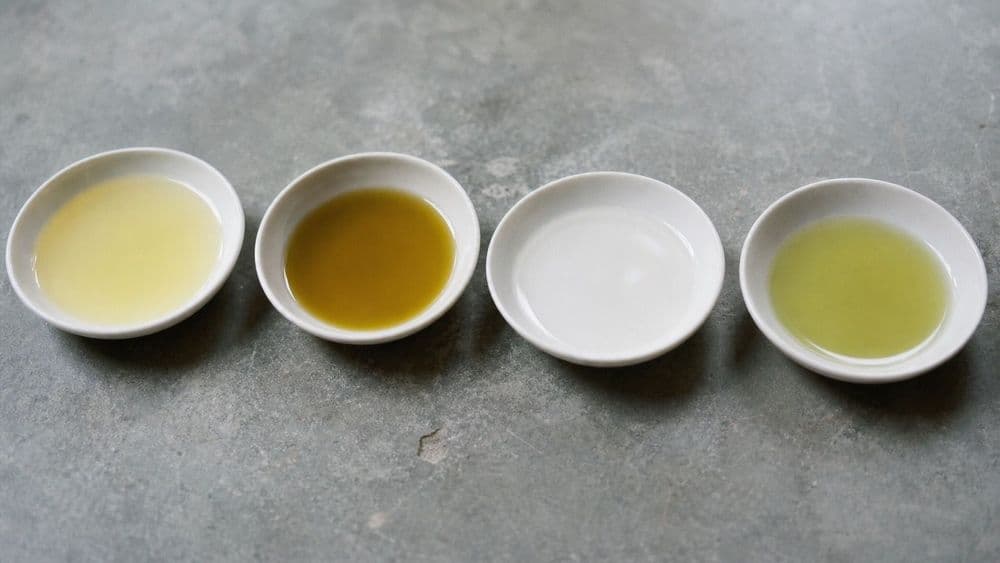
The bottle you already paid for tastes like a lawn. That is the most common reason people quietly stop using a tincture they were happy to buy, and page one of Google answers it with honey. Before you cover the taste, it is worth knowing what is producing it, because four separate things are, and only one of them means anything is wrong with the oil.
Here is the short version. A full-spectrum or broad-spectrum CBD oil tastes earthy, grassy and a little bitter because of what is dissolved in it: compounds that came out of the plant, whatever the extraction route carried along with them, and the carrier oil, which by weight is most of every drop. Those three are the oil being itself. The fourth cause, oxidation, is not normal, and it announces itself as a change: a sour, sharp or crayon-like note that was not there when you opened the bottle. There is one more thing the tips pages leave out. The standard advice for making the taste better is not neutral. Two of the five most-recommended fixes move the variable with the largest measured effect on how much CBD reaches the blood, and it is not the variable those pages think it is. If you are still deciding what to buy, our buyer's checklist for a tincture covers the rest of that decision.
What it actually tastes like, described precisely enough to check
Vocabulary first, because "it tastes bad" is not something you can check against anything later. Across the descriptions people actually use, a hemp extract dissolved in oil lands in a fairly narrow band, and it is worth learning what your own bottle does on day one so you have a baseline to compare against.
- Earthy and green, like the smell of a greenhouse or of cut hay.
- A pine, herbal or black-pepper edge, usually more noticeable on full-spectrum oils than on broad-spectrum ones.
- A slick, faintly sweet neutrality underneath everything, which is the carrier oil rather than the extract.
- A bitterness that arrives at the back of the tongue and hangs around for a minute or so after you swallow.
- A smell that is stronger than the taste, because most of what you are calling flavor is arriving through your nose.
That last point is not a figure of speech. In 2025, researchers running sensory-guided gas chromatography-olfactometry on the dried flowers of six CBD-rich cultivars identified 52 odor-active compounds, 38 of which had not previously been reported in dried hemp. Alpha-pinene, myrcene and linalool came in at flavor-dilution factors of 256 to 1024, and so did a set of sulfur compounds the authors describe as confirmed in hemp for the first time; p-cresol landed in the same band, eugenol at 1024 and sotolon at 512. Two limits travel with that: it is a study of dried flower, not of an extract and certainly not of a tincture, and a flavor-dilution factor ranks how far an odor can be diluted before it disappears, which is a potency ranking rather than a concentration. Two of the authors work at a plant-genetics company. Nothing in the paper says a bottle on your shelf contains those compounds.
It is also not only terpenes, which is where nearly every explanation on the internet stops. A 2025 review in Molecules describes cannabis flavor as the product of volatile aldehydes, ketones, esters and sulfur compounds together with non-volatile taste-active molecules including flavonoids and phenolic compounds. The distinction matters for the complaint people actually have: volatiles are what you smell, while the flavonoids and phenolics are tasted directly, and bitterness is a taste rather than an aroma. That is a narrative review with no pooled data, and its disclosure is worth reading in full: four of its six authors were consultants to Aspeya Switzerland AG, the other two were employed by that company, and the review itself was supported by it. That is worth knowing when you read a review of flavor written by people who work on flavor for a living.
Cause 1: the extract, which is really a spectrum question
Turning flower into an extract does not scale the flavor evenly with the cannabinoids, which is the part that surprises people who expect a concentrate to taste like a stronger version of the plant. In a 2018 analysis in Planta Medica comparing six chemovars as flower and as supercritical CO2 concentrate, cannabinoid potency rose 3.2-fold for delta-9 THC and 4.0-fold for CBD while the monoterpenes were lost; monoterpene alcohols rose by factors of 5.3, 7 and 9.4 and sesquiterpenes by 4.2 to 8.9, and the authors concluded that a concentrate "may have a significantly different chemotypic fingerprint from that of cannabis flower". That is analytical chemistry on six state-legal marijuana chemovars in one laboratory, not hemp and not a tincture, and the paper carries a published erratum. It reports no human outcome of any kind. What it does establish is that the flavor of an extract is not the flavor of its plant, scaled up: some notes concentrate faster than the cannabinoids and some disappear.
At the far end of the same axis there is almost nothing left to taste. A 2025 laboratory scale-up in ACS Agricultural Science and Technology ran a purification chain that reached over 99 percent pure CBD at 52 percent overall yield. That is a protocol for making crystals in a lab rather than a description of how any consumer product is made, but it explains the pattern people notice: an isolate is close to flavorless and a whole-plant oil is not, because purity and flavor sit on the same dial. So the taste is a rough signal of how much of the plant survived processing, and rough is doing real work in that sentence. It will not tell you which spectrum you bought, and it is not a quality grade. Which spectrum to choose is the job of our guide to full spectrum, broad spectrum and isolate.
Cause 2: what the extraction route left behind
Solvent choice decides what comes out of the plant alongside the cannabinoids, and that is a process fact with a direct flavor consequence. A 2024 comparison in Plants ran three methods on one CBD and CBG-dominant hemp inflorescence and found that ethanol pulled 22 to 24 percent of the biomass into the extract while supercritical CO2 pulled 1.3 to 1.8 percent, with hydrodistillation at 0.08 to 1.1 percent. The authors name what comes with the yield: with ethanol, "other compounds may also be present within the extract such as pigments from the plant material, limiting the selectivity". Pigment is the polite word for the green. That is one cultivar, one lab and three replicates, and only the CO2 arm was decarboxylated, so part of the spread is process design rather than solvent power. The paper does not rank the methods and neither do we.
There is also a step whose entire job is taking things back out. Winterization means dissolving the extract in a solvent and chilling it so waxes and fats drop out of solution and can be filtered off. The 2025 purification protocol above holds that stage at minus 18 degrees C for 24 hours, and a 2015 analytical study of concentrates describes the two commercial versions of it as performed either inline, by chilling the vessel containing the plant material with dry ice, or offline by re-dissolving the extract in ethanol and then freezing. There is a consumer-facing consequence you can see for yourself: if your oil goes cloudy in a cold kitchen, you are watching the same physics a manufacturer uses on purpose. How each extraction method works, step by step, belongs to our page on how CBD extraction is actually done, and this page only claims the flavor end of it.
One correction while we are in this section. Half of page one states that chlorophyll is what makes CBD oil bitter. It is a reasonable guess, it may well be right, and it has not been measured. On August 10, 2026 we searched PubMed for "(cannabidiol OR cannabis OR hemp) AND chlorophyll[tiab] AND (bitter*[tiab] OR taste[tiab] OR sensory[tiab])" and got zero records. What is documented is narrower and still useful: a solvent that takes more of the plant takes the pigments with it, and the steps that remove waxes and pigments are named steps with names. The chlorophyll-to-bitterness link is an inference, and it deserves to be read as one wherever you meet it, including here.
Cause 3: the carrier, which is most of what is in your mouth
Now run the arithmetic nobody on that search results page runs. A Planntz tincture is 60 mL of coconut MCT oil with the extract dissolved into it, and the certificate of analysis for the Broad Spectrum Mango and Peach batch 260320 prints a package weight of 56.7 grams. About 15 grams of that is CBD, since the bottle carries 15,000 mg. The remaining 41 grams or so is carrier oil plus the small amount of flavoring. At roughly 0.05 mL per drop there are about 1,200 drops in a bottle, which puts close to 35 milligrams of coconut MCT in every drop of the three oils that carry 15,000 mg of actives, and about 37 in the CBD plus CBN oil, which carries less active material and therefore more carrier. Against that, one drop of a 250 mg/mL tincture holds about 12.5 milligrams of CBD. The carrier outweighs the active by close to three to one, which is why the mouthfeel of a tincture is mostly a fat's mouthfeel. Drop size varies with the dropper and with how you hold it, and the per-drop arithmetic in its own right belongs to our CBD per drop calculator. This is a composition fact and not a serving suggestion: what amount suits anyone is a separate subject on a separate page.
That is not a Planntz quirk, it is what the category mostly does. In the NIH Office of Dietary Supplements' Dietary Supplement Label Database, queried on July 30, 2026, 219 of 437 unique liquid CBD or hemp-extract label records listed MCT or coconut oil, 81 listed hemp seed oil and 43 listed olive oil; of the 32 records with the word tincture in the product name, 30 listed MCT or coconut oil. That is a label archive rather than a market census, and it is worth re-dating before anyone reuses it. The carriers taste different from one another because they are different fats. In the GRAS notice FDA reviewed for hempseed-derived ingredients, the notifier's own figures describe hemp seed oil as, on average, 77 percent polyunsaturated, 13 percent monounsaturated and 9.8 percent saturated, mostly linoleic acid at 50.9 percent and alpha-linolenic acid at 16.7 percent. Those are the notifier's numbers in a notice FDA responded to by saying it had no questions, not FDA's own measurement, and that distinction matters. Coconut MCT sits at the other end of the fat spectrum: a 2022 food-chemistry study heating medium-chain triglycerides and a high-MCT coconut oil at 180 degrees C noted them for "high oxidative stability", with secondary oxidation products accumulating only as the heating ran on toward 10 hours. That is a pan, not a mug, and there is no cannabinoid anywhere in that study. If you want the fat-by-fat comparison, hemp seed oil is not the same product as CBD oil, and the word tincture on the label has a history worth knowing before you compare two bottles.
Cause 4: oxidation, the only one that means something is wrong
The first three causes are the oil being itself. The fourth is the oil changing. The tell is not a flavor you happen to dislike, it is a flavor that was not there before: sour, sharp, waxy or crayon-like, sometimes described as old nuts, usually with a stale smell arriving ahead of the taste. That is the fat oxidizing rather than the extract doing anything. A 2024 storage study in Molecules puts the chemistry plainly for the most fragile of the common carriers, describing hempseed oil as "extremely rich in unsaturated fatty acids" which determine its "high sensitivity to oxidative and photo-oxidative degradations that can lead to rancidity" even with antioxidants present. The off-notes themselves have been named elsewhere: the MCT heating study quoted in the last section reports 2-hexanone and heptane appearing after 2 hours and 2-heptanone, heptanal, methyl octanoate and octalactones after 4. And air matters more than most storage advice implies. A 1976 stability study reported that loss of THC after exposure to light does not lead to an increase in cannabinol, but air oxidation in the dark does, while still finding light to be the greatest single factor in overall cannabinoid loss. That is 1976 plant material and solutions rather than a finished MCT tincture, and it supports no shelf-life number at all. Shelf life, storage and how long a bottle keeps are the subject of our page on whether CBD oil expires, and that is where this thread continues.
- 1Decide whether this is a change or simply new to you. A first bottle of full-spectrum oil tastes strong to almost everyone, and strong is not the same as spoiled.
- 2Find the batch number on the bottle and, if you can, the date you opened it. Both are what any useful conversation about the bottle will start from.
- 3Look at how it has been stored. Heat, direct sunlight and a dropper left sitting open are the three variables you actually control.
- 4Pull that batch's certificate of analysis and confirm it is the batch in your hand. That document, not your tongue, is where potency and testing live.
- 5Contact the seller with the batch number rather than finishing the bottle to see what happens. A reputable one will want the batch number first too.
What flavoring is, and what it is not
Flavoring changes what you taste and nothing about what is underneath it. A flavored oil is not a cleaner extract, a stronger one or a worse one; it is the same oil with something added on top to cover it. That cuts in both directions, which is why the fair version is not much of a sales pitch. If you find an unflavored oil unpleasant enough that you stop using a bottle you paid for, a flavored one is a perfectly reasonable answer and it costs you nothing on the label. If you want to be able to notice the oxidation tell described above, the unflavored version is the one that will show it to you first, because there is nothing sitting on top of the extract. Neither of those is a quality argument. Any page telling you that flavored oil is inferior, or that flavored oil is an upgrade, is telling you about its own catalog.
There is exactly one worked check worth running on that part of a panel, and it is on the words "natural flavors". That is a defined federal term rather than a marketing phrase. Under 21 CFR 101.22(a)(3), which we read in full on August 10, 2026, a natural flavor "means the essential oil, oleoresin, essence or extractive, protein hydrolysate, distillate, or any product of roasting, heating or enzymolysis, which contains the flavoring constituents derived from a spice, fruit or fruit juice, vegetable" and other listed natural sources, "whose significant function in food is flavoring rather than nutritional". Now read it for what it does not require. It is a rule about origin and function, and it does not oblige the panel to name which fruit, which spice or how much. So a "natural flavors" line tells you the flavoring came from a natural source and is there to flavor rather than to nourish, and it does not tell you what the flavoring is. If you want a specific answer, the ingredient line is where to ask the company, and the rest of the panel is the subject of our guide to reading a CBD label.
The masking tips, sorted by what they actually change
Page one's tips are not wrong about taste. They are silent about delivery, and two of the five change it. Here they are with the missing column filled in. Every entry is about route and exposure, which are measurable things, and none of it is about how anything feels, which is a different question that this page does not answer.
| The tip, as page one prints it | What it does to the taste | What it does to the delivery | What the evidence says |
|---|---|---|---|
| Honey or a fatty food held in the mouth with the drops | Sweetness covers the bitter finish | Keeps the oil in the mouth, and adds fat and sugar | Nothing has been measured on this specific combination |
| Mint, gum, fruit or water after you swallow | Clears the lingering finish | Changes nothing about how it was taken | The only tip on the list with no delivery consequence at all |
| Drops in juice, a smoothie or herbal tea | Dilutes and covers | Swallowed, and taken together with food | Fed status was associated with higher Cmax and AUC across 112 trial arms; a high-fat meal raised AUC 3.8x and Cmax 5.2x in a 750 mg trial of prescription CBD |
| Drops stirred into coffee | Roast bitterness covers plant bitterness | Swallowed, taken with food, and an oil that will not dissolve leaves part of the amount on the mug | The FDA-approved CBD label states the molecule is insoluble in water; how much stays on the cup has never been measured |
| Switch to a capsule or a gummy | Removes the taste entirely | Fully swallowed | Drops and capsules were statistically indistinguishable in eight healthy men (Cmax 24.0 vs 28.0 ng/mL, p = 0.76) |
Now the correction, and it runs the opposite way from what the tips pages imply. The intuitive story is that swallowing a tincture wastes it and holding it under the tongue rescues it. In a participant-blinded randomized crossover that put those two head to head, eight healthy men took the same 69 mg/mL hemp oil either as sublingual drops or swallowed in gelatin capsules, and the two were statistically indistinguishable: peak plasma CBD of 24.0 ng/mL for the drops against 28.0 ng/mL for the capsules, both peaking at about 4 hours, area under the curve over 6 hours of 41.8 against 45.3, and an interaction p value of 0.76. The authors' own reading is that the result "implies that CBD oil delivered sublingually is swallowed before oral mucosal CBD absorption occurs". Eight healthy men, one product, plasma only, a six-hour window: that is a small study and it should be held as one. Pointing the same way, a 2024 systematic review with meta-regression across 112 trial arms from 39 studies in healthy adults reported that, compared with oral administration, oromucosal administration was associated with lower Cmax and lower AUC. An association across heterogeneous studies is not a head-to-head, and most of those oromucosal arms are a prescription spray rather than a consumer tincture. None of this is technique advice: how to actually take the drops is a separate page, and so is the case for swallowed formats like gummies.
What does move CBD exposure by multiples is food. In a phase 1 randomized pharmacokinetic trial in healthy adults, a single 750 mg oral dose of prescription CBD taken after a high-fat, high-calorie meal produced 3.8 times the AUC and 5.2 times the Cmax of the same dose taken fasted, while whole milk on its own produced 2.4 and 3.1 times. Hold that at arm's length in the right way. This is 750 mg of a pharmaceutical CBD solution in alcohol and sesame oil, a different product at a scale no tincture user is at; the trial was sponsored by the manufacturer, all five authors were its employees and three held share options in it; and the ratios do not transfer to a consumer oil. The direction is the part that transfers, and it reframes the advice. Stirring drops into a full-fat latte or blending them into a smoothie is not a flavor decision with no other consequence, it is a food decision. The useful version of this is about consistency rather than more or less: the same drops taken with a rich breakfast one day and on an empty stomach the next are not the same exposure, which is also part of why how long it takes before anything is noticeable varies so much between days. The meal question has a page of its own, where the trials that measured a meal against a fast are set side by side; it belongs here only because two of the flavor fixes create it by accident.
CBD oil in coffee, with the numbers page one leaves out
Start with the sentence that circulates on the coffee pages: stirring in a tincture "will result in an oil slick that will sit on top of your coffee", and as long as you do not mind the mouthfeel it is a fine way to take your daily amount. The first half is correct physics and the second half skips a step. The label of the only CBD medicine FDA has approved states that cannabidiol "is insoluble in water and is soluble in organic solvents", and PubChem lists its computed lipophilicity at XLogP 6.5 on a molecule of 314.5 g/mol. Quote that label for the solubility vocabulary only: it is a prescription anti-seizure medicine and nothing about its dosing or its results transfers here. An oil that will not dissolve in a water-based drink separates, clings to the rim and coats the inside of the mug, and on a 250 mg/mL tincture one drop is about 12.5 milligrams, so a film the size of a single drop is a double-digit milligram amount rather than a trace. How much actually stays behind has not been measured: our PubMed search on August 10, 2026 for cannabinoids with "dose loss", "residual drug" or "container surface" returned five records and all five were about something else. Milk fat changes the picture because it gives the oil somewhere to go, which is an emulsion argument the seller pages make without ever naming it, and it is also the food effect from the section above arriving by the back door. That mismatch between an oil and a water-based drink is exactly the problem the water-soluble and nanoemulsion category was built to solve.
Now the heat, which is the smaller problem and gets all the attention. The number circulating on seller pages is that CBD boils at about 350 degrees F and that brewing at 195 to 205 degrees F is therefore perfectly safe. Neither endpoint is attributed to anything. When we pulled the full PubChem record for cannabidiol, CID 644019, on August 10, 2026, its experimental properties section contained no boiling point entry and no melting point entry at all. That is an absence in one database on one date, stated as exactly that, and it is enough to say the figure has no entry behind it in the federal chemical database for the molecule. It is also the wrong kind of number for the question: a boiling point is a phase change at a stated pressure, not a threshold where a molecule starts breaking apart. The attributable degradation figures sit far above any drink. A 2022 study in Frontiers in Chemistry sealed 25 mg of pure CBD in vials and reported it over 80 percent degraded after 60 minutes at 220 degrees C, which is 428 degrees F, while a chromatograph inlet at 300 degrees C degraded CBD by 20 percent, generating delta-9 THC and CBN as by-products; cannabielsoin appeared only in the longer oven treatment and was not detected at the inlet. Sealed vials and an instrument inlet are not a beverage, seven of that paper's eight authors were employed by a cannabis research company, and the study says nothing at all about 90 to 100 degrees C.
Brewing temperature is not a nothing zone either, but the reaction people worry about is the wrong one for a finished tincture. A 2016 kinetics study heated cannabis extracts in a vacuum oven and printed first-order rate constants for the acidic cannabinoids: CBDA at 0.05, 0.27 and 0.83 times ten to the minus three per second at 80, 95 and 110 degrees C, with an activation energy of 112 kJ/mol, and it found the reaction is not a clean conversion, with total molar concentration falling 18.05 percent for CBDA to CBD at 110 degrees C. Note that 95 degrees C is 203 degrees F, sitting inside the brewing band the seller pages call perfectly safe. Two limits keep that from being alarming: it is a dry extract in a vacuum oven rather than a tincture in a mug, and it measures the acid forms, which is mostly what a finished, already-decarboxylated oil does not contain. Somebody has actually brewed hemp and measured the cup. A 2020 analysis of moka-pot hemp coffee made from 15 g of ground blend and 150 mL of water found phytocannabinoids to be minor constituents beside the chlorogenic acids and caffeine, with CBDA the most abundant, delta-9 THC and CBN not detected, and total THC never exceeding 0.04 percent. The authors concluded that the small CBD presence "does not seem to be due to a decarboxylation process during moka extraction, considering the maximum temperatures reached and the very limited period of exposure". That is hemp in the grounds rather than a tincture in a finished cup, so it answers the conversion question and not the how-much-reached-me question. Decarboxylation and degradation are two different reactions that get confused constantly; the acid forms and what heat does to them have their own page and are not re-derived here.
Cooking is a different question from drinking, and there is one number worth carrying into it. In a 2024 survey and thermal-processing study of 30 commercial hemp seed edible oils run by the German federal risk assessment institute, oil held at 200 degrees C for 60 minutes lost 38 percent of its summed cannabinoids and 99 percent of its cannabinoid acids, while measured delta-9 THC rose 22 percent, which is a conversion artifact of the acids disappearing rather than contamination arriving. That is a European food oil rather than a CBD tincture, and it is an hour at frying temperature rather than a stir into a warm drink. It is still the closest published thing to the question, and the direction it points is that sauteing and oven temperatures are where losses start being worth thinking about, not a mug. If your question was really about the caffeine rather than the oil, the pharmacology of CBD and caffeine taken together is a separate subject with its own page.
What nobody has measured, and why we are telling you
An honest page about taste has to say where the floor is, because several of the questions readers ask most have no published answer. We ran these searches on PubMed on August 10, 2026 and are printing the counts so you can re-run them. Cannabidiol and tincture with sensory, taste or flavor in the title or abstract returned 1 record, and that record is a self-reported stress study: there is no peer-reviewed sensory characterization of a CBD tincture. Cannabinoids with coffee, tea, juice or smoothie plus pharmacokinetics returned 6, all off topic: nobody has run a human pharmacokinetic study of CBD taken in a hot drink or a smoothie. The dose-loss search quoted in the coffee section returned 5, also all off topic. The chlorophyll and bitterness search returned 0. Underneath all of them sits a larger gap: a 2018 systematic review of human CBD pharmacokinetics in Frontiers in Pharmacology reported that bioavailability following smoking was 31 percent, however no other studies attempted to report the absolute bioavailability of CBD following other routes in humans. That review's literature cutoff is 2018 and one of its co-authors was at a cannabinoid pharmaceutical company. Read any page that prints a single confident percentage for how much of a swallowed or held dose gets in with the suspicion that absence has earned.
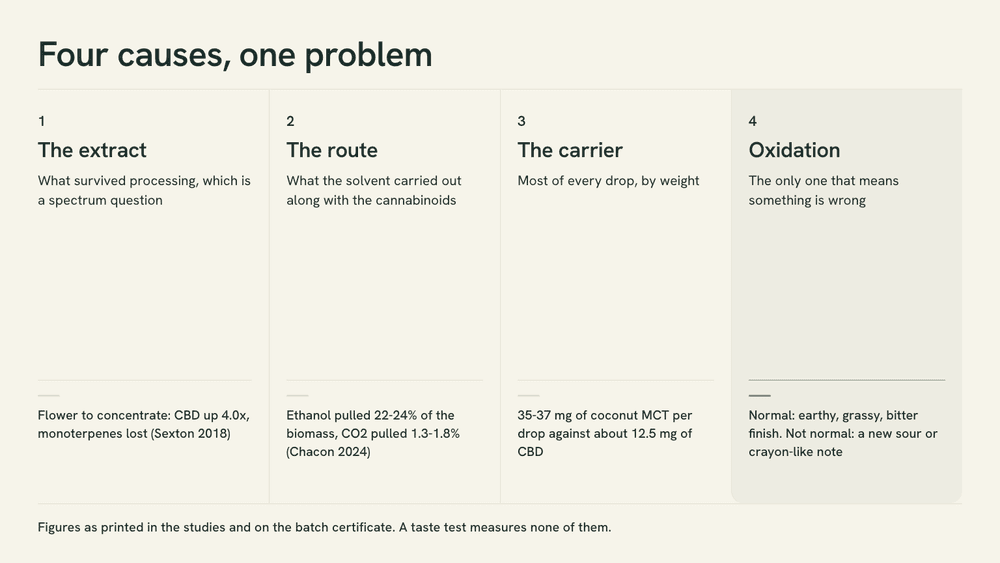
Four independent things are producing it. First, the extract's own compounds: a 2025 sensory-guided study of dried CBD-rich hemp flower identified 52 odor-active compounds, and a 2025 review notes that non-volatile flavonoids and phenolics are taste-active as well, which is where bitterness lives. Second, whatever the extraction route carried out along with the cannabinoids, since ethanol pulled 22 to 24 percent of the biomass in one 2024 comparison against 1.3 to 1.8 percent for supercritical CO2. Third, the carrier oil, which by weight is most of every drop. Fourth, oxidation. Only the fourth means something is wrong.
Neither. It is a rough signal of how much of the plant survived processing, and rough is the important word. A purification chain that reaches over 99 percent pure CBD leaves almost nothing to taste, and that is a deliberate product decision rather than a defect, which is why an isolate is close to flavorless. Flavoring is a masking agent and tells you nothing in either direction. Put simply: the tongue gives you a rough read on spectrum, and the certificate of analysis gives you the quality.
The heat is the smaller problem. The published CBD degradation figures are at 220 degrees C in sealed vials, where over 80 percent was gone after an hour, and at a 300 degrees C instrument inlet, where 20 percent was lost. The one study that actually brewed hemp, in a moka pot, concluded there was no meaningful decarboxylation given the maximum temperatures reached and the very short exposure. The bigger problem is physical: the FDA-approved CBD label states the molecule is insoluble in water, so an oil in a hot water-based drink separates, clings to the rim and coats the inside of the mug. On a 250 mg/mL tincture a drop is about 12.5 mg, so what stays behind is not a trace. Nobody has measured how much.
Yes, and it is close to the opposite of what the tips pages imply. A 2024 meta-regression across 112 trial arms found fed status associated with higher peak concentration and higher total exposure, and a phase 1 trial of 750 mg prescription CBD found a high-fat meal raised AUC 3.8-fold and Cmax 5.2-fold against fasted. That is a different product at a different scale and the ratios do not transfer to a consumer tincture. The useful takeaway is about consistency rather than more or less: taking the same drops with food one day and on an empty stomach the next means two different exposures.
We sell both, so read this knowing that. Flavoring is added to the same oil and changes what you taste, not how you take it or what the extract is. It is a masking agent rather than a grade. The one practical difference worth knowing is that an unflavored oil is the version that will show you a change in the oil first, because there is nothing sitting on top of it. If the taste is the reason a bottle goes unused, a flavored one is a reasonable answer and it costs nothing on the label.
The tell is a change rather than a flavor. A sour, sharp, waxy or crayon-like note that was not there when you opened the bottle, usually with a stale smell arriving first, is the fat oxidizing rather than the extract doing anything. Do not run a taste test on a bottle you already suspect: a taste test cannot measure remaining CBD, cannot detect a contaminant and settles nothing. Stop using it, find the batch number, look at how it has been stored, and check the batch's certificate of analysis. Shelf life and storage are covered in detail on our page about whether CBD oil expires.
The tongue is a genuinely good instrument for one job, which is noticing that something changed. It is a bad instrument for potency, purity and contamination, and those are the three things actually worth knowing about a bottle. Every Planntz batch has a third-party certificate of analysis published on our lab results page, and that document is where the potency figures and the batch identity live.
Read the batch, not the bottle
Every Planntz tincture is 60 mL of coconut MCT oil, sold as Mango and Peach, Lemon and Raspberry, or unflavored Natural, and each batch has its own third-party certificate of analysis published for anyone to read. The flavor is a preference. The certificate is the record.
See the tincturesWriting about hemp, wellness and the small rituals that keep us balanced.