Is CBD Halal? Read the Certificate, Not the Marketing
Page one answers this as a theological yes or no. Your question is about a bottle. Here are six named answers, the two published standards we could actually read, and the three ingredient questions a certificate and a label can settle. No ruling from us.
People search for "is CBD halal" as a yes-or-no question. The thing in your hand is a specific bottle, from a specific batch, with a specific number printed on a specific document. Those are two different questions, and only one of them can be settled by a website.
The short version, up front. Nobody selling CBD is in a position to answer that for you, and this page does not try. What the retrieved documents show is that the bodies who do answer it work the way a laboratory works: they name a substance, they set a limit or a test, and then somebody has to produce a document showing whether a particular batch is inside it. Six documents from four publishers, five of them dated between 2018 and 2021, apply at least five different tests. Two certifying authorities publish real numbers with real scopes. So the useful thing an evidence-led hemp company can do here is show you which number your scholar or your certifier is likely to ask for, and which document contains it. That document is the certificate of analysis for your batch.
We read the first page of results for this question on August 21, 2026. One of the six results was a religious primary source. The other five were CBD retailers, four of them selling into the UK or the EU, which is why several of them price the question at 0.2% THC, a European figure, on a query asked mostly from the United States. Across those five pages the phrase limit of quantitation appears zero times, residual solvent appears zero times, and certificate of analysis appears once. One of them carries a subheading announcing a verdict. A company that sells the product is the wrong author of a verdict about the product, so this page reports positions, attributes every one of them to a named body with a date, and issues none of its own.
Before anything else: Planntz is not halal-certified
No Planntz product holds halal certification from any certifying body, and nothing on this page should be read as a claim that one does. Our Full Spectrum CBD tinctures are not a close call under several of the positions below. The three current batches print total THC of 0.239% (Mango & Peach, batch 260310), 0.243% (Lemon & Raspberry, batch 260309) and 0.252% (Natural, batch 260303). Our CBD+CBG and CBD+CBN tinctures are also full-spectrum and print lower: 0.142% to 0.159% across batches 260313, 260314 and 260315, and 0.129% to 0.163% across batches 260304, 260311 and 260312. Every one of those figures sits inside the 0.3% federal definitional ceiling, which is a legal line and not a religious one, and every one of them is a long way from no trace detected.
Our Broad Spectrum line is where the wording has to be careful, and it is a large part of why this article exists. Two current batches report delta-9 THC as ND, meaning not detected: Mango & Peach batch 260320 and Natural batch 260319. A third, Lemon & Raspberry batch 260321, reports 0.0189%, which is 10.7 mg of THC in the bottle. Same product line, three batches, two different answers. As the next section shows, ND is not the same as zero. Our certificates cover potency, heavy metals and microbials, and they carry no residual-solvent panel, so if the body that certifies for you wants to see one, ours does not answer that question today. Every batch certificate we hold is published at our lab results page, which is the document a certifier or a scholar would ask for anyway.
What six named sources actually say, and why they do not agree
Start with the answer that currently ranks first, because it is the only religious primary source on page one and because it already frames the question as a measurement. Islam Q&A, in answer 271543 dated October 17, 2018, sets the condition this way: permissible "if it is proven that cannabidiol (CBD) is not harmful and does not contain THC, or it contains a small amount that is completely absorbed and no trace of it can be detected." Read that last clause again. "No trace of it can be detected" is a detection test, and detection is a laboratory word. It depends on an instrument, a method, and a stated floor below which that method sees nothing.
The same publisher has answered this family of questions twice more, and the tests are not identical. In answer 256355, dated August 9, 2021, about a hemp oil containing 0.06% THC, the reply is that the percentage present "is a small amount that is negligible and has no effect, so it does not make it haraam to consume it." That is a quantity test rather than a detection test, applied to one specific bottle described by one specific questioner. In answer 259044, dated August 8, 2021, the line falls somewhere else again: it is not permissible to add THC to a product "no matter what the percentage," but where it is already present and the percentage is negligible "so that it has not left any trace," the position changes. Deliberate addition and unavoidable residue are two different questions there, and that distinction does a great deal of work in every standard we read.
Three further bodies apply three further tests. The Fiqh Council of North America, in a statement adopted in Houston on September 2, 2018, writes that "THC is psychoactive" while "CBD, on the other hand, does not cause such an effect," and then sets a functional condition: "If these products do not intoxicate a user when consumed in large amounts, then they are permissible to use in Islam for medical purposes only." Darul Ifta Birmingham, in an answer its own site dates to May 21, 2020, states it with no tolerance at all: permissible "if the CBD oil is composed of pure CBD and no THC is found in it." And an answer approved by Mufti Ebrahim Desai and published on Askimam, which carried no date on the copy we read on August 22, 2026, adds a condition none of the others carry. It permits use as a remedy where it "does not lead to intoxication" and "as long as the laws and regulations of your country permit the use of CBD related products," and states plainly that "it is not permissible to smoke CBD." That last answer was written about smoking, so it is reported here only for the two conditions it sets.
A US certifier has also put a position in writing, and although it is not one of the six documents in the table below, it sits at the far end of the same range. Islamic Services of America, a certification body in Cedar Rapids, Iowa, wrote on June 3, 2021, in an article announcing that it had certified the ingredients and processes of a Colorado hemp extractor, that many CBD oils contain "between zero to .3% THC" and that "it is safe and Halal to consume CBD oils that have trace amounts of THC or none at all." Set that sentence next to Darul Ifta Birmingham's "no THC is found in it" and you have the whole spread of this question in two lines. Note what each document is, though: ISA's is a certifier's published article about a client it certified, not a standards document, and the five fatwa answers in the table are replies to specific questioners. None of them was written to you.
| Document | Date | What it says | The test it applies |
|---|---|---|---|
| Islam Q&A, answer 271543 | October 17, 2018 | Permissible if it does not contain THC, or contains so little that "no trace of it can be detected" | Detection: can the method find it at all |
| Islam Q&A, answer 256355 | August 9, 2021 | Of a hemp oil containing 0.06% THC: "a small amount that is negligible and has no effect" | Quantity: is the measured percentage negligible |
| Islam Q&A, answer 259044 | August 8, 2021 | Adding THC is not permissible "no matter what the percentage"; where it is already present and negligible, "so that it has not left any trace", the answer changes | Intent: deliberate addition versus unavoidable residue |
| Fiqh Council of North America | Adopted September 2, 2018 | "If these products do not intoxicate a user when consumed in large amounts, then they are permissible to use in Islam for medical purposes only" | Function: does it intoxicate at large amounts |
| Darul Ifta Birmingham | May 21, 2020 | Permissible "if the CBD oil is composed of pure CBD and no THC is found in it" | Absence: no THC found, no stated tolerance |
| Askimam, approved by Mufti Ebrahim Desai | No date on the page we read | Permissible where it does not lead to intoxication and where "the laws and regulations of your country permit"; smoking CBD is not permissible | Function plus the civil law where you live |
Six documents, four publishers, and at least five different working tests. Reading down the last column of that table: whether any trace can be detected at all, whether a measured percentage is negligible, whether the THC was deliberately added or was already present, whether the product intoxicates when consumed in large amounts, whether any THC is found at all, and whether the civil law where you live permits it. We are not ranking those, not counting them into a majority, and not resolving them into one position. A hemp company is the wrong institution to attempt any of that, and the differences between them are not sloppiness, they are different bodies answering different questioners at different dates. What they share is the underlying criterion, which is intoxication, and whether CBD itself is intoxicating has its own page here, on its own terms. What they differ on is how the criterion gets tested. Every one of those tests is a question about a measurement, which means every one of them lands on the same piece of paper.
The first ingredient question is THC as a number, not as THC-free
Two sentences of law, then we move on. Federal law today defines hemp as the plant and its derivatives with a delta-9 tetrahydrocannabinol concentration of not more than 0.3 percent on a dry weight basis. From November 12, 2026, the definition changes from delta-9 alone to a total tetrahydrocannabinols concentration including tetrahydrocannabinolic acid, and what the 2026 change does and does not do is covered in full on its own page rather than re-derived here. The part that matters for this question is smaller: 0.3% is a crop threshold and a legal ceiling. It is not a measurement of your bottle and it was never written as a religious standard. It is also why the 0.2% figure printed by most of page one is the wrong number to hand a US reader, because that is a European limit. If you want the difference between the two molecules or where the hemp line sits inside the plant, both have their own pages.
Now the wording problem that page one never reaches. THC-free is not a defined term. No federal rule says what it means, no agency certifies it, and a bottle carrying that phrase on the front can still print a measured figure on its certificate. What a certificate actually reports for each cannabinoid is either a number or ND, meaning not detected, alongside two floors: the LOD, or limit of detection, which is the level below which the method cannot see the substance at all, and the LOQ, or limit of quantitation, which is the level below which it can see something but cannot put a reliable number on it. ND means the method did not find it down to that floor. It does not mean the number is zero. How to read the rest of that document is a page of its own, and so is which spectrum answers which question.
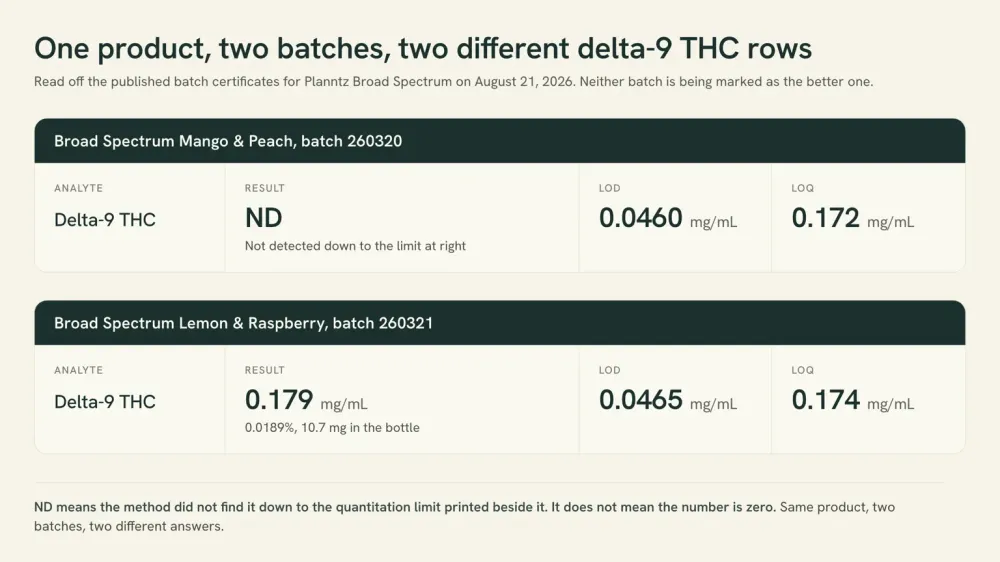
Our own certificates show why the distinction is not academic. Broad Spectrum Mango & Peach batch 260320 reports delta-9 THC as ND against a printed detection limit of 0.0460 mg/mL and a quantitation limit of 0.172 mg/mL. Broad Spectrum Natural batch 260319 reports ND against 0.0461 and 0.173 mg/mL. Broad Spectrum Lemon & Raspberry batch 260321 reports 0.179 mg/mL, which the same report also expresses as 0.0189% and as 10.7 mg in the bottle, against that batch's own quantitation limit of 0.174 mg/mL. That last result is barely above its own floor. Three batches of one product, and against the detection test written by Islam Q&A in 2018, two of them read one way and one of them reads the other. Nothing on the front of the bottle distinguishes them. Only the batch certificate does.
Alcohol is two questions, and page one answers neither
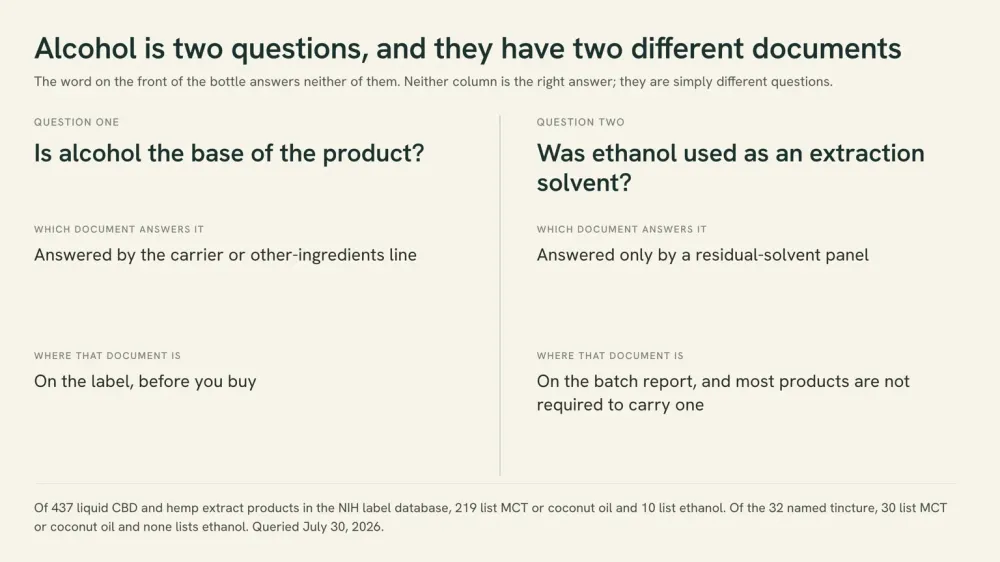
The first is alcohol as the base of the product. In older pharmacy usage a tincture is an alcohol extract, and a few liquid CBD products still are exactly that. Most are not, and where the word tincture stopped meaning alcohol is the page that owns that terminology. The measurable version, from an analysis of the NIH Dietary Supplement Label Database covering 437 unique liquid CBD and hemp extract products, queried on July 30, 2026: 219 of them, or 50.1%, list MCT or coconut oil as the carrier, and 10, or 2.3%, list ethanol. Of the 32 products whose name contains the word tincture, 30 list MCT or coconut oil and none lists ethanol. That is a label archive rather than a market census, and it does not mean no CBD tincture contains alcohol. It means the word on the front of the bottle does not answer the question, and the carrier line does.
The second is alcohol as a process solvent. Ethanol is one of the common ways cannabinoids are pulled out of hemp, and it leaves a residue question behind it: how much of the solvent is still in the finished oil. How each extraction method actually works is covered in full there. What matters here is that only one document answers the residue question, a residual-solvent panel, and for a finished hemp CBD product almost nobody is required to run one. California's Health and Safety Code section 111925, the state's hemp testing requirement, requires raw hemp extract to be tested for cannabinoid content by an independent laboratory and the total-THC cap proven, and it names no contaminant panel and no residual solvent at all. USDA's sampling rule at 7 CFR 990.3 tests the crop within 30 days of harvest, not the bottle. And a 2026 critical review of how US states regulate and measure cannabis contaminants records wide variability in allowable limits, analyte lists and method validation requirements across states, though it covers state-licensed cannabis rather than hemp. So if a solvent result matters to your standard, you have to ask for it by name. The words tested and third-party tested do not tell you which panels were run.
- Alcohol as the base of the product: answered by the carrier or other-ingredients line on the label, before you buy.
- Alcohol as an extraction solvent: answered only by a residual-solvent panel on the batch report, which most finished hemp CBD products are not required to carry.
- The word tincture on the front of the bottle: answers neither, because in current US usage it usually describes an oil.
The numbers authorities and certifiers publish, and the ones we could not verify
Religious authorities do publish numbers, and reading one shows how the reasoning is built. The MUIS Fatwa Committee's ethanol fatwa, issued by Singapore's government religious authority and last updated on February 21, 2025, permits ethanol as a solvent as long as it is not produced from prohibited products, and then states the limits plainly: "The content of ethanol in the flavoring should not exceed 0.5%, and the content of ethanol in the end-product should not exceed 0.1%." It also fixes its own scope in the same document: "The permissibility of using ethanol is exclusively for the purpose of flavoring." Note carefully what that is and is not. It is a position about food flavoring, with a number, a scope and a date. It is not a rule about hemp extraction and it was not written about a CBD tincture. We quote it because it demonstrates the method, not because it governs your bottle.
A certifier will also show you its arithmetic if it publishes openly, and one does. Halal Quality Control, a certification body based in The Hague, posts its Ethanol Usage Guideline as a public document, guideline code 0415, version 2.2, issued January 7, 2026. It does not set one limit. It sets a table per destination market, which means the same finished product can sit inside the limit for one country and outside it for another. Its own FAQ says why, verbatim: "Different Halal authorities adopt different Fiqh positions and regulatory thresholds... Export destination determines which limits apply." A second line from the same FAQ is worth carrying too, because it heads off a common confusion: "The limits defined in Guideline 0415 are religious (Halal) limits, not food safety or quality limits."
| Destination (HQC table) | Coloring | Flavoring | All other items |
|---|---|---|---|
| Gulf and Middle East (A1, itemized by food category instead) | No such row in HQC Table A1 | No such row in HQC Table A1 | 0.2% |
| Malaysia (B1) | 0.5% | 0.5% | 0.1% |
| Indonesia (C1) | 0.5% | 0.5% | 0.5% |
| Singapore (D1) | 0.5% | 0.5% | 0.1% |
Three things to hold on to from that table. First, these are ethanol limits and not THC limits: they answer the solvent question, not the cannabinoid one, and blending the two would be an error. Second, we are not placing any Planntz product in any row of it, because we are not certified by that body and nobody has assessed our products against its scheme. Third, the Gulf table is built differently from the other three. Instead of a coloring and flavoring pair it is itemized by food category: soft and energy drinks, processed foods and confectionery at 0.05%, fruit drinks and ready-to-drink flavored waters at 0.1%, juices, nectars and dairy at 0.2%, sauces and ready-to-eat foods at 0.3%, pickles, other vinegar and raw materials at 0.5%, grape vinegar at 1%, and the catch-all row shown above at 0.2%. Non-food categories such as flavors, fragrances and chemicals carry "No Defined Limit" in the guideline, footnoted with the condition that where ethanol is used as a solvent that cannot be completely dispensed within manufacturing, the amount in the final product must not exceed the maximum limits. Notice that the structure of that footnote is the same distinction the fatwas draw between something deliberately added and something unavoidably left behind.
Certified CBD products do exist in the United States, which is worth knowing if certification is what your standard requires. Salaam Gateway reported on February 17, 2022 that a Nevada company had received halal certification for CBD products from the American Halal Foundation in October 2021. We are reporting that a certification was granted and nothing more. We have not verified the certificate, we are not recommending the product, and whether any given certificate is still current is a question for the certifying body rather than for a blog post.
The ingredient line: what the label must tell you, and what it never will
One of these questions the label has to answer, because a federal rule forces it. Carmine and cochineal extract are red colorings made from an insect, Dactylopius coccus, and since a 2009 amendment 21 CFR 73.100 requires the label of a food product to "specifically declare the presence of the color additive by listing its respective common or usual name, 'cochineal extract' or 'carmine,' in the statement of ingredients." So on a coated gummy or a colored softgel, if it is in there, the word is on the panel and you can find it in five seconds.
The next one the label does not have to answer, and most readers assume the opposite. Natural flavor is a defined federal term, and the definition at 21 CFR 101.22 lists the origins it may come from: material derived from "a spice, fruit or fruit juice, vegetable or vegetable juice, edible yeast, herb, bark, bud, root, leaf or similar plant material, meat, seafood, poultry, eggs, dairy products, or fermentation products thereof." Read that list again. Animal-derived sources are inside the definition, and nothing in the rule obliges the panel to say which origin was used. Natural flavors is a category, not an ingredient. That is a fact about the labeling rule and not an accusation about any product, and its practical effect is simple: if the origin matters to you, the label cannot tell you. The manufacturer can.
Gelatin works the same way. Federal labeling requires ingredients to be listed by their common or usual name, and the common or usual name is gelatin. Whether it came from a cow, a pig or a fish is not required on the panel. On a softgel shell or a gummy, that is exactly the fact a reader in this position needs and exactly the fact the rule does not carry. The same shape of question applies to glycerin, which can be plant-derived or animal-derived without the panel distinguishing them, and to the glazes used on coated products. Those are questions to send to a manufacturer, and this page attaches no claim to any of them. Where gummies and softgels differ from oils maps those formats, and the gap between the front of the pack and the certificate is a page of its own.
For completeness about our own line, stated as scope rather than as an argument: Planntz sells four tinctures, all 60 mL, all cannabinoids in coconut MCT oil, and we do not make gummies, softgels or capsules. We also do not publish a full ingredient declaration, which means a reader who needs to know the source of a flavor has to write and ask us. That is a gap on our side, not a feature of the product, and it is the same gap you should test every manufacturer for, including this one.
- What is the source of the natural flavor in this product, and is any part of it animal-derived?
- Is the glycerin in this product plant-derived or animal-derived, and can you name the source?
- If there is a capsule, a softgel shell or a coating, what is it made of, and if it contains gelatin, which animal is it from?
- Was ethanol used at any point in extraction or processing, and do you hold a residual-solvent report for this batch?
- Does this product hold certification from any halal certifying body, and if so, which body, which certificate number, and valid through what date?

A five-minute check you can run on any bottle
None of this asks you to become a chemist. It asks you to hold two documents at the same time: the standard you were given, and the report for the batch in your hand. Our broader guide to choosing a CBD oil covers the buying decision generally. What follows is the version scoped to a suitability question, and every step names the document that answers it.
- 1Write the standard down first. Ask your scholar or the body that certifies for you what the test is, and get it as a number or as a stated condition, not as an impression.
- 2Find the certificate for your batch, not for the product. Match the lot or batch number printed on the bottle to the one printed on the report.
- 3Read the delta-9 THC row and the total THC row, then read the LOD and LOQ columns printed beside them. A result of ND is only meaningful against those two floors.
- 4Decide whether ND at that particular floor satisfies the test you were given. A detection test and a negligible-percentage test can come apart on the same batch.
- 5Check the spectrum word on the label against what the certificate actually shows. Full, broad and isolate describe processing, not results.
- 6Read the carrier line for the base of the product. MCT, coconut oil, hemp seed oil, glycerin or ethanol is a different answer each time.
- 7Ask whether a residual-solvent panel exists for that batch and request the report. Potency, metals and microbials do not answer the solvent question.
- 8Send the ingredient questions in writing and keep the reply. A dated written answer is evidence you can produce later; a phone call leaves you nothing to show.
What this page deliberately does not do
It issues no ruling, and that is not modesty, it is scope. We showed six documents precisely so that nobody has to take a hemp company's summary of them, and we have not ranked them, counted them into a majority or reconciled them. The two standards we quoted have scopes you should hold on to: the Singapore fatwa is about food flavoring, and the Halal Quality Control guideline binds that certifier's own clients and applies by export destination. Neither is a world limit and neither was written about hemp extract. Both are here as evidence that these bodies work in numbers, which is the whole reason a certificate is the useful document.
Two further limits. Certification status and batch results both change, so a certificate you read last year is not evidence about a bottle you bought this month, and our own numbers here are true of the batches named and of no others. And there is one question on this topic that sits entirely outside our competence: whether taking an ingested product affects a fast is a matter of fasting law, not of laboratory analysis, and no document we retrieved addresses it. A certificate can tell you what is in the bottle. It cannot tell you what that means for you, and neither can we.
We do not issue rulings, and a company that sells hemp extract is the wrong source for one. What we can report is what the named documents say. All six of the documents in the table above share the same underlying criterion, which is intoxication, and they differ on how that criterion is tested: whether any trace can be detected at all, whether a measured percentage is negligible, whether the THC was deliberately added or was already present, whether the product intoxicates when consumed in large amounts, whether any THC is found at all, and whether the civil law where you live permits it. Those are different questions to ask about a bottle, and they do not always produce the same answer for the same bottle, which is why each one is printed here with its issuing body and, where the page carries one, its date. The answer for you comes from your own scholar or from the body that certifies for you. What a certificate of analysis does is let you hand them a number instead of an impression.
0.3% is a US federal definition of the crop, from 7 U.S.C. 1639o, and it is a legal ceiling rather than a measurement of the bottle in front of you. It was not written as a religious standard, and the sources on this page land in different places relative to it. Islamic Services of America wrote in June 2021 that it is "safe and Halal to consume CBD oils that have trace amounts of THC or none at all", while Darul Ifta Birmingham's May 2020 answer requires that no THC is found in the oil at all. Nothing on a label closes the gap between those two positions; the batch certificate does, because it prints the measured figure and the floors the method could see down to. One more thing to watch: the 0.2% figure you will see on several pages ranking for this question is a European limit, not a US one, so it is the wrong number to apply to a bottle bought in the United States.
No. Broad spectrum is a description of processing, not a guarantee of a result, and our own certificates show the difference inside a single product line. Broad Spectrum Mango & Peach batch 260320 reports delta-9 THC as ND, meaning not detected, against a printed detection limit of 0.0460 mg/mL and a quantitation limit of 0.172 mg/mL. Broad Spectrum Lemon & Raspberry batch 260321 reports 0.179 mg/mL, or 0.0189%, just above that batch's own quantitation limit of 0.174 mg/mL. ND means the method did not find it down to the stated floor. It does not mean the number is zero, and THC-free is not a defined term anywhere in federal law. If the standard you were given is a detection test, then the batch number is the entire answer, and the product name tells you nothing.
It is two separate questions. If alcohol is the base of the product, the carrier or other-ingredients line on the label tells you, and most liquid CBD sold in the US is oil-based rather than alcohol-based. If ethanol was used as an extraction solvent, what remains in the finished oil is a residue question, and only a residual-solvent panel answers it. Ours do not include one. Both questions have been answered numerically by authorities elsewhere: Singapore's MUIS fatwa, last updated February 21, 2025, permits ethanol as a solvent where it is not produced from prohibited products, caps it at 0.1% in the end product and restricts the permission to flavoring use, while Halal Quality Control's Guideline 0415 judges unavoidable solvent residue against its finished-product table by destination. Both are quoted on this page as evidence that these bodies work in numbers. Neither was written about hemp extract, and neither is a ruling for you.
That is an ingredient-line question rather than a cannabinoid question, and the label is only partly able to answer it. Federal labeling requires ingredients to be listed by common or usual name, so a softgel shell says gelatin and is not required to say bovine, porcine or fish. The definition of natural flavor at 21 CFR 101.22 expressly includes meat, seafood, poultry, eggs and dairy products among the permitted origins, with no obligation to name which one was used. Carmine and cochineal extract are the exception that must be declared by name under 21 CFR 73.100. Glycerin and coating glazes sit in the same gray area as flavors. So the method is: read the panel for what it does carry, then write to the manufacturer for the rest and keep the reply. That written answer is what a certifier can look at later; your memory of a phone call is not.
There are two halves to that question and we can only speak to one of them. Whether taking an ingested product affects a fast is a matter of fasting law and belongs to your scholar. Nothing in a laboratory report speaks to it, and none of the six documents we retrieved for this article addresses it, so we are not going to imply an answer by arranging facts around it. The half a certificate can settle is what is in the bottle: the measured cannabinoid figures, the detection and quantitation limits sitting behind an ND result, and the carrier the cannabinoids are suspended in. This page publishes no timing advice and no amounts, because neither is ours to give.
Three routes from here, and none of them is a purchase. Every Planntz batch certificate, including each of the ones quoted on this page, is published at our lab results page, so you can check our numbers rather than take our word for them. Our walkthrough of a certificate of analysis explains the rest of that document row by row, including what else the limits columns tell you. And how the spectrum labels map onto what a certificate shows is the product-shaped version of the same question, which is useful before you are standing in front of a shelf.
Writing about hemp, wellness and the small rituals that keep us balanced.