Can You Bring CBD on a Cruise? Three Rulebooks Apply, and Only One Is US Law
Three separate rulebooks apply to one bottle on one trip: the ticket contract you agreed to at booking, the law of every port the ship calls at, and US customs on the way home. Only the third one is US law. Here is what four carriers publish, word for word.

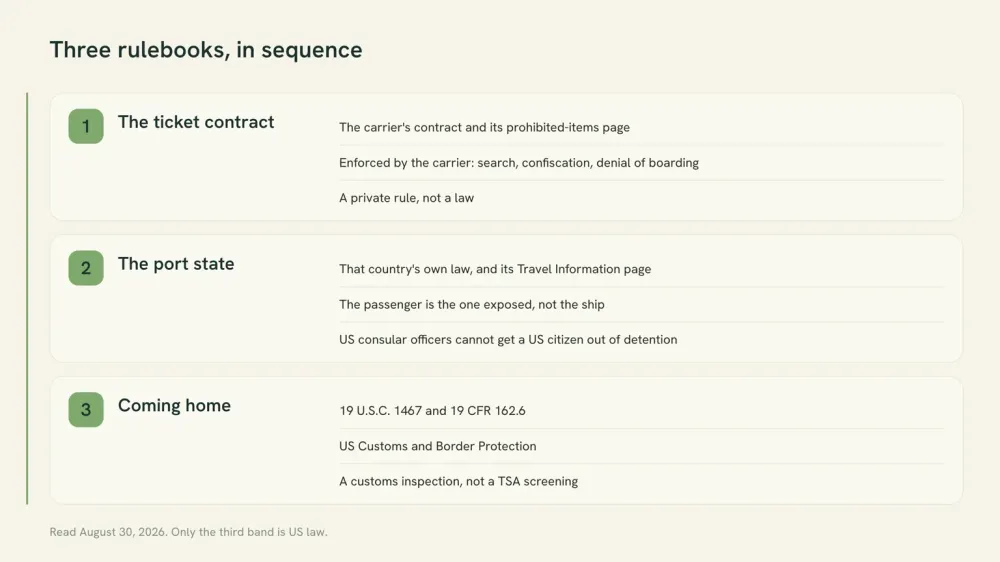
Can you bring CBD on a cruise? The reason this question is hard to answer is that it is really three questions wearing one coat. A cruise sails under a private contract you agreed to when you booked, it calls at ports where a different country's law is the only law in the room, and it ends with you walking back into the United States through a customs inspection. Three rulebooks, in sequence, and only the third one is US law. Not one of the page-one results we could read on August 30, 2026 quotes a clause from any of the three.
Can you bring CBD on a cruise? Start by noticing it is not a flight
The rule most people carry into this question is the airport one, and it does not apply at any point of a cruise. TSA screens aviation. A cruise terminal is screened by the cruise line under a contract, the ship then calls at foreign ports where the only relevant law is that country's, and the trip finishes with a customs inspection rather than a security checkpoint. Our guide to federal and state CBD law covers the domestic rule and the flying question in full, and that is where the airport answer lives. This page picks up where a boarding pass stops being relevant.
So instead of one answer, there are three, and they stack. Layer one is the carrier's own contract, a private rule that can ban a federally lawful product and is enforced by search, confiscation and denial of boarding. Layer two is each port state, where a passenger, not a ship, is the one who would face a foreign court. Layer three is US Customs and Border Protection on the way home, which is a different agency, a different statute and a different kind of search from the one you are picturing. The rest of this page takes them in that order, quotes what the actual documents say, and ends with the check you can run yourself before you pack.
Layer one: the ticket contract is a private law you already agreed to
A prohibited-items page on a cruise line's website is not a law. Nobody voted on it, no agency issued it, and it can ban a product no federal statute bans. It still binds you, and the mechanism is one clause in a document you accepted at booking and probably did not open. Royal Caribbean's US Cruise and Cruisetour Ticket Contract, read on August 30, 2026, sets out in Section 4.a what a guest may not bring aboard. The quotation below starts mid-sentence, and the ellipsis inside it marks a cross-reference to another section that we cut out of the live-animals item. Nothing else has been removed.
“any illegal controlled substances (including medical marijuana), fireworks, live animals ..., weapons, firearms, explosives or other hazardous materials, or any other items prohibited by applicable law or Carrier policy.”
Read that last clause again. Or any other items prohibited by applicable law or Carrier policy. That is the hinge of this entire subject. The webpage does not have to be law, because the contract imports the carrier's policy, whatever the policy happens to say, into a document you agreed to be bound by. A page that can be edited on a Tuesday becomes enforceable on your sailing. It is also worth noting what is verifiably absent from that contract: the words CBD, cannabidiol, hemp and cannabis appear in it zero times, and it reaches CBD anyway.
Carnival's Cruise Ticket Contract does the same job with different words. Section 4(g), read the same day, says: "Marijuana and cannabis, and any and all marijuana and/or cannabis derivatives, and all illegal controlled substances are strictly prohibited and may not be brought on board any Carnival vessel." The operative phrase there is cannabis derivatives, which reaches CBD without naming it. Two carriers, two drafting styles, and both arrive at the same place by routes a reader would never find on a prohibited-items page.
One more clause explains why this page carries a date on every line. The Royal Caribbean contract opens with a notice, printed in capitals in the original and quoted here in sentence case, that you agree the carrier may change, modify, and update the terms of this ticket contract, that notice of such change may or may not be given, and that you nonetheless agree to be bound by any such change or modification. That is a carrier telling you, in its own document, that checking last year was not a check.
What four carriers actually publish, word for word
Here is what we could read ourselves. The table covers six documents from four carriers: Carnival's prohibited-items page and its ticket contract, Royal Caribbean's prohibited-items answer and its ticket contract, Norwegian Cruise Line's Prohibited Items List, and Princess Cruises' Passage Contract. Every row carries the date we read it. None of this generalizes: a carrier's page is authoritative for that carrier's rule and for nothing else, and your carrier may not be in this table at all.
| Carrier | Document we read | Does it name CBD? | Operative wording, as printed | Retrieved |
|---|---|---|---|---|
| Carnival | Prohibited Items page | Yes, by name | Under Illegal Drugs and Controlled Substances: "Cannabis-derived products, including Cannabidiol (CBD)". The page adds that such products "remain prohibited under U.S. federal law and may also be prohibited in ports visited by Carnival ships". | August 30, 2026 |
| Carnival | Cruise Ticket Contract, Section 4(g) | No. It reaches CBD as a derivative | "Marijuana and cannabis, and any and all marijuana and/or cannabis derivatives, and all illegal controlled substances are strictly prohibited and may not be brought on board any Carnival vessel." | August 30, 2026 |
| Royal Caribbean | Prohibited items policy answer | No. CBD, cannabidiol, hemp and cannabis do not appear anywhere on the page | "Illegal drugs and illegal substances, including marijuana, are prohibited regardless of medical authorization or local legality." Unlisted items "may still be prohibited", with Security holding "sole discretion to determine whether any item is allowed". | August 30, 2026 |
| Royal Caribbean | US Cruise and Cruisetour Ticket Contract, Section 4.a | No. It reaches CBD through the catch-all | Bars "any illegal controlled substances (including medical marijuana)" and "any other items prohibited by applicable law or Carrier policy". | August 30, 2026 |
| Norwegian Cruise Line | Prohibited Items List, item 1 | Yes, by name and by format | "This includes all products containing CBD, oils, candies, and gummies or any product containing THC." The list opens by saying prohibited items "will be confiscated and not transported aboard". | English wording from an archived copy dated July 16, 2025; live page confirmed August 30, 2026, served to us in Portuguese |
| Princess Cruises | Passage Contract, Section 15 | No. Cannabis, marijuana, CBD, cannabidiol and hemp occur zero times in the contract | "You may not take on board firearms, controlled or prohibited substances, inflammable or hazardous items, any other items prohibited by applicable law, or any other item Carrier deems in its sole discretion to be detrimental to the safety, security, comfort or well-being of any person." The contract then links to a prohibited-items list on the Princess website and adds that the list "is subject to change without notice". | August 30, 2026 |
Two of the pages currently ranking for this question have already noticed that Royal Caribbean's prohibited-items answer does not name CBD. What none of them shows you is why the omission changes nothing, and it takes two documents to see it. The page itself says items not expressly listed may still be prohibited if deemed unsafe or inappropriate for onboard operations, with Security holding sole discretion to determine whether any item is allowed. The ticket contract, separately, bars anything prohibited by Carrier policy. A short public list that does not name your item has not answered your question. And the Princess row makes the same point from a third direction. Its contract never says cannabis, bars "controlled or prohibited substances" along with any item the carrier deems detrimental in its sole discretion, points at a prohibited-items list on the Princess website, and tells the guest to contact the carrier with questions about any other item. We followed that pointer on August 30, 2026: the list names medical marijuana and synthetic cannabis, and does not name CBD, cannabidiol or hemp, which leaves a reader exactly where Royal Caribbean's page leaves them.
What the carrier reserved the right to do about it
The carrier documents spell out what the carrier may do about a prohibited item, and they are unusually specific about it. Read every line below as a reserved power, which is what a contract records, and never as a description of how often anything actually happens. We have no data on how often anything happens, and neither does any page that implies it does.
- Search your cabin and your bags. Carnival's contract says the guest expressly agrees the carrier has, at all times with or without notice, the right to search the guest's cabin, baggage and personal effects for prohibited items.
- Screen you with dogs. Carnival's contract says guests and their luggage will be routinely and randomly screened by security personnel and screening tools and equipment, "including narcotics and contraband sniffing dogs".
- Screen you again at every port. The same sentence says that screening happens during embarkation, at ports of call and on board, not only at the terminal on day one.
- Refuse you the ship, with nothing back. Carnival's contract says a guest carrying such items may be denied boarding or reboarding and/or disembarked, and that no refund of any portion of the total cruise price will be issued.
- Confiscate. Norwegian's Prohibited Items List opens by saying listed items will be confiscated and not transported aboard, and that when an item is determined to be illegal the appropriate authorities will be informed.
- Search your stateroom. Royal Caribbean's Section 9.e lets the carrier search the stateroom, property or baggage of any guest, and disembark them without liability and at their expense, where in its sole opinion the guest is violating the agreement.
- Report you as a matter of policy. Royal Caribbean's Section 9.c states a zero tolerance policy for illegal activity and says such activity will be reported to the appropriate authorities.
- Hand you to CBP. Carnival's contract says a guest who brings marijuana or any illegal controlled substances on board will be reported to local and/or Federal authorities and US Customs and Border Protection for possible detainment or enforcement action.
One of the questions people type alongside this one asks whether cruise security will find hidden cannabis products. We are not answering it, and not out of squeamishness. The only two possible answers are a detection rate nobody publishes and a set of instructions for evading a search, and we will not write either one. What the contracts do publish is the list above, and that is the part you can verify and the part that binds you. A related question asks about consuming legal cannabis at a port stop and then reboarding. That is about marijuana rather than CBD and it is outside this page, with one sentence for anyone who arrived looking for it: the ship is not a jurisdiction that protects you, and the contract you signed is what governs whether you get back on.
Layer two: at a port of call, the passenger is the one who gets arrested
Carnival's contract names this layer for you, and it is the most useful sentence in any of the documents we read. It says a guest who brings marijuana or any illegal controlled substances on board, "in violation of Carnival's policy or U.S. or international law, including any law of a port or the flag state", will be reported to local and/or Federal authorities and to US Customs and Border Protection. Three separate legal systems in one clause, in the carrier's own document. The middle one is the layer that puts a passenger, not a vessel and not a company, in front of a foreign judge, and it is the layer the consumer coverage of this question skips entirely.
There is no country table on this page and there is not going to be one. A table like that goes stale silently, and the person holding the stale table is the one standing at the terminal. What transfers instead is a method, and it is the State Department's own. Its Traveler's Checklist says that "Some prescription and over-the counter medications are not legal in foreign countries, even though they are legal in the United States. This includes prescription narcotics." (The missing hyphen is the government's, quoted as printed.) It then points travelers to the Health and the Local laws and special circumstances sections of the destination's own Travel Information page. Its page on the arrest or detention of a US citizen abroad adds that you are subject to the local laws and regulations while visiting a country, and that for a specific country's laws you should contact that country's nearest embassy or consulate in the United States before you travel.
Two honest limits on that. First, the checklist is about medications generally and says nothing about CBD in particular, so treat it as a procedure rather than as a verdict about any product. Second, both of those State Department pages block automated readers, so we read them from dated archived copies (July 26, 2025 and August 8, 2025) and are citing them in plain text rather than linking them. Go to travel.state.gov yourself and read the live versions, which is what the method asks of you anyway.
Layer three: coming home is a customs question, not a TSA question
The final leg is where the airport analogy collapses completely. When a ship arrives at a US port from a foreign port, you are not being screened for a flight. You are arriving in the customs territory of the United States, and a customs officer has a statute behind them. 19 U.S.C. 1467, headed Special inspection, examination, and search, is the one that applies to a vessel.
“Whenever a vessel from a foreign port or place ... arrives at a port or place in the United States or the Virgin Islands ... the appropriate customs officer ... may ... cause inspection, examination, and search to be made of the persons, baggage, and merchandise discharged or unladen from such vessel, whether or not any or all such persons, baggage, or merchandise has previously been inspected, examined, or searched by officers of the customs.”
The regulation that implements it, 19 CFR 162.6, opens by saying that all persons, baggage, and merchandise arriving in the Customs territory of the United States from places outside thereof are liable to inspection and search by a Customs officer, and it expressly covers re-inspection even where the baggage was taken on board the vessel at another port in the United States. Notice what neither document says: neither one mentions CBD. They are authority to look, and one of our own ellipses in the section 1467 quotation above covers that statute's limit on the authority: the search is made for the purpose of "assuring compliance with any law, regulation, or instruction" that the Secretary of the Treasury or the Customs Service is authorized to enforce. What happens after somebody looks is decided by whatever federal law applies to whatever is found, which is the subject of the next section.
CBP's own published position on how federal law works at a port of entry sits in a statement about Canada's legalization of marijuana: "U.S. Customs and Border Protection enforces the laws of the United States ... Requirements for international travelers wishing to enter the United States are governed by and conducted in accordance with U.S. Federal Law, which supersedes state laws." Three limits ship with that quotation. It is about marijuana, not CBD. It is dated September 21, 2018 and updated October 9, 2018. And CBP's own banner marks the page as archived content published more than five years ago, whose information may be out of date. We quote it because it is CBP's, and we tell you its age because the agency does.
One more oddity worth knowing, because it saves you an hour of searching. The one page CBP publishes under the heading CBD is not addressed to travelers at all. CBD: Know the Facts is filed under Employee and Family Resources, in Health and Wellness, under Substance Abuse Prevention, with a footer date of September 30, 2024, and it concerns CBP's own Drug Free Workplace Plan. If you went looking for CBP guidance written for passengers and found that instead, this is why. Workplace testing is a separate subject and our explainer on CBD and drug tests handles it.
What "not legal under U.S. federal law" is actually pointing at
Carnival's prohibited-items page gives two different reasons for the same rule, on the same page, and both are worth reading slowly. The items list says cannabis-derived products including CBD "remain prohibited under U.S. federal law and may also be prohibited in ports visited by Carnival ships". The medical-marijuana answer on that same page says such items "are not legal under U.S. federal law and in all the ports we visit and therefore are also considered prohibited items". We are not going to tell you that either sentence is wrong. The rule binds through the contract regardless of which rationale is printed beside it. What is worth knowing is that the phrase "not legal under U.S. federal law" is doing two entirely different jobs in American law.
Job one is controlled-substance status. Under the Controlled Substances Act, the definition of marihuana at 21 U.S.C. 802(16)(B) expressly does not include hemp as defined in section 1639o of title 7, and 7 U.S.C. 1639o defines hemp by a delta-9 tetrahydrocannabinol concentration of not more than 0.3 percent on a dry weight basis. Job two is a marketing rule under a different statute. Under the Federal Food, Drug, and Cosmetic Act, FDA's consumer update on cannabis-derived products says it is "currently illegal to market CBD by adding it to a food or labeling it as a dietary supplement" (that page carries a content-current date of March 5, 2020). Our hemp versus marijuana explainer works through the first taxonomy, and what the FDA actually says about CBD covers the second.
Here is what to do with that observation: nothing. That is the point of making it. A single phrase on a policy page is compressing two separate federal regimes, so it will not carry the weight of a decision about your trip, in either direction. Your decision is made by the documents in the next section, and the carrier's rule binds you through the contract no matter which of the two regimes its page happens to be pointing at.
The document check to run before you pack
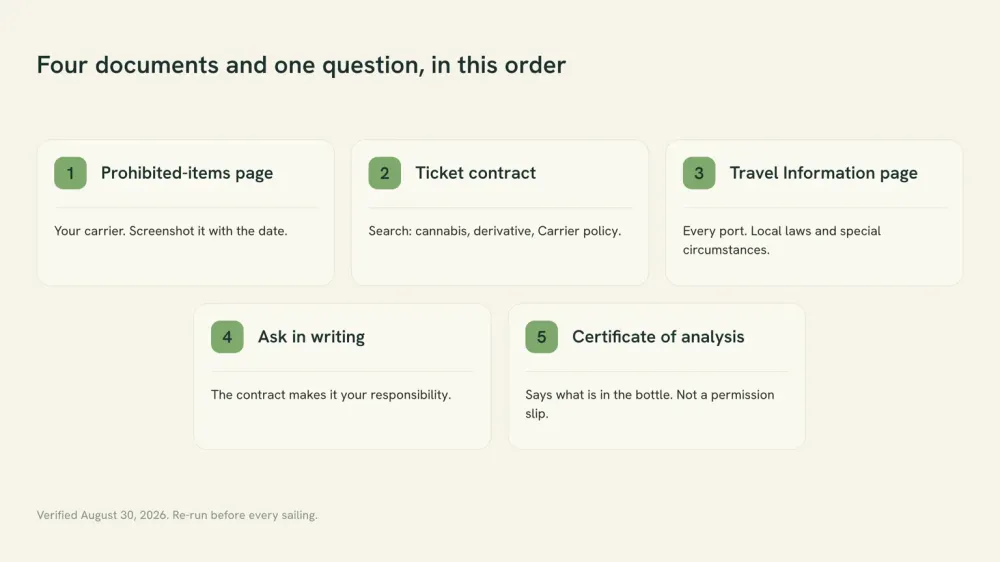
This is the deliverable, and it replaces every yes-or-no answer on the first page of results. Four documents and one question, in this order. It takes about twenty minutes and it produces an answer that is dated, which is the only kind of answer this subject has.
- 1Open your carrier's prohibited-items page today and read it yourself rather than a blog's summary of it. Screenshot it with the date visible, because the wording can change and you will want to know what it said when you packed.
- 2Open your carrier's ticket contract and search it for cannabis, derivative, controlled substance and Carrier policy. The ban often lives there and not on the list, and one contract we read reaches unlisted items through that clause alone.
- 3Open the destination's own Travel Information page for every port and read its Local laws and special circumstances section. Where anything is unclear, the State Department says to contact that country's nearest embassy or consulate.
- 4Ask the carrier in writing, and keep the answer. The contract itself tells you to: it makes advance notification the guest's responsibility whenever there is any question about whether an item may be taken onboard.
- 5Read the product's certificate of analysis, the only document that says what is actually in the bottle. It is not a permission slip, and none of the rules above turns on it, but you cannot describe what you are carrying without it.
Step four is not our advice, it is the carrier's. Royal Caribbean's Section 4.a says: "Guest shall be responsible to notify Carrier in advance of the Cruise if there is any question as to the permissibility of taking any item or substance onboard the Vessel." Ask by email, well before you sail, and keep the reply. Asking at the pier is a conversation with somebody who has no authority to change the answer.
Two notes on running this yourself. First, some carriers make it genuinely hard: on August 30, 2026 we could not retrieve a readable copy of Disney Cruise Line's or Virgin Voyages' policy, and MSC Cruises' page returned an access error, so this article reports nothing about what any of them says. If your line is not in the table above, that page is one you have to open yourself, and it is one no blog should be paraphrasing at you. Second, on the last step: our walkthrough of a certificate of analysis explains what the columns mean, and the spectrum guide explains why a broad-spectrum report and a full-spectrum report say different things about THC.
What changes on November 12, 2026
One more date belongs on this page. The federal definition of hemp quoted above is in force only through November 11, 2026. Public Law 119-37, enacted November 12, 2025, rewrites that definition effective November 12, 2026, swapping the delta-9 test for a total-THC test and adding a per-container limit, and as of August 30, 2026 the FDA had not yet published the lists the statute calls for, so the practical shape of the change is not settled. We do not re-derive any of that here: our breakdown of the 2026 hemp definition change works through the statute in full. The narrow point for a cruise is this. The federal definition your product sits inside for a September sailing is not the definition that applies to a January one, which is exactly why the check above is dated and why you run it again.
Questions people actually ask
The format is not what the rule turns on. Norwegian's Prohibited Items List names products containing CBD along with oils, candies and gummies. Carnival's list names cannabis-derived products including Cannabidiol (CBD) without listing formats at all. Royal Caribbean's list names none of them, and its ticket contract still reaches them through the Carrier policy clause. So the answer depends on your carrier's two documents, read on the date you sail, and not on whether the CBD is in a dropper or in a gummy. The Carnival and Royal Caribbean pages were read on August 30, 2026; the Norwegian English wording comes from an archived copy dated July 16, 2025, with the live clause confirmed the same day in Portuguese.
A certificate of analysis reports what one laboratory measured in one batch. Planntz's broad-spectrum COAs, for example, report non-detected THC on the mango and natural batches and a 0.019% trace on lemon. None of the three layers on this page turns on that number. The carrier's rule is a contract term, the port's rule is that country's law, and neither one reads your lab report before it applies. The certificate is still the document to have, because it is the only one that says what is in the bottle, but it is a description and not a permission.
Two of the carriers we read answer this directly and negatively. Royal Caribbean's prohibited items answer, read August 30, 2026, says illegal drugs and illegal substances, including marijuana, are prohibited regardless of medical authorization or local legality. Carnival's page, read the same day, says that while certain CBD products for medical or other use may be legal under some state or local laws, they remain prohibited under U.S. federal law. A card issued by a US state is not a term of the contract you accepted, and it is not the law of a foreign port either.
No, and this is the confusion driving the whole question. TSA screens aviation. A cruise terminal is screened by the carrier under the ticket contract you agreed to, which is where the search and screening clauses live. The arrival back in the United States is a customs inspection under 19 U.S.C. 1467, carried out by a different agency under a different authority. The domestic flying answer exists and it is a real one, but it lives in our federal and state legal guide rather than on this page.
We can tell you what the carriers say they may do, because they publish it. Norwegian says listed items will be confiscated and not transported aboard, and that when an item is determined to be illegal the appropriate authorities will be informed. Carnival says a guest traveling with prohibited items may be denied boarding or reboarding or disembarked with no refund of any portion of the total cruise price, and that a guest who brings marijuana or any illegal controlled substances on board will be reported to local and/or Federal authorities and to US Customs and Border Protection. Abroad, the State Department says consular officers cannot get US citizens out of detention and cannot pay legal fees. We will not give you odds on any of it, because nobody publishes them and a made-up probability is worse than none.
No, and answering it takes two documents rather than one. The page itself says items not expressly listed may still be prohibited if deemed unsafe or inappropriate for onboard operations, with Security holding sole discretion to determine whether any item is allowed. The ticket contract separately bars any items prohibited by applicable law or Carrier policy. And the same contract makes it the guest's responsibility to ask in advance if there is any question. A short public list that does not name your item has not answered your question, because two other clauses answer it instead.
There are three places to look before you sail, and none of them is a blog post. Your carrier's ticket contract and its prohibited-items page, which govern the ship. The official Travel Information page for every port on the itinerary, which governs the shore. And the certificate of analysis for what you own, which is the only document that describes it: Planntz publishes every batch report at our lab results page. If what you actually came for was the domestic picture, the federal rule, the state exceptions and the airport, the legal hub this page belongs to has it.
Writing about hemp, wellness and the small rituals that keep us balanced.