The 2026 Hemp Ban: What Changes on November 12, and What It Means for the CBD You Own
What people call the 2026 hemp ban is one section of a federal law, and it takes effect on November 12. Here is what the law says, why the 0.4 milligram ceiling is per container and not per serving, what our own lab reports show against it, and what the FDA has not published.
What people are calling the 2026 hemp ban is one section of a federal law that is already on the books, and on November 12, 2026 it changes what the word hemp means. It does not name CBD. It does not prohibit any product by name. It says nothing at all about what any cannabinoid does in a person. What it does is move a definition, and products that fall outside the new one stop being hemp. This article covers what changes, what the 0.4 milligram ceiling actually measures, what happened when we applied it to our own lab reports, and what still has no answer. Everything here reflects federal law as it stood on August 19, 2026.
There is a strange thing at the center of this story, and it is the reason so many explainers on the subject read as more confident than they should. The same law that narrows the definition also ordered the FDA to publish four documents that would fix the new definition's exact edge. Those documents were due on February 10, 2026. As of our cutoff they do not exist, which means that with fewer than 90 days to go, nobody outside the agency can tell you with precision which products the new line reaches. What follows is general information about how a statute is written, not legal advice, and federal law is a floor: state law can and does differ in both directions. For the evergreen federal-versus-state picture, start with our overview of where CBD stands legally.
What the 2026 hemp ban actually changes on November 12
The law is Public Law 119-37, signed on November 12, 2025. It is an appropriations act, which is part of why it took a year for most people to notice it: the hemp provision is section 781, buried in Division B, and it is not a standalone hemp bill. Section 781 opens with a clock. "Effective 365 days after the enactment of this Act," it says, "Section 297A of the Agricultural Marketing Act of 1946 (7 U.S.C. 1639o) is amended." Three hundred and sixty-five days after November 12, 2025 is November 12, 2026.
The amendment does two separate things, and they get fused constantly. The first works at the plant level: the quantity being measured changes from delta-9 THC alone to total tetrahydrocannabinols including THCA, still at 0.3% on a dry weight basis. That is the crop rule, and it has consequences for growers rather than for a bottle on a shelf. We cover what changed in the definition itself, including the conversion arithmetic and the measurement tolerance the USDA works to, on its own page, and this one does not repeat it.
The second thing is new, and it is the one that reaches a product you already own. The statute creates a category called a final hemp-derived cannabinoid product and excludes it from hemp if it contains "greater than 0.4 milligrams combined total per container of ... total tetrahydrocannabinols (including tetrahydrocannabinolic acid); and ... any other cannabinoids that have similar effects (or are marketed to have similar effects) on humans or animals as a tetrahydrocannabinol (as determined by the Secretary of Health and Human Services)." Read that second half slowly, because it is where the certainty on this topic quietly runs out. The ceiling is not only about THC. It also counts a category of other cannabinoids that the Secretary of Health and Human Services has to determine, and no such determination has been published.
0.4 milligrams per container, not per serving
On August 19, 2026 we read a consumer-facing result on the first page of Google for this query that rendered the threshold as "more than 0.4 milligrams of total THC per serving." It is not per serving, and the difference is not a small one. The statute says "per container," and then, unusually, it defines the word itself rather than leaving it to a regulator. We are not naming the site, because the point is the sentence, not the seller, and you can check it against the statute in about a minute.
“The innermost wrapping, packaging, or vessel in direct contact with a final hemp-derived cannabinoid product in which the final hemp-derived cannabinoid product is enclosed for retail sale to consumers, such as a jar, bottle, bag, box, packet, can, carton, or cartridge.”
The next subparagraph closes the obvious workaround: container "excludes bulk shipping containers or outer wrappings that are not essential for the final retail delivery or sale to an end consumer." So the unit of measurement is the bottle, the packet or the cartridge, whatever it holds and however many servings the label divides it into. The difference between the two readings is not rhetorical. A per-serving reading makes the ceiling look roughly as generous as the number of servings in the package, which for a tincture can be a factor of dozens. If percentages and milligrams tend to blur together for you, reading a CBD label without getting fooled by the units is the skill this whole section rests on.
One retrieval note, because it will save you a fruitless search. If you go looking for that container definition in the United States Code today, you will not find it. The current edition of 7 U.S.C. 1639o, which we reread on August 19, 2026, still carries the 2018 Farm Bill's delta-9 language and contains no definition of container at all. That is not an error in the Code. It is because the amendment does not take effect until November 12, so the text exists so far only as enacted law, at 139 Stat. 560. Quote it from the law, not from the Code. The plant-level half of the same amendment, the 0.3% line and the arithmetic behind it, sits on our hemp and marijuana comparison rather than here.
We ran the number on our own bottles
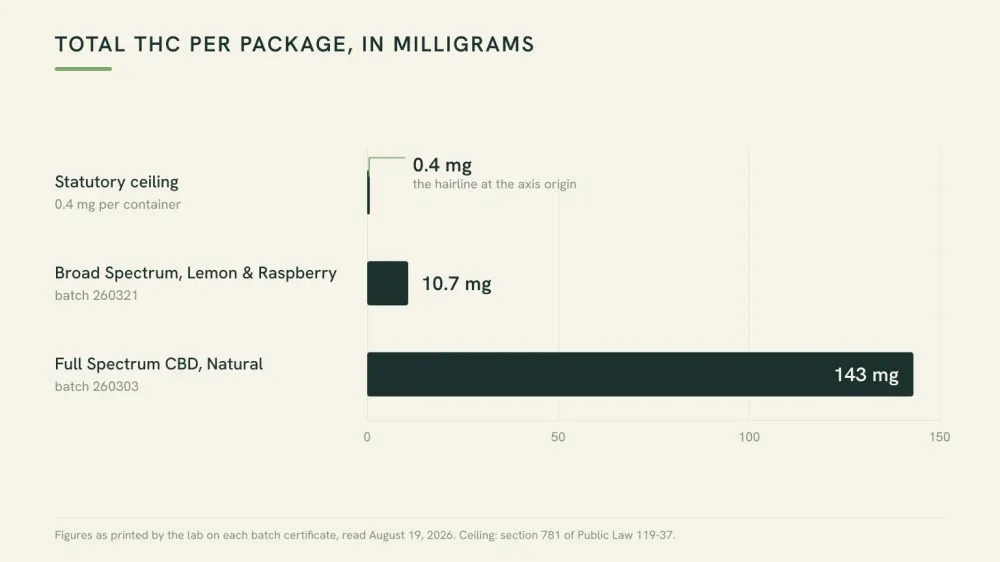
The consumer-facing pages ranking for this query are mostly written by somebody with inventory to move, and that includes us. So here is the arithmetic on our own shelf first, in the same words we would use for anyone else's product. On the definition as written, most of the products we sell would fall outside "hemp" on November 12, 2026. Our full spectrum tincture is not a borderline case. The batch certificate for the natural flavor reports 143 milligrams of total THC per package against a statutory ceiling of 0.4 milligrams per container. That is not close to the line. It is roughly 357 times over it.
We did not calculate that figure, and you should be suspicious of anyone who calculates theirs. Every certificate our lab issues prints Total THC in milligrams per package in its own header, beside a package size of 56.7 g, so there is nothing to convert and no density to assume. Converting a percentage yourself introduces an assumption the certificate has already resolved, and that is how small errors get born. The twelve batch certificates below are the ones published on our lab results page, read with a text extractor on August 19, 2026. If the header layout of a certificate is unfamiliar, how to read a COA line by line walks through where each of these figures sits on the page.
| Product | Flavor | Batch | Total THC printed (mg per package) | Multiple of the 0.4 mg ceiling |
|---|---|---|---|---|
| Full Spectrum CBD | Natural | 260303 | 143 | 357.5x |
| Full Spectrum CBD | Lemon & Raspberry | 260309 | 138 | 345x |
| Full Spectrum CBD | Mango & Peach | 260310 | 136 | 340x |
| CBD + CBN | Lemon & Raspberry | 260312 | 92.4 | 231x |
| CBD + CBG | Lemon & Raspberry | 260315 | 90.2 | 225.5x |
| CBD + CBG | Mango & Peach | 260314 | 88.5 | 221.25x |
| CBD + CBG | Natural | 260313 | 80.5 | 201.25x |
| CBD + CBN | Mango & Peach | 260311 | 79.4 | 198.5x |
| CBD + CBN | Natural | 260304 | 73.1 | 182.75x |
| Broad Spectrum | Lemon & Raspberry | 260321 | 10.7 | 26.75x |
| Broad Spectrum | Mango & Peach | 260320 | 0.000 (non-detected) | not applicable |
| Broad Spectrum | Natural | 260319 | 0.000 (non-detected) | not applicable |
Of the twelve batch certificates in that table, ten print a total THC figure above 0.4 mg per package and two print 0.000 mg, non-detected. The lowest above-threshold figure is 10.7 mg, roughly 26.75 times the ceiling. The highest is 143 mg, roughly 357.5 times. Which spectrum a product is changes the arithmetic completely, and if the categories are new to you, the differences between full spectrum, broad spectrum and isolate are worth understanding before you open your own certificate.
Three limits travel with that table, and each of them is independently true. First, the lab's Total THC is the lab's formula, not the statute's. Our certificates print their own definition at the foot of the cannabinoid panel: Total THC = Delta-10-THC + Delta-8-THC + (Delta-8-THCA x 0.877) + Delta-9-THC + THC-O-acetate + (THCA x 0.877). The statute says "total tetrahydrocannabinols (including tetrahydrocannabinolic acid)" and does not enumerate them. Enumerating them is exactly what one of the missing FDA lists was supposed to do. So the certificate's number is the best available proxy for the statutory number, not the statutory number itself.
Second, the ceiling is not only THC. It is a combined total of total tetrahydrocannabinols plus whatever other cannabinoids the Secretary of Health and Human Services determines have similar effects. That determination has not been published, which means nobody can produce a final compliant-or-not answer for any product today. Not for ours, not for anyone's. Third, non-detected is a result for one batch, not a property of a product. Two of our broad spectrum batches report 0.000 mg per package and a third batch of the same product line reports 10.7 mg. The number belongs to the batch in front of you, on the date the sample was taken, and even a non-detected line does not settle the question, because the second half of the ceiling has no published list behind it.
The lists the FDA was supposed to publish by February 10
This is the part of the story that none of the page-one results we read on August 19, 2026 put at the top, and it is the reason a confident answer about the ban's scope is more confident than the documents support. Section 781 did not only set a date. It also set the agency work that would make the date meaningful. Paragraph (3) of the section reads: "Within 90 days of the enactment of this act, the Food and Drug Administration, in consultation with other relevant Federal agencies, shall publish" four things. Ninety days after November 12, 2025 is February 10, 2026.
- 1A list of all cannabinoids known to FDA to be capable of being naturally produced by a Cannabis sativa L. plant, as reflected in peer-reviewed literature.
- 2A list of all tetrahydrocannabinol class cannabinoids known to the agency to be naturally occurring in the plant.
- 3A list of all other known cannabinoids with similar effects to, or marketed to have similar effects to, THC class cannabinoids.
- 4Additional information and specificity about the term container, as the statute defines it.
Look at what those four documents would have done. The second and third are the ones that decide the scope of the consumer ceiling: which molecules count as tetrahydrocannabinols, and which other cannabinoids count as having similar effects. The fourth would have told a manufacturer how the container rule applies to a multipack, a refill or a carton. Without them, the statutory sentence is complete and its outer edge is not. As of August 19, 2026 the deadline was 190 days past, six months and nine days, and nothing had appeared.
We checked three ways on August 19, 2026, and we are printing the method, because an absence is only as good as the search that looked for it. First, the Federal Register's JSON API: three queries covering hemp and cannabinoid documents published since November 12, 2025, plus all FDA cannabinoid documents in the same window. Nothing resembling a cannabinoid list came back. Second, the FDA's own page on cannabis and cannabis-derived products, fetched directly. It still defines hemp by the 2018 Farm Bill, and a search of the page text for "119-37", "section 781", "0.4 milligram" and "November 12" returned nothing at all. Third, the FDA's press announcements listing, which on that day carried no item on hemp, cannabis or cannabinoids. We can show non-publication. We cannot show a reason for it, so we are not offering one. What the FDA has actually said about CBD is a separate and much older story.
An independent confirmation arrived two days before our cutoff, from a source with no stake in hemp at all. The Congressional Research Service, the nonpartisan research arm of Congress, updated its In Focus brief Changes to the Statutory Definition of Hemp and Implications for Agricultural Policy on August 17, 2026. It states that the law requires FDA to consult with relevant federal agencies and publish within 90 days of enactment "(which, as of August 2026, has not been published)." CRS reports to Congress; it does not regulate, and it cannot make the FDA publish anything. But it is congressional staff writing for members, and it found what we found.
One detail that is hard to unsee once you have read the enrolled text. The paragraph meant to define the ban's outer edge went onto the statute books with two misspellings in it: it asks for "a list of all other know [sic] cannabinoids with similar effects to, or marketed to have similar effects to, tetrahyrocannabinol [sic] class cannabinoids." Those are the words as printed at 139 Stat. 561, and we are reproducing them rather than silently correcting a quotation of a statute.
What "banned" does not mean
The results we read on page one of this query use "ban" as one undifferentiated word, and it is doing at least four jobs. The first: section 781 does not prohibit products, it narrows a definition. Nothing in it says "CBD is illegal" or names a brand or a category. It changes the boundary of a legal term, and products fall out of the term rather than being individually outlawed. The categories most discussed in this context are the intoxicating ones, and we have written separately about the chemistry of delta-8 THC and of THCA flower. An earlier CRS insight, Change to Federal Definition of Hemp and Implications for Federal Enforcement, records the Senate Appropriations Committee's stated purpose for the provision, preventing "the unregulated sale of intoxicating" hemp products, and separately notes that "Both FDA and DEA may lack the resources to broadly enforce" the new prohibitions. That is an observation about capacity. It is not a forecast, and we are not turning it into one.
The second job the word is doing is the consequence, and the statute never spells it out, because it does not have to. Hemp is carved out of the Controlled Substances Act's definition of marijuana, so narrowing hemp narrows the carve-out automatically. CRS states it plainly in its legal sidebar Changes to the Federal Definition of Hemp: Legal Considerations Under the Controlled Substances Act, updated December 22, 2025: the change "will operate as an exception to the exceptions, meaning that covered hemp-derived cannabinoid products will be subject to CSA regulation as marijuana or THC." The same document says it is "unclear how it will affect future CSA enforcement" and notes the Justice Department's limited enforcement history against small-scale, state-compliant activity. Read that for exactly what it is: an unresolved question, not a safe harbor and not a promise that nothing will happen. That analysis also predates both the missed FDA deadline and the Senate vote below.
Third, federal law is a floor. A change in the federal definition does not overwrite your state's rules, and several states already restrict hemp-derived cannabinoid products more tightly than the federal definition does, while others are more permissive. That layer moves independently and it moves often, which is why it lives on its own page rather than in a dated news article. Where CBD stands state by state, along with what happens when you fly, is the place to check it.
Fourth, and this one gets lost entirely: nothing in section 781 is a statement about what any cannabinoid does in a person. It is a definition inside an appropriations act. It makes no finding about safety, about efficacy, or about whether CBD does or does not do anything at all. A change in a legal category is not a scientific result, and anyone presenting this law as evidence about how a cannabinoid behaves in the body is reading it wrong in both directions.
Where Congress actually is, as of August 19, 2026
Every result we read on the first page of this query on August 19, 2026 either predates the August 8 Senate vote described below or reports it without naming the bill. Our own page on the hemp definition has the same problem: it was written in July and says the delay bills were referred to subcommittee with no floor action, which was true when we wrote it and is no longer complete. So here is the tracker, re-pulled from the official govinfo bill status records on August 19, 2026, with the caveat that mattered most on the day it was written: of the seven measures in the table, one had passed one chamber, and none had become law. Corrected September 20, 2026: one of them has since become law. The House agreed to the Senate amendments to H.R. 6500 on September 1, 2026 and the bill was signed the next day, becoming Public Law 119-103 on September 2, 2026; its section 2019 holds most of section 781 back until December 11, 2026. The other six rows were last checked on August 19, 2026 and have not been re-pulled. Rounding a Senate vote up into "the ban is being delayed" was the mistake this section was written to prevent, and the enacted version is narrower than that phrase: it moves most of the definition by about a month, it does not repeal it.
| Bill | What it would do to section 781 | Status as of August 19, 2026 |
|---|---|---|
| H.R. 6500 (Continuing Appropriations and Extensions Act, 2027) | Sec. 2019, "Section 781 extension": until December 11, 2026 the section would apply only to cannabinoids not capable of being naturally produced by the plant | Passed the Senate with an amendment, 90 to 6, on August 8, 2026. Corrected September 20, 2026: the House agreed to the Senate amendments on September 1 and the bill became Public Law 119-103 on September 2, 2026. |
| H.R. 6209 (American Hemp Protection Act of 2025) | Full repeal of section 781 | Referred to the Subcommittee on Commodity Markets, Digital Assets, and Rural Development, January 13, 2026 |
| H.R. 7010 | Strike "365 days" and insert "3 years" | Referred to the Subcommittee on Forestry and Horticulture, May 20, 2026 |
| H.R. 7024 (Hemp Planting Predictability Act) | Same three-year delay, which would move the date to November 12, 2028 | Referred to the Subcommittee on Forestry and Horticulture, May 20, 2026. 38 cosponsors |
| S. 3686 (Hemp Planting Predictability Act) | Senate companion, same three-year delay | Read twice and referred to the Committee on Agriculture, Nutrition, and Forestry, January 15, 2026 |
| S. 3474 (Cannabinoid Safety and Regulation Act) | Does not amend section 781. Would build an FDA framework for cannabinoid products instead | Read twice and referred to Health, Education, Labor, and Pensions, December 15, 2025 |
| H.R. 10079 (Beverage Regulatory Parity Act) | Does not amend section 781. Separate federal lane for hemp-derived beverages | Referred to Energy and Commerce, and to Ways and Means, August 10, 2026 |
The one measure that has moved is easy to misread, so here is what it says. The Senate-engrossed text of H.R. 6500 carries, at section 2019 of its Division B, a provision titled "Section 781 extension." Until December 11, 2026 it would hold most of the new hemp definition back, leaving in force only the exclusions that cover cannabinoids not capable of being naturally produced by the plant. In plain terms: the part of the definition that reaches cannabinoids a cannabis plant cannot produce at all would still begin on November 12, and the rest, including the 0.4 milligram per container ceiling, would wait about a month. The Senate passed the bill with that amendment by 90 votes to 6 on August 8, 2026, Record Vote 228. The House had taken no action on the Senate amendment as of the last official status update we could read when this page was published, timestamped August 18, 2026. Corrected September 20, 2026: it is law. The House agreed to the Senate amendments on September 1, 2026, the President signed the bill on September 2, and it is now Public Law 119-103. November 12 remains the start date only for the exclusions covering cannabinoids a cannabis plant cannot produce; the rest of section 781, including the 0.4 milligram per container ceiling, applies from December 11, 2026.
The 2026 farm bill is the other thing people keep asking about, and the answer has two halves that usually get separated. The Farm, Food, and National Security Act of 2026, H.R. 7567, passed the House 224 to 200 on April 30, 2026 and was received in the Senate on May 19, with no further Senate action recorded as of August 19. We ran a text search over the engrossed House text on August 19, 2026: the strings "119-37" and "1639o" do not appear in it anywhere, so it does not amend, delay or repeal section 781. That is the half everyone reports. The other half is that the bill does change hemp law: it moves the crop testing standard from delta-9 to "total tetrahydrocannabinol concentration (including tetrahydrocannabinolic acid)", and the Congressional Research Service reads it as also requiring hemp production plans to separate industrial hemp from hemp grown for cannabinoids. So "the farm bill left hemp alone" is wrong. "The farm bill left section 781 alone" is right.
One more document belongs in the record, with a caveat attached to it. On June 24, 2026 the White House Office of Management and Budget sent Congress a formal supplemental appropriations request asking for "revising the Federal regulation of hemp to ensure the fair treatment of hemp products ... or, at minimum, an extension of implementation of the regulatory framework put in place by Section 781 of Public Law 119-37." Its own line item, filed under the Agricultural Marketing Service, says the request "would update the statutory definition of final hemp-derived cannabinoid products to allow Americans to benefit from access to appropriate full-spectrum CBD products while preserving the Congress's intent to restrict the sale of products that pose serious health risks." The caveat: we could not locate that letter on a .gov host. We downloaded and read the copy hosted by Marijuana Moment, the outlet that reported it, on August 19, 2026. The document is OMB Estimate No. 2 of the 119th Congress, addressed to the Speaker of the House and signed by OMB Director Russell T. Vought. The position is older than the letter: the CRS legal sidebar cited above records that a December 2025 executive order had already directed officials to work with Congress on nearly identical language, and quotes it saying that "some full-spectrum CBD products will once again be controlled as marijuana under the CSA" when the amendment takes effect, because they contain THC above the per-container threshold. A request is not a law, and an executive order asking Congress to act is not a delay.
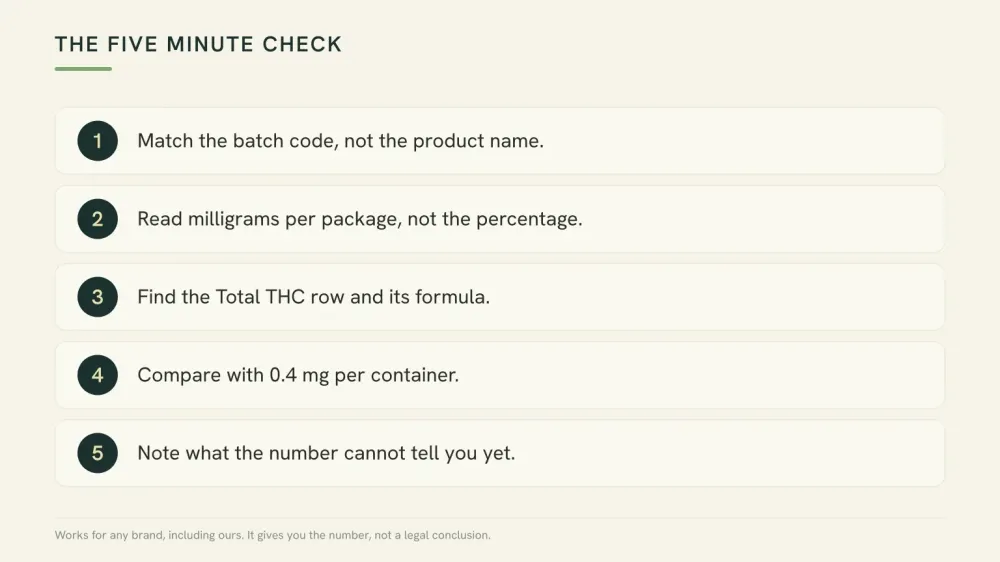
How to check your own bottle in five minutes
This works for any brand, including ours, and it needs nothing but the bottle in your hand and the certificate the brand publishes. It will not give you a legal conclusion, because as of our cutoff no certificate can. What it will give you is the actual number, which is more than most people asking this question currently have.
- 1Find the batch code printed on the bottle or the box, then open the brand's lab results page and match the batch, not just the product name. Two batches of the same product can differ.
- 2Read the milligrams-per-package figure, not the percentage. The statutory ceiling is written in milligrams per container, and most certificates print that number for you already.
- 3Find the row labeled Total THC rather than delta-9 alone, and read the lab's own formula, usually printed as a footnote. Labs differ in which THCs they add together.
- 4Compare that figure with 0.4 milligrams. For most whole-plant products the comparison is not close in either direction, which is why the check takes seconds.
- 5Note what the number cannot tell you. The ceiling also counts cannabinoids that HHS has not yet defined, so no certificate produces a final answer today.
If a brand does not publish a batch-level certificate at all, this check cannot be run on its products, which is worth knowing whatever you decide to do about it. Step three is where most of the confusion lives, because a certificate that reports only delta-9 THC is reporting a smaller number than the statute measures. Our walkthrough of what each section of a certificate of analysis is telling you covers the difference, and it is the same skill either way.
What is still genuinely unknown
A useful page on this topic has to be as clear about its holes as about its facts, and this one has real holes. None of them is a reason to panic and none of them is a reason to relax. They are simply the parts of the picture that no published federal document currently fills in, and anyone telling you otherwise is filling them in themselves. Newer molecules such as THCP are exactly the kind of thing the missing lists were written to address, and until those lists exist, nobody outside the agency can say how they will be treated.
- Which molecules count as tetrahydrocannabinols for the purposes of the 0.4 mg ceiling. That was FDA list B, due February 10, 2026.
- Which other cannabinoids the Secretary of Health and Human Services will determine have similar effects. That was FDA list C, and it is the second half of the ceiling.
- How the container rule applies to multipacks, refills and outer cartons beyond the examples the statute itself gives. That was FDA list D.
- How the change will be enforced. The Congressional Research Service says it is unclear, and a resourcing observation is not a prediction.
- Whether the effective date moves. One measure has passed one chamber. We are not guessing at the rest, and neither should anyone else.
- What happens to a product bought before the date. The statute sets an effective date and contains no possession safe harbor either way.
Questions people are asking
No, and CBD is not named anywhere in the statute. Section 781 of Public Law 119-37 narrows the federal definition of hemp, and products that fall outside the new definition stop being hemp. Because hemp is carved out of the Controlled Substances Act's definition of marijuana, the Congressional Research Service describes the change as an exception to the exceptions, so covered products would be subject to CSA regulation. That is a change to a legal category, not a statement that the molecule CBD is prohibited. This describes federal law as of August 19, 2026 and is not legal advice.
Per container, and the statute defines the word itself: the innermost wrapping, packaging or vessel in direct contact with the product and enclosing it for retail sale, such as a jar, bottle, bag, box, packet, can, carton or cartridge. It also expressly excludes bulk shipping containers and outer wrappings that are not essential to the retail sale. A consumer-facing page on the first results page for this query rendered the threshold as per serving when we read it on August 19, 2026. It is per container.
Yes, in part, and it is now law. On August 8, 2026 the Senate passed H.R. 6500 by 90 votes to 6 with an amendment whose section 2019, titled Section 781 extension, holds most of the new definition back until December 11, 2026, leaving only the exclusions for cannabinoids not capable of being naturally produced by the plant in force on November 12. That was still a bill when this page was published on August 19, 2026. Corrected September 20, 2026: the House agreed to the Senate amendments on September 1 and the bill became Public Law 119-103 on September 2, 2026, so December 11, 2026 is now the statutory date for most of section 781.
The statute changes a definition and sets an effective date. It does not contain a possession safe harbor, and it does not say that products already purchased are grandfathered. The Congressional Research Service says the effect on future Controlled Substances Act enforcement is unclear, and separately notes the Justice Department's limited enforcement history against small-scale, state-compliant activity. Neither of those is a safe harbor. Federal law is also only a floor, and your state's rules may be stricter or looser. If you have a decision with real consequences attached, ask a lawyer who practices in your state.
Because two of the four documents that would fix the scope do not exist. Section 781 required the FDA, within 90 days of enactment, to publish a list of the THC class cannabinoids that occur naturally in the plant and a list of other cannabinoids with similar effects to them. Ninety days after enactment was February 10, 2026. On August 19, 2026 we checked the Federal Register API, the FDA's own cannabis page and the FDA press announcements listing, and found nothing. A Congressional Research Service brief updated on August 17, 2026 says the same: it has not been published.
It does not mean that, and we would be misleading you if we implied it. Non-detected is a result for one batch on one date, not a permanent property of a product line: two of our broad spectrum batches report 0.000 milligrams per package and a third batch of the same line reports 10.7 milligrams. On top of that, the statutory ceiling counts total tetrahydrocannabinols plus a category of other cannabinoids that the Secretary of Health and Human Services has not yet defined, so a non-detected THC line does not settle the question either. Nobody can give a final answer today.
On the batch certificate of analysis, in the milligrams-per-package column, on the row labeled Total THC rather than delta-9 alone. Match the batch code printed on your bottle or box to the certificate, because two batches of the same product can differ. Read the lab's own Total THC formula, which is usually printed as a footnote, since labs differ in which tetrahydrocannabinols they add together. Read the printed milligram figure rather than converting the percentage yourself.
No. Section 781 is a definition inside an appropriations act. It makes no finding about safety, about efficacy, or about what any cannabinoid does in a person. The Senate Appropriations Committee's stated purpose, as recorded by the Congressional Research Service, was to prevent the unregulated sale of intoxicating hemp products. Whatever you think of that goal, a change to a legal category is not a scientific result, in either direction.
If you want the layer this page deliberately leaves out, where CBD stands under federal and state law covers the state picture and what happens when you travel. It is the evergreen version of this question, and it will outlast the date at the top of this article. Everything above reflects what we could read in primary documents on August 19, 2026, and this is a topic where the honest thing to do is put the date on the page and let you check it.
Writing about hemp, wellness and the small rituals that keep us balanced.