Hemp-Derived THC: What the Words Mean, and the Math That Put It on the Shelf
Hemp-derived THC is not a plant, a molecule or a strength. It is the name of a test result. Federal law defines hemp by a concentration of delta-9 THC on a dry weight basis, not by a dose, and the denominator is whatever the product weighs. Here is that arithmetic.
Hemp-derived THC is not a plant, not a molecule and not a strength. It is the name of a test result. Federal law defines hemp by a concentration of delta-9 THC measured on a dry weight basis, so THC that came out of a plant on one side of that percentage gets called hemp-derived, and the identical molecule from a plant on the other side gets called something the law treats very differently. The percentage is the whole category. This article is about what that percentage measures, what it does not measure, and why the milligram figure sitting behind it can be almost anything. Everything here describes federal law as it stood on August 25, 2026.
Here is the short version, up front. The federal definition sets a concentration, not a dose, and a concentration is a ratio whose denominator nothing in the statute fixes. That single piece of arithmetic explains the entire category, and it is why a percentage that sounds small can describe a package holding a large amount of THC. What follows is a description of federal statute and published research. It is general information, not legal advice, and it does not tell you what is permitted where you live.
Hemp-derived THC names a test result, not an ingredient
The federal definition lives in 7 U.S.C. 1639o. The statutory definition of hemp says the term means "the plant Cannabis sativa L. and any part of that plant, including the seeds thereof and all derivatives, extracts, cannabinoids, isomers, acids, salts, and salts of isomers, whether growing or not, with a delta-9 tetrahydrocannabinol concentration of not more than 0.3 percent on a dry weight basis." Read that clause slowly, because two things inside it do most of the work. First, it reaches derivatives, extracts and cannabinoids, not only the growing plant, which is how a definition written for farmers ended up describing what is in a wrapper. Second, the only number in it is a percentage.
Marijuana, legally, is the leftover. The Controlled Substances Act definition at 21 U.S.C. 802(16)(B) says the term does not include hemp as defined in section 1639o. So the same delta-9 THC molecule falls on one side of federal law or the other according to the test result of the plant it was taken from, and not according to anything about the molecule itself. If you want the molecules compared properly, our side-by-side of CBD and THC does that work. If you want the plant categories and the total-THC math behind them, what actually separates hemp from marijuana covers the botany and the formula. This page is about the percentage.
A percentage is a ratio, and the seller picks the denominator
This is the part almost nobody prints, and it is not our observation. A 2023 analysis in the Journal of Cannabis Research put it in a single line. Johnson and colleagues, surveying 53 hemp delta-9 products, wrote the following, in which we have spelled out delta-9 everywhere the paper prints the Greek delta symbol: "Hemp delta-9 products were devised through a very simple application of the Farm Bill's 0.3% by dry weight limit. A 10 g gummy can contain roughly 10 g x 0.3% = 0.03 g = 30 mg of delta-9 THC and still be within the legal limit." Their abstract states the consequence just as plainly: such products "must contain no more than 0.3% delta-9 THC by dry weight, but no limit is placed on overall dosage and there is no requirement that products are tested."
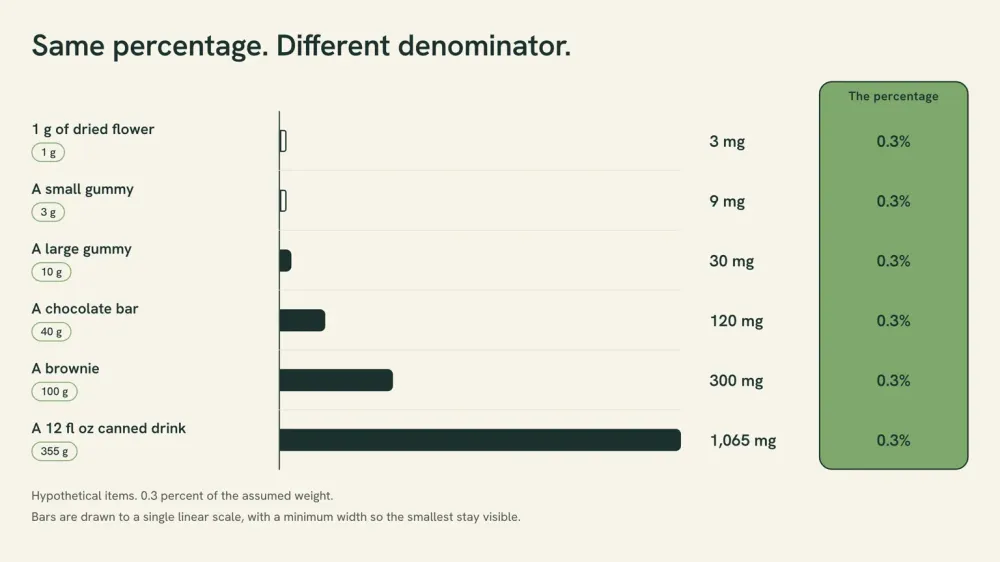
Run that same multiplication across a range of weights and the shape of the whole category appears at once. Every row in the table below is a hypothetical item chosen to show the arithmetic. None of them is a real product, none is anybody's recipe, and none is a suggestion of any kind.
| Hypothetical item | Assumed weight | 0.3 percent of that weight | The percentage |
|---|---|---|---|
| 1 g of dried flower | 1 g | 3 mg | 0.3% |
| A small gummy | 3 g | 9 mg | 0.3% |
| A large gummy | 10 g | 30 mg | 0.3% |
| A chocolate bar | 40 g | 120 mg | 0.3% |
| A brownie | 100 g | 300 mg | 0.3% |
| A 12 fl oz canned drink | 355 g | 1,065 mg | 0.3% |
The right-hand column never moves. The milligram column moves by a factor of more than 350 between the first row and the last. That is not a drafting mistake anyone can point to in the statute; it is simply what a concentration limit does when the thing being measured can be made as heavy as the manufacturer likes. A limit on concentration is not a limit on dose. Once you have seen that, the existence of a large retail category built on a number that sounds tiny stops being confusing.
What dry weight basis actually means, and why nobody agrees how to apply it
There is a second variable hiding in the definition, and it is the phrase on a dry weight basis. The only place the federal government defines those words is 7 CFR 990.1, a USDA regulation, which reads: "Percentage of THC on a dry weight basis means the percentage of THC, by weight, in a cannabis item (plant, extract, or other derivative), after excluding moisture from the item." Excluding moisture changes the denominator. For dried plant material that barely matters. For anything wet it matters enormously, and for a beverage it changes the answer by orders of magnitude.
Here are the same hypothetical items with the water taken out. Every moisture figure below is an assumption we chose in order to show the effect. None of them is a measurement of anything, and the arithmetic in this table is ours, not any agency's.
| Hypothetical item | Assumed moisture | Dry solids | 0.3 percent of dry solids | Change vs the table above |
|---|---|---|---|---|
| 10 g gummy | 15% | 8.5 g | 25.5 mg | down about 15% |
| 100 g brownie | 20% | 80 g | 240 mg | down 20% |
| 355 g sweetened drink | about 89% water | about 39 g | about 117 mg | down about 89% |
| 355 g unsweetened seltzer | about 99.9% water | about 0.35 g | about 1 mg | down about 99.9% |
For plant material the correction really is small, and somebody has measured exactly how small. Sikora and colleagues, writing in the Journal of AOAC International in 2025, examined 12 proficiency samples circulated to between 20 and 67 laboratories from 2020 to 2022. Moisture ran from 5.8 percent to 11.4 percent and total THC from 0.144 percent to 0.399 percent on a wet basis. Converting those figures to a dry weight basis raised the reported number by only 0.002 to 0.027 percentage points, a difference that reached statistical significance in 1 of the 12 samples. That is biomass, though, not a gummy and not a can of anything, and a tincture's percentage is not a dry weight number either. (The total THC in that study also counts THCA, the acid form that becomes THC with heat; how THCA converts into THC is a subject of its own.)
Now the part that is genuinely missing from the public record. The regulation that defines the term sits inside a part headed Domestic Hemp Production Program, and its companion definition says the acceptable hemp THC level applies "for the purpose of compliance with the requirements of State or Tribal hemp plans or the USDA hemp plan." It is a rule for testing crops before harvest. We went looking for a federal rule that tells anyone how to apply 0.3 percent to a finished edible or a beverage, and we did not find one. The nearest thing to an official comment on that gap comes from Congress's own nonpartisan analysts: the Congressional Research Service, in an In Focus brief updated August 17, 2026, describes the consumer-product reading of the definition as an interpretation.
“Some have interpreted the 2018 farm bill definition to mean that products containing 0.3% delta-9 THC or less, and that may contain significant amounts of other psychoactive compounds, would not be considered marijuana and would legally be considered hemp. This interpretation has been referred to as the so-called 'farm bill loophole.'”
CRS describes; it does not decide. It is congressional staff rather than a regulator, and an In Focus brief is an explanation written for members of Congress, not a ruling that binds anyone. But the sentence is worth holding onto, because it is about as close as the public record comes to an acknowledgement that the arithmetic underneath an entire retail category was never actually written down by the government whose statute produced it.
What the milligrams were when somebody measured them
Arithmetic on paper is one thing. In April 2022 the Johnson team bought 53 hemp delta-9 products from 48 brands, manufactured across 18 states, and sent them to a laboratory to be analyzed within two weeks of purchase. It is the only potency and labeling analysis of hemp delta-9 consumer products that we could find, and the numbers are worth sitting with.
The labeling findings are the ones that carry. Products advertised between 0.5 mg and 40 mg of delta-9 THC per serving, averaging 12.98 mg; the mean lab-measured figure was 10.08 mg, and 88.6 percent of the mislabeled products contained less than advertised rather than more. The laboratory also estimated that 49.0 percent, or 24 of 49 products it could assess, used delta-9 THC that had been converted from CBD through cyclization, which is a chemistry question rather than a legal one and is covered in our explainer on delta-8 and how CBD gets converted. None of these figures is guidance about any amount. They are measurements of what was inside a particular set of products in 2022.
Passing the hemp test answers one question and no others
Meeting the definition settles the classification of the plant material. It settles nothing else, and the FDA says so in its own words. On the agency's cannabis and cannabidiol policy page, whose footer was marked current as of July 16, 2024, the FDA states that it "treats products containing cannabis or cannabis-derived compounds as it does any other FDA-regulated products," and adds that "this is true regardless of whether the cannabis or cannabis-derived compounds are classified as hemp under the 2018 Farm Bill." The same page answers the point directly a second time, saying that even if a CBD product meets the definition of hemp under the 2018 Farm Bill, "it still must comply with all other applicable laws, including the FD&C Act."
It does not answer whether something is intoxicating either, and the FDA has published a warning about the word itself. In a consumer update on delta-8 THC, the agency noted that some products "may be labeled simply as 'hemp products,' which may mislead consumers who associate 'hemp' with 'non-psychoactive'." That update was written about delta-8 products specifically, so read the warning as being about the naming convention rather than about any one molecule. And it does not answer a drug test: a urine screen looks for THC metabolites, not for the plant a molecule came from, which is the subject of what a CBD drug test actually detects.
Where these products turn up, told as a dated pattern
The commercial reason this category exists at all is geographic, and the best-known statement of it is a JAMA Viewpoint from November 2022. Harlow, Leventhal and Barrington-Trimis wrote that "a federal policy loophole allows psychotropic (ie, mind-altering or intoxicating) cannabis products to be commercially marketed and sold across the US", including "states where recreational cannabis is not legal", and observed that "23 of the 29 states in which products are permitted have not legalized recreational cannabis, suggesting availability of hemp-derived cannabis products is more common in places where legal cannabis is unavailable." Three limits travel with that sentence and cannot be left behind: it is a Viewpoint rather than a study, it is nearly four years old, and its state tally came from a consumer-website map accessed in September 2022 that was describing delta-8 rather than hemp delta-9. Treat it as a dated observation about a pattern. It is not a legal map, and this article names no state.
There is also a difference between what is permitted and what is actually on a shelf, and somebody measured that too. Rossheim and colleagues telephoned 520 US vape shops in November and December 2023, sampling ten shops in every one of the 50 states plus the District of Columbia and Puerto Rico, and reported in the American Journal of Preventive Medicine that 74 percent sold some intoxicating cannabis product. Broken out by regulatory context: 43 percent of shops in states with delta-8 THC bans, 53 percent where substantial regulations applied, 90 percent where restrictions were significant, and 92 percent where regulation was limited or absent. That is self-reported by telephone, in 2023, in vape shops only. The durable point is the first figure. Forty-three percent is not zero, which means that what is sitting on a counter is not evidence of what is permitted.

The one row on a certificate that answers what you are actually asking
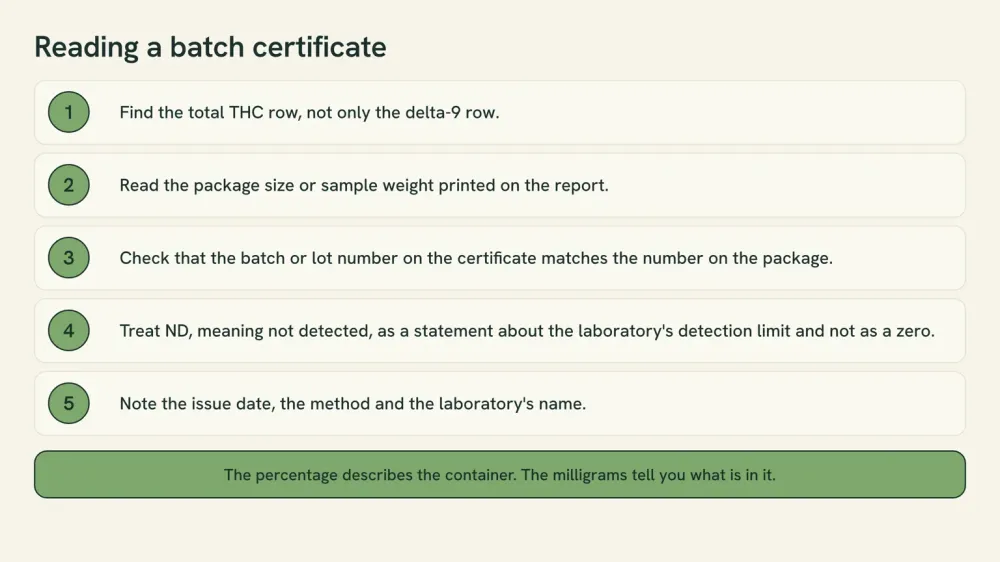
A percentage and a milligram figure answer two different questions, and a batch certificate usually prints both. The percentage tells you how concentrated the material is. The milligrams per package tell you how much is in the container in front of you. If what you want to know is what you are holding, the second number is the one you want, and it is precisely the number the federal definition does not set. Here is how to find it without needing anyone's help.
- 1Find the total THC row, not only the delta-9 row. Total THC counts THCA converted to its delta-9 equivalent, so a result can look small on one line and larger on the other.
- 2Read the package size or sample weight printed on the report. Every percentage on the document is a fraction of that weight, and it is normally printed for you rather than something you should be calculating from a bottle's volume.
- 3Check that the batch or lot number on the certificate matches the number on the package. A certificate for a different batch is a certificate for a different product.
- 4Treat ND, meaning not detected, as a statement about the laboratory's detection limit and not as a zero. The limit itself should be printed on the same page.
- 5Note the issue date, the method and the laboratory's name. A report with none of those three is not evidence of anything.
Here is one read that way. It is our own certificate, because our own lab report is the example we are able to publish in full.
| What the certificate prints | Value |
|---|---|
| Product and batch | Full Spectrum CBD, Mango & Peach, batch 260310 |
| Package size | 56.7 g |
| Delta-9 THC concentration | 0.239% |
| Delta-9 THC in the package | 136 mg |
| THCA and delta-8 | Not detected, so the total THC figure is the delta-9 figure |
That is the same class of percentage as the hypothetical brownie two tables ago, in a completely different container, with a completely different milligram figure. Which is the entire point: a number in the 0.3 percent class tells you about the container, not about a person. Every batch we sell publishes its own report on our lab results page. If you want the mechanics of reading one line by line, our guide to reading a certificate of analysis walks the document from the header down, and what third-party tested actually means explains why the laboratory's independence is the part that matters. Given that 66.0 percent of the products in the 2022 survey were off their own labels, the certificate is the only part of this you can check yourself.
What changes on November 12, 2026
On November 12, 2026 the federal definition of hemp changes, and the test moves from delta-9 THC alone toward a total tetrahydrocannabinols standard that includes tetrahydrocannabinolic acid. The change is pending and contested. We are not going to predict how it will be enforced or what will happen to it before then, and everything above describes the definition that is in force as of our cutoff date. The statute itself, its timeline and its finished-product language are covered in our full breakdown of the 2026 hemp law change.
What this page cannot tell you
The honest limits, stated plainly. We are not your lawyer, and none of this is legal advice. We have deliberately not told you what is permitted in any particular state, because that answer changes by jurisdiction and by month, and getting it wrong on a page like this helps nobody. And the evidence base on this exact category is thinner than its shelf space suggests: a PubMed search on August 25, 2026 for hemp-derived delta-9 THC returned 46 records, and after reading all 46 titles, exactly one was a potency and labeling analysis of hemp delta-9 consumer products. It is the paper quoted throughout this article. Most of the published work filed under this heading is about delta-8, a different molecule with a different literature behind it.
- A percentage with no milligram figure anywhere on the package or the report. On its own, the percentage cannot tell you what is in the container.
- A milligram figure with no package weight or sample weight beside it, so there is no way to check the percentage against it.
- A certificate whose batch number does not match the package, or that carries no batch number at all.
- The words hemp or hemp-derived used as though they were a statement about effects. The FDA has written that this framing can mislead people.
- Anyone at a counter telling you a product is legal where you live. That is a legal conclusion about your jurisdiction, and a shop is not where it comes from.
- No age check and no clear warnings. In the 2022 product survey, 84.9 percent of companies performed no online age verification at checkout.
Two safety findings are worth stating briefly and precisely. A 2026 analysis of National Poison Data System records by Weigel and Wahl looked at single-substance cannabis edible exposures in children aged 5 and under during 2023 and 2024: 9,667 delta-9 THC cases and 2,169 hemp-derived cannabinoid cases. Read that second group carefully, because the paper defines it by its own examples, delta-8 THC, delta-10 THC and tetrahydrocannabinol-O-acetate, rather than by the hemp-derived delta-9 this article is about. The hemp-derived exposures were admitted to critical care more often (11.3 percent versus 8.58 percent) and admitted overall more often (28.35 percent versus 26.13 percent). No deaths were reported. The authors write that "the lack of dose regulation for hemp-derived products may contribute to these findings." Poison-center data has no denominator of users, so this is not a rate of harm per person, and the comparison is between reported exposures rather than between equal amounts. Separately, a 2025 secret-shopper study of 100 smoke shops by Evoy and colleagues found that half of the employees made at least one health claim about THC, and that when asked directly about adverse effects, 22 percent disclosed no risks at all. That was 100 shops in two cities, so it is not a national estimate, but it makes one point well: a retail counter is not a health-information channel.
Questions people actually ask
When it is delta-9 THC, yes: the same molecule, with the same structure. What differs is the test result of the plant it came from, and therefore which statute that plant falls under. Federal law defines hemp by a delta-9 concentration of not more than 0.3 percent on a dry weight basis, and the Controlled Substances Act then defines marijuana as cannabis that is not hemp. Neither definition describes the molecule differently. Our CBD versus THC article covers what the two molecules do and how they differ from each other.
The federal definition does not answer that question, because it sets a percentage rather than a milligram amount, and it places no cap on the total dose. The 2023 Journal of Cannabis Research analysis states the point directly: a 10 g gummy can contain roughly 30 mg of delta-9 THC and still sit inside a 0.3 percent limit, because 0.3 percent of 10 g is 30 mg. Make the item heavier and that figure rises while the percentage stays put. We also looked for a federal rule explaining how to compute the percentage on a finished consumer product and did not find one: USDA's definition of dry weight basis sits inside a program for testing crops before harvest. We are not going to give you a safe number, because there is not one to give.
No. The phrase describes where a molecule came from and what its source plant tested at, not what it does in a person. The FDA has written that some products may be labeled simply as hemp products, which may mislead consumers who associate hemp with non-psychoactive. The agency said that in a consumer update about delta-8 THC specifically, so read it as a warning about the naming convention. Our article comparing CBD and THC covers which cannabinoids are intoxicating and which are not.
A urine screen looks for THC metabolites. It has no way of knowing which plant a molecule came from or what that plant tested at, so the hemp-derived label has no bearing on the result. No product can guarantee a drug-test outcome, and anyone who tells you otherwise is guessing on your behalf. Our article on CBD and drug testing covers how the screens work and where the residual risk sits.
The pattern was described in a JAMA Viewpoint in November 2022, whose authors wrote that a federal policy loophole allows these products to be marketed and sold across the US, including in states where recreational cannabis is not legal. Three limits go with that: it is a Viewpoint rather than a study, it is dated, and the state count it reported came from a consumer-website map about delta-8, so it describes a moment in 2022 and is not a legal map. The section above quotes it in full. Separately, a 2023 telephone survey of 520 vape shops found intoxicating cannabis products for sale in 43 percent of shops located in states that banned delta-8, which is a reminder that availability and permission are two different measurements. We cannot tell you what is allowed where you live. Your state's regulating agency can.
They are different molecules. Delta-9 THC occurs in the plant in meaningful amounts, while delta-8 occurs only in traces and is usually produced by chemically converting CBD, which is why it appears so often in this category. In the 2022 product survey, the laboratory estimated that around 49 percent of the hemp delta-9 products it assessed also used delta-9 that had been converted from CBD. The conversion chemistry, and what is and is not known about its byproducts, is covered in our delta-8 explainer rather than here.
The federal definition of hemp changes on that date, and the test moves from delta-9 THC alone toward a total tetrahydrocannabinols standard that includes tetrahydrocannabinolic acid. It is pending and contested. We are not predicting how it will be enforced, and this article describes the definition in force as of August 25, 2026. Our article on the 2026 hemp law change covers the statute and the timeline in detail.
If you take one thing away from this page, take the ratio. A percentage is a comparison between two numbers, and in this category federal law fixes only one of them. Everything else about a hemp-derived THC product, including how much is actually in the container, lives in the part the statute never specified. For the wider federal picture and how it meets state law, start with our overview of where CBD stands legally, and for what the definition becomes later this year, read what November 12 actually changes.
Writing about hemp, wellness and the small rituals that keep us balanced.