Is a 10 mg Edible a Lot? What the Number Actually Means
10 mg is the serving cap California and Colorado wrote into law and two of the 5 mg units researchers use. Here is what a placebo-controlled study saw at 10 mg, how often edible labels are right, and why it lands differently for different people.

You are holding a 10 mg edible and want to know whether that is a lot. The honest answer starts with what the number is: a label convention, not a dose recommendation. It appears on almost every package, yet only a handful of studies have looked at it directly. Here is what the number means, what was measured, and where the evidence stops.
The short answer. We do not give personal doses. 10 mg is the per-serving cap California and Colorado wrote into their edible rules, and two of the 5 mg "standard THC units" federally funded researchers report in. In a placebo-controlled study of adults who rarely used cannabis, 10 mg was clearly felt and raised heart rate; average test scores held, but some people were impaired, and the authors advise against driving. Whether it is "a lot" for you depends on tolerance, how your body handles swallowed THC, and whether the label is accurate.
Where "10 mg" comes from
Licensed edibles so often say 10 mg because state rules made it the ceiling, not because anyone tested it as an ideal amount. California's rule for licensed edibles, title 4, section 17304 of the state's cannabis regulations, fits in two lines:
“An edible cannabis product shall not contain more than: (1) 10 milligrams THC per serving; and (2) 100 milligrams THC per package.”
Colorado reaches the same numbers with different wording. Rule 3-335 of Colorado's marijuana rules says a "Standardized Serving of Marijuana shall be no more than 10mg of active THC," caps any single retail edible unit at 100 mg of active THC, and requires each serving in a multi-serving product to be "physically demarked" so a reasonable person can tell where one serving ends, and "easily separable." That is why a Colorado chocolate bar comes scored into squares. Both rules cover state-licensed cannabis only. They do not govern hemp-derived products sold online or in convenience stores, which follow federal hemp law instead. Canada drew a stricter line: its Cannabis Regulations, section 102.7, say an edible "must not contain a quantity of THC that exceeds 10 mg per immediate container." In Canada, 10 mg is the whole package. In California, a package can legally hold ten times that.
Researchers reached a related number from a different direction. In 2020, two addiction researchers proposed a "standard THC unit" of 5 mg, the same idea as an alcohol unit, applied to every cannabis product and every way of taking it. It was a proposal, and several published commentaries debated it. The National Institute on Drug Abuse adopted the idea for research reporting: since 2021, NIDA has asked the researchers it funds to report delta-9-THC exposure in 5 mg units, and its own example is that "10mg THC would be 2 standard THC units." NIDA is explicit that the unit does not "indicate safety or endorse any specific amount as advisable." It is a ruler for comparing studies, not a serving suggestion. To put flower and vapes on the same milligram scale, see how a THC percentage converts to milligrams.
What each number on the package tells you, and what it cannot
An edible label usually carries several THC figures, and they answer different questions. California requires two of them side by side: under section 17407 of its labeling rules, an edible label must state THC and CBD "in milligrams per serving and milligrams per package." Here is how to read each figure you are likely to see.
| Label figure | What it measures | Where it comes from | What it cannot tell you |
|---|---|---|---|
| mg THC per serving | THC in one designated serving (one gummy, one square, one marked dose) | State serving caps: 10 mg in California and Colorado retail | How it will feel to you, or whether this exact piece matches the batch average |
| mg THC per package | THC in the whole container | Package cap of 100 mg in California; 100 mg per retail unit in Colorado | How the package is meant to be divided, unless servings are also listed |
| Servings per package | Package mg divided by serving mg (100 mg / 10 mg = 10 servings) | Label design; Colorado requires each serving to be marked and easy to separate | Whether THC is spread evenly inside an unscored bar, cookie or drink |
| Standard THC units | THC counted in 5 mg units (10 mg = 2 units) | Freeman and Lorenzetti proposal (2020); NIDA research reporting since 2021 | Safety or an advisable amount, which NIDA says the unit does not indicate |
| Total THC | Delta-9-THC plus THCA, counted as the THC it can become | The lab's certificate of analysis (COA) and state labeling rules | Which other cannabinoids are in the product; read the full COA for that |
| The lab result behind the label | THC measured in a tested sample from the batch | Certificate of analysis; California allows a 10% band either way | What is in the specific piece in your hand |
The last row matters more than it looks. Under California's testing rule, section 15724(h), a THC figure on a label "shall not be considered inaccurate" if it is within plus or minus 10.0% of the certificate of analysis. That band applies to the tested batch sample, not to every gummy, so even a fully compliant "10 mg" product is a batch average with a permitted margin, not a promise about each piece. The same per-serving versus per-container logic shows up on hemp tinctures, which our line-by-line guide to reading a CBD label walks through.
What 10 mg did in a placebo-controlled study
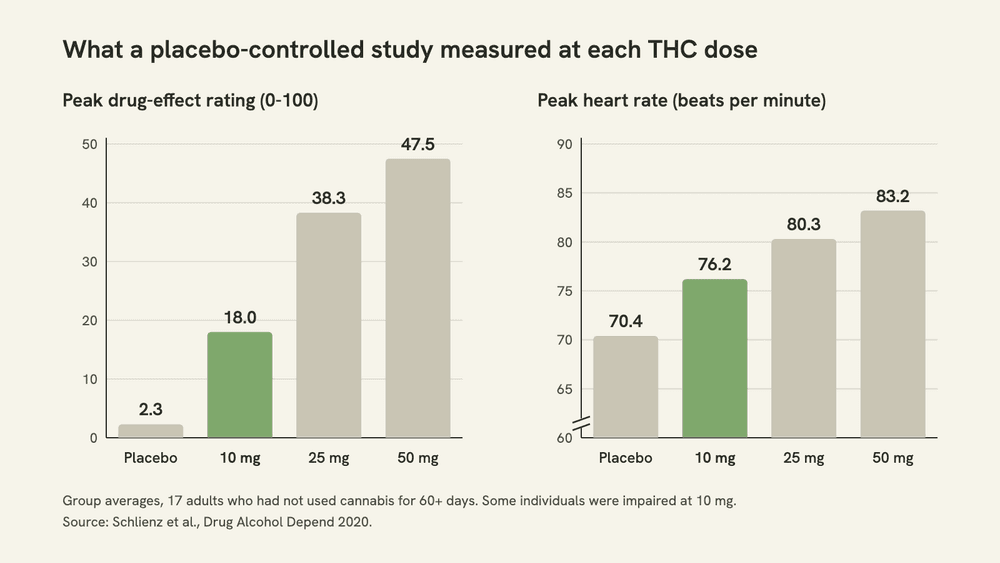
Most guides describe 10 mg from experience. One study measured it against a placebo. In a 2020 study of oral cannabis in infrequent users, 17 healthy adults (average age 25, 47% women) who had not used cannabis for at least 60 days ate brownies containing 0, 10, 25 or 50 mg of THC on separate days, without knowing which. Each session started with a low-fat breakfast about an hour before the brownie, and the researchers measured effects for 8 hours. At 10 mg, participants could tell they had taken something: their peak rating of "drug effect" on a 0 to 100 scale averaged 18.0, against 2.3 on placebo, and peak heart rate averaged 76.2 beats per minute, against 70.4 on placebo. On average, their scores on tests of attention, memory and coordination did not differ from placebo. At 25 and 50 mg the picture changed: effect ratings averaged 38.3 and 47.5, heart rate rose further, performance fell markedly, and two people vomited at the higher doses. Nobody did at 10 mg.
That average hides individuals. The authors write that "some users displayed impaired performance after ingestion of the 10mg THC dose, even though, on average, this dose did not alter performance," and they conclude that people who eat similar doses "should avoid operating a motor vehicle." Some guides say 10 mg means impairment; others imply it means none. The study supports neither shortcut, and it does not show that 10 mg, or any amount, is safe for you. Its limits matter too: 17 participants in one lab, THC-dominant brownies only, infrequent users only, and in the authors' words too few people to examine sex or other individual factors. The senior author has consulted for cannabis and cannabinoid companies, and two co-authors work in SAMHSA's Division of Workplace Programs.
An earlier study from the same research group shows how far exposure can spread under the same label. In a 2017 study of 10, 25 and 50 mg THC brownies, six people who had not used cannabis for more than 3 months ate each dose. Two of the six who ate 10 mg never had a measurable amount of THC in their blood at any time point, and three more never went above 1 ng/mL. Average peak whole-blood THC was about 1 ng/mL at 10 mg, against 3.5 and 3.3 ng/mL at 25 and 50 mg, and performance impairment appeared at 25 and 50 mg but not at 10 mg. The authors noted that their low dose "matches the current unit dose adopted by the State of Colorado." That study had no placebo and only six people per dose, which the authors say limits how far its effect data can be read. Its lesson is narrower and sturdier: same label, very different exposure.
Why the same 10 mg lands differently
Two people can eat identical pieces from the same batch and describe completely different evenings. The studies above point to several reasons, and none of them shows up on a label.
- How often you use cannabis. Impairment is 'more consistently observed among less frequent cannabis users,' the 2020 authors note, likely because of tolerance.
- How you take it. Swallowed THC passes through the liver first, which turns part of it into 11-hydroxy-THC, an active metabolite. Inhaled THC largely skips that step.
- How much reaches your blood. In the 2017 study, the same 10 mg brownie left two of six people with no measurable blood THC.
- The clock. In the 2020 study, nothing was felt for 30 to 60 minutes, and peak effects came 1.5 to 3 hours after eating.
- Whether the label is right. If a piece holds more or less THC than printed, your 10 mg is a different number. The next section shows how often that happens.
The liver step is a big part of why an edible is not just a slow joint, and our explainer on 11-hydroxy-THC covers what that metabolite does. The delay is why the clock matters as much as the number: why edibles take so long to kick in explains the onset, and how long a weed high lasts covers the other end.
Is the 10 mg on your label real?
When researchers bought and tested 75 edibles in San Francisco, Los Angeles and Seattle in 2014, from 47 brands, and analyzed each whole package, 17% matched the label within 10%. Sixty percent held less THC than claimed, and 23% held more. The study's vocabulary trips people up because the words describe the label, not the product: it calls the products with less THC "overlabeled" (the label overstates the THC) and the ones with more "underlabeled." The journal later published a correction because the first version swapped those labels in the text and table headings, so make sure any summary you read uses the corrected numbers. Both directions matter. Less THC than printed is a quality problem. More THC than printed, the authors wrote, places people at risk of adverse effects. That market was medical cannabis in 2014, before most of today's state testing rules, and the authors caution that the results may not be generalizable. Testing was paid for by a lab run by some of the co-authors.
Newer data come from hemp, with one important difference. A 2025 analysis of 97 hemp-derived products, haircare, cosmetics, foods and drinks bought in 2020 (35 from stores in the Baltimore area, 62 online), measured CBD, not THC. Of the 71 products that stated a specific CBD amount, only 12.7% were within 10% of it: 49% held more CBD than labeled and 38% held less. Ten products contained no detectable CBD, and among foods and drinks the deviation ranged from minus 100% to plus 4,468%. Products printing a third-party-testing claim were no more accurate than products without one. That study tells you nothing direct about the THC in a hemp gummy. What it does show is that a printed number, and even a printed testing claim, is not the same as a verified one. Audits of flower and concentrate labels are part of our breakdown of what THC percentages really tell you.
Reading an edible package: a seven-point checklist
None of this requires a lab. Before you open a package, these checks tell you what the number actually describes. It is the same label logic we use for choosing a CBD oil, applied to edibles.
- 1Find both numbers: mg THC per serving and mg THC per package. If only one appears, you do not know what a single piece holds.
- 2Divide the package figure by the serving figure to get the number of servings, and check that it matches the pieces in the box.
- 3Look for scoring or individual wrapping. Colorado requires each serving to be marked and easy to separate; an unscored bar or an unmarked drink leaves the split to guesswork.
- 4Check whether the label says THC, delta-9-THC or Total THC, and whether other cannabinoids are listed. They are not interchangeable.
- 5Match the batch or lot number to a certificate of analysis, and note the lab's name and the test date.
- 6Check where it was made: a state-licensed cannabis product follows that state's caps; a hemp-derived product follows federal hemp law, which is about to change.
- 7Plan storage before you open it: locked, in its original labeled package, and out of reach of children and pets.
Is a 10 mg edible the same as a joint?
No one has measured that equivalence, and the joint side is not a fixed amount. The best data-based estimate of an average joint comes from a 2016 analysis of 10,628 reported cannabis purchases made between 2000 and 2010, which put it at about 0.32 g (range 0.30 to 0.35 g). That figure was inferred from purchase records, not weighed, and the study measured no THC. How much THC a joint holds depends on the flower. As an illustration only: 0.32 g of flower at 20% THC contains about 64 mg of THC in the plant material. That is what sits in the paper, not what reaches your blood, and no study has compared what a joint actually delivers with a 10 mg edible. How much flower is in an eighth covers the joint-weight research in more detail.
Route is the other reason the comparison breaks down. Smoked THC enters the blood through the lungs; swallowed THC takes the liver detour described above. The two arrive on different clocks and produce different blood levels, so a milligram eaten and a milligram smoked are not the same experience. "10 mg equals a joint" is a rule of thumb, not a measurement.
Hemp gummies that say 10 mg of THC, and December 11
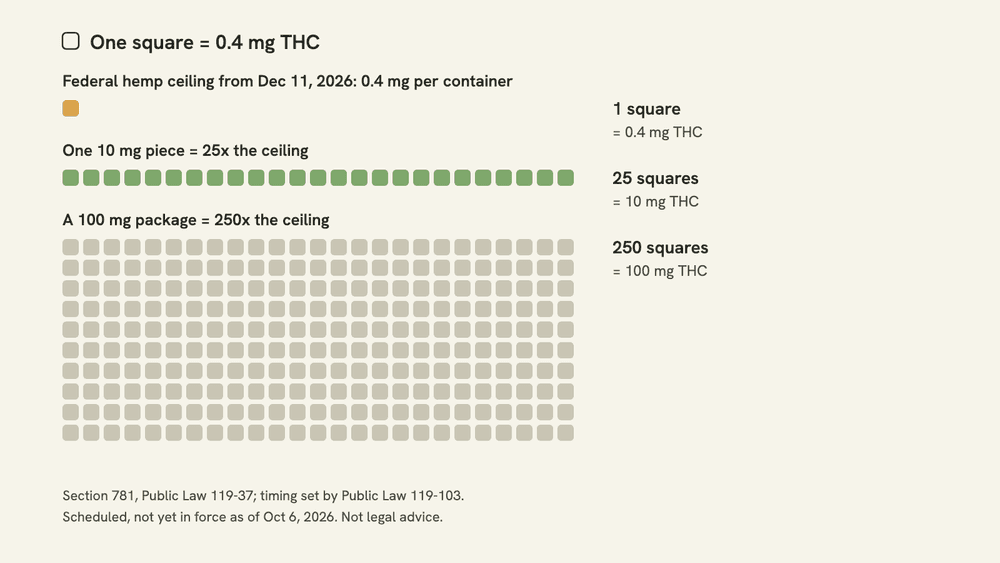
Many "10 mg THC" gummies sold online and in shops are made from hemp, under a federal definition that measures delta-9-THC by dry weight. That is how hemp-derived THC products reached store shelves in states without licensed cannabis markets. The definition is set to change. Section 781 of Public Law 119-37 excludes from hemp any finished hemp-derived product with "greater than 0.4 milligrams combined total per container" of total THC (including THCA) and other cannabinoids with similar effects, as HHS determines. "Container" means the innermost packaging in direct contact with the product. A later law, Public Law 119-103, split the timing: from November 12, 2026, Section 781 reaches only products containing cannabinoids the plant cannot naturally produce, and the 0.4 mg per-container ceiling arrives on December 11. The arithmetic is not a prediction, just a comparison: one 10 mg piece is 25 times the 0.4 mg ceiling, and a 100 mg pouch is 250 times it. The full story, including what the law leaves undefined, is in our guide to the 2026 hemp ban and the update on its delay to December 11.
If it was too much, and who should never get it
For what overconsumption feels like and what helps while it passes, see our guide to greening out, which also covers what to do when a child eats an edible. Two rules hold whatever the label says. First, do not drive, which is also what the 10 mg study's authors advise; our page on cannabinoids and driving covers impairment and the law. Second, keep edibles locked away. For a small child the arithmetic flips: in a review of 80 Colorado children under 6 who ate edibles, how sick they became tracked the THC dose per kilogram of body weight, which makes a single adult serving a large dose for a toddler. Gummies and chocolates look like ordinary treats, so the original child-resistant package is part of the product.
What is still unknown
The research on this number is thinner than its place on every label suggests. Here is where it runs out.
- Both 10 mg studies were small lab studies of infrequent users eating brownies. How frequent users, or gummies, drinks and tablets, compare at 10 mg is not measured there.
- The label-accuracy studies rest on purchases from 2014 (medical edibles) and 2020 (hemp CBD products). Today's state-tested products may do better; those audits do not show it either way.
- No study has measured a 10 mg edible against a joint.
- How federal hemp rules will be applied and enforced after December 11, 2026 is still unsettled.
Frequently asked questions
We do not give personal doses, and no study defines 'a lot' for you. 10 mg is the per-serving cap in California and Colorado and two NIDA standard THC units. In the one placebo-controlled study of adults who had not used cannabis for at least 60 days, 10 mg was clearly felt and raised peak heart rate by about 6 beats per minute; average test scores held, but some individuals were impaired, and the authors say not to drive after a dose like this. Many retail guides suggest smaller amounts for first-timers; that is their advice, not a measured threshold.
No one has measured that equivalence. The best estimate of an average joint is about 0.32 g of flower, inferred from purchase records, and its THC depends on the flower: at 20% THC that is roughly 64 mg in the plant material, which is not what reaches your blood. Smoked and swallowed THC also take different routes through the body and arrive on different clocks.
Physically, yes. But no label tells you whether the THC is spread evenly through a single piece, so each half is not guaranteed to hold 5 mg. Colorado's rule requires multi-serving products to be marked into servings of 10 mg or less and easy to separate; it says nothing about halves. And the piece itself is a batch average, which California allows to sit within 10% either way of the lab result.
A fixed amount of THC, 5 mg, proposed by two researchers in 2020 so that studies of different cannabis products could be compared, the way alcohol units work for drinks. Since 2021, NIDA has asked the researchers it funds to report delta-9-THC exposure in these units. By that measure a 10 mg edible is 2 units. NIDA states that the unit does not indicate safety or endorse any amount.
Often not, in the studies available. In a 2014 test of 75 medical edibles from three cities, 17% were within 10% of the label, 60% held less THC than printed and 23% held more. A 2025 analysis of hemp products bought in 2020 measured CBD rather than THC and found only 12.7% within 10% of the label, with third-party-testing claims making no difference. California now treats a label as accurate if it is within 10% of the lab result, which still leaves room for variation.
As of October 6, 2026, federal hemp law still draws the line at delta-9-THC by dry weight, which is how hemp gummies with 10 mg of THC reached shelves. From December 11, 2026, under Section 781 of Public Law 119-37, with its timing set by Public Law 119-103, a finished hemp-derived product with more than 0.4 mg of total THC per container falls outside the federal definition of hemp. A 10 mg piece is 25 times that. State laws vary and some are already stricter. This is not legal advice, and the status can change.
In the 2020 placebo-controlled study, effects did not appear until 30 to 60 minutes after eating and peaked 1.5 to 3 hours after. That was in infrequent users after a low-fat breakfast, so it describes that setting, not a guarantee for you.
Where to go next. If your edible lists a percentage instead of milligrams, or you want to compare it with flower, vapes and concentrates on one scale, learn how to turn a THC percentage into milligrams.
Writing about hemp, wellness and the small rituals that keep us balanced.