THC Chocolate: Why Tests Can Read Low and Squares Can Vary
A THC chocolate is an edible first, but chocolate adds two label problems: it is a hard sample for labs to measure, and scored squares are only as equal as the mixing. Plus what the 1996 cocoa study really found, and how to keep a bar away from kids and dogs.
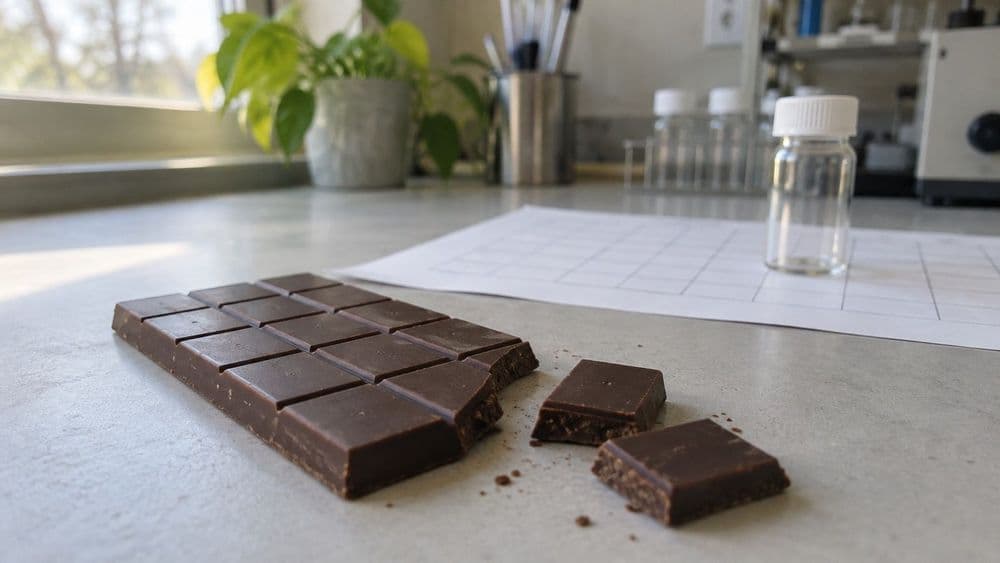
You are holding a THC chocolate bar, or thinking about buying one, and three questions come up. Is the number on the wrapper right? Are the squares really equal? And does chocolate make THC hit harder? Several pages that rank for this answer with product lists. Here is what the lab chemistry, the state testing rules and the original 1996 cocoa research say.
The short answer. A THC chocolate is an edible: THC you swallow, on the same slow clock and the same milligram math as a gummy. Chocolate adds two label cautions of its own. It is a hard sample for a lab to measure, because chocolate interferes with cannabinoid testing, and its scored squares are only as equal as the THC was mixed. The idea that chocolate makes THC stronger traces back to a 1996 letter about anandamide in cocoa, and the follow-up measurements found almost none. Planntz does not sell THC chocolate; this is a guide to the format for adults 21 and over where it is legal, not a product page.
What is actually in a THC chocolate bar
A THC chocolate bar is ordinary chocolate with a THC concentrate or a THC-infused fat blended into it, then molded into a bar of scored squares or into single pieces. Some are made with delta-9 THC from state-licensed marijuana and sold in dispensaries; others use hemp-derived THC and are sold online or in shops. The wrapper should tell you which. Either way, the chocolate itself is mostly fat and sugar. In the USDA's FoodData Central database, dark chocolate with 70-85% cacao solids carries about 42.6 g of fat per 100 g, and milk chocolate about 29.7 g. That fat matters twice: in the lab, and in the argument about what the THC does in your body.
The wrapper gives you two numbers to find before anything else: milligrams of THC per piece or square, and milligrams in the whole package. If it gives only one, work out the other from the number of squares. What a 10 mg edible actually means explains where that common serving figure comes from and what a controlled study saw at that amount. One thing the wrapper cannot tell you is whether dark or milk chocolate changes the experience. We found no study comparing how THC behaves in dark versus milk chocolate in people (PubMed search, October 14, 2026). The fat difference is real; its effect on a dose is unmeasured. A few pages that rank for this term also make medical claims about THC chocolate. Those claims are theirs, and this page does not make them.
Does chocolate make THC hit harder? The 1996 cocoa study, checked
The idea that chocolate boosts THC has a real origin. In 1996 three pharmacologists reported in a Nature letter titled "Brain cannabinoids in chocolate" that chocolate and cocoa contain anandamide, the body's own cannabinoid signal, plus related fats called N-acylethanolamines. The headlines wrote themselves. Two years later a second team, which included the Israeli chemist Raphael Mechoulam and a scientist from the Nestlé Research Centre, measured cocoa at several stages of processing. They found "no or very little anandamide", under 0.003 micrograms per gram of cocoa powder, and levels of the related fats similar to those in soybeans, hazelnuts and oatmeal. In mice, swallowed anandamide had effects only at very high amounts compared with what foods contain; that is an animal result, not tested in people. Their conclusion was blunt.
“We believe that the content of endocannabinoids in foods, and in cocoa in particular, is not sufficient to produce cannabis-like effects in mammals.”
Even the original authors accepted that much. In their published reply, Beltramo and Piomelli wrote that the new results "will reassure manufacturing companies that the risks of chocolate consumption do not include cannabis-like intoxication." Their remaining idea, that the two most abundant cocoa fats might slow the body's breakdown of its own anandamide, was a hypothesis about why people like chocolate. We found no study showing that it changes what a THC edible does. The popular claim that dark chocolate "supports your endocannabinoid system" is a cousin of this story, and our endocannabinoid system explainer covers why we do not repeat it.
The second version of the claim is about fat, and here the pharmacology is real but the scale is off. THC dissolves in fat, and food does change how swallowed THC behaves. The evidence, though, is about meals. On the prescribing label for dronabinol (Marinol), a synthetic THC capsule, a high-fat breakfast with about 59 g of fat pushed the average time to peak blood level about four hours later and raised total exposure about 2.9-fold, without significantly changing the peak itself. A 10 g square of dark chocolate carries about 4.3 g of fat, roughly one-fourteenth of that meal; a square of milk chocolate about 3 g, one-twentieth. We found no study testing whether that much fat changes a THC dose. Chocolate also has a record of not rescuing absorption: a classic oral THC study, a 1980 comparison of smoked and swallowed THC in 11 healthy volunteers, put the THC in a chocolate cookie, and only about 6% of it reached the bloodstream, against about 18% when smoked. The authors described the oral absorption as slow and erratic.
A 2020 food-science review of cannabis edibles argues that the type and structure of fat in an edible could change how it releases THC, but it builds that case from vitamins and other fat-soluble nutrients, not from people eating THC chocolate. So the honest verdict is narrow: we found no study showing that a THC chocolate hits harder than a gummy with the same milligrams. The dose on the label, whether that label is accurate and your own response matter more than the wrapper. Why edibles take so long to kick in covers food and timing in full, and our guide to 11-hydroxy-THC explains why any swallowed THC feels different from smoked.
Can the number on the wrapper read low? The chocolate matrix problem
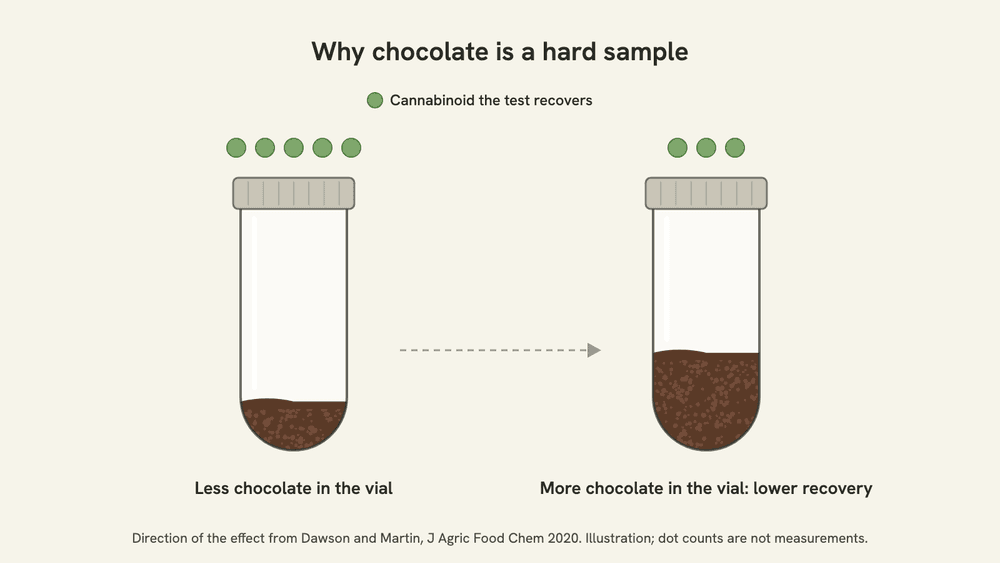
Chemists call it a matrix effect: something in the sample other than the thing being measured changes the result. In 2020 two chemists at CW Analytical, an Oakland cannabis-testing lab, published what they called the first known findings of chocolate interfering with cannabinoid analysis in the Journal of Agricultural and Food Chemistry. They added known amounts of THC, CBD, CBN, CBG and a synthetic cannabinoid to milk chocolate, dark chocolate and cocoa powder, and found that the amount of chocolate present was directly proportional to the interference: the more chocolate in the sample, the less of the cannabinoid their method recovered. The paper is peer-reviewed, its public abstract gives no recovery percentages, and the authors run a commercial testing lab. Dawson, the lead author, first described the problem at a 2019 American Chemical Society meeting, a conference talk rather than a reviewed paper. As the Associated Press reported at the time, his working idea then was that some of the THC clings to the chocolate's fat and effectively hides from the test.
How big can the effect be? Later work gives a sense of scale. In a 2023 study at the University at Albany, researchers made their own candies with 5 mg of CBD each, three chocolates and three fruit chews, and measured them with a method built for the job, using internal standards that labs add to track losses. They got back 76.2 to 84.3% of the CBD from the chocolates and 96.7 to 99.0% from the fruit chews. The same paper reports that an FDA forensic laboratory's 2018 method study recovered an average of 83% of cannabinoids from milk chocolate and 95% from dark chocolate. These are small studies, the Albany test used CBD rather than THC, and the milk and dark results point in different directions across papers, so do not read them as saying one kind of chocolate tests lower. The point is simpler: chocolate is a harder sample than a gummy, and a lab needs a method validated for it.
None of this tells you about the bar in your hand, and it does not mean chocolate labels understate THC across the market. The best-known retail audit of edibles, a 2015 JAMA study of 75 products that included chocolates among other edibles, found most packages held less THC than claimed, not more; the 10 mg edible guide has the numbers. Rules set how much drift is allowed. In California, 4 CCR section 15724(h) says a label is not considered inaccurate if it is within plus or minus 10.0% of the certificate of analysis. And California's lab sampling rule, 4 CCR section 15714(a), says all sample increments "must be homogenized prior to sample analyses": the lab blends its pieces together before testing. That gives a good average for the batch and, by design, tells you nothing about one square versus the next. How to read a COA walks through what a certificate can and cannot show, and the same label-and-certificate habit sits at the center of how we suggest choosing a CBD oil.
Breaking the bar: are the squares really equal?
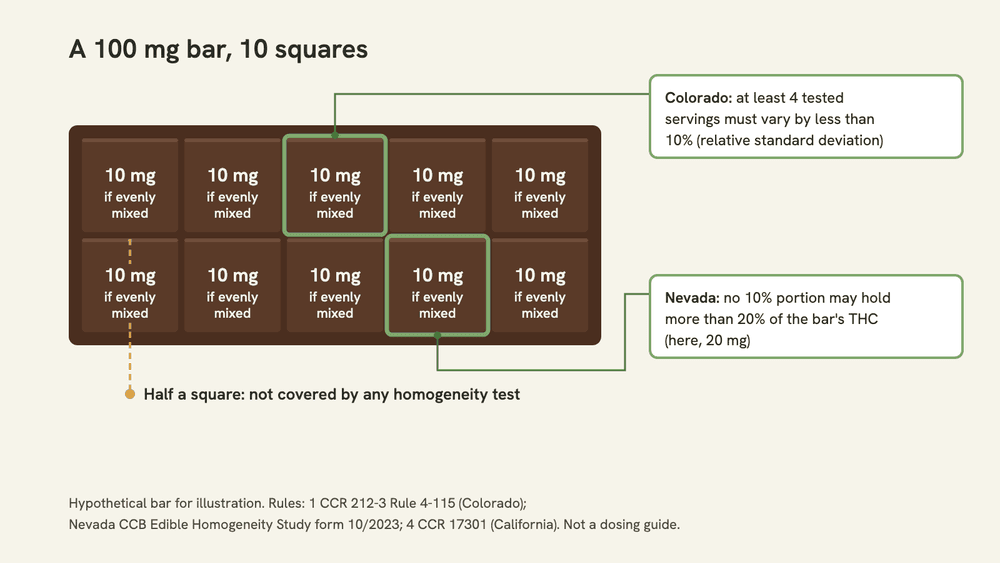
Scored squares carry a quiet promise: every square holds the same THC. That is only true if the THC was mixed evenly through the chocolate, which manufacturers call homogenization. We could not find a published study that measured THC square by square in commercial chocolate bars (PubMed search, October 14, 2026). What exists is state rules, and the lab results that go to regulators, which consumers rarely see. The rules show exactly what is and is not checked. California's edible rule, 4 CCR section 17301, says a multi-serving edible must be "homogenized so that each serving contains the same concentration of THC." Colorado's testing rule, 1 CCR 212-3 Rule 4-115, actually measures servings, and a batch that fails its homogeneity test "shall be considered to have failed potency testing." Colorado's packaging rule, Rule 3-335, adds that each serving must be physically demarked and easily separable, with no more than 10 mg of THC per serving and 100 mg per unit.
- California: each serving must contain the same concentration of THC and be readily identifiable. It is a manufacturing duty; the routine lab check runs on a blended sample.
- Colorado: at least four servings from two packages are tested, and their spread (relative standard deviation) must be under 10%. Above 2.5 mg per serving, potency must be within plus or minus 15% of target.
- Washington: solid edibles must be homogenized for uniform distribution, and THC sprayed or coated on the surface does not count as mixed in.
- Nevada: two servings per item are tested against the target. For edibles with 10 or more servings, which the form's instructions illustrate with chocolate bars, no 10% portion may hold more than 20% of the item's THC.
Washington's rule came with a warning shot. WAC 314-55-077 says edibles "must be homogenized to ensure uniform disbursement of cannabinoids", and in an August 2018 notice the state's cannabis regulator told manufacturers that some were spraying or coating THC onto edible products, and that "the THC must be three-dimensionally incorporated into a product, not just two-dimensionally on the surface." The notice says the rule exists for consistent serving sizes and to address the risk of exposure to children. Nevada's edible homogeneity study form is the most chocolate-specific of the four: its instructions name chocolate bars as the example of an edible with 10 or more servings, and a 10% portion holding more than 20% of the item's THC is an automatic failure. On a 10-square, 100 mg bar, that means no square above 20 mg. Notice what none of these rules covers: snapping a square in half. Halves sit outside every test.
The wrapper-to-square table
Put the label, the tolerances and the matrix problem together and you can see how much room sits inside one square. The three bars below are made-up labels for illustration, compared with the 10 mg reference unit that the 10 mg edible guide explains.
| Wrapper says | Squares | mg per square if evenly mixed | Compared with the 10 mg reference unit | California ±10% tolerance | Colorado ±15% potency variance | If a lab method recovered only 80% and nobody corrected it |
|---|---|---|---|---|---|---|
| 100 mg bar | 10 | 10 mg | 1 unit | 9-11 mg | 8.5-11.5 mg | 10 mg in a square reads as 8 mg; a 10 mg reading could mean about 12.5 mg |
| 100 mg bar | 20 | 5 mg | Half a unit | 4.5-5.5 mg | 4.25-5.75 mg | 5 mg reads as 4 mg; a 5 mg reading could mean about 6.25 mg |
| 50 mg bar | 5 | 10 mg | 1 unit | 9-11 mg | 8.5-11.5 mg | 10 mg reads as 8 mg; a 10 mg reading could mean about 12.5 mg |
| 100 mg bar, one square snapped in half | 10, then halves | 5 mg only if that square was itself evenly mixed | Half a unit, unverified | Not tested | Not tested | Unknown |
Read the table as arithmetic, not as a measurement or a suggested amount: no row describes a real product. Two things stand out. A legal label tolerance is already a range, so a square sold as 10 mg can sit between 9 and 11 mg in California's terms, or 8.5 and 11.5 mg under Colorado's potency rule, and of the rules above only Colorado's and Nevada's tests look at individual servings. And the 80% column is a number we picked from inside the 76 to 84% range the Albany team measured for CBD in chocolate, not a THC result. A method that under-recovers and goes uncorrected would shift every number the same way, which is why labs validate their methods for chocolate and correct for recovery.
How long THC chocolate takes to kick in
Chocolate runs on the edible clock. In controlled studies of THC baked into brownies, people felt nothing for the first 30 to 60 minutes, and effects peaked at 1.5 to 3 hours. We found no study showing that chocolate works faster than any other edible. That delay is how people end up eating a second square before the first has landed, and the digestion side of the edible delay is explained in full in its own guide. If you are comparing formats, our THC syrup guide covers liquids and the question of absorbing THC in the mouth.
Hemp chocolate vs dispensary chocolate, and December 11, 2026
A bar from a state-licensed dispensary sits under that state's rules: the serving caps, homogeneity tests and label tolerances above. A hemp-derived THC chocolate, sold online or in shops, has been sold under the federal definition of hemp, which measures delta-9 THC as a share of dry weight. Applied to a heavy, sugary bar, that percentage rule allows a lot of milligrams, and our hemp-derived THC guide works through a 40 g chocolate bar example. That is set to change. Section 781 of Public Law 119-37 will exclude from hemp any finished product with more than 0.4 mg of combined total THC per container, with container meaning the innermost packaging. Its timing was set by Public Law 119-103: when Section 781 takes effect on November 12, 2026, it will reach only synthesized cannabinoids, and the 0.4 mg per-container ceiling will apply from December 11, 2026. This is arithmetic, not a prediction: a 100 mg bar is 250 times that ceiling. Our update on the delay to December 11 explains what the law still leaves open.
Hemp or dispensary, a THC chocolate contains THC, and drug tests look for THC metabolites whatever the source. Plain chocolate is a different story. When a Belgian defendant blamed chocolate for a positive cannabis test, forensic toxicologists spiked chocolate's cannabinoid-like fats into urine, and none of the samples tested positive; the defendant was convicted. What a 10-panel drug test screens for and our guide to CBD and drug tests cover detection and why hemp products can still lead to a positive result.
Children, pets and chocolate that looks like chocolate
A THC chocolate looks exactly like ordinary chocolate, and that is the problem. The national numbers on edibles are stark. In an analysis of US poison-center reports published in Pediatrics, edible exposures in children under 6 rose from 207 in 2017 to 3,054 in 2021, a 1,375% increase; 97.7% happened at home, and 22.7% of the children were admitted to the hospital. Those records do not say whether the edible was a chocolate or a gummy. The one dataset we found that does is Canadian. In emergency-department surveillance of children up to age 11, run by the Public Health Agency of Canada from 2016 to 2021, chocolate was 26 of 293 edible cases (8.9%), behind gummies at 143 (48.8%), other candy (12.6%) and cookies (10.9%). The authors attributed 87.7% to unintentional ingestion linked to access or a lack of safe storage. That is one country, where a whole edible package is capped at 10 mg of THC, and a set of sentinel hospitals rather than a national count. It is still the best format-level evidence we found, and it points to storage, not to chocolate as a special case.
Regulators know the lookalike risk. California bans cannabis products that are "easily confused with commercially available foods that do not contain cannabis" (4 CCR section 17300(l)), and a chocolate is hard to make look different from ordinary food. Federal copycat warnings have targeted chips, candy, cookies and other snacks built to imitate well-known brands, including a July 2024 round of joint FDA and FTC warning letters; that round did not name a chocolate bar. Hemp chocolates sold outside state cannabis systems are not covered by California's rule, which leaves storage at home as the control that always applies.
- Keep THC chocolate in its original labeled, child-resistant package. Never move it into a candy dish, a lunch bag or an ordinary chocolate wrapper.
- Store it locked, out of reach and out of sight of children and pets, away from regular chocolate and snacks.
- Keep the wrapper. It tells a poison center the product, the mg per square and how many squares may be missing.
- Know how many squares are left when you put it away, so you can tell if any go missing.
Poison Control's page for parents whose child ate a cannabis edible explains what to expect after the call, and our greening-out guide covers what too much THC looks like in an adult and when it becomes an emergency. Dogs face a second problem. Chocolate is toxic to dogs on its own: the Merck Veterinary Manual's chapter on chocolate toxicosis lists semisweet and sweet dark chocolate at about 5.3 to 5.6 mg of methylxanthines (theobromine and caffeine) per gram, and milk chocolate at about 2.3 mg per gram. For a dog, a THC chocolate is two problems in one wrapper, the THC and the theobromine, so call a vet even if the amount seems small. The ASPCA's guidance on marijuana and pets covers the THC side.

Heat, bloom and storage
Chocolate that has warmed up and set again often grows a grey-white film. That is fat bloom, and a 2024 food-chemistry study of chocolate bloom describes it as the chocolate's own fats migrating to the surface and recrystallizing there. What bloom or melting does to the THC has not been measured: a PubMed search on October 14, 2026 found no study of THC stability in chocolate. The closest data come from a brownie, not a chocolate. In a 2017 study of a lab-made THC and CBD brownie used as testing reference material, baking did not degrade the THC, and the brownie held its THC at room temperature for at least three months. How THC itself breaks down over time is covered in our guide to whether weed goes bad.
- Bloom is a change in the chocolate's fat. Whether it moves THC around or reduces it is unknown.
- If a bar melted and set again, treat the squares as unreliable. This is our reasoning, not a measured result: the scoring and the mixing were set when the bar was made, and we found no test of what a remelt does.
- Keep it cool, sealed and in the original package, which also keeps the label and batch number with the bar.
- Follow the date on the wrapper. We found no study on how long THC lasts in chocolate beyond it.
What is still unknown
- We found no published study measuring THC square by square in commercial chocolate bars (PubMed, October 14, 2026).
- We found no human study comparing THC from chocolate with THC from a gummy or another edible, or dark chocolate with milk. The one chocolate-vehicle dosing model we found was in mice.
- The 2020 matrix paper's recovery figures are not in its public abstract, and the recovery numbers we do have come from small studies, one using CBD rather than THC.
- The 2015 retail audit cited here used products bought in 2014 and did not report chocolate separately.
- US child-exposure data do not record the edible's format; the Canadian data that do come from sentinel hospitals, not a national count.
- We found no measurement of what melting, bloom or long storage does to THC in chocolate.
Frequently asked questions
Plan for the edible clock. In controlled studies of THC brownies, people felt nothing for 30 to 60 minutes, and effects peaked at 1.5 to 3 hours. We found no study showing that chocolate works faster than other edibles.
Not shown. The idea that cocoa's anandamide boosts THC failed its 1998 measurement, which found little or no anandamide in cocoa powder. The fat in one 10 g square, about 3 to 4 g, is a small fraction of the meals that changed THC levels in studies, and we found no study that tested a square. The milligrams on the label, whether the label is accurate and your own response matter more than the format.
Read two numbers on the wrapper: mg of THC per piece and mg per package. In Colorado's licensed market a serving is capped at 10 mg and a unit at 100 mg, and California uses the same caps. Hemp-derived bars have followed a different, weight-based federal rule, which is set to change from December 11, 2026. We do not give personal amounts; 10 mg is a label reference unit, not a recommendation.
Physically, yes. Whether each piece holds the same THC depends on how evenly it was mixed. California requires each serving to contain the same concentration of THC, and Colorado tests at least four servings for a spread under 10%. No rule tests half a square, and we found no published study measuring square-to-square THC in commercial bars.
It can. THC chocolate contains THC, and drug tests look for THC metabolites whether the THC came from hemp or marijuana. Plain chocolate will not cause a positive: in a Belgian forensic case, chocolate's cannabinoid-like fats spiked into urine did not trigger a cannabis test. No label can guarantee a negative result.
The grey-white film on old or warmed chocolate is fat bloom, the chocolate's own fat moving to the surface. We found no measurement of what bloom, melting or long storage does to the THC. If a bar melted and set again, treat the squares as unreliable, because you can no longer assume the THC sits where the scoring says.
As of October 14, 2026, hemp THC chocolates are sold under a federal definition that measures delta-9 THC by dry weight, and state rules vary. Under Section 781 of Public Law 119-37, with timing set by Public Law 119-103, a finished product with more than 0.4 mg of total THC per container will fall outside federal hemp from December 11, 2026. This is general information, not legal advice.
Where to go next. Once you know how many milligrams are in a square, the next question is what that number means. Read what a 10 mg edible actually means: where the figure comes from, what a controlled study saw at that amount and how often edible labels match what is inside. For the certificate behind the label, our COA reading guide shows what to check.
Writing about hemp, wellness and the small rituals that keep us balanced.