
What Does a 10-Panel Drug Test Test For? The Real List
Many 10-panel lists online include two drugs with no legal US supply and skip fentanyl, which joined the federal panel in July 2025. Here is what 5-, 10- and 12-panel tests screen for, why the cannabis line is the same on every size, and what follows a non-negative screen.
A 10-panel drug test usually screens for ten drug classes: the five used in federal workplace testing (marijuana, cocaine, amphetamines, opioids and PCP) plus five add-ons, commonly benzodiazepines, barbiturates, methadone, propoxyphene and methaqualone. Two of those add-ons have had no legal supply in the US for years. And the list you will find on many results pages leaves out fentanyl, the one drug the federal panel actually added, in 2025.
The short answer. No law defines a "10-panel." The only drug panels written into federal rules are the federal workplace panels: the one the US Department of Health and Human Services (HHS) publishes for federal agencies, whose current version took effect on July 7, 2025, and the Department of Transportation's, which is tied to it. A 10-panel is a commercial product: a lab's bundle of the federal five plus extra classes, and its contents vary by lab and by order. One thing does not vary. On every panel size, the cannabis line is the same single screen for the metabolite your body makes from THC. A bigger panel adds drug classes, not cannabinoids, and CBD is not a target on any of them.
What a 5-panel drug test tests for: the federal five
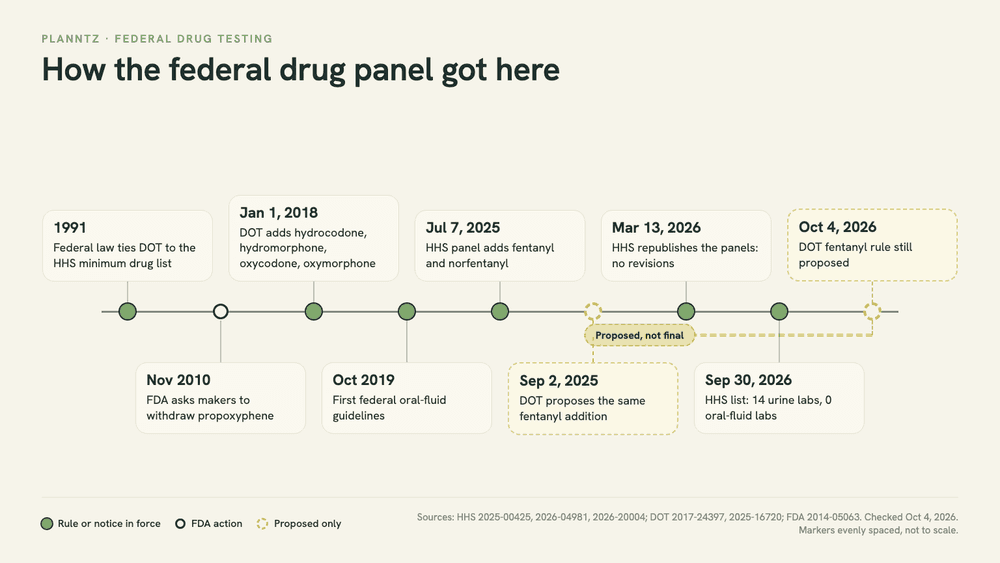
A drug "panel" is simply the list of drugs a lab checks a specimen for, each one a separate line on the report. The modern list starts with federal workplace testing. HHS sets the minimum list for federal agencies through its Mandatory Guidelines, and a 1991 law, the Omnibus Transportation Employee Testing Act, requires the Department of Transportation (DOT) to follow that minimum list for safety-sensitive jobs in trucking, aviation, rail, transit, pipelines and maritime work. DOT's version sits in 49 CFR 40.82, the section of its testing rule that names the drugs, and it is unusually strict. Labs "must test for the following five drugs or classes of drugs in a DOT drug test": marijuana metabolites, cocaine metabolites, amphetamines, opioids and phencyclidine (PCP). Then the rule closes the door on everything else.
“You must not test "DOT specimens" for any other drugs.”
That is where "5-panel" comes from. A 2019 review in American Family Physician describes the standard workplace screen as one that covers "the five major drug classes targeted by federal workplace testing programs": opioids, cannabinoids, cocaine, amphetamines and PCP. The five are not frozen, though. DOT added hydrocodone, hydromorphone, oxycodone and oxymorphone to its opioid class on January 1, 2018, so a DOT test today covers common prescription painkillers that an older five-panel kit would miss. The scale is large: DOT's program alone runs roughly 6.8 million drug tests a year, by the department's figure for 2023.
What a 10-panel drug test adds, and the two drugs you cannot buy
Private employers are not bound by the federal list, so labs sell bigger bundles. The clearest real-world example is one a lab published itself. Quest Diagnostics' 2019 employer sheet of commonly ordered urine panels lists a "10 Panel DOT look-alike" (unit code 65190N). It starts from a DOT-style base (amphetamines including MDMA-type drugs, cocaine, marijuana metabolites, opiates and the heroin marker 6-acetylmorphine, the semi-synthetic opioids, and PCP) and adds five classes. That is the key to the name: the "10" counts drug classes, not molecules. Here are the five add-ons on that sheet:
- Benzodiazepines: a class of prescription sedatives and anti-anxiety medicines.
- Barbiturates: an older class of prescription sedatives.
- Methadone: an opioid used in addiction treatment and for pain. It gets its own line because the standard opiate screen does not reliably detect it.
- Propoxyphene: a painkiller once sold as Darvon and Darvocet, off the US market since FDA's November 2010 request.
- Methaqualone: the drug once sold as Quaaludes, a Schedule I drug today with no legal prescription supply.
Read the last two again. In 2010, after new clinical data showed that propoxyphene at normal doses put patients at risk of potentially serious or even fatal heart-rhythm abnormalities, FDA concluded that its risks outweighed its benefits. In November 2010 it asked the makers to withdraw it, and it formally withdrew the last approvals (8 new drug applications and 46 generic applications) effective March 10, 2014. Methaqualone sits in Schedule I of the federal controlled substances schedules, the category for drugs with no currently accepted medical use, so no pharmacy can dispense it. Our reading is that both lines survive because panel bundles are legacy products: once employers order a bundle by name, it tends to stay on the menu. Keep the limits of this example in view. Quest's sheet is one lab's document from 2019, and current menus may differ. Even that one sheet sells two different 10-panels: a second bundle, the "10 Panel pre 2010 DOT look-alike" (unit code 35190N), has the same ten headline classes but no MDMA, no heroin marker and no semi-synthetic opioids. The point is that a "10-panel" is a product choice, not a standard.
5-panel vs 10-panel vs 12-panel, side by side
The table below puts the two rule-based panels (HHS and DOT) next to the three commercial sizes people search for. The last column shows what the screen is built to find. It lists analytes only; cutoff concentrations are deliberately left out.
| Drug class | Federal HHS urine panel (since July 7, 2025) | DOT panel today (49 CFR 40.82) | Typical 5-panel | Typical 10-panel | 12-panel | What the screen looks for |
|---|---|---|---|---|---|---|
| Marijuana | Yes | Yes | Yes | Yes | Yes | THC metabolite (in urine) |
| Cocaine | Yes | Yes | Yes | Yes | Yes | Benzoylecgonine, a cocaine metabolite |
| Amphetamines, including methamphetamine | Yes | Yes | Yes | Yes | Yes | Amphetamine, methamphetamine |
| MDMA (ecstasy) and MDA | Yes | Yes, within amphetamines | Varies | Varies | Varies | MDMA, MDA |
| Codeine and morphine | Yes | Yes | Yes | Yes | Yes | Morphine, codeine |
| Heroin marker (6-AM) | Yes | Yes | Varies | Varies | Varies | 6-acetylmorphine |
| Hydrocodone, hydromorphone, oxycodone, oxymorphone | Yes | Yes, since 2018 | DOT-style kits yes; older kits no | Varies (one of Quest's two 10-panels) | Varies | The named opioids |
| PCP | Yes | Yes | Yes | Yes | Yes | Phencyclidine |
| Fentanyl and norfentanyl | Yes, added 2025 | Proposed only | No | Not on Quest's 2019 sheet | Varies | Fentanyl, norfentanyl |
| Benzodiazepines | No | No (not allowed) | No | Yes | Usually | Varies by assay |
| Barbiturates | No | No (not allowed) | No | Yes | Usually | Barbiturate class |
| Methadone | No | No (not allowed) | No | Yes | Usually | Methadone |
| Propoxyphene | No | No (not allowed) | No | Yes on Quest's 2019 sheet, despite the 2010 withdrawal | Varies | Propoxyphene |
| Methaqualone | No | No (not allowed) | No | Yes on Quest's 2019 sheet, though Schedule I | Varies | Methaqualone |
| Alcohol | No (separate test) | Separate breath or saliva test | No | Only if added | Only if added | Not a drug-panel line |
| CBD | No | No | No | No | No | Not a target |
How to read it: the HHS and DOT columns are rules, and the other three are products. If your test is a DOT test, the DOT column is your whole test, because the lab is barred from adding anything. If it is a private employer's test, the employer chose the columns. A 12-panel has no published standard at all, and Quest's 2019 sheet does not offer one: it means a 10-panel plus two classes the lab or the employer picks. Opioids the classic opiate screen misses, such as fentanyl or buprenorphine, usually have to be named on the order to be tested, so the order form is the only reliable list.
The 2025 change: fentanyl joined the federal panel
Under a heading titled "Added Drugs: Fentanyl and Norfentanyl," the 2025 HHS update added fentanyl and norfentanyl, its main metabolite, to the federal urine panel, effective July 7, 2025. HHS also weighed removing MDMA (ecstasy) and MDA, decided that question needs further study, and kept them. Its own projection, built from non-regulated testing data, was that about 0.1 to 0.3 percent of federal workplace urine specimens would confirm positive for fentanyl or norfentanyl. That is an estimate, not a measured rate. On March 13, 2026, HHS republished the panels and said it had made no revisions: the 2025 panels remain in effect.
Why does fentanyl need its own line? Because the classic opiate screen was built for morphine and codeine. The AAFP review notes that workplace immunoassays "do not reliably detect synthetic or semisynthetic opioids," naming fentanyl and methadone among them, and that many labs require a specific order. So a 10-panel with an "opiates" line is not a fentanyl test unless fentanyl is listed by name. DOT proposed the same fentanyl addition in a notice published September 2, 2025, with comments closing October 17, 2025. As of October 4, 2026, the Federal Register shows no final rule, so the DOT panel is still five classes without fentanyl. Because the 1991 law ties DOT to the HHS minimum list, the change is expected to reach DOT; it has not yet.
The cannabis line is the same on every panel size
In urine, every federal panel looks for one cannabis target: the metabolite your body makes from delta-9 THC, which the 2025 HHS tables abbreviate as delta9THCC (often written THC-COOH). DOT's rule text still uses the older abbreviation "THCA," which is why people confuse it with the raw-plant acid of the same name; our guide to whether THCA shows up on a drug test untangles the two. A 5-panel, a 10-panel and a 12-panel all run this same single cannabis screen. Moving up a panel size adds classes such as benzodiazepines or methadone. It does not add CBD, CBG, CBN or any other cannabinoid as a separate line.
Two details matter if you use hemp products. First, oral fluid is different: the federal saliva panel looks for delta-9 THC itself rather than its metabolite. Second, CBD is not a target, so the question is always how much THC a product contains. In a 2020 controlled study funded by SAMHSA, with a SAMHSA scientist among its authors, six adults took 100 mg of pure CBD, swallowed or vaporized. Across 218 urine samples, one screened positive and none confirmed positive. When the same people vaporized a CBD-dominant cannabis containing 3.7 mg of THC, four samples confirmed positive. Six people taking single doses is a small study, and products that contain THC behave differently from pure CBD. The cannabis cutoffs, how trace THC can build up with daily use, and how spectrum type changes your exposure are covered in our guide to whether CBD shows up on a drug test. If you use a hemp product, the practical step is to check the THC line on the batch's certificate of analysis: a broad-spectrum batch whose COA reports non-detected THC is a different exposure from a full-spectrum oil with a trace below 0.3%. Either way, no product can guarantee a drug-test result.
Screen, confirmation, Medical Review Officer: what happens to a non-negative
A "non-negative" screen is not yet a failed test. In regulated testing, a specimen moves through these steps before your employer hears a result:
- 1Collection: you provide the specimen at a collection site, and a custody form tracks it to the lab.
- 2Screen: an immunoassay, a fast chemical reaction that answers yes or no for each drug class against a set cutoff.
- 3Confirmation: a non-negative screen is retested with chromatography, which separates the molecules, and mass spectrometry, which identifies them by mass. This step names the exact drug.
- 4Medical Review Officer (MRO): a physician reviews the confirmed result and gives you the chance to explain it, for example with a prescription.
- 5Report: only after that review does the MRO report the verified result to the employer.
The two-stage design exists because screens make mistakes. The AAFP review puts it plainly: immunoassays are qualitative, they "can cross-react with other medications and give false-positive results," and "all results are considered presumptive until confirmatory testing is performed." A 2017 Mayo Clinic Proceedings review of how to interpret urine drug tests compiles false-positive and false-negative data for commonly misused substances. Cross-reactivity is why a screen alone is never the final answer.
Prescriptions are handled at the MRO step. Under DOT's 49 CFR 40.137, the rule on verifying a positive result, the MRO "must offer the employee an opportunity to present a legitimate medical explanation in all cases," must not question whether your doctor should have prescribed the drug, and, if the explanation holds, must verify the result as negative. The MRO can allow up to five extra days to produce records, and can still raise a fitness-for-duty concern about the medication itself. Under 49 CFR 40.141, the rule on checking medical records, the MRO must take reasonable steps to verify your records, may contact your pharmacy, and may even ask an HHS-certified lab to test for THCV, a minor cannabinoid, when verifying a result. Under 49 CFR 40.151, the list of what an MRO is prohibited from doing, a hemp product is not a medical explanation, as our delta-8 drug-test guide explains. The same section bars verifying a negative because a doctor recommended "a drug listed in Schedule I," a clause written with state medical-marijuana laws in mind. An April 2026 federal order moved marijuana under a state medical license to Schedule III, while that clause, unamended as of September 2026, still says Schedule I; we do not guess how the two interact. Private, non-DOT programs set their own procedures, and what can happen to your job after a verified positive is covered in whether you can get fired for failing a drug test.
What standard panels do not look for
"Not on the panel" means the lab was not asked to look. It does not mean a substance cannot be detected, because an employer can order specific tests beyond the standard classes. With that in mind, these are absent from the federal panel and from a typical 10-panel:
- Alcohol: not one of the ten classes. DOT measures it separately with a breath or saliva device under its own rules, and a non-federal employer can order an alcohol marker as a urine add-on.
- CBD: not a target on any panel. The exposure that matters is the THC in a product.
- Kratom and 7-OH: not on the federal panel. A lab can test for them when an employer orders it.
- Synthetic cannabinoids (sold as spice or K2): their chemistry keeps changing, and most standard urine tests are not designed to detect them. A lab needs a specific order.
- Hemp-derived cannabinoids such as delta-8 THC, HHC, CBG and CBN: none is a separate target, but not being a target is not the same as being invisible. Some can set off the cannabis screen.
- Sports-banned substances: anti-doping tests use a different list entirely.
The hemp cannabinoids differ molecule by molecule, so each has its own page: how HHC behaves on a drug test, whether CBG can trigger a positive and what the evidence says about CBN and drug screens. Which kratom compounds the DEA has scheduled, and which it has not, is covered in our explainer on the DEA's kratom-analog scheduling. Athletes follow WADA's prohibited list rather than a workplace panel, which our guide to CBD in sports explains. Two everyday exposures have their own answers too: hemp seed oil and secondhand cannabis smoke.
Urine, saliva, hair: which specimen your panel uses
Most 10-panel tests are urine tests, and urine is the default for federal programs. HHS's September 30, 2026 list of certified laboratories counted 14 labs certified for urine (two of them limited to VA or Defense Department employees) and stated: "At this time, there are no laboratories certified to conduct drug and specimen validity tests on oral fluid specimens." That is true even though federal oral-fluid guidelines were first published in October 2019 and revised in October 2023. The gap has real consequences. In a final rule published May 11, 2026, DOT requires a directly observed urine collection where its rules call for oral fluid but oral fluid testing is not yet available, and it says at least two HHS-certified oral-fluid labs must exist before oral fluid can be used. Hair testing is sold commercially, but HHS's 2020 proposal to add hair to federal testing had not been finalized as of October 4, 2026, so hair is not an authorized federal specimen.
You will not find a detection-window chart here. How long a drug stays detectable depends on the drug, the dose, how often it is used, the person and the specimen, and a single chart suggests more certainty than the data supports. For cannabis specifically, the detection-window discussion lives in the CBD drug-test guide linked above.
Before a test: a five-question checklist
None of this is about passing a test. It is about knowing what will be tested and being ready for the conversations that can follow. Work through these in order:
- 1Is this a DOT or federal test, or a private employer's panel? A DOT test is fixed at five classes; a private panel is whatever was ordered.
- 2Which panel is being ordered? Ask HR or the collection site for the panel name or list of classes, and whether it includes add-ons such as fentanyl or alcohol.
- 3Which prescriptions do you take, and who prescribed them? Have the list ready in case the MRO calls. Do not stop or change a medication because of a test.
- 4If you use a hemp or CBD product, what does the THC line on the batch's certificate of analysis say? No product can guarantee a drug-test result.
- 5Could your job be affected? Take employment questions to HR or an employment lawyer. This page is general information, not legal advice.
What is still unclear
Three things are open as of October 4, 2026. First, timing: DOT has not finalized its fentanyl proposal, and we found no target date we could verify. Second, vendor menus: labs revise their bundles, so the 2019 Quest sheet shows that methaqualone and propoxyphene were still sold in a 10-panel then, not that every lab sells them today. Third, an employer outside the federal programs can order whatever combination of classes, cutoffs and specimens its state's law allows, so the only authority for your test is the order itself. For how federal and state rules on hemp and cannabis fit together more broadly, start at our overview of whether CBD is legal.
Frequently asked questions
A 5-panel screens for the five classes used in federal workplace testing: marijuana, cocaine, amphetamines, opioids and PCP. A 10-panel keeps those five and adds five more, usually benzodiazepines, barbiturates, methadone, propoxyphene and methaqualone, though the add-ons vary by lab. The cannabis line is the same screen on both; a bigger panel adds drug classes, not cannabinoids.
No. Alcohol is not one of the ten classes. In DOT testing, alcohol is measured separately with a breath or saliva device under its own rules. A non-federal employer can order an alcohol marker as an add-on to a urine panel, so if you need to know, ask which panel was ordered.
Usually not, unless fentanyl is listed by name. Standard opiate screens do not reliably detect fentanyl, and Quest's 2019 10-panel sheet has no fentanyl line. Federal agency testing under HHS has included fentanyl and norfentanyl since July 7, 2025. DOT proposed the same addition on September 2, 2025, and as of October 4, 2026 there is no final rule. A private employer can order fentanyl as an add-on, so ask.
It can. A prescribed drug in a tested class, such as a benzodiazepine or an opioid painkiller, can screen and confirm positive. In DOT testing, a Medical Review Officer talks to you before the employer sees a result, and a valid prescription means the result is reported as negative, although the MRO can still raise a safety concern. Private programs vary. Never stop a medication because of a test; talk to your prescriber.
CBD itself is not a target on any panel. The cannabis line looks for the metabolite of THC, so the risk comes from THC in the product. In a 2020 study of six adults, pure CBD produced no confirmed positives, while a CBD-dominant cannabis with 3.7 mg of THC did. Products differ, so check the batch's certificate of analysis, and remember that no product can guarantee a drug-test result. Our CBD drug-test guide covers cutoffs and trace THC in detail.
No rule or published standard defines one, and Quest's 2019 employer sheet does not offer one. A 12-panel is a 10-panel plus two more classes chosen by the lab or the employer. Opioids the classic opiate screen misses, such as fentanyl or buprenorphine, usually have to be named on the order to be tested. Because the contents vary, the order form is the only reliable list.
Usually urine. Federal guidelines allow oral fluid (saliva), but HHS's September 30, 2026 list showed no laboratory certified to run federal oral-fluid tests yet. Hair tests are sold commercially, but HHS's 2020 proposal to add hair to federal testing is not final. Private employers choose their specimen within their state's rules.
Under DOT, no: the lab must test for the five classes and is not allowed to test a DOT specimen for anything else. A private employer generally chooses the panel it orders, within state law. If you want to know what you are being tested for, ask HR or the collection site for the panel name or list of classes.
Where to go next. If the cannabis line is the one on your mind, read does CBD show up on a drug test? next. It covers the cutoffs, how trace THC accumulates with daily use, and how broad- and full-spectrum products differ, which this page intentionally leaves to it.
Writing about hemp, wellness and the small rituals that keep us balanced.