
Is Weed Bad for Your Liver? The Studies, and Your Kidneys
The NIH's liver-injury reference finds no convincing case of cannabis harming a healthy liver. Hepatitis C and fatty-liver studies disagree, and your kidneys get their own answer. Here are the key studies, with their designs and limits.

Is weed bad for your liver? For a healthy liver, the US government's reference on drug-induced liver injury has found no convincing case of cannabis injuring the liver. But that is only one of three questions hiding in the search. If you already have hepatitis C, the studies split. If you have read that weed protects against fatty liver, that idea comes from surveys and hospital records that cannot show it. And if you were also wondering about your kidneys, that answer is here too.
The short answer. The NIH's LiverTox database gives cannabis a likelihood score of E, its grade for an unlikely cause of clinically apparent liver injury (chapter last updated February 16, 2023). That is not the same as "proven safe": the same page calls the population studies retrospective and uncontrolled. If you have hepatitis C, fatty liver, a heavy drinking habit or kidney disease, the evidence is thinner and sometimes contradictory, and the decision belongs with your clinician, not with this page. We are a CBD company, and we already publish what the CBD liver studies show, including the findings that cut against CBD. This page does the same for THC and for smoked or eaten cannabis.
Is weed bad for your liver? It depends on which question you ask
Most pages answer "is weed bad for your liver" in a sentence. The research answers three different questions, in three different groups of people, using study designs of very different strength. Here they are in one place, along with the kidney findings. "How strong" in the table means how well the design can show cause and effect, not how big the effect was. A study that looks at people once (cross-sectional) can show that two things go together. A cohort that follows people forward in time (prospective) is better at showing which came first. Neither is a randomized trial, and no randomized trial of cannabis and liver or kidney outcomes exists.
| Who was studied | What was found | Study design | How strong |
|---|---|---|---|
| Adults without liver disease | No convincing case of liver injury; graded E (unlikely cause) by NIH LiverTox | Federal reference review of case reports and injury registries | Moderate: an absence of cases, not a trial |
| People with hepatitis C only | Daily use linked with more scarring and fatty change on biopsy (France 2005 and 2008, US 2008); pooled estimate not significant | Cross-sectional biopsy studies; meta-analysis | Weak to moderate; studies disagree |
| People with HIV and hepatitis C | No faster scarring over years of follow-up (Canada 2013, US women 2016) | Prospective cohorts using blood-based scores | Moderate |
| People with or at risk of fatty liver | Lower odds of a fatty-liver diagnosis in users; a genetic study found no causal protection | Surveys and hospital records; Mendelian randomization | Weak for any protective effect |
| Heavy drinkers | Lower odds of alcohol-related liver disease codes in users; LiverTox notes no effect at the highest intakes | Cross-sectional hospital records | Weak |
| Adults without kidney disease | No faster decline in kidney function | Three prospective cohorts | Moderate |
| Adults with chronic kidney disease | No link to progression in 3,939 people; 19 users lost function slightly faster in a smaller study | Prospective cohorts | Moderate (large study); weak (small one) |
| People using synthetic cannabinoids (Spice, K2) | An outbreak of 16 acute kidney injury cases; one case of toxic hepatitis | Outbreak investigation; case report | Different drugs, not cannabis |
Two things stand out. First, the population matters: a finding in people with hepatitis C tells you little about a healthy liver, and the reverse is also true. Second, the most-quoted "benefits" sit in the weakest rows. The rest of this page goes through the table row by row.
What the NIH's liver-injury database says
LiverTox is run by the National Institute of Diabetes and Digestive and Kidney Diseases, part of the NIH, and it is where clinicians look up whether a drug or supplement injures the liver. Its marijuana chapter says marijuana use "has not been linked to serum enzyme elevations during therapy or to instances of clinically apparent liver injury with jaundice." Case reports blaming cannabis for acute liver injury exist, it notes, but "none were convincing or well documented," and cannabis has not turned up in large case series of drug- and supplement-induced liver injury. One of those series comes from the US Drug-Induced Liver Injury Network: LiverTox notes that none of the 899 adjudicated cases the network reported for 2004 to 2013 were attributed to cannabis.
“At present cannabis does not appear to cause acute liver injury or to exacerbate preexisting liver disease.”
Read the rest of that page before you treat it as a clean bill of health. LiverTox says epidemiologic studies have "repeatedly linked" cannabis to liver abnormalities, but "all such studies were retrospective and uncontrolled," and "careful, prospective controlled studies are needed." Here is the kind of study it means. A 2004 Brazilian study of 123 hospitalized drug users found mildly raised liver enzymes (AST in 42%, ALT in 35%) among the 26 who used only marijuana, with the highest levels in people who also drank. It did not rule out other causes of liver disease; as LiverTox points out, there is no mention of tests for hepatitis B or C. So "no convincing injury" means nobody has documented cannabis clearly damaging a liver. It does not mean cannabis has been tested and cleared, and none of the studies on this page measured THC dose or product potency.
One more piece of liver biology matters for the FAQ below. LiverTox notes that cannabis is processed in the liver, is poorly absorbed by mouth and undergoes extensive first-pass metabolism, which means swallowed THC goes through the liver before it reaches the rest of your body. That is a potency story rather than a harm story. It is part of why edibles feel different: the liver turns some of that THC into 11-hydroxy-THC, an active metabolite.

Hepatitis C: the studies that found faster scarring, and the ones that did not
Hepatitis C is a viral infection that can slowly scar the liver (fibrosis) and lead to cirrhosis. The question here is not whether cannabis injures a healthy liver but whether it speeds that scarring up. Three early studies said it might. In a French study of 270 people with untreated hepatitis C, all with liver biopsies, daily cannabis smoking was independently associated with faster fibrosis progression (odds ratio 3.4, 95% confidence interval 1.5 to 7.4) and with severe fibrosis (odds ratio 2.5). An odds ratio of 1 means no difference between groups; 3.4 means about 3.4 times the odds. If the interval crosses 1, the result is not statistically significant. In the same study, excessive alcohol had an odds ratio of 2.2. The same French group then reported, in 315 untreated patients, that daily cannabis predicted marked fatty change in the liver (steatosis of 30% or more), odds ratio 2.1, with an interval starting at 1.01. In San Francisco, a study of 204 people with hepatitis C linked daily use with moderate-to-severe fibrosis, adjusted odds ratio 6.78, but with an interval from 1.89 to 24.31, which shows how few people (13.7%) were in the daily group.
Then came studies that followed people forward in time. In a Canadian cohort of 690 people with both HIV and hepatitis C, marijuana smoking did not speed progression to significant fibrosis (hazard ratio 1.02, 0.93 to 1.12) or to cirrhosis (0.99). A small signal for clinical cirrhosis or end-stage liver disease (1.13 per 10 joints a week) disappeared when the researchers looked at use 6 to 12 months before the outcome instead of at the same time. They read that as reverse causation: people who were getting sicker smoked more for their symptoms, rather than smoking making them sicker. In 575 US women with HIV and hepatitis C followed for a median of 11 years, cumulative cannabis use was not linked to significant fibrosis (hazard ratio 1.01, 0.92 to 1.10), while cumulative alcohol was. Both cohorts measured fibrosis with blood-based scores rather than biopsies, and both studied people who also had HIV, so they do not fully answer the hepatitis C-only question.
A 2019 meta-analysis of nine studies pooled the evidence and found no significant increase in fibrosis with marijuana. Look closely at the number for hepatitis C alone, though: a pooled odds ratio of 1.96, an interval from 0.78 to 4.92, and high disagreement between the studies (I-squared of 77%). "Not significant" here does not mean "no effect". The data fit anything from slight protection to nearly five times the odds, and only two of the nine studies measured progression over time. Other studies pull the opposite way. A 2018 analysis of US hospital records matched 4,728 pairs of hepatitis C patients and linked coded cannabis use with fewer recorded cirrhosis diagnoses (adjusted prevalence ratio 0.81), but found no difference in liver cancer or in-hospital death. And a French cohort of 997 people with HIV and hepatitis C linked regular or daily use with lower odds of a raised fatty liver index, a score built from blood tests and body measurements (adjusted odds ratio 0.45), which points the other way from the 2008 biopsy finding.
| Study | Who | Design | Finding with cannabis |
|---|---|---|---|
| Hézode 2005, France | 270 with untreated hepatitis C | Biopsy at one point; use recalled | Daily use: faster fibrosis, OR 3.4 (1.5-7.4) |
| Hézode 2008, France | 315 with untreated hepatitis C | Biopsy at one point | Daily use: marked steatosis, OR 2.1 (1.01-4.5) |
| Ishida 2008, US | 204 with hepatitis C | Baseline of a prospective cohort | Daily use: moderate-to-severe fibrosis, OR 6.78 (1.89-24.31) |
| Brunet 2013, Canada | 690 with HIV and hepatitis C | Prospective cohort | No faster fibrosis, HR 1.02 (0.93-1.12) |
| Kelly 2016, US | 575 women with HIV and hepatitis C | Prospective, median 11 years | No faster fibrosis, HR 1.01 (0.92-1.10); alcohol was linked |
| Adejumo 2018, US | 4,728 matched pairs | Hospital records, one point in time | Fewer coded cirrhosis diagnoses, prevalence ratio 0.81 |
| Farooqui 2019 | 9 studies pooled | Meta-analysis of observational studies | Hepatitis C only: OR 1.96 (0.78-4.92), not significant |
Why do they disagree? The early studies took one biopsy and asked people to recall years of cannabis use, so they could not tell whether heavier use came before the scarring or after it. They did, however, study hepatitis C on its own. The later studies followed people forward, but used blood scores and studied people who also had HIV. The lag analysis in the Canadian cohort shows how reverse causation can create a signal like this: its own small end-stage signal disappeared once use was measured months earlier. The biopsy studies had no way to run that check, so part of their signal could be sick people using more cannabis, but nobody can tell from their data. None of that proves the early findings wrong. It means the question is still open.
That is why two expert bodies, reading overlapping evidence, land in different places. In its 2019 position statement on cannabis in gastrointestinal and liver disease, the Canadian Association of Gastroenterology wrote: "Cannabis likely increases hepatic fibrosis and steatosis in patients mono-infected with hepatitis C, and so its use is not recommended." LiverTox, in its chapter last updated February 16, 2023, says cannabis does not appear to "exacerbate preexisting liver disease." The Canadian wording matches the biopsy studies, which looked at hepatitis C on its own; the LiverTox update came after the coinfection cohorts (2013, 2016) and the meta-analysis (2019) were published. We are not going to settle that disagreement for you; a hepatologist who knows your case is better placed to weigh it.
Does weed protect against fatty liver? What those studies measured
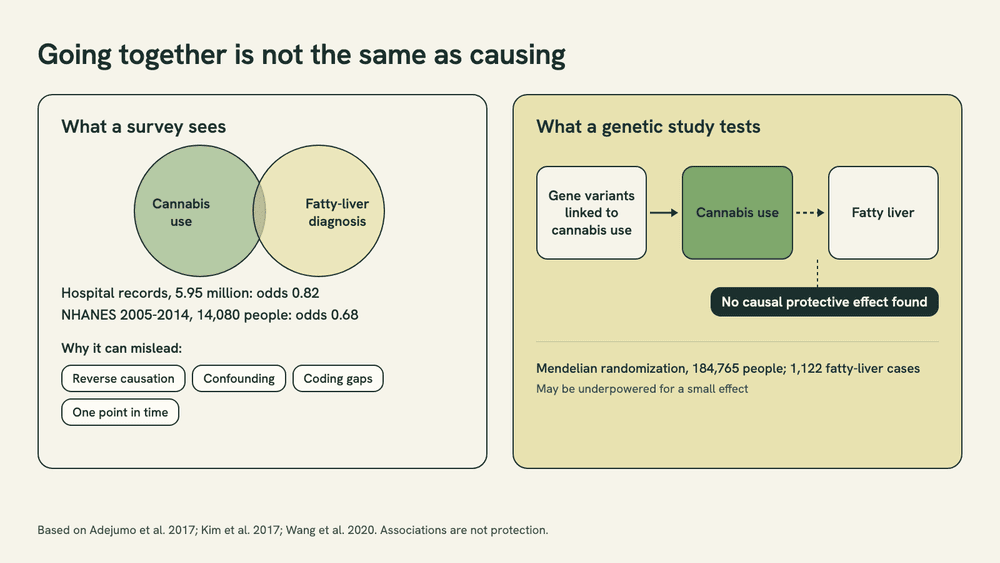
Fatty liver disease was renamed in 2023 from NAFLD (non-alcoholic fatty liver disease) to MASLD (metabolic dysfunction-associated steatotic liver disease), and it is where the "weed protects your liver" headlines come from. Here is what the studies behind them did. A 2017 analysis of 5.95 million US hospital discharge records from 2014 found that people coded as cannabis users had lower adjusted odds of a NAFLD diagnosis (0.82), and lower still among those coded as dependent (0.49). Yet NAFLD appeared in only about 1% of the records, a sign it was badly under-coded. A 2017 analysis of the national NHANES health survey, covering 22,366 people across two survey periods, found current users less likely to have suspected NAFLD (odds ratio 0.68, in 14,080 people from 2005 to 2014) or NAFLD on ultrasound (0.75, in the 1988 to 1994 survey). In the larger sample, though, "suspected NAFLD" was defined by a single liver enzyme, ALT. And a 2025 NHANES study that used liver elastography, a scan that measures liver stiffness as a marker of scarring, found no link between cannabis use and liver stiffness in 2,756 adults with MASLD overall; a lower-odds signal appeared only in women.
These are associations: cannabis use and a lower chance of a fatty-liver diagnosis showing up in the same records. There are several ways that can happen without cannabis doing anything to the liver.
- Reverse causation: people who feel unwell, or who have been told to change their habits, may use less cannabis, so the sicker group ends up looking like non-users.
- Confounding: users and non-users differ in age, weight, diet, alcohol and other habits, and adjusting for a few of these does not capture all of them.
- Coding: hospital studies only see cannabis use and fatty liver when someone wrote them into a record, and both are often missed.
- Timing: a single snapshot cannot show whether cannabis use came before the liver changes or after them.
The closest thing to a test of cause and effect here is genetic. A 2020 Mendelian randomization study used gene variants linked to cannabis use, identified in 184,765 people, as a stand-in for use. Those variants are fixed at conception and are not changed by later habits or illness, which sidesteps reverse causation and most confounding. Checked against fatty liver in the UK Biobank (1,122 cases), they gave no evidence that lifetime cannabis use, dependence or use disorder causally lowers fatty-liver risk. The authors note the study may be underpowered, so it cannot rule out a small effect, but it is the one study designed to ask the causal question, and it did not find the protection the headlines describe. The one prospective study pointing the same way as the surveys comes from a 2019 study of 390 people with first-episode psychosis who were starting antipsychotics: after 3 years, cannabis users had a lower fatty liver index and less steatosis, with no difference in fibrosis scores, and the authors link it to less antipsychotic weight gain. That is a specific group on specific medicines, not the general population.
The same hospital databases also turn up signals in the other direction. Among US inpatients with NAFLD in 2014, those with cannabis use had more ascites, a fluid buildup in the abdomen (4.5% versus 3.6%), and no difference in cirrhosis. In 3.38 million US inpatients with MASLD from 2016 to 2020, a study published online ahead of print, coded cannabis use went with lower odds of cirrhosis (0.72) but higher odds of heart attack (1.42) and stroke (1.53). Those are associations too, but they are a useful reminder that a lower number in one liver column does not add up to "good for you". The Canadian gastroenterologists' 2019 verdict on cannabis for fatty liver and alcohol-related liver disease was that "there is insufficient data to support their use." None of this is a reason to use cannabis for your liver.
Weed, alcohol and your liver
The most-quoted numbers in this debate come from a 2018 analysis of 319,514 US inpatients with a history of heavy alcohol use. Those coded as cannabis users had lower adjusted odds of alcoholic steatosis (0.55), alcoholic hepatitis (0.57), cirrhosis (0.45) and liver cancer (0.62). Some sites convert those into percentages and list them under "benefits". Three caveats travel with them. The diagnoses and the cannabis use both came from billing codes, which the Canadian gastroenterologists flag as the major limitation. A one-time snapshot cannot tell whether the people who used cannabis also drank less. And LiverTox notes that the lower odds were not seen in the patients with the highest daily alcohol intake, the group at greatest risk.
In the cohorts that followed people over time, alcohol is the factor that kept showing up. In the US women's cohort, cumulative alcohol was linked to fibrosis and cannabis was not. In the 2005 French biopsy study, excessive alcohol was an independent risk factor alongside daily cannabis. Cannabis is not a liver shield for drinking: if you use both, the liver risk the evidence points to most consistently is the alcohol, and nothing here shows cannabis offsetting it. Using the two together also has its own short-term effects, covered in what happens when you get crossfaded. How CBD fits in with drinking is a separate question, answered in our guide to CBD and alcohol.
Where the real liver risks sit next to cannabis
If cannabis itself has not been shown to injure a healthy liver, what should you actually watch? The documented risks sit next to it rather than in it. The clearest is high-dose CBD. The label of the prescription CBD medicine warns about liver-enzyme rises, and the FDA's own randomized trial in 201 healthy adults found that some people taking CBD had liver enzymes above three times the upper limit of normal, and nobody on placebo did. That is a CBD question, not a THC one, and the CBD liver guide linked above walks through those numbers, so we will not repeat them here.
- High-dose CBD: a documented liver-enzyme signal, separate from THC.
- Medicines processed by the liver: cannabinoids are broken down by liver enzymes too, which is why interactions are worth checking with a pharmacist.
- Alcohol: the factor the long-term cohorts kept linking to liver scarring.
- Synthetic cannabinoids and unknown substances: lab-made drugs sold as Spice or K2, and anything untested, are a different risk from cannabis.
On that last point: synthetic cannabinoids are not cannabis. They are lab-made chemicals sold under names like Spice and K2. A 2014 case report described a 45-year-old man who developed toxic hepatitis after smoking Spice/K2 and recovered after treatment with N-acetylcysteine. One case proves little on its own, but the Canadian position statement also describes "cannabis or synthetic analogues" as "possibly hepatotoxic." If you are not sure what is in something you were given, how to tell if weed is laced covers the warning signs, and our guide to CBD and medications covers the interaction question in depth.
What about your kidneys?
Kidney function is usually tracked with eGFR, an estimate from a blood test of how well the kidneys filter. For people without kidney disease, the long-term cohorts have not found faster loss of kidney function. CARDIA, a study that followed 3,765 US young adults for 10 to 15 years (83% had used marijuana), found that use was not associated with eGFR decline, rapid decline or protein in the urine (albuminuria). Daily current users did have about 4.5% lower eGFR at one exam, a one-time snapshot rather than a decline over time. In 1,521 Baltimore adults without kidney disease followed from 2004 to 2017, current regular use was not linked to new chronic kidney disease (odds ratio 0.79, 0.37 to 1.68), rapid decline or albuminuria.
For people who already have chronic kidney disease (CKD), the biggest study also found no link. In the CRIC cohort of 3,939 US adults with CKD, followed for a median of 5.5 years, persistent marijuana use was not associated with CKD progression (hazard ratio 0.94, 0.82 to 1.07) or with death. Hard drug use (cocaine, heroin or methamphetamine) was linked to progression (hazard ratio 1.25). A smaller hospital-based study, ASSESS-AKI, found no faster decline in 94 cannabis users without CKD, while 19 users with CKD lost about 1.3 mL/min/1.73 m² more eGFR per year than 597 non-users. That did not translate into a higher risk of CKD progression (adjusted hazard ratio 1.6, 0.7 to 3.5), and 19 people is a very small group, but it is the one signal worth knowing about if you have CKD.
| Study | Who | Follow-up | Finding with cannabis |
|---|---|---|---|
| CARDIA (Ishida 2017) | 3,765 young adults with normal kidney function | 10-15 years | No link to eGFR decline or albuminuria |
| HANDLS (Alvarado 2026) | 1,521 Baltimore adults without CKD | 2004-2017 | No link to new CKD, OR 0.79 (0.37-1.68) |
| CRIC (Bundy 2018) | 3,939 adults with CKD | Median 5.5 years | No link to CKD progression, HR 0.94 (0.82-1.07) |
| ASSESS-AKI (Rein 2024) | 94 users without CKD; 19 users with CKD | Hospital-based cohort | No change without CKD; with CKD, about 1.3 mL/min/1.73 m² faster yearly decline but no link to progression |
A 2020 review by nephrologists concluded that cannabis "does not seem to affect kidney function in healthy individuals," and advised that in people with CKD who use it, kidney function "should be closely monitored" and "smoking should be avoided." That is guidance for monitoring people who already use cannabis, not a recommendation to start, and it is one more reason the decision sits with your nephrologist. The kidney harm that is documented comes from synthetic cannabinoids, not cannabis. In 2012, the CDC investigated 16 cases of acute kidney injury in six states after synthetic cannabinoid use. No single brand explained them, but a fluorinated compound called XLR-11 turned up in 4 of 5 samples tested and in specimens from 4 of 6 patients.
If you need a transplant
Transplant programs set their own rules on cannabis, and they vary. The 2020 nephrology review notes that cannabis "may delay transplant candidate listing or contribute to ineligibility," and that "CBD may raise tacrolimus levels" (tacrolimus is an anti-rejection drug). At one New York transplant center, 97 of 1,255 kidney transplant candidates (8%) reported active cannabis use between 2016 and 2019. After adjustment, use was not linked to time to waitlisting or to graft failure (hazard ratio 0.83, 0.31 to 2.20), and the authors argue that exclusion criteria are "subjective and inequitably applied." For liver transplant, the Canadian position statement says cannabis use is "not an absolute contraindication" and should be "assessed on a case by case basis," but that "in the context of other addictions, cannabis use is not recommended." The practical point: ask your own transplant program before using anything, and tell them if you already do.
Who should talk to a clinician first
Nothing on this page is a reason to start or stop cannabis for your liver or kidneys. If any of the following describes you, raise cannabis with your doctor, hepatologist or nephrologist before using it, and be specific about how much you use and how.
- You have chronic hepatitis B or C.
- You have fatty liver (MASLD) with scarring, or cirrhosis from any cause.
- You drink heavily or have alcohol-related liver disease.
- You have chronic kidney disease or are on dialysis.
- You are on a transplant waiting list, or you take anti-rejection drugs such as tacrolimus.
- You take prescription medicines processed by the liver, or you use high-dose CBD.
- A recent blood test showed raised liver enzymes or a falling eGFR.
The FDA-approved label for prescription CBD lists the symptoms it tells patients to report as possible signs of liver injury. It is a useful general checklist whatever you are using.
What the evidence cannot tell you
Every study on this page has its own limits, and some limits are shared by all of them.
- There are no randomized trials of cannabis and liver or kidney outcomes. Everything here is observational.
- Use was self-reported or taken from diagnosis codes, and none of the studies measured THC dose or product potency.
- Hospital-records studies only see people whose cannabis use and liver disease were written down.
- The coinfection cohorts studied people with both HIV and hepatitis C, so they do not settle the hepatitis C-only question.
- The genetic study on fatty liver may be too small to detect a modest effect.
- No study above compared liver or kidney outcomes for edibles versus smoking.
- Nothing here describes a specific product, and none of it shows that cannabis treats or prevents any liver or kidney disease.
For the same evidence-graded approach applied to other organs, see our pages on whether weed kills brain cells and why weed makes you cough. For the side effects reported with CBD specifically, start with our overview of CBD side effects.
Frequently asked questions
Not according to NIH LiverTox, which says marijuana use has not been linked to liver-enzyme elevations or to liver injury with jaundice. A 2004 Brazilian study did find mildly raised enzymes in 26 hospitalized marijuana-only users, but it did not rule out hepatitis or alcohol as the cause. The documented enzyme signal is with high-dose CBD, which our guide to whether CBD is bad for your liver covers. If your enzymes are raised, ask your doctor to look for the cause rather than assuming one.
No study has compared liver outcomes by route. Swallowed THC passes through the liver before it reaches the rest of your body (LiverTox calls this extensive first-pass metabolism), and that is part of why edibles feel different. That is a difference in effect, not evidence of liver damage, and it does not make either route the safer choice for a liver.
That is a decision for you and your hepatologist. The Canadian Association of Gastroenterology (2019) advises against cannabis in hepatitis C because early biopsy studies linked daily use to faster scarring. Later cohorts in people with HIV and hepatitis C did not find that, and LiverTox (2023) says cannabis does not appear to worsen existing liver disease. For fatty liver, the studies showing lower odds in users are associations, and the one genetic study found no protective effect. If you have either condition, talk to your hepatologist before using cannabis at all, and tell them if you already do.
No study shows that. A large hospital-records study linked cannabis use with lower odds of alcohol-related liver disease codes in heavy drinkers, but it relied on billing codes, could not tell whether users drank less, and LiverTox notes the effect was not seen at the highest alcohol intakes. In the cohorts that followed people over time, alcohol was linked to scarring and cannabis was not. Cannabis is not a shield for drinking.
In people without kidney disease, three cohorts (CARDIA, HANDLS and the non-CKD group in ASSESS-AKI) found no faster decline in kidney function. In people with chronic kidney disease, the large CRIC study found no link to progression, and a small group of 19 users lost eGFR slightly faster without more progression. A 2020 nephrology review advises close monitoring of kidney function in people with CKD who use cannabis; if you have CKD, make the decision with your nephrologist. Synthetic cannabinoids are different: they were behind a 2012 outbreak of acute kidney injury.
It depends on the program, because policies are set center by center. A 2020 nephrology review notes cannabis may delay listing or affect eligibility; the Canadian gastroenterologists call it not an absolute contraindication for liver transplant, to be judged case by case. One New York center found cannabis use was not linked to worse kidney-transplant outcomes. Ask your own program, and mention any CBD too, since CBD may raise levels of the anti-rejection drug tacrolimus.
Where to go next. If you also use CBD, read the evidence on CBD and liver enzymes, including the findings that cut against CBD. If you have a liver or kidney condition, bring both pages to your next appointment.
Writing about hemp, wellness and the small rituals that keep us balanced.