Does Weed Kill Brain Cells? The Myth and What Studies Found
No study has shown that weed kills brain cells in people. The idea came from monkey and rat experiments. The better question is which effects fade in hours or weeks and which may last years, and the answer depends on age, how heavy the use is and what else was used.
Does weed kill brain cells? No study has shown that it does in people. The idea traces back to monkey experiments published in 1978 and 1980, rat studies at very high doses and a dish of cultured neurons, and a larger, year-long monkey study did not consistently reproduce it. That does not mean cannabis leaves the brain untouched. The useful question is which effects last hours, which linger for days to a few weeks, and which may persist for years. The answer depends on how old you were when you started, how heavily and how long you used, and what else you were using.
Most pages that rank for this question give the same verdict, "it doesn't kill cells, but...", then pick one study to back it up. The trouble is that the studies disagree with each other, and the disagreement is the most useful part. This page lays them out side by side: the animal work behind the myth, the Dunedin birth cohort against the twin studies on IQ, the brain scans, the teenage-brain research, the dementia signal and the recovery data from people who stopped. For each one, we give who was studied, how many, and what the design can and cannot prove. It is general information for adults 21 and over, not medical advice. If you want the background on THC first, start with our overview of what cannabinoids are and how they differ.
The short answer: three different questions hiding in one
"Does weed kill brain cells" bundles three questions that researchers study separately, with different methods and different levels of certainty. The first is what happens while you are high. The second is what lingers in the days and weeks after you stop, which researchers call residual effects. The third is whether anything persists for years. Human studies do not count brain cells. They measure memory, IQ, brain structure on MRI and brain activity during tasks. The table sorts the best human evidence for each question, and the sections below walk through every study behind it.
| Timeframe | What was measured | In whom | Best evidence | How strong |
|---|---|---|---|---|
| Acute (hours) | Recall of a short text later in the session | 24 adolescents aged 16-17 and 24 adults aged 26-29 | A 2023 double-blind lab trial comparing vaporized THC with placebo | Strong for the short term: randomized and placebo-controlled, but single sessions in a lab |
| Residual (days to about 4 weeks) | Memory, attention and other thinking tests | Young frequent users (average age 20.6); adults aged 30-55 with at least 5,000 lifetime uses; users aged 16-25 | A 2018 meta-analysis of 69 studies; a 2001 washout study; a 2018 paid-abstinence trial | Moderate: the gaps are small and shrink or disappear with abstinence |
| Persistent (years) | IQ, memory, brain structure, brain activity, dementia diagnoses | Birth cohorts followed to 38 and 45; twins; teens scanned at 14 and 19; adults 45 and over in Ontario | The Dunedin cohort, US and UK twin studies, the IMAGEN scans, Ontario health records | Weakest for cause: all observational, and the designs disagree |
Where "weed kills brain cells" came from
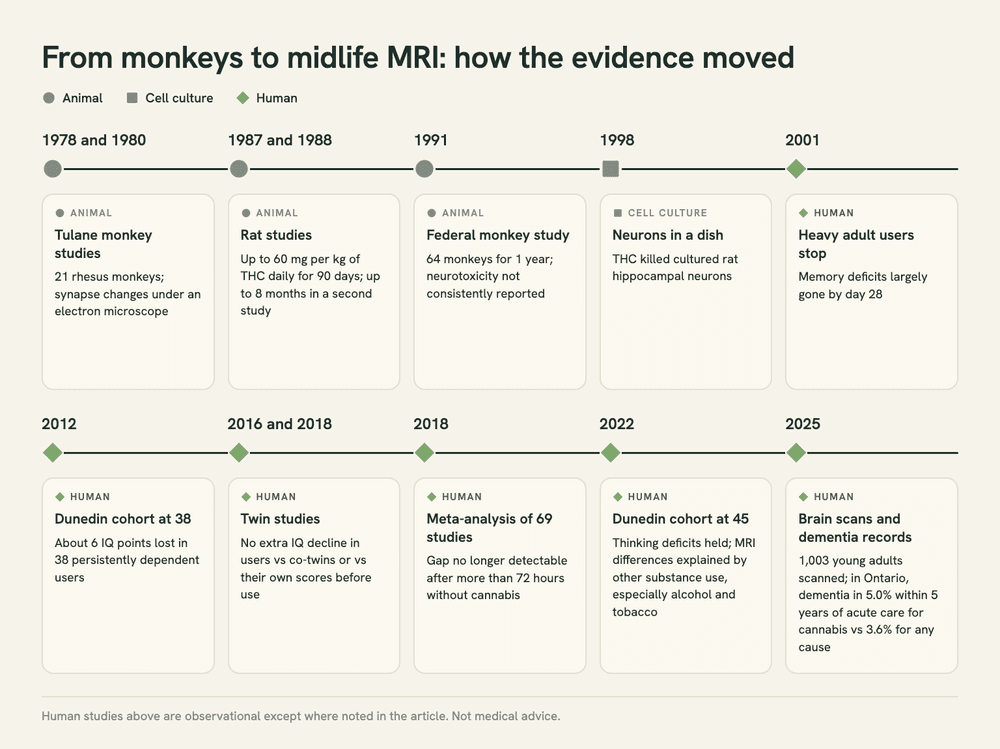
The phrase traces to rhesus-monkey experiments by psychiatrist Robert Heath and colleagues at Tulane University, published in a 1978 research volume and in more detail in a 1980 paper in the journal Biological Psychiatry. Twenty-one monkeys were split into groups. Some breathed active marijuana smoke on different schedules, some received THC intravenously (0.69 mg per kg of body weight), and some breathed smoke from marijuana with the active cannabinoids removed. Exposure lasted 6 or 8 months. After 2 to 3 months, electrodes implanted deep in the brain of some animals recorded changes in the septal region, hippocampus and amygdala, and those changes persisted through the rest of the exposure and for 1 to 8 months after it ended. Under an electron microscope, the researchers reported altered synapses (the junctions where nerve cells pass signals), damage to a structure inside nerve cells called the rough endoplasmic reticulum, and unusual inclusion bodies in cell nuclei. They concluded that THC "can produce permanent alterations in brain function and structure of monkeys."
Two things about those studies matter. First, they reported changes in cell structure, not a count of dead cells, so "kills brain cells" was already a simplification of what was measured. Second, 21 monkeys divided across several groups, with electron microscopy on only a handful of brains, is a small base for a big conclusion. The FDA's National Center for Toxicological Research then ran a larger test. Its design exposed 64 young male rhesus monkeys to the smoke of one 2.6% THC cigarette a day, either daily or on weekends only, for a year, alongside monkeys given smoke from cigarettes with the cannabinoids extracted and a sham-exposed group. A 1991 review of that work concluded that "studies of monkeys after up to 12 months of daily exposure have not consistently reported neurotoxicity", while noting that longer exposures had never been studied. A companion neurochemistry study found no changes in neurotransmitter levels in the caudate, frontal cortex, hypothalamus or brainstem about 7 months after the last exposure. And a 1991 receptor study found that cannabinoid receptors in chronically dosed rats and monkeys "do not appear to be irreversibly altered." For how quickly those receptors recover in people who pause, see our tolerance break guide and the brain scans behind it.
The clearest evidence of actual cell damage comes from rats, not monkeys. In a 1987 study, rats given oral THC at 10 to 60 mg per kg every day for 90 days showed, at the highest doses, smaller neurons in the hippocampal region called CA3 and a 44% reduction in synapses per unit volume. At 10 to 20 mg per kg, their dendrites (the branches that receive signals) were shorter, but synapse density was normal. In a 1988 study, rats given up to 8 mg per kg of THC five days a week for 8 months, about 30% of their lifespan, had lower neuron density in the hippocampus, yet "appeared to be only minimally affected behaviorally" at those doses. Doses given daily or near-daily for months of a rat's life do not translate directly to people. Finally, the result many readers land on today is a 1998 cell-culture study in which THC killed rat hippocampal neurons in a dish. Its authors suggested that nerve-cell death might explain some of the memory problems linked to cannabis, while stating in the same sentence that "there is no direct evidence that marijuana is neurotoxic for human brain".

What THC does to brain cells in the short term
Cannabis affects memory because of where its receptors are. THC acts on CB1 receptors, and the hippocampus, the seahorse-shaped structure that helps turn new experiences into memories, is one of the regions where CB1 receptors are densest. Our guide to the endocannabinoid system maps where they sit. While THC is active, it changes how those cells signal, and memory for new information is one of the most reliably measured effects. In a 2023 double-blind trial, 24 adolescents aged 16 to 17 and 24 adults aged 26 to 29, all of whom already used cannabis, each vaporized 8 mg of THC, 8 mg of THC plus 24 mg of CBD, or a placebo on separate days, with doses scaled to a 75 kg body weight. (Those are research doses, not guidance.) THC impaired their ability to recall a short text later in the session. THC also lowers working memory, the ability to hold information in mind for a few seconds, and our guide to why weed can make you paranoid looks at a trial that measured that drop and found it did not explain the paranoia. With regular use, the brain also turns down the number of available CB1 receptors, the basis of tolerance, which the tolerance break guide linked above covers. The sections below turn to what lingers once the THC itself is gone.
Does weed lower your IQ? The Dunedin study vs the twin studies
The best-known finding comes from the Dunedin study, which has followed 1,037 people born in Dunedin, New Zealand, in 1972-73. Their IQ was tested in childhood (ages 7 to 13) and again at 38, and cannabis use was assessed at 18, 21, 26, 32 and 38. The 38 people who met criteria for cannabis dependence at three or more of those assessments lost about 6 IQ points between childhood and 38 (from 99.68 to 93.93). Among the 23 who started as teenagers and kept using, the drop was about 8 points. The gap was not explained by years of education, tobacco, alcohol, hard drugs or schizophrenia, and in the adolescent-onset group, quitting for a year or more did not fully restore function. It is an association in small subgroups, not proof of cause.
The result was challenged the following year. An economist's 2013 re-analysis showed that differences in socioeconomic background could, in principle, produce the same pattern, and that the true effect "could be zero", while stating that "it would be too strong to say that the results have been discredited." It was a simulation, not new data. The stronger test came from twins, who share family background and, for identical twins, their genes. If cannabis lowers IQ, the twin who uses should decline more than the co-twin who does not.
| Study | Who | Design | What it found | What it can rule out |
|---|---|---|---|---|
| Dunedin, New Zealand (2012) | 1,037 people born 1972-73; IQ at 7-13 and 38 | Birth cohort | About 6 points lost in 38 persistently dependent users; about 8 in 23 adolescent-onset persistent users | Education, tobacco, alcohol, hard drugs; not unmeasured family factors |
| Economist's re-analysis (2013) | The Dunedin pattern, simulated | Simulation | Socioeconomic differences could produce the same pattern | Nothing by itself; it shows a confounder could explain the result |
| Two US twin cohorts (2016) | 789 and 2,277 twins; IQ at 9-12 and 17-20 | Twin comparison | Users' knowledge-based IQ fell about 4 points more than nonusers', but no dose-response and no more decline than abstaining co-twins | Shared family background and, partly, genes |
| UK ALSPAC cohort (2016) | 2,235 teenagers; IQ at 15, exams at 16 | Birth cohort | Using 50+ times not linked to IQ or exam results after adjustment; adjusting for tobacco shrank the link sharply | Earlier ability, cigarette smoking |
| UK E-Risk twins (2018) | 1,989 twins born 1994-95; IQ at 5, 12 and 18 | Twin comparison | Dependent teens already scored 5.61 points lower at 12, before use; no extra decline by 18 | Family background, IQ before use |
| Colorado twins (2020) | Twins followed to age 23 | Twin comparison | Little support for a causal effect; one exception for more frequent use at 17 | Family background, other substance use |
Here is what those designs found. Two US twin studies of more than 3,000 young people found that users' scores on crystallized IQ, the knowledge-based skills such as vocabulary, fell about 4 points (4.0 and 3.4) compared with nonusers. But there was no dose-response, meaning heavier users did not decline more, and twins who used did not decline more than their abstaining co-twins. In one of the two samples, future users already scored lower before they started. In 2,235 British teenagers from the ALSPAC cohort, even those who had used cannabis 50 or more times did not differ from never-users on IQ at 15 or exam results at 16 once earlier ability and cigarette smoking were accounted for; adjusting for tobacco "dramatically attenuated" the associations. Then the lead author of the Dunedin study ran a twin study of 1,989 British teenagers. Cannabis-dependent teens scored 5.61 points lower at age 12, before they started, and 7.34 lower at 18, but they did not show a greater decline between 12 and 18. Within twin pairs, the twin who used more often performed about the same as the co-twin on five of six executive-function tests; the exception was one working-memory test. A 2020 Colorado twin study found "little support for a potential causal effect", with one exception: more frequent use at 17 went with worse executive function and general cognitive ability at 23.
“Short-term cannabis use in adolescence does not appear to cause IQ decline or impair executive functions, even when cannabis use reaches the level of dependence.”
So which is right? Both can be, because they answer different questions. The twin studies mostly cover use through the late teens, much of it light to moderate, and they show that the IQ gap measured in teenagers is largely explained by factors that were present before use. Dunedin covers something the twin studies do not: cannabis dependence that persisted for decades into midlife. For light teenage use, the evidence of IQ harm is weak once family is taken into account. For years of heavy, dependent use, an association remains and the cause is unresolved. None of this shows that teenage use is safe. It shows that the IQ figure people quote usually carries more weight than its study can support, and that you should always ask how many people it came from.
Heavy long-term use: memory, brain scans and what they show
The most-cited recent brain study is a 2025 imaging study of 1,003 young adults aged 22 to 36 from the Human Connectome Project. The 88 who had used cannabis more than 1,000 times in their lives showed lower brain activation during a working-memory task than people who had not. The difference was small by conventional benchmarks (a Cohen's d of -0.28, a standard measure of effect size). Six other tasks showed no difference, and links with recent use, measured by urine test, did not hold up after the statistical correction for testing many brain regions at once. The authors called it an "uncontrolled, cross-sectional study", meaning a single snapshot in time, and wrote that its results "should not be considered causal." A widely shared press release about the study printed percentages of affected users that do not appear in the paper; the paper's own numbers are the ones above.
Brain-structure studies point the same modest way. A 2019 pooling of 30 MRI studies found that regular users' hippocampi were slightly smaller on average (a standardized difference of 0.14), as was the orbitofrontal cortex behind the eyes. The effect was small, varied a lot between studies, did not track how much or how long people had used, and resembled patterns seen in users of other substances. In younger people, a 2023 meta-analysis of 16 studies and 830 people aged 14 to 26, 386 of them users who started between 15 and 19, found no detectable differences in overall or regional brain volume, including the hippocampus. Its authors suggested that "prolonged and long-term exposure to heavy cannabis use may be required to detect gross volume alterations."
The Dunedin cohort shows why this is hard to untangle. At age 45, with 94% of the original members still taking part, the cognitive follow-up found that 86 long-term users had lost an average of 5.5 IQ points since childhood (from 99.3 to 93.8), with poorer learning and processing speed and a smaller hippocampus. Those thinking deficits were not explained by tobacco, alcohol, other drugs, childhood socioeconomic status, childhood self-control or family history, and they were absent or smaller in people who had quit and in midlife recreational users. When the same team analyzed MRI scans of 875 members at 45, long-term users had a thinner cortex, smaller volumes in deeper gray-matter structures and brains that a machine-learning model rated as older. But those structural differences were explained by polysubstance use, especially alcohol and tobacco. Same people, same age, two answers: the thinking-test signal survived the adjustment for other substances, and the brain-structure signal did not.
Why the teenage brain is where the concern concentrates
If there is one group researchers worry about most, it is teenagers, because the brain is still developing. The strongest imaging evidence comes from IMAGEN, a European study that scanned 799 teenagers at 14, before any cannabis use, and again at 19. Those who used more cannabis showed more thinning of the prefrontal cortex, the region behind the forehead involved in planning and impulse control, and the differences were not there at 14. The pattern of thinning partly matched a brain-scan map of where CB1 receptors are found, and thinning on the right side was linked to attentional impulsiveness at 19. A 10-year follow-up of 704 of the same participants found that starting between 14 and 19 was linked to prefrontal changes that persisted into young adulthood, while starting between 19 and 22 was linked to a different pattern, in temporal and midline regions. Add Dunedin's adolescent-onset subgroup, the 23 people who lost about 8 IQ points, and the direction is consistent. All of these are observational, with self-reported use (from none to more than 40 occasions in IMAGEN), and none can rule out every other explanation.
Not every study points the same way, and an honest summary has to say so. The 2023 meta-analysis above found no detectable brain-volume differences in 14- to 26-year-olds. A 2018 meta-analysis of 69 studies, covered in the reversibility section below, reported that the size of the cognitive gap in young users "did not vary by sample age or age at cannabis use onset." In the 2023 lab trial, 16- and 17-year-olds were affected about the same as adults in the moment. And the twin studies found little evidence that teenage use itself lowers IQ. The fair reading: specific brain changes linked to teenage use have been seen, but how large, lasting and meaningful they are is not settled. The public-health position is precautionary, and the CDC's page on cannabis and brain health states it plainly.
Does weed make your brain age faster?
This question comes from two findings, and both need careful reading. The first is Dunedin at 45: long-term users had lost 5.5 IQ points since childhood and had a smaller hippocampus. The smaller hippocampus did not statistically explain the thinking deficits. The authors pointed out that midlife thinking deficits and a smaller hippocampus are known risk factors for dementia, and wrote that research is needed "to ascertain whether long-term cannabis users show elevated rates of dementia." The second is the "older-looking brain" on MRI in the same cohort, and that is the finding that went away once alcohol and tobacco were accounted for. So the honest answer is narrower than the headline: in one cohort, long-term heavy use went with poorer midlife thinking scores, while the MRI signal of an older brain was better explained by other substances.
The dementia question got its largest data set in 2025. A study of Ontario health records covered 6,086,794 people aged 45 to 105 between 2008 and 2021 and identified 16,275 who had needed an emergency visit or hospital stay because of cannabis. Within five years, 5.0% of that group was diagnosed with dementia, compared with 3.6% of people who needed acute care for any reason and 1.3% of the general population. Before adjustment, their risk was about 1.5 times that of the acute-care group and 3.9 times the general population's. After adjusting for other factors, their risk over time (the adjusted hazard ratio) was 1.23 times that of people who needed acute care for other reasons and 1.72 times that of the general population, but lower than for people who needed acute care because of alcohol (hazard ratio 0.69 in that comparison). Read the population carefully: these are people whose cannabis use was severe enough to land them in hospital, not typical users, and the diagnoses come from administrative billing codes. It is an association in a high-risk group, not evidence that cannabis causes dementia.
Is it reversible? What happens after you stop
The most reassuring data in this field concern residual effects. The 2018 meta-analysis pooled 69 cross-sectional studies comparing 2,152 frequent users, average age 20.6, with 6,575 comparison participants. Overall, users scored slightly lower on thinking tests (an effect size of -0.25, conventionally called small). In the 15 studies, covering 928 people, that required more than 72 hours without cannabis before testing, the gap shrank to -0.08 and was no longer statistically different from zero. The authors wrote that the deficits "may reflect residual effects from acute use or withdrawal" and may be "of questionable clinical importance for most individuals." Two studies that followed people as they stopped, a 2001 study of heavy adult users and a 2018 trial that paid young users to abstain, fit the same pattern. Here is the timeline they suggest:
- 1After about 72 hours: in young frequent users, the average cognitive gap was no longer statistically detectable in studies that required this much abstinence before testing.
- 2Week 1: in 88 regular users aged 16 to 25, those paid to stop for four weeks improved on verbal memory compared with a monitoring group, and most of the gain came in the first week. Stopping made no difference to attention.
- 3Day 7: in 63 adults aged 30 to 55 who had used cannabis at least 5,000 times, word-list recall was still below that of 72 controls on days 0, 1 and 7, tracking THC metabolite levels in urine.
- 4Day 28: in the adult study, there were "virtually no significant differences" from controls, and scores were not linked to total lifetime use.
- 5A year or more: in Dunedin, adolescent-onset persistent users who had quit for at least a year had not fully recovered. Beyond that, the data run out.
Taken together, most measurable effects in young and adult users fade within days to about four weeks. The open question is the person who started young and used heavily for years, which is exactly where the data are thinnest. The American Heart Association's 2022 scientific statement sums it up: "It is unclear whether the effect of cannabis on cognition reverts after abstinence." If what you notice after stopping is less about memory and more about drive, our guide to whether weed makes you lazy covers motivation and dopamine.

What about CBD?
CBD is a different molecule with a different profile. It is not intoxicating the way THC is, and almost all of the research on this page concerns THC-containing cannabis, not CBD products. That does not make CBD a brain shield. The one thing tested directly in a controlled trial is whether CBD softens THC's short-term effect on memory: in the 2023 trial, adding 24 mg of CBD to 8 mg of vaporized THC did not reduce the memory impairment, and the authors found "no evidence that CBD significantly modulated the acute effects of THC." The closest thing to a brain-protection study in people that we found is small and uncontrolled: in an open-label study of 18 regular cannabis users who took CBD daily for about 10 weeks, one hippocampal subregion was 1.58% larger afterwards, a result reported without correction for testing many regions and with no placebo group. Its authors read that as a possible restorative effect; a study of that design cannot show that CBD protects brain cells. NCCIH's overview of cannabis and cannabinoids adds a caution in the other direction: "CBD may also produce psychotic effects or cognitive impairment in people who also regularly use THC." So a CBD-heavy or "balanced" product is not a brain-protection strategy. For how the two compounds differ, see our CBD vs THC comparison, and for dependence risk specifically, whether CBD is addictive.
How to read the next "weed and your brain" headline
New studies on cannabis and the brain appear every few months, and headlines rarely carry the details that decide what they mean. Before you let one change your mind, run it through these questions:
- 1Humans, animals or cells? The Tulane monkeys, the high-dose rats and the 1998 dish of neurons are real findings, but none of them is a person.
- 2Acute, residual or persistent? Was there an abstinence window before testing? Requiring more than 72 hours changed the answer in the 2018 meta-analysis.
- 3How heavy? "Ever used", "more than 1,000 uses" and "dependent at three or more assessments" are very different groups of people.
- 4How old at first use? Findings from people who started at 14 do not automatically apply to someone who started at 30, and the reverse is also true.
- 5Were alcohol, tobacco and other drugs accounted for? In Dunedin's brain scans at 45, they explained the structural differences.
- 6Is there a twin or sibling comparison, or only users versus non-users? Only twin designs can rule out shared family background.
- 7Absolute numbers or only a ratio? "1.5 times the risk" reads differently once you know the underlying rates were 5.0% and 3.6%.
- 8Is the number in the paper, or only in the press release? At least one widely shared figure about a 2025 brain study appears only in the press release.
What is still unknown, and when to talk to a clinician
Several gaps limit how far any of these findings can travel. Most cohorts measured cannabis that was weaker than what is sold today: an analysis of 14,234 DEA-seized samples found average THC rising from 9.75% in 2009 to 13.88% in 2019, and the Dunedin members were born in 1972 and 1973, so their teenage use predates today's market. Dose is almost always self-reported, in "uses" or "occasions" rather than milligrams. Outside twin designs, cause and confounding are still tangled. Older adults are understudied apart from the Ontario records, and most research does not separate smoking from edibles or vapes. What potency figures mean in practice is covered in our guide to whether THC percentage matters.
Does weed kill brain cells? Questions people ask
No human study has shown it. The idea came from rhesus-monkey experiments at Tulane published in 1978 and 1980, which reported structural changes at synapses in a study of 21 animals, not counted cell death. A larger, year-long federal study of 64 monkeys did not consistently reproduce it. Rats given very high daily doses for months showed hippocampal changes, and THC killed rat neurons in a 1998 cell-culture study. Human research measures memory, IQ and brain structure, and the effects it finds depend on age, dose, duration and other substance use.
It depends on who and how much. Twin studies of teenage use found that users' lower scores were largely explained by family factors present before they started. The Dunedin cohort found about 6 IQ points lost by 38 among its 38 most persistently dependent users, about 8 among the 23 who started as teenagers, and 5.5 points among 86 long-term users by 45. Those are associations. Whether decades of heavy use cause lasting IQ loss is unresolved.
In young frequent users, the average gap was no longer detectable in studies that required more than 72 hours without cannabis. In a trial of 88 users aged 16 to 25, verbal memory improved mostly in the first week. In adults who had used at least 5,000 times, deficits were largely gone by day 28. People who started young and used heavily for years may not fully recover, and the American Heart Association says reversal is unclear. If problems persist after several weeks, talk to a clinician.
Possibly. A European study that scanned 799 teenagers at 14 and 19 found more prefrontal thinning in those who used more, and it was not present before they started. Other research complicates the picture: a 2023 meta-analysis found no brain-volume differences in people aged 14 to 26, and in a lab trial 16- and 17-year-olds were affected about the same as adults in the moment. The CDC's position is that use before 18 may affect how the brain builds connections for attention, memory and learning.
No study has shown that it does. In Ontario, people aged 45 and over who needed emergency or hospital care because of cannabis were diagnosed with dementia within five years at a rate of 5.0%, versus 3.6% of people who needed acute care for other reasons and 1.3% of the general population. Their risk was lower than for people who needed acute care because of alcohol. It is an association in a high-risk group, not proof of cause.
Nobody knows yet. Most of the long-term studies followed people who used cannabis decades ago, when THC levels were lower. DEA-seized samples averaged 9.75% THC in 2009 and 13.88% in 2019. The cohorts in this article cannot answer the potency question, which is one of the biggest gaps in the research.
There is no human evidence that CBD kills brain cells, and no good evidence that it protects them: the closest study we found was open-label, had 18 participants and no placebo group. CBD is not intoxicating the way THC is. In a 2023 trial, adding 24 mg of CBD to 8 mg of vaporized THC did not reduce THC's short-term memory impairment, and NCCIH notes that CBD may produce cognitive impairment in people who also regularly use THC. CBD is not a way to offset THC's effects on the brain.
If this page has you weighing THC against CBD, the next useful read is our side-by-side guide to how CBD and THC differ: what each compound does, why only one of them is intoxicating, and what that means when you read a label.
Writing about hemp, wellness and the small rituals that keep us balanced.