Does Weed Make You Lazy? Amotivational Syndrome Explained
Amotivational syndrome is two claims in one. THC lowers willingness to work for a reward while you're high. When people are sober, most recent studies find no gap, except in people with a use disorder. Here is the evidence for each.

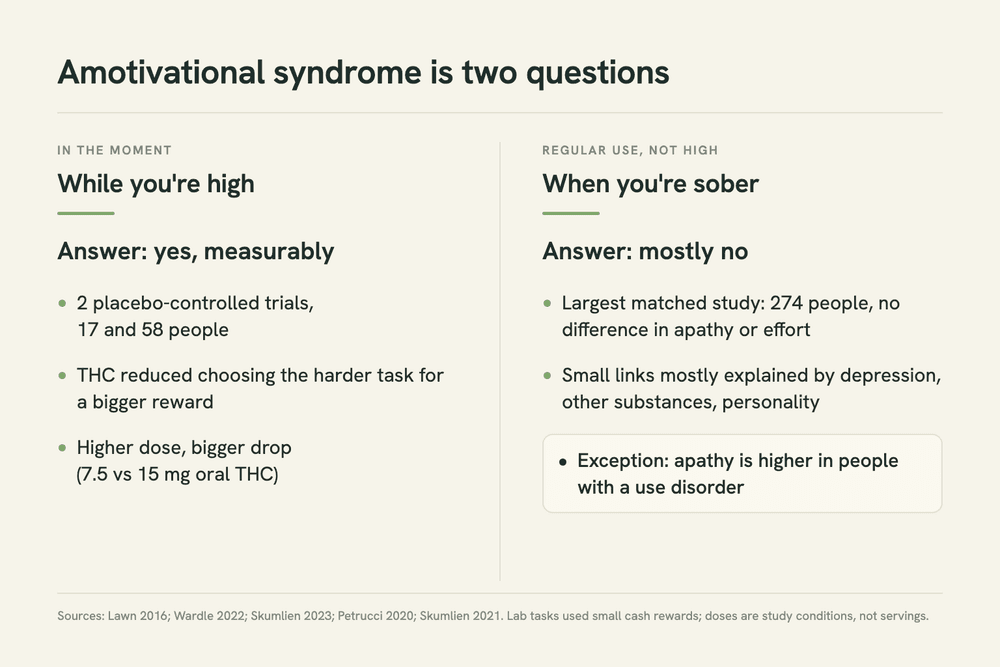
Does weed make you lazy? It depends on which question you mean. While you're high, yes, measurably: in the two placebo-controlled trials that tested it, THC made people less willing to work harder for a bigger reward, and in the trial that compared two doses, the higher dose meant a bigger drop. When you're sober, mostly no. Recent studies comparing regular users with non-users mostly find no lasting motivation gap, with one consistent exception: people with a cannabis use disorder report more apathy. That split is exactly what the phrase "amotivational syndrome" tends to blur.
Search for amotivational syndrome and you get two confident answers. Rehab pages describe it as a settled condition with a symptom list, often next to an intake form. Cannabis sites call it a myth. Neither separates the two questions researchers actually test: what THC does to effort in the moment, and whether regular use leaves a lasting deficit once you're sober. This page takes them one at a time, gives the size of every study, names the confounds that shrink the long-term link, and checks the dopamine explanation against the paper it comes from. It is general information for adults 21 and over, not medical advice, and part of our evidence-literacy series that starts with what the research on CBD does and does not show.
What "amotivational syndrome" actually means
The phrase describes a regular cannabis user who has become passive, uninterested and unwilling to pursue goals. The idea entered psychiatry in 1968, in an American Journal of Psychiatry overview of "the marihuana problem" built on clinical impressions rather than controlled measurement. It has been repeated ever since, usually with a symptom list attached, but it never became a formal diagnosis. It is a label, not a diagnosis: the DSM-5, the manual US clinicians use, has no entry called amotivational syndrome. The closest formal diagnosis is cannabis use disorder, and our guide to whether CBD is addictive explains how that condition is defined and how it differs for CBD.
Part of the reason the debate never settles is that "motivation" is not one thing. Researchers now measure at least three separate pieces, and a finding about one does not automatically transfer to the others:
- Apathy: difficulty starting things, low initiative, not caring much about goals. Usually measured with questionnaires.
- Anhedonia: a reduced ability to enjoy things you used to enjoy. Also measured with questionnaires, and a core feature of depression.
- Effort-based decision-making: whether you choose a harder task for a bigger reward. Measured by what people actually do in a lab task, not by what they say.
Reviewers of this research have complained that studies measure motivation in inconsistent ways, which is part of why their results disagree. Keep the three pieces in mind as you read. The strongest evidence below is about the third one, and it was measured in a lab.
While you're high: the lab says yes
The cleanest test is a 2016 double-blind, placebo-controlled study in Psychopharmacology. Seventeen occasional users (no more than three times a week; nine were women) came in on three separate days and vaporized either a placebo, cannabis containing 8 mg of THC and no CBD, or cannabis containing 8 mg of THC plus 10 mg of CBD, with a 50% top-up about 90 minutes later. Then they did an effort task. On each round they chose between an easy option, 30 presses of the space bar in 7 seconds with the little finger of their weaker hand for 50 pence, and a hard option, 100 presses in 21 seconds for 80 pence up to 2 pounds. The chance of actually being paid on a round was 12%, 50% or 88%.
On THC without CBD, people were less likely to choose the hard option than on placebo (p = 0.042). The authors called it "a transient amotivational state." Be clear about what that does and does not mean. It is a real, measured drop in willingness to work for a reward while intoxicated. It is also one dose, 17 people and a button task for pocket money, not a job, a degree or a workout.
A second research group found the same pattern by a different route. In a 2022 trial with swallowed THC, 58 healthy women with some cannabis experience, who were not regular users, took capsules of 7.5 mg or 15 mg of THC or a placebo on separate days. THC reduced hard-task choices, and the higher dose reduced them more. THC also slowed people down, so the researchers checked whether slowness explained the result; the effect on choice held after accounting for it. The sample was women only, and the data came from a study originally designed around hormones. The milligram figures in both trials describe study conditions, not a serving size for anyone.
That is close to the entire controlled record. A 2023 review of recent studies on cannabis and motivation, written by researchers behind the largest sober study discussed below, counted only two published acute studies, and both found that cannabis reduced people's willingness to expend effort.
Everyday life may look a little different from a button task. A 2024 University of Toronto study pinged 260 people who used cannabis at least three times a week, five times a day for a week. When high, they reported being more impulsive, but not less willing to put in effort. That is in-the-moment self-report with no non-user comparison, and it is described here from the university's summary. It does not cancel the lab trials. It suggests the effect may be narrower outside them. Whether cannabis changes the quality of what you produce is a separate question, covered in our look at what the trials found on weed and creativity.
Is amotivational syndrome real? What happens when you're sober
The lasting version of the claim, that regular use leaves you unmotivated even when you're not high, has been studied far more often, mostly with weaker designs. A 2018 systematic review of 22 studies called the snapshot (cross-sectional) evidence for a cannabis-specific effect on motivation "equivocal," found partial support in studies that followed people over time, and noted that motivation had been poorly and inconsistently defined. A 2021 systematic review of reward processing found some signs of reduced reward response, including greater anhedonia in adolescent users and some indication of greater apathy in young adults, but judged the behavioral studies too few for reliable conclusions. The 2023 review tallied the newer behavioral work: of five studies that tested people while sober, three found users were more willing to work for a reward and two found no difference.
The largest of those is the 2023 CannTeen study, which compared 274 adults (aged 26 to 29) and teenagers (aged 16 to 17) in London. Users, who used cannabis 1 to 7 days a week and about 3 to 4 days on average, were tested at least 12 hours after last use (typically two days, checked biologically) against matched non-users. They showed no more apathy, made the same effort choices, and wanted and liked rewards to the same degree; the non-users actually had slightly higher anhedonia. At the other end of the size scale, a 2023 study of 47 college students found the users, most of whom met criteria for a use disorder, chose the harder task more often, not less. Its authors call the result preliminary.
Not every study points the same way. A 2018 study that surveyed 505 college students twice, a month apart, found cannabis use predicted slightly lower self-rated initiative and persistence even after 13 other factors were accounted for; the authors called it partial support, and depression was not among the factors listed. Against that, a study that followed 401 teenagers aged 14 to 17 for about two years found no evidence that using more cannabis led to less motivation later, once depression, alcohol and nicotine were accounted for; the only link left was valuing school less at the start. And a 2006 internet survey of 487 adults found no difference in self-rated motivation between daily users and people who had never used, though people who volunteer for an online cannabis survey are not a random sample.
The one association that keeps surviving is with dependence. In a survey of 798 adults and teenagers before and during the 2020 lockdown, with depression, anxiety and other drug use controlled, teen users showed slightly more anhedonia before lockdown, and adult users were not more apathetic than non-users (after lockdown they scored lower on both apathy and anhedonia). But users who met criteria for dependence scored higher on both. The 2016 THC trial also ran a second experiment comparing 20 people with cannabis dependence against 20 drug-using controls while sober: effort choices were the same, and a difference in reward learning vanished once depression scores and cigarette smoking were factored in.
| Study | Who, how many | Design | What it found |
|---|---|---|---|
| Barnwell et al., 2006 | 487 adults, daily users vs never users | Internet survey, one time point | No difference in self-rated motivation |
| Lawn et al., 2016 (second experiment) | 20 dependent users vs 20 controls | Lab effort task, sober | Same effort choices; reward-learning gap gone after adjusting for depression and smoking |
| Lac and Luk, 2018 | 505 college students | Two surveys, 1 month apart | Use predicted slightly lower self-rated initiative and persistence |
| Petrucci et al., 2020 | 1,168 adults | Online survey, one time point | Small links mostly explained by depression, other substances, personality; problem use and apathy remained |
| Pacheco-Colon et al., 2021 | 401 teens aged 14 to 17 | 5 assessments over about 2 years | No link from more use to less motivation later |
| Skumlien et al., 2021 | 798 adults and teens | Survey before and during 2020 lockdown | Adult users not more apathetic; dependent users higher on apathy and anhedonia |
| Skumlien et al., 2023 (CannTeen) | 274 adults and teens | Matched comparison, lab effort task, 12+ hours sober | No difference in apathy, effort or reward at 3 to 4 days a week |
| Acuff et al., 2023 | 47 college students | Lab effort task | Users chose the hard task more often |
Why the link keeps shrinking: the confounds
When regular users do look less motivated, the next question is whether cannabis caused it. The clearest test is a 2020 survey of 1,168 people. It found small links between cannabis use and several measures of motivation, all weaker than a correlation of 0.30, and those links were largely accounted for by differences in depression, alcohol and other substance use, and personality. The one that stayed statistically significant was between problem use and apathy.
Then there is direction. A study that followed 3,394 Los Angeles high school students from age 14 for 18 months found that teens who took less pleasure in things at the start went on to increase their cannabis use faster. Using cannabis at the start did not predict losing pleasure later. Anhedonia is not identical to motivation, and this was adolescents over 18 months, but it shows the arrow can run from low mood toward cannabis, not only the other way. Before you believe a claim about cannabis and motivation in either direction, check it against these confounds:
- Depression. Low drive and loss of interest overlap heavily with depression, so a study that skips it cannot separate them. Adjusting for it, with other factors, erased most or all of the gap in the 2020 survey and the 2016 dependence comparison.
- Use disorder. Apathy clusters in dependent users. A sample heavy on dependence will look very different from a sample of occasional users.
- Reverse causation. People who already feel flat may use more, as the Los Angeles cohort suggests.
- Other substances and personality. Alcohol, nicotine and personality differences explained much of the 2020 survey's correlations.
- Who volunteers. Online surveys attract people with strong feelings about cannabis, in either direction.
- Self-report vs behavior. Some studies asked people to rate their own initiative; others recorded what they chose in a lab task. These are different measurements and they do not always agree.
- How much people use. The CannTeen users averaged 3 to 4 days a week. The heaviest daily users are underrepresented in most sober studies.
Does weed lower dopamine and kill drive? The dopamine story, checked
The popular explanation goes like this: cannabis burns out dopamine, the brain chemical tied to reward and motivation, so drive drops. The broad picture from a 2016 Nature review of cannabis and the dopamine system is that acute THC increases dopamine release, while long-term use is associated with a blunted dopamine system. Our explainer on why weed makes you laugh covers that chemistry in more depth. The question here is narrower: does the blunting explain lost motivation?
The study most often cited for a yes is a 2014 PET brain-imaging study of dopamine and apathy. It scanned 14 regular users and measured how much dopamine their brains were able to make. All 14 scored above the study's apathy cut-off. Those with lower dopamine-making capacity reported more apathy (a correlation of -0.64 across the striatum, a reward-related region deep in the brain), and the authors concluded that the reduction "may underlie" amotivation. But the study scanned no non-users for comparison, and apathy had no measurable relationship to how much cannabis people used or how young they started. That fits the dopamine idea without showing that cannabis caused either the low dopamine or the apathy.
The acute trials add a twist. THC tends to increase dopamine release in the moment, which you would expect to raise motivation, yet effort went down. The authors of the 2016 trial said so directly: THC may boost dopamine release, "which would be expected to enhance motivation, but we found the opposite." Even the researchers who measured the drop say the brain chemistry behind it is not worked out.

Does CBD make you lazy? What the CBD arm showed
CBD comes up in this debate because of the 2016 trial's third condition, which added 10 mg of CBD to the same 8 mg of THC. It did not measurably reduce THC's effect on effort. In the authors' words, there was "no evidence that cannabidiol reduced the overall amotivational effects of THC," and they called CBD's role "slightly ambiguous." You may read elsewhere that CBD softened the effect in this study; on the main outcome, the paper says the opposite. There was also no CBD-only condition, so the trial says nothing about CBD by itself, and no study we found has tested CBD alone on these effort tasks. CBD is not intoxicating the way THC is, as our explainer on whether CBD gets you high covers, and a plain account of what CBD feels like describes what people report. None of that makes CBD a motivation aid, and we do not sell it as one.
Lazy, or something else? A self-check
If you use cannabis and feel stuck, these questions can help you describe what is going on, to yourself or to a doctor. They are not a test, and they cannot diagnose anything.
- 1Does the low drive show up only while you're high or soon after, or also on days you don't use?
- 2Has it lasted most days for a few weeks or longer?
- 3Have you lost interest or pleasure in things you used to enjoy, not only in work or chores?
- 4Have your sleep, appetite, energy or mood changed?
- 5Are you using more than you intended, or finding it hard to cut back when you try?
- 6Did the flat feeling start before your cannabis use went up, or after?
If your answers point mostly to the hours after use, the lab trials above describe what you are likely noticing. If they point to days you don't use, to lost pleasure, or to trouble cutting back, those are the situations the research says deserve a closer look, because depression and use disorder are where the lasting links concentrate. If you want to see how you feel without cannabis for a while, our guide to planning a tolerance break walks through how to do it. Talking to a doctor is a reasonable step at any point. For treatment referrals, NIDA's cannabis facts page points to the SAMHSA National Helpline (1-800-662-4357) and to FindTreatment.gov for finding a qualified provider.
What researchers still don't know
The honest summary has large gaps, and they matter for how far you can take any of the findings above.
- The 2023 review counted only two controlled trials of effort while high, with 17 and 58 people.
- Those trials used 8 mg of vaporized THC and 7.5 to 15 mg swallowed. We found no trial of higher doses on these tasks.
- We found no study mapping how long the drop in effort lasts after use, and none here measured effort the next day.
- A button task for pocket money is a narrow stand-in for work, study or exercise.
- The heaviest daily users are underrepresented in the sober studies.
- Assigning people to use cannabis for years would not be ethical, so the long-term evidence will keep relying on observational designs that cannot fully prove cause.
- No study here measured how motivation changes, or how quickly, after someone stops using.
- We found no study testing CBD by itself on these effort tasks.
Amotivational syndrome: questions people ask
Partly. Reduced effort while high is real and has been measured in two placebo-controlled trials. As a lasting condition in people who use cannabis without a use disorder, recent studies mostly do not find it. Apathy is consistently higher in people with a cannabis use disorder. It is not a formal diagnosis in the DSM-5.
Descriptions usually list apathy, loss of interest, low drive and passivity. Those overlap heavily with depression, which is why researchers adjust for it, and once they do, most of the link to cannabis shrinks. Because it is not a formal diagnosis, there is no official symptom list.
No study we reviewed measured how long that takes. In the 2023 CannTeen study, users tested at least 12 hours after their last use, typically two days, looked like non-users on apathy and effort. If your drive stays low after you stop, treat that as a reason to see a doctor rather than something to wait out.
CBD is not intoxicating, and no study we found has tested it alone on the effort tasks used in this research. The prescription CBD medicine lists sleepiness as a common side effect at 20 mg per kg per day in epilepsy trials, a dose far above typical consumer use. Our guide to what CBD feels like covers what people usually report.
No study we found measured effort the morning after use. The closest data, from the CannTeen study, tested people at least 12 hours after use and found no difference from non-users, but those users averaged 3 to 4 days a week. If you feel flat every time, the self-check above is a better guide than a general answer.
It varies. In the 2022 swallowed-THC trial, the higher dose reduced effort more than the lower one. In sober studies, apathy clusters in people with a use disorder rather than in users in general. And the Los Angeles cohort suggests people who already take less pleasure in things may be drawn to use more.
No. The DSM-5 has no entry by that name. The formal cannabis diagnoses include cannabis use disorder, intoxication and withdrawal. If a clinic uses the term, it is describing a pattern, not a recognized condition.
One thread runs through all of this research: how motivated people say they feel and what they actually choose can give different answers. If you use CBD and want to judge its effects on something firmer than a feeling, our step-by-step guide to telling whether CBD is working shows how to set a baseline and track what changes.
Writing about hemp, wellness and the small rituals that keep us balanced.