Does Weed Make You Emotional? One Dose, Daily Use, Quitting
Does weed make you emotional, or numb? In lab studies, one dose of THC made people worse at reading fear and anger, and a higher oral dose worsened mood. Daily use and the days after quitting are different stories, with different evidence.

Does weed make you emotional? Maybe you cried at a movie you would normally shrug at, felt every feeling turned up, snapped at someone, or felt oddly flat. Search the question and you get one blended answer. The research actually splits it three ways: what a single dose of THC does to emotion in a controlled lab, what is different in people who use every day, and what happens in the days after you stop. Each has its own evidence, and each means something different for you.
The short answer. It can push you either way, and the direction depends on the dose, the setting and how often you use. In placebo-controlled studies, a single dose of THC mostly made people worse at reading fear and anger in faces and shifted brain activity away from negative images. It did not consistently make emotional photos feel more intense. Dose mattered: in one lab study, 7.5 mg of oral THC made a stress test feel less distressing, while 12.5 mg left people in a worse mood. People who use heavily every day score higher on irritability and stress reactivity, but those studies cannot show that cannabis caused it. Irritability, anger and low mood in the first days after stopping heavy use are recognized withdrawal symptoms. And no controlled study we found has measured crying while high.
What "emotional" means here, and what this page does not cover
"Emotional" covers several different experiences, and researchers measure them separately. When you read a study about cannabis and emotion, it helps to know which one it actually tested:
- Intensity: how strongly a feeling registers. Studies test this by asking people to rate emotional photos.
- Recognition: how well you read emotion in someone else's face, often using faces shown at different strengths of expression.
- Regulation: how well you can dial a feeling down on purpose, for example by reframing what you are looking at.
- Mood: your overall state across a session, such as anxious, elated, irritable or low, usually measured by questionnaire.
These do not move together. A dose can make you worse at reading a frightened face without making you feel frightened, or leave your mood worse while your ratings of sad pictures stay the same. Most of the brain studies below focus on two areas: the amygdala, an almond-shaped region involved in detecting threat, and the prefrontal cortex, which helps regulate feelings. Why a cannabis compound reaches those circuits at all is a question about the receptor system described in our guide to the endocannabinoid system.
One dose of THC: what the controlled studies found
The best evidence for what a single dose does comes from small, placebo-controlled lab studies. In each one, healthy volunteers got THC on one occasion (or in one group) and a placebo on another, without knowing which, and then did emotion tasks. Most gave THC as a capsule, so keep in mind that a swallowed pharmaceutical dose in a lab is not the same as smoking flower at home.
The first clear result came from a brain-scan study. In a 2008 University of Chicago study published in the Journal of Neuroscience, 16 healthy adults aged 18 to 28 who had used cannabis at least 10 times, but were not daily users, took 7.5 mg of oral THC or a placebo about 2 hours before an fMRI scan. On THC, their amygdala responded less to angry and fearful faces than on placebo, while visual and motor areas were unchanged. That is a brain signal recorded during a face task, not a measure of how anyone felt, and 16 people is a small sample. It does not mean THC made anyone calmer.
A 2012 study of 25 occasional users tested what people actually reported. Adults aged 18 to 35 who used cannabis fewer than three times a week took 7.5 mg THC, 15 mg THC or a placebo as capsules on separate days. THC made them worse at recognizing fear in faces at both doses and anger at the higher dose, and only marginally affected recognition of sadness and happiness. It did not consistently change how they rated emotional photos. The authors wrote that "THC's effects on emotional evaluation were not clearly related to its mood-altering effects." The same capsules produced both anxiety and elation, and fewer people wanted the higher dose again: 15 of 25 would take 7.5 mg again, against 11 of 25 for 15 mg. The limits are the usual ones for this field: 25 people, oral capsules, occasional users only.
Inhaled THC pointed the same way. In a small Dutch scan study of 11 healthy volunteers, inhaled THC lowered accuracy on emotion trials with negative content but not on trials with positive content, and activity in the brain network handling the task fell for negative content and rose for positive content. We could not verify the exact dose from the published abstract, and 11 people is too few to generalize from, so read it as one more data point in the same direction, not as a finding about mood.
Put together, these studies point somewhere most pages on this question never go. A single dose of THC mostly blurred the reading of threat and negative faces. It did not reliably turn up the intensity of emotional pictures, and the feeling side, mood, went both ways in the same people. If THC seems to make everything louder for you, the lab data do not show a general amplifier. They show a drug that changes how emotional signals are processed, in ways that depend on the dose and the person. How long those effects stick around depends mostly on how you took it, which our guide to how long a weed high lasts breaks down by route.

Why do some people cry when they're high?
Here is the honest starting point: no controlled study we found has measured crying while high. A PubMed search we ran on October 7, 2026 for cannabis, marijuana or THC together with crying, tears or tearfulness returned 16 records, and none of them was a human dosing study with crying as an outcome. What researchers have measured are the pieces that make a teary session plausible.
Dose can flip the direction. In a 42-person lab study of healthy adults who used cannabis occasionally, people took a capsule of placebo, 7.5 mg THC or 12.5 mg THC 2.5 hours before a public-speaking and mental-arithmetic stress test. The 7.5 mg dose made the test feel less distressing, while 12.5 mg increased negative mood overall, both before and throughout the tasks, and worsened performance. The authors suggest that higher doses may non-specifically increase negative mood. With about 14 people per group and one lab task, it is not a dose guide and not evidence that THC relieves stress. But the gap between those two doses is small, which is one reason the same person can have a good night and a teary one. The hormone side of that study is covered in what weed does to cortisol.
Regulation can look fine from the inside. In a 2016 trial of 78 adults with fewer than 10 lifetime cannabis uses and none in the past month, 41 took 7.5 mg of oral THC and 37 took a placebo, then tried to talk themselves down from unpleasant pictures by reframing them. Both groups said they succeeded equally well. But in the THC group, the amygdala was more active during the attempt and less in sync with the dorsolateral prefrontal cortex, an area that does much of the regulating. People with almost no cannabis experience, one oral dose, one task: it is a clue about why a feeling can seem bigger than it is, not a rule about how THC affects emotional control.
Product type and age show up in real-world logs. In a 2024 analysis of 34,279 sessions logged by 4,435 people in a cannabis-tracking app, mostly in North America, 31.1% of sessions included at least one unpleasant state: anxious, confused, distracted, irritable, paranoid, scattered or restless. Those reports were more common with THC-dominant products than with balanced ones (about 21% higher odds), with pills (odds ratio 1.65) and tinctures (1.32) than with flower, and among 18-to-30-year-olds. Food edibles were not clearly different from flower (1.16, within the margin of error). Sad and tearful were not on the list the researchers counted, the data came courtesy of the app's maker, and people chose what to log, so it shows patterns, not causes. The authors also flag that the link with oral products could reflect reverse causation rather than an effect of the product. Part of the oral story is timing, which why edibles take so long to kick in explains.
Amount, strength and experience matter too. NIDA, the federal institute that funds drug-use research, notes that cannabis can make people feel happier or more relaxed, but can also make them more irritable or restless, and that anxiety, fear and panic are more common with a large amount, a strong high-THC product, or little experience. Where the anxious side goes further, why weed can make you paranoid covers set and setting in depth, and why weed makes you laugh explains the giddy side of the same effect. If a session leaves you heavy and slowed rather than teary, whether weed counts as a depressant explains what that word does and does not mean.
None of these findings can tell you why you cried on a particular night. Together they point to things you can actually check: how much THC you took, in what form, how used to it you are, and what state you were in going in.
Does weed make you emotional? One dose, daily use and quitting compared
Most pages answer "does weed make you emotional" by mixing three kinds of evidence as if they were one. They are not interchangeable. A lab dose study tells you what happens in a single session. A study of daily users compares people who already differ in many ways besides cannabis. Withdrawal is what happens when a body used to THC goes without it. Here they are side by side.
| What you are asking about | Best evidence | What was measured | Direction | Design | What it does not prove |
|---|---|---|---|---|---|
| One dose, in a lab | 2008 scan study (16 people, 7.5 mg oral); 2012 study (25, 7.5 and 15 mg oral); Dutch scan study (11, inhaled); 2015 UCL trial (48, 8 mg vaporized); 2016 trial (78, 7.5 mg oral); 2017 stress study (42, 7.5 and 12.5 mg oral) | Brain response to faces; face-reading accuracy; ratings of emotional photos; regulation; mood under stress | Threat and negative faces read less sharply; emotional photos not consistently more intense; 7.5 mg eased distress, 12.5 mg worsened mood | Randomized, placebo-controlled, small | How you will feel; what smoked high-THC flower does at home; any benefit |
| People who use often | 2014 PNAS study (24 heavy users vs 24 non-users); 2016 EEG study (27 vs 43); CannTeen (moderate users vs matched non-users) | Dopamine response and a negative-emotionality questionnaire; brain waves to faces; pleasure and apathy scales | Heavy daily users: blunted dopamine response, more irritability and stress reactivity. Moderate users: not flatter than non-users | Cross-sectional (one-time comparison) | That cannabis caused the difference; it could predate use |
| The days after stopping | NIDA withdrawal summary | Self-reported symptoms after heavy or long-term use | Irritability, anger, anxiety, low mood, poor sleep, strange dreams; estimated in 12.1% of frequent users | Clinical criteria and surveys | That everyone who stops gets it, or that it lasts |
Does weed make you emotionally numb? What daily-use studies show
The "weed numbs you" claim usually rests on studies of heavy users. The strongest is a 2014 brain-imaging study published in PNAS. It compared 24 people diagnosed with marijuana abuse or dependence, who used about 4.9 days a week, around 4.8 joints a day, for about 10.5 years on average, with 24 non-users. When given methylphenidate, a stimulant that raises dopamine, the heavy users showed a markedly blunted dopamine response. The more muted that response in the ventral striatum, a reward area, the higher they scored on negative emotionality, a questionnaire measure that covers irritability and stress reactivity. Their average score was 22.4, against 13.7 for non-users. They had last used cannabis 1 to 7 days before testing, which overlaps the first days of withdrawal.
“Our study cannot ascertain if group differences reflect chronic use of marijuana rather than premorbid differences.”
In other words, the heavy use may have caused the difference, or people who already felt more irritable and stressed may have been more likely to use heavily. Nothing in this study says one session flattens your feelings, it does not say cannabis damages dopamine, and it describes diagnosed heavy daily users, not occasional ones.
The study behind most "weed changes your empathy" headlines is smaller still. A 2016 Colorado State EEG study compared brain-wave responses to faces in 27 students who used cannabis with 43 who did not. Users showed a smaller response to happy faces and a larger one to angry faces, and the effect looked stronger in those reporting the most use. But only 7 of the 27 used more than once a week, nobody's dose was controlled, intoxication was not ruled out, and a one-time comparison cannot separate cause from a difference that was there before.
A UK study pushes back on the idea that regular use always flattens you. The CannTeen study compared adults aged 26 to 29 and teenagers aged 16 to 17 who used cannabis one to seven days a week, about three to four days on average, with matched non-users on pleasure, apathy and reward tasks. Users were not flatter than non-users. In both age groups, users actually scored slightly lower than non-users on anhedonia, the reduced ability to feel pleasure. This is also a one-time comparison, and it studied moderate users rather than the heavy daily users in the PNAS study, so it does not show that cannabis protects anyone's mood. It does show that "numb" is not the default for everyone who uses regularly. Motivation, the closely related question, has its own breakdown in does weed make you lazy, and long-term thinking and memory are covered in whether weed kills brain cells.
The week you stop: why quitting can feel raw
If you used heavily and then stopped, the emotional swing may come from the stopping rather than the using. NIDA lists these among cannabis withdrawal symptoms after heavy or long-term use:
- Anger, irritability or aggression
- Feeling nervous or anxious, and restlessness
- Depressed mood
- Insomnia, and strange or unsettling dreams
- Physical signs: decreased appetite or weight, headaches, sweating, stomach pain and tremor
NIDA cites one study estimating that 12.1% of people who frequently use cannabis experience withdrawal, so it is common among frequent users but not universal. The irritability scores in the PNAS study above were collected in that same early window, which is one more reason not to read them as a permanent trait. How long withdrawal usually lasts, and how to plan around it, is laid out in our tolerance break guide. If the symptoms are severe, or are not easing, talk to a clinician.
Does CBD make you emotional?
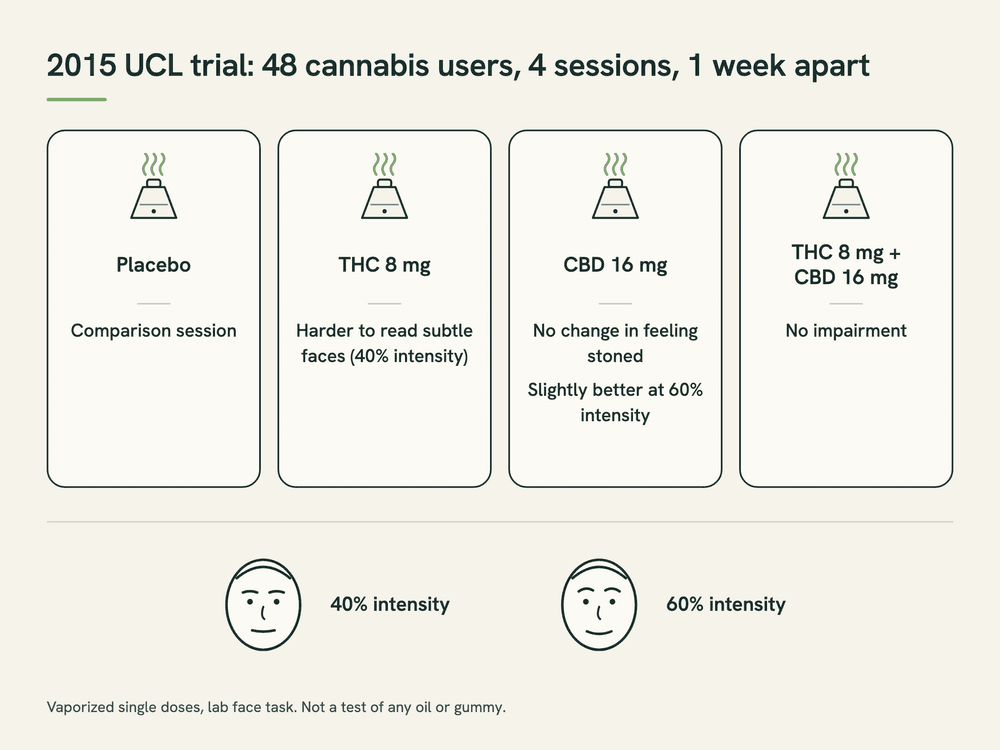
Only one trial we found compared THC and CBD directly on emotion. In a 2015 University College London trial, 48 cannabis users (24 light, 24 heavy) inhaled vaporized THC (8 mg), CBD (16 mg), both together, or a placebo on four separate days a week apart, then tried to identify emotions in faces shown at different intensities. THC made subtle expressions, shown at 40% intensity, harder to read. CBD alone did not change how stoned people felt and slightly improved recognition at 60% intensity. The THC plus CBD session showed no impairment. How often people used cannabis made no difference to the results. The authors call the effects modest and ask for replication, and these were vaporized pure compounds in a lab face task, not a test of any oil or gummy.
The app data are consistent with that without proving anything: CBD-dominant products were not linked to more reports of unpleasant states, which is not the same as protecting against them. None of this shows that CBD improves or steadies mood, and it is not a reason to choose a product. For how the two compounds differ more broadly, see our CBD vs THC comparison. For what human trials have and have not shown on CBD and stress specifically, our review of CBD and stress research goes study by study.
A rough night or a pattern? A self-check
One emotional session and a pattern are different things. Use these two lists to sort them, not as a diagnosis. If a session went badly because you simply took too much, what greening out is and how to handle it is the more practical read.
Signs it was probably the session
- You took more THC than usual, or a stronger product than you are used to.
- It was an edible, capsule or tincture, which can build slowly and land harder than you planned.
- It was a new product, or a new way of taking it, for you.
- You were tired, hungry, hungover or already upset, or the place or company felt off.
- The feeling faded as the high wore off, and you felt like yourself the next day.
Signs worth raising with a clinician
- Low mood, irritability or emotional flatness on most days, not only on the nights you use.
- You use cannabis to cope with or switch off feelings, and find it harder to manage without it.
- You want to cut down and cannot.
- Your emotions feel worse between sessions than during them.
- Strong irritability, anger or low mood come back every time you stop.
- You have panic, paranoia, or thoughts of harming yourself.

What the research still can't tell you
- Whether THC makes people cry. No controlled study we found measured it, and the 2024 app analysis did not count sad or tearful.
- What smoked, high-THC flower does at home. Most dose studies used capsules of 7.5 to 15 mg, in occasional users, in a lab.
- Who is most likely to feel worse. With 11 to 78 people per dose study, none could reliably separate individual risk factors.
- Cause and effect in daily users. Every heavy-user study compared people who chose to use with people who did not.
- What months of use do. Single-dose studies say nothing about long-term use, and the long-term data are one-time comparisons.
- Brain signals versus feelings. A smaller amygdala response in a scanner is not the same as feeling calmer, and none of these studies showed that it is.
Frequently asked questions
No controlled study we found has measured crying while high, so nobody can say exactly why it happens. The measured pieces suggest some reasons. In one lab study a higher oral dose (12.5 mg) worsened mood while a lower one (7.5 mg) did not. In another, THC changed how the brain handled deliberate efforts to turn down unpleasant feelings. And app users reported unpleasant states more often with THC-dominant products, with pills and tinctures, and at ages 18 to 30. An occasional teary session is usually about dose and setting. If it happens often, or the sadness lingers, talk to a clinician.
Because the effect depends on the dose, the product and the context, not just the plant. In a 2012 study, the same THC capsules produced both anxiety and elation. In a 2017 study, 7.5 mg made a stress test feel less distressing while 12.5 mg worsened mood from the start. How much you have used before and how you felt going in shift the result too.
Not in the way many pages suggest. A single dose mostly made people worse at reading fear and anger in faces, which is not the same as feeling nothing. In heavy daily users, a 2014 study linked a blunted dopamine response to more irritability and stress reactivity, but it could not tell whether cannabis caused it. Moderate users in a UK study were not flatter than non-users on pleasure and apathy measures.
It can. NIDA notes that cannabis can make people more irritable or restless as well as happier or more relaxed, and irritable was one of the unpleasant states counted in the 2024 app analysis. Anger and irritability are also on NIDA's list of withdrawal symptoms, so irritability that shows up when you cut back may come from the stopping, not the using.
After heavy or long-term use, it is a recognized pattern. NIDA lists anger, irritability, anxiety, restlessness, depressed mood, insomnia and strange dreams among withdrawal symptoms, and cites an estimate that 12.1% of frequent users experience withdrawal. If the symptoms are severe or are not easing, talk to a clinician.
In the one trial we found that compared them directly, 16 mg of vaporized CBD did not make people feel stoned and did not impair their reading of facial emotions, unlike 8 mg of THC, and the THC plus CBD session showed no impairment. In app data, CBD-dominant products were not linked to more unpleasant states. These are small or self-reported findings, and none shows that CBD changes or improves mood.
The evidence is indirect. In the 2024 app analysis, sessions with pills had higher odds of an unpleasant state than flower (odds ratio 1.65), and tinctures somewhat higher (1.32), but food edibles were not clearly different from flower (1.16, within the margin of error). People chose their own products and logged their own feelings, and the authors flag possible reverse causation, so it cannot show the product caused it. Edibles also take longer to kick in, which makes it easy to take more than you meant to.
Where to go next. If your emotions feel most off when you cut back rather than when you use, what to expect during a break from THC walks through how to plan one and what the first days are usually like.
Writing about hemp, wellness and the small rituals that keep us balanced.