Why Does Weed Make You Laugh? What the Brain Scans Show
Most pages say THC floods your brain with dopamine. Human brain scans found a real but small signal, and two studies found no significant change. Here is what dopamine really does, why the same high can turn to paranoia, and why CBD doesn't do it.

Why does weed make you laugh? Almost every page gives the same answer: THC floods your brain with dopamine and serotonin, the "happy chemicals". The brain scans tell a quieter story. THC does release dopamine in people, but the pooled human PET signal was about 3.7%, two studies found no significant change, and we found no human study that has measured serotonin after THC at all. A better-supported picture is that THC changes what your brain flags as important, and laughter, which is social and contagious to begin with, spreads from there. That last link is a reasonable hypothesis that, as far as we can find, no study has tested directly.
This page checks each piece of the usual explanation against the studies that measured it. It is part of our series on everyday THC effects, alongside why weed turns your eyes red and what causes cottonmouth. It describes an effect of THC, not of CBD. It is general information for adults 21 and over, not medical advice and not a reason to use cannabis.
Why does weed make you laugh? First, what is being explained
The usual answer skips this step. Laughter is a behavior. Humor is the sense that something is funny. Euphoria is the feeling of being high and pleased. Cannabis research almost never measures the first two. Lab studies ask people to rate how "high" they feel and how much they like the drug, and they score psychiatric symptom scales. A PubMed search we ran in September 2026, pairing laughter, mirth, giggling, amusement or humor with cannabis or THC, returned 37 records and no controlled trial that used laughter as an outcome. So every explanation of stoned laughter, including this one, is built from studies that measured something next to it.
What people do report is more varied than the giggles stereotype. A 2003 review of 12 naturalistic and 18 laboratory studies of self-reported cannabis effects found that relaxation, not euphoria, was the effect reported most often in studies of users, whatever method was used. The same review noted that different people report opposite effects, and that effects vary for one person within a single occasion and between occasions. It is an older narrative review rather than a systematic one, but it sets the frame: laughing is one possible outcome, not the default.
Sometimes the opposite outcomes arrive together. In a 2019 double-blind, placebo-controlled crossover trial, 16 healthy adults with modest previous cannabis use received 1.19 mg of THC intravenously under research supervision in London. The researchers list slowing of time, euphoria and anxiety among the effects. Within 20 minutes, 94% of participants had at least mild symptoms and 19% had moderate to severe ones, and 31% still had mild effects two and a half hours later. One participant described it like this:
“I feel I am all over the place and can't stop laughing, thinking you will expose me, I will say something stupid or strange.”
The clinicians coded that as conceptual disorganization and excitement, not as a good time. It is one person's words, so it says nothing about how common the experience is. What it does show is that laughing and feeling watched can come from the same dose in the same head, at the same moment. That is the thread the rest of this article follows.
Does weed release dopamine? The scans, one by one
The popular answer says THC floods your brain with dopamine. That can be checked, because dopamine release in a living human brain can be estimated with PET scanning. The standard method uses a tracer called raclopride that sits on dopamine D2 receptors. When more dopamine is released, it pushes some tracer off, so a small drop in tracer binding is read as a small rise in dopamine. It is a proxy, not a count of dopamine molecules. The human studies that the field's reviews cite come down to five analyses, drawn from three groups of volunteers.
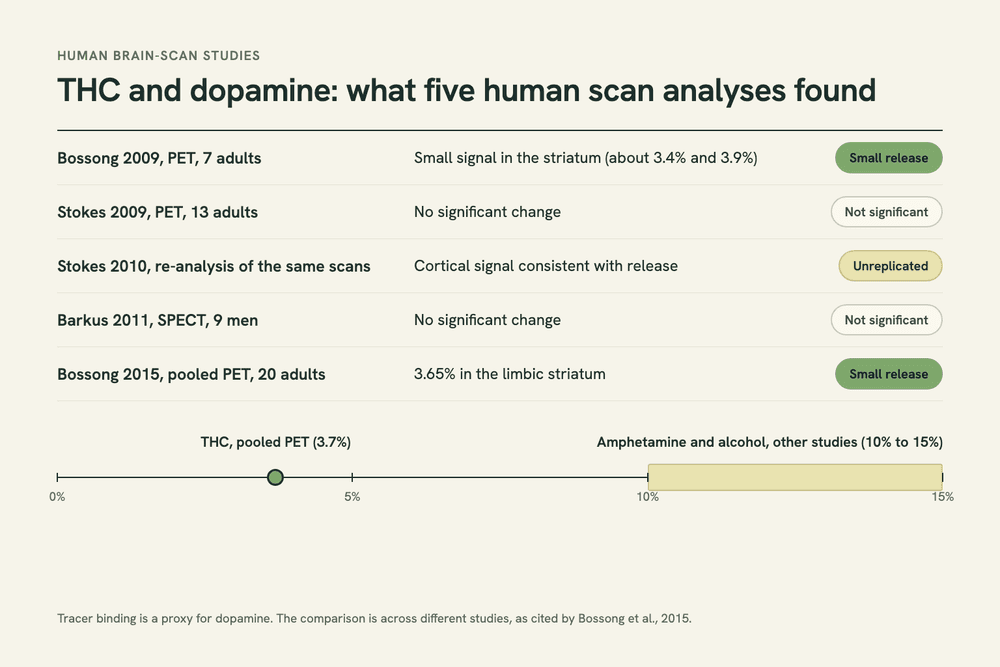
The first PET study to find release, published in 2009, gave 7 healthy adults inhaled THC and found reduced raclopride binding in the ventral striatum and part of the putamen, a change later summarized as 3.4% and 3.9%. A 2009 study of 13 volunteers with previous cannabis experience used oral THC at what the authors called a dose "equivalent to a standard cannabis cigarette" and found no significant effect on binding, even though THC "markedly increased psychosis-like symptoms". A 2010 re-analysis of those same scans then found lower binding in parts of the frontal and temporal cortex, a signal consistent with release, although raclopride is a weak tracer in the cortex and blood flow also fell in one of those regions. A 2011 SPECT study gave 11 healthy men intravenous THC (9 could be analyzed) and found no significant change in the caudate or putamen, although the dose was enough to produce psychotic-like symptoms.
The clearest single number comes from pooling. In a 2015 re-analysis that combined the two PET datasets (20 people in all), THC lowered raclopride binding in the limbic striatum by 3.65%, from 2.39 to 2.30 (p = 0.023), with no change in the other parts of the striatum. The authors argued that the 2009 oral study had simply been too small to detect a change this size: its raw figures were 1.6% and 3.2%. They also put their result in context. Other studies, they wrote, report reductions "in the range of 10 - 15%" after amphetamine and alcohol and around 10% after nicotine, "whereas we found a relatively modest decrease of 3.7%". That comparison is across different studies, not a head-to-head test.
| Study | Who | THC given | What changed | The catch |
|---|---|---|---|---|
| Bossong 2009 (PET) | 7 healthy adults | 8 mg, inhaled by vaporizer | Small drop in tracer binding in the striatum (about 3.4% and 3.9%), read as release | Very small sample |
| Stokes 2009 (PET) | 13 volunteers with prior cannabis use | 10 mg, oral | No significant change (raw 1.6% and 3.2%), despite marked psychosis-like symptoms | Too small to detect a change this size, the 2015 pooled analysis argued |
| Stokes 2010 (PET re-analysis) | The same 13 people | 10 mg, oral | Lower binding in frontal and temporal cortex, consistent with release | Tracer is weak in the cortex; blood flow also fell in one region; not replicated |
| Barkus 2011 (SPECT) | 9 analyzable healthy men | 2.5 mg, intravenous | No significant change in caudate or putamen, despite psychotic-like symptoms | Small; SPECT is less sensitive than PET |
| Bossong 2015 (pooled PET) | 20 people (both PET groups) | 8 mg inhaled and 10 mg oral | 3.65% drop in the limbic striatum (p = 0.023); no change elsewhere | Two routes pooled; tracer binding is a proxy for dopamine |
| Other drugs, for comparison | Other studies, as cited by Bossong 2015 | None (amphetamine, alcohol or nicotine instead) | About 10% to 15% for amphetamine and alcohol; about 10% for nicotine | Cross-study comparison, not a head-to-head test |
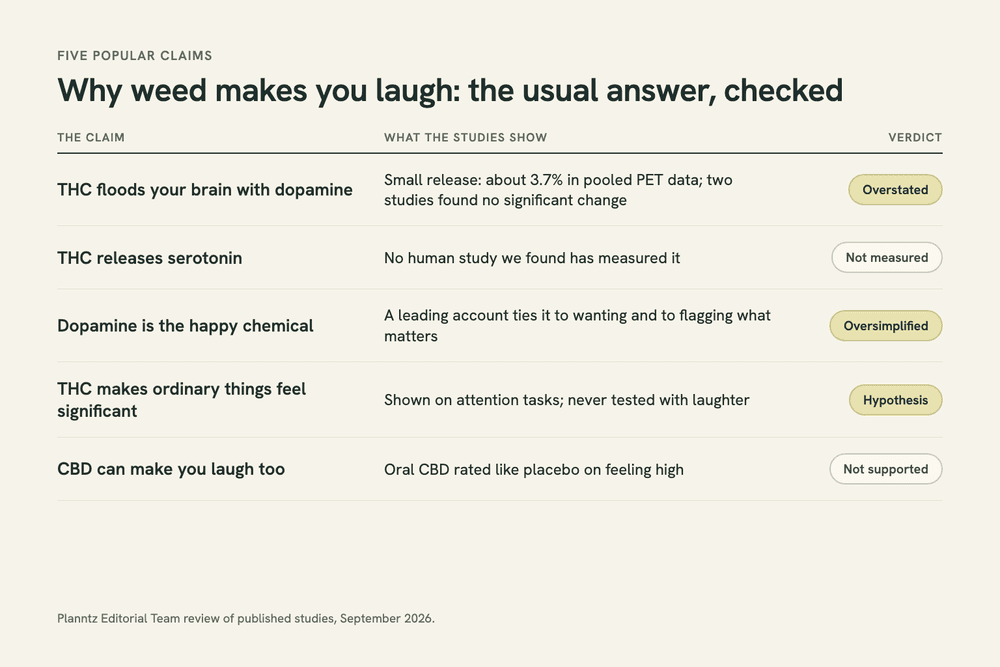
So the verdict has two halves. THC does release dopamine, and a widely cited 2016 review in Nature says so plainly: "Acute THC administration causes increased dopamine release and neuron activity." The same review adds that THC-induced release in the striatum "appears to be of a lower magnitude" than that caused by amphetamine and methylphenidate. What does not hold up is the word "floods". The measured signal is small, regional and hard to detect, and two of the studies found no significant striatal change at all. Those two studies still produced strong effects in their volunteers, and a search we ran found no study linking people's euphoria ratings to a measured dopamine change in the same people. Dopamine is part of the story. It is not a flood, and on its own it does not explain the laughing.
The long-term picture runs the other way
The 2016 review has a second half that the popular answer never mentions: "long-term use is associated with blunting of the dopamine system." Its authors describe "converging evidence for reduced presynaptic dopaminergic function in cannabis users." One of the studies behind that line is a 2014 PET study of 19 regular users and 19 matched non-users. The users, all of whom had had psychotic-like experiences on cannabis, showed lower dopamine synthesis capacity in the striatum than the non-users. It is cross-sectional, so it cannot show that cannabis caused the difference, and the users were selected for a particular reaction, so it does not describe everyone. Worth knowing: one of the pages that repeats the "dopamine release enhances pleasure" claim cites this very paper in support, although it found reduced, not increased, dopamine capacity.
Blood-flow imaging also cuts against the idea that THC lights up a reward center. In a 2002 double-blind, placebo-controlled PET study of 12 recreational users who smoked cannabis, blood flow rose in the orbital and mesial frontal lobes, insula, temporal poles, anterior cingulate and cerebellum, changes the authors said "may be related to marijuana's mood-related effects". Flow fell in auditory and visual areas and in regions tied to attention. And there was "no significant rCBF change in the nucleus accumbens or other reward-related brain regions". Blood flow is not dopamine and not humor, and the study is small and more than 20 years old. It does correct two lines you will find online: that THC acts on "the right frontal and left temporal lobe", and that it simply switches on the brain's reward hub.
Dopamine was never the "happy chemical" (and serotonin has no human data)
Part of the confusion is the nickname. In a 2015 review of the brain's pleasure systems in the journal Neuron, neuroscientists Kent Berridge and Morten Kringelbach separate "wanting" (the pull toward a reward) from "liking" (the pleasure itself). Wanting is generated by a large, distributed brain system in which dopamine plays a central part. Liking comes from a much smaller set of hedonic hotspots. The review goes as far as saying that some of the best-known textbook candidates for pleasure generators, "including classic pleasure electrodes and the mesolimbic dopamine system, may not generate pleasure after all." The wanting and liking split rests largely on animal work, so treat it as a leading account rather than settled fact. Still, it means "dopamine equals happiness" was a shaky starting point before anyone scanned a cannabis user.
The same review describes a finding that is easy to overread, so here it is with its label on: it comes from rats. When researchers microinjected anandamide, one of the body's own cannabinoids, into a small hotspot in the nucleus accumbens, the rats showed more "liking" reactions to sugar, while stimulating dopamine in the same hotspot did not change liking at all, even though it raised wanting. That is rat taste research, not human humor, and it says nothing about what THC, CBD or any product does in people. It is a reminder that the cannabinoid system has its own links to pleasure that do not run through dopamine. If the receptor side is new to you, start with how the endocannabinoid system works.
Serotonin is the other half of the popular answer, and it has nothing under it. When we searched PubMed in September 2026 for human trials pairing serotonin with THC, we found five records, and none measured serotonin after giving THC. A search for human PET or SPECT studies of serotonin and THC returned zero. Serotonin may turn out to play a role. Until someone measures it in people, a page that says THC "releases serotonin" is stating a guess as a fact.
Why does weed make everything funny? The salience hypothesis
If dopamine's main job is not pleasure, what is it? One influential answer comes from psychiatry. In a 2003 paper that described psychosis as a state of "aberrant salience", psychiatrist Shitij Kapur wrote that "a central role of dopamine is to mediate the 'salience' of environmental events and internal representations." Salience is the brain's tag for "this matters, pay attention." Kapur's paper is a framework about psychosis, not a measurement, but it reframes the question. What THC might do is not pour out pleasure but change what gets tagged as significant. That idea would also sit comfortably with a small dopamine signal, although none of the studies here connects the two.
There is imaging evidence that THC disrupts that tagging, at least on attention tasks. In a 2015 placebo-controlled fMRI study, 15 healthy men with limited cannabis experience (fewer than 15 lifetime uses) took 10 mg of oral THC, 600 mg of oral CBD or a placebo in sessions at least a month apart, then did an "oddball" task: spotting the one stimulus that differs from the rest. THC weakened the connection between frontal and striatal regions, which tracked with its effect on task performance, and strengthened a connection between the medial temporal lobe and the prefrontal cortex. CBD pushed those same connections the opposite way. The 600 mg CBD arm is a research dose far above any tincture serving, and the result is not evidence that CBD cancels a high. A 2018 systematic review of 13 studies concluded that acute THC causes "an impairment of immediate salience processing", then added that "the lack of research specifically exploring the effects of cannabis use on salience processing" weakens any conclusion.
Put those pieces together and you get a plausible explanation for the giggles. If THC makes ordinary things (a word, a pause, the way a friend is sitting) feel strangely significant, the gap between what is happening and how much it seems to matter can register as absurd, and absurd often registers as funny. The same tagging, landing on a stranger's glance or on your own heartbeat, can register as a threat. Kapur built his framework to explain that second, darker outcome in psychosis. Applying it to laughter flips the sign, and that step is ours, not his. One more claim you will see is that weed boosts divergent thinking, so you connect funny ideas. In a randomized, double-blind trial of 54 regular users, a higher vaporized dose made divergent thinking worse and a lower one did nothing, as our look at whether weed makes you more creative explains in detail.
Laughter is social first
The other half of the story has nothing to do with cannabis. A 2014 article on the social life of laughter by neuroscientist Sophie Scott and colleagues sums up the research: laughter is "a social emotion, occurring most often in interactions"; we are "30 times more likely to laugh if we are with someone else than if we are on our own"; and laughter is "highly behaviourally contagious". In ordinary conversation, people laugh around 5 times every 10 minutes. The 30-times figure comes from older observational work that Scott cites, not from a cannabis study. But it explains a lot of stoned laughter on its own terms. If you are high with friends, one person's giggle is exactly the kind of cue that sets off the next.
Even the chemistry of laughter has been studied without dopamine at the center. A 2017 PET study of social laughter scanned 12 healthy men after 30 minutes of watching comedy with close friends and after 30 minutes alone. Social laughter "increased pleasurable sensations and triggered endogenous opioid release" in the thalamus, caudate nucleus and anterior insula. No cannabis was involved, so this is not evidence that THC releases opioids or endorphins. What it shows is narrower: when these researchers scanned people laughing, the chemical they tracked was an opioid, not dopamine.

Why the same high makes one person laugh and another paranoid
Go back to the trial participant who could not stop laughing while feeling exposed. That trial listed euphoria and anxiety among THC's effects in the same small group, and the 2003 review found opposite reactions across people and across occasions. Several variables are known to change how THC lands, although none has been tested against laughter specifically. None of them is a recipe, and none of this is advice to use cannabis.
- Dose. At the doses used in the trials above, the clear effects included anxiety and psychosis-like symptoms, not only euphoria.
- Route and timing. Swallowed THC starts later and peaks later than inhaled THC, and edibles produce more of a metabolite with its own profile.
- Previous exposure. People who had barely used cannabis reacted more strongly than people with some previous use.
- Company and setting. Laughter is social and contagious, so the same effect lands differently among friends, alone or among strangers.
- Individual variation. The 2003 review of self-reported effects found opposite reactions in different people, and different reactions in the same person on different occasions.
On timing, a 2020 controlled study of oral cannabis in infrequent users found effects did not start until 30 to 60 minutes after dosing and peaked at 1.5 to 3 hours, and a 2018 study of smoked and vaporized cannabis found blood THC and heart rate peaking within 30 minutes. Each enrolled 17 infrequent users. That delay, plus the metabolite explained in our guide to 11-hydroxy-THC and edibles, is why edibles so often surprise people.
On previous exposure, a 2018 fMRI study of 24 healthy men found that THC disrupted salience and emotional-processing activity in the brain and caused transient anxiety and psychotic symptoms, and that all of this was more pronounced in 12 near non-users than in 12 modest users, whose responses were "more blunted". That is about symptoms and attention tasks, not laughter. If you have noticed that cannabis simply does less for you than it used to, our guide to tolerance breaks covers what is known. The negative side of this balance (anxiety, the amygdala and whether CBD changes it) belongs to our explainer on why weed can make you paranoid.
Does CBD make you laugh?
No. Neither trial here scored laughter, but both measured the high it comes with: in a 2017 trial of 31 frequent cannabis users, oral CBD was "placebo-like on all measures collected", including ratings of feeling high, while active cannabis reliably produced them, and in a 2020 study of 18 adults, the subjective effects of oral CBD did not differ from placebo. Whether CBD is intoxicating at all, and what the trace THC in full-spectrum products means, is covered in does CBD get you high?
When laughing is not funny
We found no source that describes laughing on its own as dangerous. The concern is what can come with it. The CDC's page on cannabis and mental health notes that "cannabis use can cause disorientation and sometimes unpleasant thoughts or feelings of anxiety and paranoia." These are the signs worth taking seriously:
- Confusion, or not knowing where you are or what time it is.
- A racing heart together with panic or a sense of dread.
- Vomiting, especially more than once.
- Fear, suspicion or panic alongside the laughter, so that it feels distressing rather than fun.
- Bouts of laughter that feel involuntary, happen when you have not used cannabis, or come without feeling amused.
If any of the first four show up after cannabis, our greening-out guide covers what to do, when to call Poison Help and when to call 911. The last one is different, because it has nothing to do with being high. Laughter without amusement can occasionally be neurological. NIH's rare disease information center, for example, describes a rare brain malformation that causes gelastic, or laughing, seizures. It is rare and usually starts early in life, and it is not something to diagnose yourself. Repeated episodes like that are worth raising with a doctor.
What is still unknown
The honest summary is that, as far as we can find, the question in the title has not been studied head-on. Strain claims deserve a special mention, because when we checked in September 2026, four of the nine top results for this question recommended strains or terpenes for laughing. A 2015 genetic study of cannabis samples found that "marijuana strain names often do not reflect a meaningful genetic identity", and our guide to cannabinoids and terpenes covers what terpenes can and cannot be shown to do. Here is what the studies we found do not settle:
- Whether THC changes laughter in a controlled trial. We found no trial that used laughter or humor as an outcome.
- Whether salience explains the giggles. The salience studies used attention tasks, mostly in men, and never measured amusement.
- How large THC's dopamine effect really is. The imaging groups had 7, 13 and 9 people (20 when the two PET groups were pooled), and the main tracer is weak in the cortex.
- Whether serotonin is involved at all. No human measurement after THC turned up in our search.
- Whether strains or terpenes change laughter. We found no controlled human study comparing them.
Questions people ask about weed and laughing
The most plausible explanation is that THC changes what your brain flags as significant, so ordinary things can suddenly seem strange or absurd, and laughter, which is highly contagious, spreads through the group. Imaging studies show THC disrupts this kind of salience processing on attention tasks, but we found no study that has tested the link to humor directly, so it remains a hypothesis.
Yes, a little. When two PET datasets were pooled (20 people), THC produced a 3.65% change in the limbic striatum, a small signal consistent with release. The authors noted other studies report 10% to 15% for amphetamine and alcohol. Two studies found no significant change, and long-term heavy use is associated with a blunted dopamine system.
It has not been measured, as far as we can find. A PubMed search we ran in September 2026 found no human study that measured serotonin after giving THC, and no human PET or SPECT study of serotonin and THC. Pages that say THC releases serotonin are repeating an assumption.
Some people report euphoria, but across studies of users, relaxation is the effect reported most often, and some people report anxiety or paranoia instead. The same person can react differently on different occasions. THC's effects on mood are an intoxicant's effects, not a treatment for low mood.
No. In human trials, oral CBD was rated like placebo on feeling high and on other subjective measures, while active cannabis reliably produced a high. Laughter when high is a THC effect.
The research does not track laughter over time, but in one imaging study, people with some previous use had more blunted responses to THC than people who had barely used it. Relaxation, not euphoria, is also the most commonly reported effect overall. Setting matters too: laughter is far more likely with other people than alone.
It can happen, and one trial participant described being unable to stop laughing while also feeling exposed. Laughter alone is not described as dangerous in the sources we found. The concern is what comes with it, such as confusion, panic or vomiting, and our greening-out guide covers what to do then. Laughing fits that happen without cannabis, or without feeling amused, are worth raising with a doctor.
We found no controlled human study comparing strains or terpenes on laughter, and a genetic study found that strain names often do not reflect a meaningful genetic identity. Pages that name strains for laughing are not drawing on trial data, so we do not name any.
If you want the bigger picture behind all of this, the next step is how THC and CBD differ, and why only one of them gets you high. For transparency, Planntz sells a tablet that contains delta-9 THC; nothing on this page describes that product's effects.
Writing about hemp, wellness and the small rituals that keep us balanced.