Is Weed a Depressant? Why Cannabis Gets Its Own Drug Class
Weed is not officially a depressant, a stimulant or a hallucinogen: the US police drug recognition system gives cannabis its own category. Here is the evidence for each effect, and why the label matters when you mix it with real depressants.

Is weed a depressant? Ask around and you will hear three answers: it is a depressant, it is a stimulant, it is a hallucinogen. Each one is partly right, and none of them is the official answer. The drug recognition system US police use to classify impairment at the roadside puts cannabis in a category of its own, separate from all three. This guide explains why, using the roadside data, controlled lab studies and the brain mechanism behind it.
The short version: weed can slow you down, speed your heart up and, at high doses, change how you perceive things, sometimes in the same session. That mix is why it does not fit neatly in any one box. The question is not just trivia, either. The word "depressant" matters most when cannabis is combined with drugs that really are depressants, such as alcohol, benzodiazepines, opioids and sleep aids. This page is general information for adults, not medical advice.
Depressant, stimulant or hallucinogen? The answer at a glance
The table lines up the three popular answers against the category cannabis actually gets. The definitions in the second column are quoted from the police drug recognition program's own category sheet. The rest summarizes the studies covered further down, each with its design and its limits.
| Category | What the category means | Textbook examples | What cannabis shares with it | When it tends to show up | Key evidence |
|---|---|---|---|---|---|
| CNS depressant | "Slow down the operations of the brain and the body" | Alcohol, benzodiazepines, barbiturates | Sleepiness, sedation, slower reactions; officers most often described cannabis drivers as "relaxed" or "lethargic" | Later in a session: sleepiness peaked 1 to 4 hours after inhaling in one lab study | Spindle 2018 (17 adults, lab); Hartman 2016 (302 drivers); DEA guide |
| CNS stimulant | "Accelerate the heart rate and elevate the blood pressure" | Cocaine, amphetamines | Higher pulse and blood pressure, a racing heart, anxiety at higher doses | Early: the racing-heart feeling peaked about 10 minutes after inhaling | Hartman 2016; Spindle 2018; Childs 2017 (42 adults, lab) |
| Hallucinogen | "Cause the user to perceive things differently than they actually are" | LSD, psilocybin | Altered perception of time and the senses; true hallucinations are rare | Mainly at high doses | D'Souza 2004 (22 adults, IV THC, lab); DEA guide |
| Cannabis (its own category) | "This category includes cannabinoids and synthetics like Dronabinol" | THC, dronabinol (prescription THC) | All of the above, in a mix | Depends on dose, product, experience, timing and the person | IACP Drug Evaluation and Classification Program |
What "depressant" actually means (it is not about mood)
Much of the confusion comes from the word itself. In pharmacology, a depressant has nothing to do with feeling depressed. The police drug recognition program defines the category in one line: "CNS depressants slow down the operations of the brain and the body." CNS stands for central nervous system, meaning the brain and spinal cord. Alcohol, benzodiazepines and barbiturates are the textbook examples. So asking whether weed is a depressant is really asking whether it slows the nervous system down, not whether it lowers or lifts your mood.
It is also not the opposite of an antidepressant. Antidepressants are a class of medicine named for the condition they are prescribed for, not for whether they speed the brain up or slow it down. Nothing on this page is about whether cannabis causes or treats depression. That is a separate question with its own evidence, and this article does not answer it.
The official answer: cannabis is its own category
In the US, the people who most need a working answer to this question are police officers trained as drug recognition experts (DREs). When a driver seems impaired, a DRE runs a standardized evaluation that includes pulse, blood pressure, pupils, eye movements and more, then decides which kind of drug most likely explains what they see. The program behind it, the Drug Evaluation and Classification Program, was developed by the National Highway Traffic Safety Administration with the International Association of Chiefs of Police (IACP), which runs it today. The program's category sheet sorts impairing drugs into seven groups:
- 1CNS depressants, which "slow down the operations of the brain and the body"
- 2CNS stimulants, which "accelerate the heart rate and elevate the blood pressure and 'speed-up,' or over-stimulate, the body"
- 3Hallucinogens, which "cause the user to perceive things differently than they actually are"
- 4Dissociative anesthetics
- 5Narcotic analgesics
- 6Inhalants
- 7Cannabis: "The active ingredient in cannabis is delta-9 tetrahydrocannabinol, or THC. This category includes cannabinoids and synthetics like Dronabinol."
Cannabis sits on that list as a separate group, not as a subtype of the depressants, stimulants or hallucinogens. The practical reason is that the pattern of signs it produces does not match any one of them, as the roadside data in the next section show. The Drug Enforcement Administration arrives at the same place from a different direction. Its reference guide, Drugs of Abuse: A DEA Resource Guide (2024 edition), opens its drug section with "The Controlled Substances Act regulates five classes of drugs: Narcotics, Depressants, Stimulants, Hallucinogens, Anabolic Steroids", and then gives marijuana a chapter of its own. That chapter lists "sedation" and "increased heart rate" in the same sentence.
One note on terms: a drug's legal schedule is a different question from its pharmacological class. Schedules are about legal control and accepted medical use, not about what a drug does to the brain, and the federal status of marijuana has been changing. Our explainer on the Schedule III ruling covers where that stands.
What cannabis looks like at the roadside: 302 drivers
A detailed picture of cannabis impairment outside a lab comes from a 2016 analysis of 302 drug recognition evaluations. In 302 cases in which examiners had already correctly identified cannabis as the only drug (confirmed by blood tests), the drivers' median pulse was 91 beats per minute against 71 in 302 controls judged not impaired, their systolic blood pressure was higher (138 vs 130 mmHg) and their pupils were dilated in every lighting condition. That is a stimulant's signature. Yet the eye-jerk sign that flags alcohol and other depressants was not significantly more common than in the controls (2.65% vs 0.33%), and in the 97 cases where officers wrote notes on demeanor, their most common words were "relaxed" and "lethargic".
Put together, that is a stimulant's vital signs with a depressant's demeanor, and without a true depressant's eye sign. HGN (horizontal gaze nystagmus) is an involuntary jerking of the eyes that officers check for. The study notes it is associated with "alcohol, CNS depressants, dissociative anesthetics, inhalants" but "is not typically associated with cannabis" in these protocols. Keep the limits in view. Because only correctly identified cases were included, the data show what cannabis impairment looks like when it is recognized, not how often it is recognized. The drivers were mostly young men (87.4% male, median age 21), while the controls were older (median 34), were not drug-tested and were examined during business hours. This is field data, not a controlled dose.
The depressant face: sleepy, slower, impaired
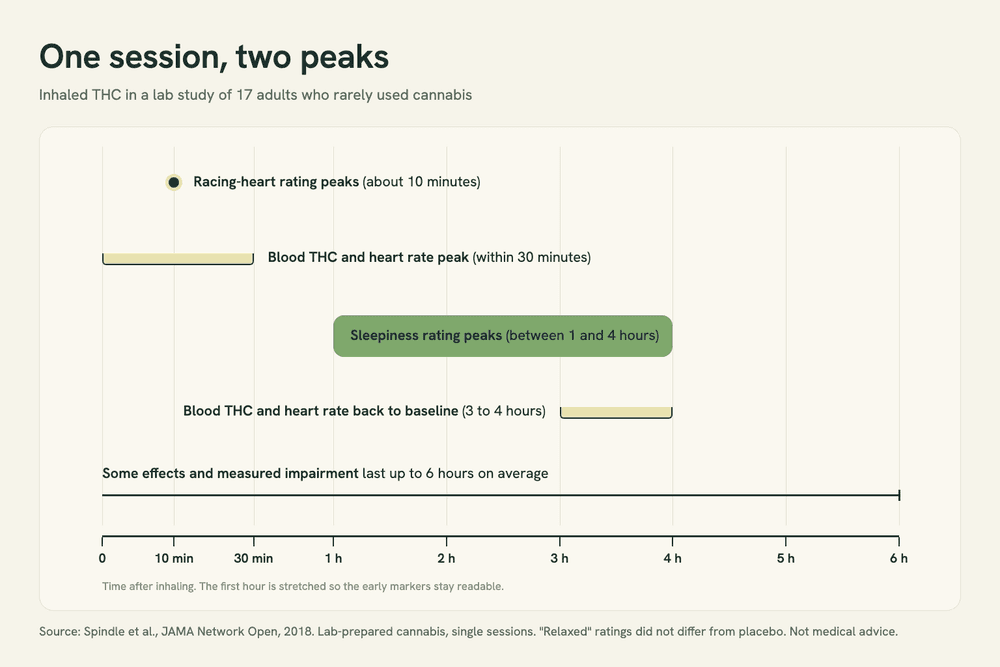
For a controlled look at how the effects unfold over time, a useful source is a 2018 Johns Hopkins crossover study. Seventeen healthy adults who had not used cannabis in the previous 30 days smoked and vaped cannabis containing 0, 10 and 25 mg of THC in separate double-blind sessions. Every active condition made people rate themselves sleepier than placebo did, with sleepiness peaking between one and four hours after inhaling. Blood THC and heart rate had peaked within 30 minutes and returned to baseline within three to four hours, yet several subjective effects and measured cognitive and psychomotor impairments lasted up to six hours on average.
One detail is easy to miss: in that study, ratings of feeling "relaxed" did not differ from placebo at any dose or by either route. Sleepier, yes. Measurably more relaxed, no. The study was small, used lab-prepared cannabis and tested people who rarely used it, so it cannot tell you how a regular user or a stronger product would compare.
Other sources point the same way. The DEA guide lists sedation first among cannabis's short-term physical effects, and the FDA label for dronabinol, a prescription form of THC, reports somnolence (sleepiness) in 3 to 10% of patients in its trials. That slowing, and the impairment that outlasts the high, is why driving after THC is a real risk; our guide to cannabinoids and driving covers impairment and the law. If sleep is what you are really asking about, what happens when you sleep high is a separate read.
The stimulant face: a racing heart and, at higher doses, anxiety
The same Johns Hopkins study that recorded sleepiness recorded the opposite, too. Ratings of "heart racing" rose significantly in three of the four active conditions, and each time they peaked at the first measurement, about 10 minutes after inhaling. That is the stimulant end of the same session, and it lines up with the roadside pulse data above. The dronabinol label names the mechanism plainly: "Dronabinol-induced sympathomimetic activity may result in tachycardia", meaning THC can switch on part of the body's fight-or-flight system and speed up the heart. Our write-up of a randomized THC and CBD trial covers a study in which both oils raised heart rate.
Anxiety belongs on this side of the ledger as well. In the Johns Hopkins study, "anxious/nervous" ratings rose only at the 25 mg dose, by both routes. A University of Chicago lab study shows how dose can flip the direction. Forty-two healthy occasional users swallowed a capsule of placebo, 7.5 mg or 12.5 mg of THC before a public-speaking stress test. The lower dose blunted how distressing people found the test; the higher dose made their mood worse before the test even started and impaired their performance. It is a small lab study, with about 14 people per group and one kind of stressor, and it describes a direction, not a dose anyone should aim for.
NIDA's summary of cannabis effects captures both sides in plain language. Cannabis can make people feel "more happy or relaxed", and it can also make them feel "more irritable or restless." It also says cannabis "can increase heart rate and blood pressure right after use." Anxiety, panic and paranoia get their own full treatment in why weed can make you paranoid.
“These effects are more common when a person takes a large amount, the cannabis product is strong (has a high level of THC), or the person has little experience with using cannabis.”
The hallucinogen face: altered perception, rarely true hallucinations
Cannabis commonly changes perception; NIDA lists altered time perception among its effects. Full hallucinations are another matter. The DEA guide says illusions, delusions and hallucinations are "rare except at high doses", and the dronabinol label lists hallucination among the side effects reported in more than 1% of its trial patients. Controlled evidence for this end comes from a Yale study that gave THC intravenously to 22 healthy volunteers, all previously exposed to cannabis, at 0, 2.5 and 5 mg under medical supervision. THC altered perception, raised anxiety, produced euphoria and produced brief psychosis-like symptoms, all of them transient. Intravenous dosing is far from how people use cannabis, which is the point: the hallucinogen-like end shows up at the extreme.
So is weed a psychedelic? Pharmacologically, no. Classic psychedelics such as LSD and psilocybin work mainly by switching on the serotonin 2A receptor, a consensus summarized in a 2016 pharmacology review. THC's main target is a different receptor, CB1, which is one reason pharmacologists do not group it with them. If you came here from the "California sober" conversation, where cannabis and psychedelics often get lumped together, our California sober guide covers that context.
Why one molecule can push in opposite directions
The explanation starts with where THC acts. Its main target, the CB1 receptor, belongs to the endocannabinoid system (ECS), the signaling network our endocannabinoid system explainer walks through step by step. CB1 receptors sit on the sending side of synapses, the junctions between nerve cells, and turn down the release of chemical messengers, as a 2009 review of the system describes. The catch is that they sit on both kinds of nerve endings. A 2012 review in the journal Neuron describes this signaling at "both excitatory and inhibitory synapses."
In plain terms, CB1 can dampen the brain's main "go" signal, glutamate, and also its main "stop" signal, GABA. Put the brake on a brake and activity goes up; put it on an accelerator and activity goes down. Which effect wins depends on dose, brain region and the person. This model comes from animal and brain-slice research. It explains why mixed effects are plausible, but it has not been measured synapse by synapse in people. In practice, four variables shape which face you are most likely to meet:
- Dose and product strength. In a lab study, two oral doses pushed mood in opposite directions, and NIDA notes that anxiety, panic and hallucinations are more common with large amounts and strong products.
- Timing and route. After inhaling, the racing-heart phase came first (about 10 minutes) and sleepiness came later (1 to 4 hours), so one person can meet more than one face in a single session.
- Experience and tolerance. People with little experience are more likely to feel anxiety or panic, and frequent users show blunted responses to some effects of THC.
- The person. The dronabinol label describes THC's effects on mood, cognition and perception as dose-related and "subject to great inter-patient variability."
On tolerance: in a 2008 Yale study of intravenous THC in frequent cannabis users, those users had blunted psychosis-like, perceptual and anxiety responses, but not blunted euphoria. Our tolerance break guide covers what brain-imaging studies show about how long that tolerance takes to reset. One thing that does not reliably predict which face you get is the indica or sativa label on the package.
Is THC a depressant? Is CBD?
THC is the ingredient behind all three faces described above. That is why the dronabinol label, written for a prescription form of THC, warns in both directions: about additive effects with CNS depressants, and separately about combining it with amphetamines and other stimulant-type drugs because of its effects on the heart. The most accurate description of THC is the one the police category uses: a cannabinoid with a profile of its own.
CBD is a different story. THC and CBD are both cannabinoids, compounds that act on the ECS, but CBD is not intoxicating like THC and does not fit any of the intoxicant categories. The World Health Organization's 2018 critical review of CBD concluded that "in humans, CBD exhibits no effects indicative of any abuse or dependence potential." That review covered pure CBD, not any particular product.
Not intoxicating does not mean inert, though. NIDA lists drowsiness among CBD's possible side effects, and the FDA label for Epidiolex, the prescription CBD medicine, has a section titled "CNS Depressants and Alcohol" warning that combining them "may increase the risk of sedation and somnolence." Those are seizure-treatment doses, far above what a consumer product delivers, but the direction is worth knowing if you take anything sedating. Full-spectrum CBD products also contain trace THC below the 0.3% federal limit, so they are not THC-free. Our CBD vs THC comparison covers the practical differences.
Why the label matters: mixing cannabis with real depressants
This is where "is it a depressant?" stops being trivia. In 2016, the FDA added its strongest warning to nearly 400 opioid and benzodiazepine products, because combining them with other CNS depressants, including alcohol, can cause "unusual dizziness or lightheadedness, extreme sleepiness, slowed or difficult breathing, coma, and death." That warning is about opioids and benzodiazepines, not cannabis. But THC's own FDA label, for dronabinol, warns that "additive CNS effects (e.g., dizziness, confusion, sedation, somnolence) may occur" when it is taken with CNS depressants. Its examples include barbiturates, benzodiazepines, alcohol, opioids, antihistamines and muscle relaxants. One drug label, two opposite warnings: added sedation with depressants, added heart effects with stimulants.
Alcohol is a common combination. In a controlled driving-simulator study, alcohol and THC together impaired lane control more than either alone, and a moderate combination (5 µg/L of THC in blood with a 0.05 breath alcohol level) produced weaving similar to a 0.08 breath alcohol level alone. Our crossfaded guide has the study-by-study picture, and CBD and alcohol covers the non-intoxicating side of the question.
Before you combine cannabis with anything sedating
- 1List everything you take that slows the brain and body: alcohol, benzodiazepines, opioid painkillers, prescription or over-the-counter sleep aids, sedating antihistamines and muscle relaxants.
- 2Ask your prescriber or pharmacist before combining cannabis with any of them, and tell them if you already do. They can check your specific medicines and doses.
- 3Do not stop, skip or change a prescription on your own to make room for cannabis.
- 4Do not drive or operate anything dangerous after using cannabis, and especially not after combining it with alcohol or a sedating medicine.
- 5Remember the timing: the early heart-racing phase can give way to sleepiness one to four hours later, after you may think the effects are wearing off.
- 6Store cannabis and medicines out of reach of children and pets.
For the wider interaction picture, our guide to CBD and medications explains how CBD can interact with prescriptions. And if you or someone with you has simply taken too much THC, our greening out guide explains what usually happens and when to get help.

Is weed a narcotic?
Not under the federal definition. The Controlled Substances Act's definition of "narcotic drug" covers opium and opiates, poppy straw, coca leaves, cocaine and ecgonine, plus mixtures containing them. Marijuana is not on that list, and the DEA's guide says that today "narcotic" refers to opium, opium derivatives and their semi-synthetic substitutes, for which "a more current term" is opioid. Some state laws and older writing use "narcotic" more loosely, which is where the idea comes from. The police category sheet keeps them apart too: narcotic analgesics and cannabis are two different groups on its list of seven.
What we still don't know
The evidence behind this page is useful but narrow. The controlled studies gave between 2.5 and 25 mg of THC, mostly to people who used cannabis rarely, in single lab sessions with lab-prepared products. Today's concentrates and high-potency flower postdate most of that work, and none of these studies tells you how a daily user of a strong product would respond. The roadside data include only cases police had already identified correctly, with controls who were older and never drug-tested. The brake-on-a-brake mechanism comes from animal and brain-slice research, and nobody has mapped, in people, which brain circuits tip toward sleepiness and which toward a racing heart. Finally, individual variation is large: the same dose can land differently in two people, or in the same person on two different days.
Is weed a depressant? Questions people ask
Officially, neither. The police Drug Evaluation and Classification Program puts cannabis in its own category, separate from CNS depressants and CNS stimulants. It shares effects with both. In 302 cases where officers had correctly identified cannabis as the only drug, drivers' pulse and blood pressure were up like a stimulant's, while officers most often described them as relaxed or lethargic.
Often both, in sequence. In a controlled study of 17 adults who rarely used cannabis, the feeling of a racing heart peaked about 10 minutes after inhaling THC, while sleepiness peaked one to four hours later. Dose, product strength and experience shift the balance.
Changes in perception, such as time seeming to stretch, are common. True hallucinations are, in the DEA's words, "rare except at high doses". Cannabis is not a classic psychedelic: LSD and psilocybin act mainly on the serotonin 2A receptor, while THC's main target is the CB1 receptor.
THC is the compound behind all three faces. The FDA label for dronabinol, a prescription form of THC, warns about additive sedation with CNS depressants and, separately, about heart effects when it is combined with stimulant-type drugs. That two-way profile fits a category of its own.
CBD is not an intoxicant in any of these categories; the WHO's 2018 review found no effects indicating abuse or dependence potential in humans. It is not inert, though. NIDA lists drowsiness as a possible side effect, and the label of the prescription CBD medicine warns about added sedation with alcohol and other CNS depressants at seizure-treatment doses.
Dose, product strength, experience and timing all change which face shows up. In one lab study, a lower oral THC dose blunted distress under a stress test while a higher one worsened mood, and NIDA notes that anxiety and panic are more common with large amounts, strong products and little experience. Animal research on THC's target, CB1, shows it can dampen both excitatory and inhibitory signals, which makes mixed effects plausible.
Combining THC with CNS depressants can add up. The dronabinol label warns of additive dizziness, confusion, sedation and sleepiness, and in a driving study alcohol plus THC impaired lane control more than either alone. Talk to your prescriber or pharmacist before combining cannabis with alcohol, sleep aids, benzodiazepines or opioids, do not drive, and never change a prescription on your own.
If your real question is about the other cannabinoid, the next useful read is our answer to whether CBD can get you high: what controlled CBD studies found, and why a spectrum name on a label does not guarantee the answer.
Writing about hemp, wellness and the small rituals that keep us balanced.