A Randomized Trial Gave 18 Adults 12.5 mg of THC, With and Without CBD. Both Oils Raised Heart Rate.
A randomized, double-blind crossover trial published on August 27, 2026 gave 18 healthy adults 12.5 mg of THC, with and without 12.5 mg of CBD, then made them breathe against a resistance. Both oils raised heart rate. Here is what the record supports and what it does not.
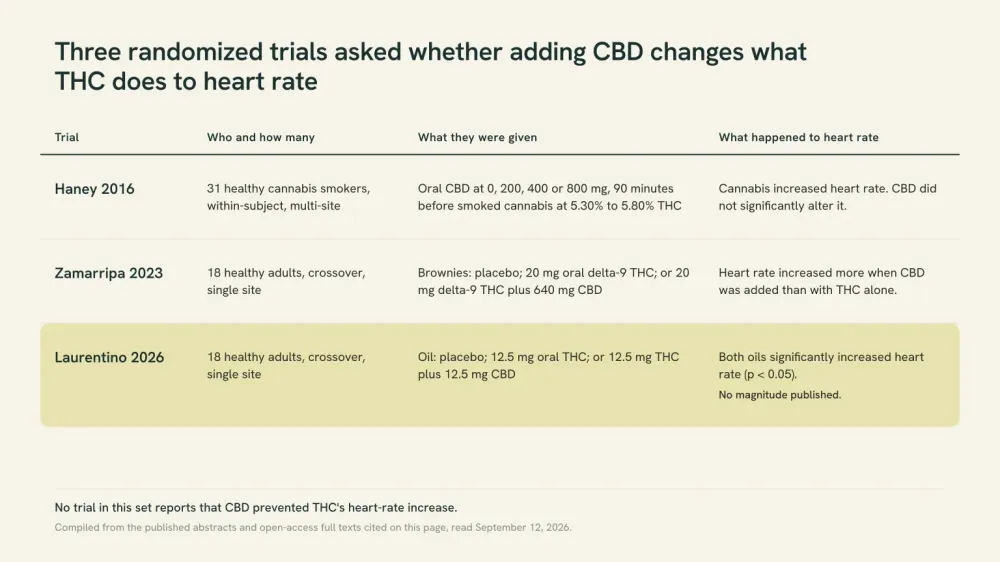
On August 27, 2026 a randomized, double-blind, placebo-controlled crossover trial appeared online in the British Journal of Clinical Pharmacology. Eighteen healthy adults, average age 26, swallowed one of three things on three separate days: an oil containing 12.5 mg of THC, an oil containing 12.5 mg of THC plus 12.5 mg of CBD, or a placebo. Then they breathed against a resistance while their heart and their breathing muscles were measured. In the authors' words, both oils significantly increased heart rate. If you came here to find out whether adding CBD cancels what THC does to your pulse, that is the answer, and it is the same answer two earlier randomized trials already gave.
Two things set the limits of this page. The trial's full text sits behind a subscription, so everything here comes from three documents we read end to end: the structured abstract on the trial's PubMed record, the same laboratory's open-access protocol paper from October 2025, and the trial's entry in Brazil's public clinical trial registry. And this is not breaking news. The record was 16 days old when we started, and when we searched on September 12, 2026 there was no consumer-facing coverage of it anywhere, only database records of the paper itself. That is why the piece exists: a trial that lands squarely on a question people ask every day, and nobody had translated it.
What the trial did, and who did it
The work comes from PneumoCardioVascular LAB, a physiotherapy research laboratory inside Hospital Universitario Onofre Lopes, the public university hospital of the Universidade Federal do Rio Grande do Norte, in Natal, Brazil, with co-authors at two Chilean universities. It was funded by CAPES and CNPq, Brazil's public research-funding agencies. That matters for reading the result correctly: this is an academic physiology laboratory, not a regulator and not a drug agency, and its publishing a result is not an official action of any kind.
The design, as the abstract prints it, is a randomized, double-blind crossover trial, and the title adds placebo-controlled. Eighteen individuals were evaluated, aged 26 plus or minus 5 years, and each went through every condition on separate days. Participants received orally administered CBD+THC oil at 12.5 mg plus 12.5 mg, THC oil at 12.5 mg, or placebo, and cardiovascular hemodynamics, respiratory muscle electromyography and peripheral tissue perfusion were evaluated during breathing tasks. A protocol paper published by the same laboratory in October 2025 describes the design and names the oils, and you can read the full protocol, open access in the Journal of Clinical Medicine yourself. The results paper does not cite it, so read it as the plan for this line of work rather than as a formal appendix.
Why a heart-rate trial had a breathing valve in it
This is the part of the trial nobody else has covered, and it explains the shape of everything else. The laboratory is a cardiorespiratory physiotherapy group, and its standard stressor is loaded breathing: you breathe through a valve that resists you, which makes the accessory muscles of the neck and chest work visibly harder. Heart rate was not an afterthought here. It was a pre-registered primary outcome. The trial's entry in ReBEC, Brazil's public clinical trial registry, registered on April 30, 2024, lists a cardiovascular hemodynamic assessment as its primary outcome, "measuring heart rate, cardiac output index, left ventricular systolic work index and systemic vascular resistance index", using a non-invasive cardiac output monitor. Also primary: airway occlusion pressure, and surface electromyography of the sternocleidomastoid, scalene, parasternal and rectus abdominis muscles. Registering the outcome before collecting the data is a real strength, and it is worth saying so on a page that is otherwise about limits.
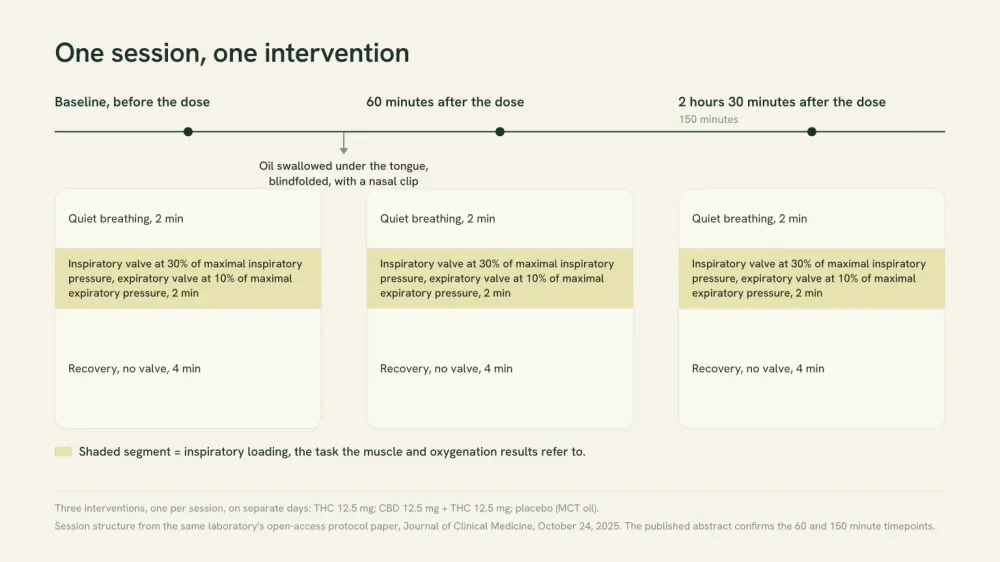
- 1Dosing, per the protocol: blindfolded, wearing a nasal clip, drops under the lifted tongue from bottles identical in color and viscosity, known only to a researcher in a locked room. That is the procedure as described, not an audit of what happened.
- 2Every measurement block: 2 minutes of quiet breathing, then 2 minutes through an inspiratory valve at 30 percent of maximal inspiratory pressure, with an expiratory valve at 10 percent of maximal expiratory pressure, then 4 minutes of recovery.
- 3Blocks ran at baseline, 60 minutes after the dose, and 2 hours 30 minutes after the dose, which is the 150-minute timepoint the results refer to. Each participant repeated the session once per intervention, on separate days, as their own control.
How unusual is it to give someone a cannabinoid and then record the electrical activity of their breathing muscles? Here is the checkable version rather than an adjective. Searched on September 12, 2026, PubMed returns three records where "respiratory muscle" appears in a title or abstract alongside cannabis, cannabidiol or tetrahydrocannabinol. One of them is this trial. The other two are a 2024 study of exercise capacity in people with substance use disorders and a 2018 review of marijuana and the lung, and neither gave anyone a cannabinoid and then recorded the electrical activity of their breathing muscles. That is a count from one index, on one date, with one query shape, and it is the strongest honest form of the claim.
The results, arm by arm
Here is every result clause the published abstract prints, with the arm it belongs to. The two active arms are labeled I-THC and I-CBD+THC in the paper, and keeping them apart is the whole job on a page like this: several of the findings belong to one arm only, and a summary that reads across them manufactures a result the trial did not report.
| What was measured | THC oil, 12.5 mg (I-THC) | CBD + THC oil, 12.5 mg + 12.5 mg (I-CBD+THC) | When |
|---|---|---|---|
| Heart rate | Significantly increased (p < 0.05) | Significantly increased (p < 0.05) | The abstract states it for both oils and prints no magnitude for either |
| Cardiac index | Significantly increased (p < 0.05) | Not reported as significant in the abstract | 60 and 150 minutes after the dose |
| Vascular resistance index | Lower, with significant differences during respiratory overload and recovery (p < 0.05) | Not reported in the abstract | During the loaded breathing task and the recovery that follows it |
| Sternocleidomastoid muscle activity | Significant increase (p < 0.05) | Not named in this arm | During inspiratory loading, at 60 and 150 minutes |
| Parasternal muscle activity | Significant increase (p < 0.05) | Increased activation (p equal to or below 0.021) | During inspiratory loading |
| Scalene muscle activity | Not named in this arm | Increased activation (p equal to or below 0.021) | During inspiratory loading |
| Tissue oxygenation (O2Hb and HHb) | O2Hb showed a significant increase during inspiratory loading (p < 0.05), while the HHb decrease was descriptive and did not reach statistical significance | Not reported in the abstract | During inspiratory loading and recovery |
Notice what is missing: a number of beats. The abstract says both oils significantly increased heart rate at p < 0.05, and it does not publish the size of that increase for either arm. Neither does the protocol, and neither does the registry. So we cannot tell you how many beats per minute, and we are not going to fill the gap with a figure borrowed from somewhere else. Consumer pages about THC and pulse do print ranges; we read those pages on September 12, 2026 and not one of them attached a study to the number it printed. An unattributed number is not a smaller version of a measurement. It is a different kind of thing.
What the word attenuated does and does not mean
The authors' conclusion reads: acute administration of THC and CBD+THC oils induced distinct cardiorespiratory responses in healthy individuals, affecting cardiovascular hemodynamics, respiratory muscle activation and peripheral tissue oxygenation; THC produced more pronounced physiological responses, while CBD+THC was associated with a more attenuated pattern. That is their sentence and their word. Read exactly what it is: a description of how two arms looked next to each other in 18 people, in a trial whose registered primary outcome was a set of hemodynamic measures, not a test of whether one compound prevents the effects of another. The authors do not claim that CBD protected anyone's heart. Both oils still significantly increased heart rate. The comparison is between two increases.
This matters because the idea that CBD blunts what THC does to your pulse is already everywhere online, and it has been tested directly, twice, by design. In 2016 a multi-site randomized, double-blind, within-subject trial gave 31 healthy cannabis smokers oral CBD at 0, 200, 400 and 800 mg, 90 minutes before they smoked cannabis containing 5.30 to 5.80 percent THC, across eight outpatient sessions. Active cannabis significantly increased heart rate. That 2016 trial, run across Columbia, the Medical University of South Carolina, Kentucky and NIDA, reports that CBD, which alone produced no significant psychoactive or cardiovascular effects, did not significantly alter any of those outcomes. Its limits are real: the participants were experienced smokers rather than naive volunteers, the cannabis was smoked rather than swallowed, and the CBD was a pretreatment rather than a co-formulated dose.
The second test points further in the same direction. In 2023, a crossover trial at the Johns Hopkins Behavioral Pharmacology Research Unit, published in JAMA Network Open, gave 18 healthy adults brownies in three sessions: placebo, 20 mg of delta-9 THC, or 20 mg of delta-9 THC with 640 mg of CBD. The combination increased self-reported anxiety, sedation and memory difficulty, increased heart rate, and produced more pronounced impairment of cognitive and psychomotor performance than THC alone. The authors proposed a mechanism: CBD inhibiting the metabolism of THC and of its active metabolite, which raises exposure to THC rather than lowering it. Carry the limits with the finding. A probe-drug cocktail was co-administered in every session, so no arm was a clean THC-alone condition; the CBD dose is 51 times the CBD dose in the 2026 trial; and the disclosure list is long, with the authors reporting personal fees or contract work with Canopy Health Innovations, MyMD Pharmaceuticals, Mira1a Therapeutics, Syqe Medical, Radicle Science, WebMD, MIRA Pharmaceutical, Cultivate Biologics and Canopy Growth, plus a patent pending at Johns Hopkins University.
“Stronger adverse effects were elicited from a CBD-dominant cannabis extract compared with a delta-9-THC-dominant cannabis extract at the same delta-9-THC dose, which contradicts common claims that CBD attenuates the adverse effects of delta-9-THC.”
None of this is new territory for researchers, only for the consumer web. A PubMed search run on September 12, 2026 returns nine randomized-controlled-trial records where cannabidiol, tetrahydrocannabinol and heart rate all appear in a title or abstract, going back to a 2011 comparison of Sativex, a mouth spray containing both molecules, against oral THC. Three of those nine are trials described on this page: the 2016 and 2023 trials above, and a 2012 crossover study you will meet in the next paragraph. So the honest summary of the 2026 trial is not that it discovered something about the pair, but that it adds another measurement to a small and so far consistent picture: across the trials on this page, every arm containing THC raised heart rate, and none of them reports that CBD prevented it.
The heart-rate half of this trial is also a replication, and saying so is not a criticism. In 2012, a crossover trial in 16 healthy men gave oral THC at 10 mg, oral CBD at 600 mg, or placebo in sessions a month apart, and reported an increase in heart rate with THC at p < 0.05 and no differences between CBD and placebo on any physiological variable. What that trial could not do was give the two compounds together, which is the gap the 2026 trial fills. What CBD does to a pulse on its own is a separate and messier question, and our standing page on it holds that evidence, including the 2017 trial that found a rise and the same laboratory's 2020 trial that did not reproduce it. For why these two molecules behave so differently in the first place, our side-by-side comparison of CBD and THC is the page to read.
12.5 mg in one swallow is a laboratory dose
The most reader-relevant fact in the whole file is what was actually in the bottles, and the protocol prints it. The THC arm used an over-the-counter US hemp product described as a full-spectrum delta-9 THC oil at a concentration of 2.50 mg/mL. The combination arm added a second over-the-counter oil, a full-spectrum cannabis oil containing 50 mg/mL of CBD and 1.83 mg/mL of THC, and the protocol says the two were combined to reach an equal ratio of CBD and THC at each dose, which is why the paper writes the arm as 12.5 mg plus 12.5 mg. The placebo was the carrier on its own: MCT oil, 70 percent fractionated coconut and 30 percent corn. Here are the volumes as the protocol's table prints them.
- THC arm, 12.50 mg: 5.00 mL of the 2.50 mg/mL full-spectrum delta-9 THC oil.
- CBD plus THC arm, 12.50 mg each: 4.81 mL of that same THC oil, plus 0.25 mL of the 50 mg/mL CBD oil.
- Placebo: 5 mL of MCT oil, 70 percent fractionated coconut oil and 30 percent corn oil.
- Given in drops under the lifted tongue in a Phase 1 session inside a hospital, with a multidisciplinary team on standby, and a rule withdrawing anyone whose heart rate passed 85 percent of their maximum or who had a hypertensive peak.
Swallowing several milliliters of oil to receive 12.5 mg of delta-9 THC in a single dose, under observation, is a measured laboratory exposure. It is not a figure that comes off a hemp label, and the two are not even written in the same units: federal law defines hemp by a ceiling, not by a serving. Section 1639o of title 7 of the US Code defines hemp as Cannabis sativa L. and its derivatives with a delta-9 tetrahydrocannabinol concentration of not more than 0.3 percent on a dry weight basis. That is a percentage of a crop, not a milligram on a serving, and how the two relate is its own subject, which we keep on the page about hemp-derived THC and the milligram question. If what you are weighing is whether a dose like this one is an intoxicating dose, our page on whether CBD gets you high draws that boundary. What this article will not do is translate a trial dose into servings of anything, because that arithmetic is how a physiology result turns into a dosing suggestion it cannot support.
What this trial cannot tell you
A good newsroom item spends as much space on the boundary of a result as on the result. Here is the boundary, item by item, from the three documents we read.
- There is no CBD-only arm. Every arm that moved contained THC, so nothing here describes what a CBD-only product does to anything.
- Eighteen people were evaluated against a registered target of 30, and on September 12, 2026 the registry still read Recruiting, with first enrolment recorded February 1, 2024. Registry fields go stale, which is why we print the date we read it.
- The registry gives the dose as 12.25 mg, while the protocol's table and the paper both say 12.50 mg. The registry's title also calls one arm a THC isolate, where the protocol names a full-spectrum product. We report both and pick no winner.
- The protocol describes five interventions, including a higher 18.75 mg pair; the published abstract reports three. The full text is paywalled, so we cannot say how the higher-dose arms were handled, and we are not going to guess.
- The registry lists rectus abdominis among the muscles recorded; the published abstract reports the other three. Same reason, same silence.
- No a priori powered sample size was published. The protocol says the size would be set after a five-person pilot, and recruitment was by convenience sampling on social media. That is a design limitation, stated in the protocol itself, not misconduct.
- Volunteers had to be 18 to 50, with a BMI of 18.5 to 29.9, no cardiovascular disease, no history of arrhythmia or hypertension, no regular medication and no cannabis in six months. Pregnant participants were excluded.
- It is acute: one dosing day per arm, measurements ending at 150 minutes, one laboratory, one country, healthy young adults, and an abstract rather than a full text.
That exclusion list is the one to sit with. If you take a medicine for blood pressure or a heart rhythm problem, this trial did not include anyone like you, by design, and a result measured in medication-free 26-year-olds does not transfer to you in either direction. The useful next step there is a conversation with a pharmacist or prescriber, and what is known about CBD alongside blood pressure medication lays out the questions worth asking. It is also worth knowing that the oral literature does not agree with itself: a 2026 preprint that has not been peer reviewed followed 59 people using commercially available edibles in everyday conditions and reported a small, statistically significant decrease in heart rate overall, with an increase in the 10 to 20 mg group at the timepoint the authors describe as expected peak drug effect. That is a naturalistic observation, not a randomized trial, and it has not been through peer review. It is here to show that the picture is unsettled, not to reassure anyone.
What did not change on August 27, 2026
No agency acted. No rule was proposed, finalized, delayed or withdrawn because of this trial, no product label changed, and no recall followed. A published paper from a university laboratory is not a regulatory event, and it does not become one by being about a cannabinoid. The US picture is where it was: the FDA's consumer update on products containing cannabis and cannabis-derived compounds states that the agency has approved only one CBD product, a prescription drug for seizures associated with Lennox-Gastaut syndrome, Dravet syndrome or tuberous sclerosis complex in people one year of age and older, and that it is currently illegal to market CBD by adding it to a food or labeling it as a dietary supplement. Neither sentence moved in August 2026, and neither is a comment on this trial.
Nor does anything here change what a pulse is. NIDA's DrugFacts page on cannabis still says cannabis can increase heart rate and blood pressure right after use, notes an association between long-term use and increased risk of stroke, heart attack and arrhythmias, and adds in the same breath that more research is needed to know whether the connection is direct. MedlinePlus still puts a normal adult resting pulse at 60 to 100 beats per minute and notes that you have to have been resting for at least 10 minutes before a reading counts as a resting one. What follows is not about this trial. It is the standing advice for symptoms, from the same service.
In controlled human trials, yes. The 2026 crossover trial reports that both oils containing THC significantly increased heart rate. A 2012 crossover trial in 16 healthy men found the same direction with 10 mg of oral THC. Federal drug information says cannabis can increase heart rate and blood pressure right after use. This is a long-standing, repeatedly measured finding rather than a new one, and the 2026 trial does not publish a figure for how many beats, so neither do we.
Nothing in the published record supports that. In the 2026 trial both arms raised heart rate, and the arm with CBD in it was still an arm with 12.5 mg of THC in it. Two earlier randomized trials tested the question head-on. The 2016 trial found that oral CBD at up to 800 mg did not significantly alter the heart-rate increase from smoked cannabis. The 2023 trial found that adding 640 mg of CBD to 20 mg of oral THC increased heart rate compared with THC alone, and its authors wrote that this contradicts common claims that CBD attenuates the adverse effects of THC.
This trial does not publish that number. The abstract reports statistical significance at p < 0.05 and no magnitude; the protocol and the registry describe the plan and the instruments, not the results; and the full text is behind a subscription. Consumer pages that print a range for THC and heart rate do not attach a study to it, so we are not repeating one. If the full text becomes readable and reports a magnitude, this page gets updated with it.
It is a laboratory dose. It was swallowed in a single administration inside a hospital, in a Phase 1 trial with a multidisciplinary team on standby, by volunteers aged 18 to 50 with no cardiovascular disease, no history of arrhythmia or hypertension, no regular medication use and no cannabis in the previous six months, under a rule that withdrew anyone whose heart rate passed 85 percent of maximum. That is the context the figure belongs to. It is not a serving size and we will not translate it into one.
Because the laboratory is a cardiorespiratory physiotherapy group and loaded breathing is its standard stressor: participants breathed through a valve set to 30 percent of their maximal inspiratory pressure while surface electrodes recorded the accessory muscles of the neck and chest. A PubMed search on September 12, 2026 returns three records pairing respiratory muscle with cannabis, cannabidiol or tetrahydrocannabinol, and the other two administered no cannabinoid to anyone. The measurement is electrical activity during a resistance task in healthy volunteers, which is a physiology reading, not a statement about anyone's breathing.
No. No agency acted on it, no rule was proposed or finalized because of it, no label changed and no recall followed. The FDA's stated position is unchanged: it has approved one CBD product, a prescription drug for three seizure disorders, and it says it is currently illegal to market CBD by adding it to a food or labeling it as a dietary supplement. The federal definition of hemp, a ceiling of 0.3 percent delta-9 THC on a dry weight basis, is also unchanged. One published trial from one university laboratory is a data point, not a regulatory event.
The reason we wrote this is on our own site. Our standing page on the question, does CBD affect heart rate, has carried this sentence for a while: we cannot tell you that CBD counteracts, blocks or offsets THC's effect on heart rate, and neither can anyone else honestly. That sentence was written before this trial existed. A trial has now given healthy volunteers both compounds in the same swallow, on a registered primary outcome, with a placebo and a THC-only comparison, and the sentence still holds. That is what a trial is for: it is allowed to change our answer, and this one did not.
Writing about hemp, wellness and the small rituals that keep us balanced.