An Appeals Court Left Medical Marijuana in Schedule III. It Did Not Decide the Case
On September 9, 2026 the D.C. Circuit denied a stay of the April order placing state-licensed medical marijuana in Schedule III. The challenges are still pending, broader rescheduling is still a proposal, and the rule says it does not affect hemp.

In an order filed September 9, 2026, a three-judge panel of the U.S. Court of Appeals for the D.C. Circuit refused to pause the federal order that moved state-licensed medical marijuana and FDA-approved marijuana drug products into Schedule III on April 28, 2026. That is a stay denial, not a ruling on the merits. The petitions challenging the April order are still pending, and the broader proposal to move marijuana to Schedule III is still a proposal. Here is what the two-page order actually did, what it left alone, and why none of it changes the status of hemp.
Everything below comes from primary records we read on September 14, 2026. The main one is the court's September 9 order, from a copy on CourtListener's RECAP archive, which is Document #2192118 in No. 26-1106. It is signed Per Curiam, meaning it issued from the panel as a whole rather than under one judge's name, and its header lists the agency record as DEA-91FR22714, the Federal Register citation of the April order. We also read the dockets of the three consolidated cases and the documents DEA published on April 28. We quote the order wherever the wording matters, because the difference between who petitioned, who asked for a pause and what the court actually decided is where most of the confusion lives.
What the court ordered, in its own words
The panel was Circuit Judges Wilkins, Walker and Garcia. The caption names SAM, Inc. and National Drug and Alcohol Screening Association, Inc. as petitioners against the United States Department of Justice, and the order notes that the case is consolidated with Nos. 26-1130 and 26-1136. The order makes four rulings, and the one that made the headlines comes third. Here they are in the sequence the court printed them.
| What was decided | Who raised it | Result | What the order gives as the reason |
|---|---|---|---|
| Leave to intervene as a party, or alternatively to participate as amicus curiae (a friend of the court who files a brief but is not a party) | Two companies the order calls the Medical Marijuana Companies: MedPharm Iowa, LLC, which the docket lists as doing business as Bud & Mary's, and Tri-Mountain Pure, LLC | Intervention denied. Amicus participation granted. | They "fail to demonstrate that their interests in this litigation are not adequately represented by existing parties." |
| Leave to participate as amicus curiae | Cannabis Industry Attorneys | Granted | No reason is stated. The order construed their amicus brief in opposition to a stay as including a motion to participate as amicus curiae. |
| A stay of the April order while the court reviews it | A joint motion filed June 9, 2026 by the National Drug and Alcohol Screening Association in 26-1106 and three MMJ companies in 26-1136 | Denied | "Petitioners have not satisfied the stringent requirements for a stay pending court review." |
| Proposed formats for briefing the cases | The court, on its own motion | The parties must propose formats within 30 days and are strongly urged to submit a joint proposal | The court "looks with extreme disfavor on repetitious submissions" and will, where appropriate, require a joint brief of aligned parties. |
“FURTHER ORDERED that the motion for stay be denied. Petitioners have not satisfied the stringent requirements for a stay pending court review.”
Those two sentences, followed by two citations, are the whole of the court's stated reasoning on the stay. The first citation is to the Supreme Court's 2009 decision in Nken v. Holder, 556 U.S. 418, at page 434. The second is to page 33 of the D.C. Circuit Handbook of Practice and Internal Procedures (2025). Both describe the same standard, and that standard is the key to reading the result correctly.
A stay denial is not a verdict
A stay pending review asks a court to pause an agency's order now, before the court decides whether the order is lawful. In Nken v. Holder, the 2009 Supreme Court decision the order cites, the Court wrote that a stay "is not a matter of right, even if irreparable injury might otherwise result", and that "The party requesting a stay bears the burden" of justifying one. The Court described the traditional standard as four questions:
- 1Whether the stay applicant has made a strong showing that he is likely to succeed on the merits.
- 2Whether the applicant will be irreparably injured absent a stay.
- 3Whether issuance of the stay will substantially injure the other parties interested in the proceeding.
- 4Where the public interest lies.
Nken adds that "The first two factors of the traditional standard are the most critical." The D.C. Circuit builds the same test into its own practice. The court's Handbook of Practice and Internal Procedures, on the page the order cites, says a motion for a stay "must specifically discuss four factors": the likelihood that the moving party will prevail on the merits, irreparable injury to the moving party, substantial harm to other parties, and the public interest. So the denial tells you the movants did not satisfy that standard on the record in front of the panel. It does not tell you the panel thinks the April order is lawful, and it does not tell you how the petitions will come out.
Who is challenging the April order
Three petitions for review, each asking the court of appeals to review the April order, were filed in May 2026 and consolidated. This is how the dockets list them, as indexed by CourtListener on September 14, 2026. We print names as the court does and do not characterize anyone's reasons for filing.
| Case | Caption | Filed | Petitioners on the docket |
|---|---|---|---|
| No. 26-1106 | SAM, Inc. v. DOJ | May 4, 2026 | SAM, Inc.; National Drug and Alcohol Screening Association, Inc. |
| No. 26-1130 | State of Nebraska v. DOJ | May 22, 2026 | Nebraska and Indiana. Louisiana withdrew by Clerk's order of July 10, 2026. |
| No. 26-1136 | New Directions Addiction Recovery Services v. Donald Trump | May 28, 2026 | New Directions Addiction Recovery Services; Kenneth Finn, M.D.; Elizabeth B. Stuyt, M.D.; Cannabis Industry Victims Educating Litigators; MMJ BioPharma Cultivation Inc.; MMJ Biopharma Labs Inc.; MMJ International Holdings Inc. |
Petitioners and the parties who asked for the pause are not the same group, and it is easy to blur them. The docket for No. 26-1106 records the stay request as a joint motion filed June 9, 2026 by the National Drug and Alcohol Screening Association in 26-1106, and by MMJ Biopharma Cultivation, MMJ International Holdings and MMJ Biopharma Labs in 26-1136. SAM, Inc. is a petitioner in 26-1106 but is not listed on that motion. The states in No. 26-1130 are not listed on it, and neither are the other petitioners in No. 26-1136. The government opposed the stay in its response filed July 2, 2026, and the same day four individuals filing together as Cannabis Industry Attorneys submitted a brief as amici curiae in opposition to the motion for stay. The joint motion itself is not on the RECAP archive, so we have not read the movants' arguments and do not summarize them.
What the Schedule III order the court left in place covers
The order the petitioners want set aside is the final rule published April 28, 2026 at 91 FR 22714. It was signed April 22, 2026 by Todd Blanche, Acting Attorney General, and it was published and took effect on April 28. It is much narrower than "marijuana is Schedule III". Its abstract applies it to marijuana, marijuana extract, and delta-9 THC and other plant-derived compounds "that falls outside the definition of hemp", and only "to the extent that any of these are included in an FDA-approved drug product or are subject to a state-issued license to manufacture, distribute, and/or dispense marijuana or products containing marijuana for medical purposes". Schedule III is still a schedule of controlled substances; moving something there changes which controls apply, not whether it is controlled.
What moved to Schedule III on April 28
- Marijuana, when it is in an FDA-approved drug product or subject to a state medical marijuana license.
- Marijuana extract, under the same two conditions.
- Naturally derived delta-9-tetrahydrocannabinols, under the same two conditions, excluding any material that falls within the federal definition of hemp.
What stays in Schedule I
- Any form of marijuana that is not in an FDA-approved drug product and not subject to a state medical marijuana license.
- Synthetic THC, which the rule says remains in Schedule I.
- Unlicensed bulk marijuana, marijuana extract and delta-9 THC material used to make FDA-approved drug products.
In the rule's own words, "any form of marijuana other than in an FDA-approved drug product or marijuana subject to a state medical marijuana license remains a schedule I controlled substance". The rule never uses the words "recreational" or "adult". Read plainly, marijuana sold only under a state adult-use license is not in either category the rule names. That is a reading of the rule's sentence, not advice about any state's market. The rule also says it "is not rescheduling any drug product containing marijuana or THC that previously has been rescheduled out of schedule I (e.g., Marinol and Syndros)", and that it does not "impact the status of any previously scheduled synthetic cannabinoids." Three more details explain how the rule works. It was issued by order under 21 U.S.C. 811(d)(1), the provision for scheduling that international treaty obligations require, and DEA wrote that it "believes that the notice-and-comment requirements of the Administrative Procedure Act (APA), 5 U.S.C. 553, do not apply to this scheduling action"; the rule took effect the day it was published. It created an expedited DEA registration path: the Administrator "shall make every effort" to process applications submitted within 60 days of publication within six months, and those applicants may operate under their state license "during the pendency of the application". And on taxes, it says state licensees "will no longer be subject to the deduction disallowance imposed by Section 280E" while also stating that "Nothing in this rule constitutes a determination regarding federal tax liability", and that qualifying state licensees should consult tax counsel about how Section 280E applies to them. For the statutory line these categories sit on, see our explainer on how federal law separates hemp from marijuana.

Three federal records from April 28, and why "withdrawn" was the wrong word
DEA published three related documents in the same Federal Register issue on April 28, 2026. Read together, they explain how the same day could be summarized both as "marijuana rescheduled" and as "rescheduling withdrawn". Either summary would rest on a real document, and each would describe only one of the three.
| Document | Document type | What it does | The accurate verb |
|---|---|---|---|
| 2026-08176, 91 FR 22714 | Final rule, issued as an order (Attorney General Order No. 6754-2026) | Places marijuana in FDA-approved drug products and marijuana subject to a state medical marijuana license in Schedule III, effective April 28, 2026 | Rescheduled, for those two categories only |
| 2026-08177, 91 FR 22777 | Notice of hearing on proposed rulemaking (Attorney General Order No. 6753-2026, Docket DEA-1362) | Announces a DEA hearing on the proposed rescheduling of marijuana into Schedule III, beginning June 29, 2026 | Proposed, with a hearing |
| 2026-08178, 91 FR 22778 | Notice of hearing on proposed rulemaking; withdrawal (Attorney General Order No. 6752-2026) | Withdraws the August 29, 2024 notice of hearing (89 FR 70148) and ends those proceedings so new ones can begin | Withdrew a hearing notice, not the proposal |
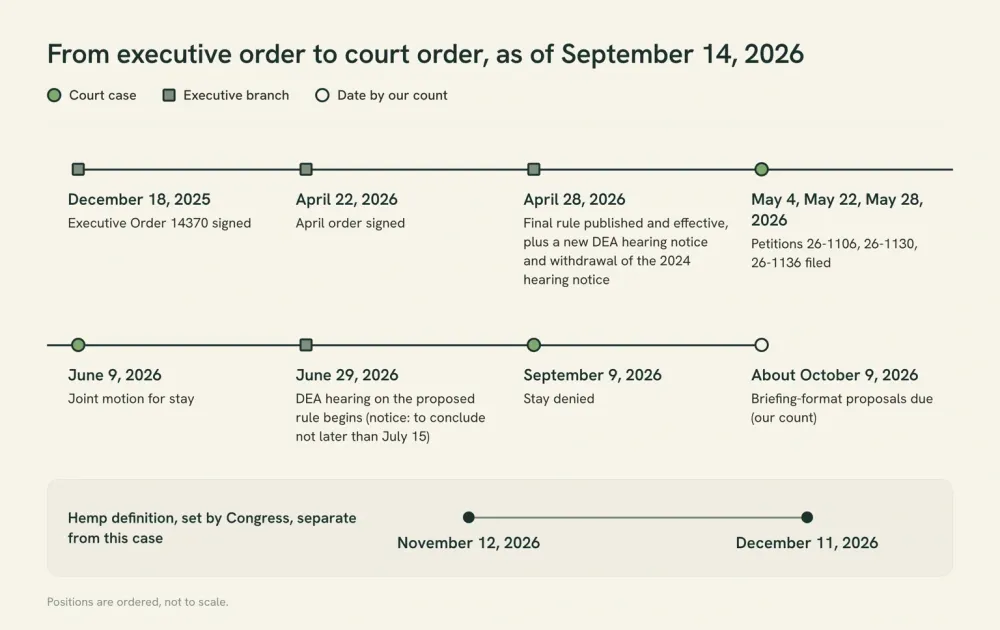
The broader proposal is older than the April rule. The Justice Department proposed moving marijuana to Schedule III on May 21, 2024, and DEA noticed a hearing on it on August 29, 2024. The April 28 withdrawal notice explains what happened to that hearing: the presiding administrative law judge stayed the proceedings on January 13, 2025, "The proceedings remain stayed to this day", and "In the intervening period, the presiding ALJ retired from Federal service." So DEA wrote that it is "withdrawing the notice of hearing and terminating the pending hearing proceedings" in order to "initiate new hearing proceedings". The verb is withdrawing, and its object is the notice of hearing. The new hearing notice cites Executive Order 14370, Increasing Medical Marijuana and Cannabidiol Research, signed December 18, 2025, and quotes it as directing the Attorney General to "take all necessary steps to complete the rulemaking process related to rescheduling marijuana to Schedule III of the CSA in the most expeditious manner in accordance with Federal law, including 21 U.S.C. 811."
Where does that hearing stand? The notice set it to begin June 29, 2026 at the DEA Hearing Facility in Arlington, Virginia, and said it "will conclude not later than July 15, 2026." In its July 2 response in the court case, the government said in a footnote: "The hearing began on June 29, 2026, and is scheduled to conclude by July 15." DEA's own rescheduling pages blocked our automated check on September 14, so for what came after we rely on named reporting. Marijuana Moment reported on July 16, 2026 that the hearing wrapped up on Wednesday, July 15, that post-hearing briefs were due August 17, 2026, and that the judge "stressed that the final decision will ultimately be up to the DEA administrator." If you have followed other DEA actions, note that this is a notice-and-hearing track, a different instrument from the temporary scheduling order explained in our item on DEA's August kratom analog order.
As of September 14, 2026, no final rule moving marijuana as a whole to Schedule III has been published. We checked three ways that fail differently. A Federal Register search on Docket DEA-1362 returns four documents: the May 21, 2024 proposal, the August 29, 2024 hearing notice, and the two April 28, 2026 notices. A search for DEA documents mentioning marijuana published since April 29, 2026 returns 13, none of them about rescheduling marijuana. And the Public Inspection list, which shows documents filed but not yet published, carried 157 documents that day, none with marijuana, cannabis or hemp in its title. We are not going to guess when, or whether, a final rule appears.
Does any of this change hemp or CBD products?
“This final rule also does not affect the status of hemp (as defined in 7 U.S.C. 1639o), because hemp is excluded from the definition of marijuana.”
For products that meet the federal definition of hemp, that sentence is the rule's own answer. Its new Schedule III entry for naturally derived delta-9 THC makes the same cut, excluding "any material, compound, mixture, or preparation that falls within the definition of hemp set forth in 7 U.S.C. 1639o". The September 9 order did not change the rule, so it did not change that boundary either. For the federal and state layers that actually govern CBD, see where CBD stands under federal and state law.
Hemp's federal definition is changing anyway, on its own timetable, through Congress rather than DEA or the courts. Section 781 of Public Law 119-37, enacted November 12, 2025, amends the definition effective 365 days after enactment, and section 2019 of H.R. 6500, as enrolled, says that until December 11, 2026 those amendments "shall only apply" to certain products. The result is one piece arriving November 12, 2026 and the rest on December 11, 2026, which we walk through in our newsroom item on the separate hemp-definition deadline. The September 9 order decided procedural motions about a DEA rule, and it moves neither date.
Two other questions come up. The first is FDA. The April rule and the September 9 order are Justice Department and DEA scheduling actions, and neither amends the law FDA administers, so FDA's page on cannabis and cannabis-derived products, including CBD, and our summary of what the FDA says about CBD are not changed by this case. How an FDA-approved cannabidiol medicine differs from a retail oil is a separate question from scheduling, covered in our comparison of Epidiolex and CBD oil. The second is drug testing. Neither the September 9 order nor the April rule addresses workplace drug-testing rules, and when we searched the rule's text, the phrases "drug testing" and "Department of Transportation" did not appear. One petitioner's name, the National Drug and Alcohol Screening Association, points toward testing, but that tells you who is in the case, not what the testing rules are. Our guide to how CBD and drug tests interact covers what is known, and your employer or testing program administrator is the authority for your own situation.
What happens next, by date
Only some of the next steps have dates. Here they are, with the undated ones labeled as undated.
- About October 9, 2026: proposed briefing formats are due, 30 days after the September 9 order by our count. The docket, not our arithmetic, is the authority on the actual due date.
- Not yet scheduled: briefing and decision on the petitions themselves. The court has not set that schedule, and this page does not predict the timing or the outcome.
- No published timeline: a final DEA decision on the broader proposal. As of September 14, 2026 no final rule has been published on Docket DEA-1362.
- November 12 and December 11, 2026: the two dates for hemp's new federal definition, set by Congress and not part of this case.
What this article cannot tell you
We read the order, the dockets, the April rule and the April hearing notices, and there are still fair questions we cannot answer. We have not read the joint stay motion, which is not on CourtListener's RECAP archive, so we do not know the movants' full arguments. The order does not say which stay factor was not met, so neither can we. DEA's rescheduling pages and the Department of Transportation's drug-testing pages both blocked our automated checks on September 14, 2026, which is why the post-hearing details above are attributed to Marijuana Moment and why this page states no testing-agency position. State law varies by state and is not covered here. If a decision about your business, your license or your job turns on any of this, a lawyer licensed in your state is the right next call, not a news article.
Questions readers are asking
No. On September 9, 2026 it denied a motion to pause the April order while the challenges proceed, ruled on two requests to take part in the case, and asked the parties to propose briefing formats. The petitions themselves are undecided, and the order does not say which part of the stay standard the movants failed to meet.
The April rule names two categories: marijuana in an FDA-approved drug product, and marijuana subject to a state medical marijuana license. It says any other form of marijuana "remains a schedule I controlled substance". The rule never uses the words recreational or adult, and marijuana sold only under a state adult-use license is not in either category it names. That is a reading of the rule, not legal advice.
The rule the court left in place says it "does not affect the status of hemp", because hemp is excluded from the definition of marijuana. Hemp's own federal definition is changing separately, with one piece on November 12, 2026 and the rest on December 11, 2026, and this case does not move either date.
No. On April 28, 2026 DEA withdrew the August 29, 2024 notice of hearing and published a new hearing notice the same day. The broader proposal to move marijuana to Schedule III is still a proposal, and no final rule on it has been published as of September 14, 2026.
The parties have 30 days from September 9 to propose how the consolidated cases should be briefed, which lands on October 9, 2026 by our count, and the court strongly urged a joint proposal. The court has not set a schedule for deciding the petitions.
Neither the September 9 order nor the April rule addresses workplace drug-testing rules. We could not reach the Department of Transportation's own pages on September 14, 2026, so we do not state its position. Your employer or testing program administrator is the authority for your situation.
Nothing in the order or the April rule says so. Schedule III is still a schedule of controlled substances, the rule says every form of marijuana outside its two categories remains in Schedule I, and state law is a separate layer. This page is general information, not legal advice.
The easiest way to keep this story straight is to hold two definitions apart: marijuana, which DEA schedules, and hemp, which Congress defines. Our side-by-side guide to hemp and marijuana under federal law covers that line, and the CBD legality hub covers how the federal and state layers stack.
Writing about hemp, wellness and the small rituals that keep us balanced.