Why Does Weed Make Your Eyes Red? What Studies Measured
Red eyes after cannabis come from THC in the blood, not smoke: lab studies recorded them after injected, smoked and swallowed THC. See what was measured, why the blood pressure story fails for single doses, how long redness lasts, and what is still unknown.
Why does weed make your eyes red? Short answer: it is the THC in your blood, not the smoke. Controlled lab studies recorded reddened eyes after THC was injected, smoked or swallowed, and in one research program the redness lasted as long as THC stayed measurable in the blood. The usual explanation online, that THC lowers your blood pressure so the vessels in your eyes widen, does not match what single-dose studies measured.
Below, each step of that explanation is checked against the studies that measured it. This is general information for adults 21 and over, not medical advice.
What "red eyes" actually is
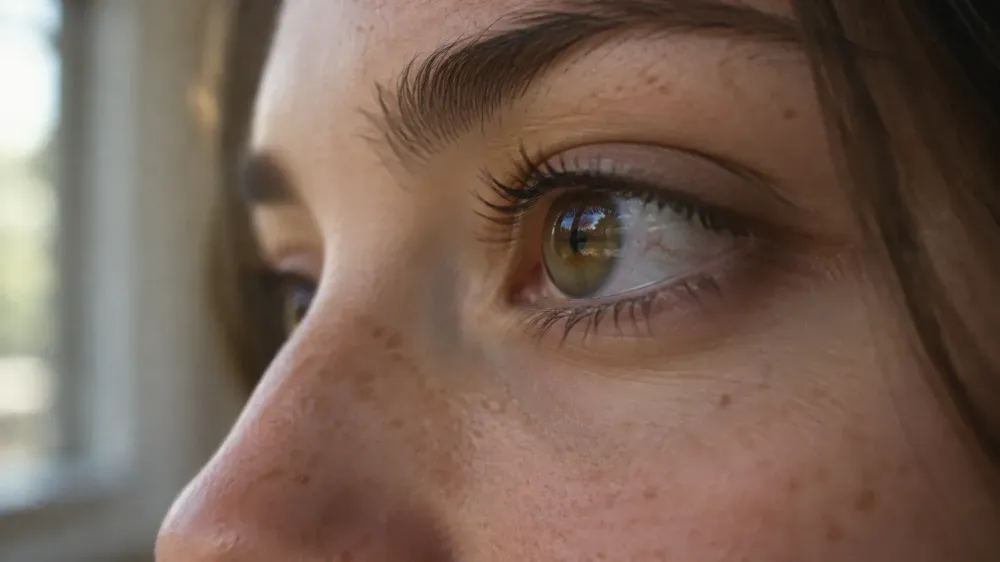
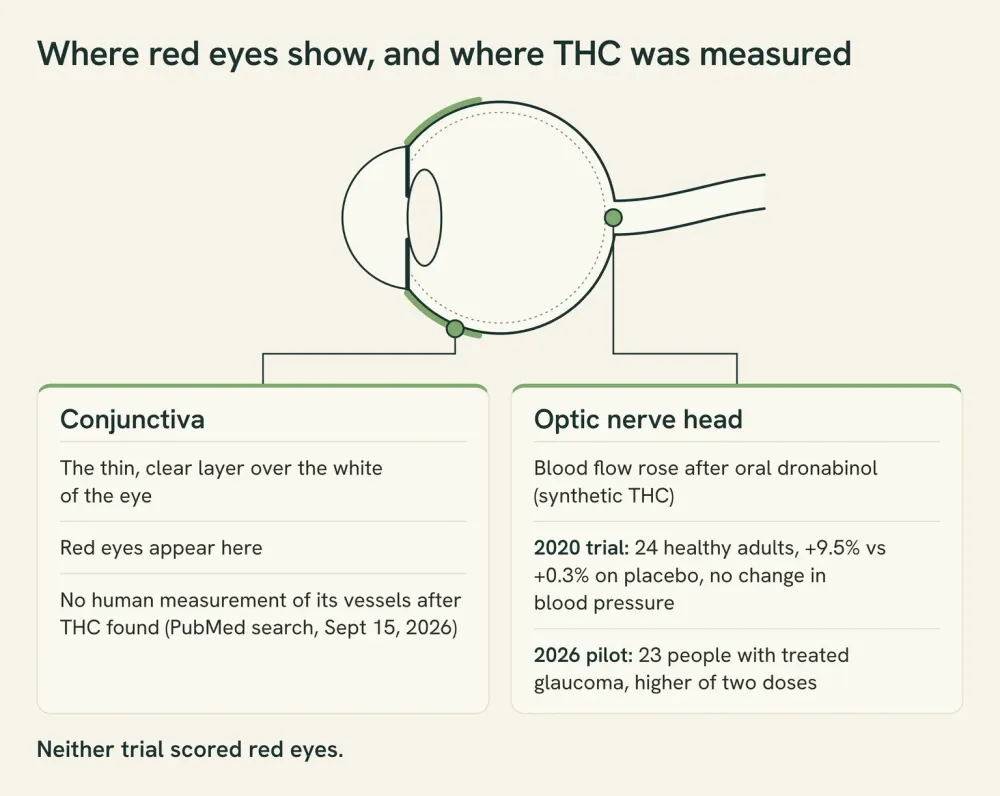
Clinicians call it conjunctival injection, or hyperemia. The conjunctiva is the thin, clear layer over the white of your eye, and it carries fine blood vessels. When those vessels widen and fill, the white looks pink or red. Redness is a sign, not a diagnosis: the American Academy of Ophthalmology's page on red eye lists many conditions associated with it, including conjunctivitis, eye allergies, uveitis and angle-closure glaucoma.
Red eyes after THC have been measured for decades
The core evidence is a set of small, controlled dosing studies. In a 1980 study of 11 healthy subjects, THC was given into a vein, smoked, and by mouth in a chocolate cookie. The authors named reddened eyes and a fast pulse as the two major clinical signs of cannabis intoxication, and reported that "reddened conjunctivae persisted for as long as THC levels were above 5 ng/ml, and tachycardia was a less reliable measurement". That 5 ng/mL is a blood level in that study, not a roadside or legal limit. A companion paper from the same group put it plainly: "Conjunctival injection was found so long as plasma concentration of THC could be measured." The two papers come from one research program and very likely share data, so read them as one finding, not two.
In a 2025 open-label feasibility study, 12 adults inhaled vaporized medicinal cannabis (22% THC) while a smartphone app measured the color of the whites of their eyes. Redness rose from baseline under bright light (p=0.007) but not significantly under dim light (p=0.14). There was no placebo group, and the study was funded by Kontigo Care AB, which employs two of the authors and has made a product partly based on the results; two authors are also named inventors on patents.
Why does weed make your eyes red: smoke or THC?
Smoke can irritate eyes, so it is a fair guess, but the dosing studies point to the drug. In a 1990 study that gave THC intravenously to 18 volunteers, with no smoke involved, the researchers named the level of intoxication and "the degree of conjunctival injection" as "two quite reliable clinical indicators of THC action". In a 1975 study of five volunteers who had swallowed THC two hours earlier, the authors describe "the degree of tachycardia and conjunctival injection produced by THC".
The reverse test points the same way. When researchers applied THC directly to one eye of paid volunteers in 1982, toxicity was limited to "minor conjunctival injection that was of short (less than 60 minutes) duration and occurred with both drug and vehicle alone". The vehicle is the drug-free liquid the THC was dissolved in, so red eyes are not simply THC touching the eye. None of these studies tested whether smoke adds some irritation on top.
The blood pressure explanation, checked step by step
The page-one results we read explain red eyes in three steps: THC lowers blood pressure, the vessels in your eyes widen, and your eyes stay red for 3-4 hours. The first step is where it breaks. A 2002 review of marijuana's cardiovascular effects says marijuana and THC "increase heart rate, slightly increase supine blood pressure, and on occasion produce marked orthostatic hypotension": supine means lying down, and orthostatic hypotension is a drop in blood pressure on standing. A 1975 inpatient study contrasted the "tachycardia and unchanged or increased blood pressure seen after single doses" with the lower blood pressure that came with prolonged THC dosing. In a 1977 study of six experienced smokers, smoked cannabis produced "marked increases in HR, BP and conjunctival injection": blood pressure and redness rose together.
Where blood pressure does fall after a single dose, it is mostly on standing. In a placebo-controlled study of 10 healthy men, six reported moderate to severe dizziness while standing after marijuana but not after placebo, and those with severe dizziness showed marked decreases in blood pressure. The heart-rate side is well documented: see why a racing heart after cannabis is mostly a THC finding and a trial in which THC oils, with and without CBD, raised heart rate in 18 adults.
The second step, vessels in the eye widening, is plausible, but it has been measured somewhere other than where redness shows. In a 2020 randomized, placebo-controlled crossover trial, a single low oral dose of dronabinol (synthetic THC) raised blood flow at the optic nerve head, at the back of the eye, by 9.5% on average in 24 healthy adults aged 20 to 35, against 0.3% on placebo, one hour after the dose. Neither dronabinol nor placebo "had an effect on IOP, MAP, or OPP", meaning eye pressure, mean arterial pressure and ocular perfusion pressure, and heart rate did not change. A 2026 pilot trial in 23 people with treated open-angle glaucoma, a different and older group, found a rise in optic nerve head blood flow with the higher of two doses lasting up to 4 hours, again without a change in eye pressure or mean arterial pressure. Neither trial looked at the whites of the eyes.
The most plausible explanation is local, but it rests on a review rather than a measurement. A 2024 review of cannabis and the eye states that THC widens vessels by binding cannabinoid receptors in the eye, increasing blood flow to the conjunctiva. THC's best-known target is the CB1 receptor, part of the endocannabinoid system. In a PubMed search we ran on September 15, 2026, we found no human study that measured conjunctival blood flow or vessel size after THC.
| The popular claim | What the studies show | Grade |
|---|---|---|
| THC makes the whites of your eyes red | Recorded after injected, smoked and swallowed THC; measured by camera in 2025 | Measured |
| because it lowers your blood pressure | Single doses raise heart rate and leave resting blood pressure steady or slightly higher; falls show up mainly on standing or with prolonged dosing | Not supported for a single dose |
| so the vessels in your eyes widen | THC raised blood flow at the optic nerve head with no blood pressure change; a 2024 review attributes redness to local vessel widening | Plausible, not measured in the conjunctiva |
| and it lasts 3-4 hours | No page-one result we read cites a source; a 2025 camera study reported an eye effect of 2-3 hours after inhaling | Unsourced; not measured for edibles |
Do edibles make your eyes red?
Yes, going by controlled studies of swallowed THC, with real limits. The 1975 study above recorded red eyes after swallowed THC, and the 1980 program gave THC in a cookie as one of its routes. That program found oral absorption "slow and erratic", with systemic availability of 6% (plus or minus 3) against 18% (plus or minus 6) for smoking, and after oral THC the "onset of clinical effects was much slower and lasted longer". Swallowed THC also passes through the liver first, which changes the mix of compounds reaching your blood, as our explainer on 11-hydroxy-THC shows. The controlled studies that recorded red eyes after swallowed THC date from the 1970s and early 1980s, and in a PubMed search on September 15, 2026 we found no study that timed eye redness after a modern edible.
How long do red eyes from weed last?
The 3-4 hour figure has no cited source on the page-one results we read, but it is roughly consistent with inhaled cannabis. In a 2018 study of 17 infrequent users who smoked or vaped, blood THC and heart rate peaked within 30 minutes and returned to baseline within 3 to 4 hours; that study did not score redness. In the 2025 camera study, the bright-light redness change was no longer significant at 5 hours. These are averages from small groups, and fading redness says nothing about whether you are fit to drive; that question belongs to our guide to what per se THC driving laws actually punish.
Red eyes and eye pressure are not the same finding
Weed is also said to lower eye pressure. That is a different measurement: intraocular pressure is the fluid pressure inside the eye, which glaucoma care manages, and the evidence is small and short-lived. In a 2006 randomized, double-masked crossover study of six patients with ocular hypertension or early glaucoma, a single sublingual THC dose lowered eye pressure at 2 hours compared with placebo (23.5 vs 27.3 mm Hg), and pressure returned to baseline after the 4-hour measurement; the higher of two CBD doses briefly raised it at 4 hours. A 2026 systematic review and meta-analysis pooled 5 studies of 99 patients, 69 of them exposed to THC. The pooled peak reduction was 14.66%. By route, only intravenous THC was significant (33.27%); the oral (10.65%) and topical (9.36%) estimates had confidence intervals crossing zero. In the four studies that also had a control group, the pooled estimate was 6.88% (p=0.41), not significantly different from control.
Eye doctors' professional bodies have weighed in. In guidance published January 21, 2026, the American Academy of Ophthalmology says research in the 1970s and 1980s showed a measurable decrease in eye pressure "for three or four hours" after smoking cannabis or taking THC as a pill or injection, and that "eye pressure must be managed 24 hours a day". By the Academy's account, keeping pressure down with cannabis would mean taking it several times a day, every day. The American Glaucoma Society, which the Academy says agrees, published a 2010 position statement on marijuana and the treatment of glaucoma. The blood-flow trials above are not glaucoma evidence either: the 2026 pilot's authors say it lacked the statistical power and duration to evaluate long-term clinical effects.

Can police tell you are high from red eyes?
Red eyes are one of the signs officers look for, but they suggest rather than prove. In a California crime-lab review of drivers suspected of driving under the influence, 94% of those who tested positive for THC had red eyes. That figure covers only suspected drivers who tested THC-positive, and the abstract reports no comparison with THC-negative drivers. In a Norwegian database of 589 drivers with THC as the only drug found, blood THC concentration was related to conjunctival injection, pupil dilation and reaction to light.
Eye signs can also look diagnostic and test poorly. Eyelid tremor, another eye sign used in cannabis evaluations, was put to a blinded test in a 2024 study of 103 participants: expert observers reviewing video found no significant association with recent cannabis use. Its specificity was 0.18, so most participants who had not used cannabis were still flagged. Red eyes have many causes, so on their own they do not show that anyone is high.
Does CBD make your eyes red?
We found no study that tested it directly. In a PubMed search on September 15, 2026, we found no human study that scored eye redness after CBD alone. That is a gap, not evidence that CBD never reddens eyes. The search did return a case report that points back at THC: in a 2016 report on two children with treatment-resistant epilepsy, a CBD-enriched cannabis extract produced "typical signs of intoxication by Δ9-THC", including eye redness, and those signs improved after a switch to purified CBD at the same dose. Two case reports with an unregulated extract show only that the redness followed the THC in that product.

Redness drops, and when red eyes are not about weed
If you reach for redness-relief drops, read the warnings, because a federal rule sets them. FDA's over-the-counter monograph for ophthalmic drug products covers vasoconstrictors, such as naphazoline and tetrahydrozoline, which it defines as agents that cause transient constriction of conjunctival blood vessels. Their labels must warn that "Overuse of this product may produce increased redness of the eye", tell people with narrow angle glaucoma to ask a doctor before use, and tell users to stop and consult a doctor for eye pain, changes in vision, continued redness or irritation, or a condition that worsens or persists for more than 72 hours. A tetrahydrozoline redness-reliever label on DailyMed puts it as "overuse may cause more eye redness".
The research on rebound redness is mixed. In a 1984 study of 11 volunteers, neither naphazoline nor tetrahydrozoline produced rebound vessel widening after 10 days of use ended, but only naphazoline kept its whitening effect, and the authors warned that tetrahydrozoline's diminished effectiveness "may encourage its overuse". On the other side, an eye-clinic case series described 70 patients (137 eyes) with conjunctivitis attributed to vasoconstrictor drops, including conjunctival hyperemia in 50, after a median of 3 years of daily use; symptoms took a median of 4 weeks to resolve. Neither study involved cannabis.
Whether or not you used cannabis, see an eye-care professional if red eyes come with any of these:
- Eye pain.
- Any change in your vision.
- Redness or irritation that continues, gets worse, or lasts more than 72 hours.
- Discharge from the eye, an injury to the eye, or strong sensitivity to light.
If red eyes come with chest pain, collapse, severe anxiety or vomiting, the eyes are not the main concern. Our guide to greening out, including when to call Poison Help and when to call 911, covers what to do.
What is still unknown
- No study we found measured conjunctival blood flow or vessel size after THC, so the local-vessel explanation is plausible but unconfirmed.
- We could not verify any human study relating the amount of THC to how red eyes get.
- Tolerance to THC's early cardiovascular effects is documented, but we found no research on tolerance to redness or on why some people redden less.
- The core redness studies are small, and most of those described here were published between 1975 and 1990.
Questions people ask about red eyes and weed
Yes, in controlled lab studies from the 1970s and early 1980s in which people swallowed THC. After oral THC, effects started more slowly and lasted longer than after smoking. We found no study that timed eye redness after a modern edible.
The evidence points to THC itself. Red eyes were recorded after THC was injected into a vein and after it was swallowed, with no smoke involved. Those studies did not test whether smoke adds irritation on top.
We found no human study that scored eye redness after CBD alone (PubMed search, September 15, 2026). In a 2016 report on two children, THC intoxication signs, including eye redness, improved after a CBD-enriched extract was replaced with purified CBD.
The drop in eye pressure after THC is short, and in a 2026 meta-analysis THC was not significantly different from control. The American Academy of Ophthalmology does not recommend marijuana or other cannabis products for the treatment of glaucoma. If you have glaucoma, talk to your eye doctor before changing anything.
Their labels warn that overuse may produce increased redness of the eye, wording FDA's over-the-counter monograph requires. Controlled evidence on rebound is mixed: a small 1984 study found none after 10 days of use, while an eye-clinic case series described drop-related conjunctivitis after years of daily use.
If you want the chemistry underneath all of this, start with how THC and CBD do different jobs at the same CB1 receptor, then our evidence-led atlas of cannabinoids. For transparency, Planntz sells a tablet that contains delta-9 THC; nothing on this page describes that product's effects.
Writing about hemp, wellness and the small rituals that keep us balanced.