Does Weed Dilate Your Pupils? Why Studies Say Both, and What Each One Measured
Page one says weed both dilates and shrinks your pupils. Both are partly right, because studies measured different things in different light. Here is what each study found, why red eyes are the steadier sign, and why no pupil check settles impairment.
Does weed dilate your pupils? Search for it and page one gives you both answers, sometimes from the same website. Here is the short version. In studies that measured pupils with instruments, THC mostly left them the same size or slightly smaller, and made their reaction to light slower and weaker. Police drug recognition records more often note larger pupils, but those come from selected roadside cases. Red eyes are the more consistent sign, and no pupil reading can establish impairment on its own.
A 1970s eye study, a 2016 analysis of police records and a 2025 clinical trial can all be correct and still seem to disagree, because they did not measure the same thing. Some measured how big the pupil is at rest, some measured how it reacts to a flash of light, and police records capture what an officer estimated with a printed card. Line the studies up with their lighting, route and dose, and most of the contradiction goes away.
Size, light reflex and the roadside exam are three different measurements
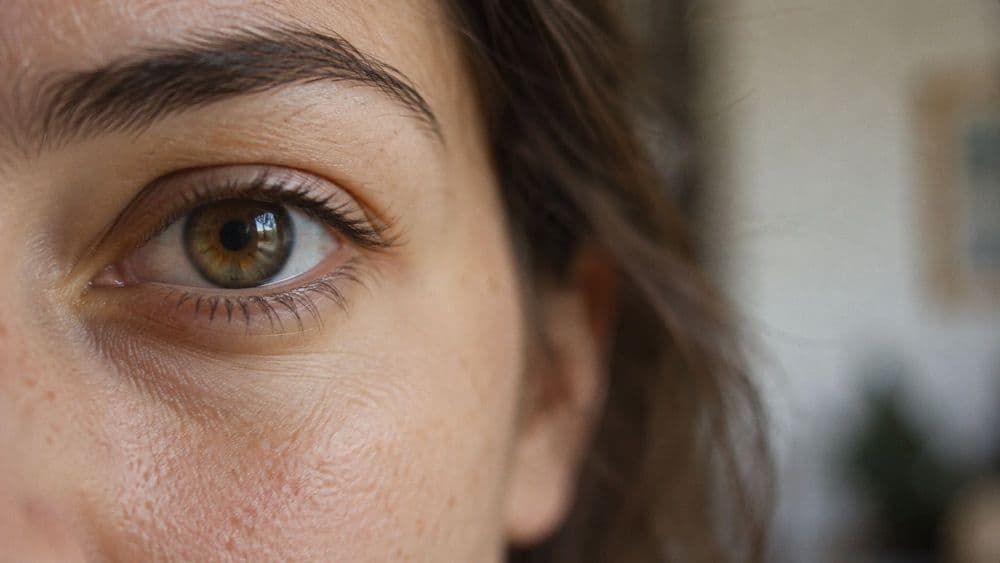
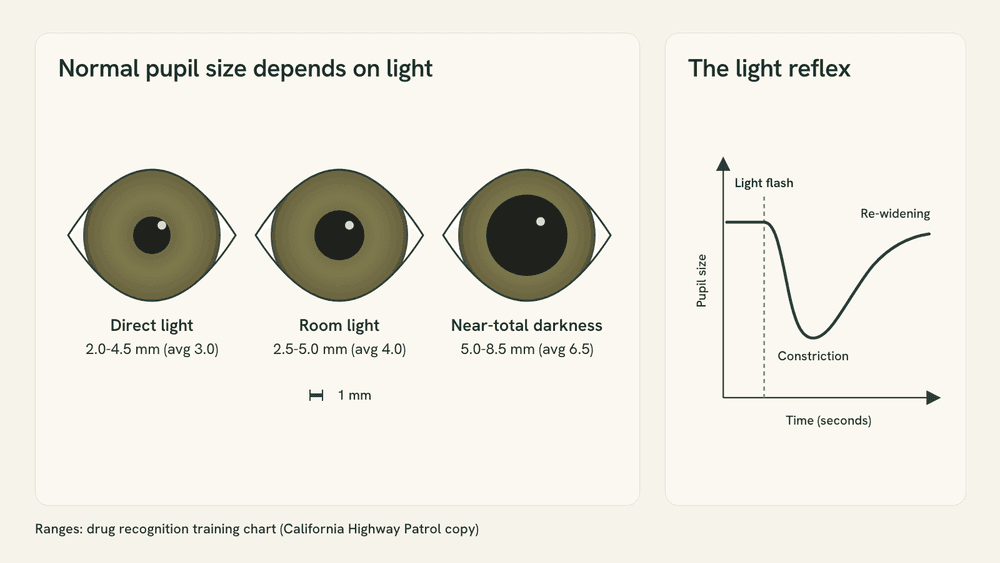
Your pupil is the opening in the colored iris, and the iris muscles change its size all day. Light is the main driver. The drug symptom chart that drug recognition officers train with, in the California Highway Patrol's copy, gives normal ranges of 2.5 to 5.0 mm in room light, 5.0 to 8.5 mm in near-total darkness and 2.0 to 4.5 mm under a direct light. The same healthy pupil can legitimately be 3 mm or 7 mm depending on where you are standing. Age, emotion, tiredness, many medicines and other drugs move it too. So when anyone says cannabis changed pupil size, the first questions are: measured in what light, and compared with what?
- Resting pupil size. The diameter in millimeters at one light level, read by an infrared camera in research or estimated against a printed card at the roadside. This is what "dilated" (bigger) and "constricted" (smaller) refer to.
- The light reflex. What the pupil does when light hits it: how far it shrinks (usually reported as a percentage of its starting size), how fast, and how quickly it widens again afterward. Devices called pupillometers measure this.
- The roadside drug recognition exam. A trained officer's structured evaluation, which includes estimating pupil size in room light, near darkness and direct light, and watching how the pupil behaves under a penlight. It is one part of a longer protocol.
Does weed dilate your pupils? What controlled studies found
The first report in an eye journal, in 1972, was titled "Pupillary constriction after marijuana smoking". No abstract or full text was available to us, so we cite only the title and print none of its numbers. Five years later, a 1977 study of 10 people found that smoked marijuana made pupils slightly smaller in dim indoor light, and more so at higher doses, while alcohol had no effect on pupil size. In 2021, a Spanish lab that tested 31 cannabis users with and without their usual joint found pupils 5.2% smaller in darkness (about 6.7 mm down to 6.4 mm), and little difference at the dim light levels of 0.3 and 3 lux. The comparison was a no-cannabis session, not a placebo, and the dose was not measured, but it shows the lighting effect inside a single paper: the same people, a change in darkness that nearly vanished once a little light was added.
Among the controlled studies here, the one result pointing toward bigger pupils came from a placebo-controlled study at the National Institute on Drug Abuse that gave smoked, vaporized and oral THC. Under direct light, the oral dose (a brownie containing about 50 mg of THC, a study condition and not a serving suggestion) left pupils about 0.4 mm larger than placebo at 1.5 hours and 0.5 mm larger at 3.5 hours. The researchers saw no pupil effect from the smoked and vaped doses, and they explain why: the tests came too late to catch inhaled THC at its peak. So this is evidence about an oral dose a few hours in, not proof that smoking leaves pupils unchanged.
A tightly controlled recent example is a placebo-controlled trial of intravenous THC in people who did not use cannabis. The pupil's response to a flash of light shrank by about a third: average constriction fell from 23.5% to 15.0% of starting size at 20 minutes, while the placebo group stayed at 27.5 to 28.1%. Resting pupils trended smaller, from 6.09 to 5.45 mm at 60 minutes, but that size change was not statistically different from placebo, and the trial had only 15 THC and 4 placebo volunteers, using a route almost nobody uses. A 2025 study that filmed pupils with a smartphone gave 12 adults inhaled cannabis flower (65 mg at 22% THC) and found pupils slightly smaller, a borderline result, with a weaker light response for two to three hours. It was funded by Kontigo Care, a company that sells a product based partly on the method. And in a Colorado study of 126 adults, the size of the pupil in darkness did not change consistently after people smoked or vaped their own products.
| Study | Route and dose | Who | Lighting | Pupil size | Light reflex |
|---|---|---|---|---|---|
| Brown 1977 | Smoked, rising doses | 10 adults | Dim indoor light | Smaller, more at higher doses | Not reported |
| Newmeyer 2017 (NIDA) | Oral brownie, about 50 mg THC; also smoked and vaped; tested at 1.5 and 3.5 h | Frequent and occasional users, placebo-controlled | Direct light | Oral: 0.4 to 0.5 mm larger. Inhaled: no effect seen at those late times | Not reported |
| Ortiz-Peregrina 2021 | Own joint, smoked in about 10 min | 31 users, no-cannabis comparison session | Darkness, 0.3 lux, 3 lux | 5.2% smaller in darkness; little change in light | Not reported |
| Kleine-Brueggeney 2025 | Intravenous THC 0.1 mg/kg vs placebo | 15 THC, 4 placebo, non-users | Dark-adapted, light flash | Trended smaller (6.09 to 5.45 mm), not significant vs placebo | Constriction fell from 23.5% to 15.0%, significant |
| Kuijpers 2025 | Inhaled flower, 65 mg at 22% THC | 12 adults, industry-funded | About 50 and 500 lux | Slightly smaller (borderline) | Weaker at 50 lux |
| Godbole 2024 | Smoked as desired, 15 min | 84 adults: daily, occasional, no use | Light-response test | Not measured | Less constriction, slower re-widening |
| Brooks-Russell 2025 | Own flower or concentrate | 126 adults (95 users, 31 non-users) | Darkness plus light test | No consistent change in darkness | Weaker; best single marker (AUC about 0.75) |
| Hartman 2016 (police records) | Real-world, unknown | 302 blood-confirmed cases officers had identified correctly vs 302 sober controls 13 years older | Room, near-dark, direct light (printed card) | Larger in all three | Rebound dilation (police sense) in 70.9% |
| Declues 2018 (crime lab) | Real-world, unknown | THC-positive drivers stopped on suspicion | Room light | Larger in about 64% | Rebound dilation or hippus in 89% |
| Martino 2025 (CBD only) | Vaporized CBD 16 or 32 mg vs placebo | 30 adults, randomized crossover | Darkness, 0.3 lux, 3 lux | No change | Not the focus |
Read down the pupil size column and a pattern appears. Studies that used instruments under controlled conditions mostly found pupils the same size or slightly smaller, and each instrument study that tested the reflex found it weaker in at least one lighting condition. The sources that found larger pupils differ in ways you would expect to matter: Newmeyer tested an oral dose hours later, and the two field datasets come from selected roadside cases measured with a card.
What police drug recognition experts record
Drug recognition experts are officers trained in the Drug Evaluation and Classification Program, which sorts drugs into seven categories, cannabis among them. Our explainer on whether weed is a depressant walks through that system. In a 2016 case-control study of 302 drug recognition evaluations, limited to cases where officers had correctly identified cannabis and blood tests confirmed it, pupils were larger than in sober comparison subjects in room light, near-total darkness and direct light. Rebound dilation (the police meaning: widening under a steady light) appeared in 70.9% of those selected cases against 1.0% of controls. The sober group, police officers and academy students with no drug testing, had a median age of 34 against 21 for the cases.
The training chart reflects the field view. It lists cannabis pupils as "dilated", with a footnote saying pupil size is "possibly normal", and lists the reaction to light as "normal". The size entry roughly matches the field records. The reaction entry does not match the instrument studies: the intravenous trial, the smartphone study and both Colorado studies measured a weaker or slower light response. In plain terms, the roadside chart expects bigger pupils that react normally, while instruments find pupils that are the same size or smaller and react less.
Several things can pull field and lab apart without anyone being dishonest. Selection: records of cases officers got right will over-represent the signs officers look for. Method: in the 2016 study, officers estimated pupil size against a printed card that runs from 1.0 to 10.5 mm in 0.5 mm steps, while research uses infrared cameras. Timing and route: roadside subjects used unknown products, by unknown routes, at unknown times. Age: the factor that is easiest to miss.
Pupils get smaller as you get older. A 1994 study of 91 healthy adults aged 17 to 83 measured that shrinkage at about 0.043 mm per year in the dimmest light tested and 0.015 mm per year in the brightest. Apply those rates to the 13-year age gap in the 2016 police study and you get the numbers below. This is our arithmetic, not a finding of either paper, and it does not refute the field study. It shows why comparing young drivers with older officers makes a pupil difference hard to interpret, especially when the card itself moves in 0.5 mm steps.
Pupillometry: testing the reflex instead of the size
Because resting size is so noisy, researchers have shifted to the light reflex. In a 2024 Colorado study of 84 adults who used cannabis daily, occasionally or not at all, smoking was followed by less pupil constriction, and people who had not used re-widened faster after a flash than either group of users (rebound dilation in the pupillometry sense). The differences were small: at their peak, 4.00% for occasional users and 2.88% for daily users compared with people who had not used, and daily and occasional users were not significantly different from each other. The same team had described its video method earlier in a preprint that had not been peer reviewed. In the 126-person Colorado study, the percent change in pupil size after light did better than resting size, with an accuracy score (AUC) of 0.73 at 40 minutes and 0.75 at about 100 minutes. On that scale, 0.5 is a coin flip and 1.0 is perfect, so 0.75 is fair, not diagnostic: it still misclassifies a meaningful share of people.
Regular use complicates every reading. A forensic study from Italy, Austria and Germany that paired pupillography with blood tests found that habitual users' pupil function was already altered before they took their first dose, so there is no clean baseline to compare a single reading against. Breath devices run into a similar gap between detecting recent use and measuring impairment, as our look at whether a weed breathalyzer can work explains.
Pupils vs red eyes: which sign is more consistent?
If you want to know which eye change shows up most reliably after cannabis, the evidence points to redness. In a crime-lab review of THC-positive drivers, who had been stopped on suspicion of impaired driving and then tested positive, 94% had red eyes while about 64% had enlarged pupils in room light, and 89% showed rebound dilation (the police meaning) or hippus, a rhythmic pulsing of the pupil. Those drivers were stopped partly because of the signs officers look for, so the numbers do not describe cannabis users in general. In the smartphone study, redness of the white of the eye was the clearest eye result in brighter light, and the training chart lists "marked reddening" of the eye's surface as a general cannabis indicator. The causes of that redness, and what it does and does not mean for eye pressure, are covered in why cannabis turns the whites of your eyes red.
Edibles, tolerance and CBD
Edibles. The only controlled oral pupil result we found is the NIDA one: pupils about half a millimeter larger than placebo under direct light, 1.5 to 3.5 hours after an oral dose. That fits the slower arc of edibles, which take longer to kick in than smoked cannabis, but one study with two time points cannot tell you when the change starts or ends.
Tolerance. It is murkier than people assume. In the 2024 Colorado study, daily and occasional users had similar light-reflex changes after smoking, and habitual users in the European forensic study already differed before dosing. The training chart itself footnotes that its indicators vary with "individual reaction, dose taken and drug interactions".
CBD. This is the clearest part of the picture. In a randomized, double-blind, placebo-controlled crossover trial in 30 adults, inhaling 16 or 32 mg of vaporized CBD did not change pupil size in darkness or at 0.3 and 3 lux. In darkness, pupils averaged 6.53 mm on placebo against 6.36 and 6.30 mm on the two CBD doses, a difference that was not statistically significant. That was pure CBD, inhaled, in single doses. It does not tell you about products that also contain THC, including full-spectrum CBD, which carries trace THC below 0.3%. Our guide to whether CBD can get you high covers that difference.
Can police tell you're high from your pupils?
Pupil size and reaction are part of the drug recognition exam, but they are one set of observations in a longer evaluation, and the official chart concedes that cannabis pupils may be normal. In the 2016 police study, the best single indicators of cannabis impairment came from the balance and coordination tests (missed finger-to-nose touches, eyelid tremors during a balance test, sway on the one-leg stand and walk-and-turn clues), not from pupil measures, and the authors wrote that it would be inappropriate to base an opinion of impairment solely on one or two outcome measures. The research above points the same way: in controlled studies resting size barely moved, age and habitual use shift the baseline, and even the best reflex measure misclassifies a meaningful share of people. What happens at a traffic stop is a legal question that varies by state, and this page does not give legal advice. For how impaired-driving laws treat THC, see CBD, THC and the rules for driving. For searches, see whether the smell of weed counts as probable cause.
When pupils matter medically
Those overdose signs are listed in NIDA's fact sheet on naloxone. In the smartphone study, oxycodone shrank pupils and a stimulant enlarged them in any light, which cannabis did not do. If you suspect a cannabis product was contaminated, our guide on how to tell if weed is laced covers the warning signs.
Unequal pupils are a separate issue. According to the NIH's MedlinePlus guide to unequal pupils, slight differences are found in up to 1 in 5 healthy people, but some patterns need care:
- After an eye or head injury: pupils of different sizes need medical help right away.
- With other symptoms: blurred or double vision, a droopy eyelid, light sensitivity, fever, headache, vision loss, nausea or vomiting, eye pain or a stiff neck alongside unequal pupils need immediate attention.
- A new, lasting difference: a gap of more than 1 mm that develops later in life and does not go back to equal may signal an eye, brain, blood vessel or nerve problem, so have it checked.
What is still unknown
Researchers have not settled why THC blunts the pupil's light reflex. THC acts through the endocannabinoid system, but we found no human study that pins the eye effect to a specific pathway, so we will not guess. Other gaps: we found no large placebo-controlled study that used instruments across all three police lighting conditions; the time course after edibles beyond 3.5 hours is unmeasured in the studies we found; daily users' baselines are poorly understood; and some of the newest smartphone and eye-tracking work is funded by companies that sell the technology. What the record does support is narrower and more useful: pupil size alone is a weak signal of cannabis, the light reflex is a better but still imperfect one, and red eyes remain the more consistent sign.
Frequently asked questions
In studies that measured pupils with instruments, they usually stayed about the same size or got slightly smaller, and they reacted more slowly and weakly to light. Police field records more often note larger pupils, but those come from selected roadside cases estimated with a printed card. Lighting, route, timing, age and who was measured explain most of the split.
Pupil size and reaction to light are part of the drug recognition exam, but they are one observation among many. The training chart itself says cannabis pupils may be normal, and research shows resting pupil size is a weak signal. No pupil reading establishes impairment on its own. Driving and search laws vary by state, and this is not legal advice.
In one placebo-controlled NIDA study, an oral THC dose left pupils about half a millimeter larger than placebo under direct light, 1.5 to 3.5 hours later. That is the only controlled oral pupil result we found, so the full time course after edibles is not known.
In a randomized, double-blind, placebo-controlled trial of 30 adults, inhaling 16 or 32 mg of CBD did not change pupil size in darkness or dim light. That was pure, vaporized CBD. Products that also contain THC are a different question.
In the smartphone study, inhaled cannabis affected the eyes for about 2 to 3 hours. In the oral NIDA study, pupils were still larger than placebo at 3.5 hours, the last time point measured. In the intravenous trial, the authors described the light reflex as returning close to baseline by the last measurement, 5 hours after the injection, though it was still a little below where it started. No study we found tracked a full edible time course.
Lighting and normal variation are the most common reasons. Pupils are naturally large in dim rooms: the drug recognition training chart puts the normal range in near darkness at 5.0 to 8.5 mm. Strong emotions, other substances and many medicines also change pupil size. Pupils that become unequal, change suddenly or come with headache or vision changes need a clinician.
Very small pupils, especially with slow breathing or a person who will not wake up, point to opioids, not cannabis. Call 911. According to NIDA, naloxone has no effect on someone who does not have opioids in their system.
Redness is the eye sign that shows up most consistently after cannabis. To see what causes it and what it means for eye pressure, read our explainer on why weed makes your eyes red.
Writing about hemp, wellness and the small rituals that keep us balanced.