Is the Smell of Weed Probable Cause? A State-by-State Map
Whether police can search your car because they smell weed now depends on your state. A dated, sourced map of statutes and court rulings, raw vs burnt odor, drug dogs, and why legal hemp drove the change.
Is the smell of weed probable cause? For decades, in most states, courts treated the answer as yes: an officer who said they smelled marijuana could usually search your car without a warrant. That is no longer a national answer. Since 2021, five state legislatures have written odor rules into statute, and four state supreme courts have held that odor alone is not enough (in Illinois, for burnt cannabis only). Other states still count it. Here is the map as of September 29, 2026.
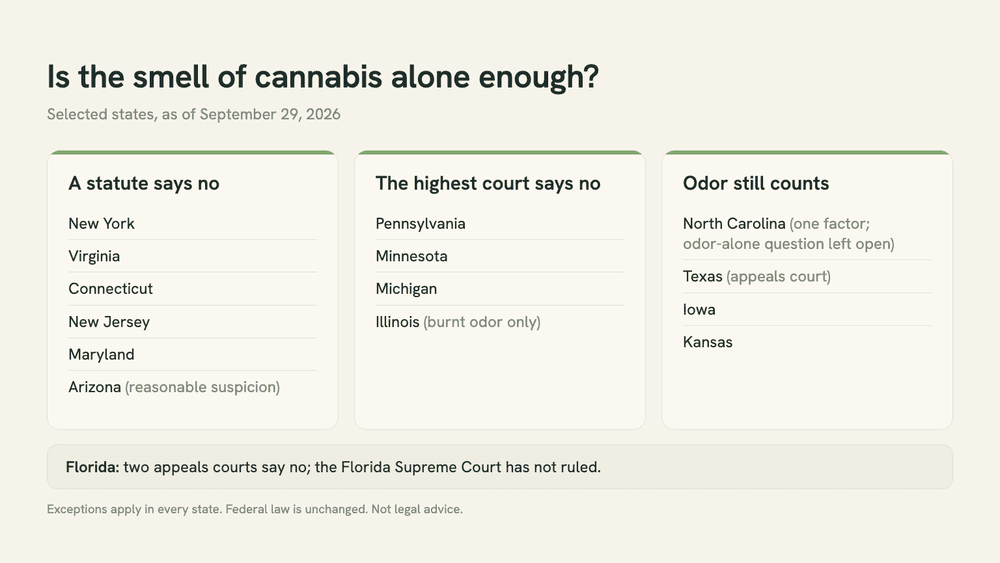
The short version: it depends on your state, and on what the officer says they smelled. In New York, Virginia, Connecticut, New Jersey and Maryland, a statute now says the odor of cannabis cannot be the only basis for a stop or a search, with exceptions written into each law. In Pennsylvania, Minnesota and Michigan, the state's highest court made odor "one factor" rather than a stand-alone reason, and Illinois did the same for burnt cannabis while holding that the smell of raw cannabis is still enough. In North Carolina, Texas, Iowa and Kansas, courts still count odor toward probable cause. Nowhere on this map does odor become irrelevant, and nowhere does the new rule mean you cannot be searched. The reason the rule moved at all is the part most pages leave out: legal hemp smells like marijuana.
Is the smell of weed probable cause? The answer by state (as of September 29, 2026)
The table sorts 16 states by where their rule comes from: a statute, the state's highest court, or courts that still count odor toward probable cause. Florida sits apart because its change came from intermediate appeals courts and is not final. Every row names its source and year, and the court level is labeled, because a ruling from a state's highest court governs every court in that state while an intermediate appeals court's ruling may be revisited. This is not a 50-state survey. A state missing from the table is simply one we did not verify from the primary record, and its absence tells you nothing about its rule.
| State | Rule on odor alone | Source (year) | Court or body | Limits and notes |
|---|---|---|---|---|
| New York | Not enough: no finding of reasonable cause based solely on the odor of cannabis or burnt cannabis | N.Y. Penal Law 222.05(3) (2021) | Statute | Burnt odor may be used in drugged-driving investigations, but not to search areas not readily accessible to the driver |
| Virginia | Not enough: no stop, search, seizure or warrant solely on the odor of marijuana | Va. Code 4.1-1302 (2021) | Statute | Does not apply at airports or to commercial motor vehicles; evidence excluded even if obtained with consent |
| Connecticut | Odor is not probable cause or reasonable suspicion "in part or in whole" | Conn. Gen. Stat. 54-33p (eff. July 1, 2021) | Statute | Officers may test for impairment based on odor if they suspect impaired driving; probation exception |
| New Jersey | Odor of cannabis or burnt cannabis is not reasonable articulable suspicion of a crime | N.J.S.A. 2C:35-10c, P.L.2021, c.16 (2021, as enacted) | Statute | Does not apply on school property or at detention and correctional facilities |
| Maryland | No stop or search of a person, vehicle or vessel based solely on burnt or unburnt cannabis odor | Md. Code, Crim. Proc. 1-211 (eff. July 1, 2023) | Statute | Impaired-driving searches limited in scope; evidence excluded even with consent; not retroactive (Md. Supreme Court, 2026) |
| Arizona | Odor of marijuana or burnt marijuana is not, by itself, reasonable articulable suspicion | A.R.S. 36-2852(C) (Proposition 207, 2020) | Statute (voter initiative) | Speaks to reasonable suspicion, not probable cause; does not apply in impaired-driving investigations |
| Pennsylvania | One factor, not a stand-alone basis for a warrantless vehicle search | Commonwealth v. Barr (2021) | Pa. Supreme Court | Reasoning rests on the state's Medical Marijuana Act |
| Minnesota | Odor from a vehicle, alone, is not probable cause to search it | State v. Torgerson (2023) | Minn. Supreme Court | Decided on facts from before adult use began in August 2023 |
| Michigan | One factor that may play a role in the probable-cause decision | People v. Armstrong (2025) | Mich. Supreme Court | Fourth Amendment ruling after the state's adult-use law |
| Illinois (burnt) | Burnt odor alone is not probable cause to search a vehicle | People v. Redmond (2024) | Ill. Supreme Court, 6-0 | Burnt cannabis only |
| Illinois (raw) | Raw odor alone is enough, for officers trained to tell raw from burnt | People v. Molina (2024) | Ill. Supreme Court, 4-2 | Tied to the Vehicle Code rule on how cannabis must be carried in a vehicle |
| Colorado | A sniff by a dog trained to alert to marijuana is a search; police need probable cause first | People v. McKnight (2019) | Colo. Supreme Court | State constitution; about dogs, not human smell |
| Florida | Smell alone not enough (for a detention, 2024; for probable cause, 2025) | Baxter v. State (2024); Williams v. State (2025) | Fla. 5th and 2d District Courts of Appeal, en banc (intermediate) | Question certified to the Florida Supreme Court; no ruling found as of Sept. 29, 2026 |
| North Carolina | Odor is one factor in the totality; whether odor alone is enough left open | State v. Dobson (2026); In re J.B.P. (2024) | N.C. Supreme Court; N.C. Court of Appeals (intermediate) | The 2024 appeals ruling that sight or smell creates probable cause was not overruled; marijuana remains illegal |
| Texas | Odor alone still probable cause, despite the state's hemp law | State v. Gonzales (2023) | Tex. Court of Appeals, Dallas (intermediate) | One intermediate court, not the Court of Criminal Appeals |
| Iowa | Odor establishes probable cause, under long-standing precedent | State v. Leonard (2026), citing State v. Eubanks (1984) | Iowa Court of Appeals (intermediate), quoting the Iowa Supreme Court | Leonard itself turned on a dog alert plus other facts |
| Kansas | Raw odor from a home can supply probable cause, judged on the totality | State v. Hubbard (2018) | Kan. Supreme Court | Residence case; strength, proximity and other factors weighed |
What probable cause means, and why smell used to be enough
Probable cause is the level of justification the Fourth Amendment requires for most searches: a reasonable basis to believe evidence of a crime will be found. It is a probability, not proof. A lower bar, reasonable suspicion, lets an officer briefly stop someone to investigate. Cars get special treatment. In Carroll v. United States, a 1925 Prohibition case, the Supreme Court said officers may search a vehicle without a warrant if they have "reasonable or probable cause" for believing it is carrying contraband. That is the automobile exception, and it is why the smell question matters most at the roadside: if odor is probable cause, no warrant is needed to search the car.
Smell entered the picture in 1948. In Johnson v. United States, a case about burning opium in a hotel room, the Court wrote that when an odor is "sufficiently distinctive to identify a forbidden substance", it had "never held such a basis insufficient to justify issuance of a search warrant." Johnson was about a warrant, not a roadside search, and the same opinion noted an earlier ruling that odors alone do not authorize a search without a warrant. Still, for decades courts treated marijuana's smell as exactly that kind of distinctive odor. When every cannabis plant was contraband, the logic was simple: if an officer smelled it, a crime was probably being committed. Legalization weakened that logic, and hemp weakened it further.
Why the rule changed: legal hemp smells like marijuana
Hemp and marijuana are the same plant, Cannabis sativa L. The legal line between them is a THC number, not a smell: under federal law, cannabis at or below 0.3% delta-9 THC on a dry-weight basis is hemp, and since the 2018 Farm Bill it has been legal to grow and sell. The forensic side, including why a roadside test cannot tell the two apart, is covered in our guide to whether CBD flower is legal, and the legal line itself in hemp vs. marijuana, explained. What produces that familiar smell in the first place is its own story, told in why weed smells like skunk. For this page, what matters is what courts have been told, and what they have concluded.
“the odor of legal hemp and illegal marijuana are virtually identical”
That line from the North Carolina Supreme Court's opinion in State v. Dobson is not an outlier. In 2024, Florida's Fifth District Court of Appeal, sitting en banc in Baxter v. State, noted that testimony that hemp and marijuana smell the same "has been presented in various Florida and federal courts without contradiction." In a 2023 Texas case, State v. Gonzales, officers testified that they could not tell whether what they smelled was marijuana or hemp. Where courts disagree is what follows. Some say an odor that might come from something lawful can no longer, alone, make a crime probable. Others say probable cause only ever required a probability, and a smell that is often marijuana still clears that bar.
Legalization added a second reason. Pennsylvania's Supreme Court grounded its 2021 ruling in the state's Medical Marijuana Act, and Michigan's Supreme Court reached a similar result in 2025 in light of the state's adult-use law. Once some people may lawfully have marijuana, its smell no longer points only to a crime. One more change is coming that no court has addressed yet. Congress rewrote the federal definition of hemp in 2025, and a law signed on September 2, 2026 split its start into two steps: on November 12, 2026 it reaches only hemp products containing cannabinoids the plant cannot produce naturally, and the rest, including the total-THC standard, is scheduled for December 11, 2026 (see what the 2026 federal hemp changes do and why the deadline was split in two). How courts will treat odor once hemp is defined more narrowly is not yet tested, and we will not predict it.
States where a statute says odor alone is not enough
Five legislatures and one set of voters have written the rule down. The wording differs in ways that matter, and every one of these laws has exceptions written into it. The quotes below come from the statute text as published, read on September 29, 2026. Three links go to archived copies of the official pages, because those legislature sites turn away automated checks.
New York. New York Penal Law 222.05, as published by the New York Senate, part of the state's 2021 adult-use law, says no finding of reasonable cause to believe a crime was committed "shall be based solely on evidence of the following facts and circumstances, either individually or in combination with each other", and the list begins with "the odor of cannabis" and "the odor of burnt cannabis". The burnt-odor clause does not apply when an officer is investigating drugged driving. Even then, the statute says burnt odor "shall not provide probable cause to search any area of a vehicle that is not readily accessible to the driver and reasonably likely to contain evidence relevant to the driver's condition."
Virginia. Under Virginia Code 4.1-1302, no officer "may lawfully stop, search, or seize any person, place, or thing and no search warrant may be issued solely on the basis of the odor of marijuana". Evidence obtained in violation is inadmissible, "including evidence discovered or obtained with the person's consent." The section does not apply in any airport, or when the violation occurs in a commercial motor vehicle.
Connecticut. Connecticut General Statutes 54-33p uses the strongest words on this page. It lists "the odor of cannabis or burnt cannabis" among circumstances that "shall not constitute in part or in whole probable cause or reasonable suspicion and shall not be used as a basis to support any stop or search of a person or motor vehicle." Evidence obtained in violation is inadmissible. There are two exceptions: an officer who reasonably suspects impaired driving may conduct a test for impairment based on the odor, and the rule does not bind probation officers supervising someone barred from using cannabis. It took effect July 1, 2021.
New Jersey. New Jersey's 2021 legalization law, P.L.2021, chapter 16, added N.J.S.A. 2C:35-10c. It lists circumstances, starting with "the odor of cannabis or burnt cannabis", that shall not "individually or collectively, constitute reasonable articulable suspicion of a crime", unless on property used for school purposes or at a detention or correctional facility. We read the text as enacted in 2021. The legislature's site was unreachable, but a commercial copy of the current code, read on September 29, 2026, carries the same odor clause and the same exceptions.
Maryland. Maryland Criminal Procedure 1-211, enacted as House Bill 1071, Chapter 802 of 2023, says an officer "may not initiate a stop or a search of a person, a motor vehicle, or a vessel based solely on" the odor of burnt or unburnt cannabis, among other things. Like Virginia, it excludes evidence gathered in violation, "including evidence discovered or obtained with consent." In an impaired-driving investigation, officers may not search areas that are not readily accessible to the driver or not reasonably likely to hold evidence of the driver's condition. The rule looks forward only. In Cutchember v. State, decided March 3, 2026, the Supreme Court of Maryland held that the exclusion remedy "does not apply to cannabis-related stops or searches conducted before the statute's effective date" of July 1, 2023.
Arizona. Arizona Revised Statutes 36-2852(C), from the Proposition 207 adult-use measure of 2020, is narrower: "the odor of marijuana or burnt marijuana does not by itself constitute reasonable articulable suspicion of a crime." Reasonable suspicion is the lower bar for a brief stop, so this text speaks to stops, not to probable cause for a search. It does not apply when an officer is investigating impaired driving.
- Most of these laws target odor as the only basis. Connecticut goes further: odor cannot count in part or in whole.
- Each carves something out: impaired driving (New York, Connecticut, Arizona, Maryland), airports and commercial vehicles (Virginia), schools and correctional facilities (New Jersey).
- Virginia and Maryland exclude evidence gathered in violation of the rule even when the person consented.
- None of them says you cannot be stopped or searched. Other facts, and other laws, can still justify a search.
- Maryland's rule is not retroactive: it does not reach stops or searches from before July 1, 2023.
States where the highest court said odor alone is not enough
Pennsylvania. In Commonwealth v. Barr, decided December 29, 2021, the Pennsylvania Supreme Court held "that the smell of marijuana may be a factor, but not a stand-alone one, in determining whether the totality of the circumstances established probable cause to permit a police officer to conduct a warrantless search of a vehicle." It reinstated the trial court's order suppressing the evidence found in the car. Pennsylvania had a medical program, not an adult-use law, when we checked, and the court's reasoning rests on the Medical Marijuana Act.
Minnesota. In State v. Torgerson, filed September 13, 2023, the Minnesota Supreme Court concluded "that the odor of marijuana emanating from a vehicle, alone, is insufficient to create the requisite probable cause to search a vehicle under the automobile exception." Odor remains "one of the circumstances in the totality of circumstances analysis." The state had appealed, and the court affirmed, so the suppression ruling stood. Two justices dissented. The facts predated adult-use legalization in Minnesota, which began in August 2023, so the court was weighing legal hemp and the medical program.
Michigan. In People v. Armstrong, filed April 2, 2025, the Michigan Supreme Court set aside its older rule that the smell of marijuana alone was enough, in light of the Michigan Regulation and Taxation of Marihuana Act, the state's adult-use law. The opinion's conclusion puts it this way:
“Instead of a rule that the smell of marijuana alone may be sufficient to support a finding of probable cause, the appropriate rule is that the smell of marijuana is one factor that may play a role in the probable-cause determination.”
The court affirmed the suppression of a handgun found in the car and the dismissal of the charges. Armstrong decided a Fourth Amendment question only; no claim under the state constitution was raised, and one justice dissented. Illinois. In People v. Redmond, decided September 19, 2024, a unanimous Illinois Supreme Court held: "We hold that the odor of burnt cannabis, alone, is insufficient to provide probable cause for police officers to perform a warrantless search of a vehicle." It affirmed the suppression of the cannabis found in the car. Note the word burnt. Less than three months later the same court answered the raw-cannabis question the other way, covered below. Massachusetts got there earliest, in a narrower setting: in Commonwealth v. Cruz, 459 Mass. 459 (2011), decided after the state decriminalized small amounts in 2008, the Supreme Judicial Court held that the odor of burnt marijuana alone could not justify ordering a driver out of a car. That was an exit order, not a vehicle search, and we did not verify the state's current rule for other situations.
Read together, these rulings do not make odor disappear. They demote it, from a reason that could stand alone to one factor among the others an officer can point to.
Florida: two appeals courts, and a question the state Supreme Court has not answered
Florida's change came from its intermediate appeals courts, the District Courts of Appeal, not its Supreme Court. On August 2, 2024, in Baxter, the Fifth District, sitting en banc, held that because it is no longer "immediately apparent" that the smell of cannabis means a crime, "it cannot be the sole basis supporting reasonable suspicion for an investigatory detention", though it remains "a factor that may be considered under the totality of the circumstances." On October 1, 2025, the Second District, also en banc, went further in Williams v. State: the smell of cannabis standing alone is insufficient to establish probable cause, and the court receded from its own 2021 precedent. It certified this question to the Florida Supreme Court: "Does the plain smell doctrine continue to apply to establish probable cause based only on the odor of cannabis?" As of September 29, 2026, we found no Florida Supreme Court decision on it. Both courts still affirmed the outcomes in front of them, because the officers had relied in good faith on the law as it stood.
Under a Florida rule quoted in Baxter, district court decisions bind all Florida trial courts unless another district disagrees. So the accurate description is this: two Florida appeals courts have said odor alone is not enough, and the final word is pending in the Florida Supreme Court. It is not accurate to say that Florida law has settled the question.
Where the smell of weed still counts
North Carolina has not flipped, but it moved this year. In 2024, in In re J.B.P., the North Carolina Court of Appeals, an intermediate court, accepted a State Bureau of Investigation memo's premise that "Hemp and marijuana are indistinguishable" and still held that "even if illegal marijuana could be confused with legal hemp, a police officer's professed sight or smell of marijuana creates a probability of contraband possession." Then, on May 22, 2026, the North Carolina Supreme Court decided Dobson and its companion case, State v. Rowdy. It said it would "continue to follow our precedents which require examination of the 'totality of the circumstances'", and that "the odor of cannabis is one factor that may be considered." It expressly declined to decide whether odor alone is enough, and it upheld the searches before it on odor plus other facts. On August 14, 2026, it dismissed a third case, State v. Schiene, as improvidently allowed because Dobson had answered it. J.B.P. was not overruled, and possession of marijuana remains illegal in North Carolina.
Texas. In Gonzales, decided October 12, 2023, the Dallas Court of Appeals, one of Texas's intermediate appeals courts, reversed a trial judge who had ruled that the Texas hemp law "eradicated" the older cases. It restated that "courts have long held that the odor of marijuana alone is sufficient to constitute probable cause to search a defendant's person, vehicle, and objects within the vehicle." It is not a ruling of the Texas Court of Criminal Appeals, the state's highest criminal court. Iowa. In State v. Leonard, decided September 2, 2026, the Iowa Court of Appeals, also an intermediate court, wrote that "the Iowa Supreme Court has long held that marijuana odor establishes probable cause", citing the 1984 decision State v. Eubanks. Leonard itself turned on a dog alert plus other facts. Kansas, where marijuana is not legal, is the home case covered in the next section.
Raw vs burnt, car vs person vs home, and drug dogs
Raw vs burnt: Illinois draws the line
On December 5, 2024, the Illinois Supreme Court decided People v. Molina, 4-2, and held that "the odor of raw cannabis coming from a vehicle being operated on an Illinois highway, alone, is sufficient to provide police officers, who are trained and experienced in distinguishing between burnt and raw cannabis, with probable cause to perform a warrantless search of a vehicle." The majority tied its holding to the Illinois Vehicle Code, which requires cannabis in a vehicle to be kept in a "sealed, odor-proof, child-resistant cannabis container". Two justices, including the chief justice, dissented. So in Illinois, burnt odor alone is not probable cause (Redmond) and raw odor alone is (Molina). New York draws a different raw-versus-burnt line: its statute bars both, but lets burnt odor, and only burnt odor, back in during a drugged-driving investigation. Maryland's statute names burnt and unburnt odor alike.
Car vs person vs home
What the officer wants to search can change the answer. In Pacheco v. State, decided August 12, 2019, Maryland's highest court held that odor plus a marijuana cigarette may have given officers probable cause to search a car, but not to arrest the driver and search his person, because people have a heightened expectation of privacy in their bodies compared with their cars. Maryland's 2023 statute has since replaced the odor-alone question for both. Homes are a separate category again. In State v. Hubbard, decided December 7, 2018, the Kansas Supreme Court held that the smell of raw marijuana coming from a residence can supply probable cause when the totality of the circumstances supports it, and it listed what courts should weigh:
- How close the officer was to the source of the odor
- How strong the odor was reported to be
- The officer's experience identifying the odor
- Whether other possible sources of the odor were ruled out
- How many witnesses detected it
In Hubbard itself, the court affirmed the convictions. The case came from a state with no legal marijuana and predates most hemp litigation, so it tells you how one high court approaches a home, not how every state does.
Drug dogs
Dogs raise the same problem in a different form. Under the federal Constitution, the Supreme Court held in Illinois v. Caballes (2005) that a trained dog sniffing the outside of a car during a lawful traffic stop "generally does not implicate legitimate privacy interests", so it is generally not a search at all. In Florida v. Harris (2013), it said a probable-cause hearing about a dog's alert "should proceed much like any other", with the court deciding "what all the circumstances demonstrate." But courts have heard that a dog trained on marijuana cannot tell it from hemp, and states have split on what follows. Colorado's Supreme Court, in People v. McKnight (2019), held under the state constitution that a sniff from a dog "trained to alert to marijuana constitutes a search" because it "can detect lawful activity", so officers need probable cause before using one. Tennessee's Supreme Court, in State v. Green (2024), went the other way: an alert "may continue to contribute to a finding of probable cause when examining the totality of the circumstances, notwithstanding the legalization of hemp." And in Ford v. State (January 7, 2025), Florida's Fifth District Court of Appeal asked whether the alert of a dog that "cannot distinguish between illegal pot and legal medical marijuana or hemp" can be the sole probable cause, and answered: "Going forward, that dog won't hunt." It still affirmed that conviction under the good-faith exception.
What legalization did not change
State odor rules bind state and local police enforcing state law. They do not change federal law. Under 21 U.S.C. 844, it is still a federal crime to knowingly or intentionally possess a controlled substance without authorization, and marijuana is still a controlled substance. Since April 28, 2026, a narrow DEA rule has placed only marijuana in FDA-approved drug products and marijuana subject to a state medical license in Schedule III; everything else stays in Schedule I, as explained in our breakdown of the Schedule III ruling. A state odor statute is written for that state's officers and courts. It does not change how federal officers enforce federal law. Several other things stay the same, too.
- Impaired driving. New York, Connecticut, Arizona and Maryland all write an impaired-driving exception or limit into their odor rules.
- Place. Virginia's rule does not apply at airports or to commercial motor vehicles; New Jersey's does not apply on school property or at correctional facilities.
- Odor as a factor. In every court ruling above, odor can still count alongside other facts. Connecticut's statute is the exception, barring it in part or in whole.
- Consent. Consent is a separate legal basis for a search. Virginia and Maryland exclude evidence gathered in violation of their odor rule even when obtained with consent. Whether to consent is a question for a lawyer, not this page.
- Other facts. Anything else an officer sees, hears or finds can still build probable cause under each state's rules.
Impairment is a different legal question from possession, with its own tests and penalties; it is covered in our guide to CBD and driving. Airports run on their own rules, including federal screening, explained in whether you can fly with weed.
Carrying CBD or hemp flower: what paperwork can and cannot do
If you carry legal hemp or CBD, the odor debate is not really about you, but the indistinguishability problem is. Nothing on this page is meant to help anyone avoid a stop or a search, and paperwork does not prevent one. What documentation can do is show what a product is if the question comes up later. The key document is the certificate of analysis, and our guide to reading a COA walks through the batch number, the lab, and the delta-9 THC line. A simple checklist:
- 1Keep the product in its original labeled packaging, with the brand, product name and batch or lot number visible.
- 2Keep the certificate of analysis for that batch, printed or saved, showing the delta-9 THC result from a third-party lab.
- 3Check that the batch number on the COA matches the one on the package.
- 4Know your own state's hemp rules. They differ, especially for smokable hemp flower.
- 5Remember the limit: a COA documents a product. It does not stop a traffic stop, a search or a field test.
The word "smell" also shows up in a different body of law. New York's employment rules say the smell of cannabis, on its own, is not evidence of impairment at work, as explained in what happens if you fail a drug test at work. That is employment law, not search law, and it does not change anything on this page.
What this page cannot tell you
This page cannot tell you whether a particular stop or search was lawful, whether evidence would be suppressed, or what to do during a traffic stop. It covers 16 states; the others are not on it, and a state's absence means only that we did not verify its rule. Trial courts apply these rules to specific facts, and appellate courts keep revising them: the Florida Supreme Court has a certified question in front of it, North Carolina's highest court left the odor-alone question open, and no court has ruled on odor after the federal hemp definition changes on November 12 and December 11, 2026. Some statutes here were read from archived copies of the official pages and checked against current copies where the official site was unreachable. For your situation, the right person is a criminal-defense attorney licensed in your state. For a wider discussion across states, the Brennan Center's State Court Report published an analysis of how legalization is changing search-and-seizure law in September 2025.
Questions people ask about the smell of weed and car searches
It depends on your state and on what else is going on. In New York, Virginia, Connecticut, New Jersey and Maryland, a statute says odor cannot be the only basis for a stop or search, with exceptions such as impaired-driving investigations. In Pennsylvania, Minnesota and Michigan, the highest court made odor one factor rather than enough on its own, and Illinois did the same for burnt cannabis. In Texas and Iowa, appeals-court rulings still treat odor as probable cause. Almost everywhere, odor combined with other facts can still support a search. This is the picture as of September 29, 2026.
Not on its own, according to two of Florida's intermediate appeals courts sitting en banc: the Fifth District in Baxter (2024, about reasonable suspicion for a detention) and the Second District in Williams (2025, about probable cause). The Second District certified the question to the Florida Supreme Court, and we found no ruling from that court as of September 29, 2026. Until it rules, district court decisions bind Florida trial courts unless another district disagrees.
In North Carolina, the state Supreme Court said in May 2026 that odor is one factor in the totality of the circumstances, and it expressly left open whether odor alone is enough. A 2024 Court of Appeals decision holding that an officer's sight or smell of marijuana creates probable cause was not overruled. In Texas, the Dallas Court of Appeals held in 2023 that odor alone still supplies probable cause despite the state's hemp law. That is an intermediate court, not the state's highest criminal court.
Court records say it does. North Carolina's Supreme Court called the odors virtually identical, a Florida appeals court noted uncontradicted testimony that they smell the same, and Texas officers testified that they could not tell which one they smelled. Courts disagree about what follows from that. The forensic side, including why roadside tests cannot tell them apart, is in our guide to whether CBD flower is legal.
Courts have heard that dogs trained on marijuana cannot tell it from hemp, and they have split on the consequences. Colorado treats a sniff by such a dog as a search that needs probable cause. Tennessee lets an alert still contribute to probable cause. A Florida appeals court said in 2025 that such an alert alone will not do going forward. Federally, a dog sniff of a car's exterior during a lawful stop is generally not a search. None of these cases is about CBD oil specifically.
In Illinois it decides the case: burnt odor alone is not probable cause (Redmond, 2024) and raw odor alone is, for officers trained to tell them apart (Molina, 2024, decided 4-2). New York's statute bars both as the sole basis, but lets burnt odor back in during a drugged-driving investigation, with limits on which parts of the car can be searched. Maryland's statute covers burnt and unburnt odor alike.
The person is often treated differently from the car. In 2019, Maryland's highest court held that odor plus a marijuana cigarette may have justified searching a car, but not arresting the driver and searching his person. Maryland's 2023 statute now bars stops or searches of a person or a vehicle based solely on odor. Other states may draw the line elsewhere, and a lawyer in your state can tell you where.
In several states, yes, because the statutes say so. New York lets burnt odor count in a drugged-driving investigation; Connecticut lets officers test for impairment based on odor if they reasonably suspect impaired driving; Arizona's odor rule does not apply in impaired-driving investigations; and Maryland limits which areas can be searched. Impairment is a separate question from possession, covered in our guide to CBD and driving.
For how federal and state law treat hemp CBD itself, beyond the roadside, start with our overview of whether CBD is legal in the US.
Writing about hemp, wellness and the small rituals that keep us balanced.