
Marijuana and Child Custody: What Courts Actually Weigh, and Where CBD Fits
Legalization did not take cannabis out of family court. In several states it changed the question from whether you used to whether your use endangered your child. The clause several states wrote, its proof standards, how CPS cases differ, and where hemp CBD fits.

Can you lose custody for using marijuana in a state where it is legal? On marijuana and child custody, legalization did not make cannabis irrelevant in family court. What it changed, in the states that wrote it down, is the question: less "did you use?" and more "did your use endanger the child?" Several state cannabis laws now say lawful use alone cannot cost you custody unless your behavior creates an unreasonable danger to your child, and they set very different bars for proving that danger. Hemp-derived CBD is mostly not what those laws were written for. This is the picture as of September 2026.
Most of what you find when you search this question is written by law firms, one state at a time. What that leaves out is the pattern: the same three-part sentence shows up in cannabis statutes from Arizona to New York, and the part that changes from state to state, how hard the danger is to prove, matters most. This page lays out that pattern from the statute text, separates a custody case from a child-protection case, explains what a court-ordered drug test does and does not show, and answers the question almost nobody takes on: where CBD fits.
The question a family court actually asks: the child's best interests
In a custody case between two parents, the court is not deciding whether cannabis is legal. It is deciding what arrangement serves the child. States call this the "best interests of the child", and many list the factors a judge must weigh. Substance use appears on those lists, but usually tied to its effect on the child rather than to use as such. Minnesota's best-interests statute, Minn. Stat. 518.17, is a clear example. Among the factors a Minnesota court must consider is this one.
“any physical, mental, or chemical health issue of a parent that affects the child's safety or developmental needs”
The same statute tells the court it "must consider and evaluate all relevant factors", so no single factor decides the case. Notice where the limiting words sit: a chemical health issue counts when it affects the child's safety or developmental needs. California's custody factors statute, Family Code 3011, is worded differently. It lists "the habitual or continual illegal use of controlled substances" by either parent, alongside the habitual or continual abuse of alcohol or of prescribed controlled substances. Before considering those allegations, the court "may first require independent corroboration", such as written reports from law enforcement, courts, probation departments, social welfare agencies or medical facilities. And when such allegations have been raised and the court still gives that parent sole or joint custody or unsupervised visitation, it must state its reasons in writing or on the record. Whether cannabis use that is legal under California law counts as "illegal" under that factor is a question this page does not answer. California's general custody policy, Family Code 3020, sums up the frame: the "health, safety, and welfare of children shall be the court's primary concern".
The custody clause many states wrote, and its exception
Beginning with their medical marijuana laws, a number of states added a sentence aimed squarely at family court. We read eight of them from the statute text: Arizona's medical marijuana act, A.R.S. 36-2813(D); Michigan's Medical Marihuana Act, MCL 333.26424(d); Illinois's Compassionate Use of Medical Cannabis Program Act, 410 ILCS 130/40; Delaware's Medical Marijuana Act, 16 Del. C. 4905A; Minnesota's medical cannabis custody provision, Minn. Stat. 342.57; South Dakota's cardholder custody statute, SDCL 34-20G-21; California Health and Safety Code 11362.84; and New York Cannabis Law section 127. The Michigan, Illinois and New York links go to archived copies of the official pages, captured in December 2025, January 2026 and October 2025, because those legislature sites turn away automated checks. Read side by side, and this is our synthesis rather than any court's, the sentence has three parts.
- 1No denial of custody, visitation or parenting time for cannabis conduct or status that the state's law allows.
- 2No presumption of neglect or child endangerment from that conduct. Five of the eight clauses say this in so many words: Arizona, Illinois, Delaware, Minnesota and South Dakota.
- 3An exception when the parent's behavior endangers the child. What changes from state to state is how that danger has to be proved.
| State | Statute | Who it covers | The exception, as written | Proof standard |
|---|---|---|---|---|
| Arizona | A.R.S. 36-2813(D), Arizona Medical Marijuana Act | Conduct allowed under the medical marijuana act | "the person's behavior creates an unreasonable danger to the safety of the minor" | "clear and convincing evidence" |
| Michigan | MCL 333.26424(d), Michigan Medical Marihuana Act (initiated law, 2008) | A person acting in accordance with the medical act | "the person's behavior is such that it creates an unreasonable danger to the minor" | The danger must be one that "can be clearly articulated and substantiated" |
| Illinois | 410 ILCS 130/40(b), Compassionate Use of Medical Cannabis Program Act (P.A. 101-363, eff. Aug. 9, 2019) | Conduct allowed under the medical cannabis act | "the person's actions in relation to cannabis were such that they created an unreasonable danger to the safety of the minor" | "clear and convincing evidence" |
| Delaware | 16 Del. C. 4905A(b), Delaware Medical Marijuana Act | Conduct allowed under the medical marijuana chapter | "the person's actions in relation to marijuana were such that they created an unreasonable danger to the safety of the minor" | "clear and convincing evidence" |
| Minnesota | Minn. Stat. 342.57, subd. 6 | Medical cannabis registry patients and Tribal medical cannabis program patients | "the individual's behavior creates an unreasonable danger to the safety of the minor" | "clear and convincing evidence" |
| South Dakota | SDCL 34-20G-21 (from Initiated Measure 26, 2020; amended 2022) | Medical cannabis cardholders | "the person's behavior creates an unreasonable danger to the safety of the minor" | None stated |
| California | Health and Safety Code 11362.84 (added by Proposition 64, Nov. 8, 2016) | Qualified medical patients acting under the Compassionate Use Act, in family or juvenile court | No written exception. Status and conduct "shall not, by itself" be used to restrict custodial or parental rights | None stated |
| New York | Cannabis Law 127(5) (Marihuana Regulation and Taxation Act, 2021) | Conduct permitted under the Cannabis Law, including adult use | It must be in the child's best interest, and the child's condition "has been impaired, or is in imminent danger of becoming impaired" as a result of the person's behavior | "a fair preponderance of the evidence" |
Two phrases in that table deserve a plain-English gloss. "Clear and convincing evidence" is a demanding standard: more than showing something is probably true, though less than the criminal standard of beyond a reasonable doubt. "A fair preponderance of the evidence" means more likely than not, which is a lower bar. Michigan's "clearly articulated and substantiated" is its own formula, and the Michigan text does not call it clear and convincing. None of these standards tells you how a judge will read a particular set of facts. Other states have similar language, and some we could not verify from the official text this month, so they are not in the table. Check your own state's statute, or better, ask a family-law attorney there.
- Medical is the norm: seven of the eight clauses protect a medical program's patients or conduct. Arizona's and Minnesota's sit in medical provisions, even though both states now allow adult use.
- New York's clause also covers adult use. It adds that the determination "cannot be based solely on whether, when, and how often a person uses cannabis without separate evidence of harm".
- Broader is not the same as stronger. New York's proof standard, a fair preponderance, is a lower bar than the clear and convincing evidence that Arizona, Illinois, Delaware and Minnesota require.
- South Dakota's current text, amended by its legislature in 2022, names no proof standard and says the chapter does not override custody decisions based on the best interests of the child.
- California's clause has no written exception. It rests on two words, "by itself": medical status and conduct cannot be the only reason, which leaves room for other facts.
- Each clause protects only the conduct its own law allows. Use outside what that law permits is not covered by it.
Custody case or CPS case? Two different forums
People who search "can CPS take your child for weed" are usually asking about a different kind of case from a custody dispute, and the difference matters. A custody case is typically a private dispute between parents, or other family members, over where the child lives and when each parent has time with the child. The state acts as referee. A child-welfare case is brought by the state itself, through a child protective agency, and the question is whether a child has been abused or neglected. California calls this a dependency case in juvenile court; New York calls it a neglect proceeding in Family Court. The standards, the parties and the cannabis rules can all differ.
| Custody dispute | Child-welfare (CPS) case | |
|---|---|---|
| Who starts it | A parent or other family member | The state, through a child protective agency |
| The core question | What arrangement serves the child's best interests | Whether the child was abused or neglected, or is at risk |
| How substance use comes in | As one best-interests factor, such as a chemical health issue that affects the child's safety (Minnesota) | Through the neglect definition, such as chronic and severe use that adversely affects the child's basic needs and safety (Minnesota) |
| What cannabis law adds, examples | Custody clauses such as New York Cannabis Law 127(5) and the medical-act clauses in the table above | New York: consuming cannabis is not, by itself, prima facie neglect. New Jersey: metabolites cannot be the sole or primary basis for action |
| Possible outcomes | Custody and parenting-time orders | A neglect or dependency finding, court-ordered services, removal and, in the most serious cases, termination of parental rights |
Some states wrote cannabis rules into the child-welfare side too. New York amended its neglect statute in 2021, as part of legalization. New York Family Court Act 1046 still treats repeated misuse of drugs or alcohol, to the point of intoxication or a substantial impairment of judgment among other effects, as prima facie evidence of neglect. It then adds that "the sole fact that an individual consumes cannabis", without a separate finding that the child's physical, mental or emotional condition was impaired or is in imminent danger of becoming impaired, established by a fair preponderance of the evidence, "shall not be sufficient to establish prima facie evidence of neglect". New Jersey took a different route in its 2021 legalization law. P.L.2021, chapter 16, section 47 says cannabinoid metabolites in the body of a parent, legal guardian or pregnant woman "shall not form the sole or primary basis" for an action by the state's Division of Child Protection and Permanency. It also keeps the agency's power to act "based on harm or risk of harm to a child", and to use information about metabolites in any proceeding. And Minnesota's child-maltreatment definitions, Minn. Stat. 260E.03, count as neglect the "chronic and severe use of alcohol or a controlled substance by a person responsible for the child's care that adversely affects the child's basic needs and safety".
How common are rules like these? The federal Child Welfare Information Gateway, run by the US Department of Health and Human Services, tracks them in its survey of state laws on parental substance use as child maltreatment, current through September 2024. It found that approximately 35 states, the District of Columbia and the Penobscot Nation specifically require health care providers to report substance-affected infants; that in 27 states, 5 tribes and the District of Columbia, prenatal exposure to controlled substances is included in definitions of child abuse or neglect; and that about 18 states list "using a controlled substance that impairs the caregiver's ability to adequately care for the child" as a circumstance of abuse or neglect. Those counts cover all controlled substances, not cannabis specifically, and "approximately" is the publication's own word.
Newborns: the federal plan of safe care
One federal law sits under all of this. The Child Abuse Prevention and Treatment Act (CAPTA), at 42 U.S.C. 5106a, requires states, as a condition of the act's grants, to have policies under which health care providers notify child protective services about infants "born with and identified as being affected by substance abuse or withdrawal symptoms resulting from prenatal drug exposure". States must also develop a "plan of safe care" for those infants, including "addressing the health and substance use disorder treatment needs of the infant and affected family or caregiver". The same section says the notification "shall not be construed to" establish a federal definition of child abuse or neglect, or to require prosecution. It is a requirement on state programs, not a rule that applies directly to a parent. What cannabis and CBD mean medically during pregnancy and nursing is a separate question, covered in our guide to CBD during pregnancy and breastfeeding.
Court-ordered drug tests: what a positive does and does not prove
Whether a judge can order a parent to take a drug test in a custody case depends on the state. California writes its rules into statute, which makes it a useful example of the moving parts, not a model of what your state does. Under California Family Code 3041.5, a custody court may order drug testing only after determining, by a preponderance of the evidence, that there is habitual, frequent or continual illegal use of controlled substances by the parent. The court "shall order the least intrusive method of testing", testing follows the procedures used for federal employees, and the parent may request a hearing to challenge a positive result. The results "shall be maintained as a sealed record in the court file", a breach of their confidentiality can bring civil sanctions of up to $2,500, and either or both parties can be ordered to pay for the testing. The sentence that matters most to most parents is this one: "A positive test result, even if challenged and upheld, shall not, by itself, constitute grounds for an adverse custody or guardianship decision." The statute continues: "Determining the best interests of the child requires weighing all relevant factors."
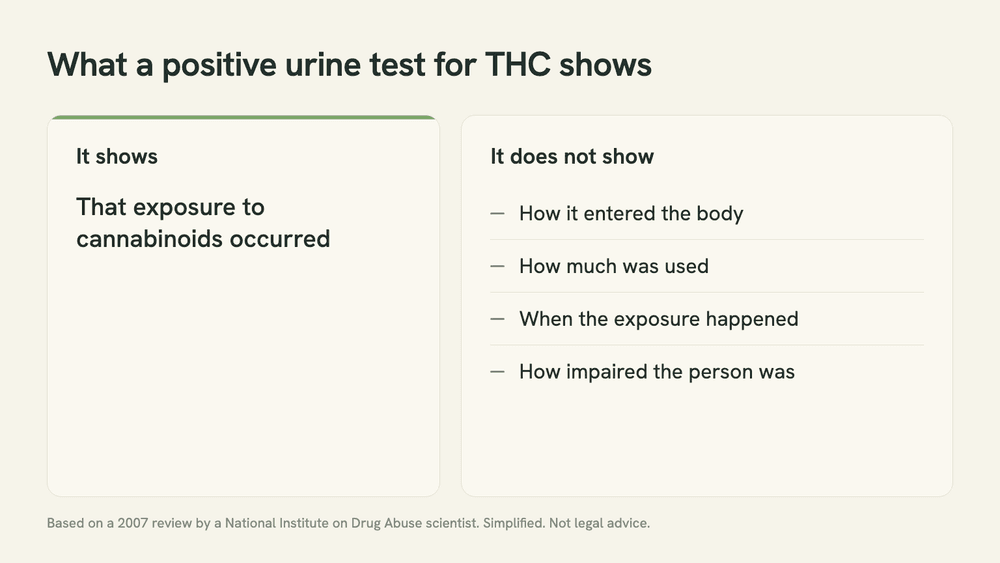
What a positive result shows is narrower than many people assume. In a review of human cannabinoid pharmacokinetics by Marilyn Huestis of the National Institute on Drug Abuse, the conclusion is direct: "A positive urine test for cannabinoids indicates only that drug exposure has occurred. The result does not provide information on the route of administration, the amount of drug exposure, when drug exposure occurred, or the degree of impairment." That review dates from 2007, and it says nothing about parenting, which is the point: a test answers a narrower question than the one a family court asks. Hair tests have their own limit. A 2015 forensic study titled "Finding cannabinoids in hair does not prove cannabis consumption" showed that THC in hair can come from outside the body, such as smoke, hands or sweat, and not only from use. It was a small study, and it describes a limit of hair testing, not a strategy.
For how testing works and what shapes a result, see how long CBD stays in your system and what CBD users should know before a drug test.
Where CBD and hemp fit
This is the question the law-firm pages skip, and the one our readers ask most. What follows is our reading of the statutes above, not a court holding. Seven of the eight clauses in the table protect a medical program: a cardholder, a registered patient, or "conduct allowed under" a medical cannabis act. Someone using a hemp-derived CBD product bought at a store is usually not acting under that program, so those clauses were not written with them in mind. That does not make CBD a problem in itself. It means that in a custody case, a lawful CBD product would most likely be looked at the way any lawful product is, through the best-interests factors, which ask about effects on the child. Where hemp ends and marijuana begins legally is explained in hemp vs. marijuana, explained, and the wider framework in the federal and state rules for hemp CBD.
There is one exception to that reading we can name. New York's clause protects "conduct permitted under this chapter", and New York's Cannabis Law also contains an article on cannabinoid hemp and hemp extract. So we cannot say CBD users fall outside every clause. We found no court opinion applying New York's custody clause to a hemp product. Whether any clause reaches a hemp product in your state is a question for a lawyer there.
- CBD from hemp is not the marijuana these clauses name, and most of them protect medical program conduct.
- Full-spectrum CBD products contain some THC, and a label is a claim, not a guarantee.
- A drug test detects THC exposure. It cannot tell whether the THC came from a CBD product, a marijuana product or something else.
So the practical risk for a CBD user is the test, not the clause. In a controlled study of CBD and urine drug testing, co-authored by staff of the federal office that administers workplace drug testing, six adults took a single 100 mg dose of pure CBD; over five days, 1 of 218 urine specimens screened positive at the screening cutoff the study used, and none reached the confirmatory cutoff. A CBD-dominant cannabis product that also contained THC did produce confirmed positives, and the authors wrote that "CBD products that also contain Δ9-THC may produce positive urine results". Six people and one dose say little about daily use. Labels add uncertainty too: a 2017 JAMA analysis of 84 CBD products sold online detected THC in 18 of them. What "full-spectrum" means is laid out in our guide to CBD spectrums, and why hemp seed oil in food is a different case is in our look at hemp seed oil and drug tests. If someone in your home smokes, our page on secondhand smoke and drug tests covers passive exposure.
What courts looked at in real cases
Statutes set the rules; appellate opinions show how judges apply them. The four opinions below are all child-welfare or termination-of-parental-rights cases brought by the state, not custody disputes between parents, and each turns on its own record. Read them for what the courts examined, not as a rulebook.
In In re N.R., decided December 14, 2023, a unanimous California Supreme Court held that a showing of substance abuse is not automatically enough for dependency jurisdiction. The statute also requires that the abuse leave the parent unable to provide regular care and cause, or create a substantial risk of, serious physical harm or illness to the child. The court rejected a presumption that substance abuse alone proves risk for young children: "the statutory scheme does not allow courts to treat a showing of substance abuse as always being sufficient on its own to establish these other requirements for dependency jurisdiction under section 300(b)(1)(D), even when a young child is involved." Two cautions. N.R. was about a father's positive cocaine test, not marijuana. And the same opinion read "substance abuse" broadly, in its ordinary meaning, with no clinical diagnosis required.
Along the way, the court discussed an earlier appellate case, In re Drake M. (2012), and said its conclusion rejecting jurisdiction "was nonetheless correct". The facts it described: the father used marijuana under a medical recommendation four to five times a week. "He smoked the substance in a detached garage, away from his young child, and otherwise kept it in a locked box that the child could not access." "When the father smoked marijuana with his wife, another adult watched over their child." And the father stated that at least four hours would pass between when he smoked and when he saw his child after day care. Those are the facts one court found insufficient in one case. They are not a checklist that makes anyone safe.
In Michigan, the Court of Appeals vacated the termination of a mother's and a father's parental rights in In re S. R. Richardson, decided July 25, 2019. The mother, who has epilepsy, held a medical marijuana card, and the court quoted Michigan's custody clause. It concluded that the referee "placed far too great an emphasis on the fact that mother consumed medical marijuana", and noted that "not every ingestion of a substance constitutes abuse". It went on:
“There must be facts within the record demonstrating that the parent's acts are actually harming or presenting an articulable risk of harm to the child”
New Jersey's Appellate Division drew a similar line in a termination case, and then applied it against the parents. In N.J. Division of Child Protection and Permanency v. D.H., decided August 2, 2021, it held that "a parent's status as a recreational marijuana user cannot suffice as the sole or primary reason to terminate that parent's rights under Title 30, unless the Division proves with competent, case-specific evidence that the marijuana usage endangers the child or children." It then affirmed the termination. The parents had each admitted using marijuana on several occasions while caring for their preschool child, the agency presented unrebutted expert testimony on the risks of that conduct, and the trial judge had substantial other evidence.
New York shows the same exception at work. In Matter of Mia S., decided December 7, 2022, New York's Appellate Division, Second Department, concluded that the Legislature intended the 2021 cannabis amendment to the neglect statute to apply retroactively, and still affirmed a neglect finding. The finding rested on repeated misuse with a substantial impairment of judgment: "Such a finding is not based on 'the sole fact' that the parent 'consumes cannabis'". The record included hospital records, paranoia and psychosis, and other drugs. A protective statute changes what has to be shown. It does not stop a court from finding harm when the evidence shows it.
Red flags that turn cannabis into a child-safety question
Pulling the statutes and opinions together, these are the facts that recur when cannabis becomes the issue in a case rather than a side note. They come from the sources above. They are not a scoring system, and the absence of every one of them does not guarantee any outcome.
- Use while you are the adult responsible for a young child. Who was supervising, and when, came up in both Drake M. and D.H.
- Impairment that affects judgment. New York's neglect statute points to misuse producing, among other effects, a substantial impairment of judgment.
- Use that is chronic and severe enough to affect a child's basic needs and safety, the language of Minnesota's neglect definition.
- A child who can reach the product. The storage facts in Drake M. were part of the record that court weighed.
- A newborn identified as affected by prenatal substance exposure, which starts the notification and plan-of-safe-care process in state systems.
- A broader history, such as other drugs or mental-health crises, as in Mia S.
- Use outside what your state's law allows, which falls outside any clause that protects only lawful conduct.
What to do in the first minutes after a child swallows a product, and how to store one safely, are covered in detail in our guide to whether CBD is safe for kids.
What this page cannot tell you, and where to get help
This page cannot tell you whether you will keep or lose custody, whether a clause applies to you, or what a judge in your county will do. One state's clause does not travel to another. Statutes get amended, as South Dakota's was in 2022, and ours were read in September 2026. Judges have wide discretion in best-interests cases. We found no appellate opinion applying a custody clause to hemp-derived CBD. And the four opinions above are child-welfare and termination cases, which are not the same as a custody dispute between parents. For your case, the right person is a family-law attorney licensed in your state. If cost is a barrier, the Legal Services Corporation's I Need Legal Help page lets you search by address or city for an LSC-funded civil legal aid organization near you. We do not recommend any firm.
Custody is one of several places where a cannabis or CBD question turns into a legal consequence. The others we cover: what happens at work after a failed drug test, how federal immigration law treats marijuana and hemp CBD, and the rules for CBD in the armed forces.

Marijuana and child custody: questions parents ask, including about CBD
Legality alone does not settle it. A custody court decides on the child's best interests, and a parent's substance use can be a factor when it affects the child's safety or needs, as Minnesota's statute puts it. Some states go further: their cannabis laws say lawful conduct alone cannot cost you custody unless your behavior creates an unreasonable danger to the child, proved to a stated standard. New York's clause covers adult use; most others cover medical patients. How a judge weighs your facts is not something any article can predict.
Several medical cannabis laws say your status as a patient, or conduct the act allows, cannot by itself be the reason custody is denied. Arizona, Illinois, Delaware and Minnesota require clear and convincing evidence of unreasonable danger before that changes; Michigan requires a danger that can be clearly articulated and substantiated. In a 2019 case, a Michigan appeals court vacated a termination that put too much weight on a mother's medical marijuana use. How, when and around whom you use can still come up.
It depends on the state. California's statute is specific: testing only after a finding of habitual, frequent or continual illegal use by a preponderance of the evidence, the least intrusive method, sealed results, a right to request a hearing on a positive result, and a rule that a positive result shall not, by itself, decide custody. Other states set different rules or leave more to the judge. A family-law attorney in your state can tell you which apply.
Not necessarily, and no page can promise either way. A positive urine test shows exposure, not when, how much, or whether you were impaired. California's statute says a positive result, even if upheld, is not by itself grounds for an adverse custody decision. On the child-welfare side, New Jersey bars metabolites from being the sole or primary basis for agency action, and in New York consuming cannabis is not, by itself, prima facie evidence of neglect without a separate finding that the child was impaired or in imminent danger.
A child-welfare case is a separate forum with its own question: abuse or neglect. In New York, the sole fact that a parent consumes cannabis is not prima facie evidence of neglect without a separate finding of impairment or imminent danger. In New Jersey, cannabinoid metabolites cannot be the sole or primary basis for action. California's Supreme Court held in 2023 that substance abuse alone is not automatically enough for dependency jurisdiction. All three still allow action when there is evidence of harm or risk to the child. Newborns identified as substance-affected enter a separate notification and plan-of-safe-care process.
In our reading, hemp CBD is generally not what these custody clauses were written for, since most protect a medical cannabis program, so a court would weigh a lawful CBD product through the ordinary best-interests factors. New York is a caution, because its Cannabis Law also covers hemp. The real-world issue is testing: products that contain THC, including full-spectrum CBD, can produce a THC-positive result, and the test cannot say where the THC came from. Ask a lawyer in your state before assuming anything.
Where and when use happens is exactly what courts have examined. In the earlier California case the state Supreme Court discussed, the facts included smoking in a detached garage away from the child, locked storage, another adult watching the child and, by the father's account, hours between use and contact. Those were facts in one case, not a standard anyone can rely on. Secondhand smoke also matters for testing, which our page on secondhand smoke and drug tests covers.
For the broader picture of where hemp CBD stands under federal and state law, start with our overview of whether CBD is legal in the US. If this page described your own situation, the next step is not another article. It is a lawyer.
Writing about hemp, wellness and the small rituals that keep us balanced.