Can You Use CBD in the Military? The Rule Does Not Care What the Label Says
For a service member, "hemp CBD is federally legal" is true and irrelevant. Each branch's own rule, why a 0.0% THC label is no defense, and what 2026 did and did not change.
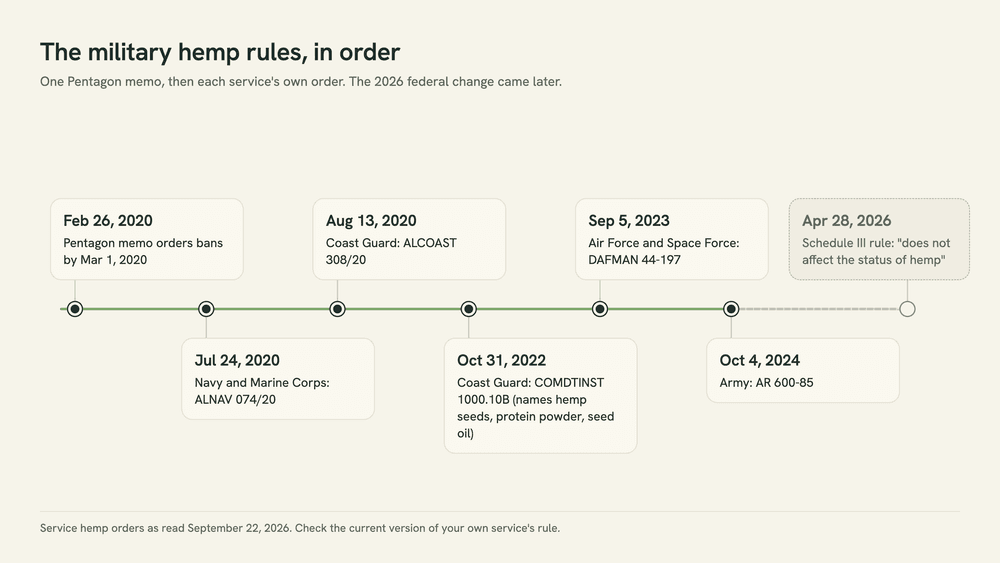
Can you use CBD in the military? No. If you serve on active duty, in the Reserve or in the National Guard, your service bans products made or derived from hemp, CBD included, whatever the label says about THC and even though a civilian can buy the same product legally. The rule traces to a Pentagon memo dated February 26, 2020, which ordered the Army, Navy and Air Force to put a ban in place by March 1, 2020. The Coast Guard adopted its own. This page explains each rule as we read it on September 22, 2026. It is general information, not legal advice.
Almost everything written about CBD starts from one fact: hemp-derived CBD is federally legal for civilians, within limits that our guide to whether CBD is legal walks through. For a service member, that fact is true and irrelevant. The Pentagon memo titled "Adoption of Punitive General Orders to Address Use of Hemp Products" told the services to ban hemp products "regardless of whether such products may lawfully be bought, sold, and used under the laws applicable to civilians". A product can be legal in the store and still be off-limits to you. The military answers that second question on its own terms, and it answered it in 2020.
Can you use CBD in the military? The rule in the Pentagon's words
The memo is dated February 26, 2020 and signed by Matthew P. Donovan, then performing the duties of the Under Secretary of Defense for Personnel and Readiness, the Pentagon's senior personnel official. It went to the Secretaries of the Army, the Navy and the Air Force. It did not ban anything by itself. It ordered each military department to issue a punitive general order, meaning a rule you can be prosecuted for breaking under Article 92 of the Uniform Code of Military Justice (UCMJ), the article on failing to obey a lawful order or regulation. It set a deadline of March 1, 2020, and it covered active-duty members and the Reserve Components. This is the sentence that matters.
“By March 1, 2020, the Military Departments are hereby directed to issue punitive general orders or regulations enforceable under Article 92 ... prohibiting the use by active duty Service members and the members of the Reserve Components of products made or derived from hemp, including CBD, regardless of the product's THC concentration, claimed or actual, and regardless of whether such products may lawfully be bought, sold, and used under the laws applicable to civilians, and regardless of the route of administration or use.”
Read the three "regardless" clauses as a list of arguments that do not work: the THC number on the package, the fact that the product is legal to buy, and the way you use it. The memo also told the services to make a violation a "general intent offense". In plain words, what counts is that you meant to use the product, not what you meant it to do. The Navy's order, ALNAV 074/20, spells it out: a violation occurs whenever a service member intends to use a hemp product, "regardless of the Service Member's intended consequences of that use".
The memo is also candid that the ban is wider than the risk it guards against. It says the prohibition will reach, "in some instances", products "the normal use of which could not cause a positive urinalysis result." The department judged that it could not practically vet products one by one, so it banned the category instead. The exceptions it allows are narrow and named:
- Use as part of law enforcement duties.
- Use as part of medical duties.
- Use where you did not know a product contained hemp, and that lack of knowledge was reasonable.
- Durable goods that contain hemp, such as rope or clothing.
- FDA-approved cannabinoid drugs you hold a valid prescription for, such as dronabinol (Marinol, Syndros) and cannabidiol (Epidiolex).
That is the whole list. A state medical-marijuana card is not on it, and neither is a product sold as "THC-free". The Army states the first point outright in Army Regulation 600-85: use of cannabis products "for medical reasons or by prescription will not constitute an 'authorized use'", while "prescriptions for FDA approved medications that can cause THC positive results will be considered authorized use." Epidiolex is one of those prescription drugs. A bottle of CBD oil is not, whatever it contains.
Your branch's order, instrument by instrument
The memo was an instruction to the departments. The rule you can be charged under is your own service's order, and each service wrote its own, with its own number, date and wording. Here is each one as we read it on September 22, 2026.
| Branch | Current instrument | Date | Operative words | Topicals named? | Hemp foods named? |
|---|---|---|---|---|---|
| Army | Army Regulation 600-85, para. 4-2l(8)(a) | October 4, 2024 | Hemp products, including CBD, "regardless of the product's THC concentration" and "regardless of the route of administration or use" | Yes: transdermal patches, topical lotions and oils, soaps, shampoos, other cosmetics | Yes: "food products" are listed as an example |
| Navy and Marine Corps | ALNAV 074/20 (Secretary of the Navy general order) | July 24, 2020 | "any product made or derived from hemp", including CBD, "regardless of the product's THC concentration, claimed or actual" | Yes: transdermal patches, shampoos, conditioners, lotions, lip balms, soaps | Not named separately |
| Air Force and Space Force | DAFMAN 44-197, para. 1.2.2.1 (updated by DAFGM2026-01, February 4, 2026) | September 5, 2023 | "The ingestion of products containing or derived from hemp, including but not limited to" delta-8 THC and CBD | Not named in the current text (see the warning below) | Not named separately |
| Coast Guard | Commandant Instruction 1000.10B, ch. 7 (first order: ALCOAST 308/20, August 13, 2020) | October 31, 2022 | Any product containing hemp, including its extracts and derivatives, whatever the THC concentration (ALCOAST 308/20: "regardless of the product's THC concentration, claimed or actual") | Yes: ALCOAST 308/20 counts "topical skin application" as use and names shampoos, lotions, lip balms and soaps | Yes: hulled hemp seeds, hemp seed protein powder and hemp seed oil |
Army. The current rule is paragraph 4-2l(8)(a) of Army Regulation 600-85, dated October 4, 2024. It replaced a 2020 edition. The Defense Department's Operation Supplement Safety page on hemp and DoD policy was last updated November 14, 2022, so any Army text it quotes comes from the older version. The regulation bans products made or derived from hemp, including CBD, "regardless of the product's THC concentration" and "regardless of the route of administration or use", and gives examples: food products, transdermal patches, topical lotions and oils, soaps, shampoos and other cosmetics. The paragraph is punitive under Article 92(1). It covers the Regular Army, the Army Reserve and the Army National Guard on federal (Title 10) orders. Army public affairs restated the rule on May 14, 2026, after the Schedule III change, with the program manager of the Army Substance Abuse Program saying the "zero-tolerance stance remains absolute".
Navy and Marine Corps. Sailors and Marines are bound by ALNAV 074/20, a general order issued by Secretary of the Navy Braithwaite and dated July 24, 2020. It replaced an earlier message, ALNAV 069/20 of July 2, 2020. It prohibits "any product made or derived from hemp", including CBD, and says that "use" includes topical products "such as shampoos, conditioners, lotions, lip balms, or soaps". It states that it will "remain in effect until superseded or cancelled", and the Navy's published ALNAV lists for 2021 through 2026, as read September 22, 2026, contain no later hemp message. No separate Marine Corps message is needed: the order names Sailors and Marines.
Air Force and Space Force. The rule is paragraph 1.2.2.1 of Department of the Air Force Manual 44-197, dated September 5, 2023, as updated by a guidance memo dated February 4, 2026 (DAFGM2026-01, which added kratom). It reads: "The ingestion of products containing or derived from hemp, including but not limited to delta-8-tetrahydrocannabinol (Delta-8 THC) and cannabidiol (CBD), is prohibited." Breaking it is a violation of Article 92(1) and, the manual says, "may also constitute a violation of Article 112a", the UCMJ's drug article. It applies to the Regular Air Force, the Space Force, the Air Force Reserve and the Air National Guard. Delta-8 THC, which our guide to hemp-derived THC explains, is named in the rule itself. Many of the Air Force base articles that fill the first page of search results, and the OPSS page, quote an older version of this paragraph.
Coast Guard. The Coast Guard is part of the Department of Homeland Security, so the Pentagon memo was not addressed to it. It adopted its own ban anyway. ALCOAST 308/20, dated August 13, 2020, said: "Effective immediately, Coast Guard members are prohibited from knowingly using products made or derived from hemp, including cannabidiol (CBD)", and it counted "topical skin application" as use. The current rule is Commandant Instruction 1000.10B, dated October 31, 2022 and announced in ALCOAST 438/22, which added a chapter on hemp, and it goes further than any other service. It prohibits any product containing hemp, including its extracts and derivatives, whatever the THC concentration, and it names hemp-derived CBD, hulled hemp seeds, hemp seed protein powder and hemp seed oil. Applying a product to the skin counts as use. Those three hemp foods are grocery-aisle items that most people would never connect with drug policy. Why hemp seed oil worries testing programs at all is covered in our look at hemp seed oil and drug tests. We found no newer Coast Guard instruction as of September 22, 2026.
Reserve and National Guard. The memo covers the Reserve Components, and each service's order reaches its Reserve and Guard members. The Air Force manual adds a detail that matters for Guard members: Article 92 of the UCMJ "does not apply to members of the ANG while in Title 32 status", but they "may be subject to an equivalent article under a state military justice code." State codes vary, and we did not survey them. If you are on state orders, your state's judge advocate is the person to ask. How the rule is enforced between drill periods is a question for your legal office too.
One instrument people often cite is not the ban. DoD Instruction 1010.01, the Defense Department's drug-testing program, was last changed on August 21, 2025. It tells the services to "process all Service members who knowingly misuse drugs for separation" under their own regulations, but it does not mention hemp at all. The hemp ban lives in the service orders above. Instruction 1010.01 is the testing and separation machinery around it.
Why "0.0% THC" on the label does not protect you
This is the misconception that catches people, so it is worth being precise. There are two separate reasons the label is no defense. One is legal and one is practical, and either would be enough on its own.
The legal reason: the rule is about the category
Every order above bans hemp products as a class. Your product's THC figure is not part of the question. The Navy and Coast Guard orders say "regardless of the product's THC concentration, claimed or actual", the Army's says the same in slightly different words, and the Air Force manual sets no THC threshold at all. The memo explains why. The FDA "does not determine or certify the THC concentration of commercially-available hemp products", and so, in the memo's words, "Service members cannot rely on the packaging and labeling". For what the agency does and does not do with CBD, see our summary of the FDA's position on CBD. We sell CBD ourselves, and we are telling you plainly: for a service member, no certificate of analysis changes the answer. Put together, the rule ignores all of the following.
- The THC percentage printed on the package or in an online listing.
- A certificate of analysis, a batch number or a brand's reputation.
- Whether the product is called full-spectrum, broad-spectrum, isolate or THC-free.
- Whether the product is legal to buy in your state or online.
- Whether you swallowed it or put it on your skin. The Army, Navy, Marine Corps and Coast Guard orders name topical products.
- Who bought it, or whether it was sold in a shop just outside the gate.
The practical reason: labels are unreliable, and a test cannot tell the source
Even if the rule did depend on the label, the label would be a weak shield. In a 2017 JAMA analysis of 84 CBD products bought online, researchers found THC in 18 of them, at up to 6.43 mg/mL. That was a 2017 sample of online products, not today's whole market, but it is the kind of mislabeling the memo describes, where a product can "omit any reference to THC on the product label" or list the wrong amount. And a drug test reports THC, not where it came from. The memo says it is "not possible to differentiate between THC derived from legal hemp products and illicit marijuana". How hemp products can produce a positive result is covered in our guide to CBD and drug tests. We deliberately publish no cutoffs or detection times on this page. For a service member, the number that matters is zero use, not a waiting period.
What changed in 2026, and what did not
Two federal changes made headlines, and it is reasonable to assume one of them loosened things. Neither touched a service hemp order. The Schedule III final rule, published and effective April 28, 2026, moved two narrow kinds of marijuana to Schedule III: marijuana in FDA-approved drug products and marijuana covered by a state medical license. Every other form of marijuana stayed in Schedule I, and the rule says it "does not affect the status of hemp". Petitions challenging the rule are pending in federal court, and our report on the court's refusal to pause the Schedule III order covers what the rule includes and where that case stood in September 2026. For service members, the text that matters is Article 112a of the UCMJ, the military's drug article. It names marijuana by name, and it separately covers any substance listed in Schedules I through V. Our reading of those words: moving some marijuana to Schedule III moves it from one covered list to another, not off the list.
The second change has not arrived yet. Public Law 119-37, enacted November 12, 2025, will rewrite the federal definition of hemp in 7 U.S.C. 1639o, the section the Army, Navy and Coast Guard orders use to define hemp. A later law, P.L. 119-103, enacted from H.R. 6500 on September 2, 2026, holds most of the change until December 11, 2026; only the exclusion of synthesized cannabinoids will apply from November 12, 2026. Our reading: when the new definition arrives, a product will either still count as hemp, and the hemp orders ban it, or stop counting as hemp and lose the exemption that kept it outside the federal drug laws Article 112a enforces. Neither outcome makes it permitted. The Coast Guard's instruction says the second half outright: substances that do not meet the definition of hemp are treated as controlled substances. The new definition is explained in our hemp ban explainer, and the timing in our update on the December 11 delay.
| Event | Date | What it means for civilians | What it means for service members |
|---|---|---|---|
| Schedule III final rule (91 FR 22714) | April 28, 2026 | FDA-approved marijuana drug products and state-licensed medical marijuana moved to Schedule III; all other marijuana stayed in Schedule I | Nothing. Article 112a covers Schedules I through V, and the rule "does not affect the status of hemp" |
| Federal hemp redefinition (P.L. 119-37, sec. 781) | Enacted November 12, 2025; not yet in force | Will narrow what counts as legal hemp | Our reading: a product either stays hemp, which the orders ban, or loses the hemp exemption from federal drug law, which Article 112a enforces. Neither makes it permitted |
| P.L. 119-103 | September 2, 2026 | Most of the new definition will apply from December 11, 2026; the synthesized-cannabinoid exclusion will apply from November 12, 2026 | Nothing |
| FY2026 defense authorization act (P.L. 119-60) | Signed December 18, 2025 | Not applicable | Nothing. The enacted text does not contain the word "hemp" |
| Army restatement of AR 600-85 | May 14, 2026 | Not applicable | The Army said the ban on hemp and CBD still applies after Schedule III |
One more piece of confusion lingers in search results. In July 2020 the House voted for an amendment to the annual defense bill, adopted 336 to 71 as part of a package of amendments, that would have said the "Secretary of Defense may not prohibit, on the basis of a product containing hemp ... the possession, use, or consumption of such product by a member of the Armed Forces", as Marijuana Moment reported that July. It never became law. The defense authorization act enacted for fiscal 2021 does not contain the word "hemp", and neither does any enacted defense authorization act since, through fiscal 2026. OPSS puts it in one line: "The passage of the House bill in 2020 has not changed DoD policy."
If you also compete in sport, anti-doping rules are a separate system with their own treatment of CBD, covered in our guide to CBD in sports. Nothing in a sports rule changes a military order.
Not in uniform? The rule that applies to you
Search results, and even some official reminders, blur service members, civilian employees and families together. They sit under different rules. The table sorts them, and the paragraphs below give the source for each line. Where we could not find an instrument, we say so rather than guess.
| Who | What governs you | Bottom line |
|---|---|---|
| Active duty, Reserve, and Guard on federal orders | Your service's hemp order (branch table above) | Prohibited, whatever the label says |
| National Guard on state (Title 32) orders | Article 92 may not apply, but a state military justice code can | Ask your state judge advocate |
| Defense Department civilian employees | Generally not the service hemp orders (Navy and Marine Corps civilians: see below); federal workplace testing rules if your position is tested | A legal hemp product is not accepted as an explanation for a THC positive |
| Contractor employees | Your employer's drug-free workplace program and your contract | Ask your company's program or security office |
| Spouses and dependents | No instrument located that bans a dependent's lawful hemp use | Ask your installation about its own rules |
| Security clearance holders (any of the above) | Director of National Intelligence guidance, December 21, 2021 | CBD use "may be relevant to adjudications" |
Defense civilian employees. The service hemp orders are written for service members. The Army regulation's hemp paragraph speaks to Soldiers, and the Air Force's separate manual for its civilian drug program, AFMAN 44-198 (Change 1, April 2, 2026), does not mention hemp or CBD at all. One exception to check: ALNAV 074/20 prohibits use by "Sailors and Marines" but also describes itself as "applicable to all DON personnel", meaning the Department of the Navy. If you are a Navy or Marine Corps civilian, ask your command's drug program office how it is applied to you. That does not make CBD safe for you if your position is drug-tested. Federal workplace testing rests on Executive Order 12564, signed in 1986, and the Medical Review Officer Guidance Manual that SAMHSA (the Substance Abuse and Mental Health Services Administration) issued for federal testing programs, effective July 7, 2025, says that when a donor blames a THC positive on a legal hemp product, the reviewing doctor "may not accept such explanations". SAMHSA had already told agencies, in a July 24, 2019 memo, to warn employees that hemp products may cause a positive marijuana test. What happens to a civilian job after that is employment law, which our guide to whether you can be fired for failing a drug test covers.
Contractors. A service hemp order does not reach a contractor's employees. Your obligations come from your employer's drug-free workplace program and from the contract you work under; federal contractors covered by the Drug-Free Workplace Act at 41 U.S.C. 8102 must maintain one. Your company's program or security office is the place to ask what that means for you.
Spouses and dependents. We did not find any instrument that bans a spouse's or dependent's lawful use of hemp products; the orders above are written for members. Two cautions. What may be brought onto an installation is a separate question we did not research, so ask your installation before you assume. And your service's rule is about what you use, whoever bought it. If you are in the Coast Guard, that includes hemp seeds and hemp seed oil in the family kitchen.
Clearance holders. If you hold a security clearance, as a service member, a civilian or a contractor, there is one more layer. On December 21, 2021, the Director of National Intelligence, acting as Security Executive Agent, issued guidance saying agencies "should be aware that using these cannabis derivatives may be relevant to adjudications", and warning that CBD products may "cause sufficiently high levels of THC to result in a positive marijuana test". That is guidance, not an automatic bar, and clearance decisions weigh the whole person. It predates the 2026 Schedule III rule, and we found no update to it.
Veterans and VA patients: a different rulebook
This section is separate on purpose. Everything above applies to people who are still serving. Once you have separated from the military, the service hemp orders no longer apply to you, and hemp CBD falls under the same civilian rules as for anyone else. The Department of Veterans Affairs page on what veterans need to know about VA and marijuana, as of its August 1, 2023 update, says "Veterans will not be denied VA benefits because of marijuana use." It also says VA clinicians may not recommend medical marijuana, that most products containing THC, CBD or other cannabinoids are not approved by the FDA for medical use, that "When you are on VA grounds it is federal law that is in force", and that veterans who work for the VA are drug-tested under the terms of their employment. That page is about marijuana and predates the 2026 changes. Military retirees are outside what this page covers; ask your legal assistance office.
The shelf outside the gate
CBD is sold in malls, gas stations, gyms and supplement shops, including the ones a few minutes from every base. None of that is clearance. A product marketed as "military-friendly" or "THC-free", a clerk's reassurance, or a shop full of service members tells you nothing about your order. Operation Supplement Safety (OPSS), the Defense Department's own supplement-safety program, says it without qualification: "Hemp is prohibited for use by Service Members." Hemp also turns up in products that are not sold as CBD at all, which is why the check below is about ingredients, not marketing. Before anything new goes in or on your body:
- 1Read the full ingredient list, not the front of the package. Look for hemp, hemp seed, hemp oil, hemp extract, CBD, cannabidiol, cannabinoids, or delta-8, delta-9 or delta-10 THC.
- 2Treat "full spectrum", "broad spectrum", "whole plant" and "phytocannabinoid" as hemp-extract wording, whatever else the label claims.
- 3Check the product types people forget: gummies, drinks, sleep and energy supplements, protein powders, lotions, balms, shampoos, lip balms and patches.
- 4In the Coast Guard, treat hulled hemp seeds, hemp seed protein powder and hemp seed oil as prohibited by name.
- 5Ignore the THC figure and any certificate. Neither changes the answer for a service member.
- 6If you cannot tell whether something contains hemp, do not use it until you have asked OPSS or your chain of command.
- 7If a doctor wants to prescribe an FDA-approved cannabinoid drug, raise it with your military medical provider first. That is the only route the exceptions describe.
Who to ask instead of the internet
The people who can actually answer your question are in your own chain of command and legal system, not on a search results page, this one included. In rough order:
- Your chain of command or senior enlisted leader, for how your unit applies your service's order.
- Your legal assistance office or judge advocate (JAG), for what a word in an order means for you.
- Operation Supplement Safety (OPSS), for whether a specific product or ingredient falls under the ban.
- Your military medical provider, for any FDA-approved cannabinoid prescription.
- Your installation's substance abuse or behavioral health program, if you have been relying on a product to get through the day or to sleep.
- Defense counsel or JAG, before anyone else, if you already have a test result or have been told you are under investigation. This page cannot help with that.
What this page cannot tell you
It is not legal advice, and it cannot tell you how your command will apply any rule to your facts. It describes each instrument as we read it on September 22, 2026, and instruments change: check the current version of your own service's order. Some widely cited sources lag the current text (the OPSS page's Air Force and Army quotes predate the 2023 manual and the 2024 regulation), and several of the official documents we quote are hard to reach from outside US government networks, so we cite them by name, number and date. We did not survey state military justice codes, installation-specific rules or the position of military retirees, and we make no forecast about future policy. We also publish no detection windows or cutoffs here, on purpose.
Questions service members ask about CBD
No. Army Regulation 600-85, dated October 4, 2024, bans products made or derived from hemp, including CBD, regardless of the product's THC concentration and regardless of how you use it. The Navy, Marine Corps and Coast Guard orders use the same 'claimed or actual' wording, and the Air Force manual sets no THC threshold at all. The label is not part of the question.
The Army, Navy, Marine Corps and Coast Guard name topical products explicitly: lotions, oils, soaps, shampoos, conditioners, lip balms and patches, and the Coast Guard counts topical skin application as use. The current Air Force manual says 'ingestion', but the Pentagon memo it carries out covers every route of use. Do not treat that word as permission; a question about it belongs with your legal office.
The exceptions cover FDA-approved cannabinoid drugs you hold a valid prescription for, such as dronabinol and Epidiolex. A state medical-marijuana card is not that; the Army's regulation says medical or prescription cannabis use is not an authorized use. Raise any prescription with your military medical provider.
No. In July 2020 the House voted for an amendment that would have stopped the Pentagon from banning hemp products, but it did not become law. The defense authorization act enacted for fiscal 2021, and every one since through fiscal 2026, does not contain the word 'hemp'. Operation Supplement Safety says the 2020 House bill has not changed DoD policy.
No. The April 28, 2026 rule moved only FDA-approved marijuana drug products and state-licensed medical marijuana to Schedule III, and it says it does not affect the status of hemp. Article 112a of the UCMJ names marijuana by name and covers every substance in Schedules I through V, and no service changed its hemp order.
The concern is THC, not CBD. Labels can understate THC (a 2017 analysis found THC in 18 of 84 CBD products sold online), and the Pentagon memo says THC from legal hemp cannot be told apart from THC from marijuana. But the ban does not depend on a test result: using the product is the violation. Our CBD drug test guide covers how detection works in general.
We found no instrument that bans a spouse's or dependent's lawful use of hemp products; the service orders are written for members. Ask your installation about its own rules, and remember that your service's order covers what you use, whoever bought it. In the Coast Guard that includes hemp seeds and hemp seed oil.
The service hemp orders are written for service members, although the Navy's ALNAV 074/20 describes itself as applicable to all Department of the Navy personnel, so Navy and Marine Corps civilians should ask their drug program office. If your position is drug-tested, federal rules say the reviewing doctor may not accept a legal hemp product as an explanation for a THC positive, so the practical risk remains.
Possibly. The Director of National Intelligence's December 21, 2021 guidance says CBD use may be relevant to adjudications and warns that CBD products can cause a positive marijuana test. It is guidance, not an automatic bar, and it applies to military, civilian and contractor clearance holders.
This answer is only for people who have left the military. Once separated, the service hemp orders no longer apply, and hemp CBD falls under the same civilian rules as for anyone else. The VA, as of its August 2023 page, says veterans will not be denied benefits because of marijuana use, but its clinicians may not recommend it and federal law applies on VA grounds. If you are still in the Reserve or the Guard, including the Individual Ready Reserve, you are still a Reserve Component member under the Pentagon memo; ask your legal office how your service's order applies to your status.
On federal (Title 10) orders, yes. On state (Title 32) orders, the Air Force manual notes that Article 92 of the UCMJ does not apply, but a state military justice code may have an equivalent article. States differ, so ask your state judge advocate.
If you are a civilian trying to understand where hemp CBD stands under federal and state law, our overview of CBD's legal status in the US is the next page to read. If you are serving, the next step is not another article. It is the current version of your own service's order, and a conversation with your legal office if anything about it is unclear.
Writing about hemp, wellness and the small rituals that keep us balanced.