Hemp Seed Oil and Drug Tests: What Two Controlled Studies Measured
Hemp seeds do not make THC, and hemp seed oil can still carry a trace of it. Two controlled human studies, twenty-five years apart, dosed volunteers and measured the urine. Here is the dose ladder, the 1997 positives with their dates, and what none of it can promise you.
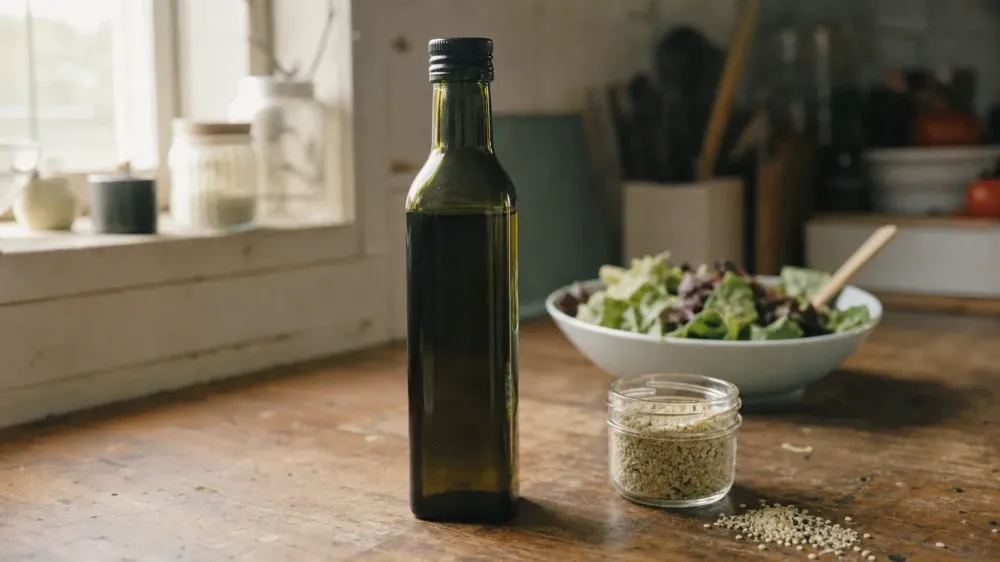
Will hemp seed oil make you fail a drug test? Most people asking that question are not CBD customers. They cook with a green oil, they put hulled hemp seed on a salad, they use a shampoo with hemp on the front of the bottle, and they have a urine test on Thursday. The short answer has three parts: hemp seeds do not make THC, hemp seed ingredients can carry a trace of it anyway, and whether that trace reaches a testing threshold depends on how much you ate, what was actually in the bottle, and which number the laboratory is measuring against.
Two controlled human studies have dosed volunteers with hemp seed products and followed their urine, twenty-five years apart and on two continents, and both landed under the federal confirmation cutoff. Between them sits a short run of case work from 1997 in which people genuinely did screen positive, on oils that were measured at up to 1,500 micrograms of THC per gram against the 5 micrograms per gram a 2001 paper calls typical. This page prints all of it: the dose ladder, the equivalences in millilitres, the positives with their dates and their sample sizes, and the one situation where the answer has nothing to do with chemistry at all. What it does not print is a waiting period, because nothing in this literature supports one.
Hemp seeds do not make THC. The bottle still carries some.
Start with the sentence the whole question turns on, and take it from the agency rather than from a brand. In a constituent update published on December 20, 2018, the FDA wrote that "the seeds themselves do not naturally contain tetrahydrocannabinol (THC)", and then, in the same paragraph, that the hemp seed ingredients it had reviewed "contain only trace amounts of THC and CBD, which the seeds may pick up during harvesting and processing when they are in contact with other parts of the plant." Both halves have to travel together, and most pages only carry the first one. The seed is not a cannabinoid factory. The pressed oil is not cannabinoid-free either, because the hull, the leaf fragments and the resin the seed rubs against on the way to the press are not clean. Contamination, not content. That distinction is the whole page. Notice also what the agency does not do there: it never attaches a number to the word trace. The measured retail ranges, and how they compare with a CBD oil, are set out in our side-by-side on hemp seed oil and CBD oil, and this page will not rebuild them.
Those ingredients are in the American food supply because of three notices filed by one Canadian company, Fresh Hemp Foods, and answered in December 2018. The FDA said it had no questions about hulled hemp seed (GRN 765), hemp seed protein powder (GRN 771) and hemp seed oil (GRN 778), and it added that products containing any of them "must declare them by name on the ingredient list", which turns out to be the single most useful fact on this page for anyone standing in a supermarket aisle. Open the response letter for hemp seed oil and the same mechanism appears again, this time as the agency's record of what the company told it. Fresh Hemp Foods, the letter says, "states that hemp seeds themselves do not produce THC, and that THC present in hemp seed oil comes from contact between the seeds and cannabinoid-containing resins from other plant parts during growth, harvest, and processing." That sentence is the notifier's account, not a finding of the agency's own, and it is worth more for that: the regulator and the company that files the paperwork describe the same route from two directions. One caution, because it is routinely misreported: a no-questions letter is not an FDA affirmation that an ingredient is generally recognized as safe, and the letter says so in terms. The THC specification written into GRN 778 is the notifier's own commitment, not a federal limit on hemp seed oil.
The dose ladder: fifteen adults, forty days, and the number nobody prints
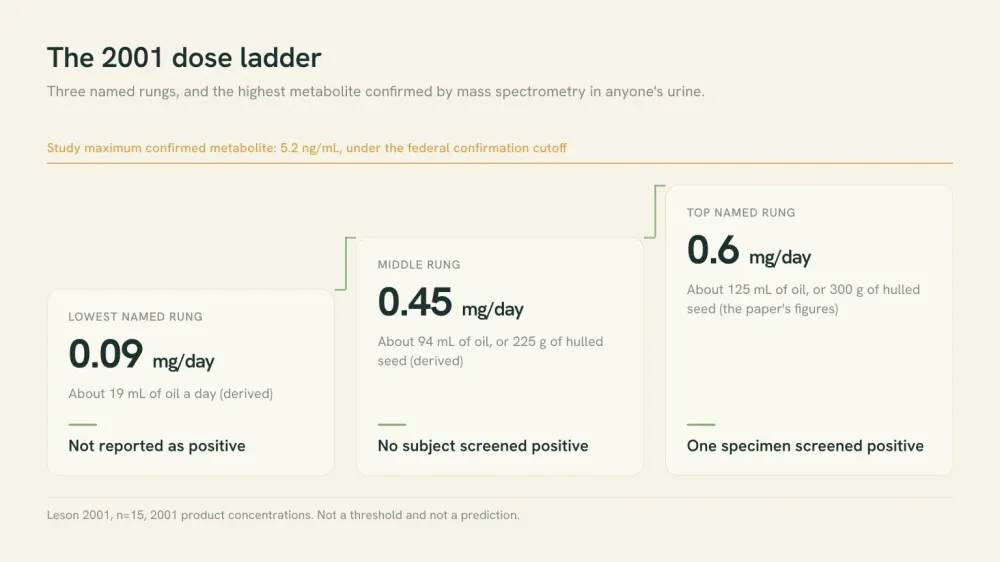
Almost every page on this subject answers with a yes or a no. The literature answers with a curve. In 2001, a group of researchers published a study in the Journal of Analytical Toxicology that fed measured amounts of THC to fifteen THC-naive adults for forty days. Not a survey and not a case report: four successive ten-day periods, one daily dose per period, climbing from 0.09 up to 0.6 milligrams of THC, taken as a 15 mL aliquot of a hemp and canola oil blend, 20 mL at the top rung. Urine went in at baseline, on days 9 and 10 of every period, and again one and three days after the final dose. Screening was by direct radioimmunoassay, confirmation was by gas chromatography with mass spectrometry, and creatinine was measured throughout so that a watered-down specimen could be spotted.
Those specimens were measured against two numbers, and they are the same two numbers a federal workplace program uses today. The authorized testing panel HHS published at 90 FR 4662 on January 16, 2025, effective July 7, 2025, lists the marijuana metabolite with an initial test at 50 ng/mL and a confirmatory test at 15 ng/mL. HHS republished those panels at 91 FR 12308 on March 13, 2026 and stated it had made no revisions. Those cutoffs bind federal agency testing; a private employer outside a regulated program sets its own panel and its own thresholds, which is one reason a federal number describes a procedure and never predicts a person. Every figure on the rest of this page is measured against that pair, and this page prints them once.
| Daily THC dose | Roughly equivalent to, at 2001 product concentrations | Screened positive at the screening cutoff? | Highest confirmed metabolite in the whole study |
|---|---|---|---|
| 0.09 mg/day (lowest named rung) | About 19 mL of hemp oil a day at 5 micrograms of THC per gram (derived by proportion) | Not reported as positive | Not reported separately by rung |
| 0.45 mg/day | About 94 mL of hemp oil a day, or about 225 g of hulled seed a day (derived by proportion) | No subject screened positive | Not reported separately by rung |
| 0.6 mg/day (top named rung) | About 125 mL of hemp oil at 5 micrograms per gram, or about 300 g of hulled seed at 2 micrograms per gram (the paper's own figures) | One specimen screened positive | 5.2 ng/mL, the study maximum, roughly a third of the federal confirmation cutoff |
Here is what came back, in the authors' own terms. At 0.45 milligrams a day, no subject screened positive. At 0.6 milligrams a day, one specimen did. And across the entire study, the highest metabolite level confirmed by mass spectrometry in anyone's urine was 5.2 ng/mL, roughly a third of the confirmation threshold. That is the real shape of the answer: not a yes and not a no, but a ladder with a rung on it where a screen first flickers. The paper then performs the conversion that the entire first page of search results declines to perform. A daily intake of 0.6 milligrams of THC was, in 2001, about 125 millilitres of hemp oil containing 5 micrograms of THC per gram, or about 300 grams of hulled seed at 2 micrograms per gram, concentrations the authors describe as then typical in Canadian hemp seed products. Half a cup of oil. Every day. For ten days at a stretch.
The positives are real, and every one of them has a date on it
If hemp food were inert to a urine panel there would be no literature at all. There is one, it is small, and it is old. Five laboratories published controlled ingestion work between 1997 and 2000, and volunteers in several of them produced specimens a workplace program would have flagged. Printing the ladder without printing them would be the dishonest version of this page, so here is the whole record in publication order, with each study's sample size attached to its own numbers wherever the published abstract states one. Two of these papers are routinely merged online into a single mythical study, and they are not the same paper, the same laboratory or the same design.
| Year and laboratory | What people took | n | What the urine showed | Read it as |
|---|---|---|---|---|
| 1997, Struempler and colleagues, ARUP Laboratories, Salt Lake City | 135 mL of a store-bought cold-pressed hemp seed oil, taken twice daily across four and a half days | 1 | The metabolite climbed through the dosing period, peaked at 68 ng/mL fifteen hours after the last dose, and the first negative specimen came at 146 hours | One person, one bottle, 1997. A time course, and never a timetable. |
| 1997, Lehmann and colleagues, University of Bern | 11 or 22 g of a seed oil measured at 1,500 micrograms of THC per gram, the worst of 25 oils the same team surveyed at 3 to 1,500 | 6 | Urine positive for up to six days, with confirmed metabolite from 5 to 431 ng/mL; all six reported psychotropic effects | The upper bound of what a badly made oil could do. That is not a hemp food. |
| 1997, Costantino and colleagues, American Medical Laboratory, Chantilly | A single 15 mL dose of a retail hemp oil sold as Hemp Liquid Gold, with sampling at 8, 24 and 48 hours | 7 | Of 18 post-dose specimens, 14 screened above the study's own 20 ng/mL kit cutoff, 7 above 50 and 2 above 100, and every post-dose specimen showed the carboxy metabolite on GC-MS | The strongest counter-case in the literature, and it is 29 years old. |
| 1997, Fortner and colleagues, PharmChem Laboratories | Retail hemp seed snack bars and cookies (sample size not stated in the published abstract) | Not stated | Specimens screened positive at both of the study's own cutoffs; the only quantifiable confirmations were 0.6, 0.7 and 3.1 ng/mL and none met reporting criteria; hemp seeds similar to those used in the foods showed no THC by GC-MS | The clearest published case of a screen and a confirmation disagreeing about one specimen. |
| 2000, Bosy and Cole, Division of Forensic Toxicology, Armed Forces Institute of Pathology | Commercially available hemp seed oil products, bought and analysed, then ingested by volunteers | Not stated | Peak urine metabolite ran from 1 to 49 ng/mL, and the paper reports that THC in retail hemp oil products "has been reduced considerably since the publication of earlier studies" | A United States military forensic laboratory recording the product changing. |
| 2001, Leson and colleagues | 0.09 to 0.6 mg of THC a day in hemp and canola oil blends, over four successive ten-day periods | 15 | No screen positive at 0.45 mg/day; one specimen positive at 0.6 mg/day; study maximum confirmed metabolite 5.2 ng/mL | The only dose ladder on this list. Private-consultancy affiliation, and still the strongest design here. |
| 2026, Soyturk and colleagues, Institute of Forensic Sciences, Ankara University | Oral hemp oil, hemp oil on the skin, or hemp seed eaten, with ten days of serial urine | 15 (5 per arm) | Oral arm: the metabolite was detectable in 93.5% of samples, with a highest median of 3.91 ng/mL and an arm maximum of 4.52 ng/mL | Modern instrumentation, small arms, low numbers. Detectable is not positive. |
Those rows are not directly comparable with one another: the cutoffs, the instruments and the products differ across twenty-nine years. But there is a key that makes the table readable, and it is a single number. In 1997 a University of Bern group surveyed twenty-five cannabis seed oils and found THC ranging from 3 to 1,500 micrograms per gram, a five hundred fold spread inside one product category. Four years later the dose-ladder paper calls 5 micrograms per gram typical. That is roughly a three hundred fold difference between the worst oil on the 1997 shelf and the ordinary oil on the 2001 one, and it is not the hemp industry's own claim. In 2000, the Division of Forensic Toxicology at the Armed Forces Institute of Pathology bought the products again, measured them, and dosed volunteers, and reported that the THC content of commercially available hemp oil products "has been reduced considerably since the publication of earlier studies", with peak urine metabolite in their volunteers running from 1 to 49 ng/mL. So the 1997 positives are true, and they are true about 1997 oils, and the entity that documented the change was a military laboratory rather than a trade association.
The two 1997 case papers deserve their own sentence each, because the internet keeps fusing them. The single-subject series from ARUP Laboratories in Salt Lake City is one volunteer who drank 135 millilitres of cold-pressed hemp seed oil over four and a half days and produced a workplace-positive urine; the metabolite peaked at 68 ng/mL fifteen hours after the last dose and the first negative specimen came at 146 hours. The seven-subject study from American Medical Laboratory is a different laboratory, a different design and a single 15 millilitre dose, and of its eighteen post-dose specimens, fourteen screened above the study's own 20 ng/mL kit cutoff, seven above 50 and two above 100, with the carboxy metabolite confirmed in every one. Eighteen for eighteen. That is the counter-case, and it is real. And then the refusal, because it belongs in this paragraph rather than in a footnote: the 146-hour figure is a measurement from one person on a 1997 oil, and turning it into "stop N days before your test" would be dishonest about a study with one subject in it. This page is not going to do it. If you came here wanting a clock, the honest account of why cannabinoid timelines resist a single number is in our piece on how long CBD stays in your system.
Someone ran it again in 2026, with a sharper instrument
Twenty-five years after the dose ladder, a forensic toxicology group at Ankara University's Institute of Forensic Sciences repeated the exercise with instrumentation that did not exist in 2001. Their study in Forensic Science International analysed 22 hemp seed oils and 12 hemp seed products, then split fifteen volunteers into three arms of five: oral hemp oil, hemp oil applied to the skin, and hemp seed eaten. Urine was collected serially for ten days and analysed by isomer-specific liquid chromatography with tandem mass spectrometry, a method that separates the delta-8 and delta-9 forms of the carboxy metabolite instead of reporting them together. Nothing on the first page of search results for this question cites it, and it appears in none of our own 120 published articles until now.
Read those four numbers in that order, because the first one is the one that gets quoted alone. Detectable in 93.5 percent of samples means a research instrument found molecules. It does not mean a workplace panel would call anything positive: the highest median in that arm was 3.91 ng/mL, the single highest reading in it was 4.52, and even the one-sided ninety-nine percent upper prediction limit of 9.35 sits under the federal confirmation cutoff. Detectable by a research method and positive on a workplace panel are two different events, and conflating them is how a reassuring study becomes a frightening headline. The arm that ate hemp seed rather than drinking the oil produced recurrent but lower-level findings. One further result belongs to a different page: the delta-8 form of the metabolite predominated over the delta-9 form, at ratios from 1.92 to 8.83, which is a forensic interpretation point about telling exposures apart and is not a statement about delta-8 products. That distinction lives in our page on delta-8 and workplace panels.
That same study is also the only controlled answer anyone has on hemp lotion, hemp shampoo and hemp body oil. Its dermal arm produced the weakest and least consistent urinary detections of the three arms. That is the entire evidence base for the topical question: five people, one product, one protocol, in one country. It points in a reassuring direction and it is far too small to be an assurance, and it is the whole reason this page gives topicals a paragraph rather than a section.
Why "hemp seed oil has no THC" and "you can screen positive on a drug test" are both true
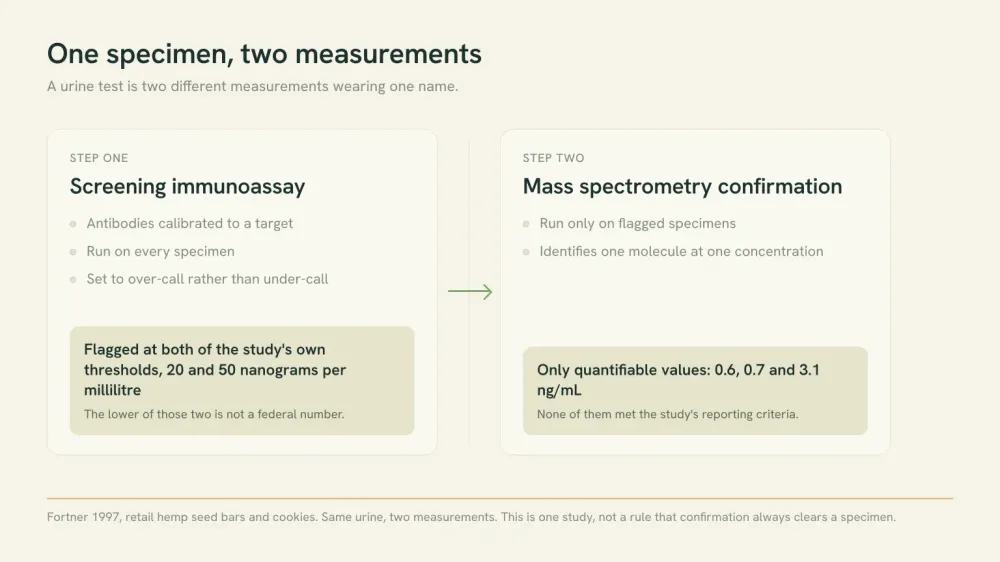
Those two sentences look like a contradiction and they are not, because a urine test is two different measurements wearing one name. The first is an immunoassay: antibodies calibrated to a target, run fast and cheap on every specimen, and deliberately set to over-call rather than under-call, because a laboratory would rather re-examine a clean sample than miss a dirty one. The second is mass spectrometry, run only on the specimens the first step flags, which identifies a specific molecule at a specific concentration. A screen positive is a question. A confirmation is an answer. They disagree more often than most people expect, and the case where they disagree is exactly the case this page is about.
The clearest illustration in the literature is from 1997 and it is about snack food. PharmChem Laboratories gave volunteers retail hemp seed bars and cookies and collected their urine. Several specimens screened positive at both of the study's own screening thresholds, 20 and 50 nanograms per millilitre, and the lower of those two is not a federal number. The only quantifiable confirmation values in the whole study were 0.6, 0.7 and 3.1 ng/mL, and none of them met the study's reporting criteria. Hemp seeds similar to the ones used in those foods, tested directly, showed no THC by mass spectrometry at all, and the paper is careful with that word: it tested seeds like the ones in the foodstuffs, not the exact batch. Same urine, two answers, and the two-step design is precisely what stops the first answer from being the last word. It does not follow that a confirmation always rescues a specimen. What follows is narrower and more useful: the number that decides is the confirmation number, not the screen. How that process actually runs in a workplace, and where the trace THC in a full-spectrum CBD product fits into it, is covered in our guide to CBD and drug testing.
Four things sold as "hemp", ranked by how much they can carry
The label word is the same in all four cases and the risk is not. Ranking them is more useful than any single yes or no, because the reader's real problem is not the toxicology. It is working out which of these four is actually in their hand.
| What it is | Where the cannabinoids come from | What the controlled studies measured | What identifies it on a label |
|---|---|---|---|
| Hulled hemp seed, hemp hearts, hemp protein powder | Contact with hull, leaf and resin during harvest and processing. The seed itself makes none. | Seeds like those used in the 1997 foods, tested directly, showed no THC by mass spectrometry. The 2026 seed-eating arm produced recurrent but lower-level urinary findings than the oil arm, on five people. | Hulled hemp seed or hemp seed protein powder, declared by name in the ingredient list (GRN 765 and GRN 771). |
| Cold-pressed culinary hemp seed oil | Pressing concentrates into the oil whatever the hull carried in. | This is the arm both controlled studies dosed hardest: 0.09 to 0.6 mg of THC a day in 2001, and a 4.52 ng/mL maximum in the 2026 oral arm. | Hemp seed oil or Cannabis sativa seed oil, usually the only ingredient (GRN 778). Sold by the 250 or 500 mL bottle. |
| Hemp seed oil cosmetics: lotions, shampoos, body oils | The same seed oil, applied to skin instead of swallowed. | One five-person dermal arm in 2026, which produced the weakest and least consistent urinary detections of the three arms. That is the entire evidence base. | Cannabis sativa seed oil in a cosmetic ingredient list, with no cannabinoid milligram figure anywhere on the pack. |
| Products labelled hemp oil or hemp extract that are cannabinoid extracts | Added on purpose, from flower and leaf. Nothing to do with the seed. | Nothing on this page applies to these. A 2026 systematic review attributes most real-world positives to product content: undeclared THC, mislabeling and contamination. | A milligram figure for CBD, a batch certificate of analysis, a dropper, and a price per millilitre no food oil comes near. |
That fourth row is the actual exposure risk on this page, and it is a different question from the one the studies answer. A product sold as hemp oil that is in fact a cannabinoid extract is not a hemp food that happens to be contaminated; it is a cannabinoid product with a food word on the front. Two of our pages exist for exactly that problem: what a label means when it says hemp extract explains why that phrase gets used, and how to check whether a product is what it claims to be is the verification routine.
Which leaves the practical part, and notice what it is: a label check, not a clock. The GRAS notices are what make it work. Because those ingredients have to be declared by name, the ingredient statement is a reliable place to look, and it takes about a minute.
- 1Turn the bottle around and read the ingredient list, not the front label. The front is marketing; the ingredient statement is the part that has to name hulled hemp seed, hemp seed protein powder or hemp seed oil when they are present.
- 2Learn the two vocabularies. Cannabis sativa seed oil, hemp seed oil, hulled hemp seed and hemp hearts are food ingredients. Hemp extract, full spectrum hemp, phytocannabinoid-rich, cannabidiol and CBD are not, whatever else the package says.
- 3Look for a cannabinoid milligram figure anywhere on the pack. A number like 1,000 mg or 25 mg per serving means you are holding a cannabinoid product, even if the words hemp seed oil also appear on it.
- 4Look for a batch certificate of analysis or a QR code that leads to one. A culinary seed oil normally has neither. If a product publishes a cannabinoid panel per batch, that is what it is.
- 5Check the aisle and the price per millilitre. Culinary hemp seed oil sits with the cooking oils at cooking-oil prices. A 30 mL bottle with a pipette at forty dollars is a different category, and the label word does not change that.
Where the answer is not toxicological at all
There is one group of readers for whom everything above is beside the point. Since a Department of Defense memorandum dated February 26, 2020 and effective March 1 of that year, the armed services have prohibited products made or derived from hemp regardless of the product's THC concentration, claimed or actual. Operation Supplement Safety, the Defense Department's own supplement-safety program run by the Consortium for Health and Military Performance at the Uniformed Services University, collects the service regulations on a single page and quotes them. Army Regulation 600-85 lists "food products" among the prohibited examples, alongside topical lotions and oils, soaps and shampoos. The line printed at the foot of that page is one sentence long: "All products containing hemp are prohibited for use by Service Members." For a service member the question is not whether an assay would have cleared you. It is a general order.
- The Defense Department memorandum: dated February 26, 2020, effective March 1, 2020.
- Army Regulation 600-85 prohibits the use of any product made or derived from hemp "regardless of the product's THC concentration, claimed or actual".
- The same regulation names food products, transdermal patches, topical lotions and oils, soaps and shampoos among the prohibited examples.
- ALNAV 074/20 for the Navy and Marine Corps, ALCOAST 308/20 for the Coast Guard, and DAFMAN 44-197 for the Air Force and Space Force, all quoted on that same page with the same structure.
- The exception, in the same regulation: "The use of durable goods containing hemp, such as rope or clothing, is not prohibited."
- Two dates to hold together: that program page was last updated November 14, 2022, and it was read for this article on September 4, 2026. Service policy can change, and this is not legal or command advice.
For civilians in a regulated program there is one line of federal regulation that makes the stakes concrete without any chemistry in it. Under 49 CFR 40.151(f), a medical review officer "must not accept an assertion of consumption or other use of a hemp or other non-prescription marijuana-related product as a basis for verifying a marijuana test negative", and the same section states that consuming or using such a product "is not a legitimate medical explanation". The confirmation number is what decides, not the explanation. What that officer's role actually involves is set out on our delta-8 testing page, and the workplace procedure itself on the CBD drug testing guide. Competitive athletes are governed by a separate rulebook again, which is our page on CBD and sport.
Why the seeds are on the shelf at all
A short piece of history, because it explains why this question exists in this shape. In October 2001 the DEA published an interpretive rule at 66 FR 51530 treating any product containing any amount of THC as a Schedule I controlled substance, and followed it in March 2003 with final rules at 68 FR 14114 and a companion rule that together would have cleared hemp seed foods out of the aisle. In Hemp Industries Ass'n v. DEA, 357 F.3d 1012, decided February 6, 2004, the Ninth Circuit vacated them. Writing for the court, Judge Betty B. Fletcher held that the rules "cannot regulate naturally-occurring THC not contained within or derived from marijuana". The reason she gave was short: "non-psychoactive hemp is not included in Schedule I." The companies bringing the case were importing sterilized hemp seed, oil and cake and making food and cosmetic products from them. That decision is from 2004 and it predates the 2018 Farm Bill, which is the authority that governs now. The current federal definition is in our hemp versus marijuana explainer, and the broader legality question sits on our hub page on CBD and the law.
The part we have to disclose, and what this page cannot tell you
We should say where we stand, because the honest version of this page is bad for us. Planntz does not sell hemp seed oil. We sell cannabinoid tinctures in coconut MCT oil, and our Full Spectrum certificates report 136 to 143 milligrams of total THC per bottle depending on the flavor. At roughly 1,200 drops in a 60 mL bottle, that works out at about 0.11 to 0.12 milligrams of THC in a single drop, which lands inside the range fifteen adults were dosed with daily, for ten days at a stretch, in 2001. That is not a safe-drop count and we are not going to turn it into one. Drop size varies with the dropper and with the hand holding it, one study of fifteen people is not a threshold, and no product can guarantee a drug-test outcome. We print it because it is the reason a bottle of culinary hemp seed oil and a bottle of ours are two different questions, and because a page that tells most of its readers their groceries carry less risk than the thing we sell should show its arithmetic rather than assert it.
Now the limits, starting with the size of the field, because a claim about a small literature deserves its own search. Run on September 4, 2026, PubMed returns 21 records for hemp seed oil combined with drug test, urine or workplace, and 3 for hempseed with cannabinoids and urine. Broaden it to hemp seed, hempseed, hemp oil or hemp food with urine and cannabinoid terms, restricted to human studies, and it is 27. Filter that to clinical trial publication types and it is 2. The dose-ladder paper does not even appear in the first of those searches, because its title says hemp food rather than hemp seed oil, which is part of why the most informative study on this question stays invisible to the obvious query and never reaches the first page of results. For a wider view, a 2026 systematic review in the International Journal of Legal Medicine screened 477 records, included twelve studies, and reported that five of the eight that measured cannabinoid positivity in people found nothing above the limit of quantitation or the cut-off. Its authors attribute the positives that do occur mainly to what is in the product: undeclared THC, mislabeling and contamination. Two caveats on it: its literature search closed in March 2024, so the 2026 controlled study above is not in it, and it pools CBD oils with hemp oils, so it cannot produce a hemp-seed-only answer.
- There is no published 2026 survey of THC in the hemp seed oil actually sitting on a United States shelf. The product concentrations on this page come from 1997, 2000 and 2001 analyses, plus a 2026 sample of the Turkish market.
- The 2001 dose ladder is fifteen people, twenty-five years old, and its lead author's affiliation is a private consultancy in Berkeley rather than a university or a government laboratory. It is not an independent audit.
- The 2026 replication is five people per arm on products bought in one country. The topical answer in particular rests on five people.
- Case reports have no denominator. Knowing that one volunteer in 1997 produced a positive tells you that it can happen, and tells you nothing about how often.
- No page, this one included, can predict what a specific panel will do with a specific person's urine. Cutoffs, instruments, laboratory practice and employer policy all vary independently of each other.
The seed itself does not make THC or CBD. The FDA's December 2018 constituent update says the seeds do not naturally contain THC and, in the same paragraph, that the hemp seed ingredients it reviewed contain only trace amounts of THC and CBD, picked up during harvesting and processing from contact with other parts of the plant. So a bottle of cold-pressed hemp seed oil can carry a trace, and how much depends largely on how carefully the seed was cleaned before pressing. Note that the agency attaches no number to the word trace. The measured retail ranges, and how they compare with a CBD oil, are on our hemp seed oil versus CBD oil page.
In the only published dose ladder, one specimen screened positive at an intake of 0.6 milligrams of THC a day, and nobody screened positive at 0.45 milligrams a day. The 2001 paper converts that top rung for you: roughly 125 millilitres of hemp oil a day at the 5 micrograms per gram it calls typical, or roughly 300 grams of hulled hemp seed a day at 2 micrograms per gram, sustained for ten days. Even at that intake, the highest confirmed metabolite level anywhere in the study was 5.2 ng/mL, well under the federal confirmation cutoff. Two cautions travel with that answer: those are 2001 product concentrations, and one screen positive is not zero.
The seeds are the least loaded part of the plant. In the 1997 PharmChem study, hemp seeds similar to those used in the foods, tested directly, showed no THC by mass spectrometry, while foods made from them produced specimens that screened positive whose only quantifiable confirmations were 0.6, 0.7 and 3.1 ng/mL, none of which met the study's reporting criteria. In the 2026 Ankara study, the arm that ate hemp seed produced recurrent but lower-level urinary findings than the arm that drank the oil. Lower is not none, those studies used the products of their own decade, and none of this is a prediction about a particular brand or a particular panel.
The only controlled data anyone has is the five-person dermal arm of the 2026 Ankara study, which produced the weakest and least consistent urinary detections of its three arms. That is the entire evidence base: five people, one product, one protocol. It points in a reassuring direction and it is far too small to be an assurance. Note separately that a hemp-derived topical is prohibited outright for United States service members regardless of what an assay would have shown, because the service regulations name topical lotions and oils, soaps and shampoos explicitly.
Not in a DOT-regulated program. 49 CFR 40.151(f) tells a medical review officer that they must not accept an assertion of consumption or other use of a hemp or other non-prescription marijuana-related product as a basis for verifying a marijuana test negative, and states that consuming such a product is not a legitimate medical explanation. What decides the outcome is the confirmation measurement. We do not publish scripts for that conversation, and the process itself is described on our CBD and drug testing page. If your job is on the line, that is a conversation for a lawyer or your union representative, not for a blog.
No, and the difference runs against us. Planntz sells cannabinoid tinctures in coconut MCT oil, not hemp seed oil, and our Full Spectrum certificates report 136 to 143 milligrams of total THC per bottle. Culinary hemp seed oil is a food ingredient whose cannabinoid content arrives as contamination from the hull; a full-spectrum tincture contains cannabinoids on purpose, trace THC included. Those are two different exposures and two different questions, and the second one is what our CBD and drug testing page is for. Neither product, and no page about either, can guarantee what a laboratory will report.
Where to go next depends on what is actually in your kitchen. If you own a CBD product rather than a bottle of culinary oil, the trace-THC pathway, the spectrum decision and the workplace procedure are all in our guide to CBD and drug tests, which is the page this one defers to on every question about a cannabinoid you bought on purpose. If you are still working out which of the two you are holding, start with the identity comparison between hemp seed oil and CBD oil and then run the five-step label check above.
Writing about hemp, wellness and the small rituals that keep us balanced.