K2 vs Weed: Why Synthetic Marijuana Is a Different Drug
K2 and Spice are sold as synthetic marijuana, but they are lab-made chemicals that act on the brain's CB1 receptor far more forcefully than THC. Here is the side-by-side comparison, the dated outbreak record, how testing and the law differ, and when to get help.
K2 and Spice are sold as "synthetic marijuana," but they are not weed in any chemical sense. They are lab-made chemicals added to dried plant material, and they act on the same brain receptor as THC in a far more forceful and less predictable way. Here is the K2 vs weed comparison row by row, the dated poisoning record, how drug testing and the law differ, and what to do if someone is in trouble.
The short answer: no, K2 is not weed, and it is not simply a stronger version of weed. NIDA describes synthetic cannabinoids as lab-made substances that are chemically similar to chemicals in the cannabis plant, "though they often produce very different effects," and warns they can be life-threatening. THC, the main intoxicating compound in cannabis, is usually characterized as a partial agonist at the brain's CB1 receptor. Many of the chemicals found in K2 act as full, high-efficacy agonists in cell studies, and as a group they act at much lower doses. Add contents that change from batch to batch, and you get a drug with a record of mass poisonings that has no parallel in the cannabis sources reviewed here.
What is K2 (Spice)?
K2 and Spice are the best-known street names for a family of drugs called synthetic cannabinoids. They also go by "synthetic marijuana," "fake weed" and a long list of brand names that change constantly (we do not repeat them here). New York City's health department puts it plainly: K2 is not the same as cannabis and has different effects. What you see in the packet is dried, shredded plant material, but the plant is only a carrier. The drug is the chemical sprayed onto it. Packets are often misleadingly labeled "herbal incense" or "not for human consumption," which tells you nothing about what is inside and nothing about whether it is legal.
The chemicals have an unusual history. A 2016 CDC report on patients treated by US medical toxicologists notes that synthetic cannabinoids were research compounds in the 1980s, made to study the cannabinoid system, and that the first recognized shipment was seized at a US border in 2008. No cannabis is needed to make them. And "K2" is not one chemical. The 2012 federal law that wrote these drugs into Schedule I defined them across five structural families, and new compounds keep arriving. A 2014 NIDA-led review describes "a stream of novel" synthetic cannabinoids that may not be legally controlled or detectable by routine laboratory tests. Two packets with the same name can hold different drugs at different strengths.
One distinction worth making early: K2 chemicals are not the same thing as the semi-synthetic cannabinoids sold in the hemp market, such as HHC, which are made by chemically converting compounds from the hemp plant. That is a separate category with its own unknowns, and our HHC explainer covers it. This page is about the fully lab-made drugs sold as K2 and Spice.
Why the same receptor gives a different drug: partial vs full agonists
THC and the chemicals in K2 both work mainly through CB1, a receptor found throughout the brain and part of the body's endocannabinoid system. Two properties decide what a chemical does there. Potency is how little of it you need to get an effect. Efficacy is how far it can switch the receptor on once it binds. THC is modest on the second one. A 2008 review of cannabinoid receptor pharmacology describes THC as a CB1 and CB2 receptor partial agonist, and other receptor studies call it a low-efficacy CB1 agonist. Picture a dimmer that only turns partway up.
Many K2 chemicals behave more like a switch that goes all the way on. In a 2010 study in cultured mouse neurons and cell lines, JWH-018, one of the first chemicals identified in Spice, acted as "a potent and effective CB1 receptor agonist." It worked at nanomolar concentrations: the concentration for half its maximal effect was about 14.9 nM for dampening excitatory nerve signals, 4.4 nM for activating a signaling pathway called ERK, and 2.8 nM for pulling CB1 receptors inside the cell. The authors concluded that the subjective effects of Spice are due to JWH-018 activating CB1. A 2011 follow-up found that two other common Spice chemicals, CP47,497-C8 and JWH-073, worked with an efficacy and potency similar to JWH-018, though JWH-073 was somewhat less potent. These are cell studies. The nanomolar figures describe dishes of cells, not doses in people, and they cannot be read that way.
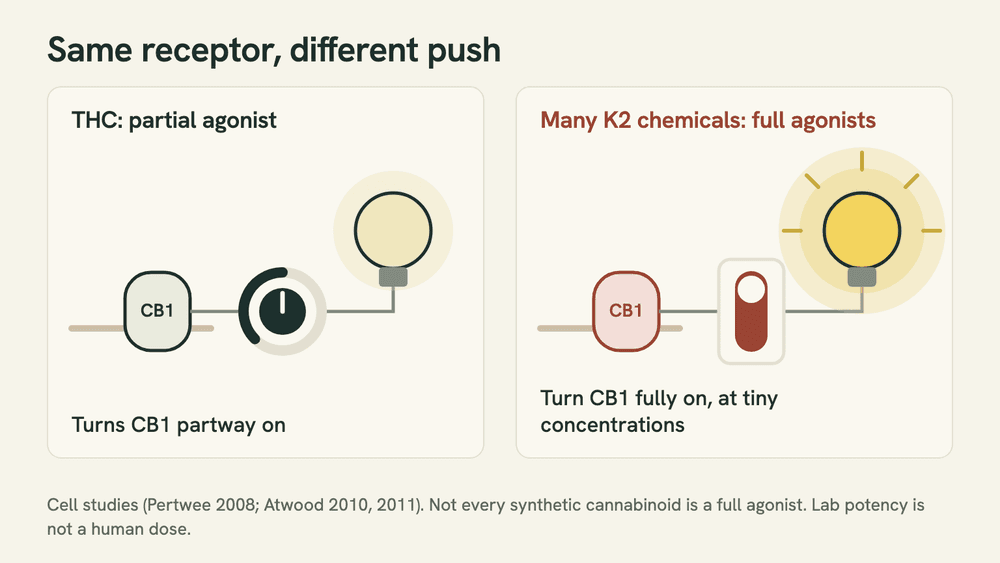
The 2014 review pulls the wider picture together. It reports that synthetic cannabinoids generally have "greater binding affinity to the cannabinoid CB1 receptor" than THC does, and that in lab and animal studies their effects are 2 to 100 times more potent than THC. That range comes from lab and animal work, so it is not a human dose ratio. The review is also careful about exceptions: its pharmacology tables list some synthetic cannabinoids, such as RCS-4, as partial agonists, and some assays have measured THC as closer to a full agonist. The accurate statement is that many K2 chemicals, not all, are full agonists, and as a group they act at much lower doses.
Why does that matter to a person? In receptor terms, a partial agonist has a limit to how far it can push CB1, even as the amount goes up. With a full agonist that works at tiny amounts, a small difference in how much chemical ends up on a batch of plant material can mean a large difference in effect. CDC investigators of a 2018 outbreak described synthetic cannabinoid products as unregulated, "resulting in variable product compositions." Strong receptor action plus unknown, changing contents is the mechanism behind the record below. For where these drugs sit next to plant cannabinoids and the body's own endocannabinoids, see our map of the cannabinoid families.
K2 vs weed, row by row
Here is the comparison in one place, with every K2 cell drawn from the sources linked on this page. The cannabis column is not a safety endorsement. Cannabis has a different and better-characterized risk profile, with harms of its own. NIDA's cannabis research summary estimates that 22% to 30% of people who use cannabis have cannabis use disorder, and the FDA's 2022 alert on THC edibles reported 10,448 poison-center cases involving only THC edibles from January 2021 to May 2022, 77% of them in people 19 or younger.
| Question | K2 / synthetic cannabinoids | Cannabis (THC) |
|---|---|---|
| What it is | Lab-made chemicals added to dried plant material, often labeled "herbal incense" or "not for human consumption" | A plant; THC and the other cannabinoids are made by the plant itself |
| Action at the CB1 receptor | Many, starting with JWH-018, act as full, high-efficacy agonists in cell studies; some are partial | THC is usually described as a partial, low-efficacy agonist |
| Potency | 2 to 100 times THC in lab and animal studies (not a human dose ratio) | The reference point |
| Batch consistency | Unregulated, with variable compositions; new compounds keep appearing | THC is one known molecule; strength varies by product, and lab reports exist where products are legal |
| Documented mass poisonings | 33 people in one New York City neighborhood on one day (2016); 155 cases and 4 deaths in Illinois (2018) | No comparable cluster in the sources reviewed here; documented harms include use disorder and child edible poisonings |
| Sought emergency treatment in the past year (one survey of 22,289 people) | 1.0% of users; about 30 times the risk per estimated day of use | 0.2% of users |
| Among people who had used both (2011 survey) | Rated worse for negative effects, hangover and paranoia | Preferred by 93% |
| Routine THC drug screen | Generally not detected; specialized lab tests exist but lag behind new compounds | Built to detect a THC metabolite |
| Federal status (as of October 17, 2026) | Schedule I for "cannabimimetic agents" and named compounds since July 9, 2012; more listed since | Schedule III only for state-licensed medical marijuana and FDA-approved drugs (since April 28, 2026, under court challenge); all other marijuana Schedule I |
Read the table as two different kinds of risk, not a "safe" column and an "unsafe" one. The harms of cannabis are real, and because they have been studied for decades, they are more predictable. The harms of K2 come from chemicals that change faster than anyone can study them, which is why the next section is a list of dated events rather than a settled profile.
The record: what K2 outbreaks actually looked like
On July 12, 2016, 33 people in one New York City neighborhood were intoxicated at the same time, and 18 were taken to hospitals. The investigation published in the New England Journal of Medicine traced the cluster to an herbal "incense" product containing AMB-FUBINACA, a synthetic cannabinoid the authors called "ultrapotent." Its acid metabolite was found in all 8 patients whose samples were tested. The authors wrote that the drug's potency was "consistent with strong depressant effects that account for the 'zombielike' behavior" seen in the patients.
Two years later, a different kind of danger appeared in Illinois. The CDC report on the outbreak counted, as of April 25, 2018, 155 cases, 4 deaths and 147 people hospitalized. The median age was 32, and 81% of patients had blood in their urine. Every one of the 81 patient specimens analyzed contained brodifacoum, and 38 more patients had been reported in eight other states. CDC wrote that the reason brodifacoum was present in the synthetic cannabinoids is not known. One hospital's view of the same outbreak, a 34-patient case series in NEJM, found brodifacoum in all 15 patients tested, and one patient died of bleeding inside the skull. Because the contaminant thins the blood, the outbreak also matters for donors, which our guide to plasma donation and cannabis covers in detail.
Outbreaks show the extremes. User surveys show the everyday comparison, from people who have tried both. In a 2011 Global Drug Survey analysis of 14,966 people, 2,513 had ever used synthetic cannabis and 980 had used it in the past year, and 99% of those recent users had also used natural cannabis. Among people who had used both, 93% preferred natural cannabis, and they rated synthetic cannabis worse for negative effects, hangover and paranoia, with a faster onset and a shorter duration. A later survey of 22,289 people asked about emergency care. In the past year, 0.2% of cannabis users (37 people) and 1.0% of synthetic cannabinoid users (21 people) had sought emergency medical treatment. Calculated per estimated day of use, the risk was about 30 times higher for synthetic cannabinoids (95% confidence interval 17.5 to 51.2). The authors say the findings "must be treated with caution": respondents were self-selected online, only 21 people were in the synthetic group's count, and the use-days were estimates.
None of this means every use ends in an emergency room, and an honest comparison has to say so. A 2016 systematic review of about 4,000 cases in 106 studies found that most presentations were not serious: typically young men with a fast heart rate, agitation and nausea, and hospital stays of less than 8 hours. The same review counted at least 26 deaths and serious complications including heart attacks, ischemic strokes, acute kidney injury, seizures, psychosis and repeated vomiting. In the 2016 CDC report, US medical toxicologists had treated 456 patients for synthetic cannabinoid poisoning between 2010 and 2015, 277 of them with no other drug involved, and the most common signs were neurologic: agitation, coma-like depression of the nervous system, and delirium or toxic psychosis. For most people the episode is short and rough. The severe tail is real, and nobody can predict in advance who lands in it. For the kidney and liver side of that record, see how cannabis and synthetic cannabinoids compare on organ harm.
Effects and warning signs that differ from cannabis
The 2014 review sums up the acute effects of synthetic cannabinoids as similar to THC's, "but with greater intensity, resulting in medical and psychiatric emergencies." That is the practical difference. Too much THC usually means anxiety, a racing heart, vomiting and a frightening few hours, which our guide to greening out walks through, including when that becomes a 911 call. The signs below come from K2 case reviews, outbreak reports and health department guidance. There is no "safe amount" of an unknown chemical, so this list is for recognizing trouble, not managing it. Any one of these is a reason to get medical help now: call 911 or go to an emergency department, and if you are not sure whether it is an emergency, call Poison Help at 1-800-222-1222.
- A seizure or uncontrolled jerking movements.
- Chest pain, a very fast or pounding heartbeat, or sudden weakness or trouble speaking. Heart attacks and strokes appear in the K2 case record.
- Severe agitation, confusion, hallucinations, paranoia or psychosis.
- A blank, slowed, "zombie-like" stupor, or someone who can't be woken.
- Vomiting that keeps coming back.
- Passing very little urine, or pain in the side or lower back, which can signal kidney injury.
- Unexplained bleeding: blood in the urine, nosebleeds, bleeding gums or heavy bruising. This was the pattern in the 2018 brodifacoum outbreak.
- Thoughts of suicide or self-harm. Call or text 988, or call 911 if there is immediate danger.
Does K2 show up on a drug test?
Usually not on a routine one, and that is a medical problem before it is anything else. Standard THC panels are built to find a THC metabolite, and K2 chemicals are not THC, so they are not what those tests look for. NIDA describes synthetic cannabinoids as mostly undetected by routine urine drug screens, and New York City's health department says K2 does not show up on standard toxicology tests. Our guide to the 10-panel drug test explains what a standard panel actually targets. The 2014 NIDA-led review gives a sense of the gap: in a 2012 Army study it reports, 2.5% of 10,000 randomly collected urine samples that had already screened negative for routinely tested drugs were positive for synthetic cannabinoids.
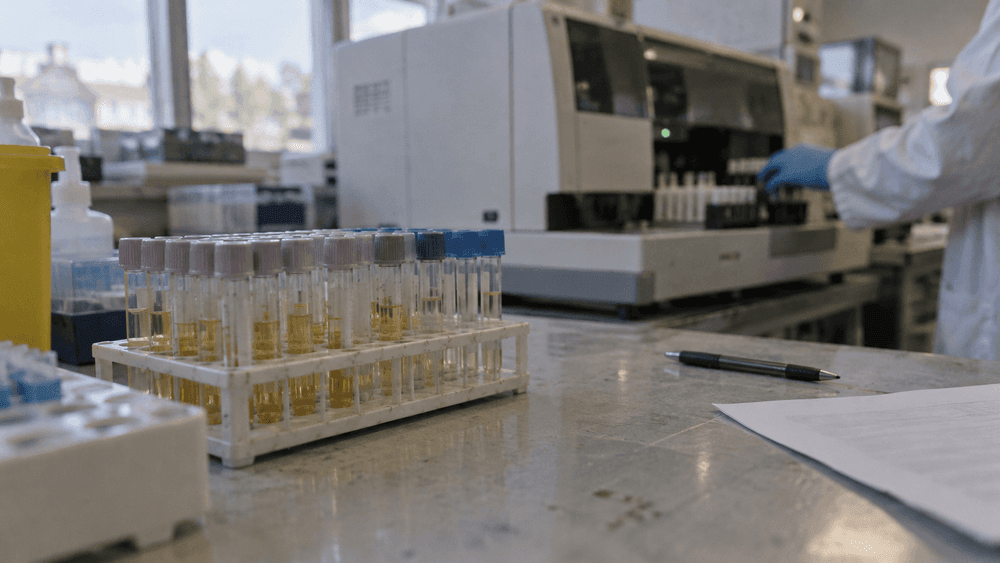
Specialized laboratory methods for synthetic cannabinoids do exist, but they chase a moving target. The 2014 review warns that a stream of new compounds may not be detectable by routine laboratory tests, and the 2016 CDC report notes that enforcement is hampered by "the continual introduction of new chemical compounds." This is not a loophole. Specific tests are available, and the outbreak record above is the price of a drug nobody can measure in advance. What it means in practice is that a negative screen in an emergency department does not rule out K2 poisoning. If you are with someone who is unwell, tell the clinicians exactly what was taken and bring any packaging, so they are not working from a test that was never designed to find it.
Is K2 legal?
No. As of October 17, 2026, the federal picture looks like this. The Synthetic Drug Abuse Prevention Act of 2012, part of Pub. L. 112-144 and signed July 9, 2012, placed "cannabimimetic agents" in Schedule I. It defined them as substances that act as CB1 receptor agonists in binding and functional studies, across five structural classes, and it named 15 compounds outright, including JWH-018, JWH-073 and CP-47,497. The same law lengthened the time the DEA can temporarily schedule new drugs. By 2017, the CDC outbreak report notes, 26 synthetic cannabinoids were listed in Schedule I, and the current federal Schedule I list now includes both AMB-FUBINACA, the New York outbreak chemical, and 4-CN-CUMYL-BUTINACA, found in a counterfeit sold as CBD in Utah. A label that says "not for human consumption" does not change any of that. States have their own laws too, and this is general information, not legal advice.
Cannabis sits somewhere different. Since April 28, 2026, marijuana in an FDA-approved drug product or covered by a state medical marijuana license has been in Schedule III, and all other marijuana remains in Schedule I. Court challenges to that rule are still pending, as our coverage of the Schedule III ruling explains. Hemp follows a separate statute, and its definition is about to change. Under P.L. 119-37, with its timing set by P.L. 119-103, the federal hemp definition will exclude, starting November 12, 2026, hemp-derived products containing cannabinoids "not capable of being naturally produced by a Cannabis sativa L. plant"; most of the rest of the rewrite, including the exclusion for cannabinoids that "were synthesized or manufactured outside the plant," is set to apply after December 11, 2026. Our guide to hemp-derived THC and our report on the December 11 delay cover what that means for hemp products.
When K2 shows up inside weed or "CBD"
Synthetic cannabinoids do not only travel as K2. They have also turned up as an adulterant in products sold as something else. When they are sprayed onto ordinary cannabis, nothing about the look or smell reliably gives them away, which is the argument our guide to whether weed can be laced makes in full. They have also been sold as CBD. In a Utah investigation reported by CDC in 2018, 52 suspected cases of illness from October 2017 to January 2018 were linked to products sold as CBD, and 9 product samples contained the synthetic cannabinoid 4-CCB and no CBD at all. That was a counterfeit in one state, not a finding about regulated hemp or CBD products, and our guide to spotting fake CBD oil covers how to check what you are buying.
What is still unknown
Several important questions have no good answer yet. Both the 2014 review and the 2016 systematic review say the long-term effects of synthetic cannabinoids are unknown. Nobody knows how often K2 use leads to harm, because case reports and registries count the people who reached a hospital, with no count of everyone who used it. The survey numbers on this page come from self-selected online samples. The potency figures come from cells and animals and do not convert into human doses. CDC never established why brodifacoum ended up in the Illinois products. And because the chemicals sold as K2 change from year to year, any comparison, including this one, is a snapshot of the compounds that have been studied, not of whatever is in the next batch.
Frequently asked questions about K2 and weed
No. K2 is lab-made chemicals sprayed onto dried plant material, and the plant is only a carrier. The 2010 JWH-018 study notes that Spice products had not been reported to contain THC at all. NIDA says synthetic cannabinoids are chemically similar to cannabis compounds but often produce very different effects, and many act on the CB1 receptor far more forcefully than THC does.
Per amount, usually far more potent: lab and animal studies put synthetic cannabinoids at 2 to 100 times the potency of THC, and many are full agonists at CB1 where THC is a partial one. That is not a human dose ratio. "Stronger" also undersells the problem, because the contents change from batch to batch. K2 is less a stronger high than a less predictable drug.
Three things stack up. Many of its chemicals switch CB1 fully on at tiny concentrations. Nobody knows which chemical, or how much of it, is in a given batch. And products can carry contaminants, like the rat poison brodifacoum found in Illinois in 2018. In one survey, emergency treatment was about 30 times more likely per day of use than with cannabis, a figure its authors say to treat with caution.
Routine THC panels generally do not detect it, because they are built to find a THC metabolite and K2 chemicals are not THC. Specialized laboratory tests exist, but they lag behind new compounds. The practical point is medical: a negative screen does not rule out K2 poisoning, so tell clinicians exactly what was taken.
No. The Synthetic Drug Abuse Prevention Act, signed July 9, 2012, placed "cannabimimetic agents" and 15 named compounds in federal Schedule I, and more have been listed since, including the chemicals behind the 2016 New York and 2017-2018 Utah poisonings. A "not for human consumption" label does not change that. This is general information as of October 17, 2026, not legal advice.
Call 911 for a seizure, chest pain, trouble breathing, collapse, extreme agitation or confusion, unexplained bleeding, or someone who can't be woken. Otherwise call Poison Help at 1-800-222-1222, which is free, confidential and answered 24/7. Stay with the person, keep any packaging, and tell responders what was taken. For an emotional or suicidal crisis, call or text 988.
Synthetic cannabinoids come up in donor screening for a specific reason: the 2018 outbreak tied contaminated products to brodifacoum, a long-acting blood thinner. Our plasma donation guide, linked in the outbreak section above, explains why synthetic cannabinoids are treated differently from cannabis. Answer the donor center's questions honestly, and check with them before donating.
Not in the same sense. Delta-8 THC and HHC are semi-synthetic cannabinoids, typically produced by chemically converting compounds from hemp, and they are close relatives of THC. The chemicals sold as K2 are a separate, fully lab-made class. That does not make delta-8 or HHC risk-free; the HHC explainer linked near the top of this page covers what is and is not known.
If your real worry is weed that might contain something it shouldn't, the next read is how to tell if weed is laced, and why sight-and-smell checklists fall short. And if you want the bigger picture of how synthetic cannabinoids relate to THC, CBD and the body's own signaling molecules, start with what cannabinoids are.
Writing about hemp, wellness and the small rituals that keep us balanced.