NyQuil and Weed: What Each Ingredient Does With THC
Most NyQuil boxes hold three drugs, and THC meets each one differently. What the current labels say, what the one human study found, why drowsiness can reach the next morning, and when to call a pharmacist or get help.
You are sick, you have taken NyQuil or are about to, and you also use cannabis. So can you mix NyQuil and weed tonight? Here is the short answer. As of October 2026, we found no well-documented chemical interaction between THC and NyQuil's ingredients, and the one human trial we found that gave THC with NyQuil's cough suppressant saw no change in its blood levels. The known risk is a different one: NyQuil's antihistamine and THC both make you drowsy and impaired, the effects add up, and the antihistamine lingers long enough to reach the next morning. Do not drive, and read the Drug Facts on your own box first. This is general information for adults 21 and over where cannabis is legal, not medical advice, and a pharmacist is the right person to check your exact box against everything else you take.
What is actually in your NyQuil
NyQuil is not one product. DailyMed, the National Library of Medicine's database of official drug labels, lists 64 NyQuil label records, and the three we checked all show updates from early October 2026. Formulas differ from box to box, so the only label that counts is the one in your hand. These are the three flagship versions, as printed on the labels we read on October 16, 2026.
| Product | One adult dose | Acetaminophen | Dextromethorphan HBr | Doxylamine succinate | Also in it |
|---|---|---|---|---|---|
| NyQuil Cold & Flu Liquid | 30 mL every 6 hours, no more than 4 doses in 24 hours | 650 mg | 30 mg | 12.5 mg | Alcohol (carton prints "Alcohol 10%") |
| NyQuil Cold & Flu LiquiCaps | 2 LiquiCaps every 6 hours, no more than 8 in 24 hours | 650 mg (325 mg each) | 30 mg (15 mg each) | 12.5 mg (6.25 mg each) | No alcohol listed |
| NyQuil Severe Cold & Flu Liquid | 30 mL every 4 hours, no more than 4 doses in 24 hours | 650 mg | 20 mg | 12.5 mg | Phenylephrine HCl 10 mg; alcohol (carton prints "Alcohol 10%") |
Read across the rows and a pattern appears. The NyQuil Cold & Flu Liquid label and the Cold & Flu LiquiCaps label deliver the same three drugs at the same amounts per dose. The difference is that the liquid contains alcohol and the capsules list none. The Severe Cold & Flu Liquid carries less dextromethorphan and adds a decongestant. Other boxes break the pattern entirely: some NyQuil versions use diphenhydramine (the antihistamine in Benadryl) or chlorpheniramine instead of doxylamine. If your box is not one of these three, our CBD and Benadryl guide keeps the full NyQuil label table, version by version.
Can you take NyQuil and smoke weed? Ingredient by ingredient
Start with the label, because it is written for you. Both Cold & Flu labels say, under When using this product: "marked drowsiness may occur", "avoid alcoholic drinks", "be careful when driving a motor vehicle or operating machinery" and "alcohol, sedatives, and tranquilizers may increase drowsiness." They also tell you to ask a doctor or pharmacist before use if you are "taking sedatives or tranquilizers." The label does not name cannabis. It warns about alcohol, sedatives and tranquilizers, and THC's own prescription label lists antihistamines among the drugs that add to its sedation:
“Concomitant use of other drugs that cause dizziness, confusion, sedation, or somnolence such as CNS depressants may increase this effect.”
That sentence comes from the prescribing information for dronabinol (Marinol), a prescription capsule of synthetic THC. Its examples include ethanol and antihistamines, and the same section tells patients not to drive or operate machinery "until they are reasonably certain that MARINOL does not affect them adversely." Doxylamine's side carries a matching warning. The FDA-approved label of a prescription doxylamine tablet says combining it with other central nervous system depressants "may result in severe drowsiness leading to falls or accidents," and tells patients to avoid other sedating medications, including "other antihistamines (present in some cough and cold medications)." Two labels that point at each other are the closest thing to an official answer. Neither one, and no study we found, measured THC and doxylamine together. Here is how that plays out for each ingredient.
| NyQuil active | What it does | What is known with THC | What has not been measured | Practical note |
|---|---|---|---|---|
| Doxylamine succinate (12.5 mg per dose) | Sedating antihistamine; the "night" part of NyQuil | Added drowsiness is warned on both sides: the NyQuil label, the MARINOL label and a prescription doxylamine label | THC and doxylamine given together: no published study found as of October 2026 | The biggest overlap. Its long half-life means drowsiness can last into the next morning |
| Dextromethorphan HBr (30 mg per dose; 20 mg in Severe) | Cough suppressant | Brownies with 20 mg THC, with or without 640 mg CBD, did not change its blood levels in a trial of 18 healthy adults (Bansal 2023) | Smoked or vaped THC, repeated use, and how drowsy THC and dextromethorphan make you together | No measured liver clash. Taking more than the label allows is a separate emergency pattern (see below) |
| Acetaminophen (650 mg per dose) | Pain and fever reducer | Neither label names an interaction with THC | No study cited here gave THC with acetaminophen | The printed hazard is doubling up: never add another acetaminophen product |
| Alcohol (liquid versions; "Alcohol 10%" on the carton) | Part of the liquid formula | The MARINOL label names ethanol among drugs that add to THC's sedation | How much the alcohol in a dose adds when THC is on board | The label says to avoid alcoholic drinks. LiquiCaps list no alcohol |
| Phenylephrine HCl (10 mg in Severe Liquid) | Oral decongestant | Nothing measured | Any interaction with THC | FDA proposed removing it in 2024 over effectiveness, not safety; no final order found as of October 16, 2026 |
Dextromethorphan. Some pages claim cannabis slows the liver enzyme that clears dextromethorphan, so NyQuil would hit harder or last longer. That idea comes from test-tube work, and when it was tested in people it did not hold up. In a 2023 randomized crossover trial in 18 healthy adults, researchers gave cannabis-extract brownies with 20 mg of THC and no CBD, or 20 mg of THC plus 640 mg of CBD, followed by a cocktail of probe drugs that included 30 mg of dextromethorphan, the same amount as one 30 mL dose of NyQuil Cold & Flu Liquid. The CBD-plus-THC brownie raised blood levels of several other probe drugs but had no effect on dextromethorphan's levels or half-life. The authors report that the THC-only brownie inhibited none of the enzymes tested, although it lowered the ratio of dextromethorphan's main breakdown product to the drug itself by 30%. Keep the limits in the same breath: it was one oral dose, two participants were left out of the dextromethorphan analysis because their bodies break it down unusually slowly, the volunteers had used cannabis before, and smoked or vaped THC was not tested. This paper reports blood levels, not how drowsy the combination makes you.
Acetaminophen. The hazard printed on the box is not cannabis; it is taking acetaminophen twice. The label says: "Do not use with any other drug containing acetaminophen (prescription or nonprescription)," and its liver warning says severe liver damage may occur if you take it with other acetaminophen products or with 3 or more alcoholic drinks every day while using it. The FDA's acetaminophen guidance makes the same point: "Do not use more than one acetaminophen-containing product at a time," because "you could accidentally take too much." A Tylenol for a headache on top of a NyQuil dose is the classic way that happens. For how cannabinoids and acetaminophen meet in the liver, see our CBD and Tylenol guide, and for what the evidence says about cannabis and liver health in general, read is weed bad for your liver?
Phenylephrine. Only the Severe version in our table contains it. On November 7, 2024, the FDA proposed ending the use of oral phenylephrine as an over-the-counter decongestant because "oral phenylephrine is not effective for this use," and stressed that the proposal "is based on effectiveness concerns, not on safety concerns." As of October 16, 2026 we found no final order, and phenylephrine is still printed on current Severe labels. Nothing about it has been measured with THC.
The drowsiness math: why it can reach the next morning
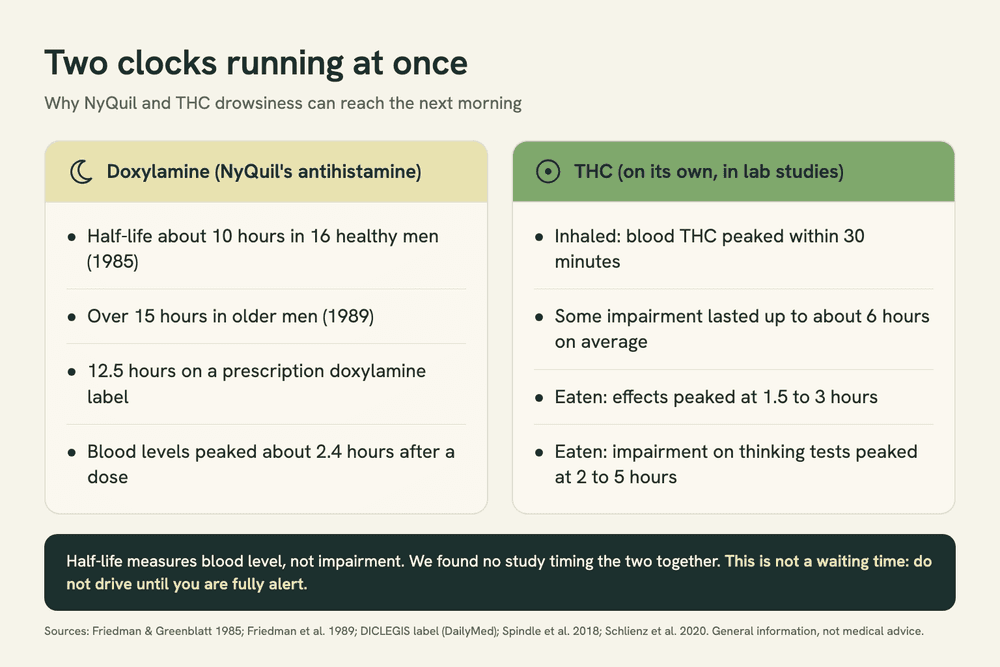
Doxylamine is the ingredient that matters most here, and its clock runs longer than most people assume. Half-life is the time it takes for the amount of a drug in your blood to fall by half. In a 1985 study of 16 healthy men given a single 25 mg dose, twice the doxylamine in one NyQuil dose, the half-life averaged about 10 hours, and blood levels peaked about 2.4 hours after the dose. A 1989 study comparing younger and older adults found it averaged over 15 hours in older men, against about 10 hours in younger men; in women the gap (12.2 vs 10.1 hours) was not statistically significant. The current prescription doxylamine label puts it at 12.5 hours.
In plain terms, roughly 10 hours after a dose, about half of that dose's doxylamine can still be in your blood. Blood level is not the same as impairment, and people vary, but it explains why the FDA's consumer page on medicines and driving has a section headed "Some Sleep Medicines Can Impair You, Even the Next Morning." Its list of medicines that might affect driving includes cold remedies and allergy medicines that contain an antihistamine. Right after that list, the agency writes that "taking products containing cannabis or cannabis-derived compounds, including CBD, could make driving dangerous." It does not say the two together are worse, and we found no study that measured that.
THC runs on its own clock. In a controlled study of 17 adults who rarely used cannabis, smoking or vaping made blood THC and heart rate peak within 30 minutes, and both were back to baseline in 3 to 4 hours, yet some effects and measurable impairment lasted up to about 6 hours on average. Those figures describe THC alone, in a lab, in people who had not taken NyQuil. They are not a waiting time. Put a sedating antihistamine with a long half-life on top and you have two clocks running at once that, as far as we found, no study has timed together. Our guide to cannabinoids and driving covers impairment testing and DUI law.
There is also the night itself. Stacking sedating substances at bedtime does more than make you sleepy, and our guide to whether it is bad to sleep high explains how alcohol, sleep medicines and antihistamines pile onto THC and what that means for your sleep. The practical rule for this page is simpler. If you have taken NyQuil and used cannabis, plan on not driving or doing safety-sensitive work the next morning until you are fully alert, and if you are older, expect the antihistamine to linger longer.
NyQuil and edibles vs smoking when you are sick
How you take THC changes how the two clocks overlap. Smoked or vaped THC acts within minutes and peaks early. Edibles start slower and peak later: in a controlled study of 17 adults eating cannabis brownies, nothing was felt for 30 to 60 minutes, effects peaked at 1.5 to 3 hours, and impairment on thinking tests peaked between 2 and 5 hours after eating. Doxylamine peaked at about 2.4 hours in the 1985 study. So an edible taken around the same time as a NyQuil dose can peak in roughly the same window, and both are still on board hours later. Why edibles take so long to kick in explains the biology, including why people take a second dose too soon.
No single number fits everyone, because several things change the overlap:
- Route: inhaled THC peaked within about 30 minutes in the lab; eaten THC peaked at 1.5 to 3 hours.
- Amount: in the lab studies above, higher THC doses produced more impairment.
- How often you use: those lab numbers come from people who rarely use cannabis, and regular users can respond differently.
- Age: doxylamine's half-life was longer in older men in the 1989 study.
- Which NyQuil: the liquids add alcohol, Severe adds phenylephrine, and some versions use a different antihistamine.
- Everything else in your system: alcohol, sleep aids, other antihistamines or prescription sedatives each add drowsiness of their own.
Then there is the cold itself. Smoking sends smoke into the same airways your cough medicine is trying to settle. Whether smoking while sick affects your recovery is its own question, covered in does weed weaken your immune system? To be clear about what this page does not say: we found no evidence that cannabis eases cold or flu symptoms or helps you sleep when you are sick, and we do not claim it does.
Liquid NyQuil already contains alcohol
This is the detail most pages miss. The cartons of NyQuil Cold & Flu Liquid and Severe Cold & Flu Liquid print "Alcohol 10%," and alcohol appears in the liquid's inactive ingredients. The same label tells you to "avoid alcoholic drinks." The LiquiCaps list no alcohol. A dose of liquid NyQuil is not a drink, but it does mean liquid NyQuil plus cannabis brings three things that each add drowsiness: doxylamine, the alcohol in the formula and THC. The NyQuil label warns that alcohol may increase drowsiness, and the dronabinol label names ethanol among the drugs that add to THC's sedation.
Add an actual drink and you are in crossfaded territory with a sedating antihistamine on top. Our crossfaded guide covers what happens when alcohol and weed are stacked, before any cold medicine enters the picture.

When it is an emergency
Know the signs that mean this is no longer a groggy night. Call 911 if someone who has taken NyQuil and used cannabis:
- Cannot be woken, or does not respond normally
- Has slow, shallow or troubled breathing
- Collapses or has a seizure
- Vomits while very drowsy or hard to rouse
- Has chest pain or severe confusion
One more pattern belongs here, as harm reduction and nothing more. Dextromethorphan is sometimes misused in amounts far above the label, and cannabis shows up often when it is. In a review of 1,382 dextromethorphan misuse cases reported to the California Poison Control System from 1999 to 2004, 20.1% involved another substance by history, and marijuana was the second most common (40 cases), after alcohol (93). All 7 cases with the most serious outcomes involved serious breathing complications, such as slowed breathing or inhaling vomit, severe enough to need a breathing tube; 5 of those 7 involved other substances. The study has real limits: about three in four cases were aged 9 to 17, other substances were self-reported, the data are about 20 years old, and the authors found no significant difference in moderate or major outcomes with or without another substance. The point is narrow. Taking more NyQuil than the label allows is not a way to use it with cannabis; it is a documented emergency pattern. If it has happened, call Poison Help at 1-800-222-1222, or 911 if breathing is affected. If the problem is simply too much THC, our greening out guide covers what usually happens and when to get help.
What to tell a pharmacist before you combine them
A pharmacist can check your exact box against everything else you take, and the NyQuil label itself tells you to ask one before use if you take sedatives or tranquilizers. Cannabis belongs in that conversation, whether or not it is legal where you live. You are not asking permission; you are giving them what they need to judge your total sedation load. Bring this list:
- 1The exact product and its Drug Facts panel: Cold & Flu, Severe, LiquiCaps, a store brand, or a DayQuil and NyQuil combo pack.
- 2That you use cannabis, how (smoked, vaped or edible), roughly how much and how often.
- 3Every other sedating substance: sleep aids, other antihistamines, prescription sedatives or anxiety medicines, opioids and alcohol.
- 4Any other acetaminophen you have taken today, including Tylenol and other cold, flu or pain products.
- 5Your other prescriptions, especially the blood thinner warfarin, which the NyQuil label names.
- 6Conditions the label asks about: liver disease, glaucoma, breathing problems, or trouble urinating because of an enlarged prostate.
- 7Your age, since doxylamine lingered longer in older men in the 1989 study.
- 8Whether you need to drive, care for a child or do safety-sensitive work in the next day.

What is still unknown
More than most pages admit. As of October 2026, we found no published study that gave people THC together with doxylamine: a PubMed search we ran on October 16, 2026 returned 12 records mentioning doxylamine alongside cannabis, THC or a cannabinoid medicine, and none was a study giving the two together. The only human trial we found of THC with dextromethorphan gave a single oral dose in brownies, and its result is about blood levels, not impairment. We found no study of smoked or vaped THC with doxylamine or dextromethorphan, and none that measured driving or next-morning alertness with THC and NyQuil's antihistamine. The doxylamine numbers come from small, single-dose studies in healthy adults. Until that changes, the honest answer is the one the labels already give: drugs that each cause drowsiness add up, and the sensible planning assumption is that you will be impaired for longer than you feel.
NyQuil and weed: questions people ask
There is no tested waiting time, and we will not invent one. Several things decide it: doxylamine's half-life averaged about 10 hours in healthy men and over 15 hours in older men, THC's own effects last hours depending on route and amount, and blood level is not the same as impairment. We found no study that timed the two together. The overlap that matters most is the next morning, so do not drive until you are fully alert, and ask a pharmacist about your specific box and situation.
The same added-drowsiness warning applies, with a timing problem on top. In a controlled study, eaten THC took 30 to 60 minutes to be felt and peaked at 1.5 to 3 hours, with impairment on thinking tests peaking between 2 and 5 hours, while doxylamine peaked at about 2.4 hours in its own study. The two can peak together rather than one after the other. Talk to a pharmacist first, and do not drive.
Partly. The DayQuil Cold & Flu LiquiCaps label lists acetaminophen 325 mg, dextromethorphan 10 mg and phenylephrine 5 mg per LiquiCap, and no antihistamine, so the stacked drowsiness from doxylamine mostly falls away. Acetaminophen double-dosing still applies, THC still impairs you on its own, and the label says to stop and ask a doctor if you get nervous, dizzy or sleepless. Some combo packs contain both DayQuil and NyQuil, so check which one you are holding.
ZzzQuil is a sleep aid, not a cold medicine, and its antihistamine is diphenhydramine, the one in Benadryl, rather than doxylamine. The same logic applies: two sedating inputs add up, and next-morning driving is the concern. Our CBD and Benadryl guide covers diphenhydramine and its labels in detail.
NyQuil contains no THC. Its antihistamine has a different testing quirk: the label of a prescription doxylamine product says false-positive screens for methadone, opiates and PCP can occur, and confirmation tests such as gas chromatography tell them apart. If you are being tested, tell the lab or medical review officer what you took.
That is a separate question with its own answer, and our CBD and Benadryl guide covers it, including the full NyQuil label table and what the brownie trial found for the other drugs it tested.
That depends less on NyQuil and more on your airways and your recovery, which our article on whether weed weakens your immune system covers. Nothing in the evidence on this page shows that cannabis eases cold or flu symptoms or helps you sleep when you are sick.
NyQuil is one of many medicines people take alongside cannabis. For the wider picture, including which medicines run through the liver enzymes that cannabinoids can affect and which ones meet them through added sedation instead, read our guide to CBD and medications. If a drug test is what worries you, what a 10-panel drug test screens for explains what standard panels look for.
Writing about hemp, wellness and the small rituals that keep us balanced.