Can You Smoke Weed With a Concussion? What Studies Found
You hit your head and you use cannabis. Here is what CDC says to watch for first, what the human studies on weed and concussion actually found, why THC blurs the symptoms your recovery is judged by, and what to tell your clinician.
You hit your head, in a game, a fall or a car door, and now you want to know: can you smoke weed with a concussion, or is tonight a problem? No randomized trial has tested cannabis or CBD in people with a concussion, so nobody can honestly tell you it helps or that it is safe, and THC's short-term effects look a lot like concussion symptoms. Get assessed, tell your clinician what you use, and do not drive. Check the danger signs below before anything else. This is general information for adults, not medical advice.
First: the danger signs that mean 911, not a blog post
That list comes from CDC's page on the symptoms of mild TBI and concussion, dated September 15, 2025. Two more points come before anything about cannabis. First, CDC's overview of mild TBI and concussion says plainly that people with one "need to be seen by a healthcare provider," even when the knock seemed minor. Second, a rule of our own, not CDC's: if you are high and cannot tell whether a symptom is the drug or the injury, treat it as the injury. Sleepiness and vomiting are both listed side effects of prescription THC, and both are on that emergency list. Nobody should be guessing which one is causing them.
What a concussion does, and what recovery asks of you
A concussion is a mild traumatic brain injury (mild TBI). CDC describes the cause as "a bump, blow, or jolt to the head," or a hit to the body that makes the brain move quickly inside the skull. That movement can cause "chemical changes in the brain" and stretch and damage brain cells. CDC notes that a brain scan is not needed to spot a concussion, though one may be used if bleeding in the brain is a concern. A clinician assesses you, and tests of learning, memory, concentration and problem solving, sometimes called neurocognitive tests, can help identify the effects. CDC also notes that people with repeated concussions may have a longer recovery.
CDC sorts concussion symptoms into four groups:
- Physical: bothered by light or noise, dizziness or balance problems, feeling tired with no energy, headaches, nausea or vomiting early on, vision problems.
- Thinking: attention or concentration problems, feeling slowed down, feeling foggy or groggy, memory problems, trouble thinking clearly.
- Emotional: anxiety or nervousness, irritability, being more emotional than usual, sadness.
- Sleep: sleeping less than usual, sleeping more than usual, trouble falling asleep.
The good news first: CDC says most people with a concussion "feel better within a couple of weeks." CDC's guidance on what to do after a concussion says "resting is good the first few days," with time off usually no more than 1 to 2 days, and then a gradual return to your regular activities "even if you still have some mild symptoms." If symptoms get worse, you cut back on that activity. You should see a provider if symptoms do not go away within 2 to 3 weeks, and CDC tells you to "ask your health care provider for written instructions about when you can safely return to work, school, or other activities, such as driving a car." It also says "anxiety and depression may make it harder to adjust," and defines recovery as being able to do your regular activities without symptoms.
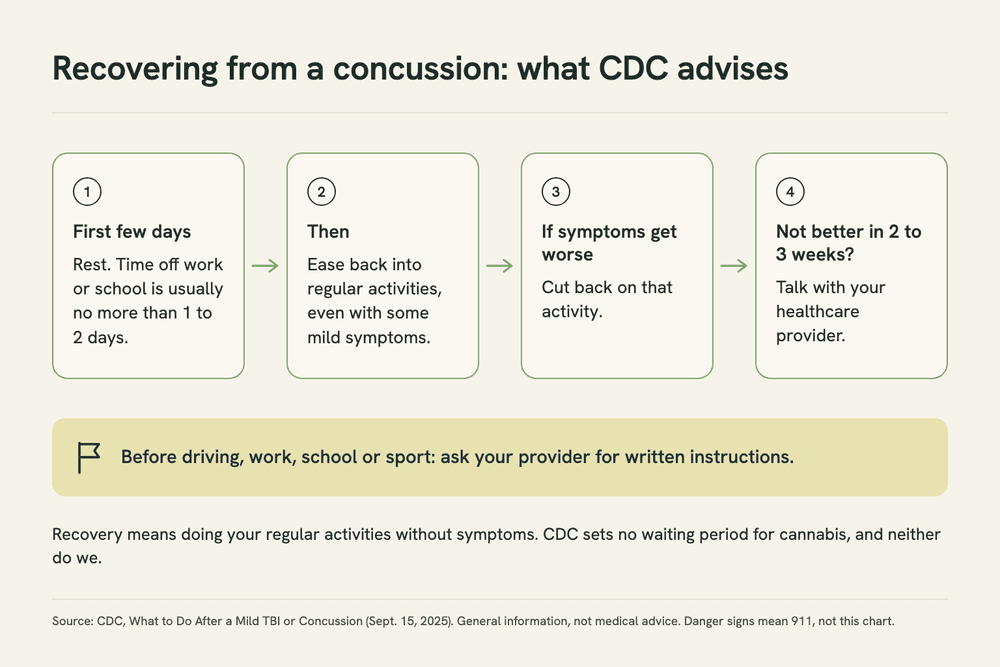
Notice what that means. Your recovery is judged almost entirely by how you feel and how you perform on thinking tests. CDC itself warns that concussion symptoms "may be difficult to sort out as they are similar to other health problems," and that a person "may not recognize or admit that they are having problems." Anything that changes how you feel and think changes that readout. Keep that in mind as you read the studies.
What the human studies on cannabis and concussion actually found
The human research on weed and concussion is small, and all of it is observational, meaning researchers watched what people did rather than assigning cannabis at random. Four sets of data are worth knowing: a 2020 Toronto cohort of 307 people with a fresh concussion, a 2022 survey of 84 Canadian undergraduates, a 2026 chart review of 297 patients with post-concussion syndrome, and two large student surveys, one of 4,849 college-age adults and one of 894 university students. Here is what each one measured, and what it cannot tell you.
| Study | Design | Who | What was measured | What it found | What it cannot tell you |
|---|---|---|---|---|---|
| Lawrence 2020, Brain Injury | Prospective cohort, followed weekly for at least 4 weeks | 307 adults with a physician-diagnosed concussion, Toronto emergency department and concussion clinic, mean age 33.7 | Self-reported cannabis, alcohol and cigarette use in the acute period; physician-judged recovery; weekly symptom score | 43 people (14.0%) used cannabis. Use was not associated with time to recovery. Among people not yet recovered, users had lower symptom scores at week 3 (p = .061, not significant) and week 4 (p = .029) | Use was self-reported and not randomized; product, dose and route unknown; only 4 weeks; a symptom score is not recovery |
| Gallant 2022, Neuropsychological Rehabilitation | Cross-sectional questionnaire (one time point) | 84 undergraduates, 33 with a past concussion and 51 without | Head-injury history, substance use, current post-concussive symptoms | A concussion history went with more cannabis use. Among users, the more severe the concussion had been, the worse their ongoing symptoms, such as headaches and memory problems | Small, self-reported, one snapshot; cannot say which came first; the concussions were in the past, not fresh |
| Snyder 2026, NeuroRehabilitation | Retrospective chart review | 297 patients with post-concussion syndrome at a Honolulu neurology clinic, 2020 to 2023 | PHQ-2 depression screen against tobacco, alcohol, marijuana and antidepressant use before and after injury | 31% screened at risk for depression. Marijuana use before or after the injury was linked to higher risk; co-use of marijuana and antidepressants carried the highest risk | One clinic; PHQ-2 is a screen, not a diagnosis; association only; the abstract gives no effect sizes |
| Newman 2020, Journal of Neurotrauma; Wilson 2026, PLoS One | Cross-sectional surveys | 4,849 college-age adults; 894 university students | Cannabis-use-disorder screening scores, mood, self-reported concussion history | A concussion history went with higher cannabis-use-disorder scores, partly through depression and panic symptoms. More concussions went with more problematic substance use | Who uses, not what use does; past injuries; no timing of use relative to the injury |
Lawrence 2020 is the study page one gets wrong. It is the only one of these that followed people forward from a fresh, physician-diagnosed concussion, and its main result is that the 43 people who used cannabis recovered on the same timeline as everyone else. That is often summarized as "cannabis lowered symptoms," which is not what it showed. Among people who were still not recovered, users reported lower symptom scores at week four (p = .029); the week-three difference (p = .061) did not reach statistical significance. Use was self-reported and not randomized, and the abstract reports no adjustment for why people chose to use or how users differed from non-users, so this cannot show that cannabis eased symptoms. Alcohol was far more common in the same cohort: 40.7% drank during the acute period, against 14.0% who used cannabis.
Even the lead author did not read his result as a green light. Concussion Alliance, summarizing a 2019 interview, reported that he suggested people follow current clinical recommendations to avoid cannabis, alcohol and cigarettes, and quoted him:
“We would still recommend to [stop] use until further research supports or negates their use.”
Gallant 2022 points the other way, with its own limits. In this survey of Canadian undergraduates, those with a past concussion used more cannabis, and among the users, the more severe the concussion had been, the worse their ongoing post-concussive symptoms. The authors suggested long-term use "may be detrimental," possibly "exacerbating, rather than mitigating" symptoms. A single snapshot cannot say which came first: people with worse symptoms may simply use more.
Snyder 2026 is about mood. In a review of 297 patients with lingering post-concussion symptoms in Honolulu, 31% screened at risk for depression, and marijuana use before or after the injury was linked to higher risk. A prior antidepressant prescription was itself a strong predictor, and the highest risk was in people using marijuana alongside antidepressants. It is a chart review: it shows who was at risk, not what caused it. If you take an antidepressant, do not change it on your own; tell your prescriber about cannabis, and see what is known about combining Zoloft and weed.
The big surveys tell you who uses, not what use does. In the 4,849-person survey, part of the link between concussion history and cannabis use ran through depression and panic symptoms, which matters because mood is one of the four things a concussion changes. Put together, the honest reading is narrow: no study found that cannabis speeds recovery, no study found that a single use wrecks it, and two of them tie use to worse symptoms or mood. None was randomized, and none measured a specific product, dose or timing.
Why THC makes a concussion harder to read
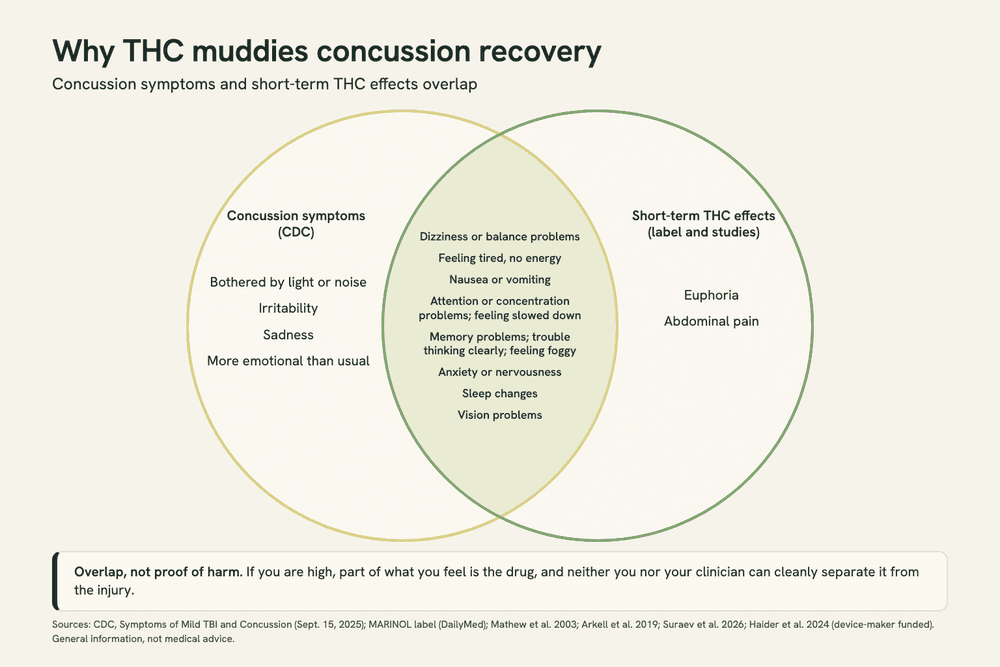
Even if cannabis did nothing to the injury itself, it would still change the signals you and your clinician use to track it. The FDA label for dronabinol (Marinol), a prescription form of THC, lists abdominal pain, dizziness, euphoria, nausea, paranoid reaction, somnolence (sleepiness), "thinking abnormal" and vomiting as its most common side effects. In a controlled study of 29 volunteers given IV THC or smoked marijuana, both caused dizziness on standing, and 28% reported severe symptoms. In a 2019 randomized crossover trial of 14 occasional users, vaporized THC-dominant cannabis slowed processing speed and impaired divided attention, and cannabis with an equal amount of CBD still impaired divided attention. A small 2026 sleep-lab trial found that one oral dose of 10 mg THC with 200 mg CBD cut REM sleep by about 34 minutes in 20 adults with insomnia. And a 2024 Buffalo study of 159 cannabis users found that being high changed pupil and gaze measurements of the kind clinicians use when assessing brain injury.
| Concussion symptom (CDC) | What THC can do in the short term | Source |
|---|---|---|
| Dizziness or balance problems | Dizziness is a common listed side effect; dizziness on standing after IV THC and smoked marijuana, severe in 28% | MARINOL label; Mathew 2003 (29 volunteers) |
| Feeling tired, no energy | Somnolence (sleepiness) is a common listed side effect | MARINOL label |
| Nausea or vomiting | Nausea and vomiting are common listed side effects | MARINOL label |
| Attention or concentration problems; feeling slowed down | Slower processing speed and impaired divided attention after vaporized THC-dominant cannabis | Arkell 2019 (14 occasional users) |
| Memory problems; trouble thinking clearly; feeling foggy | "Thinking abnormal" is a common listed side effect | MARINOL label |
| Anxiety or nervousness | "Paranoid reaction" is a common listed side effect | MARINOL label |
| Sleep changes | One dose of 10 mg THC with 200 mg CBD cut REM sleep by about 34 minutes and total sleep by about 25 minutes | Suraev 2026 (20 adults with insomnia, one night) |
| Vision problems | Changes in pupil size variability and gaze after inhaling cannabis until high | Haider 2024 (159 users; funded by the eye-tracking device maker) |
Read each row with its limits. The label describes a prescription capsule, not cannabis from a dispensary. The lab studies tested healthy or insomnia-affected adults, not people with a concussion. The eye-tracking study was funded by Oculogica, the maker of the EyeBOX device it used, and one author was a paid Oculogica advisor; its introduction notes that eye measurements like these "have been used to diagnose abnormalities" in conditions including traumatic brain injury. None of this shows THC damages an injured brain. It shows something more practical: if you are high, your dizziness, fatigue, fog and sleep are partly the drug's, and nobody, including you, can cleanly separate the two.
That plays out in four everyday ways. Driving: CDC asks you to get written instructions before you drive again, and THC impairs driving on its own; our guide to cannabinoids and driving covers the impairment research and the law. Sleep: sleep is one of CDC's four symptom groups, and whether it is bad to sleep high explains what THC does to sleep stages. Headache: headache is both a concussion symptom and something some people report with cannabis use or withdrawal, as our article on whether weed can cause headaches explains. Ringing in the ears: ringing that starts after a head injury is its own reason to call a doctor, which our guide to weed and tinnitus flags as well.
Does cannabis or CBD treat a concussion? Where the research stands
Start with the wider field. A 2021 review in the Journal of Neurotrauma opens with a sentence worth knowing: "There is not a single pharmacological agent with demonstrated therapeutic efficacy for traumatic brain injury." Not cannabis, not anything. The reviewers counted only a single phase III randomized trial of a cannabinoid in brain injury. That trial, published in Lancet Neurology in 2006, gave 861 people with severe brain injuries, across 86 centers in 15 countries, one IV dose of dexanabinol (a synthetic, non-intoxicating cannabinoid) or a placebo within 6 hours. Six months later, outcomes were the same: 50% vs 51% had an unfavorable result. The authors concluded it was "safe, but is not efficacious." That was severe injury and a lab-made drug, not a concussion and not cannabis, but it is the largest controlled test of any cannabinoid in brain injury, and it was negative.
For concussion and CBD specifically, there is a research rationale and no trial results. Researchers in Saskatchewan argued in a 2020 review that CBD deserves testing after concussion, and wrote that "double-blind randomized controlled trials are still required" to validate it. The same group ran a CBD dose-finding study registered as NCT06204003, with the National Football League and My Next Health Inc. listed as collaborators. According to the registry, it enrolled 34 healthy male university contact-sport athletes (40 were planned) and finished in November 2024. As of October 18, 2026, no results have been posted or published, and its published protocol makes clear it did not test anyone with a concussion. J. P. Neary, an author of both papers, holds a patent on the heart-monitoring (seismocardiography) device used in the protocol. The only published study we found that gave CBD to people with post-concussion syndrome is a four-person case series with no comparison group.
The only FDA-approved CBD medicine, Epidiolex, is approved for seizures associated with Lennox-Gastaut syndrome, Dravet syndrome or tuberous sclerosis complex, not for concussion or any brain injury. So no strain, product or dose is supported for a concussion, and pages ranking "best strains for concussion" are guessing. Most of the hopeful-sounding material you will find is animal and cell work, which cannot tell you what happens in a person.
You may also see a 2014 trauma-center study cited as proof that THC protects the brain. It reviewed 446 adults with traumatic brain injuries and a drug screen at one Level I trauma center, not people with concussions. Of the 82 who screened positive for THC, 2 died (2.4%), against 42 deaths (11.5%) in the rest, and the adjusted result only just reached significance (p = 0.049). A positive screen shows exposure, not dose or timing, and a 2020 systematic review found only one of eight studies reported a link like that. It cannot tell you anything about smoking after a concussion. Questions about long-term brain structure in healthy users are a different topic, covered in does weed kill brain cells?
Smoking, edibles or CBD with a head injury: what changes
People often ask whether a different way of using cannabis is "safer" with a concussion. No study has compared routes in concussed people, so here is only what the evidence supports about each.
Smoking. Inhaled THC acts within minutes and peaks around 15 to 30 minutes, so its effects stack directly on top of whatever you are feeling. Smoke of any kind also makes most people cough, as our explainer on why weed makes you cough covers. That is the only smoke-specific point the evidence supports here. Claims that coughing or smoke worsens a concussion are not backed by a study we could verify.
Edibles. Edibles avoid smoke, but they carry the same THC effects, with a timing problem added. A controlled study of eaten cannabis saw effects begin 30 to 60 minutes after dosing, and a widely cited pharmacology review puts the onset at 30 to 90 minutes with a peak 2 to 3 hours after eating. That delay makes it easy to take more before the first dose lands, and harder to tell, hours later, whether new dizziness or drowsiness is the edible or the injury. Why edibles take so long to kick in explains the biology.
CBD. CBD itself is not intoxicating, but it has no concussion trial results, and CBD products are not all THC-free: full-spectrum products can contain small amounts of THC. CBD can also cause side effects of its own, such as drowsiness, and can interact with some medicines. If you are taking anything for your concussion symptoms, CDC's advice applies: ask your healthcare provider which medications are safe during recovery, and mention any supplements or natural remedies, CBD included.
Athletes: return to play, sideline tests and drug testing
If your concussion happened in sport, the rules are stricter and the tests matter more. CDC's HEADS UP guidance on sports-related concussion, written mainly for youth sports, says to keep an athlete out of play "the same day of the injury and until cleared by a healthcare provider," that "the decision about return to sports is a medical decision," and that "returning to sports is a multi-step process that can take a week or more to complete." Returning too soon means a "greater chance of getting a repeat concussion." Those steps follow the 2022 Amsterdam consensus on concussion in sport, built on 10 systematic reviews, which produced the SCAT6 sideline assessment, a child version, and the SCOAT6 office assessment tool.
Those tools measure symptoms, balance, memory and concentration, the same functions THC changes in the controlled studies above. If you are high at a sideline or clinic assessment, your scores describe the drug and the injury together, and a return-to-play decision built on them is shakier. Tell your athletic trainer or team physician, even if it feels awkward. Once you are cleared and back in training, our guide to working out high covers what THC does to performance and coordination, and CBD in sports covers anti-doping rules and testing risk.
What to tell the clinician managing your concussion
Your clinician cannot read your symptoms or your test results properly without knowing what else is in your system. CDC's sport guidance already asks you to tell the provider about prescription and over-the-counter medicines and natural remedies, along with details of the injury. Add cannabis to that conversation. Bring this list:
- 1What you use: flower, vape, edible, concentrate or CBD oil, and whether it contains THC.
- 2How much and how often, both before the injury and since.
- 3When you last used, especially before an exam, a sideline test or a neurocognitive test.
- 4Every medicine you take, including antidepressants, plus any supplements or natural remedies.
- 5Any changes in your sleep, mood, anxiety or irritability since the injury.
- 6CDC's own list: how the injury happened, whether you lost consciousness, any memory loss or seizures, and how many concussions you have had before.
- 7A request for written instructions on when you can drive and return to work, school or sport.
What nobody knows yet
More than most pages admit. When we searched PubMed on October 18, 2026, there was no published randomized trial of cannabis or CBD in people with a concussion. Every human finding above is observational and relies on self-reported use. No study has measured how dose, THC potency, route (smoked, vaped or eaten) or timing after the injury changes anything, and none separates CBD from THC in concussed people. There is no evidence for any waiting period after a concussion before using cannabis, so any number you see online is invented. The one CBD study connected to concussion research ran in healthy athletes and has not reported results. Until better data exist, the honest position is the one this page started with: cannabis has not been shown to help, its effects overlap the symptoms your recovery is judged by, and the person who should decide your return to normal activities is the clinician managing your concussion.
Can you smoke weed with a concussion? Questions people ask
No study has tested a waiting period, so nobody can give you a safe number, and we will not invent one. CDC's recovery advice is a day or two of rest, then a gradual return to activity, with written instructions from your clinician about driving and other activities. Ask the clinician who is managing your concussion, and tell them you use cannabis so they can factor it in.
In the largest study, 307 people in Toronto, the 43 who used cannabis recovered on the same timeline as non-users over four weeks. Other studies tied cannabis use to worse ongoing symptoms in students with past concussions and to higher depression risk in people with post-concussion syndrome. None was randomized, so none can say cannabis caused the difference either way.
First check the CDC danger signs at the top of this page; if any apply, get emergency care. Beyond that, no study shows a single use harms a concussion, and none shows it helps. The practical problem is that THC causes dizziness, sleepiness, nausea and slowed thinking, which are the same signs you and your clinician are watching. Do not drive, and tell the clinician what you used.
Edibles avoid smoke but carry the same THC effects, and they take 30 to 90 minutes to start, with a peak around 2 to 3 hours. That makes it easier to take too much and harder to tell a drug effect from a new symptom hours later. No study has compared edibles and smoking in people with a concussion.
It has not been shown to. As of October 18, 2026, there is no published randomized trial of CBD in people with a concussion. The NFL-funded CBD study ran in healthy athletes and has not reported results, the only published study we found that gave CBD to people with post-concussion syndrome is a four-person case series, and the only FDA-approved CBD medicine is approved for three seizure syndromes, not brain injury.
Sleep problems are one of CDC's four concussion symptom groups, and in a small 2026 trial one dose of THC with CBD shortened REM sleep by about 34 minutes. CDC's sleep advice for recovery is to limit screens and loud music before bed, sleep in a dark room and keep a fixed schedule. And if someone who hit their head cannot be woken up, that is an emergency, not a high: call 911.
No. CDC tells you to get written instructions from your provider before you drive again after a concussion, and THC impaired driving-related skills such as lane keeping and divided attention in controlled studies, on its own. Wait for your clinician's clearance and do not drive while high.
The most useful next step is not another article: it is a conversation with the clinician managing your concussion, with the checklist above in hand. If you are weighing any cannabinoid while you recover, CBD included, read what CBD's known side effects and drug interactions are first, and bring those questions to that same appointment.
Writing about hemp, wellness and the small rituals that keep us balanced.