Can Weed Cause Tinnitus? What the Studies Actually Show
Heavy cannabis use is linked to tinnitus in US data, with published estimates about 1.3 to 2 times higher, not the '20 times' repeated online. Here is every tier of evidence, what the CBD research does and does not show, and when ringing ears are a medical emergency.

Can weed cause tinnitus? Possibly, but the link is smaller than many pages claim. In three of four large US studies, cannabis use was linked to roughly 1.3 to 2 times the odds or rate of ringing in the ears, not 20 times. Those studies show an association, not proof that cannabis caused the ringing, and the newest one found the extra risk in the first year only. Nothing shows that cannabis or CBD treats tinnitus. And if your hearing drops suddenly, with or without ringing, treat it as a medical emergency.
If your ears started ringing after a session, or you already live with tinnitus and wonder whether cannabis is making it worse, you have probably landed on hearing-clinic pages that repeat the same alarming statistic without a source. This page lays out every tier of evidence we could find: four population studies (one of which found no link), a small controlled trial from 1975, two FDA drug labels, and the animal research. For each one, we say what it can and cannot tell you. This is general information for adults 21 and over, not medical advice.
What tinnitus is, and why it is so common
Tinnitus is hearing a sound, often ringing, that has no outside source. It can also sound like buzzing, hissing, humming or roaring. According to the National Institute on Deafness and Other Communication Disorders (NIDCD), US surveys estimate that 10 to 25% of adults have it, and it counts as chronic once it lasts three months or longer. Most people with tinnitus have some degree of hearing loss. There are currently no FDA-approved medicines for treating it.
Tinnitus is a symptom, not a disease, and it has many known triggers. Loud noise, such as a concert or a sporting event, is the classic one. Hearing loss, earwax buildup, ear infections, and head or neck injuries are also on NIDCD's list, along with several common medicines: aspirin and other NSAIDs, certain antibiotics, anti-cancer drugs, anti-malarials and antidepressants. In rare cases, the sound pulses in time with your heartbeat. That type more often has an identifiable cause, so it is worth having checked. The practical upshot: before you blame cannabis for a ringing ear, it helps to know how many other things can cause one.
Can weed cause tinnitus? What the population studies found
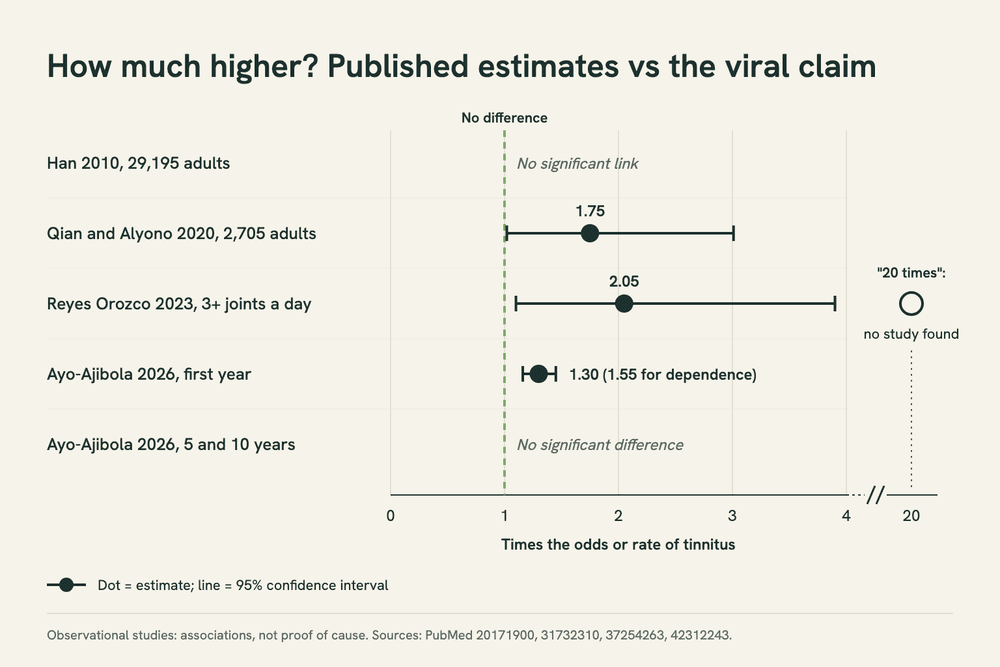
Four studies have looked at cannabis and tinnitus across large groups of people, and they do not all agree. The oldest, a 2010 analysis of the National Survey on Drug Use and Health, covered 29,195 adults aged 35 to 49, surveyed from 2005 to 2007. After adjustment, years of marijuana use were not associated with tinnitus, although years of hallucinogen and inhalant use were. A decade later, a Stanford analysis of 2,705 adults in the National Health and Nutrition Examination Survey (NHANES) found that people who had used cannabis at least monthly over a 12-month period had about 1.75 times the odds of tinnitus (95% confidence interval 1.02 to 3.01). That was after adjusting for age, sex, hearing loss measured on a hearing test, noise exposure, depression, anxiety, smoking, aspirin-type drug use, heart disease, high blood pressure and diabetes. But using more, or more often, did not mean more frequent or worse ringing. Alcohol, cocaine, methamphetamine and heroin were not associated with tinnitus at all.
A 2023 NHANES analysis in Otology & Neurotology looked at adults aged 20 to 59 and sorted them by how much they used. About 20.5% of people who used three or more joints or pipes a day reported bothersome tinnitus in the past year, compared with 17.0% of those who used one or two a day and 12.0% of non-users. After adjusting for demographics, cardiovascular factors, hearing loss, noise exposure and depression, the heaviest users had about twice the odds (odds ratio 2.05, 95% confidence interval 1.1 to 3.9). The adjusted result was reported for the heaviest-use group, and tinnitus severity did not differ between groups. One detail if you read the abstract yourself: it labels those three percentages as odds ratios. They are prevalences, the share of each group reporting tinnitus. The adjusted odds ratio is 2.05.
The newest study is also the only one that followed people over time. A 2026 study in OTO Open used electronic health records to match 92,077 adults who had a diagnosed cannabis-related disorder, and no prior ear problems, against 92,077 similar adults without one. Within a year, the cannabis group was about 30% more likely to be diagnosed with tinnitus (hazard ratio 1.30, 95% confidence interval 1.16 to 1.45), rising to about 42% for a diagnosis of cannabis abuse and about 55% for dependence. At 5 and 10 years, the difference was no longer statistically significant. The absolute numbers were small: 0.7% of the cannabis group had a tinnitus diagnosis at one year, 1.8% at five years and 2.1% at ten.
| Study | Who | Exposure | Result | What it cannot show |
|---|---|---|---|---|
| Han 2010 (NSDUH) | 29,195 US adults, 35-49 | Years of marijuana use | No significant link after adjustment | How much or how recently people used |
| Qian and Alyono 2020 (NHANES) | 2,705 US adults, 20-69 | Monthly or more over 12 months | Odds about 1.75x; no dose-response | Which came first, the use or the ringing |
| Reyes Orozco 2023 (NHANES) | US adults, 20-59 | 3 or more joints or pipes a day vs none | 20.5% vs 12.0% with bothersome tinnitus; adjusted odds about 2x | Cause; the survey was a single snapshot |
| Ayo-Ajibola 2026 (health records) | 92,077 matched pairs | Diagnosed cannabis-related disorder | About 1.3x at 1 year (1.55x for dependence); no significant difference at 5 or 10 years | Casual use; diagnosis codes can be wrong |
Why a link is not proof
All four studies are observational. They can show that two things travel together, not that one causes the other. The Stanford authors named three possible explanations for their own result, and each one is plausible:
- Cannabis contributes to tinnitus in some people. The animal work below points this way, but it is not human proof.
- Tinnitus comes first, and some people turn to cannabis to cope with it. A one-time survey cannot tell these two apart.
- A third factor drives both. Mood problems are the example the authors raise.
The dose question cuts both ways. A real cause usually shows up as a dose-response, with more exposure bringing more effect. In the Stanford study, using more did not mean more or worse ringing. In the 2023 NHANES analysis and the 2026 cohort, though, the heavier-use groups did have more tinnitus, which is the pattern a real effect would produce, and also the pattern you would expect if heavier users differ in other ways. The timing detail is steadier: in the 2026 cohort, the excess faded after the first year. That fits a short-term effect better than steady, cumulative damage, though the study cannot say why it happened. The same cohort has a built-in limit, too: everyone in the cannabis group had their use recorded as a diagnosis in a medical chart, so it says little about occasional use.
What controlled studies and drug labels say about THC
The only controlled human data come from an old trial that was not about tinnitus. In a 1975 double-blind crossover study of 34 people with cancer pain, participants took oral THC (10 or 20 mg), codeine or a placebo on different days. According to a 2020 Yale review of cannabinoids and tinnitus, 11 people reported ringing ears after THC, compared with 3 after placebo, with more at the 20 mg dose. Tinnitus was never tested statistically, the trial was small and is half a century old, and the participants were seriously ill. Still, it is the one blinded study where tinnitus showed up after a known dose of THC.
The second clue is regulatory. The FDA label for Marinol (dronabinol), a synthetic THC capsule, lists tinnitus among its less common adverse reactions, reported in clinical trials at a rate of 1% or less, in the same row as depression, nightmares and speech difficulties. Dizziness, by comparison, is listed as more common, at 3% to 10%. This is the only regulator document we found that ties a cannabinoid to tinnitus. It covers pharmaceutical THC taken by mouth, not smoked flower, but it tells you the effect has been observed in trials. Taking too much THC at once brings its own set of effects, such as feeling unsteady and vomiting, which our guide to greening out covers in detail.
The animal research: no relief, possible worsening
Most of the direct experiments come from one research group at the University of Otago in New Zealand, and they were done in rodents. In a 2010 rat study, researchers triggered tinnitus with high-dose salicylate, the compound family aspirin belongs to, then injected two synthetic cannabinoids, WIN55,212-2 and CP55,940. Neither reduced tinnitus-like behavior, and at certain doses both increased it. A 2015 follow-up exposed rats to damaging noise, then gave them a daily mix of THC and CBD in a 1:1 ratio. The mix significantly increased the number of noise-damaged rats showing signs of tinnitus. Rats without hearing damage were unaffected. The authors concluded that cannabinoids may promote the development of tinnitus, especially when there is pre-existing hearing damage.
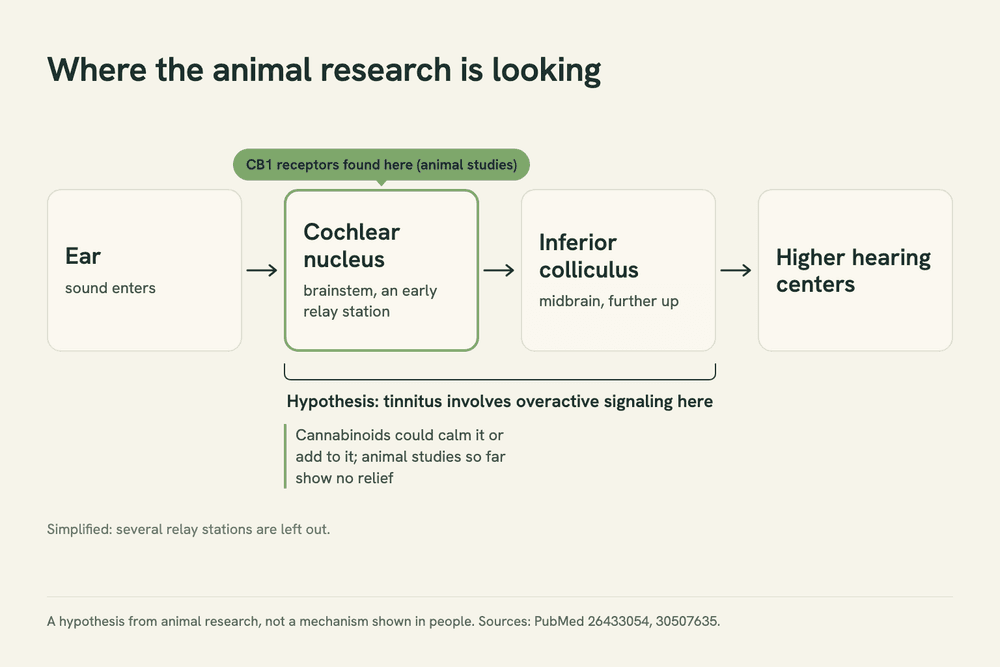
A 2017 guinea pig study tested a compound that targets the CB1 receptor more selectively and found no evidence that it reversed tinnitus. A 2016 review by the Otago team set out the question behind this work. One hypothesis treats tinnitus as overactive signaling in hearing regions of the brain, such as the cochlear nucleus, an early relay station for sound in the brainstem, and the inferior colliculus, further up the pathway in the midbrain. CB1 receptors are found in the cochlear nucleus, so cannabinoids there could in principle either calm that overactivity or add to it. Reviewing the evidence in 2019, the same group concluded that in regions such as the dorsal cochlear nucleus, cannabinoids have the potential to facilitate that overactivity and worsen tinnitus, and that all of the available experimental evidence from animal studies suggests CB1 agonists (compounds that switch on the CB1 receptor, as THC does) "will either have no effect on tinnitus or will worsen it". That is a hypothesis built on animal work, not a mechanism shown in people.
Keep the limits in view. These are rats and guinea pigs, the tinnitus is inferred from trained behavior rather than reported, the drugs were mostly injected, and several were synthetic compounds far from anything people use. The same authors also reviewed their own experiments. What the animal data do support is the careful reading: no sign of relief, and some sign of harm, particularly after noise damage.
Where the '20 times more likely' claim comes from
If you searched this question, you have probably seen a passage like the one below. It appears, nearly word for word, on many hearing-clinic websites:
“More than 20% of study participants who employed cannabinoid products noted hearing a ringing in their ears. And that's in individuals who had never experienced tinnitus before. What's more, marijuana users were 20-times more likely to report having tinnitus symptoms after 24 hours.”
None of the pages we read cite a study, and we could not find one. A PubMed search for cannabis and tinnitus on September 30, 2026, returned 26 records, and none reports a 20-fold difference or a 24-hour figure. The published adjusted estimates we found sit between about 1.3 and 2 times: odds ratios of 1.75 and 2.05 in the two NHANES analyses, and hazard ratios of 1.30 to 1.55 in the 2026 cohort. The only "20" we found in the peer-reviewed data is a prevalence: about 20.5% of heavy users in one NHANES analysis reported bothersome tinnitus, versus 12% of non-users. That is a share of people, not a multiplier. Whatever its origin, the "20 times" figure should not be repeated as fact.
Does CBD cause tinnitus?
Short answer: it has not been studied in humans. CBD is a different cannabinoid from THC and does not produce a high, but no human study has looked at CBD and tinnitus in either direction. The closest data point is regulatory. The prescribing label for Epidiolex, the FDA-approved CBD medicine, does not list tinnitus or any hearing effect among its adverse reactions. We searched the full label for tinnitus, hearing, vertigo and dizziness and found none. The nearest entry is ear infection, reported in 8% of patients on Epidiolex versus 3% on placebo in its tuberous sclerosis trial; ear infections are on NIDCD's list of tinnitus causes, but the label does not report tinnitus itself. That label covers prescription doses of 10 to 25 mg/kg a day in people with severe epilepsy, so its silence does not settle the question for a consumer CBD oil, and it is not proof of safety. The only experiment that included CBD is the 2015 rat study above, which gave it together with THC, so it cannot tell you what CBD does on its own.
There is one indirect route worth knowing about. Several medicines on NIDCD's tinnitus list are common: aspirin and other NSAIDs, certain antibiotics, and antidepressants (if you take an SSRI, our guide to Zoloft and cannabis covers that combination). CBD can change the blood levels of some medicines, as our overview of CBD side effects and drug interactions explains. No study has shown that CBD raises any of these particular drugs enough to cause tinnitus. But if you take one of them and add cannabis or CBD, tell your pharmacist.
Other things that can ring your ears at the same time
When ringing shows up after a night out, cannabis is rarely the only exposure. Before you blame one thing, run through the others:
- Loud sound. NIDCD names concerts and sporting events as noise exposures linked to tinnitus. If you used at a show, a club or a loud party, the noise is a known cause on its own.
- Aspirin and other NSAIDs. Both are on NIDCD's list of medicines linked to tinnitus.
- Earwax or an ear infection. Both are common causes on the same list, and both are easy for a clinician to check.
- Alcohol. In the Stanford NHANES analysis, alcohol use was not associated with tinnitus.
- Other drugs. In the 2010 federal survey, years of hallucinogen and inhalant use were linked to tinnitus, while marijuana was not.
Caffeine is the surprise. In a study that followed 65,085 women for 18 years, those who took in the most caffeine (600 mg a day or more) had about a 21% lower rate of new tinnitus than those who had less than 150 mg a day (hazard ratio 0.79). It was an association, in women only, so it is not a reason to drink more coffee. It does suggest your morning cup is an unlikely culprit. Our guide to CBD and caffeine covers how the two interact.
When ringing ears are urgent
Doctors call this sudden sensorineural hearing loss. NIDCD's page on sudden deafness describes one sign as a loss of at least 30 decibels in three connected frequencies within 72 hours. It frequently affects only one ear, and about half of people recover some or all of their hearing on their own, usually within one to two weeks. The catch is that delaying diagnosis and treatment can make treatment less effective. The US ear, nose and throat clinical practice guideline estimates about 66,000 new cases a year in the United States, notes that it is frequently but not always accompanied by tinnitus or vertigo, and calls for a hearing test as soon as possible, within 14 days of symptoms starting.
A quick checklist if your ears are ringing
Most ringing is not an emergency, but some of it still needs a visit. MedlinePlus, the National Library of Medicine's health encyclopedia, says to contact a provider if ear noise starts after a head injury, comes with unexplained dizziness, imbalance, nausea or vomiting, keeps bothering you after you try self-help measures, is in only one ear and continues for several weeks or longer, or pulses with a steady beat. The checklist below combines those signs with NIDCD's emergency signs.
- 1Your hearing dropped suddenly, with or without ringing: treat it as an emergency and see a doctor immediately.
- 2Your hearing went muffled after a loud pop, or along with ear fullness, dizziness or ringing: same as above, do not wait.
- 3Ringing started after a head injury, or comes with unexplained dizziness, imbalance, nausea or vomiting: contact a doctor.
- 4The sound pulses in time with your heartbeat: book a doctor's visit, since this type more often has an identifiable cause.
- 5Ringing is in one ear only and lasts several weeks or longer, or keeps bothering you despite quiet and rest: see an audiologist or an ear, nose and throat (ENT) doctor.
- 6Brief ringing right after a loud event: give your ears quiet and protect them next time. If it does not fade, go back to the item above.
- 7It seems tied to using: pause, note the timing, amount and route, and list any medicines you take, including aspirin. Bring those notes to your appointment.
The same logic applies to other sudden symptoms. A headache that comes on suddenly and explosively is an emergency too, as our guide to whether weed can cause headaches explains. Telling a clinician plainly that you use cannabis helps them read your symptoms correctly.

What is still unknown
The honest summary is that cannabis and hearing are barely studied. A 2021 scoping review of 48 studies listed tinnitus, vertigo and hearing loss among reported ear, nose and throat side effects of cannabis, while noting that the evidence was limited and carried moderate to critical risk of bias. The 2020 Yale review found no compelling animal or human data that cannabinoids relieve tinnitus. Meanwhile, people with tinnitus are curious: in a survey of 45 patients at one Toronto clinic, 96% said they would consider cannabis, and only about one in five had learned about it from a doctor or nurse. A survey of opinions cannot show whether cannabis helps or harms. Here is what nobody has answered yet:
- Cause. No randomized trial has tested whether cannabis causes or worsens tinnitus in people.
- CBD on its own. There is no human study, and the one animal study mixed it with THC.
- Route. Smoking, vaping and edibles have never been compared for tinnitus.
- Duration. The 2026 cohort saw no long-term difference, but no study has tracked whether cannabis-linked ringing goes away.
- Who is most at risk. The rat data hint that existing noise damage matters; no human study has checked.
- Potency. None of the population studies measured how much THC people actually took.
Questions people ask about weed and tinnitus
It has been reported. In a small 1975 double-blind trial, 11 of 34 people reported ringing ears after oral THC, versus 3 after placebo, and the FDA label for dronabinol, a synthetic THC capsule, lists tinnitus as a rare side effect (1% or less). If it happens, stop, give your ears quiet, and check the red flags above: sudden hearing loss needs a doctor immediately.
It has not been studied in humans. The Epidiolex prescribing label lists no tinnitus or hearing side effects, but it covers prescription doses in people with severe epilepsy, so it is not proof either way for a consumer product. The one animal study that included CBD combined it with THC, so it cannot isolate CBD.
Animal studies point that way. In rats with noise-damaged hearing, a daily THC and CBD mix increased the number showing tinnitus, and researchers reviewing the field found no animal evidence of relief. No human trial has tested it. If your tinnitus seems louder after using, note it and tell your audiologist.
No randomized trial has tested it, so there is no evidence that it does. A 2020 review found no compelling animal or human data that cannabinoids relieve tinnitus, and animal studies found no relief and sometimes worse tinnitus. Patient surveys record opinions, not results. An audiologist or ENT doctor can explain the management options for tinnitus.
Nobody knows. No study has followed cannabis-linked ringing to see whether it goes away. In the largest study, the extra risk showed up in the first year and was no longer significant at 5 or 10 years, which argues against a steady long-term effect but does not answer the question for any one person.
The only controlled data involve THC taken by mouth: the 1975 trial used oral THC, and the dronabinol label covers capsules. Smoking, vaping and edibles have never been compared for tinnitus, so no route can be called safer for your ears.
Immediately if your hearing drops suddenly, especially in one ear. Contact a doctor if ringing follows a head injury, comes with unexplained dizziness or nausea, pulses with your heartbeat, or is in one ear only and lasts several weeks or longer; for lasting ringing, an audiologist or ENT doctor is the right place to start. US guidelines call for a hearing test within 14 days of a sudden hearing change.
Ringing ears are one of the less talked-about effects of cannabis, and the evidence is thinner than either the warnings or the marketing suggest. For the broader picture of what cannabinoids can do in your body, and the signals that mean stop, the next read is our guide to CBD side effects. What smoke does to your airway is a separate story, covered in why weed makes you cough. And if your ears are ringing right now and your hearing has changed, close this page and call a doctor.
Writing about hemp, wellness and the small rituals that keep us balanced.