Flexeril (Cyclobenzaprine) and Weed: What Both Labels Say
No study has given people cyclobenzaprine and THC together. What exists instead: two FDA labels that point the same way on drowsiness, driving, dry mouth and the heart, plus an honest list of what is unknown and the questions to bring to your pharmacist.
You take cyclobenzaprine (sold as Flexeril, Amrix and generics) for a muscle spasm, and you also use weed. Can you mix Flexeril and weed? Here is the short answer as of November 14, 2026. No study has given people both drugs and measured what happened. What does exist are two FDA labels, one for cyclobenzaprine and one for dronabinol, a prescription form of THC, and they point the same way: more drowsiness, slower reactions, a faster heart and a drier mouth. That is a reason to talk to your pharmacist with specifics, not a verdict either way. This is general information for adults 21 and over where cannabis is legal under state law, not medical advice.
This page is about THC, the compound in cannabis that makes you high. If your question is CBD, our guide to CBD and muscle relaxers reads each muscle relaxer's label for the CBD side, and our primer on what CBD is explains how the two compounds differ. Here we put the cyclobenzaprine label next to the THC label and sort what we found into three piles: what a label states, what we infer by reading the two together, and what nobody has measured. Most pages on this question blend those three, and the difference matters when you are the one deciding.
What you are actually taking when you take Flexeril
Flexeril is the original brand name. According to the FDA's approval record for Flexeril, the brand 5 mg and 10 mg tablets, first approved in 1977, are now discontinued in the US, and the agency recorded that this was not for safety or effectiveness reasons. Most people today take generic cyclobenzaprine tablets or the extended-release capsule sold as Amrix. Everything on this page applies to the drug, whichever name is on your bottle.
The current cyclobenzaprine tablet label (revised May 2026) says the drug is indicated "as an adjunct to rest and physical therapy for relief of muscle spasm associated with acute, painful musculoskeletal conditions," and that it "should be used only for short periods (up to two or three weeks)." Two details on that label shape everything below. First, cyclobenzaprine is not an antidepressant, but the label says it "is closely related to the tricyclic antidepressants, e.g., amitriptyline and imipramine," and it carries warnings written for that class. Second, the Amrix label says, based on animal studies, that the drug acts "primarily within the central nervous system at the brain stem" and not directly on skeletal muscle. It works in the brain, not in the muscle, which is why sleepiness is its most common side effect.
It also stays in your body a long time. The tablet label gives an average effective half-life of 18 hours, ranging from 8 to 37 hours across 18 people, and says that with regular dosing, levels reach a steady state within 3 to 4 days at about four times what a single dose produces. The Amrix label gives an elimination half-life of 32 hours. Those are population averages, not a spacing rule, which is why the question of when is one for your pharmacist rather than for arithmetic.
Flexeril and weed: two labels, side by side
None of the pages we read on page one of the search results on November 14, 2026 made this comparison. The first column is the cyclobenzaprine label (tablets and Amrix). The second is the MARINOL (dronabinol) label, revised January 2023. Dronabinol is synthetic THC in prescription capsules, so its label is one of the few FDA documents that describe THC's effects in writing. It is not a label for the flower, vapes or edibles sold at a dispensary, whose strength and form vary. The last column tells you whether each overlap is stated on a label, inferred by us, or unknown.
| Topic | Cyclobenzaprine label | Dronabinol (THC) label | Labeled, inferred or unknown |
|---|---|---|---|
| Drowsiness and other CNS effects | "May enhance the effects of alcohol, barbiturates, and other CNS depressants." Drowsiness in 29% to 38% of trial patients vs 10% on placebo | Lists muscle relaxants and tricyclic antidepressants among drugs whose CNS effects may add to THC's | Labeled on the THC side, by drug class. Cyclobenzaprine itself is not named |
| Driving and machinery | May impair abilities needed to drive or operate machinery, especially with alcohol or other CNS depressants | May impair abilities needed to drive or operate machinery | Labeled on each side separately. Never tested together |
| Heart rate and rhythm | Not for people with arrhythmias, heart block, conduction problems, heart failure or a recent heart attack. Lists tachycardia (fast heart rate) | Can cause tachycardia. Avoid with amitriptyline, other tricyclic antidepressants and other anticholinergic agents | Inferred: cyclobenzaprine is tricyclic-related but is not named on the THC label |
| Dry mouth, urination, bowels | Atropine-like action: caution with urinary retention and angle-closure glaucoma. Dry mouth 21% to 32% vs 7% on placebo. Constipation 1% to 3% | Overdose signs include dry mouth, urinary retention and reduced bowel motility | Overlap on the labels. Combined effect unknown |
| Names the other drug? | Cannabis, marijuana and cannabinoid appear zero times | Cyclobenzaprine does not appear. Muscle relaxants appear as a class | No label addresses the pair directly |
| Studied together? | No | No | Unknown: no human study found (PubMed, November 14, 2026) |
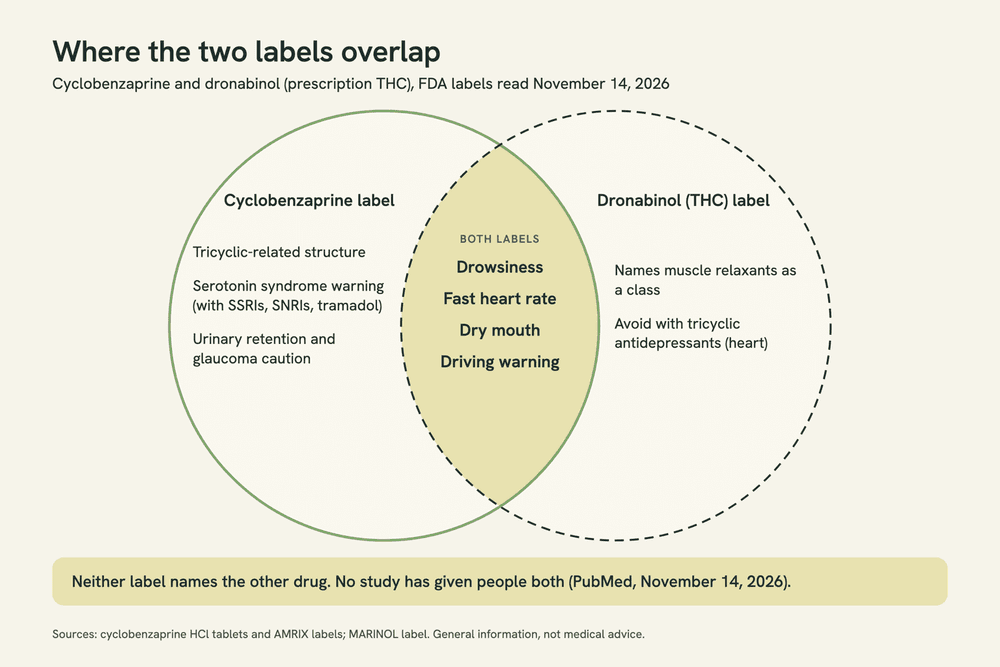
Read across the rows and the pattern is plain. Neither label mentions the other drug by name, yet on every effect row the two point the same direction. That overlap in effects is the main concern, which is why the rest of this page spends its time on what you would feel rather than on blood levels.
The THC label already names muscle relaxants
Section 5.1 of the dronabinol label lists drugs whose effects on the brain may add up with THC's. The list is specific, and it ends with the class your prescription belongs to:
“(e.g., barbiturates, benzodiazepines, ethanol, lithium, opioids, buspirone, scopolamine, antihistamines, tricyclic antidepressants, other anticholinergic agents, muscle relaxants)”
Two of those words describe cyclobenzaprine: it is a muscle relaxant, and its own label calls it closely related to the tricyclic antidepressants. Section 7.1 of the same label adds that "additive CNS effects (e.g., dizziness, confusion, sedation, somnolence) may occur," and the label warns that dronabinol "may impair the mental and/or physical abilities required for the performance of hazardous tasks such as driving a motor vehicle or operating machinery." That is the closest thing to an official statement on this pair: a class-level warning on a prescription THC product, not a study of cyclobenzaprine. It does not tell you how much drowsier you would get, and it describes capsules of 2.5 to 10 mg of THC with a known dose, not a joint or a gummy whose strength you may not know.
The heart: the part most pages skip
The cyclobenzaprine label lists who should not take it at all, including people in the "acute recovery phase of myocardial infarction, and patients with arrhythmias, heart block or conduction disturbances, or congestive heart failure," along with hyperthyroidism and anyone who has taken an MAO inhibitor within 14 days. It then carries the warning written for its chemical cousins: "Tricyclic antidepressants have been reported to produce arrhythmias, sinus tachycardia, prolongation of the conduction time leading to myocardial infarction and stroke." Its adverse-reactions section lists tachycardia, arrhythmia, palpitation and hypotension (low blood pressure) under cardiovascular effects. Some of the rarer reactions are listed because they were reported with other tricyclic drugs, so read this as a class warning, not a measured rate.
THC pushes the heart in a similar direction. A review of the cardiovascular research on marijuana describes "a substantial dose-dependent increase in heart rate, generally associated with a mild increase in blood pressure," notes that blood pressure can drop on standing in some people, and says regular users develop tolerance over several days to a few weeks. Most of that research involved smoked cannabis. The dronabinol label agrees that THC's "sympathomimetic activity may result in tachycardia." For the details, see what a controlled trial found about THC, CBD and heart rate and how weed affects blood pressure.
The dronabinol label then goes a step further. Section 5.2 tells prescribers to "avoid concomitant use of other drugs that are also associated with similar cardiac effects," and names amitriptyline, desipramine and "other tricyclic antidepressants," along with other anticholinergic agents. Cyclobenzaprine is not on that list by name. We connect them because cyclobenzaprine's own label says it is closely related to amitriptyline and carries the same class warning. That is an inference from reading two labels together, not a measured result: no one has recorded heart rate or rhythm in people taking both.
In practice, this is the row to raise with your pharmacist if you have any heart history, take other medicines that speed the heart, or notice palpitations. People with arrhythmias, heart block or heart failure are already told by the cyclobenzaprine label not to take it, whatever else they use.
Drowsiness, driving and the next morning
Drowsiness is the most common side effect on the cyclobenzaprine label. In its clinical trials, 29% of people on 5 mg (n=464) and 38% on 10 mg (n=249) reported drowsiness, against 10% on placebo (n=469); the 10 mg figure comes from a single trial. Fatigue was 6% on either dose versus 3% on placebo. The label warns that cyclobenzaprine, "especially when used with alcohol or other CNS depressants, may impair mental and/or physical abilities required for performance of hazardous tasks, such as operating machinery or driving a motor vehicle." The dronabinol label carries its own driving warning. Two impairing drugs with separate warnings is the plain reading; no driving study has tested them together.
THC is an awkward fit for the word depressant, because it can make you sleepy while speeding up your heart; our explainer on whether weed is a depressant sorts that out. The way sedating drugs stack is laid out in our gabapentin and weed guide, and it applies here too. For what research has measured about THC and driving on its own, see the evidence on cannabis and driving. And because the cyclobenzaprine label names alcohol specifically, adding a drink makes three sedating substances, not two; our page on being crossfaded covers alcohol and weed together.
Toxicologists already treat both drugs as driving drugs. In a 2021 survey of US and Canadian labs that test drivers suspected of drug impairment, THC was among the 15 most frequently detected drugs at 62 of the 64 labs that listed theirs, and cyclobenzaprine made that list at 8. The labs' consensus testing recommendations place cyclobenzaprine among the central nervous system depressants worth testing for. Detection is not the same as impairment, but it tells you both show up in impaired-driving casework.

Dry mouth, constipation and trouble urinating
The cyclobenzaprine label describes an "atropine-like action," the drying, slowing effects also called anticholinergic, and asks for caution "in patients with a history of urinary retention, angle-closure glaucoma, increased intraocular pressure, and in patients taking anticholinergic medication." In its trials, dry mouth was reported by 21% of people on 5 mg and 32% on 10 mg, against 7% on placebo, and constipation by 1% to 3%. The dronabinol label's overdose section reads partly like that list: drowsiness, dry mouth, tachycardia, urinary retention and reduced bowel motility. Those are signs of too much THC, not typical-dose effects, but they show where the two drugs push the same way. Why weed makes your mouth dry explains the THC side. Before adding THC, mention any of these to your pharmacist:
- You have had urinary retention, meaning trouble emptying your bladder.
- You have angle-closure glaucoma or raised pressure inside the eye.
- You take another medicine with drying, atropine-like effects. Ask your pharmacist which of yours count.
- Dry mouth or constipation is already bothering you on cyclobenzaprine alone.
Does weed make Flexeril stronger? The enzyme question
This is the question most people ask, and the answer runs the other way from what many expect. According to its label, cyclobenzaprine is "extensively metabolized, and is excreted primarily as glucuronides via the kidney." Three liver enzymes, CYP3A4, CYP1A2 and, to a lesser extent, CYP2D6, handle N-demethylation, which the label calls "one of the oxidative pathways." Lab work with human liver tissue from 1996 found that CYP3A4 and CYP1A2 do most of that one chemical step, with CYP2D6 playing "only a minor role." That was an in vitro study, in liver tissue in a dish, not in people.
Smoke matters for CYP1A2. In a 1978 study of theophylline clearance in smokers, a drug handled by the same enzyme, regular marijuana smokers cleared theophylline about 40% faster than nonsmokers (74 versus 52 mL/kg/hr), and people who smoked both marijuana and tobacco cleared it faster still (93 mL/kg/hr). The study was small (7 marijuana smokers, 7 who smoked both, 43 controls) and tested theophylline, not cyclobenzaprine. A 2016 review of drug interactions with tobacco and cannabis smoking says both marijuana and tobacco smoking switch the enzyme on through the aryl hydrocarbon receptor, which ties the effect to smoking rather than to cannabis as such. It says the effects of the two smokes add up and that the enzyme drops back quickly after someone stops smoking. Our propranolol and weed guide walks through the same smoke effect for another prescription.
Put together, if the smoke matters at all, the expected direction is that cyclobenzaprine clears a little faster, not that it builds up. Because the main exit route is glucuronidation and CYP1A2 shares its step with CYP3A4, any change is plausibly small. That is our inference from the label and the studies above, not a finding: no one has measured cyclobenzaprine blood levels in people who use cannabis. Edibles do not involve smoke, so they would not be expected to switch the enzyme on, though no one has tested that with this drug either. Enzyme math is not where the main risk of this pair lies; the overlap in effects is. The CBD side of the enzyme story is different, and the parent guide covers it under Cyclobenzaprine: three enzymes, one pathway, no cytochrome in the interactions section.
Over 65? This combination deserves extra care
The American Geriatrics Society's 2023 Beers Criteria, the standard list of medicines that tend to cause trouble in people 65 and older, puts cyclobenzaprine on its "avoid" list with other skeletal muscle relaxants such as carisoprodol and methocarbamol. Its reasoning: these drugs "are poorly tolerated by older adults due to anticholinergic adverse effects, sedation, and increased risk of fractures; effectiveness at dosages tolerated by older adults is questionable." The recommendation is rated strong, on moderate-quality evidence, and cyclobenzaprine also appears in the panel's table of drugs with strong anticholinergic properties. Baclofen and tizanidine are excluded from that muscle relaxant criterion. Beers is a population guideline, not a ruling on any one person, and it says nothing about cannabis.
The labels show why age matters. In a small study on the tablet label, steady-state exposure was about 1.7 times higher in 10 older adults than in 18 younger ones, and about 2.4 times higher in older men; the label says the drug "should be used only if clearly needed" in the elderly. The Amrix label reports a 40% increase in plasma levels and a 56% longer half-life in older people and says Amrix "is not recommended in the elderly." In a tablet-label study of 16 people with liver impairment (15 mild, 1 moderate), exposure roughly doubled. Adding another sedating, heart-speeding substance does not make that picture simpler. The Beers panel names sedation and fractures, and THC can drop blood pressure on standing in some people, which is how falls happen.

Muscle relaxers and weed: the rest of the class
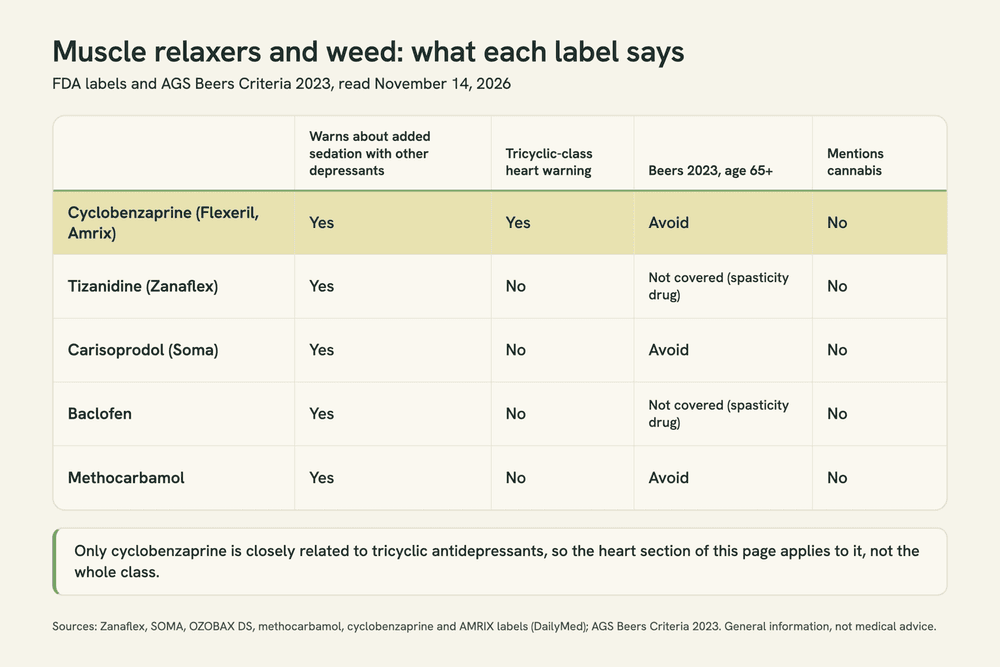
If your prescription is a different muscle relaxer, the sedation story is the same and the heart story is not. All four labels below warn about additive sedation with other CNS depressants, and none of them names cannabis. Only cyclobenzaprine carries the tricyclic cardiac warning, so the heart section above is specific to it. The CBD side of every muscle relaxer, drug by drug is covered in our parent guide.
Tizanidine (Zanaflex). The Zanaflex label says the "sedative effects of Zanaflex, alcohol, and other CNS depressants are additive," and warns about low blood pressure. About 95% of a dose is metabolized, mainly by CYP1A2. The label says nothing about smoking, and any effect of cannabis smoke on tizanidine levels has not been measured, so we will not guess at a size. The overlap to watch is low blood pressure, since THC can cause a drop on standing in some people.
Carisoprodol (Soma). The Soma label describes "a Schedule IV controlled substance" with "additive sedative effects when used with other CNS depressants including alcohol," and it mentions "post-marketing reports of motor vehicle accidents." In its trials, drowsiness was reported by 13% of people on 250 mg and 17% on 350 mg, versus 6% on placebo.
Baclofen. The OZOBAX DS baclofen label says baclofen "can cause CNS depression, including drowsiness and sedation, which may be additive when used concomitantly with other CNS depressants or alcohol," and reports drowsiness and sedation in up to 63% of patients taking baclofen. Baclofen is prescribed for spasticity; that is its indication, not a statement about cannabis.
Methocarbamol. The methocarbamol label says that because the drug "may possess a general CNS depressant effect," people taking it "should be cautioned about combined effects with alcohol and other CNS depressants." It also states plainly: "Methocarbamol does not directly relax tense skeletal muscles in man."
What the FDA's adverse event reports show
The FDA collects voluntary reports of problems people have while taking medicines in its Adverse Event Reporting System, known as FAERS (the agency now presents it as part of a broader Adverse Event Monitoring System, AEMS). We queried it through the openFDA drug adverse event API on November 14, 2026, with data current to October 28, 2026. It holds 436 reports that name both cyclobenzaprine (under that name, Flexeril or Amrix) and cannabis or marijuana. Almost all of them involve many other drugs too: every one names at least three products, the typical report names 13, and 297 of the 436 name 10 or more. The drugs most often listed alongside include gabapentin, trazodone, pregabalin, oxycodone, morphine, alprazolam and cocaine. Most of the time, both cyclobenzaprine and cannabis are recorded as something the person was also taking rather than as the suspected cause (cyclobenzaprine 353 times versus 116; cannabis 342 versus 114).
The FDA's own FAQ for its adverse event dashboard spells out the limits: there is "no certainty" that a reported event was due to the product, the data "cannot be used to calculate the incidence" of a problem, duplicate reports exist, and the FDA does not receive a report for every event. In plain terms, a report shows that someone noticed a problem while taking several drugs; it cannot show which one caused it, or how often anything happens, because there is no count of how many people take the pair without trouble. Two limits of our own query add to that: product names are matched imperfectly, and cannabis use often goes unrecorded. For what an interaction checker's rating does and does not mean, see What a moderate interaction rating actually means in our Zoloft guide.
Red flags and the questions to bring to your pharmacist
One warning on the cyclobenzaprine label is not about cannabis at all. The label warns about serotonin syndrome when the drug is combined with "selective serotonin reuptake inhibitors (SSRIs), serotonin norepinephrine reuptake inhibitors (SNRIs), tricyclic antidepressants (TCAs), tramadol, bupropion, meperidine, verapamil, or MAO inhibitors." Cannabis is not on that list. If you take one of those as well, that is a separate question for your pharmacist, and our guide to Zoloft and weed covers the SSRI side. The cyclobenzaprine label also notes that the most common effects of an overdose are drowsiness and tachycardia, and that taking several drugs at once, including alcohol, is common in deliberate overdoses.
A useful pharmacist conversation is specific. Bring this list:
- 1Say how you use cannabis: smoked, vaped or edible, how often, and roughly how strong, if you know.
- 2Say whether you take cyclobenzaprine tablets or Amrix, and at what dose, since their half-lives differ.
- 3Ask whether any heart history, such as palpitations, an arrhythmia or blood pressure problems, changes the picture.
- 4Ask whether your other medicines stack: SSRIs or SNRIs, opioids, gabapentin or pregabalin, sleep aids, antihistamines, and alcohol.
- 5Ask whether your age, or any liver problem, changes how long cyclobenzaprine stays active in you.
- 6Ask what this means for driving, work and anything else that needs you alert, including the next morning.
- 7Mention glaucoma or trouble urinating, because both labels touch on drying, atropine-like effects.
What nobody has studied yet
We searched PubMed on November 14, 2026 for cyclobenzaprine together with cannabis, marijuana, tetrahydrocannabinol (THC) or dronabinol, and got three records. None of them gave people both drugs and measured what happened. One is a urine-testing paper that lists each drug separately as a possible source of interference with other drugs, one is a federal review of non-opioid treatments for chronic pain, and the third matched only because of wording in an author disclosure. Widening the search to cannabinoids added two drug reviews that discuss cyclobenzaprine and cannabinoids separately. Searches pairing cyclobenzaprine and cannabis with deaths or serotonin syndrome, and cyclobenzaprine with smoking and drug levels, returned nothing.
So there is no drug-level study of the pair, no driving study and no heart study. The FAERS reports cannot fill that gap. Absence of evidence is not evidence of safety, and it is not evidence of harm either. It means every statement about this pair, including ours, rests on reading two labels side by side and on older enzyme work done with other drugs. That is the honest limit of this page.
Frequently asked questions
Neither label forbids it by name. The cyclobenzaprine label warns about combining the drug with alcohol and other CNS depressants, and the prescription THC (dronabinol) label names muscle relaxants among drugs whose sedating effects may add to THC's. The pair has never been studied directly, so there is no evidence-based verdict either way. Bring the specifics to your pharmacist: how you use cannabis, your dose and form of cyclobenzaprine, your other medicines and any heart history.
Partly. Edibles involve no smoke, so they would not be expected to switch on the CYP1A2 enzyme the way smoking does, though that has not been tested with cyclobenzaprine. THC's sedation and heart-rate effects apply whatever the form. Swallowed THC is also slow: the dronabinol label gives an onset of about 30 minutes to 1 hour, a peak at 2 to 4 hours and psychoactive effects lasting 4 to 6 hours, all while cyclobenzaprine's long half-life is still in play. Those are label facts about a measured capsule, not a schedule, and a dispensary edible's strength may differ.
No one can give a safe gap from the evidence, and we will not invent one. The tablet label gives an average half-life of 18 hours (range 8 to 37) and the Amrix label 32 hours, and regular dosing builds levels to about four times a single dose. Those numbers are why the timing question belongs with your pharmacist, who knows your dose.
There is no evidence that it does through the liver, and nobody has measured it. Cannabis smoke speeds up CYP1A2, one of the enzymes that processes cyclobenzaprine, so if anything the expected direction is slightly faster clearance. What you would feel is the overlap in effects: more drowsiness, slower reactions, a faster heart and a drier mouth.
No cannabis product is FDA-approved as a muscle relaxant, and this page will not tell you weed can stand in for one. The FDA's cannabis-related drug approvals are dronabinol, nabilone and the CBD drug Epidiolex, and none of them is approved as a muscle relaxant. If muscle pain is why you are reaching for both, say that out loud to your prescriber.
CBD is a different compound with a different evidence record, and it does not cause a high. Our guide to CBD and muscle relaxers reads each muscle relaxer's label for the CBD side, drug by drug.
If you are still working out how THC stacks with other sedating prescriptions, our gabapentin and weed guide walks through the same framework for another common medicine. For the CBD side of cyclobenzaprine and every other muscle relaxer, start with our label-by-label guide to CBD and muscle relaxers. Neither replaces a conversation with the pharmacist who fills your prescription.
Writing about hemp, wellness and the small rituals that keep us balanced.