Nutmeg High: What Poison Centers Actually See (and Why It's Not Like Weed)
Nutmeg can intoxicate in large quantities, but poison center records read more like a poisoning than a high: hours of delay, a racing heart, nausea and confusion. Four case series side by side, the MDMA myth checked, and when to call Poison Control.
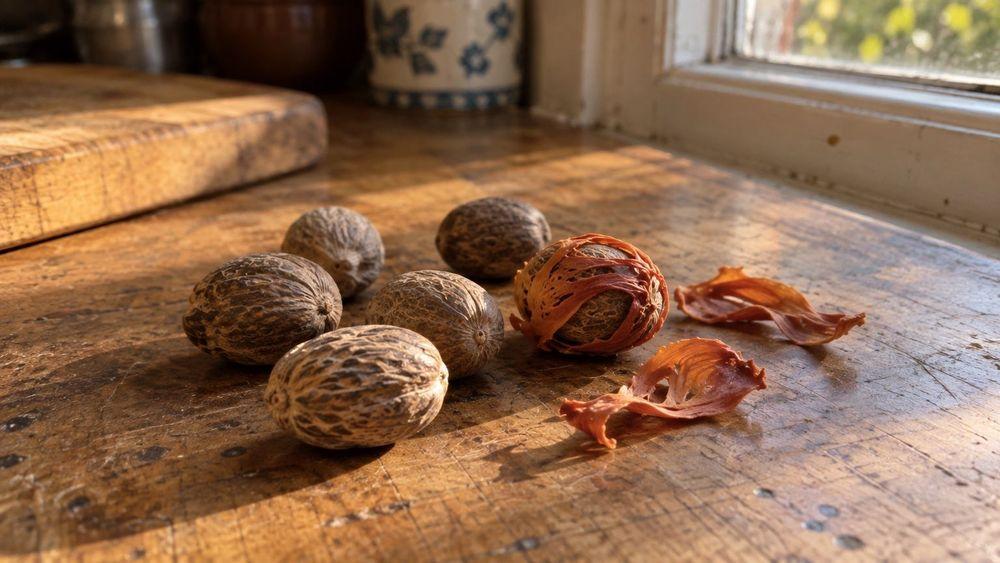
The question usually arrives one of three ways: a rumor that the spice rack hides a cheap high, a "nutmeg challenge" video, or the claim that nutmeg turns into MDMA in your body. Most pages that rank for it retell trip reports or repeat that metabolism claim. This one uses what poison centers actually logged. We set four published poison center series side by side, from Illinois, California, Texas and Switzerland, check the MDMA claim against the metabolism study that went looking for it, explain how a spice that federal food rules treat as safe can still poison you, and compare it with cannabis for readers who came here from the weed side. One thing you will not find is an amount. Every paper below prints the quantities involved, and we leave them out on purpose: there is no amount that is safe to take for effect, and the cases describe quantities far beyond cooking.
What's in nutmeg, and why a kitchen spice can be toxic
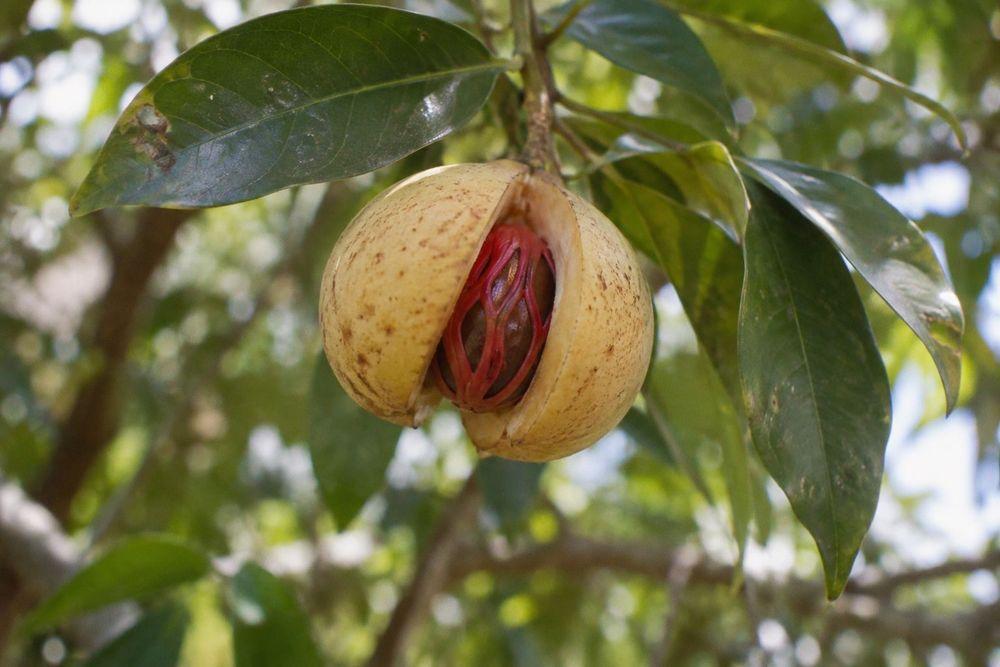
Nutmeg is the seed of Myristica fragrans, an evergreen tree, and mace is the lacy red covering wrapped around that same seed. Both carry volatile oils. A review of nutmeg calls to Texas poison centers lists the main ones as myristicin, elemicin and safrole, and toxicologists attribute nutmeg's effects mainly to that trio. How they act in the human brain is not well worked out. The authors of a 2026 Swiss poison center study describe myristicin and elemicin as having anticholinergic properties, meaning they block some of the signals carried by acetylcholine, one of the nervous system's main chemical messengers, and describe myristicin as a weak monoamine oxidase (MAO) inhibitor. Treat those as proposed mechanisms, partly drawn from animal work. The clinical picture is better documented: a clinical note from the Tennessee Poison Center says large exposures mimic anticholinergic poisoning, which typically means a fast heart, dry mouth, flushed skin, big pupils and confusion.
So how can a spice in your cupboard be toxic? Dose and purpose. Federal food rules, in 21 CFR 182.10, list nutmeg, and mace from the same tree, among the spices "generally recognized as safe for their intended use": flavoring food. The same rules, in 21 CFR 189.180, bar adding safrole, one of nutmeg's natural compounds, to food as such; the regulation's own example is sassafras tea. That second rule does not name nutmeg. Read together, the two show where the line falls. The amount that seasons a dish is a spice, and the quantities in poison center cases are something else. Under federal law nutmeg is a grocery spice, not a scheduled drug, but that is a statement about food rules, not about what large amounts do to you.
What poison centers actually record
Poison centers hold the best record of what happens when people take nutmeg, but read their numbers for what they are. They count calls from people, parents and clinicians, not everyone who has ever tried it, so they cannot give you a rate. Many cases are never reported, and each center codes and follows up its cases differently. Within those limits, four published series give a consistent picture of who calls and what happens next.
The most cited is a 10-year review from the Illinois Poison Center, covering 2001 to 2011. It logged 32 nutmeg cases: 17 accidental and 15 deliberate. Ages ran from 2 to 30, with a median of 16, and 22 of the 32 were male. Twenty were managed at home with poison center advice, ten were seen in a hospital and two at an unknown acute-care facility. Deliberate use was not significantly linked to ending up in a hospital. As for outcomes, 5 people had no effect, 14 had minor effects and 4 had moderate effects, all four of them deliberate cases. No outcome was coded as major, nobody died, and 9 were lost to follow-up.
A California Poison Control System analysis looked at 119 exposures to nutmeg alone between 1997 and 2008. In that series 86 (72.3%) were deliberate, and 80.2% of the deliberate cases were aged 13 to 20, against 9.1% of the accidental ones. About three in five deliberate cases (61.6%) "required medical evaluation", the authors' phrase for needing to be seen by a clinician, against one in three (33.3%) of the accidental ones. The authors recorded no major effects and no deaths, and still concluded that the effects "can be significant and can require medical intervention".
The Texas review covered 17 nutmeg calls from 1998 to 2004, 64.7% of them deliberate abuse. Every abuse call involved a male, and 55.6% involved an adolescent, against 16.7% of the other calls. Most calls in both groups were managed outside a health-care facility (54.5% of abuse calls, 66.7% of the rest), and nothing went beyond a moderate effect. The newest series, from Switzerland's poison center Tox Info Suisse, covers 2014 to 2023: 236 patients aged 0 to 85, 51% of them female, including 78 children under 16, most of them aged 0 to 3. Only 33 had follow-up documentation. Of those, 8 had no symptoms, 16 had minor symptoms and 9 had moderate ones, and none was severe or fatal. The Swiss authors write that nutmeg intoxications "usually show a mild course".
| Series | Years | Cases | Deliberate | Who | Where managed | Worst outcome recorded |
|---|---|---|---|---|---|---|
| Illinois Poison Center | 2001-2011 | 32 | 15 (46.9%) | Ages 2 to 30, median 16; 10 children under 13, all accidental | 20 at home, 10 in a hospital, 2 unknown | 4 moderate (all deliberate); 0 major; 0 deaths; 9 unknown |
| California Poison Control System | 1997-2008 | 119 (nutmeg only) | 86 (72.3%) | 80.2% of deliberate cases aged 13 to 20, vs 9.1% of accidental | Required medical evaluation: 61.6% of deliberate, 33.3% of accidental | No major effects; no deaths |
| Texas poison centers | 1998-2004 | 17 calls | 64.7% (abuse) | Abuse calls: all male, 55.6% adolescents | Most outside a health-care facility (54.5% of abuse calls, 66.7% of others) | None beyond moderate; no deaths |
| Tox Info Suisse (Switzerland) | 2014-2023 | 236 patients | Not reported | Ages 0 to 85, 51% female; 78 under 16, most aged 0 to 3 | Follow-up documented for 33 | Of 33: 8 no symptoms, 16 minor, 9 moderate; none severe or fatal |
Nationally, the trend points up. A study of US poison center data from 2000 to 2017 found that nutmeg was one of only three natural psychoactive substances, with marijuana and kratom, whose exposure rate rose significantly over that period. The abstract does not give a nutmeg count, so read it as a direction, not a size. Put together, the honest summary has two halves. Nutmeg intoxication is unpleasant, slow and long, and somewhere between a third and three-fifths of cases end up seen by a clinician or in a hospital, depending on the series and on who is counted. On nutmeg alone, it is rarely life-threatening: none of the four series recorded a death, and none coded an outcome as major or severe. The serious end of the record sits where nutmeg meets other drugs.
What a nutmeg high feels like: symptoms as recorded
The Illinois effects table is the closest thing to a symptom list built from real cases. The effects recorded most often were dizziness, vertigo or fainting; hallucinations or paranoia; agitation or irritability; drowsiness; a racing heart; nausea and vomiting; dry mouth; and dilated pupils. Blurred vision, confusion and one seizure, in a patient with a history of seizures, also appear. The counts are small, a handful of patients each, so we do not turn them into percentages. In California, deliberate cases were more likely than accidental ones to have a fast heart rate and agitation. In the Swiss grading, a "moderate" case meant a heart rate above 140 beats per minute, stupor, agitation, hallucinations or myoclonus, which is sudden muscle jerking.
- Heart and circulation: a racing heart, dizziness, vertigo, fainting.
- Stomach: nausea and vomiting.
- Mind: agitation, drowsiness, hallucinations, paranoia and confusion, with stupor in some of the Swiss moderate cases.
- Eyes, mouth and skin: dilated pupils, blurred vision, dry mouth and, in clinical descriptions, flushed skin.
- Rare: a seizure, recorded once in the Illinois series, in a patient with a seizure disorder.
Can nutmeg poisoning kill you? Deaths are very rare, according to the MedlinePlus page on myristica oil poisoning, the National Library of Medicine's consumer reference that covers nutmeg and mace. In a fatal case German forensic doctors reported in 2001, a prescription sedative, flunitrazepam, was also in the blood, and the authors attributed the death to the combined effect of the two. They noted only one earlier fatal case in the literature at the time. That pattern, nutmeg plus something else, runs through the serious end of the record.
Why it takes so long, and lasts so long
Nutmeg is reported to act slowly. The Tennessee Poison Center's clinical note puts the usual onset at 3 to 8 hours after swallowing, with symptoms lasting from hours to days. The Swiss authors, citing a toxicology textbook and a review, give an onset of 1 to 6 hours, with symptoms usually gone within 24 hours and lasting at most about 72. The two windows do not match, which tells you how loosely this has been measured, and in the case reports much of that time is spent feeling sick.
One Swiss case shows the shape. A 23-year-old man had a heart rate of 140 and dilated pupils four hours after swallowing nutmeg, was drowsy and disoriented at about 14 hours, and his heart rate settled only at 26 hours. He was also taking an antidepressant and an antipsychotic, and he needed no symptomatic treatment. Why so long? The honest answer is that this is poorly characterized in people, because very few cases have been measured. In one Japanese poisoning case, cited by the Swiss team, the blood level of myristicin took about 19 hours to fall by half, safrole about 17 hours and elemicin about 8.5 hours. Half-lives of that length fit the long course poison centers describe. That is one patient, not a rule.
Does nutmeg turn into MDMA?
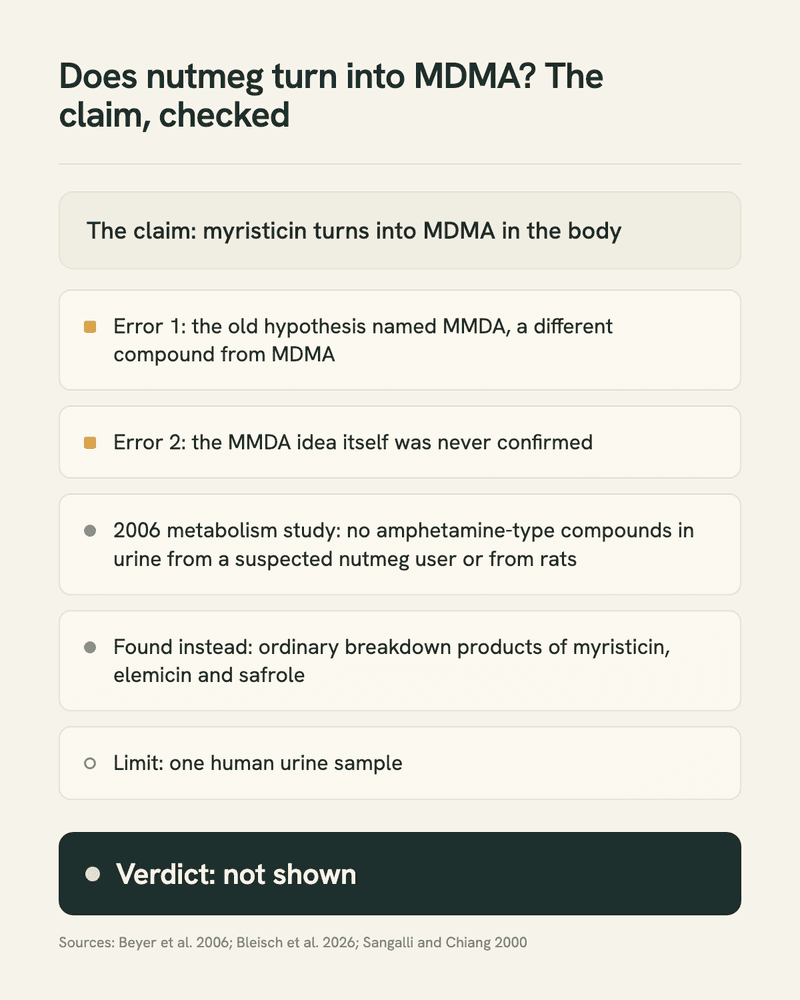
You will read that myristicin and elemicin "turn into MDMA" or "amphetamines" in your body, and that this explains the effect. The idea even appears in clinical writing: the Illinois paper's introduction and the Tennessee Poison Center note both say myristicin is metabolized to MMDA. There are two problems. First, MMDA is not MDMA. The Swiss authors describe MMDA (3-methoxy-4,5-methylenedioxyamphetamine) as an analog of MDMA, the drug sold as ecstasy, so "nutmeg turns into MDMA" is a garbled version of the original hypothesis. Second, the original hypothesis has not been confirmed. When German toxicologists studied the metabolism of elemicin, myristicin and safrole in 2006, they analyzed urine from rats given the compounds and from a person suspected of nutmeg abuse, using gas chromatography with mass spectrometry, a standard forensic method. Their abstract is direct:
“In a case of a suspected nutmeg abuse, neither such amphetamine derivatives nor the main nutmeg ingredients could be detected in urine.”
The rat samples showed the same thing. What the team did find were ordinary breakdown products: demethylated, demethylenated and hydroxylated forms of elemicin, myristicin and safrole. That was one human urine sample, and urine cannot show what happens in the brain, so the study does not settle the question. But it is the opposite of established. A 2000 review of the toxicology of nutmeg abuse called the amphetamine pathway "often postulated" and said "this has not been proven", and the 2026 Swiss authors write that animal and human urine studies "could not confirm" it. The fair verdict is not shown. Not disproven either, and in no way a reason to treat nutmeg as a substitute for anything.
Nutmeg vs weed: how they compare
If you came here from the cannabis side, the first difference is chemical. Nutmeg's active compounds are not cannabinoids, and nutmeg is not among the plants known to make cannabinoid-like compounds. The lists you may see claiming nutmeg "supports your endocannabinoid system" are the kind of unsourced diet claim our guide to the endocannabinoid system declines to repeat. Here is how the two compare on the questions people actually ask.
| Question | Nutmeg | Cannabis |
|---|---|---|
| Main active compounds | Myristicin, elemicin and safrole, from its volatile oils | THC, the main intoxicating cannabinoid, plus CBD and other cannabinoids |
| Contains cannabinoids? | No | Yes |
| How it acts | Not well worked out; anticholinergic-type effects and weak MAO inhibition are proposed | THC acts mainly on CB1 cannabinoid receptors |
| A bad experience, as recorded | Racing heart, agitation, dizziness, nausea and vomiting, dry mouth, big pupils, hallucinations or confusion | Too much THC has its own pattern, covered in our greening-out guide |
| Federal status | A spice generally recognized as safe for flavoring food; not a scheduled drug | Marijuana remains a controlled substance under federal law; adult-use sales are legal only under state law, to adults 21 and over |
| On the standard federal workplace drug test? | No; specialized labs can detect it if they look | Yes, the THC metabolite is on the panel |
Timing separates them as much as chemistry does. Smoked cannabis is usually felt within minutes and fades within a few hours, according to a 2003 review of cannabinoid pharmacokinetics, while nutmeg's effects are reported to arrive hours later and run on for a day or more. Too much THC has its own unpleasant pattern, which our guide to greening out covers, and where cannabis sits between stimulants and depressants is in is weed a depressant?. Combining the two is not a safer middle ground. Cannabis was among the other substances in the Illinois deliberate cases, and every deliberate case admitted to a hospital in that series had taken more than one substance.
Kids, teens and the nutmeg challenge: what parents should know
Start with the spice rack, because young children are a larger share of calls than most coverage suggests. In the Illinois series, 10 of the 32 cases were children under 13, every one of them accidental, and four of those were nutmeg in the eye. In Switzerland, 78 of 236 patients were under 16, most of them aged 0 to 3. Teenagers dominate the deliberate cases: 80.2% of deliberate California cases were aged 13 to 20, and 55.6% of Texas abuse calls involved adolescents.
Then there is the "nutmeg challenge", a social media dare built around eating the spice. Swiss enquiries were at their highest of the decade in 2020 and 2021, the years of a TikTok nutmeg challenge and of pandemic home baking, and the authors offer both as possible reasons. In the US, a 2024 analysis of poison center data on school-aged children found that ingestions of nutmeg, like those of diphenhydramine, laundry pods and cinnamon, rose around the peaks in online searches for each "challenge". The authors say that timing does not prove the trend caused them. Nobody has a reliable count of challenge cases, so be wary of headlines that give one. The storage habit that protects small children is the same one that applies to medicines or to CBD in a home with kids: up high, closed, out of sight.
- Keep whole nutmeg, ground nutmeg and mace in a closed cabinet or on a high shelf, the way you store medicines.
- Wipe up spilled spice and keep it away from small children's faces: four of the Illinois child cases were nutmeg in the eye.
- Know the signs after a large amount: a racing heart, flushed skin, dry mouth, big pupils, vomiting, agitation, unusual drowsiness or confusion.
- Remember the delay. Signs can start hours after swallowing, so a child or teen who seems fine now may not stay fine.
- Talk to teens plainly: poison center records show hours of feeling sick, not a high, and a third or more of cases end up seen by a clinician.
- If you suspect a large amount, call Poison Control now, even without symptoms, and say when it happened and what else was taken.

Will nutmeg show up on a drug test?
Not on a standard federal workplace test. The federal workplace drug-testing panels list what federal programs may test urine for, from the THC metabolite and cocaine to opioids, PCP, fentanyl, amphetamines and MDMA. Myristicin, elemicin and safrole are not among them. We also searched PubMed on November 11, 2026 for any report of nutmeg or its compounds triggering a positive drug screen and found none. That is not a guarantee, and private panels vary. Specialized labs can find nutmeg if they look for it: the 2006 metabolism study showed its breakdown products can be identified in urine, and a 2021 report on three people who had taken nutmeg detected myristicin, safrole and their metabolites in blood and urine using liquid chromatography with mass spectrometry, methods a routine screen does not run. If cannabis was taken too, its THC metabolite will show as usual. Our guide to the 10-panel drug test explains what standard panels look for.
What the evidence does not show
- Poison centers count calls, not users. None of these series can tell you how often nutmeg causes harm, only what happened in the cases reported.
- The series are small: 17 calls in Texas and 32 cases in Illinois, and only 33 of 236 Swiss patients had follow-up documentation.
- We read the California and Texas papers as abstracts; their full tables were not available to us, so per-symptom figures for those series are not given here.
- Onset and duration come from clinical summaries that disagree (1 to 6 hours vs 3 to 8 hours), not from controlled measurement.
- The half-lives come from a single poisoning case, and the metabolism study's human evidence is one urine sample.
- The link to the nutmeg challenge is timing only. Neither the Swiss nor the US authors claim it caused the rise in calls.
- The drug-test answer rests on what standard panels target and on a dated literature search, not on testing nutmeg against every screen.
Frequently asked questions
Large quantities can cause intoxication, sometimes with hallucinations, but poison center records describe something closer to a poisoning: a slow start, a long course, a racing heart, nausea, dizziness, agitation and confusion. In California, about three in five deliberate cases required medical evaluation. There is no amount that is safe to take for effect.
Reports put the onset at hours, not minutes: 3 to 8 hours in a US poison center's clinical note, 1 to 6 hours in a 2026 Swiss review. Symptoms usually fade within about a day but can last up to about three days. In one Swiss case, the heart rate took 26 hours to return to normal.
Deaths are very rare, according to MedlinePlus, and none of the Illinois, California, Texas or Swiss series recorded one. In a fatal case reported in Germany in 2001, a prescription sedative was also in the blood and the authors attributed the death to the combination. Mixing nutmeg with other drugs or medicines is where the serious cases cluster.
That has not been shown. The original hypothesis named MMDA, a different compound from MDMA, and a 2006 metabolism study found no amphetamine-type compounds in the urine of a person suspected of taking nutmeg or in rats. It was one human sample, so the question is not closed, but the claim is not established.
Federal food rules list nutmeg and mace as spices generally recognized as safe for their intended use, which is flavoring food. The poison center cases involve large quantities swallowed on purpose, or small children getting into the spice. Ordinary seasoning is not what those series describe.
Under federal law nutmeg is a grocery spice, not a scheduled drug. Being legal says nothing about safety in large amounts, which is a question of dose, not of law.
Myristicin, elemicin and safrole are not on the standard federal workplace panel, and a PubMed search we ran on November 11, 2026 found no report of nutmeg causing a positive screen. Specialized forensic labs can detect its breakdown products if they look. No result is guaranteed.
Call Poison Control at 1-800-222-1222 now, even if your child seems fine, because symptoms can take hours to appear. Call 911 for a seizure, trouble breathing or a child who is hard to wake. Do not make your child vomit unless a professional tells you to.
Nutmeg belongs to a family of things people try as a cannabis substitute, and across that family the rumor tends to outrun the evidence. For the household-plant version of this question, read why catnip won't get you high like weed, and for the smokable side, our look at what is really in herbal smoking blends.
Writing about hemp, wellness and the small rituals that keep us balanced.