Can You Smoke Catnip? Why It Won't Get You High Like Weed
Dried catnip will burn, but no controlled study has shown it gets people high. Here is what catnip is, how it acts on cats, where the 1969 'catnip high' report went wrong, how it compares with weed, and the real risk on the herbal-smoke shelf.
Can you smoke catnip? Dried catnip leaves will burn like any other dried herb, so in that narrow sense, yes. Will it get you high the way weed does? No controlled study has ever shown that. Catnip contains no cannabinoids, and the famous effect it has on cats starts in their noses and appears to run through an opioid reward signal, not the cannabinoid receptors THC acts on. And smoke from a burning leaf is still smoke.
The question usually comes from one of two places: curiosity after watching a cat roll around on the floor, or a rumor that catnip is a mild, legal high. The answer to both starts in the same place. Catnip is a mint, not a relative of cannabis. Its signature molecule, nepetalactone, is not a cannabinoid. In cats, its effect is triggered by smell and linked to the body's own opioid signals. And the idea that people get high from it traces back to a single two-page medical report from 1969 that described four patients, used no controls and was never repeated. Below is what catnip is, what it does to cats and to people, how it compares with cannabis, and why the riskier thing on the "herbal smoke" shelf is something else entirely.
What catnip is, and what it is not
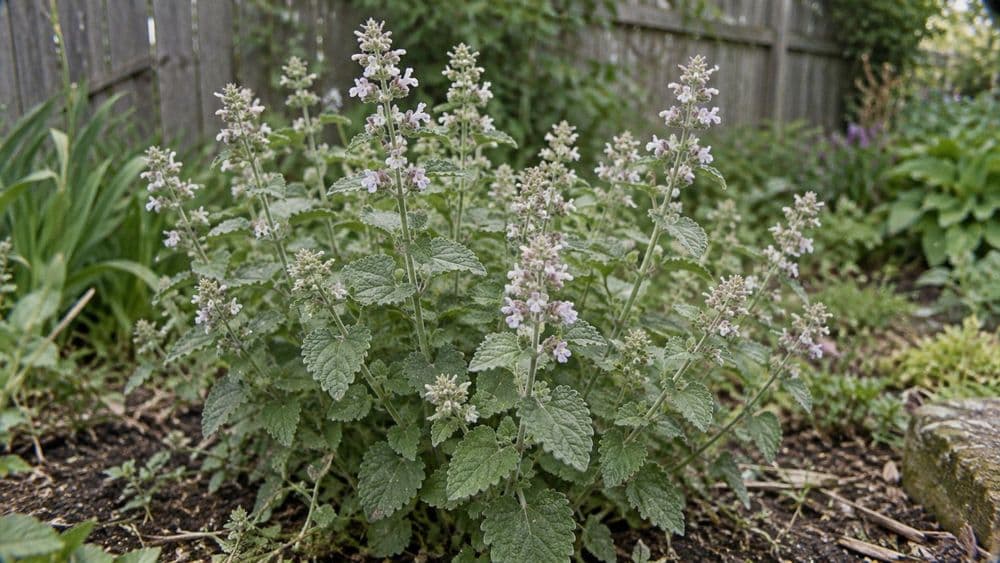
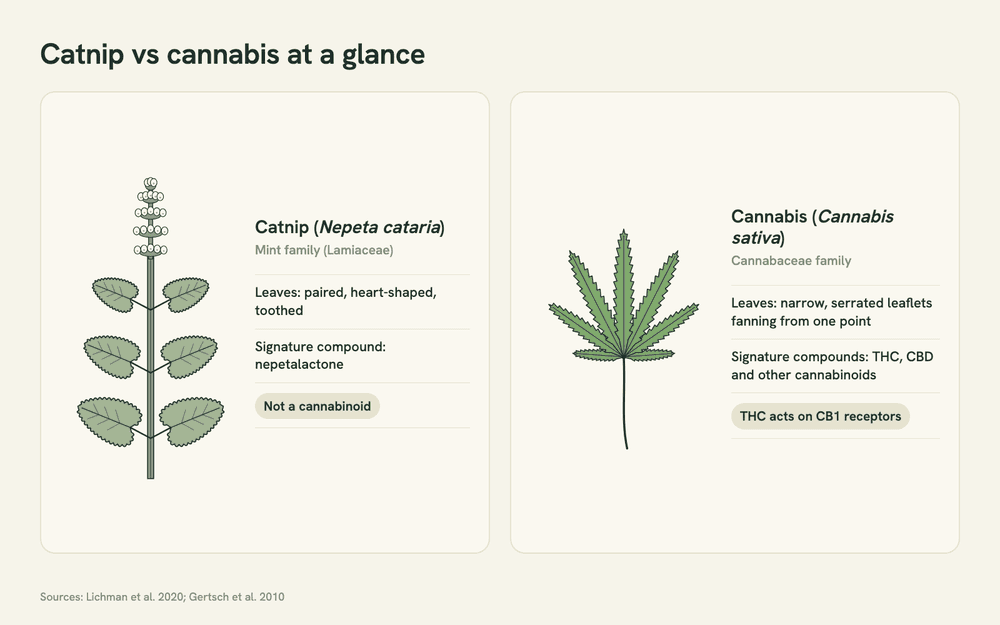
Catnip (Nepeta cataria) is a perennial herb in the mint family, Lamiaceae, the same family as thyme and marjoram. A 2020 genomics study of catnip and its relatives pins its famous effect on cats to nepetalactone, a volatile iridoid, which is a type of terpene-derived compound. Different Nepeta species make different versions of the molecule, known as stereoisomers. The same study found an evolutionary twist: the branch of the mint family that catnip belongs to lost the ability to make iridoids, and catnip's lineage later evolved it again. The authors are also clear about why the plant bothers. Nepetalactone repels insects, and its job is to protect the leaves from plant-eating insects, not to stimulate cats.
What catnip does not contain matters just as much. Cannabinoids, in the strict sense, are the terpenophenolic compounds of the cannabis plant, which is how a 2010 review in the British Journal of Pharmacology defines them; THC and CBD are the best known. Nepetalactone belongs to a different class of molecule. A PubMed search we ran in November 2026 for catnip, Nepeta or nepetalactone together with cannabinoids or the CB1 receptor returned 2 papers, and neither tested catnip compounds at cannabinoid receptors. Some plants outside cannabis do make cannabinoid-like compounds, and our guide to plants that contain cannabinoids covers them. Catnip is not one of them. Chemically, its iridoids sit on the terpene side of the line between cannabinoids and terpenes. Botanically, it is not even a relative: cannabis belongs to a different family, Cannabaceae, which it shares with hops, as our piece on whether hops and weed are related explains.
What catnip does to cats, and why that pathway doesn't carry over
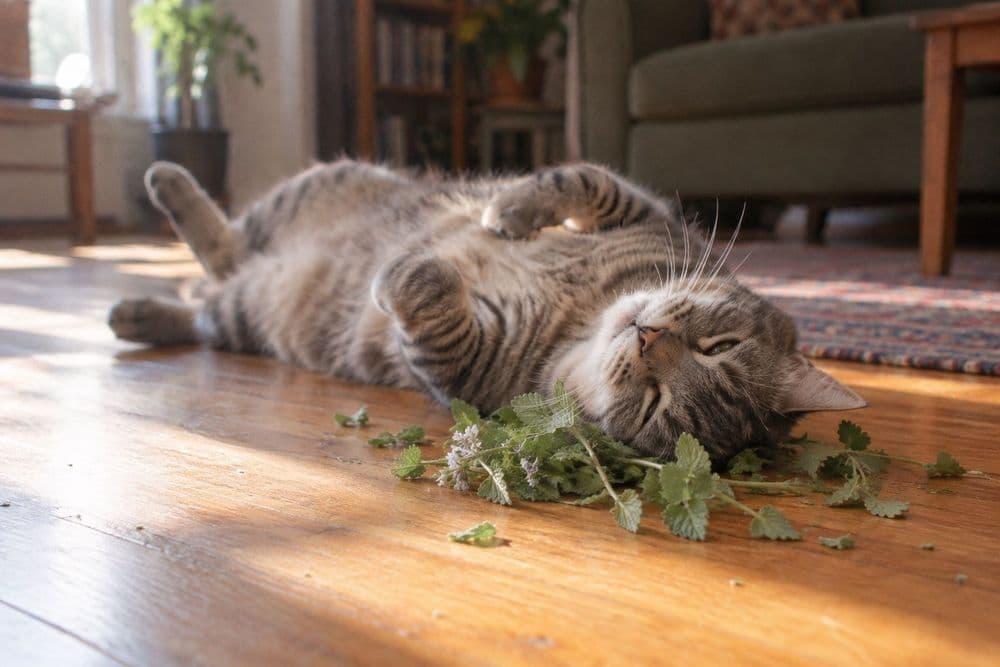
For decades nobody could say what was happening inside a cat rolling on catnip. The clearest answer so far comes from a 2021 study in Science Advances by a team in Japan, with one detail most summaries skip: the key experiments used nepetalactol, a close chemical cousin of catnip's nepetalactone found in silver vine, another plant cats respond to. The authors treat the catnip and silver vine responses as the same behavior. In 5 cats, smelling nepetalactol raised blood levels of β-endorphin, one of the body's own opioids. In 6 cats, naloxone, a drug that blocks μ-opioid receptors, suppressed the classic rubbing and rolling. Each test used 200 µg of nepetalactol, which the authors say matches the amount in roughly 10 silver vine leaves. The study also suggests a purpose for the behavior: rubbing spreads the compound onto the cat's face and head, where it repelled mosquitoes in their tests. These are small lab experiments in cats, so read them as a strong lead on the mechanism, not the last word.
Two details explain why none of this carries over to a person lighting a leaf. First, even in cats the response runs through the nose. The 2021 paper notes that cats perceive these compounds through the main olfactory system and that nepetalactone given by mouth produces no response. A 1969 feeding study in Science gave cats 20 to 80 mg of nepetalactone orally and saw no marked physiological or tissue effects, and the cats excreted 86% to 94% of the labeled compound in their urine. The cat response looks like a smell-triggered reward reflex, not a drug that travels through the blood to the brain, and nothing in the evidence suggests that burning the leaf turns it into one. Second, our receptors read the plant differently. In lab tests of TRPA1, an irritant-sensing receptor, catnip and nepetalactone switched on the fly and mosquito versions, which helps explain why insects avoid it, but catnip did not activate the human version. That was an in vitro experiment on one receptor, and it says nothing about smoke. What it does show is that the same plant can mean very different things to different species. No study we found has identified a comparable reward response in people.
Why some cats ignore catnip
Not every cat reacts. In a 2017 study of 100 domestic cats and 9 tigers, about one in three domestic cats did not respond to catnip, while almost 80% responded to silver vine, and nearly 75% of the catnip non-responders responded to silver vine instead. In the 2021 study's own lab colony, 18 of 25 cats (72%) responded. These are research findings about behavior, included here to explain the mechanism, not pet-care advice. If you have questions about what is right for your own cat, your veterinarian is the person to ask.
Can humans get high on catnip? Where the myth came from
The idea has a precise origin. In 1969 two authors published a two-page report in JAMA, Catnip and the alteration of consciousness, describing four psychiatric patients aged 17 to 23. Three were regular marijuana users, and one had also taken LSD. They said smoked catnip produced effects "very similar to those produced by marihuana". That self-report is the entire evidence base for the human catnip high. There was no control group, no blinding, no measured dose, no lab check of the plant and no chemistry. Some of the reported use involved catnip extract mixed with tobacco, so catnip was not even the only thing being smoked. At one point the report drifts from its own headline, suggesting the effect "may be more similar to that of LSD than to marihuana". The authors added their own caveat:
“More clinical evidence needs to be gathered to be certain that catnip does have a consciousness-altering effect in a larger sample of patients.”
That larger sample never came. As of November 2026, PubMed lists no controlled human trial of catnip for any effect. Look at the drawings printed with the 1969 paper and something else is off. The one captioned Cannabis sativa shows paired, heart-shaped, toothed leaves with dense whorls of small flowers at the stem tips, which is what catnip looks like. The one captioned Nepeta cataria shows long, narrow, serrated leaflets fanning out from a single point, the leaf almost every reader would recognize as cannabis. The captions appear to be swapped. That is our reading of the printed figures, and we found no published correction. It does not tell us what the four patients actually smoked. It does tell you how carefully the report was put together, and it may explain why a 2013 Popular Science explainer said the 1960s researchers had "mixed up the two plants".
JAMA printed two replies in May 1969. A letter from J. M. Benforado pointed out that catnip had been official in the United States Pharmacopeia from 1840 to 1880 as a mild stimulant and for its "quieting effect on the nervous system". A second letter, from V. de P. Lynch, noted that mint-family herbs such as thyme and marjoram were already used as filler in cheap marijuana, and described law-enforcement agents who became convinced that thyme they were handling was marijuana. You will sometimes read that one of these letters exposed the patients as marijuana smokers. Neither letter says that. The only human case report we found since then points somewhere else entirely. In a 1997 case report from the Children's Hospital of Philadelphia, a toddler showed central nervous system depression, meaning he was abnormally drowsy and dulled, after eating a large quantity of catnip, with no other cause found. That is sedation in one small child, not a high, and it is a good reason to keep catnip away from young children.
- 11840 to 1880: catnip is listed in the United States Pharmacopeia as a mild stimulant and nerve-quieting herb.
- 2February 1969: a JAMA report describes four patients who said smoked catnip felt like marijuana.
- 3May 1969: two letters in JAMA reply. Neither says the patients smoked marijuana.
- 41969: a Science study feeds cats 20 to 80 mg of nepetalactone by mouth and sees no marked effects.
- 51997: a toddler shows central nervous system depression after eating a large amount of catnip.
- 62017: a study of 100 domestic cats finds about one in three ignore catnip, and most of those respond to silver vine.
- 72021: cats that smell nepetalactol show a β-endorphin rise, and naloxone blunts their response. Separately, catnip fails to activate the human TRPA1 receptor in lab tests.
- 8November 2026: PubMed still lists no controlled human trial of catnip.
Catnip vs weed: molecule by molecule
Here is how the two plants line up on the questions people actually ask when they search "catnip vs weed".
| Question | Catnip (Nepeta cataria) | Cannabis (Cannabis sativa) |
|---|---|---|
| Plant family | Lamiaceae, the mint family | Cannabaceae, shared with hops |
| Signature compounds | Nepetalactone isomers, iridoids made from the terpene pathway | THC, CBD and other cannabinoids, plus terpenes |
| Main known target | In cats, the sense of smell, linked to a β-endorphin (opioid) reward signal | CB1 and CB2 cannabinoid receptors |
| Effect reported in people | One uncontrolled 1969 report of 4 patients; one toddler sedated after eating a large amount | THC's intoxicating effects are well characterized |
| Controlled human trials | None in PubMed as of November 2026 | Many, for cannabinoids such as THC and CBD |
| Federal status | Not on the federal controlled-substance schedules | Marijuana is federally controlled; hemp is defined separately by its THC content |
So, is catnip like weed? Only in the loose sense that both are dried green herbs that will burn. THC produces its high mainly by acting on CB1 receptors, part of the endocannabinoid system that runs through your body, and it is the main cannabinoid responsible for intoxication, the core difference laid out in our comparison of CBD and THC. Nepetalactone has no documented action at those receptors. The cat response runs through smell and opioid reward signals instead, and there is no evidence that a person's brain answers it the same way. If you want the broader picture of what makes a compound a cannabinoid in the first place, start with what cannabinoids are and how they work. For where federal law draws the line inside the cannabis plant itself, see hemp versus marijuana. And if you like this kind of myth check, we gave the same treatment to the claim that mango boosts a high.
Can you smoke catnip? What you are actually inhaling
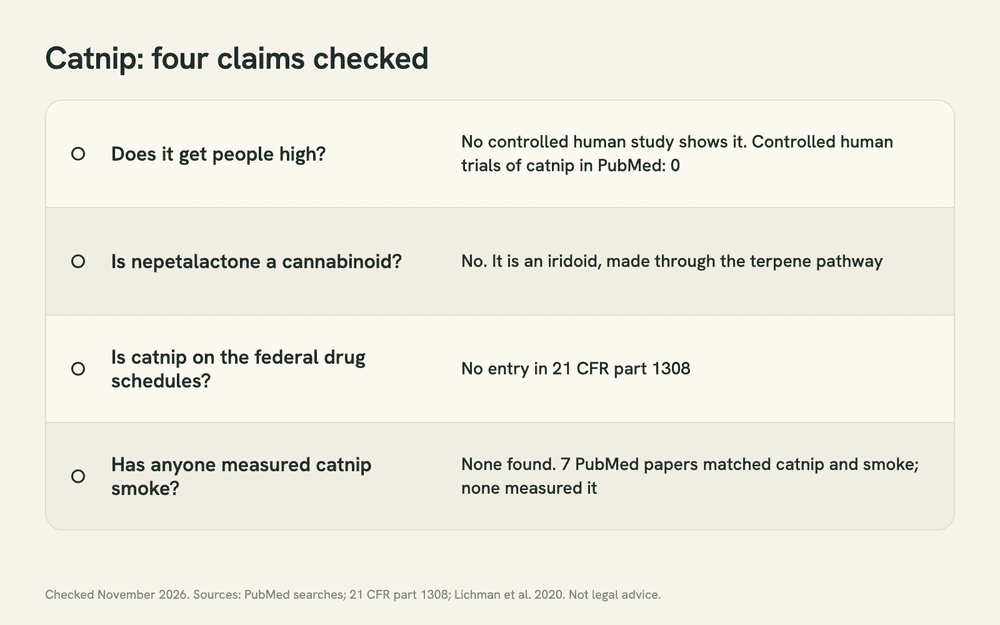
Burning any dried leaf makes smoke, and smoke carries irritants. A 2008 review of the airway's irritant sensors describes TRPA1 on airway nerves as a receptor activated by noxious constituents of smoke and smog, and a 2009 study in guinea pigs and healthy volunteers found that chemicals which switch on TRPA1, a group that includes the smoke irritant acrolein, made both cough. Do not confuse that with the lab finding above. Catnip itself not switching on human TRPA1 says nothing about what forms once the leaf is burned. And here the evidence simply runs out. As of November 2026, a PubMed search for catnip together with smoke, smoking, combustion or inhalation returned 7 papers, and none measured what is in catnip smoke. We found no published tar, particle or combustion-chemical numbers for catnip, so there is no evidence that it is gentler on your lungs than any other burned plant. Figures you may see for cannabis smoke are about cannabis and should not be borrowed for catnip.
That leaves the practical picture plain. Smoking catnip means inhaling plant smoke for an effect no controlled study has found, which is roughly what a veterinarian told Popular Science in 2013: catnip is cheap and legal, and "if it had a significant effect on people, everyone would be smoking it". This page is not a guide to smoking anything, and we are not recommending it. If you want to understand what smoke does on the way in, our explainers on why smoke makes you cough and whether a hookah changes what is in smoke go into the chemistry.
The real risk on the herbal shelf: blends sprayed with synthetic cannabinoids
The more serious danger in the "herbal smoke" category is not catnip. It is plain-looking dried plant material sprayed with synthetic cannabinoids and sold as incense or potpourri, the products known as K2 or Spice. NIDA describes synthetic cannabinoids as lab-made substances that are chemically similar to compounds in the cannabis plant but often produce very different effects, and warns that they can be life-threatening. The plant matter in these products is mostly a carrier, which is why an innocent-looking "herbal blend" tells you nothing about what has been sprayed on it. Our comparison of K2 and natural cannabis covers the record in detail, and our guide to spotting laced weed explains why looks and smell are unreliable.
Is catnip legal, and will it show up on a drug test?
Catnip does not appear anywhere in the federal controlled-substance schedules. In November 2026 we searched the full text of 21 CFR part 1308, the regulation that lists scheduled drugs (current through October 21, 2026), including the Schedule I list at 21 CFR 1308.11, and found no entry for catnip, Nepeta or nepetalactone. That is a factual check, not legal advice, and it does not cover state or local rules. Being unscheduled also does not make catnip a legal substitute for anything: as the sections above show, there is no good evidence it gets people high at all.
FDA's view of catnip as medicine is on record too. Its rule on over-the-counter drug ingredients, 21 CFR 310.545, lists catnip among digestive-aid ingredients for which "there are inadequate data to establish general recognition of the safety and effectiveness". In plain terms, FDA has formally found that there is not enough evidence to call catnip safe and effective as an OTC digestive aid. That finding is about drug marketing, not about the herb in your garden, but it is the clearest official statement we found on one of catnip's traditional uses.
As for drug tests, a marijuana screen does not look for "weed" in general. Under the federal workplace drug-testing guidelines, the cannabis target is a breakdown product of THC, delta-9-THC-9-carboxylic acid. Catnip makes no THC or any other cannabinoid, so there is nothing in it for that test to find. Labs and test types vary, and our guide to the 10-panel drug test explains what standard panels actually detect.
What the evidence does not show
- No controlled human trial of catnip (Nepeta cataria) appears in PubMed as of November 2026. The two Nepeta trials it does list tested a different species, Nepeta menthoides, and say nothing about catnip.
- No published study has measured what is in catnip smoke, based on the same November 2026 search.
- No study we found tested nepetalactone at CB1 or CB2, the receptors THC acts on.
- The opioid mechanism was shown in cats, with a related molecule from silver vine and small numbers (5 and 6 cats). It has not been tested in people.
- The human TRPA1 result is a lab-dish finding about one receptor. It is not evidence that catnip, or its smoke, is safe.
- The swapped captions are our reading of the 1969 figures. We found no published correction, and they do not show what the patients smoked.
Frequently asked questions
There is no good evidence that it does. The only report of a high is a 1969 series of four psychiatric patients who described their own experiences, with no controls and no check of what they smoked, and no controlled human study has tested it since. The one documented medical case, from 1997, was a toddler who became abnormally drowsy after eating a large amount: sedation, not a high.
Little is documented. Catnip was in the US Pharmacopeia from 1840 to 1880 and is still brewed as a traditional tea, but traditional use is not proof of any effect, no controlled human trial has tested it, and FDA has found inadequate data to call it safe and effective as an over-the-counter digestive aid. Keep it away from small children. Because it was historically used to bring on menstruation, skip it if you are pregnant and ask a clinician first, and check with a clinician or pharmacist if you take sedating medicines.
Federally, catnip is not a controlled substance: it does not appear in the schedules in 21 CFR part 1308 (checked November 2026). State and local rules can differ, and this is not legal advice. Legal does not mean intoxicating, though. There is no good evidence that catnip gets people high.
A standard marijuana screen looks for a breakdown product of THC. Catnip contains no THC or other cannabinoid, so there is nothing in it for that test to detect. Test types and labs vary, so questions about a specific test are best put to the lab or the program running it.
Not in the usual sense. In cats the response is triggered by smell, and nepetalactone given by mouth produced no response in feeding studies. A 2021 study linked the response to a rise in β-endorphin, one of the body's own opioids, using nepetalactol, a related compound from silver vine. That is mechanism, not care advice: ask your veterinarian about your own cat.
You are not alone. In a 2017 study of 100 domestic cats, about one in three did not respond to catnip. Almost 80% responded to silver vine, including nearly three quarters of the cats that ignored catnip.
No. Catnip is in the mint family, Lamiaceae. Cannabis belongs to Cannabaceae, the family it shares with hops. Their signature compounds also belong to different chemical classes: catnip makes iridoids, and cannabis makes cannabinoids.
Catnip is a clean example of a plant that gets compared with cannabis but contains no cannabinoids at all. For the opposite case, plants that really do make cannabinoid-like compounds, read our guide to which plants besides cannabis contain cannabinoids.
Writing about hemp, wellness and the small rituals that keep us balanced.