Is THC Fat Soluble? Yes, and Here Is What That One Fact Explains
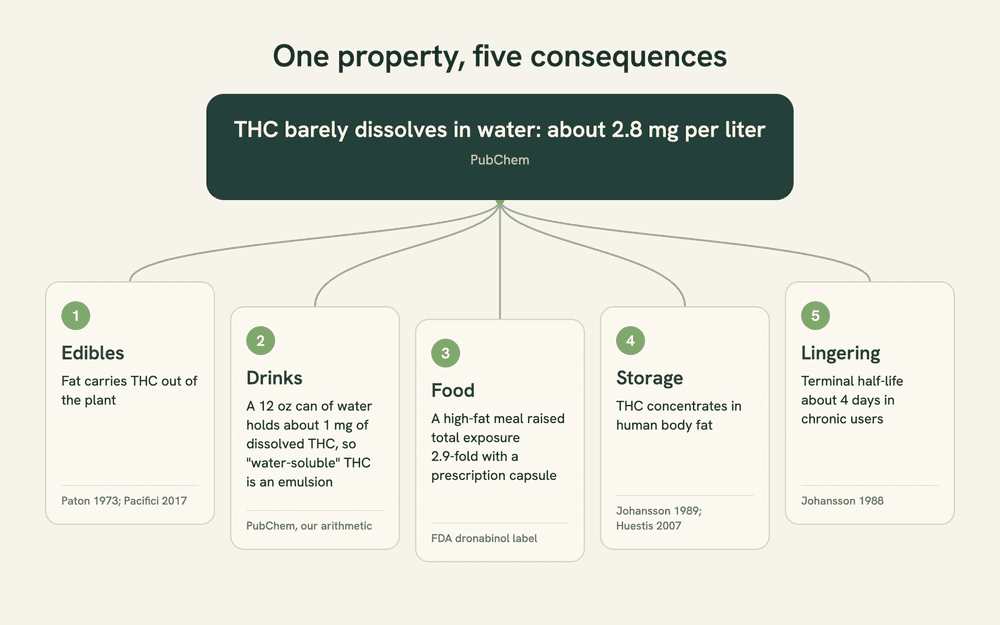
THC is extremely fat soluble: a liter of water dissolves only about 2.8 mg of it. That one number explains why edibles use fat, why THC drinks are emulsions, why food changes a swallowed dose, and why the dramatic "released from fat" results come from rats.
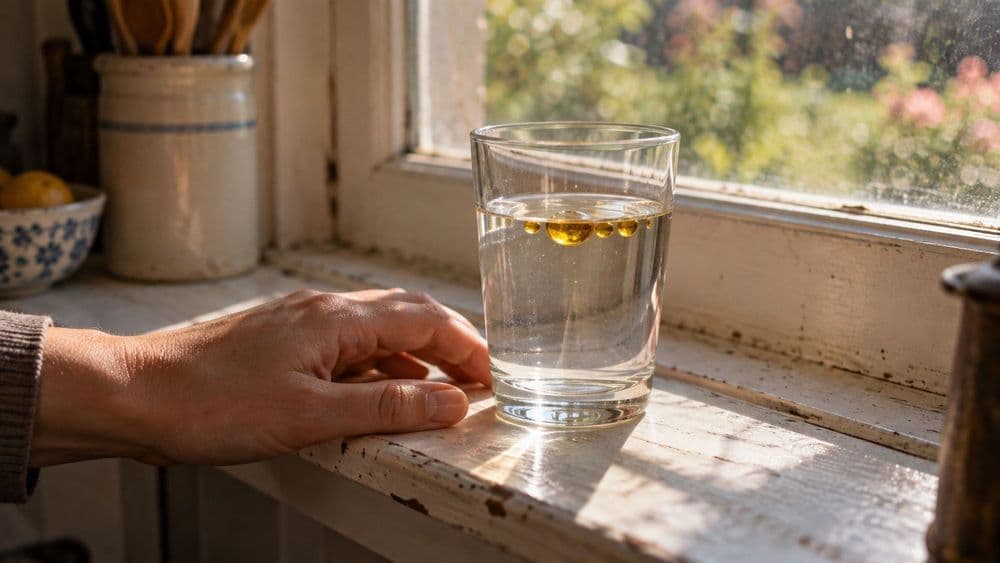
Is THC fat soluble? Yes, and extremely so. THC barely mixes with water and dissolves readily in oils and fats. That single property sits behind several questions people usually ask separately: why edibles are made with butter or oil, why THC drinks need emulsifiers, why a meal changes how a swallowed dose lands, and why THC lingers in people who use it every day.
The short answer: PubChem's record for THC lists its solubility in water at 2.8 milligrams per liter at 23 °C (73 °F), and about 0.77 mg per liter in salt water at the strength of body fluids. At saturation, a full liter of water holds less THC than one 5 mg edible contains. In oil, it dissolves freely. THC does build up in the body fat of people who use it often, and it leaves slowly. What the human studies do not show is that a workout or a diet releases enough of it to matter: the dramatic "released from fat" results were measured in rats.
Is THC fat soluble, and by how much? The numbers
Chemists measure how much a molecule prefers fat with a partition coefficient. You shake the compound with water and octanol, an oily alcohol that stands in for fat, let the two layers separate, and compare how much ends up in each. A ratio of 1 means no preference; above 1, the compound prefers the oily layer. Because the ratios get very large, they are usually written as a logarithm called log P: a log P of 3 means 1,000 to 1, and a log P of 6 means 1 million to 1.
For THC, the figure you will see most often is 6,000 to 1. It comes from a 1973 paper by the Oxford pharmacologist W.D.M. Paton, which set it beside chloroform at about 300 and ethanol at about 0.1 (modern databases put ethanol nearer 0.5), and it is still printed on the FDA label for dronabinol, a prescription form of THC: "an octanol-water partition coefficient: 6,000:1 at pH 7". Later measurements came out far higher. PubChem lists a measured log P of 6.97, which works out to roughly 9 million to 1, and a computed value of 7.0. A NIDA review of cannabinoid pharmacokinetics by Marilyn Huestis puts the estimate between 6,000 and over 9 million, "depending on the method of determination".
Why would two honest measurements differ by about 1,500-fold? The hard part is the water side. When a molecule barely dissolves in water, the amount left in the water layer is tiny, and small errors there (an older assay at the edge of its sensitivity, or a trace of oily droplets that never fully separated) swing the ratio enormously. The practical point survives either number: THC prefers fat to water by at least thousands to one, and probably by millions.
| Molecule | Dissolves in water | Log P (octanol/water) | Fat-to-water preference, roughly |
|---|---|---|---|
| THC (delta-9) | 2.8 mg per liter at 23 °C | 6.97 measured; 7.0 computed | About 9 million to 1 (6,000 to 1 by the older 1973 figure) |
| CBD | "Insoluble in water" (Epidiolex label) | 5.79 measured; 6.5 computed | About 600,000 to 3 million to 1 |
| Caffeine | 21,600 mg per liter at 25 °C | -0.07 | About 0.85 to 1 (slightly prefers water) |
| Ethanol | Mixes with water in any proportion | -0.31 | About 0.5 to 1 (prefers water) |
Put in everyday terms (our arithmetic from the PubChem figures): dissolving 5 mg of THC in plain water at room temperature would take about 1.8 liters, and about 6.5 liters of salt water at body-fluid strength. A 12 oz (355 mL) can of water can hold at most about 1 mg of truly dissolved THC. By the figure in PubChem's caffeine entry, caffeine dissolves in water about 7,700 times better than THC, and ethanol's entry puts it on the water side of the scale. CBD's PubChem record places it in THC's range, but its computed and measured values disagree on the gap, so we do not rank the two.
Why THC avoids water: the molecule in one paragraph
THC's formula is C21H30O2: 21 carbons, 30 hydrogens and only 2 oxygens. Most of the molecule is a three-ring carbon frame with a five-carbon tail, the pentyl chain, hanging off one side. Carbon and hydrogen share electrons almost evenly, so that surface gives water nothing to grip. Water dissolves things it can hydrogen-bond with or that carry a charge. THC has one hydroxyl group (an oxygen-hydrogen pair) that can bond with water, and it carries essentially no charge in the body: the dronabinol label lists a pKa of 10.6, which means the hydroxyl only gives up its hydrogen in strongly alkaline conditions. At a blood pH of about 7.4, by our calculation, fewer than 1 in 1,500 THC molecules is charged. One small handle on a large oily molecule is not enough. That is why the label says plainly that dronabinol "is insoluble in water and is formulated in sesame oil", and why about 97% of the THC in blood travels bound to proteins rather than floating free.
Consequence 1: why edibles are made with fat
Because THC dissolves in fat and not in water, fat is what carries it out of plant material and into food. People understood this long before anyone measured a partition coefficient. Paton, writing in 1973, described the traditional cannabis confection majoun in exactly these terms:
“the extraction of the psychically active principle into butter, a partition which then resists washing with water”
In other words, once THC has moved into fat, water does a poor job of pulling it back out. Modern lab work says the same thing from the other direction. A 2017 Italian analysis of standardized cannabis tea and oil preparations found that oil extracted cannabinoids significantly more efficiently than water, and in a 2024 Czech lab study of cannabis brews, plain hot water carried only about 0.4 to 1.9% of the plant's delta-9 THC into the cup. Our guide to hemp tea covers why, and what heat actually does to THC is its own question, because the plant makes mostly the acid form, THCA.
This page does not give a recipe: no ratios, temperatures or times. The point is the mechanism. Fat also shapes what happens after you swallow. A swallowed dose passes through the gut and the liver before it reaches the rest of the body, which is a large part of why edibles take so long to kick in, and why the liver produces more 11-hydroxy-THC, the metabolite formed on that first pass.
Consequence 2: is THC water soluble? What "water-soluble" drinks actually are
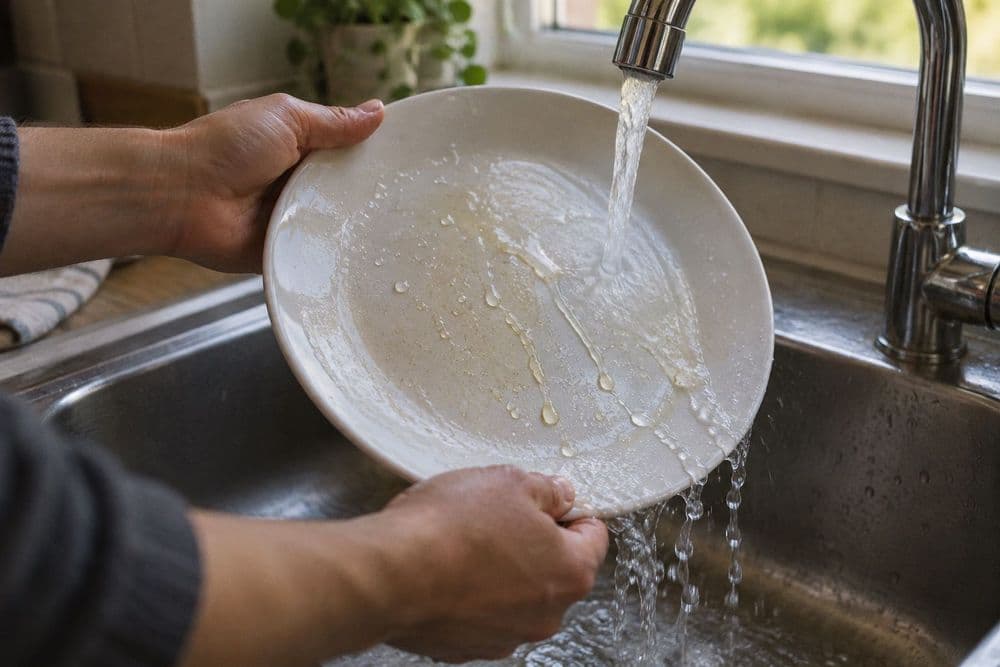
No. The arithmetic above settles it: a 12 oz can of water can hold about 1 mg of truly dissolved THC at most, so a drink labeled 5 mg or 10 mg per can cannot be a true solution. So-called water-soluble THC is an emulsion. The THC stays dissolved in tiny droplets of oil, and each droplet is coated with an emulsifier that keeps it spread through the water instead of floating to the top. The THC molecule itself does not change. The same approach is laid out in our explainer on how water-soluble CBD is made, and it is what lets hemp drinks and THC syrups exist at all.
How well those products deliver is less settled than the marketing suggests. A 2024 review of 29 studies on cannabis drinks called the evidence sparse and inconsistent and noted that beverages tested showed inaccurate cannabinoid labeling. Its fastest onset figure, about 19 minutes, came from 35 people describing their own experience in a survey, not from blood measurements.
Consequence 3: food changes how swallowed THC lands
Being fat soluble cuts both ways once THC is swallowed. The dronabinol label reports that 90 to 95% of an oral dose is absorbed, yet only 10 to 20% reaches the circulation, "due to the combined effects of first pass hepatic metabolism and high lipid solubility". Huestis's review gives a range of 4 to 20% for oral THC and notes that "glycocholate and sesame oil improved the bioavailability of oral THC" in early studies. Glycocholate is a bile salt, the body's own emulsifier. That history is part of why the prescription capsule is an oil capsule.
A meal adds fat and bile to the gut, and that changes the numbers. In the food-effect study on the dronabinol label, a high-fat meal (59 g of fat, about 950 calories) delayed the average blood peak by about 4 hours and nearly tripled total exposure, while the peak level itself did not change significantly. In a randomized, open-label crossover study of 54 adults taking dronabinol capsules or an oral solution, run by scientists employed by the solution's maker, the average capsule peak came at 1.7 hours fasted and 5.6 hours fed, and food raised total exposure 2.1 to 2.4 times. These are prescription products, not gummies, and they measure blood levels, not how anyone felt. In a literature search on November 3, 2026, we found no controlled study that gave a consumer edible with and without food.
Read those numbers as an explanation of a drug label, not as a timing tip. CBD's food question has its own evidence, covered in whether you should take CBD with food. A CBD study is not evidence about THC, and the reverse holds too.
Consequence 4: is THC stored in fat? What people show vs what rats show
Yes, in people who use it often. The first clue is another number on the label: an apparent volume of distribution of about 10 L/kg, "because of its lipid solubility". For a 70 kg adult that is about 700 liters, roughly 17 times the 42 or so liters of water in the whole body (our arithmetic). It is a mathematical figure, not a real volume. It means most THC leaves the blood for tissue, fat above all. Direct evidence came in 1989, when Swedish researchers took small fat samples from heavy users, one week before and four weeks after a smoking session, and measured THC at between 0.4 and 193 nanograms per gram of fat. Huestis's review sums it up: "With prolonged drug exposure, THC concentrates in human fat, being retained for extended periods of time."
What happens next is where most pages blur species. Here is what was measured, and in whom.
| Study | Species and who | What was done | What changed | Limit |
|---|---|---|---|---|
| Johansson 1989 | Humans: heavy users | Small fat samples taken 1 week before and 4 weeks after a smoking session | THC found in fat at 0.4 to 193 ng per gram | Methods paper; number of people not given in the abstract |
| Johansson 1988 | Humans: chronic users | Labeled THC smoked over 2 days, blood followed for 13 days | Terminal plasma half-life 4.1 days on average (range 2.9 to 5.0) | Small sample; blood levels, not effects |
| Wong 2013 | Humans: 14 regular users | 35 minutes of cycling, fed and after an overnight fast | Small rise in blood THC with exercise, larger with higher BMI; overnight fast: no significant change | Short session; impairment not measured |
| Westin 2014 | Humans: 6 daily users in detox | 45 minutes on a treadmill; separately, a 24-hour fast | No major change in blood or urine; mean serum THC 1.6 to 2.0 ng/mL after exercise | Six lean people; authors call for studies in heavier users |
| Gunasekaran 2009 | Rats | THC injected at 10 mg/kg daily for 10 days, then 24 hours without food or the fat-releasing hormone ACTH | Blood THC and THC-COOH rose | Injected doses; authors say functional effects are unconfirmed |
| Wong 2014 | Rats | Repeated or single THC doses, then fasting or treadmill | Blood THC-COOH rose; reduced movement only after repeated dosing | Rats; reduced movement is not a human high |
In people, the effects are small. A 2013 Sydney study found that 35 minutes on a bike nudged blood THC up a little in 14 regular users, more in those with a higher BMI, while an overnight fast did not significantly change it. Our guide to working out high covers that study in more depth. A 2014 Norwegian study put six daily users through a 45-minute treadmill session and, separately, a 24-hour fast during detox. Blood and urine levels did not change in any major way: mean serum THC went from 1.6 to 2.0 ng/mL after exercise, and no one went above 3.6 ng/mL. The authors note that all six were lean and the study was small.
The large effects come from rats given much bigger doses. In rats injected with THC every day for 10 days, a day without food, or a hormone that triggers fat breakdown, raised blood THC; the authors themselves wrote that further research would need to confirm whether this can lead to functional effects. A follow-up study in rats found reduced movement only after repeated daily doses and none after a single dose, and exercised rats were no less likely than controls to finish a 30-minute treadmill run. For scale, the rats' 10 mg/kg would be 700 mg for a 70 kg person, though doses do not translate simply between species (our arithmetic). The tolerance side of this story, including the popular claim about how many days THC takes to leave fat, is covered in how a tolerance break actually works.
Fat solubility also explains where else THC goes. Milk is fatty, and in a 2021 study of 20 cannabis-using mothers, THC levels in milk ran a median of about seven times those in their plasma. The broader evidence on cannabinoids during pregnancy and breastfeeding has its own page.
Consequence 5: why THC lingers in people who use it daily
Fat storage stretches out the tail end of elimination. After single doses, the dronabinol label lists an initial half-life of about 4 hours and a terminal half-life of 25 to 36 hours. In frequent users, the slowest phase is longer. In a 1988 study of chronic users, who smoked four cigarettes containing labeled THC over two days and then gave blood for 13 days, the terminal plasma half-life averaged 4.1 days (range 2.9 to 5.0 days); the authors noted the sample was small. Huestis's review attributes this to "extensive storage and release from body fat", and reports a half-life of about 5.2 days in frequent users for THC-COOH, the main breakdown product that most urine tests look for.
Because the release from fat is slow and varies from person to person, blood THC can stay measurable long after use stops. In a 2013 inpatient study of 30 men who smoked daily, only 1 of 11 still being followed was negative at 26 days, and 2 of the 5 followed for the full 30 days still had measurable THC in blood. How that maps onto real timelines is covered in how long THC stays in your blood, and what a workplace screen looks for is in our explainer on the 10-panel drug test. Keep in mind that a half-life describes blood levels. It is not a measure of effects, and it is not a test window.
Can losing weight or exercising release THC?
This is the question most pages answer with confidence and no source. Here is each common claim next to what has actually been measured.
- "THC stays in your fat cells for 90 days." Repeated without a source. Human fat samples show THC is stored in fat; no study we found measured a 90-day fat window.
- "Exercise releases stored THC." In people: a small rise in one study, no major change in the other (see the table above). Neither measured impairment.
- "Exercise or fasting can get you high again." The only behavioral effect was in rats, as reduced movement after repeated daily doses. We found no human study showing a felt effect.
- "Fasting flushes THC out." In people, overnight and 24-hour fasts did not significantly change blood levels. In rats, a day without food raised blood THC.
- "Losing weight will make you fail a test." No study we could find followed people through deliberate weight loss and measured THC. That is the gap the 2014 Norwegian authors flagged.
What is still unknown
Several important pieces are missing. We found no human study that tracked THC through deliberate weight loss. The two controlled human exercise and fasting studies are small, 14 regular users in one and six lean daily users in the other, and the authors of the second called for studies in heavier users, with rapid weight loss and longer fasts. The human fat measurements come mainly from a 1989 methods paper whose abstract does not give the number of people. Rat work suggested THC might be stored partly as fatty-acid esters, a bound form; a 2019 German autopsy study looked for two of them in 196 human samples, including six of body fat, and found none, though the authors did not rule them out entirely. We found no study linking THC released from fat to a felt effect in people. And the 2.8 mg per liter figure is for pure water at room temperature: the gut contains bile salts and food fats that change how much THC can be carried, which is exactly why a meal moves the numbers.
Frequently asked questions
Essentially no. PubChem lists THC's solubility in water at 2.8 mg per liter at 23 °C, so a full liter of water holds less than one 5 mg edible contains. Products sold as water-soluble THC are emulsions: the THC stays inside tiny oil droplets that an emulsifier keeps spread through the liquid.
We found no controlled study of a consumer edible that answers it. With a prescription THC capsule, a high-fat meal nearly tripled total exposure in the blood and pushed the peak about 4 hours later, without significantly raising the peak level. Those are blood measurements of a drug product, not a measure of how strong an edible feels, and they are not a reason to change how you take anything.
No study we could find has measured that in people. The controlled human data cover only short fasts (overnight and 24 hours) and found no significant rise in blood THC. The dramatic release-from-fat results come from rats given large injected doses. Detection depends on use pattern, test type and cutoff, and no diet, workout or product can guarantee a test result.
Slightly, in one study: 35 minutes of cycling raised blood THC a little in 14 regular users, more in those with a higher BMI. In another, six lean daily users showed no major change after 45 minutes on a treadmill. Neither study measured impairment. Our working-out-high guide covers the exercise research in detail.
Yes, in the same range as THC. PubChem lists a computed log P of 6.5 for CBD and a measured value of 5.79, and the Epidiolex label describes CBD as insoluble in water. Our water-soluble CBD guide explains how products work around that.
Very little. In a 2024 lab study, plain hot water carried only about 0.4 to 1.9% of the plant's delta-9 THC into the cup, because THC does not dissolve in water. Our hemp tea and THC boiling point articles cover the details. This page does not give a recipe.
Fat solubility is one of the properties that set cannabinoids apart from each other and from most things you eat or drink. For the wider family, start with what cannabinoids are and how they differ, and for the two most people compare, read the side-by-side look at CBD and THC.
Writing about hemp, wellness and the small rituals that keep us balanced.