Hemp Tea: What Lab Tests Found in the Bag and the Cup
Hemp tea is dried hemp leaf or flower steeped in water. Here is what labs found in the bag and in the cup, why THCA and fat change the answer, what the only drug-test study we found tested, and what changes for US hemp products on December 11, 2026.
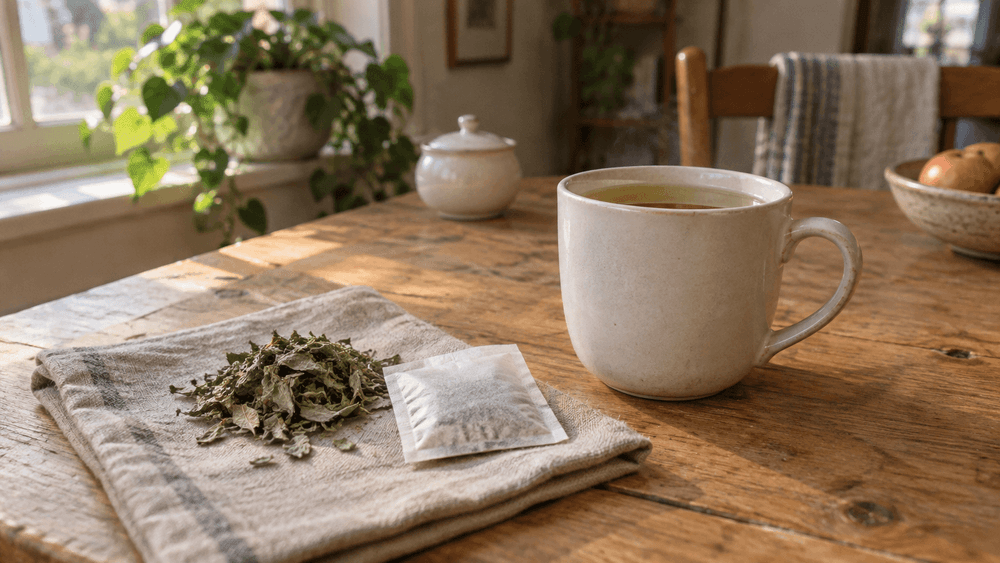
Hemp tea is dried hemp leaf, flower or a blend of the two, steeped in hot water. Here is the short answer, checked against primary sources on October 30, 2026. Water is poor at pulling cannabinoids out of the plant, so in lab tests most of the THC stayed in the leaves. But every leaf or flower tea carries some, the strongest bags carry far more than the weakest, and what else goes into the pot changes the math. Its effect on drug tests has barely been studied, and the federal definition of hemp is set to change on December 11, 2026.
That is the summary. The detail matters, because the top search results for hemp tea tell you it "won't get you high" and is "unlikely" to show on a drug test without measuring anything. Below you get what is actually in a hemp tea bag, what laboratories found in the dry tea and in the brewed cup, why the THCA in raw leaves and fat in the brew change the answer, what the only controlled drug-test study we found really tested, and what federal law says about these products before and after December 11. If you are comparing hemp foods, hemp tea sits on the same shelf as hemp milk and the other seed-based drinks, but it is a different kind of product: seed foods start with almost no cannabinoids, and leaves and flowers do not.
What hemp tea is made of
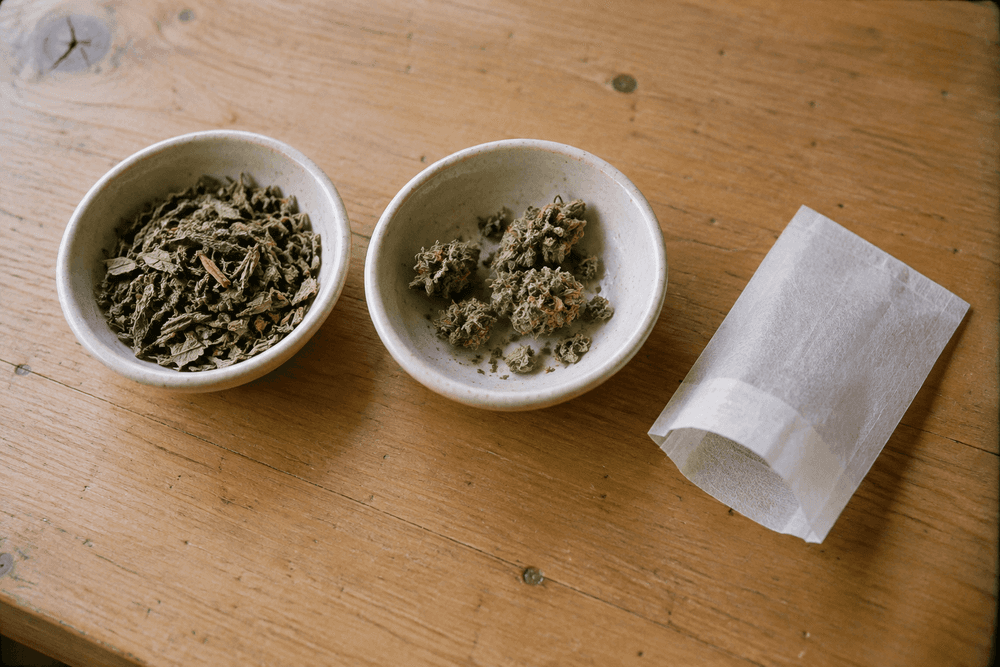
Hemp tea is an herbal infusion, not tea in the botanical sense. Green, black and oolong tea all come from one plant, Camellia sinensis, and that plant is where the caffeine in tea comes from, as the NIH's National Center for Complementary and Integrative Health explains in its green tea fact sheet. Hemp tea is made from the hemp plant, Cannabis sativa, and what goes into the bag decides almost everything else on this page. Retail hemp teas usually contain one or more of these:
- Leaves: the traditional hemp tea, dried and cut leaf. Leaves carry cannabinoids, mostly in their raw acid forms, CBDA and THCA.
- Flowers: dried hemp buds or flower pieces, often sold as hemp flower tea or CBD tea. Germany's official food-control laboratory ties higher THC in recent hemp teas to flowers, with a jump once new tea products arrived from 2016.
- Seeds: some blends add hemp seeds or hulls. Seeds do not grow the resin glands that make cannabinoids, so they start with far less than leaf or flower.
- Stems: a separate subject with its own thin evidence, which we cover in a dedicated guide linked below.
- Blends: many hemp teas mix hemp with other herbs, and some add green or black tea, which brings caffeine with it.
Germany's Federal Institute for Risk Assessment (BfR) explained in a 2018 risk opinion why the plant part matters so much: apart from the seeds and roots, every part of the hemp plant has glandular hairs, called trichomes, that produce a resin containing cannabinoids. So THC is a natural part of any tea made from leaves or flowers. Nothing has to be added for it to be there. The same opinion noted that no official method existed for preparing a standardized tea infusion, one reason results vary between labs. This is what separates hemp tea from seed foods such as hemp milk or baking with hemp flour. For the full map of the plant, from fiber to seed to flower, see what hemp is used for. Stem tea gets its own section in our guide to what people do with weed stems, so we do not repeat it here.
What labs found in the bag and in the cup
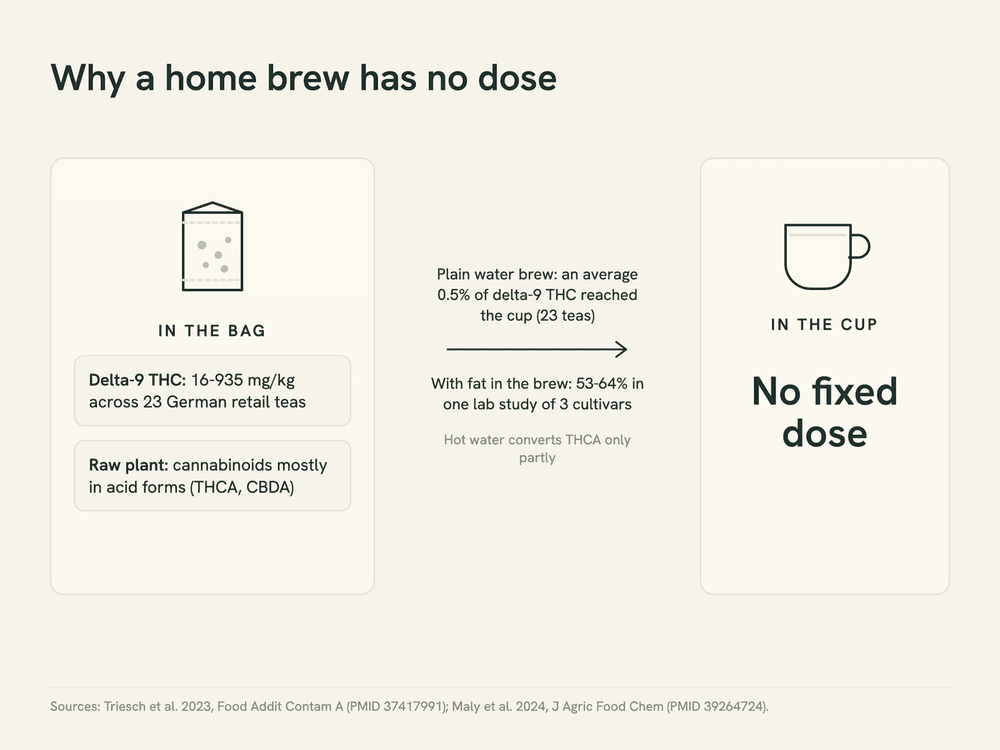
A handful of research groups have measured hemp or cannabis tea in a way that answers the question you actually have: how much of what is in the bag ends up in the cup. The largest retail test came from the BfR. In a 2023 study of 23 hemp teas sold in Germany, the delta-9 THC in the dry tea ranged from 16 to 935 mg/kg, with an average of 221 mg/kg. Most of the cannabinoids were not THC at all: total cannabinoids averaged 14,960 mg/kg, and CBD plus its acid form, CBDA, made up 87% of that. Brewed to a standard laboratory protocol, an average of only 0.5% of the delta-9 THC moved into the infusion, because cannabinoids dissolve poorly in water. That is an average across 23 European products, not a promise about any one bag.
A second German dataset shows how much the bag itself varies. Germany's official food-control laboratory in Karlsruhe found measurable THC in 78 of the 89 hemp teas it tested between 2009 and 2021, and its authors singled out teas made from flowers rather than leaves as the problem group. Three more studies in the table below explain why the cup varies too: a Leiden University study of pharmacy cannabis brewed as tea, a 2024 Prague study that compared plain brews with brews containing fat, and a Danish analysis of prescribed cannabis tea made three times over.
| Study | What was brewed | In the dry material | In the cup | What moved the number |
|---|---|---|---|---|
| Triesch 2023, BfR (Germany) | 23 retail hemp teas | Delta-9 THC 16-935 mg/kg (mean 221); 87% of cannabinoids were CBD + CBDA | Average 0.5% of the delta-9 THC | The product itself: about a 58x THC range from bag to bag |
| Draeger 2022, CVUA Karlsruhe (Germany) | 89 hemp teas tested 2009-2021 | THC quantifiable in 78 (88%); median 20.9, max 588 mg/kg | Not measured | Flower-based teas; a jump once new tea products arrived from 2016 |
| Hazekamp 2007, Leiden (Netherlands) | Pharmacy cannabis, 19.1% THCA (not hemp) | About 174 mg of potential THC in the plant used | About 10 mg of THC in the finished tea, outweighed by THCA | Water saturates; THCA converts only partly; losses in storage |
| Maly 2024, Prague (Czech Republic) | 3 cultivars, 2 of them hemp-type (CBD-dominant) | 42 cannabinoids profiled | 0.4-1.9% of delta-9 THC in a plain brew; 53-64% with dairy fat in the brew | Dairy fat in the brew |
| Soenderskov 2024, Denmark | Prescribed cannabis, 6.3-22% total THC (not hemp) | Labelled total THC | 0.46-11.3 mg of THC per 0.2 L serving | The product; creamer in the brew raised THC 2.3-4.4x |
The BfR then did the arithmetic in its public summary of the 2023 study. Until that work, regulators had assumed that 100% of the THC moved into the cup, for lack of data. At the average transfer it measured, a 60 kg adult would need about 14 litres of hemp tea in a day to pass Europe's acute reference dose for THC. For the strongest tea it tested, 0.9 litres would be enough. The average and the worst bag are about 15 times apart, and that spread is the real story. Be clear about what the yardstick is: European food-safety scientists set the acute reference dose at 1 microgram of delta-9 THC per kilogram of body weight, an estimate of what can be eaten within a day without appreciable health risk (EFSA Journal 2015;13(6):4141). It is a European benchmark, not an American rule, and not the point where you would feel anything. Europe's legal THC limits for food, in Commission Regulation (EU) 2023/915, cover hemp seed products and hemp seed oil only, not leaf or flower tea, which is why European labs keep measuring teas. Our guide to hemp drinks puts the Karlsruhe survey next to the rest of the beverage shelf.
Does hemp tea get you high?
In lab tests of plain water brews, only a small share of the THC in the plant reached the cup. That is not the same as none, and the reason is chemistry. THC is the compound in cannabis that causes a high. Raw leaves and flowers carry most of it as THCA, its acid form, which does not cause a high until heat converts it, a step called decarboxylation. Hot water does that only partly. The Leiden team brewed pharmacy-grade cannabis under controlled conditions and found the tea held mostly THCA rather than THC. The plant material they used carried about 174 milligrams of potential THC; the finished tea held about 10. Adding more plant material did not significantly raise the levels, because water can only carry so much of these oily compounds, and the tea lost a share of its cannabinoids to a sediment within a day in the fridge. The BfR, citing earlier lab work, notes that at the temperature of an ordinary cup of tea the conversion of THCA stays incomplete. Italian government chemists at the Istituto Superiore di Sanità found the same pattern: oil extracted far more than water, and a brewed tea lost half its THC within three days at room temperature. Leiden and the Italian group used medical cannabis, not hemp, so read them for the mechanism, not the numbers. If you want to know how THCA itself behaves on a test, see does THCA show up on a drug test.
The second variable is fat. In the Prague study, a plain water brew carried between 0.4 and 1.9 percent of the plant's delta-9 THC into the cup. When the researchers added dairy fat to the brew, the figure jumped to 53-64 percent. For the two hemp-type cultivars brewed plain, the authors calculated that a 70 kg adult would need more than four and six cups, respectively, to reach the European reference dose, counting delta-9 THC alone; they note that counting the other THC forms lowers those numbers considerably. The Danish laboratory saw the same direction with prescribed cannabis: a standard 0.2 litre serving ranged from 0.46 to 11.3 milligrams of THC depending on the product, and creamer in the brew raised the THC in the cup by 2.3 to 4.4 times. The evidence is not unanimous: the Prague authors note an earlier study in which fat reduced transfer. None of this is a tip. It means the same bag can deliver very different amounts depending on the plant, the water, the time and what else is in the pot, which is why a tea you brew at home does not have a dose.
Our guide to greening out after too much THC covers what those symptoms mean and when to call for help. For a sense of what a milligram figure means in a product that does carry a stated dose, see what a 10 mg edible actually is.
Hemp tea and drug tests
The only controlled study of hemp tea and urine drug tests we found on PubMed dates from 1999, and it used tea made from hemp seed. Twenty-two volunteers took part: 10 drank 12 ounces, 10 drank 24 ounces and 2 drank a placebo tea, and their urine was collected over the next 24 hours. Seven of them produced 10 specimens with trace cannabinoids on GC/MS, the lab method used to confirm a screen, all below the 15 ng/mL federal confirmation cutoff used for Department of Transportation testing. Under those conditions, the authors concluded, seed tea could produce detectable cannabinoids without triggering a positive test. That tells you a lot less than it seems, for four reasons:
- It tested seed tea. Seeds do not grow the resin glands that make cannabinoids; leaves and flowers do, and the German retail teas above carried 16 to 935 mg/kg of delta-9 THC before any THCA is counted.
- It predates flower teas. German food-control data tie higher THC in recent hemp teas to flowers, with a jump once new tea products arrived from 2016, 17 years after the study.
- It was small and used single servings, and the study abstract does not report the tea's own THC content or brand.
- We found no repeat with leaf or flower. A PubMed search on October 30, 2026 turned up no published study that measured drug-test results after drinking a leaf or flower hemp tea.
So the honest answer is that a positive test cannot be ruled out, and for leaf and flower teas it has not been measured. Standard urine tests look for a breakdown product of THC, and any leaf or flower tea contains THC and THCA. If you are tested for work, sport or a court program, the only choice that removes the risk is not drinking it. Our guide to CBD and drug tests explains how screening and confirmation cutoffs work, and the hemp seed oil drug test explainer covers the seed foods that the 1999 study actually resembles.
Is hemp tea legal in the US? What changes on December 11, 2026
Neither the FDA nor Congress has written a rule aimed at hemp leaf tea, but both have written words that bear on it. The FDA's food-safety clearances for hemp cover three seed ingredients, hulled seed, seed protein and seed oil, which the agency announced in December 2018. When we searched the FDA's GRAS inventory for "hemp" on October 30, 2026, every result was a seed ingredient. Nothing covers leaves or flowers. Separately, the FDA's position on cannabis-derived products in food is about food "to which THC or CBD has been added", which it calls a prohibited act in interstate commerce. A hemp leaf tea is an odd fit for that sentence: nothing is added, because the cannabinoids come with the leaf. The agency has not said how it sees that case. Our explainer on what the FDA says about CBD covers the wider position.
The definitions are in section 781 of Public Law 119-37, and the date comes from section 2019 of Public Law 119-103, which limits the new rules to a narrow group of products "Until December 11, 2026". On November 12, 2026, only the exclusion for cannabinoids not capable of being naturally produced by the plant is set to take effect; the total-THC standard and the container limit are set for December 11. Our timeline of the hemp ban delay to December 11 tracks the dates, and our explainer on how total THC is counted in hemp-derived products walks through the math.
What the law leaves open matters just as much for tea. First, a tea is sold to be steeped, and the statute treats products "prepared with or into any other substance prior to ... consumption" as intermediate products, which are excluded from hemp if sold directly to consumers. The law does not say whether steeping a tea in water makes it intermediate or final; either reading is restrictive. Second, the law counts hemp grown for "edible hemp leaf products" from an immature plant as industrial hemp, as the Congressional Research Service summarizes in its September 28, 2026 update, and the new definition of a hemp-derived cannabinoid product leaves industrial hemp out. "Immature" is not defined, and the carve-out is a poor fit for flower, which comes from a mature plant (our reading). Third, the law counts per "container", defined as the innermost wrapping in direct contact with the product, with examples that include a bag, a box and a packet. Which of those is the container for a box of individually wrapped tea bags, the law does not say. The FDA was told to publish lists that fix the law's scope, including more detail on that word, by February 10, 2026; as of October 30, 2026 they have not been published. State laws vary and can be stricter. This is a reading of the statute's words as of October 30, 2026, not legal advice.
What about hemp tea benefits?
As of October 30, 2026, PubMed lists no randomized or clinical trial of hemp tea for any health outcome. We searched for hemp tea, hemp teas, cannabis tea, CBD tea and hemp leaf tea with a clinical-trial filter and got zero results; the same filter on "herbal tea" returned 41, so the search works. Without the filter, the search returned 20 records, and every one was lab chemistry, an engineering paper on tea waste, a patient-experience survey or a chronic-pain cohort, not a trial of hemp tea. A wider search turned up one near miss: a 2005 Swiss driving study (Ménétrey and colleagues, Journal of Analytical Toxicology) in which volunteers drank a cannabis decoction made up to a set THC dose. It measured impairment and blood levels, not a health outcome, and the drink was not a retail hemp tea. The benefit lists you see on page one of search results borrow from studies of purified CBD given at doses far higher than anything lab measurements put in a cup. That absence is not evidence of harm or of no effect. It means the claims have not been tested in people drinking hemp tea, so we will not repeat them here.
How to read a hemp tea label
A hemp tea box can tell you more than its front panel suggests, if you know where to look. Use this checklist before you buy, and pair it with our step-by-step guide to reading a certificate of analysis.
- 1Find the plant part. The ingredient list should say hemp leaf, hemp flower, hemp seed or a mix. Flower teas tend to carry the most cannabinoids, and seed the least.
- 2Check what else is in the blend. Camellia sinensis, green tea or black tea means caffeine. Other herbs change the taste, not the cannabinoid question.
- 3Ask for a batch COA (certificate of analysis) from a third-party lab, matched to the lot number on your box.
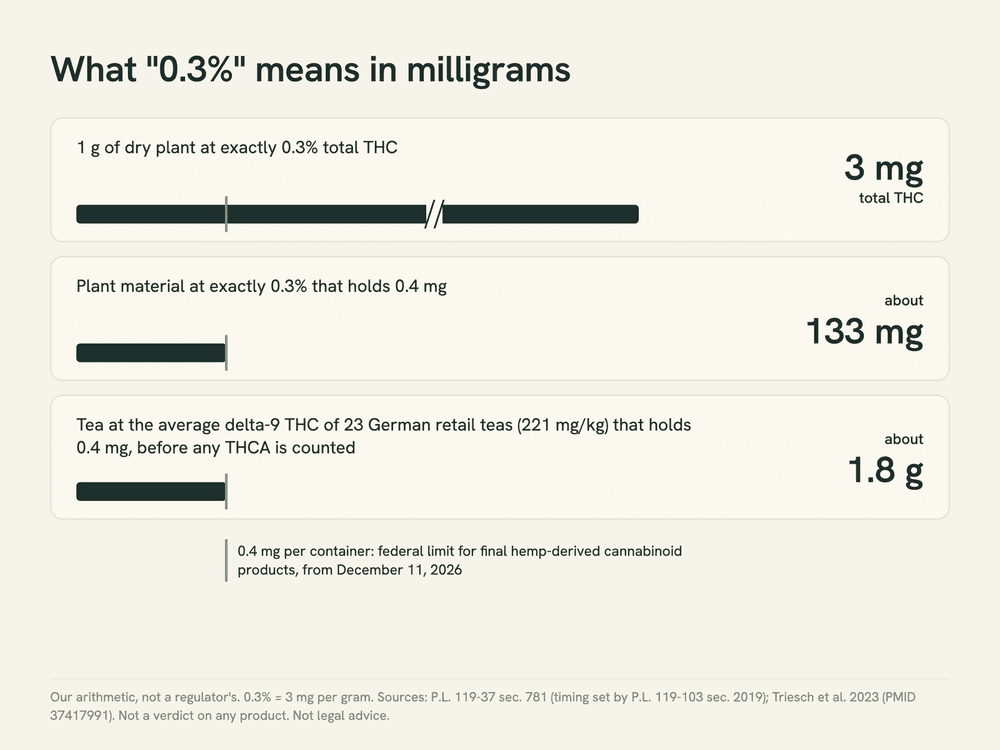
- 4Look for total THC, not just delta-9 THC. Most lab reports calculate total THC as delta-9 THC plus 0.877 times THCA. A report that lists delta-9 THC alone can miss most of the THC a raw leaf carries.
- 5Turn the percentage into milligrams per package. Less than 0.3% sounds tiny, but at 0.3% one gram of dry tea holds 3 mg of total THC. From December 11, 2026, the federal limit for a final product will be 0.4 mg per container.
- 6Confirm that THCA and CBDA were measured at all, and note the lab name and the test date.
- 7Treat health claims on the box as a red flag. The FDA has not approved any hemp tea for any condition, and we found no clinical trial that tested one for a health outcome.
The 0.877 factor comes from USDA's hemp regulation, which defines total THC for the crop test: it accounts for the weight THCA loses when it converts to THC. It is the crop rule, and the 2026 statute itself speaks of total THC "including tetrahydrocannabinolic acid" without a formula, but it is what you will find on most reports. The same habit of reading the lab report before the marketing works for oils, too; our guide to choosing a CBD oil applies it step by step.
Who should skip hemp tea
Skip it if you are pregnant or breastfeeding: the FDA strongly advises against using CBD, THC or marijuana in any form during pregnancy or while breastfeeding, and our page on CBD during pregnancy and breastfeeding explains the reasoning. Skip it if you are subject to drug testing, for the reasons above. Keep it away from children, since the THC in any given cup is unknown. If you take prescription medicines, talk to your doctor or pharmacist before using any cannabis product, because cannabinoids can interact with some drugs. And if you feel any effect at all, do not drive.
Hemp tea questions, answered
Not from the hemp. The caffeine in tea comes from the tea plant, Camellia sinensis, and a bag that is only hemp has none of that plant in it. Many hemp teas are blends, though, and some add green or black tea. We found no lab assay of caffeine in hemp itself, so the ingredient list is your best guide.
Usually, yes, but mostly as CBDA, the raw acid form. In the German test of 23 hemp teas, CBD and CBDA made up 87% of all the cannabinoids in the dry tea. Water carries little of them into the cup, and the amount varies with the product and how it is brewed, so a cup of hemp tea has no reliable CBD dose.
It cannot be ruled out. The only controlled study we found, from 1999, used hemp seed tea and found traces below the federal confirmation cutoff in 7 of 22 volunteers. Leaf and flower teas carry far more cannabinoid than seed, and we found no published study that tested them against a drug test. If you are tested, the only way to remove the risk is not to drink it.
Not necessarily. Some products sold as CBD tea are simply hemp leaf or flower, with the cannabinoids that come with the plant. Others are tea with an added hemp extract, which is a different product: the FDA's statement that adding THC or CBD to food in interstate commerce is a prohibited act speaks directly to added cannabinoids. Check whether the ingredient list names hemp leaf or flower, or a hemp extract.
The FDA strongly advises against using CBD, THC or marijuana in any form during pregnancy or while breastfeeding. A leaf or flower hemp tea carries cannabinoids, THC and THCA included, so that advice applies to it. Talk to your doctor or midwife about any product you are considering.
We make no recommendation either way. We found no human trial of hemp tea for any health outcome, daily or otherwise. The honest answer is about variability: in the German test of 23 teas, the strongest bag held about 58 times the THC of the weakest, and what goes into the pot changes how much reaches the cup. If you drink it regularly, choose products with a batch COA that reports total THC in milligrams per package, and remember that regular use adds to your drug-test exposure.
Hemp tea is one shelf in a larger aisle. For the rest of it, from seed milks to cans with milligrams printed on the label, see our overview of hemp drinks and what is in them. This page reflects primary sources as read on October 30, 2026. It is information, not legal or medical advice.
Writing about hemp, wellness and the small rituals that keep us balanced.