Hemp Seed Oil Benefits: What Human Studies Actually Tested
Hemp seed oil is a food oil, not CBD and not a therapy. Here is what a tablespoon holds, what the five human trials we found that fed it to people measured, and where the popular benefit claims really come from.
Is hemp seed oil good for you? Here is the short answer on hemp seed oil benefits, checked against the research on October 25, 2026. It is a food oil with an unusual mix of omega-6 and omega-3 fats, at about 120 to 125 calories a tablespoon. In most of the few human trials that gave people the oil, the fats in their blood shifted toward what the oil contains, and none that reported cholesterol found a difference against its comparator. Most other benefits you read about come from other oils, from rats or from CBD.
This page is about eating or taking the oil. Hemp seed oil is one of several foods made from the seed, alongside hulled hemp hearts, protein powder and plant milk; our map of what hemp is used for shows where the oil fits among the seed, fiber and flower products. Below you get what the oil is, what a tablespoon holds in grams, every human trial we found that gave people the oil by mouth, where the popular claims really come from, how it compares with flaxseed, olive and fish oil, and how to store and use it. If you came for skin care, that is a different question with different evidence, covered in our evidence check on hemp seed oil for skin.
What hemp seed oil is, and what it is not
Hemp seed oil is the oil pressed from the seeds of the hemp plant, Cannabis sativa. In the GRAS notice for hemp seed oil that the FDA answered in 2018, the company describes whole seeds that are cold pressed and then filtered before packaging. GRAS stands for generally recognized as safe: a company concludes that an ingredient is safe for its intended food uses and can notify the FDA of that conclusion. In December 2018 the agency answered three notices covering hulled hemp seed, hemp seed protein and hemp seed oil as food ingredients, saying it had "no questions" about the companies' conclusion that they are generally recognized as safe for their intended uses. The hemp seed oil letter then adds, in its own words: "This letter is not an affirmation that hemp seed oil is GRAS under 21 CFR 170.35." So this is a food-safety record, not a health claim and not an FDA approval. It is also the honest frame for this whole page. The benefits worth discussing are food-level nutrition, not therapy.
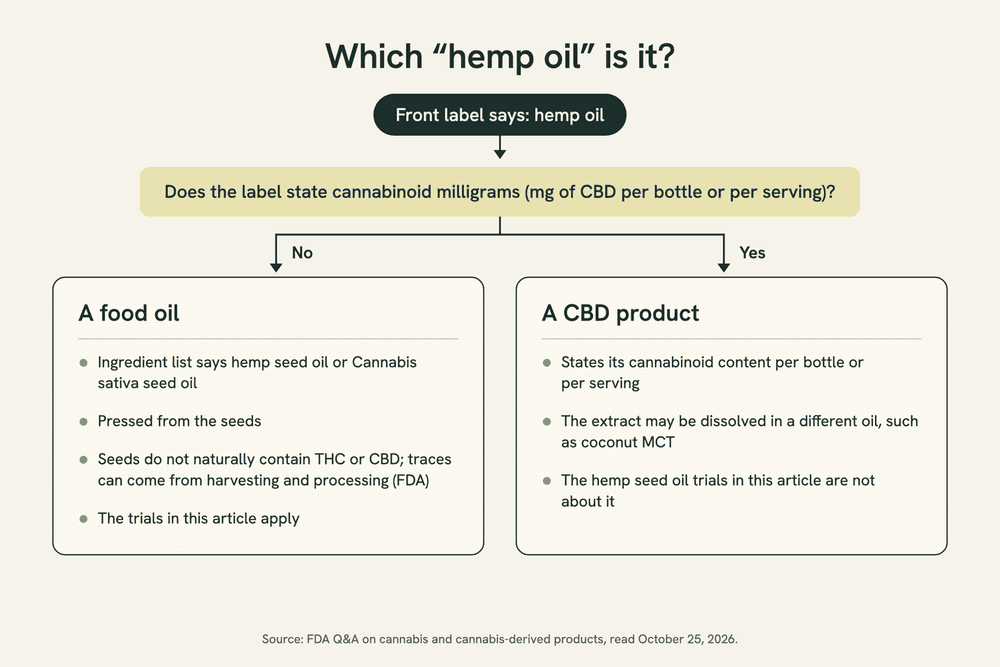
The FDA is just as plain about cannabinoids. On its page about cannabis and cannabis-derived products, it says: "The seeds of the plant do not naturally contain THC or CBD." The same paragraph adds the part many pages drop: hemp seed ingredients "contain only trace amounts of THC and CBD, which the seeds may pick up during harvesting and processing when they are in contact with other parts of the plant." So hemp seed oil is not CBD oil. The confusion comes from the name. "Hemp oil" on a front label can mean seed oil or a cannabinoid extract, while "hemp seed oil" and "Cannabis sativa seed oil" mean the food oil. Our side-by-side of hemp seed oil and CBD oil covers how each is made and labeled. The mix-up also runs the other way: many CBD tinctures do not use hemp seed oil at all. Planntz tinctures, for example, dissolve their extract in coconut MCT oil.
What is in a tablespoon
You would expect USDA to have a standard entry for hemp seed oil. It does not. On October 25, 2026 we searched the lab-analyzed datasets in USDA FoodData Central (Foundation, SR Legacy and FNDDS) for "hemp oil" and "hemp seed oil" and found none. What the database does hold is label data that manufacturers file in its Branded section. Three hemp seed oils filed there (Nutiva, FDC ID 2277552; Manitoba Harvest, FDC ID 1916119; Humming Hemp, FDC ID 2409585) list 120 to 125 calories and 13 to 14 grams of fat per tablespoon, 1 gram of it saturated. Those are the makers' own rounded label figures, not USDA lab analysis. For the individual fatty acids, the card below multiplies 14 grams of fat by two sets of published percentages, so you can see the range rather than one tidy number.
| Per tablespoon | Amount | Where the number comes from |
|---|---|---|
| Calories | 120-125 kcal | Three manufacturers' labels in USDA FoodData Central (Branded) |
| Total fat | 13-14 g | Same three labels |
| Saturated fat | 1 g | Same three labels |
| Polyunsaturated fat | About 11 g | Nutiva label data (73.3 g per 100 g), our calculation |
| Linoleic acid (LA, omega-6) | About 7.1 g (GRN 778); 7.7-8.1 g (Farinon) | Our calculation from 50.9% (GRN 778) and 55.0-58.2% (Farinon) |
| Alpha-linolenic acid (ALA, omega-3) | About 2.3 g (GRN 778); 1.8-2.7 g (Farinon) | Our calculation from 16.7% (GRN 778) and 12.6-19.6% (Farinon) |
| Gamma-linolenic acid (GLA, omega-6) | About 0.5 g (GRN 778); 0.08-0.63 g (Farinon) | Our calculation from 3.6% (GRN 778) and 0.6-4.5% (Farinon) |
| Stearidonic acid (SDA, omega-3) | About 0.17 g (GRN 778); 0.03-0.21 g (Farinon) | Our calculation from 1.2% (GRN 778) and 0.2-1.5% (Farinon) |
| Omega-6 to omega-3 | About 3 to 1 | GRN 778 percentages; 2.8 to 4.5 in the Farinon dataset, and up to 5.5 in others the review lists |
| EPA and DHA (the fish-oil omega-3s) | None | Not present in the composition data |
Two things to know about those percentages. The GRN 778 figures (77% polyunsaturated, 13% monounsaturated and 9.8% saturated fat, with linoleic acid at 50.9% and ALA at 16.7%) are one company's numbers in a notice the agency said it had no questions about. They are not measurements the FDA made. And real oils vary. A 2020 review of hempseed composition in the journal Nutrients compiles several multi-cultivar analyses in one table. In the one the card uses, linoleic acid made up 55 to 58 percent of the oil, ALA 13 to 20 percent, and GLA anywhere from under 1 to about 4.5 percent. Other analyses in the same table run from about 52 to 59 percent linoleic acid and reach about 6 percent GLA. Cultivar, growing season and pressing all move the numbers, so read the card as a range, not a specification.
The ALA number is the one worth understanding. One tablespoon carries more ALA than the adequate intake the National Academies set for adults, which is 1.1 grams a day for women and 1.6 for men. That is a composition fact, not a promise about your health, and ALA is not the same as the omega-3s in fish oil. The body makes some EPA from ALA, but human tracer studies reviewed by Burdge and Calder found that conversion limited, and conversion on to DHA very low. So "hemp seed oil is rich in omega-3" is true for ALA and misleading if you read it as a fish oil substitute.
You will also read that hemp oil's roughly 3-to-1 ratio of omega-6 to omega-3 is ideal. That idea has more repetition behind it than evidence. A lipid researcher who reviewed the omega-6/omega-3 ratio in 2006 concluded that the ratio is, "both on theoretical and evidential grounds, of little value" as a measure, and that metrics built on the omega-3s alone, especially EPA and DHA, hold more promise. That is one author's review, not a guideline. It is still a good reason to read "the perfect ratio" as marketing rather than settled science.
The human trials, one by one
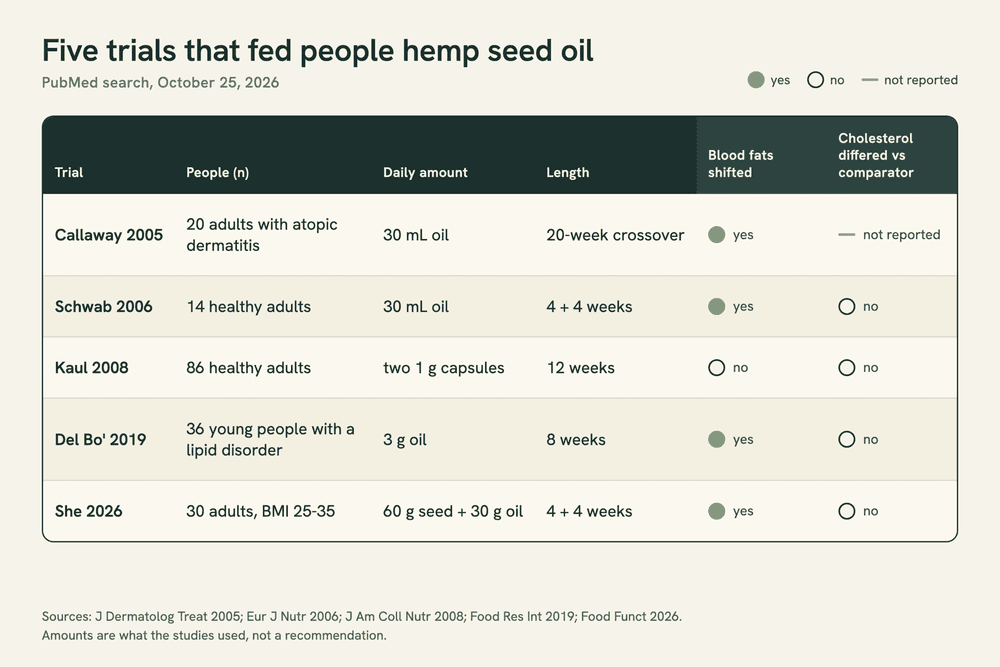
This is the part the top search results skip. We searched PubMed on October 25, 2026 with four query strings, combined the 69 unique records they returned, and read every title. We found four trials that gave people hemp seed oil by mouth and measured something about their health or blood, plus one 2026 trial that gave hemp seed and oil together. We left out studies that applied the oil to the skin, combination products that mixed it with other oils or herbs, drug-testing studies whose outcome was THC detection, CBD studies that used hemp seed oil only as the inactive oil in both arms, and trials of hemp seed or hemp protein rather than the oil. That is not a claim that no other study exists anywhere. It is what that dated search found, and the table lists every trial it turned up.
| Trial | Who took part | Daily amount | Compared with | Length | What changed | What did not |
|---|---|---|---|---|---|---|
| Callaway 2005, Finland | 20 adults with atopic dermatitis | 30 mL oil | Olive oil (single-blind crossover) | 20-week crossover | Plasma LA, ALA and GLA rose; arachidonic acid did not | Symptom ratings and medication use did not differ significantly from olive oil (2023 review) |
| Schwab 2006, Finland | 14 healthy adults | 30 mL oil | Flaxseed oil (double-blind crossover) | 4 weeks each, 4-week washout | Serum fatty acids mirrored each oil | Cholesterol, lipoproteins, glucose, insulin, clotting factors |
| Kaul 2008, Canada | 86 healthy adults | Two 1 g capsules | Fish oil, flaxseed oil or placebo (double-blind) | 12 weeks | Fish oil raised EPA and DHA | Hempseed oil changed no plasma fatty acid; no oil changed cholesterol or platelet aggregation |
| Del Bo' 2019, Italy | 36 children and teens with an inherited lipid disorder | 3 g oil | Control group (pilot) | 8 weeks | Red-blood-cell omega-3 and omega-6 rose | Serum lipid profile, compared with control |
| She 2026, University of Manitoba | 30 adults with a BMI of 25 to 35 | 60 g hulled seed plus 30 g oil | Sesame seed plus soybean oil (crossover; participants, investigators and assessors masked) | 4 weeks each | Blood ALA, GLA, DGLA and EPA higher | Serum lipids, glucose, insulin, blood pressure, body composition |
The cleanest test of the oil in healthy people is Schwab's 2006 Finnish crossover. Fourteen healthy volunteers took 30 mL a day of hempseed oil for four weeks and flaxseed oil for another four, with a four-week washout in between, in a double-blind design. Each oil showed up in their blood fats: hemp raised linoleic acid and GLA, flax raised ALA. But the researchers found no significant differences in fasting cholesterol, lipoproteins, glucose, insulin or clotting factors between the two periods. One number sometimes gets quoted as a win. The ratio of total to HDL cholesterol was lower after hemp, at P = 0.065, which is above the usual 0.05 threshold. That is not a significant result, and it is not evidence of an improvement.
Kaul's 2008 Canadian trial is the only one that tested capsules, the format most supplements come in. It gave 86 healthy adults two 1-gram capsules a day of fish oil, flaxseed oil, hempseed oil or a placebo for 12 weeks. Fish oil raised EPA and DHA in the blood. In the authors' words, "supplementation with hempseed oil did not significantly alter the concentration of any plasma fatty acid," and none of the oils changed cholesterol or platelet aggregation (how readily the blood cells called platelets clump together). The authors concluded that this kind of supplementation "may not provide the desired or expected result over a 3 month period."
Two trials were in people with a medical condition, and each gets exactly one fact here. In a 2005 Finnish crossover, 20 adults with atopic dermatitis took 30 mL of hempseed oil a day by mouth and, in another period, olive oil, and the fatty acids in their blood shifted toward what hemp oil contains. The limits are large: 20 people, a single-blind design, and, as a 2023 systematic review notes, the skin-symptom and medication changes the abstract reports were measured within the hemp period and did not differ significantly from olive oil. In a 2019 Italian pilot trial, 36 children and teenagers with an inherited lipid disorder took 3 grams a day for eight weeks, and the fatty acids in their red blood cells changed while their cholesterol profile did not change compared with the control group. That was a small pilot in young people already on diet therapy for the condition, and it is reported here only for what it measured.
The newest and largest crossover, published in 2026 and sponsored by the University of Manitoba, fed 30 adults with a body mass index of 25 to 35 a daily 60 grams of hulled hemp seed plus 30 grams of hemp oil for four weeks, and sesame seed plus soybean oil for another four. Their blood fatty acids shifted as expected. Cholesterol, glucose, insulin, blood pressure and body composition did not differ between the two periods. Because seed and oil were eaten together, this is not a test of the oil alone. The trial was also registered in 2015 on ClinicalTrials.gov, more than a decade before the results appeared.
Put the five side by side and one pattern holds as of October 25, 2026. In four of the five, the fatty acids in participants' blood shifted toward what the oil contains; the exception was the low-dose capsule trial. Four of the five report a cholesterol result (the 2005 abstract does not), and none of those four found a difference compared with the oil or food it was tested against. On side effects, the 2005 trial reported no significant side effects in its 20 participants. The other abstracts do not give enough detail to say more, so treat that as one small data point, not a safety verdict.
Capsules versus a spoonful
Hemp seed oil capsules are a common format, so it is worth doing the arithmetic their labels leave out. Here is how a capsule serving compares with what the trials used, step by step. These are our calculations from the figures above, not new measurements.
- 1A tablespoon is 15 mL and holds about 14 grams of fat, per the label data.
- 2Two 1-gram capsules, the amount in Kaul's trial, add up to 2 grams: about a seventh of a tablespoon.
- 3At the GRN 778 notifier's 16.7% ALA and 50.9% linoleic acid, those 2 grams carry roughly 0.33 grams of ALA and 1.0 gram of linoleic acid.
- 4The two Finnish trials used 30 mL a day, close to 28 grams of oil. That is roughly fourteen times as much as two capsules, and about 240 to 250 calories' worth.
- 5For scale, the company's own exposure estimate in the 2018 GRAS notice put typical intake from its intended food uses at about 4.1 grams a day, with heavy users (the 90th percentile) at 8.2 grams.
Kaul's team did not test why their capsules changed nothing, so we cannot say the low dose was the reason. But dose is the obvious difference between that trial and the ones where blood fats moved. If you are weighing capsules, the honest summary is that the one trial of this format, at two capsules a day for 12 weeks, saw no change in any plasma fatty acid. None of these numbers is a recommended amount. They are simply what the studies used.
Where the popular hemp seed oil benefits come from
If the human trials are this modest, where do the long benefit lists come from? We read the top-ranking pages for this search on October 25, 2026 and traced the citations behind each claim. Most of the evidence quoted is not about hemp seed oil at all. It is about other oils, isolated GLA, animals or CBD. This is the same method we apply to the evidence behind CBD's claimed benefits: name the study, the substance and the species, then say what it actually allows.
| Claim topic | What was actually studied | What it lets us say |
|---|---|---|
| Eczema and skin | Hempseed oil taken by mouth by 20 adults with atopic dermatitis, compared with olive oil (Callaway 2005) | Blood fatty acids changed; symptom ratings did not differ significantly from olive oil. Skin care is a separate question. |
| Heart and cholesterol | Four human trials reported blood lipids and found no difference against their comparators. The most-cited heart source is a 2010 review of studies "mostly in animals" | Not shown for hemp seed oil |
| Blood pressure | The page making this claim cites an omega-3 trial in people with high blood pressure, not hemp oil. She 2026 measured blood pressure and found no difference | Not shown for hemp seed oil |
| Inflammation | An omega-3 supplement trial in medical students, plus GLA results borrowed from evening primrose and borage oil reviews | Not shown for hemp seed oil |
| PMS | Capsules that were about one-fifth GLA by weight (Rocha Filho 2011). The word hemp does not appear in the paper | Not about hemp seed oil |
| Menopause | 20 ovariectomized rats fed diets containing hemp seed for three weeks (Saberivand 2010) | An animal study of the seed, not the oil |
| Brain health | A mouse study of a hemp seed extract | An animal study, not the oil in people |
| Acne | CBD applied to cultured skin cells in a lab | Not hemp seed oil at all |
Three of these deserve a closer look because they sound the most clinical. The PMS figure that circulates traces to a 2011 Brazilian trial in which each 1-gram capsule held a mean of 210 mg of GLA, so the capsules were about one-fifth GLA by weight. Hemp seed oil runs from under 1 to about 6 percent GLA in the analyses the 2020 review compiled, and the word hemp does not appear in the paper. The menopause claim comes from 20 rats fed hemp seed for three weeks. And the heart-health citation most pages lean on is a 2010 review whose own abstract says the studies it covers were "mostly in animals." There is a larger dataset, and it says little about hemp. When a 2018 network meta-analysis ranked 13 oils and fats by their effect on blood lipids across 54 trials, hempseed oil was one of the candidate oils, but the only hempseed trial in its reference list is the 14-person Finnish one, and hempseed is not among the oils the authors could say lowered LDL compared with butter. That is a data gap, not a verdict either way. The skin claims, acne included, are traced in detail on the skin page linked above.
Hemp seed oil vs flaxseed, olive and fish oil
These four oils get compared constantly, usually to crown a winner. The useful comparison is narrower: which omega-3 each one carries, and how much omega-6 comes with it. All values are per tablespoon.
| Oil | Main fat | Omega-3 it carries | Linoleic acid (omega-6) | EPA + DHA | Basis |
|---|---|---|---|---|---|
| Hemp seed | Polyunsaturated, about 11 g | ALA, 1.8-2.7 g, plus a little SDA | About 7-8 g (about 3 parts to 1 of ALA) | None | Labels plus GRN 778 and Farinon 2020 percentages, our calculation |
| Flaxseed, cold pressed | Polyunsaturated, mostly ALA | ALA, about 7.3 g | About 1.9 g (about 1 part to 4 of ALA) | None | USDA SR Legacy, FDC ID 167702 |
| Olive | Monounsaturated, about 9.9 g | 18:3 fats about 0.1 g (USDA does not split omega-3 from omega-6 here) | About 1.3 g | None | USDA SR Legacy, FDC ID 171413 |
| Salmon fish oil | Mixed; EPA and DHA are about 31% of it | EPA about 1.8 g and DHA about 2.5 g | About 0.2 g | About 4.2 g | USDA SR Legacy, FDC ID 172343 |
Read the table as a map, not a ranking. Flaxseed carries roughly three to four times as much ALA per tablespoon as hemp, with far less omega-6. Olive oil is mostly monounsaturated fat and carries little of either polyunsaturated family. Fish oil is the only one of the four with EPA and DHA ready-made, which matches what Kaul's trial saw: fish oil raised EPA and DHA in the blood. Hemp sits between flax and the omega-6-heavy oils, with small amounts of GLA and SDA. If your question is about omega-3s and the endocannabinoid system, or whether fish oil and CBD clash, our explainer on CBD and omega-3s covers it. If you are choosing between whole seeds rather than oils, see how hemp hearts compare with chia seeds.
Using it as food: storage, heat and the THC trace
Hemp seed oil is a food fat, and it ages like one. A 2024 storage study cold-pressed hempseed oil and kept it for 270 days in four packaging materials, at 25 degrees Celsius under diffused light and at 10 degrees in the dark, tracking peroxides the whole way. The authors describe the oil as "extremely rich in unsaturated fatty acids" and therefore highly sensitive to oxidation, and amber glass wrapped in foil at refrigerator temperature protected it best. Heat changes it in a second way that surprises people. When German food-safety researchers heated hemp seed oils to 200 degrees Celsius for 60 minutes, total cannabinoids fell 38% and cannabinoid acids fell 99%, but delta-9 THC rose 22%. The practical upshot of both findings is the same: treat it as a cold oil.
- Buy the smallest bottle you will finish in a reasonable time, and look for a pressing or best-by date.
- Choose dark glass over clear glass or plastic.
- Refrigerate after opening, cap it tightly, and keep it away from the stove and the windowsill.
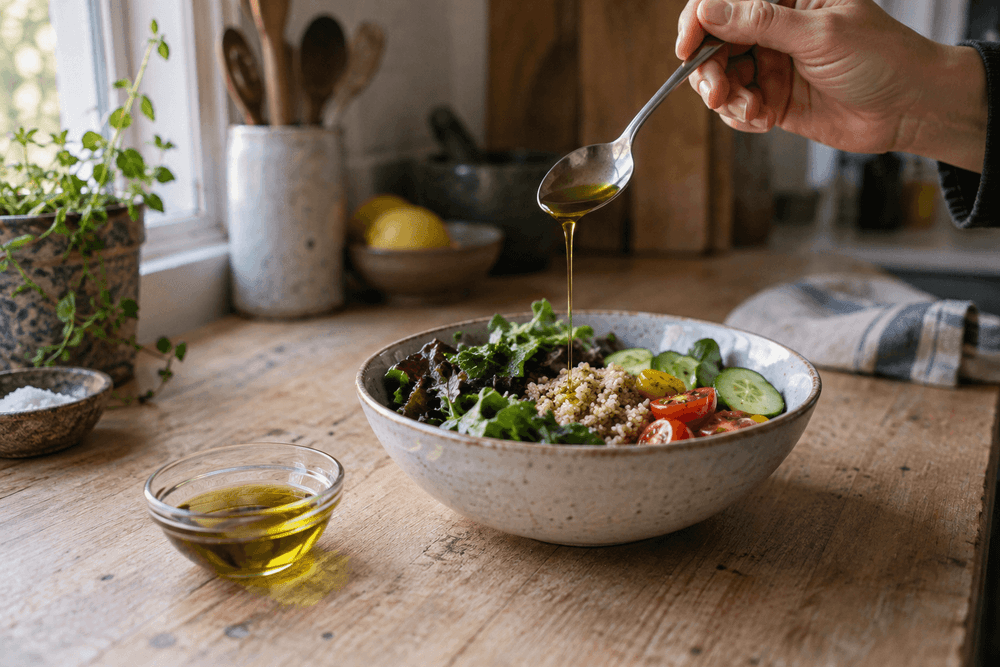
- Use it cold: in dressings and dips, drizzled over a finished dish, or stirred into a smoothie.
- Smell it before you use it. Fresh unrefined oil smells nutty or grassy; sharp, bitter or stale means it has oxidized.
- If it smells off, throw it out rather than cooking it away.
Then there is the trace THC. In the same German survey of 30 retail hemp seed food oils, delta-9 THC ran from 0.2 to 6.7 milligrams per kilogram of oil, and three of the thirty came in above the European maximum. That maximum is set on delta-9 THC equivalents, meaning THC plus 0.877 times THCA, which is how an oil can exceed it with a raw THC reading below the limit. Under EU Regulation 2023/915, the ceiling is 7.5 milligrams per kilogram for hemp seed oil. The United States sets no equivalent number for a finished hemp seed oil food. Most hemp seed oils carry only traces of THC, but older and some current retail oils have carried enough to show up in urine, and no oil can promise a clean test. The controlled studies are on our page about hemp seed oil and drug tests. For whether the oil belongs in a hot pan at all, our hemp flour guide has a section on cooking with hemp seed oil.
Who should check with a clinician first
- You have a known allergy to hemp seed, or you have reacted to other seeds or nuts.
- You take a blood thinner and are not sure whether your "hemp oil" contains CBD.
- You are pregnant or breastfeeding and are considering daily supplement-size amounts. We found no source that supports a claim either way.
- You have surgery coming up. Tell your surgeon about every supplement you take, this one included.
- You are watching calories: 30 mL a day, the amount two of the trials used, is roughly 240 to 250 calories.
On allergy: the FDA's response letter on hulled hemp seed (GRN 765) states that "instances of allergic reactions to hemp seed-derived ingredients have been documented in the scientific literature," and a published case report describes anaphylaxis after eating hempseed. Hemp seed allergy is uncommon, but it is real. Our page on whether you can be allergic to CBD and cannabis explains the plant allergens involved. On blood thinners: two of the trials checked clotting, and neither saw hempseed oil change clotting factors or platelet clumping. That is reassuring but small. The interaction worth asking about is with CBD, which some "hemp oil" products contain; see how CBD interacts with blood thinners.
What is still unknown
Quite a lot, and it is worth saying plainly. No trial of hemp seed oil has been large or long: the biggest enrolled 86 people, the longest ran 20 weeks including a crossover, and four of the five were run in Finland or Canada. None measured clinical events or diagnoses; they measured blood fats and a handful of lab values. Capsule doses have been tested once. Composition varies by cultivar, harvest and press, so the oil in a given bottle may not match the percentages above. And the most useful dataset, a head-to-head comparison against other common oils in many people, does not exist yet, which is why the 2018 meta-analysis, with a single 14-person hempseed trial to draw on, could not rank hempseed oil with any confidence. What can be said honestly is narrow. It is a food oil with a distinctive fatty-acid profile, it shows up in your blood fats when you eat enough of it, and the claims that go further rest on other substances or other species.
Hemp seed oil: common questions
It is a reasonable food oil: mostly polyunsaturated fat, with about 1.8 to 2.7 grams of the plant omega-3 ALA per tablespoon by our arithmetic, and about 120 to 125 calories. In the small human trials that fed it to people, blood fatty acids usually shifted toward what the oil contains, but none that reported cholesterol found a difference against the oil or food it was compared with. Think of it as food, not therapy.
Not in amounts that make it a CBD product. The FDA says hemp seeds do not naturally contain THC or CBD, but seed ingredients can pick up traces during harvesting and processing. A German survey of 30 retail oils measured delta-9 THC at 0.2 to 6.7 mg/kg, so no bottle can be promised free of it. If you want CBD, you need a product that states its cannabinoid content.
The trials gave it every day, in amounts from two 1-gram capsules to 30 mL, for 4 to 20 weeks. No study sets a recommended daily amount, and we do not suggest one. Keep the calories in mind (about 120 to 125 per tablespoon), and check with a clinician first if you have a seed allergy, take a blood thinner, are pregnant or have surgery coming up.
They are not interchangeable. Hemp seed oil carries ALA, the plant omega-3; fish oil carries EPA and DHA. Human tracer studies show the body converts only a limited amount of ALA to EPA, and very little to DHA. In the one trial that compared them directly, at two 1-gram capsules a day for 12 weeks, fish oil raised EPA and DHA in the blood and hempseed oil changed no plasma fatty acid. No verdict on "better" follows from that; they are different foods.
Yes, mainly ALA: roughly 1.8 to 2.7 grams per tablespoon by our calculation, plus a little stearidonic acid (SDA). That is more than the adequate intake for ALA the National Academies set for adults, 1.1 grams a day for women and 1.6 for men. It contains no EPA or DHA.
Two 1-gram capsules hold about a seventh of a tablespoon of oil. The only trial of capsules we found, Kaul 2008, reported that two a day for 12 weeks did not significantly change any plasma fatty acid. Whether a capsule is worth it to you is your call, but that is the evidence there is.
Their fats differ. Olive oil is mostly monounsaturated, about 9.9 grams per tablespoon in USDA's data; hemp seed oil is mostly polyunsaturated, about 11 grams, with roughly 3 parts omega-6 to 1 part omega-3. In the 2005 Finnish crossover, olive oil was the comparison, and a 2023 review found no significant difference between the two on skin-symptom ratings or medication use. Hemp's polyunsaturated fat makes it sensitive to oxidation, so keep it cold.
Cold, dark and closed. In a 2024 storage study, amber glass wrapped in foil at refrigerator temperature protected the oil best over 270 days. Buy small bottles, refrigerate after opening, and throw it out if it smells sharp, bitter or stale.
Looking for CBD instead? A bottle of hemp seed oil is the wrong place to find it, whatever the front label says. Our guide to telling hemp seed oil and CBD oil apart shows how each is made, what each contains and how to read the label before you buy. And for the wider picture of what the seed becomes, from hearts to hemp milk, start with the many uses of the hemp plant.
Writing about hemp, wellness and the small rituals that keep us balanced.