Hemp Milk vs Oat Milk: Protein, Sugar and Fortification
Hemp milk and oat milk are both water plus a seed or a grain. Here are five cartons compared per cup from USDA data, why an oat milk with no sweetener can show 7 g of added sugar, how to read the carton, and the THC questions only hemp raises.
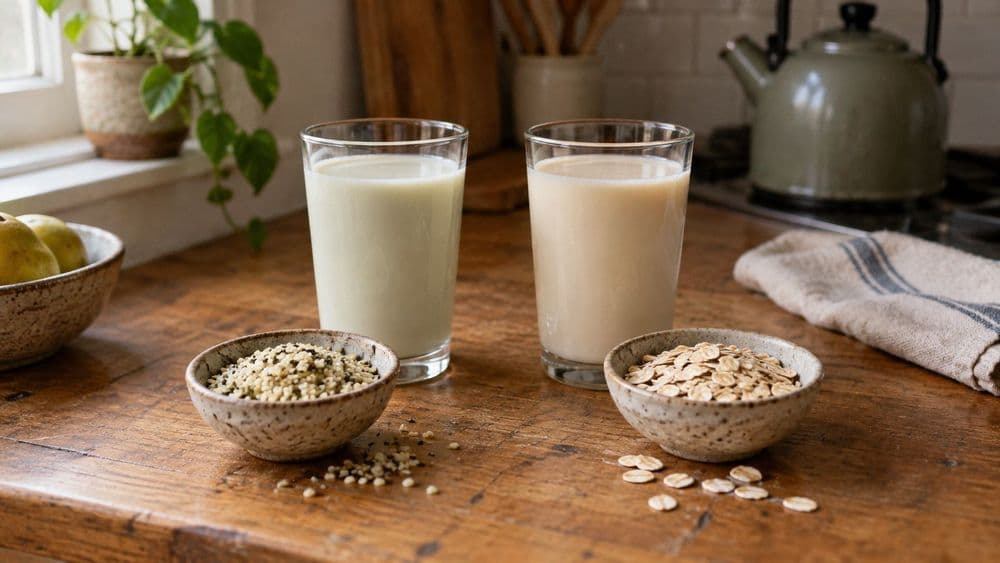
Hemp milk vs oat milk is a smaller choice than the shelf makes it look. Both are water plus a seed or a grain. Unsweetened hemp milk is lower in carbohydrate, usually lower in sugar, and carries the seed's own fat. Oat milk carries sugar made from its own starch, which FDA counts as added sugar even when no sweetener is on the list. Protein runs 1 to 3 grams a cup for either. Calcium, vitamin D and B12 are whatever the maker chose to add, so the carton, not the plant, decides.
That is the short answer. The pages that rank for this question disagree with one another on calcium, vitamin D and B12, mostly because they compare an unfortified hemp drink with a fortified oat drink, or the reverse. Below, every number sits on one basis, a 240 mL cup, and is tied to a USDA FoodData Central entry. You also get the FDA rule that explains why an oat milk made from oats and water can show 7 grams of added sugar, an FDA lab check that found one hemp carton far short of its calcium label, a checklist for reading the carton, and the three questions only hemp raises: THC, drug tests and legality. This is food composition and labeling, not a health claim about either drink.
What is hemp milk, and what is oat milk?
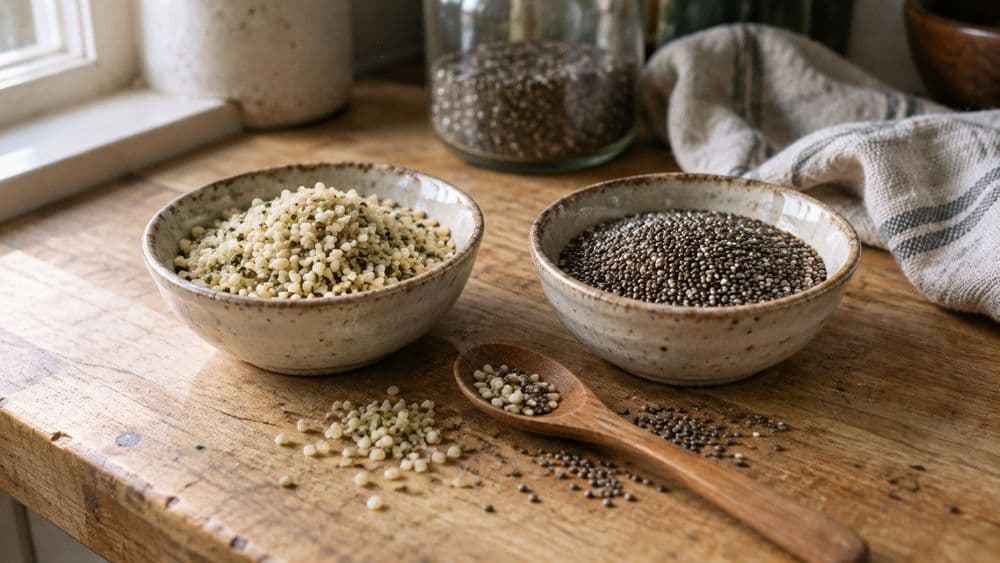
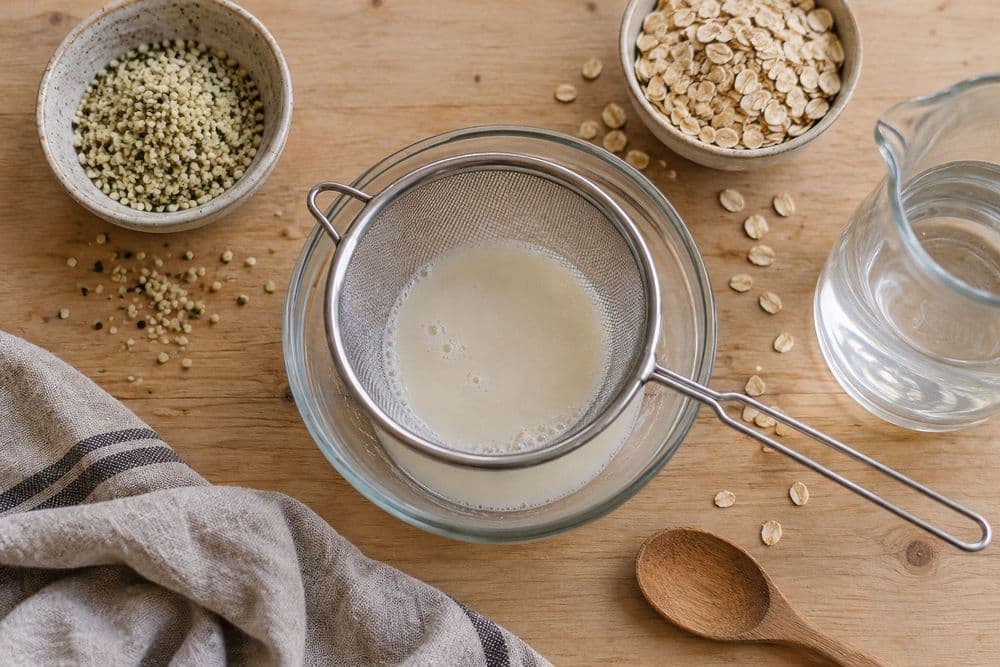
Hemp milk is hulled hemp seed and water. According to the University of Florida's extension fact sheet on hemp milk, commercial makers mix the seed with hot water, wet-mill it, filter the slurry and homogenize it; the sheet puts the result at about 3 grams of protein per serving. The seed is the same one sold as hemp hearts. In December 2018 the FDA responded to three GRAS notices for hemp seed ingredients, covering hulled hemp seed, hemp seed protein powder and hemp seed oil, and said it had no questions about the company's conclusion that they are generally recognized as safe (GRAS) for their intended food uses. That is not an approval, but it is why hemp seed shows up in ordinary food. Milk is only one of the crop's uses; our overview of what hemp is used for, from seeds to fiber maps the rest.
Oat milk starts the same way, oats plus water, with one extra step that changes the drink. UF's companion fact sheet on oat milk describes rolled oats mixed into a slurry that goes through hydrolysis, which breaks down the starch so the drink does not gel and thicken when it is heated, before filtering and, usually, ultra-high-temperature (UHT) processing for a shelf-stable carton. Food scientists who study that step use enzymes: a 2025 lab study of oat-milk processing describes alpha-amylase, amyloglucosidase and debranching enzymes cutting oat starch into smaller pieces to keep the drink stable. Hold on to that detail, because it is where oat milk's sugar comes from. One maker, Pacific Foods, sells both drinks and filed both labels with USDA on the same day, with the same 240 mL serving. Their ingredient lists show how simple the base drinks are:
- Pacific Foods Unsweetened Hemp Milk: water, hulled hemp seed, and 1% or less of tricalcium phosphate, natural flavoring, disodium phosphate, xanthan gum, gellan gum and vitamin D2.
- Pacific Foods Original Hemp Milk: water, brown rice syrup, hulled hemp seed, and 1% or less of tricalcium phosphate, disodium phosphate, xanthan gum and vitamin D2.
- Pacific Foods Original Organic Oat Milk: water, oats, and 1% or less of tricalcium phosphate, sea salt, locust bean gum, gellan gum and vitamin D2. No sweetener of any kind.
One naming trap before the numbers. "Hemp" on a carton of milk and "hemp" on a can of seltzer are different ingredients. The milk is seed and water. A hemp drink in the cannabinoid sense is usually a beverage with a hemp extract added for its THC or CBD, which is a different product under different rules. USDA's food database lists both kinds under "hemp", so read the ingredient list, not just the front of the package.
Hemp milk vs oat milk, cup for cup
Every number below comes from USDA FoodData Central, per 240 mL cup (8 fl oz), with each product's FDC entry number in the column header. These are Branded entries, which means they are the makers' own label data filed with USDA, not USDA lab analysis. That is not a shortcut. USDA's food database has generic, lab-analyzed entries for oat milk, but none for hemp milk, so the hemp side has to come from cartons. Putting the same maker's hemp and oat drinks next to each other keeps the comparison fair, and Oatly Original and Planet Oat Unsweetened show the spread across oat brands. The % Daily Value figures use FDA's label Daily Values (calcium 1,300 mg, vitamin D 20 mcg, protein 50 g). "Not reported" means the entry has no value for that line, not that the drink contains none.
| Per 240 mL cup | Pacific Hemp, Unsweetened (FDC 2775993) | Pacific Hemp, Original (FDC 2775991) | Pacific Organic Oat, Original (FDC 2775990) | Oatly Original (FDC 2677675) | Planet Oat Unsweetened (FDC 2756512) |
|---|---|---|---|---|---|
| Calories | 60 | 139 | 110 | 120 | 45 |
| Protein | 3 g (6% DV) | 3 g (6% DV) | 3 g (6% DV) | 3 g (6% DV) | 1 g (2% DV) |
| Total fat (saturated) | 5 g (0.5 g) | 5 g (0.5 g) | 2 g (0 g) | 5 g (0.5 g) | 0.5 g (0 g) |
| Carbohydrate | 1 g | 21 g | 20 g | 16 g | 8 g |
| Total sugars | 1 g | 12 g | 4 g | 7 g | 0 g |
| Added sugars | 0 g | 12 g | 4 g | 7 g | Not reported |
| Fiber | 0 g | 1 g | 0 g | 2 g | 1 g |
| Calcium | 290 mg (22% DV) | 300 mg (23% DV) | 139 mg (11% DV) | 350 mg (27% DV) | Not reported (calcium carbonate listed) |
| Vitamin D | 2.4 mcg (12% DV) | 2.4 mcg (12% DV) | 2.4 mcg (12% DV) | 4.8 mcg (24% DV) | Not reported (vitamin D2 listed) |
| Vitamin B12 in ingredients | No | No | No | Yes | Yes |
| Sweetener in ingredients | None | Brown rice syrup | None | None | None |
| Added oil in ingredients | None | None | None | Low erucic acid rapeseed oil | None |
Read across the rows and three patterns stand out. First, unsweetened hemp milk is mostly water and seed fat: 5 grams of fat, 1 gram of carbohydrate, 60 calories. Second, oat drinks carry carbohydrate even without a sweetener: 16 to 20 grams for Pacific and Oatly, with 4 to 7 grams of it counted as added sugar, though no sugar appears in either ingredient list (the fats and carbohydrates section explains why). Third, protein is a wash: 3 grams in four of the five cartons. Two more hemp cartons show how wide the range runs. Living Harvest Tempt Unsweetened Original (FDC 2755962) declares 80 calories, 8 grams of fat and 2 grams of protein. Elmhurst Milked Hemp Vanilla (FDC 2155475) declares just 19.2 milligrams of calcium, 1% of the Daily Value, because none is added, and it contains whole grain oats and cane sugar alongside the hemp. USDA's own lab-analyzed oat entry (Foundation 2257046, "Oat milk, unsweetened, plain, refrigerated") works out to about 1.9 grams of protein and 5.7 grams of sugar per cup, so an "unsweetened" oat milk is not necessarily a sugar-free one.
Protein: how much, and how good
Some pages that rank for this comparison print 5 to 10 grams of protein per cup of hemp milk. No hemp milk in USDA's database comes close: the cartons above declare 2 to 3 grams, and UF's fact sheet says about 3. Oat is the same story. Pacific's and Oatly's oat drinks declare 3 grams, and Planet Oat Unsweetened declares 1. So protein per cup is a brand choice too: 1 to 3 grams for either drink. That is typical of the whole category. An analysis of 1,042 plant milks in USDA's branded database found an average of about 1.1 grams of protein per 100 grams, roughly 2.6 grams a cup, and only 7.7% met a "best of class" bar of at least 2.8 grams of protein and under 3.1 grams of added sugar per 100 grams. Most of those were soy milks. The author disclosed past funding from food-industry groups, including a dairy council, which is worth knowing when a paper compares plant drinks with milk.
Quality is the second question, and almost nobody asks it. The standard yardstick is PDCAAS, the protein digestibility-corrected amino acid score, which rates a protein from 0 to 1.0. In a 2010 study of 30 Canadian hemp products, hulled hemp seed, the ingredient in most hemp milks, scored 0.63 to 0.66, held back by lysine, the first limiting amino acid in every product tested. The digestibility part came from rats, the standard bioassay for this score, and the samples were seed, not milk. For oats, a 2025 analysis of commercial plant drinks found specific essential amino acids running short in the oat-based and oat-hemp drinks it tested, though those products were European. At 3 grams a cup, quality is the smaller issue; quantity is the bigger one. For a benchmark, USDA's school-meal rules (covered in the carton section below) set the floor for any drink served in place of milk at 8 grams of protein per cup. No hemp or oat carton in the table reaches it. Our comparison of hemp hearts and chia seeds has the whole-seed protein numbers, and if you are weighing plant protein for training, our look at whether cannabis affects muscle gains covers the other side of the hemp name.
Fats and carbohydrates: seed oil versus oat starch
Most of the fat in a hemp milk is the seed's own oil. Pacific's unsweetened hemp milk lists no added oil and still declares 5 grams of fat per cup. That oil is mostly polyunsaturated: a 2020 review of hemp seed composition puts linoleic acid (LA, an omega-6) at about 55% to 58% of the oil and alpha-linolenic acid (ALA, the plant omega-3) at about 12.6% to 19.6%, and USDA's hulled-seed entry (SR Legacy 170148) works out to roughly 3 parts LA to 1 part ALA. We do not turn that into omega-3 grams per cup, because no carton declares it and makers do not publish how much seed goes in. One more caution applies. ALA is not the EPA or DHA found in fish, and a review of human tracer studies found the body's conversion of ALA to EPA limited in men, with further conversion to DHA very low. Our explainer on omega-3 fats and CBD picks up that chemistry. Oats, by contrast, bring little fat of their own, so creamier oat drinks add it: Oatly Original lists low erucic acid rapeseed oil and declares 5 grams of fat, while Pacific's oat drink, with no added oil, declares 2.
Carbohydrate is where the drinks really split. Unsweetened hemp milk has almost none, 1 gram a cup on Pacific's label, because hemp seed is mostly fat and protein. Oat milk is largely oat starch that has been broken down, which is why Pacific's oat drink declares 20 grams of carbohydrate and Oatly's 16. The enzyme step that keeps oat milk from thickening also turns part of that starch into sugars, and that produces the most confusing line on an oat carton. Oatly Original's ingredients are an oat base of water and oats, rapeseed oil, sea salt, added minerals and vitamins. There is no sweetener, yet its label reads 7 grams of total sugars and 7 grams of added sugars. Pacific's oat drink, made from water, oats, sea salt, added minerals and gums, shows 4. That is not a labeling mistake. FDA's question-and-answer guidance on the Nutrition Facts label, issued in 2018 and revised in 2019, says in its answer to question 15 that sugars "created through the controlled hydrolysis of starch or other complex carbohydrates in the production of plant-based beverages (e.g. beverages made from oats and rice)" must be declared as Added Sugars. FDA applies that even when the maker's goal was a thinner drink rather than a sweeter one. Processes do differ: Planet Oat Unsweetened declares 0 grams of sugar.
One more sweetener note. In a separate FDA-led survey of minerals in 85 plant-milk cartons, the two hemp drinks tested ranked second only to rice drinks for total arsenic, and the authors pointed out that both were sweetened with brown rice syrup. Every product sat below Health Canada's limit of 100 micrograms per liter for ready-to-drink beverages. That is a point about the sweetener, not about hemp. If it matters to you, an unsweetened carton removes the rice ingredient: Pacific's original hemp milk lists brown rice syrup second, and its unsweetened version lists none.
Calcium, vitamin D and B12 are the maker's choice
This is where comparison pages contradict one another most, and the reason is simple: hemp seed and oats bring little calcium of their own, so the number on the carton is whatever the maker added. Elmhurst's Milked Hemp, with no calcium added, declares 19.2 milligrams a cup. Pacific's unsweetened hemp milk, with tricalcium phosphate added, declares 290. Same seed, about a fifteenfold difference, decided entirely by the recipe. Vitamin D works the same way (Oatly declares 4.8 mcg, Pacific 2.4 mcg), and so does B12, which Oatly and Planet Oat list as an ingredient and Pacific's three drinks do not. A 2025 census of 219 US plant milks from 21 brands found about 70% fortified with both calcium and vitamin D, which leaves about 30% that are not, and high variability in every nutrient it measured. Even fortified, these drinks sat outside the dairy group in the 2020-2025 Dietary Guidelines, which, as quoted in an FDA draft guidance, say plant drinks such as almond, rice, coconut and hemp "milks" may be a source of calcium but are not part of the dairy group; among plant drinks, that edition counted only fortified soy.
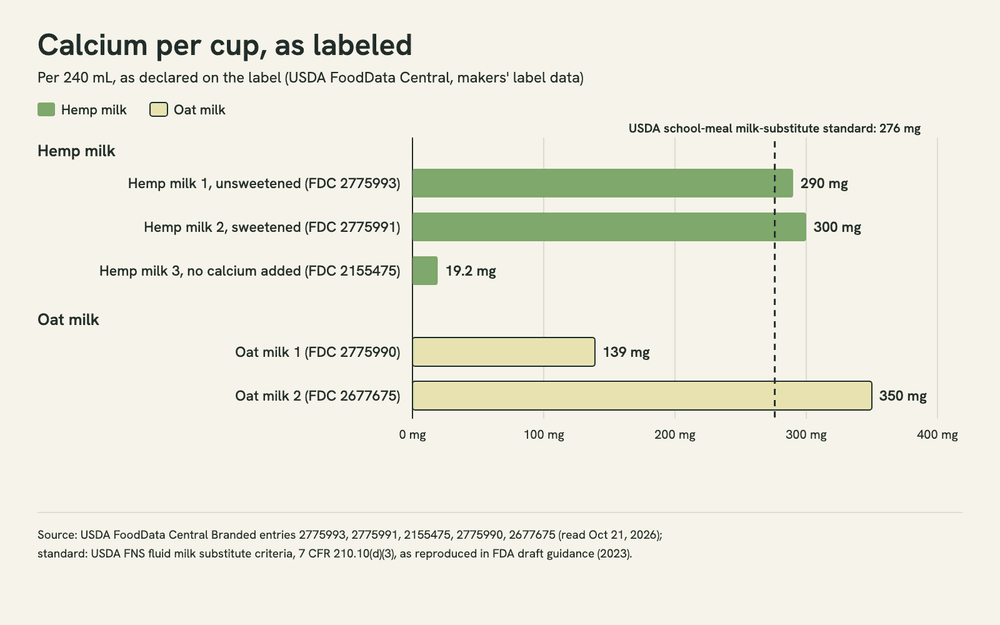
Labels are also claims, not guarantees. When FDA scientists bought and measured 90 cartons from 19 brands in the Chicago area in fall 2020, most brands came close to their declared calcium, and all three oat brands were within about 15%. One of the two hemp brands was not. It held about 17.6 milligrams of calcium per 100 grams against 163 on its label, roughly 89% short, and about 90% less potassium than declared. The other hemp brand matched its calcium label within 3.5% but contained no added vitamin A. The brands were anonymized, two hemp brands is a tiny sample, and the cartons are from 2020, so this is not a verdict on hemp milk or on any brand named in this article. It is a reason to read the calcium line as the maker's claim rather than a measured guarantee.
How to read a plant milk carton
FDA boils the shelf decision down to three questions. Its consumer page on milk and plant-based milk alternatives quotes the then-director of its food center:
“Has the product been fortified with nutrients such as calcium? How much added sugar is in the product? What is the protein content?”
There may also be a shortcut on the front of the carton. In a 2023 draft guidance on labeling plant-based milk alternatives, still a draft as of October 2026, FDA asked makers that call a plant drink "milk" to add a voluntary statement such as "Contains a lower amount of potassium than milk", the example on its own sample oat milk carton, near the product name, or a symbol pointing to it. Nothing requires it, so a carton without one tells you nothing either way. The same document reproduces USDA's school-meal standard for milk substitutes, a handy yardstick per cup: 276 mg calcium, 8 g protein, 500 IU vitamin A, 100 IU vitamin D, 24 mg magnesium, 222 mg phosphorus, 349 mg potassium, 0.44 mg riboflavin and 1.1 mcg vitamin B12. These are school-meal rules, not a health threshold, but they show what "close to milk" means in numbers. Then work through the carton in this order:
- 1Front panel: look for a voluntary nutrient statement such as "Contains a lower amount of potassium than milk". If there is one, it is the fastest read on the shelf.
- 2Protein: read the grams per cup. Hemp and oat cartons run 1 to 3 g; the school-meal milk-substitute standard is 8 g.
- 3Added Sugars: compare this line, not the ingredient list. Oat drinks can show 4 to 7 g with no sweetener listed; sweetened hemp can reach 12 g.
- 4Calcium, vitamin D and B12: check the milligrams and micrograms, not just the word "fortified". One hemp milk declares 290 mg of calcium per cup; an unfortified one declares 19.2 mg.
- 5Ingredient list: see whether oil is added (common in creamier oat drinks), which sweetener is used (brown rice syrup, cane sugar), and whether a hemp drink also contains oats.
- 6Hemp named by name: FDA says foods containing hemp seed ingredients must declare them by name, so expect hulled hemp seed or similar near the top of the list.
- 7Gluten and allergens: if gluten matters, look for "gluten-free" on an oat milk, and read the allergen statement on either drink.
- 8Price: compare the unit price per fluid ounce on the shelf tag, since carton sizes differ.
Does hemp milk contain THC or CBD?
Hemp milk is made from the seed, and the seed is not where the plant makes its cannabinoids. The FDA addresses this directly on its page about cannabis and cannabis-derived products, including CBD, in its answer about hulled hemp seed, hemp seed protein and hemp seed oil in food:
“Hemp seeds are the seeds of the Cannabis sativa plant. The seeds of the plant do not naturally contain THC or CBD. The hemp seed-derived ingredients that are the subject of these GRAS notices contain only trace amounts of THC and CBD, which the seeds may pick up during harvesting and processing when they are in contact with other parts of the plant.”
The same answer says eating these ingredients is not capable of making you high, and that foods containing them must list them by name. Note the word trace. It is FDA's word and the honest one, which is why no one can truthfully promise a hemp milk is THC-free. For scale, the company behind the 2018 GRAS notice for hulled hemp seed set its own specification of no more than 4 milligrams of THC, counting THCA, per kilogram of seed. That is one company's spec, not a federal limit, and it says nothing about any other brand's seed.
Is it CBD? No. Hemp milk is a seed food, not a CBD product, and FDA notes that its hemp seed GRAS conclusions do not change its position on adding CBD or THC to food. Our comparison of hemp seed oil vs CBD oil explains where cannabinoids actually come from. Can it affect a drug test? Trace is not zero, so no food can guarantee a result; how much you consume and how sensitive the test is both matter. Our guide to hemp seed foods and drug tests goes through the evidence. Is it legal? Congress rewrote the federal definition of hemp in 2025, and a later law split its start into two steps, November 12 and December 11, 2026 (timing set by P.L. 119-103). Once the 2025 federal law that redefines hemp is fully in effect, its text will treat hemp grown for the seed's grain, oil or nut as "industrial hemp", and its new limits on "hemp-derived cannabinoid products" are written for products derived from hemp "other than industrial hemp". That is our reading of the statute's text; no agency has issued guidance on it yet, and this is not legal advice. Our explainer on whether cannabis seeds are legal covers the dates and the details.
Allergens, gluten and who should ask first
Neither hemp nor oats is on the FDA's list of nine major food allergens, so neither has to be flagged as one. That does not mean nobody reacts: allergic reactions to hemp seed are documented, including a 2003 report of anaphylaxis after eating hempseed. Gluten is the oat question. Under FDA's gluten-free labeling rule, the gluten-containing grains are wheat, rye and barley, so oats are not on the list. But oats are often grown and processed alongside wheat, and UF's oat-milk sheet advises looking for a gluten-free label if that matters to you. On a carton, "gluten-free" means under 20 parts per million of gluten. Hemp milk usually sidesteps the question, but not always: Elmhurst's Milked Hemp lists whole grain oats, so read the ingredients. If your concern is reactions to hemp extracts rather than seeds, see whether you can be allergic to CBD.
Coffee, cooking and taste: choose by the job
Taste is where the evidence is thinnest, so we keep it descriptive. In a 2024 tasting of 18 plant milks by 143 adults in New Zealand, smooth mouthfeel was what made barista-style drinks well liked, and the barista-style drinks in that study were oat, almond and coconut. The study gives no separate score for hemp, so we cannot tell you hemp milk tastes better or worse than oat. Hemp milk carries the flavor of the seed, so a small carton is the cheapest way to find out whether you like it. For everything else, pick by what you need the drink to do:
| The job | What to pick | What to check on the carton |
|---|---|---|
| Most protein per cup | A tie at 3 g: Pacific hemp, Pacific oat, Oatly | Some unsweetened oat drinks drop to 1 g; neither drink reaches 8 g |
| Least sugar | Unsweetened hemp (0-1 g), or an oat drink that declares 0 g | The Added Sugars line; oat drinks often show 4-7 g |
| Fewest calories | Unsweetened versions of either (45-60 per cup here) | Sweetened hemp reached 139 per cup |
| Most calcium | Whichever carton declares it | Milligrams per cup: 350 and 290 here, 19.2 in an unfortified hemp milk |
| Coffee and foam | A barista-labeled version of either | Ingredient list for added oil and gums |
| Savory cooking | Unsweetened version of either | No brown rice syrup or cane sugar on the list |
| Avoiding gluten | Hemp milk with no oats listed, or oat milk labeled gluten-free | "Gluten-free" means under 20 ppm; some hemp drinks contain oats |
| Avoiding a rice sweetener | Unsweetened hemp or oat | Brown rice syrup on the ingredient list |
| Price | Compare per fluid ounce | Unit price on the shelf tag; carton sizes differ |

What the labels do not tell you
A few honest gaps. USDA has no generic, lab-analyzed hemp milk entry, so every hemp number here is a maker's label, rounded and as filed; formulas change, and your carton's panel wins. FDA's label-versus-lab check covered only two hemp brands, bought in 2020 in one region, so nobody can say how common a calcium shortfall is today. No carton declares its omega-3 content or how much seed it contains, so we do not estimate ALA per cup. The protein-quality score for hemp comes from seed tested in rats, not from hemp milk in people. And by design, this page makes no claims about what either drink does for your heart, weight, blood sugar or digestion; those are different questions that would need their own careful treatment. What the labels do support is the practical answer: decide on protein, added sugar and calcium per cup, and let the carton, not the plant, settle it.
Frequently asked questions
Neither, at the brand level. Pacific's hemp milk, Pacific's oat milk and Oatly Original all declare 3 grams per cup, while some unsweetened oat drinks declare 1 gram. Hulled hemp seed protein scored 0.63 to 0.66 out of 1.0 on the standard quality score (PDCAAS) in a 2010 study, limited by lysine. Neither drink is close to the 8 grams per cup USDA requires of a school-meal milk substitute, and pages claiming 5 to 10 grams for hemp milk do not match any carton in USDA's database.
Unsweetened hemp milk, usually. Pacific's unsweetened hemp milk declares 1 gram of total sugar and 0 grams added. Oat drinks often declare 4 to 7 grams of added sugars even with no sweetener in the ingredients, because FDA counts sugar created from oat starch during processing as added sugar. There are exceptions both ways: Planet Oat Unsweetened declares 0 grams, and Pacific's sweetened hemp milk declares 12 grams from brown rice syrup. Compare the Added Sugars line.
It depends on what you want from it, so here are the facts rather than a verdict. A cup of unsweetened hemp milk declares about 60 calories, 3 grams of protein and 5 grams of fat, mostly polyunsaturated seed oil with more omega-6 than omega-3, plus whatever calcium and vitamin D the maker added. It does not contain EPA or DHA, its protein is far below milk's, and fortified versions vary by brand. The label on your carton is the honest answer.
No to both. FDA says hemp seeds do not naturally contain THC or CBD and that hemp seed food ingredients are not capable of making you high. Those ingredients can carry trace amounts of THC and CBD picked up from the rest of the plant during harvesting and processing, so trace is possible, but hemp milk is a seed food, not a CBD product.
No one can promise it will not. Hemp seed ingredients can carry trace THC from processing, and how much you consume and how sensitive the test is both affect the outcome. If you are tested, our guide to hemp seed foods and drug tests covers the evidence in detail.
We did not pull almond cartons for this comparison, so we will not print almond numbers. The same three label checks decide it: protein grams per cup, the Added Sugars line, and calcium and vitamin D in milligrams and micrograms. The 2020-2025 Dietary Guidelines, as quoted by FDA, name both almond and hemp drinks among the plant milks that may supply calcium but are not part of the dairy group.
Not automatically. Oats are not one of FDA's gluten-containing grains (wheat, rye and barley), but they are often handled alongside wheat. If gluten matters to you, buy an oat milk labeled gluten-free, which under FDA's rule means under 20 parts per million of gluten. Some hemp milks also contain oats, so check their ingredients too.
Plant drinks are not infant formula. FDA's consumer page says infants should not consume milk or plant-based milk alternatives before 12 months of age to replace human milk or infant formula. For any question about a child's diet, ask your pediatrician.
Wondering how hemp food differs from CBD? Hemp milk, hemp hearts and hemp seed oil all come from the seed and carry, at most, trace cannabinoids picked up during processing. CBD products are made from extracts of the plant, not pressed from its seeds. Our side-by-side of hemp seed oil and CBD oil, label by label walks through that difference and how to tell the two apart on a shelf.
Writing about hemp, wellness and the small rituals that keep us balanced.