Are Weed Seeds Legal? What Changes After December 11, 2026
Under DEA's 2022 letters, most cannabis seeds count as hemp because a seed carries almost no THC. After December 11, 2026, federal law is set to judge a viable seed by its parent plant's total THC. Here is what each document says, and where state law comes in.
Are weed seeds legal? Most answers online say either "federally illegal" or "legal because seeds have no THC", and both skip the documents that actually decide it. Two DEA letters from 2022, a 2025 law that rewrites the federal hemp definition and a 2026 law that sets its timing give a clearer answer, and that answer is about to change. Law as of October 9, 2026. This is legal education, not legal advice.
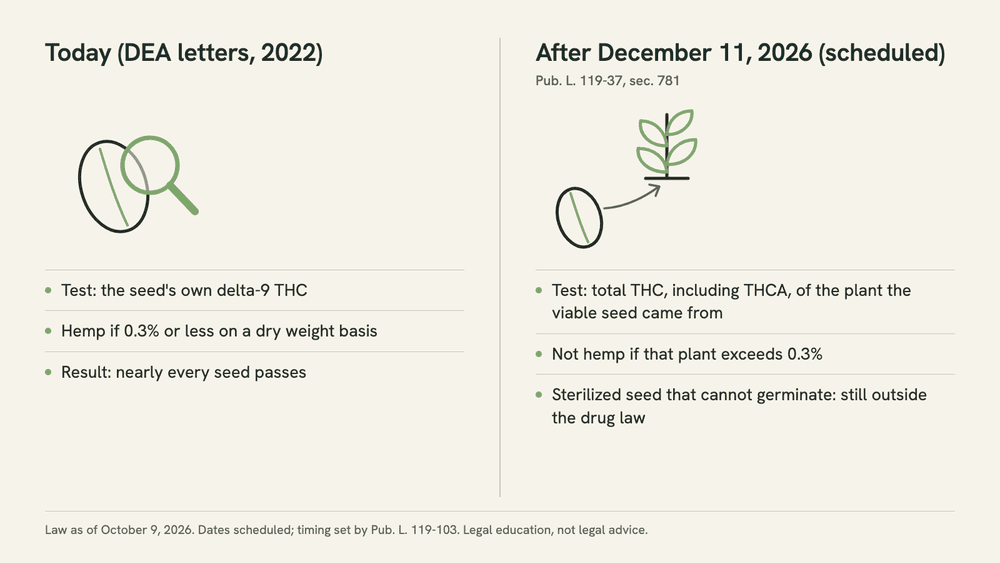
The short answer, as of October 2026: under DEA's reading of federal law today, most cannabis seeds count as hemp. DEA reads the 2018 hemp definition seed by seed, and in two 2022 letters it said a seed at or under 0.3% delta-9 THC is hemp, not a controlled substance. Seeds carry so little THC that nearly all of them pass. That test is scheduled to change. After December 11, 2026, the new federal definition will judge a viable seed by the total THC of the plant it came from. State law, mail, import and growing are separate questions, and each can give a different answer.
Are marijuana seeds legal? The answer in three parts
Whether you call them weed seeds or marijuana seeds (federal law calls them seeds of Cannabis sativa L. either way), the honest answer depends on two things: the date, and whose law you are asking about. Here is how it breaks down, with each part explained in its own section below.
- Federal law today: under DEA's 2022 letters, a seed whose own delta-9 THC is 0.3% or less is hemp and not controlled. Nearly every seed meets that line. The letters are DEA's reading, not a regulation.
- Federal law after December 11, 2026: a viable seed is not hemp if the plant it came from exceeds 0.3% total THC, including THCA. The seed's own THC stops being the question.
- State law, at any date: a state can define seeds its own way, restrict possession and decide whether anyone may grow at home. Federal hemp status does not override a stricter state.
What federal law says about seeds today
Start with the Controlled Substances Act (CSA), the 1970 law that schedules drugs. Its definition of marijuana, 21 U.S.C. 802(16), covers "all parts of the plant Cannabis sativa L., whether growing or not; the seeds thereof". Then it takes things back out. The definition does not include hemp, and it does not include "oil or cake made from the seeds" or "the sterilized seed of such plant which is incapable of germination." So under the drug law, a seed that cannot sprout is not marijuana, and a seed that can sprout is marijuana unless it qualifies as hemp.
Hemp is defined in 7 U.S.C. 1639o, written by the 2018 Farm Bill: "the plant Cannabis sativa L. and any part of that plant, including the seeds thereof ... with a delta-9 tetrahydrocannabinol concentration of not more than 0.3 percent on a dry weight basis." Notice the four words in the middle: including the seeds thereof. The statute puts seeds inside hemp and measures hemp by a THC number, but it never says whose THC counts for a seed: the seed's own, or the plant it came from. Our explainer on where the federal line between hemp and marijuana sits covers the plant-level definition. This page is about the seed.
In November 2021, a lawyer named Shane Pennington asked DEA that question directly. The answer came in a letter dated January 6, 2022, signed by Terrence L. Boos, chief of the Drug and Chemical Evaluation Section in DEA's Diversion Control Division:
“Accordingly, marihuana seed that has a delta-9-tetrahydrocannabinol concentration of not more than 0.3 percent on a dry weight basis meets the definition of "hemp" and thus is not controlled under the CSA. Conversely, marihuana seed having a delta-9-tetrahydrocannabinol concentration more than 0.3 percent on a dry weight basis is controlled in schedule I under the CSA as marihuana.”
DEA said it again on December 20, 2022, in a second letter, to California lawyer Omar Figueroa. It applied the same reading to "any seed, tissue culture, or other genetic material" and added a sentence about germination that most summaries leave out, covered below in the section on growing. Two limits matter. First, these are letters answering one lawyer's question each, not a rule: they have no force of law and were never published in the Federal Register. Second, DEA does not post them. The copies online are hosted by a news outlet's document archive and by the law office that received the second letter. Even so, they are the clearest statement of how the agency reads the 2018 definition for seeds.
Why almost every seed passed: the numbers
Why would a seed from a high-THC plant pass a 0.3% test? Because the seed itself holds almost no THC. In a 2000 lab analysis published in the Journal of Analytical Toxicology, chemists at the University of Mississippi measured total delta-9 THC in drug-type (marijuana) and fiber-type (hemp) seeds. Drug-type seeds carried 35.6 to 124 micrograms per gram (µg/g), and hemp seeds 0 to 12 µg/g. Most of it sat on the outside of the seed. A solvent wash removed about 90%, which left washed drug-type seeds under 10 µg/g, and the kernels inside the shell measured under 2 µg/g for drug-type seeds and under 0.5 µg/g for hemp.
The arithmetic is short. A limit of 0.3% on a dry weight basis is 3 milligrams per gram, or 3,000 µg/g. The highest drug-type figure in the study, 124 µg/g, is 0.0124%. That is roughly a twenty-fourth of the line.
| Measurement | Delta-9 THC (µg/g) | As % of dry weight | Compared with the 0.3% line |
|---|---|---|---|
| Federal hemp line | 3,000 | 0.3% | The line itself |
| Drug-type seeds, as tested | 35.6 to 124 | 0.0036% to 0.0124% | About 24 to 84 times under |
| Hemp (fiber-type) seeds, as tested | 0 to 12 | 0% to 0.0012% | At least 250 times under |
| Drug-type seeds after a surface wash | Under 10 | Under 0.001% | More than 300 times under |
| Drug-type kernels (inside the shell) | Under 2 | Under 0.0002% | More than 1,500 times under |
| Hemp kernels (inside the shell) | Under 0.5 | Under 0.00005% | More than 6,000 times under |
THC sitting on the surface fits resin rubbing off from the flower around the seed. That resin is made in the tiny glands described in our guide to trichomes, though the paper's abstract only says where the THC was, not how it got there. Read the numbers with their limits: this is lab chemistry from one group in 2000, it reports what the authors call total delta-9 THC, which is not the same measure as the 2026 definition's "total tetrahydrocannabinols", and contamination varies from lot to lot. It is not a test of any particular seed. It does explain the result of the 2022 letters: judged on its own chemistry, nearly every seed is hemp. And it explains why Congress moved the test away from the seed.
What changes after December 11, 2026: the parent-plant test
On November 12, 2025, Public Law 119-37 rewrote the federal hemp definition in section 781 of its Division B. The rewritten definition lists what hemp does not include, and the first item on that list is about seeds:
“Such term does not include-- (i) any viable seeds from a Cannabis sativa L. plant that exceeds a total tetrahydrocannabinols concentration (including tetrahydrocannabinolic acid) of 0.3 percent in the plant on a dry weight basis”
Read closely, that clause makes three changes at once:
- 1From the seed to the plant. The concentration is measured "in the plant" the seed came from, not in the seed. The 2022 letters asked the opposite question.
- 2From delta-9 to total THC. The new test counts "total tetrahydrocannabinols", including THCA, the acid form that turns into delta-9 THC with heat.
- 3From all seeds to viable seeds. Only seeds that can germinate are covered. The CSA's carve-out for sterilized seed that cannot germinate is untouched.
The second change matters more than it sounds. Many plants sold as high-THCA are low in delta-9 THC until they are heated, and our comparison of THCA and CBD explains how the acid form relates to the active one. Under a total-THC test, those plants count as over the line, and so would viable seeds that come from them.
When does it apply? Section 781 was written to take effect one year after enactment, on November 12, 2026. Then Public Law 119-103, signed September 2, 2026, added a limit in its section 2019: "Until December 11, 2026, the amendments made by section 781 ... shall only apply with respect to products described in paragraphs (1)(C)(ii)(I) and (1)(C)(iv)(I)", which are products with cannabinoids "not capable of being naturally produced" by the plant. The seed clause is (1)(C)(i), so it is not one of them. It will not apply until that window closes, after December 11, 2026. On our reading of "until", that is December 12, 2026, the same reading our news explainer on the December 11 delay uses. The timing is set by P.L. 119-103; the text of the seed clause did not change. The finished-product rules in the same section, such as the per-container THC limit, are covered in our guide to the 2026 hemp ban.
The Congressional Research Service, which writes nonpartisan analysis for Congress, reads the clause the same way. A CRS legal sidebar updated in December 2025 describes the exclusion as "viable seeds from a cannabis plant if the plant exceeds a total THC concentration, including THCA, of 0.3%". A CRS brief updated September 28, 2026 adds what that means: products excluded by these provisions "would instead be subject to regulation under the CSA as marijuana." CRS is congressional staff, not a regulator or a court, but on this point the text and its reading line up.
That creates a practical problem nobody has solved yet. A seed's own THC can be measured on the seed in front of you. A parent plant's THC belongs to a plant that may already have been harvested, and the statute does not say how that concentration is to be shown, by whom, or on what record. We found no federal agency guidance on it as of October 9, 2026: a Federal Register search that day returned no notice addressing the seed clause, and USDA's hemp program page did not mention the 2025 law when we checked it the same day.
Which test applies when: a timeline
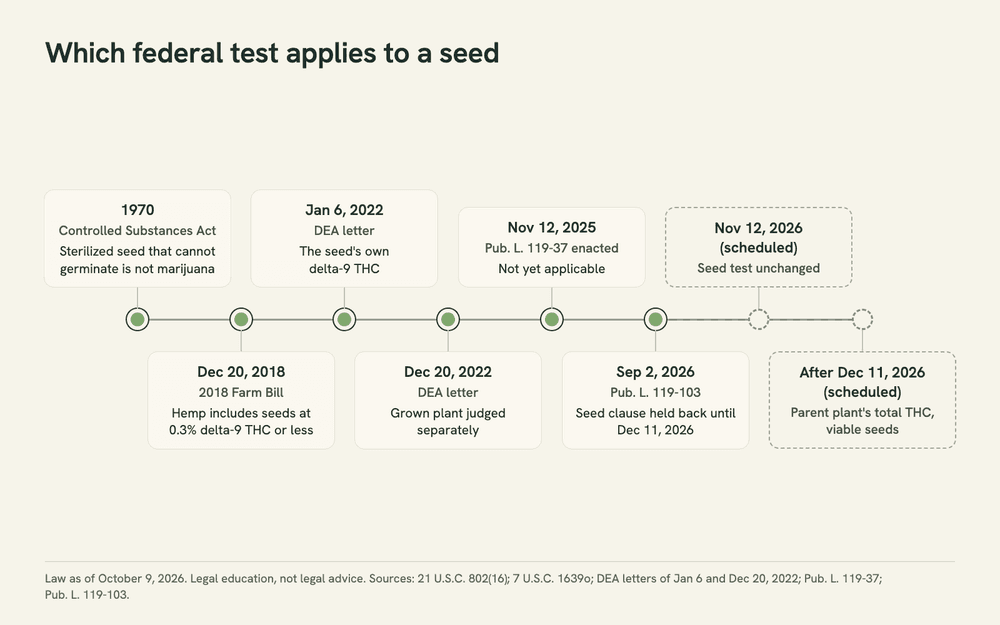
Five documents and two scheduled dates decide how federal law treats a seed. Here they are in order, with the test each one sets and what it means for a seed sold in a packet.
| Date | Document | The test for a seed | What it means for a seed packet |
|---|---|---|---|
| 1970 | Controlled Substances Act, 21 U.S.C. 802(16) | "The seeds thereof" are marijuana; sterilized seed "incapable of germination" is not | Only sterilized seed sits outside federal drug law |
| December 20, 2018 | 2018 Farm Bill, 7 U.S.C. 1639o | Hemp includes "the seeds thereof" at not more than 0.3% delta-9 THC | Seeds can be hemp, but whose THC counts is left open |
| January 6, 2022 | DEA letter to Shane Pennington | The seed's own delta-9 THC, 0.3% or less | Nearly every seed counts as hemp (a letter, not a rule) |
| December 20, 2022 | DEA letter to Omar Figueroa | Same seed test; the plant it grows into is judged on its own THC | Owning a seed and germinating it become two questions |
| November 12, 2025 | Pub. L. 119-37, Div. B, sec. 781, enacted | New definition written; not yet applicable | No change yet |
| September 2, 2026 | Pub. L. 119-103, sec. 2019 | Until December 11, 2026, sec. 781 is to apply only to products with cannabinoids "not capable of being naturally produced" | The seed clause is held back |
| November 12, 2026 (scheduled) | Sec. 781, first piece | Seed test unchanged | The 2022 seed-by-seed reading still describes the definition in force |
| After December 11, 2026 (scheduled) | Sec. 781, seed clause | Viable seeds excluded if the plant they came from exceeds 0.3% total THC, including THCA | The packet's own THC no longer answers the question |
Owning a seed vs growing a plant
This is the part most answers miss. A seed and the plant it becomes are judged separately. DEA's December 2022 letter says so in plain terms: "If the Cannabis sativa L. seed germinates into material that contains delta-9-tetrahydrocannabinol in concentrations of not more than 0.3 percent on a dry weight basis, the material meets the definition of 'hemp.' Conversely, if the seed germinates into material having a delta-9-tetrahydrocannabinol concentration of more than 0.3 percent on a dry weight basis, that material does fall within the CSA schedule I listing of marihuana." In other words, a seed that passed the test does not carry its status into the plant. Whatever grows is measured on its own.
Growing hemp is also regulated as "producing" it. USDA's hemp rule, 7 CFR 990.21, says: "Any person producing or intending to produce hemp must have a valid license prior to producing hemp." Where a state or tribe has no approved hemp plan, 7 U.S.C. 1639q makes it "unlawful to produce hemp in that State ... without a license issued by the Secretary" of Agriculture. And federal hemp law says outright, in 7 U.S.C. 1639p, that it does not preempt or limit a state or tribal law that regulates hemp production and "is more stringent than this subchapter."
So a single seed raises at least three separate legal questions. Where you live adds a fourth layer, because a lease can forbid growing even where state law allows it; our article on whether you can be evicted over cannabis covers how landlords and leases fit in. Seed labels such as "feminized" describe plant biology, not legal status, and our explainer on male and female cannabis plants covers what that biology means.
- Holding a seed: decided by the federal definition in force on that date, plus your state's own definitions and possession rules.
- Germinating it: the plant is judged on its own THC. Growing hemp requires a license; a plant over the line is marijuana under federal law, whatever a state allows.
- Growing it at home under state law: only where a state allows it, within that state's limits, and separate from any federal answer.
Federal law is not the last word: state law, mail and import
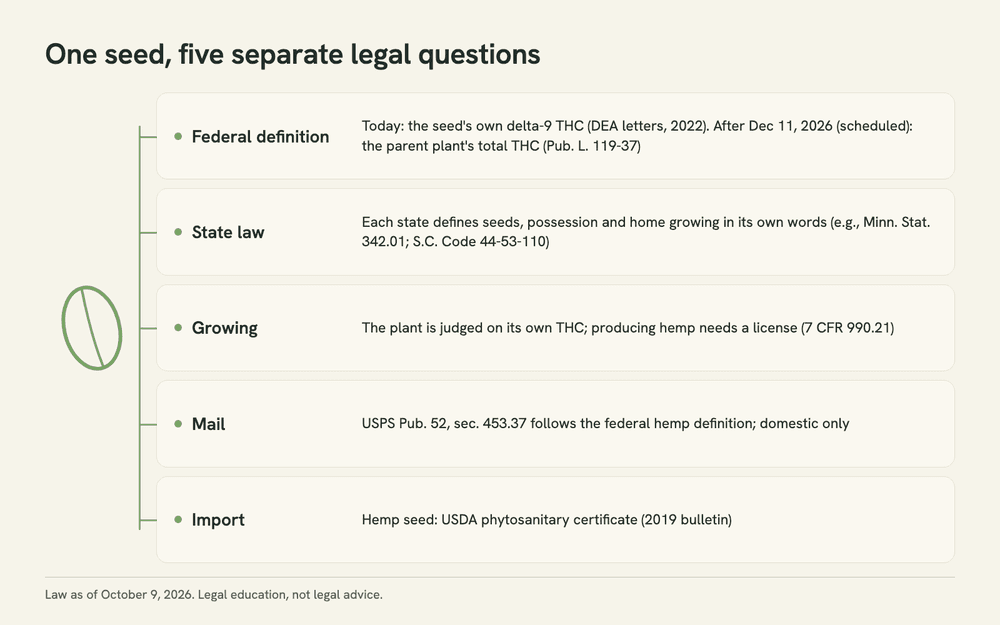
Federal hemp status answers only one question. States write their own definitions, decide what adults may possess and whether anyone may grow at home, and license hemp farming. The mail and imports run on their own rules too. Rather than a 50-state table that would go stale, here is the framework the law actually applies, followed by two dated state examples.
Four questions the law asks about a seed
- 1Is the seed viable, or sterilized and incapable of germination? Sterilized seed is outside the federal drug-law definition of marijuana entirely.
- 2Which date applies? Through December 11, 2026, DEA's reading looks at the seed's own delta-9 THC. After that date, the statute is scheduled to look at the parent plant's total THC.
- 3What does the state's own law say? States define seeds, possession and home growing in their own words, and some tie their hemp definition to the federal one.
- 4Is the question about holding a seed or germinating it? Production of a plant is a separate legal question, with separate rules and licenses.
Those questions describe how statutes and agencies analyze a seed. They are not a buying or growing checklist, and a seed passing one of them does not make it lawful to hold or plant where you are.
Minnesota, which has an adult-use program, shows how differently a state can draw the line. Its cannabis statute defines "cannabis seed" as "the viable seed of the plant of the genus Cannabis that is reasonably expected to grow into a cannabis plant" and "hemp seed" as one "reasonably expected to grow into a hemp plant". That is a test on the future plant, not on the seed's chemistry. The same section says cannabis flower "does not include cannabis seed". Under Minn. Stat. 342.09, adults 21 and older may grow up to eight cannabis plants, no more than four of them mature and flowering, at their primary residence "in an enclosed, locked space that is not open to public view". (Minn. Stat. 342.01 and 342.09, as of October 9, 2026. The state's revisor notes a 2026 law affecting a different subdivision of 342.09.)
South Carolina, which has no adult-use program, shows the other end. Its drug law lists "the seeds of the marijuana plant" as marijuana and exempts only "the sterilized seed of the marijuana plant which is incapable of germination". It also defines "production" to include planting. Its hemp law covers "the nonsterilized seeds thereof" only at "the federally defined THC level for hemp", which on our reading means the federal change carries straight into state law. It also makes it unlawful "to cultivate, handle, or process hemp in this State without a hemp license". (S.C. Code 44-53-110, 46-55-10 and 46-55-20, as of October 9, 2026.)
Mail. USPS's hemp rule, section 453.37 of Publication 52, as posted on October 9, 2026, never mentions seeds. It defines hemp by pointing to 7 U.S.C. 1639o "or any successor provision", and the statute's hemp definition includes the seeds. So the postal rule follows whatever the statute says on a given day, including the seed clause once it applies. The same section limits hemp mail to domestic addresses. A mailability standard is not a statement that anything is lawful to buy or receive. Our guide on the USPS rules for mailing CBD covers the section in full.
Import. Since 2019, USDA has treated imported hemp seed as a plant-health question. In an April 2019 USDA bulletin on hemp seed imports, the agency said "DEA no longer has authority to require hemp seed permits for import purposes" and that hemp seed needs a phytosanitary certificate from the exporting country's plant protection organization (seed from Canada can instead use a federal seed analysis certificate). Shipments "may be inspected upon arrival" by Customs and Border Protection. That path is for hemp. A seed that falls outside the hemp definition is not covered by it.
Hemp seeds you eat are a different product
The hemp seeds sold in grocery stores, usually hulled and sold as hemp hearts, sit in a different place in the law. They are food, not planting stock. The CSA has long excluded "oil or cake made from the seeds" and sterilized seed that cannot germinate, and the 2025 definition lists growing hemp "for the use of the whole grain, oil, cake, nut, hull" of its seeds as industrial hemp. Food seed raises its own questions, about nutrition and about trace THC, and two of our articles cover them: how hemp seed oil differs from CBD oil and whether hemp seed oil can show up on a drug test.
What is still unknown
- How the parent plant's THC will be shown. The clause says "in the plant" and stops there. As of October 9, 2026, we found no agency guidance on it.
- Which parent counts. The clause names one "plant", while a seed has the plant it grew on and a pollen donor. Our reading is that it means the plant the seed grew on, but the text does not say.
- Clones and tissue culture. The clause names "viable seeds" and nothing else. DEA's 2022 letters covered tissue culture under the old test; nothing yet says how the new one treats it.
- Enforcement. We found no agency statement on how it will approach seeds after December 11, 2026, and we do not forecast it.
- The dates themselves. Bills would delay the new definition by two years (H.R. 7024, H.R. 7010, S. 3686) or repeal it (H.R. 6209). They are proposals; as of October 9, 2026, none has become law.
On the clone question, one cannabis law firm has pointed out that the new definition "appears to remain silent on tissue cultures and clones", and warned in the same post that silence does not make them "clearly legal". That is commentary from a law firm, written before the 2026 timing law, not guidance from an agency. The pending bills listed above come from the September 2026 CRS brief linked earlier.
Frequently asked questions
Today, under DEA's reading, most are not controlled. In letters dated January 6 and December 20, 2022, DEA said a seed at or under 0.3% delta-9 THC meets the definition of hemp. Those were letters answering two lawyers, not a rule. After December 11, 2026, the statute is scheduled to exclude viable seeds from a plant over 0.3% total THC. State law applies separately at every date.
Very little. A 2000 lab analysis found 35.6 to 124 micrograms of delta-9 THC per gram in drug-type seeds and 0 to 12 in hemp seeds, most of it on the shell's surface. Even the top figure is about 0.012%, roughly 24 times under the 0.3% line. The test scheduled to apply after December 11, 2026 stops asking about the seed's own THC.
There is no single answer, and this page gives no buying guidance. Federally, it depends on the date and the seed: DEA's 2022 reading today, the parent-plant test after December 11, 2026. Your state can define seeds differently or restrict possession, as Minnesota and South Carolina show. A website being able to sell a seed is not evidence that you can lawfully hold it where you live.
USPS's hemp rule, section 453.37 of Publication 52, never mentions seeds. It defines hemp by pointing to 7 U.S.C. 1639o or any successor provision, so it follows whatever the statute says on a given day, and it limits hemp mail to domestic addresses. A mailing rule is not a statement that anything is lawful to send, buy or receive.
Not automatically. DEA's December 2022 letter judges the grown plant on its own THC, separately from the seed. Producing hemp requires a license under federal rules, and whether anyone may grow at home is a state question. Minnesota allows a limited home grow for adults 21 and older; South Carolina requires a state license to cultivate even hemp.
Not by name. Neither the statute nor DEA's letters mention autoflowering or feminized seed, so on our reading the same tests apply: the seed's own delta-9 THC under the 2022 letters, and the parent plant's total THC after December 11, 2026. Feminized and autoflower describe genetics and flowering, not legal status.
Food hemp seed sits in a different place in the law. The CSA excludes oil and cake made from cannabis seeds and sterilized seed that cannot germinate, and the 2025 definition lists the whole grain, oil, cake, nut and hull of hemp seeds as industrial hemp uses. Hulled seeds sold as food are not sold for planting.
The seed clause is one line in a much larger rewrite of federal hemp law. For the finished-product side of the same section, read our explainer on what the 2026 hemp ban changes. For the wider picture of what is legal and where, start with our hub on whether CBD is legal.
Writing about hemp, wellness and the small rituals that keep us balanced.