Why Are Dispensaries Cash Only? The Federal Rules Behind It
Dispensaries are not cash-heavy by choice or by state law. A 2014 FinCEN guidance, the federal money-laundering statutes and Visa and Mastercard rules produce the ATM by the door, and neither Schedule III nor the SAFE Banking bill has removed it.
Why are dispensaries cash only? Not by choice, and not because state law requires it. A 2014 Treasury guidance, two federal money-laundering statutes and the rules of Visa and Mastercard together produce the ATM by the door. The two big cannabis developments of 2026, the Schedule III order for medical marijuana and the reintroduced SAFE Banking bill, have not removed any of those layers yet. This guide walks through each one with the document behind it, and explains why the CBD you buy online is a different case. Current as of October 7, 2026.
Why are dispensaries cash only? The short answer
Federal law still treats a marijuana sale as illegal, even in a store your state licensed. So a bank that takes a dispensary's deposits has to file federal reports on it and pay for extra checks, and most banks decline. Separately, Visa and Mastercard bar illegal transactions from their networks, which keeps credit cards out even where a bank says yes. Neither layer changed in 2026: the April Schedule III order does not mention banks, and the SAFE Banking Act is still a bill. What is left is cash, in-store ATMs and debit options that often vanish.
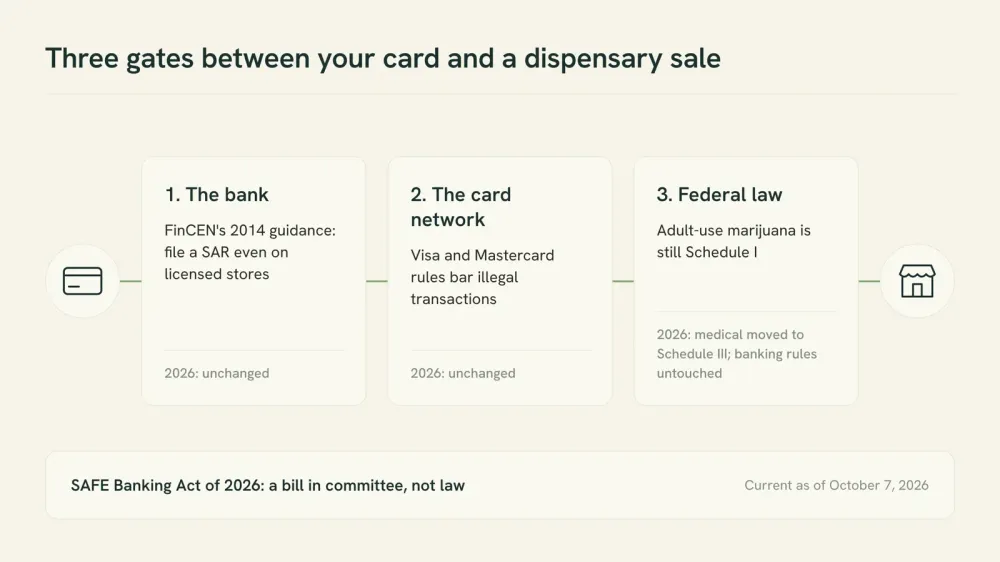
Most explanations stop at "banks are scared." That is true as far as it goes, but it hides the fact that there are several separate gates, each written down in a different document, and each would have to open before your card works at the register. The table below lists them, with what each one does to your payment and whether anything changed this year. The rest of this guide takes them one at a time.
| Layer | Document | What it does to your payment | Changed in 2026? |
|---|---|---|---|
| Treasury guidance to banks | FinCEN FIN-2014-G001 (February 14, 2014) | Tells a bank to file a suspicious activity report on a marijuana business, even a state-licensed one | No. Not withdrawn or replaced as of October 7, 2026 |
| Money-laundering laws | 18 U.S.C. 1956 and 1957 | Make knowingly moving the proceeds of unlawful activity a federal crime, which is how federal law sees marijuana revenue | No |
| Suspicious activity reporting | 31 U.S.C. 5318(g), part of the Bank Secrecy Act | Lets the Treasury require banks to report, and bars them from telling the customer | No |
| Card networks | Visa Core Rules (April 18, 2026 edition); Mastercard policy | Bar illegal transactions; GAO reports both networks prohibit cannabis purchases on their cards | No. Their trade group told GAO only federal legalization would change it |
| Schedule III order | 91 FR 22714 (April 28, 2026) | Moves state-licensed medical marijuana and FDA-approved drug products to Schedule III | Yes, for scheduling and the 280E tax rule for medical licensees. The text never mentions banks |
| SAFE Banking Act of 2026 | H.R. 9471 and S. 4942 (bills) | Would protect banks that serve state-sanctioned marijuana businesses and order a rewrite of the 2014 guidance | No. Introduced June 2026, in committee, not law |
| Federal hemp definition | Rewritten by section 781 of P.L. 119-37; start dates set by P.L. 119-103 | Keeps hemp-derived CBD outside the controlled-substance rules, so cards usually work | Will change in two steps, on November 12 and December 11, 2026 |
Can you use a credit card at a dispensary?
Usually not, at least not for marijuana. The reason sits in the card networks' own rules, not in your state's cannabis law. Visa's public rulebook, in its April 18, 2026 edition, never uses the words "cannabis" or "marijuana." It does not need to. It says an acquirer, the bank that connects a store to Visa, "must not knowingly accept from a Merchant for submission into the Visa payment system any Transaction that is illegal or that the Acquirer or Merchant should have known was illegal," and it requires each store to carry the merchant category code that most accurately describes its business. Because federal law still treats a marijuana sale as illegal, that one line does the work. The Government Accountability Office put the result plainly in its August 2026 report on cannabis banking, GAO-26-107498: "At present, Mastercard and Visa prohibit the use of their cards for cannabis-related transactions." GAO also reports that the trade group representing the networks said they "would not change their policies unless cannabis is legalized at the federal level."
Debit has been squeezed too. In July 2023, a Mastercard spokesperson quoted by NBC San Diego said the company had told the banks connecting cannabis stores to its network to stop processing those sales:
“In accordance with our policies, we instructed the financial institutions that offer payment services to cannabis merchants and connect them to Mastercard to terminate the activity. The federal government considers cannabis sales illegal, so these purchases are not allowed on our systems.”
So what is the "debit" option some stores still offer? Often it is not a store purchase at all, as far as the card system can tell. GAO describes the "cashless ATM": an in-store device where you swipe a debit card, and "to avoid scrutiny from the card issuer, the device disguises the transaction so that it appears to be a cash withdrawal from an ATM." The amount "may be rounded up to the nearest $20 denomination, and the retailer gives the customer the difference in cash." GAO notes these transactions "may violate applicable Visa and Mastercard rules because card processing still occurs," and that cashless ATMs and other electronic options "can be unreliable and frequently stop working without warning." A trade-group representative also described to GAO a cruder version: recording the sale of a non-cannabis item and handing over the cannabis as a "gift." We describe these so you can recognize them on a statement, not as options to look for. And Apple Pay or Google Pay? Phone wallets run on the same Visa and Mastercard cards underneath, so the same rules apply.
Why banks hesitate: two laws and one 2014 guidance
Banks face a different problem from the card networks, and it comes from criminal law. Under federal law, a dispensary's marijuana revenue is treated as the proceeds of an illegal sale, and three federal provisions make that a bank's problem. The main federal money-laundering law reaches anyone who, "knowing that the property involved in a financial transaction represents the proceeds of some form of unlawful activity," conducts the transaction anyway, with up to 20 years in prison. A companion section makes it a crime to knowingly engage in larger monetary transactions in criminally derived property, with up to 10 years. And the Bank Secrecy Act's reporting provision lets the Treasury require banks to report suspicious transactions, and bars them from telling the customer they did.
On February 14, 2014, the Treasury's financial-crimes bureau, FinCEN, published a short guidance document, FIN-2014-G001, that still decides how banks handle cannabis money. It was meant to open a door: it "clarifies how financial institutions can provide services to marijuana-related businesses consistent with their BSA obligations." But it opened the door on terms. Its central line is blunt: "The obligation to file a SAR is unaffected by any state law that legalizes marijuana-related activity." Because federal law prohibits marijuana sales, the guidance says, transactions with a marijuana business "would generally involve funds derived from illegal activity," so a bank must file a suspicious activity report (SAR) on that activity, "including those duly licensed under state law." Customers never see these reports. The guidance sorts them into three labels:
| SAR label | What it tells FinCEN | What the bank is doing |
|---|---|---|
| Marijuana Limited | The business does not appear to implicate any of the federal priorities or violate state law | Reporting a customer it has checked and keeps serving |
| Marijuana Priority | The bank believes the business implicates one of the federal priorities or violates state law | Reporting a customer where it found a concern |
| Marijuana Termination | The bank found it necessary to end the relationship to keep an effective anti-money-laundering program | Reporting that it is closing the relationship |
Before choosing a label, the bank is asked to check, account by account, whether the business touches any of eight federal priorities, from sales to minors, to revenue going to gangs and cartels, to marijuana leaving for other states. Large cash deposits also trigger a separate report, the currency transaction report, and the guidance says a marijuana business "may not be treated as a non-listed business," which means a bank cannot exempt it from those reports. None of this is a penalty on you as a shopper. It is cost and legal exposure for the bank, and it is the main reason many banks say no. Breaking up cash to avoid a bank's reports is itself a federal crime (31 U.S.C. 5324).
How many banks actually serve cannabis businesses?
The two headline numbers measure different things. FinCEN's spreadsheet of marijuana-related business metrics, posted on its FOIA records page with data through December 2024, counts "active filers": institutions that filed a Marijuana Limited or Marijuana Priority report in a given quarter. In the last three months of 2024 that was 689 depository institutions, 507 banks and 182 credit unions. Add 127 non-bank filers, such as money services businesses, and you get 816, which is where the "800-something" figure in trade coverage comes from; it is not a count of banks. GAO's figure is annual: about 1,000 banks and credit unions filed at least one such report in 2024, out of 4,487 insured banks and 4,455 insured credit unions. Neither number counts dispensary customers. GAO notes that an institution may serve only businesses on the edge of the industry, or file after a single transaction. Most reports also say little: in Q4 2024, 18,614 carried the Limited label, against 1,546 Priority and 2,235 Termination. Banks filed 88,326 of these reports in 2024 alone.
Why do most institutions stay out? Those that do not serve the industry told GAO that "factors dissuading institutions from serving CRBs include potential legal and regulatory sanctions and the costs of complying with BSA requirements" (CRB is GAO's shorthand for cannabis-related business). Federal bank regulators have not filled the gap with their own rules. GAO reports they "have not issued specific guidance on cannabis banking," defer to FinCEN's 2014 document, and "neither encourage nor discourage" banks from taking these customers. The trend is not clearly upward, either: FinCEN's last narrative banking update counted 755 depository institutions in September 2021, more than the 689 active in late 2024, though the two reports use different formats.
The Cole memo: what was withdrawn in 2018, and what was not
FinCEN's guidance was half of a pair, and the other half has since been withdrawn. It was built on the Cole memo of August 29, 2013, a Justice Department memo from Deputy Attorney General James Cole that told federal prosecutors to focus marijuana enforcement on eight priorities. It was an enforcement-priorities memo, not a change in the law. On February 14, 2014, the same day FinCEN published its guidance, Cole issued a second memo telling prosecutors to apply those priorities to money-laundering, unlicensed money transmitter and Bank Secrecy Act cases. FinCEN's own text says so: "Concurrently with this FinCEN guidance, Deputy Attorney General Cole is issuing supplemental guidance." In other words, FinCEN told banks how to report, and DOJ told prosecutors how to treat banks that followed it.
On January 4, 2018, Attorney General Jeff Sessions declared that "previous nationwide guidance specific to marijuana enforcement is unnecessary and is rescinded", effective immediately. His memo's first footnote lists both DOJ documents: the 2013 enforcement memo and the February 2014 memo on marijuana-related financial crimes. It does not mention FinCEN's guidance, and FinCEN never withdrew it. Washington's Department of Financial Institutions sums up the result: "The Cole Memorandum was rescinded by Attorney General Jeff Sessions in January of 2018, but the FinCEN guidance remains in effect." GAO adds that as of February 2026 it is "the only federal guidance that specifically discusses requirements for providing financial services" to cannabis businesses, and as of October 7, 2026 we found no FinCEN document replacing or withdrawing it. So banks still check customers against eight priorities taken from a DOJ memo that DOJ itself withdrew, without the companion memo that told prosecutors how to treat them. That is the position the 2018 rescission left banks in, and it has not changed since.
Does Schedule III fix it?
On April 28, 2026, a federal order published in the Federal Register moved two narrow categories of marijuana to Schedule III: marijuana in an FDA-approved drug product, and marijuana subject to a state medical marijuana license. Everything else, including adult-use marijuana sold under a state recreational law, "remains a schedule I controlled substance." As of October 7, 2026, the order is in effect: a federal appeals court declined to pause it on September 9, 2026, and the challenges are still pending. Our explainer on what the medical marijuana Schedule III ruling does covers the order and the litigation. Here the question is narrower: does it change anything at the register?
Not for banking, as of October 7, 2026. Search the rule's text for "bank," "FinCEN," "financial institution" or "money laundering" and you get zero hits. Schedule III is still a controlled-substance schedule. Moving a drug down the list does not make an unregistered sale legal, so the money-laundering statutes and FinCEN's 2014 guidance still apply on their own terms. The order did change one money rule. It says state medical licensees "will no longer be subject to the deduction disallowance imposed by Section 280E," the provision of the tax code that denies deductions to businesses trafficking in Schedule I or II substances, while noting that it makes no determination on federal tax liability. That is a tax question, separate from whether a bank can take the deposit. A cannabis banking association told GAO the same thing from the bank's side: even under rescheduling, institutions "would still have to adhere to existing BSA obligations," although some might be more willing to serve the industry because they would see less risk.
SAFE Banking in 2026: what the bill would and would not do
Congress has "considered, but not enacted" safe-harbor laws for banks, in GAO's words. The current version is the Secure And Fair Enforcement Banking Act of 2026, filed as two identical bills: H.R. 9471, introduced by Rep. David Joyce (R-OH) on June 25, 2026, and S. 4942, introduced by Sen. Jeff Merkley (D-OR) on June 24, 2026. As of October 7, 2026, both are bills in committee, not law. The House bill went to the Financial Services, Judiciary and Veterans' Affairs committees and was referred to a subcommittee on July 17; the Senate bill sits with the Banking Committee. A naming note: the 2023 Senate bill was called the SAFER Banking Act (S. 2860). Search results for a "SAFER Act of 2026" point to unrelated bills. Here is what the 2026 text would do if enacted, and what it would not:
- Would: stop federal bank regulators from penalizing a bank solely because it serves a state-sanctioned marijuana business (section 3).
- Would: say such a business's proceeds are not "proceeds from an unlawful activity" under the two money-laundering statutes solely because of the marijuana activity (section 4).
- Would: require the Treasury to amend FinCEN's 2014 guidance or issue new guidance within 180 days (section 6). Reporting of suspicious transactions would continue.
- Would not: require any bank, card company or payment processor to serve a marijuana business. Section 15(a) says nothing in the bill requires it.
Would it bring cards to the counter? Not necessarily. The bill's definition of a financial service includes processing payments "by the use of credit cards, debit cards," but it removes a penalty rather than creating a duty, and the networks' trade group told GAO they would not change policy short of federal legalization. Banks are split, too. In a GAO poll of institutions that do not serve the industry, 20 of 25 expected that a safe-harbor law would likely affect which cannabis businesses they would serve, while some said they would not change their policies without broader reforms, such as federal legalization. We make no prediction about whether or when either bill moves.
Why the CBD you buy online can take a card
A shop selling products within the federal hemp definition is a different customer to a bank, because hemp is not a controlled substance. The regulators' written statements on this are narrower than the shelf, so it helps to read them exactly. In December 2019, the federal banking agencies announced that banks "are no longer required to file suspicious activity reports (SAR) for customers solely because they are engaged in the growth or cultivation of hemp in accordance with applicable laws and regulations." In June 2020, FinCEN's hemp guidance, FIN-2020-G001, repeated the point for growers and for the processors and manufacturers that buy hemp directly from them, and added a caveat: where a hemp business's transactions are "comingled with marijuana-related activities," the bank "should apply FinCEN's 2014 Marijuana Guidance." Neither document names CBD retailers, but the reason both give, that hemp is no longer a Schedule I substance, is the same reason the 2014 marijuana rules do not reach a hemp-only store. That is why you can usually pay for hemp-derived CBD by card, and why a store that mixes hemp and marijuana money can end up back under the 2014 rules. Card acceptance is still each processor's decision, and hemp is not friction-free: the SAFE Banking bill's own findings say "businesses involved in the sale of hemp-derived CBD products are particularly affected" by banking difficulty. The dividing line is a THC line, set out in our guide to how hemp and marijuana differ under federal law.
That line is about to move. Congress rewrote the federal definition of hemp in 2025, in section 781 of P.L. 119-37, and a law signed on September 2, 2026, P.L. 119-103, set its start in two steps. The new definition will apply first, on November 12, 2026, to hemp products containing cannabinoids the plant cannot produce naturally, and then, on December 11, 2026, to the rest, including the total-THC limits. Products that fall outside the new definition will be treated as marijuana under federal law, and with that, they would inherit marijuana's banking problem. What each date covers is laid out in our explainers on the 2026 federal hemp ban and why part of it was pushed to December 11. Payment is not the only practical difference that follows the same federal line: so does whether you can ship CBD through the mail.

What it means at the counter
Here is what the federal picture tends to look like from your side of the counter. Practices vary by state and by store, and this describes patterns GAO documented, not any particular shop:
- Expect cash. Many stores keep an ATM on site; whether it charges a fee, and how much, depends on the machine's operator and your own bank.
- If a store offers debit, it may be booked as an ATM withdrawal. That is why a statement can show an ATM name and a fee instead of a store purchase.
- The amount may be rounded up, with the difference handed back in cash. GAO's example is rounding to the nearest $20.
- Electronic options can disappear overnight. GAO found they frequently stop working without warning, so a store that took debit last month may be cash-only today.
- A credit card charge for marijuana is outside Visa and Mastercard rules. A receipt or statement naming an item you did not buy matches a workaround GAO describes.
- Keep your receipt. It is your record of the price, the product and the weight you paid for.
The receipt matters for more than the price. It is also where weight shows up, and our guide to what an eighth weighs and who checks dispensary scales covers that side of the transaction.
What is still unknown
This is general information, not legal or financial advice. It describes federal documents and their status as of October 7, 2026, and it does not cover state rules on how dispensaries may take payment. Several things that would change the picture are still open:
- Whether FinCEN rewrites or withdraws its 2014 guidance. As of October 7, 2026 it had published nothing new on marijuana in the Federal Register.
- Whether the SAFE Banking Act of 2026 (H.R. 9471 and S. 4942) moves out of committee. Both are bills, not law.
- Whether DEA finalizes broader rescheduling of all marijuana. As of October 7, 2026 no final rule had been published.
- How the court challenges to the April 2026 Schedule III order end.
- Whether Visa or Mastercard change their policies. Their trade group told GAO that would take federal legalization.
- How the November 12 and December 11, 2026 hemp changes affect which products card processors accept.
Banking is one of several places where state-legal cannabis still runs into federal law. Another is work: how dispensary jobs and marijuana use affect immigration cases follows the same federal logic.
Frequently asked questions
Usually not for marijuana. Visa's rulebook bars banks from submitting any transaction that is illegal, and federal law still treats a marijuana sale as illegal. GAO's August 2026 report states that Mastercard and Visa prohibit the use of their cards for cannabis-related transactions. That holds for medical dispensaries too: the networks' trade group told GAO they would not change their policies unless cannabis is legalized at the federal level. Phone wallets like Apple Pay and Google Pay use the same cards underneath, so the same rules apply.
Some offer a debit option, but it is often not a normal purchase. GAO describes the cashless ATM, a device that makes a debit swipe look like an ATM cash withdrawal, sometimes rounded up to the nearest $20 with the difference given back in cash. GAO says these transactions may violate Visa and Mastercard rules and frequently stop working without warning. In July 2023 a Mastercard spokesperson said the company had told the banks connecting cannabis stores to its network to end the activity.
Most likely because the sale was processed as an ATM withdrawal rather than a purchase. That is how a cashless ATM works, according to GAO, and it is why your statement may show an ATM name and a fee instead of the store's name. Whether there is a fee, and how much, depends on the device operator and your own bank.
Some do. FinCEN counted 689 banks and credit unions actively filing marijuana-business reports in the last quarter of 2024. But under FinCEN's 2014 guidance each of them must file a suspicious activity report on these customers, even licensed ones, and check them against eight federal priorities. Institutions that stay out told GAO the reasons are legal and regulatory risk and the cost of compliance. Federal bank regulators have issued no cannabis-specific guidance of their own.
No, as of October 7, 2026. The April 28, 2026 order moved only marijuana under a state medical license and FDA-approved drug products to Schedule III; adult-use marijuana stays Schedule I. The rule's text does not mention banks or FinCEN, and the card networks told GAO only federal legalization would change their policies. The order did lift the 280E tax deduction ban for medical licensees, which is a tax question, not a payment one.
No. The SAFE Banking Act of 2026 was introduced as S. 4942 on June 24, 2026 and H.R. 9471 on June 25, 2026, and as of October 7, 2026 both are bills in committee. If enacted, the bill would protect banks that serve state-sanctioned marijuana businesses and order a rewrite of FinCEN's 2014 guidance, but it states that nothing in it requires any bank or payment company to provide services.
Generally yes, for hemp-derived products within the federal hemp definition. Hemp is not a controlled substance, and FinCEN said in 2020 that banks do not have to file a suspicious activity report on hemp growers solely because they grow hemp, while its 2014 marijuana guidance covers marijuana money, not hemp. Acceptance is still up to each store's payment processor, and the federal hemp definition will change on November 12 and December 11, 2026. Products that fall outside the new definition will be treated as marijuana under federal law.
Where to go next. Start with the federal line between hemp and marijuana, and why THC content decides it. For how that line plays out for CBD products, including the November and December 2026 changes, read our hub on whether CBD is legal where you live.
Writing about hemp, wellness and the small rituals that keep us balanced.