Can You Mail Weed? What USPS and Schedule III Say (2026)
Federal law treats mailing marijuana as distributing a controlled substance, in a legal state, between legal states and with a medical card. Here is the USPS rule, what the 2026 Schedule III order changed, the Georgia question and why hemp is different.
Can you mail weed? No. Under federal law, sending marijuana to someone is distributing a controlled substance, and the Postal Service's own rulebook says that makes mailing it unlawful too. That holds in a legal state, between two legal states and, after the April 2026 Schedule III order, for a patient with a state medical card. Hemp is the separate case, with its own rule. Law as of October 12, 2026. This is legal education, not legal advice.
State-licensed medical marijuana moved to Schedule III on April 28, 2026, but the postal rule covers every schedule and asks who is mailing and who is receiving, and a patient with a state card is not a DEA registrant. Hemp that meets the federal definition can be mailed domestically under a separate section, covered in our guide to mailing CBD through USPS. The one genuinely open question is not about patients at all: Georgia has written a rule that lets its licensed dispensaries ship to registered patients by mail, and the Postal Service has not said whether it will accept those packages.
Can you mail weed? The short answer, case by case
Is it illegal to mail weed? For almost everyone asking, yes. The answer only shifts with what is inside the package and who is sending it. Here is how it breaks down as of October 2026, with each line explained in the sections below.
- Adult-use (recreational) marijuana, including flower, edibles and concentrates: no. It is still Schedule I under federal law, and the postal rule treats it as nonmailable in every state.
- Medical marijuana under a state license: no for the patient. Whether a DEA-registered dispensary may mail it to a patient is unresolved, and no federal agency has answered it.
- Hemp CBD at or under 0.3% delta-9 THC: yes, domestically, under Publication 52 section 453.37, if the mailer meets that section's conditions.
- Hemp-derived THC (delta-8, THC gummies and similar): only while the item meets the federal hemp definition, which is scheduled to change on November 12, 2026 and again after December 11, 2026.
Why weed is nonmailable: the rule and the statutes behind it
Most answers stop at "it's federally illegal." The actual rule is short and worth reading in full. It sits in USPS Publication 52, section 453.31, the Postal Service's manual on hazardous, restricted and perishable mail, and its first sentence does all the work:
“If the distribution of a controlled substance is unlawful under 21 U.S.C. § 801-971 or any implementing regulation in 21 CFR Chapter 2, then the mailing of the substance is also unlawful under 18 U.S.C. § 1716.”
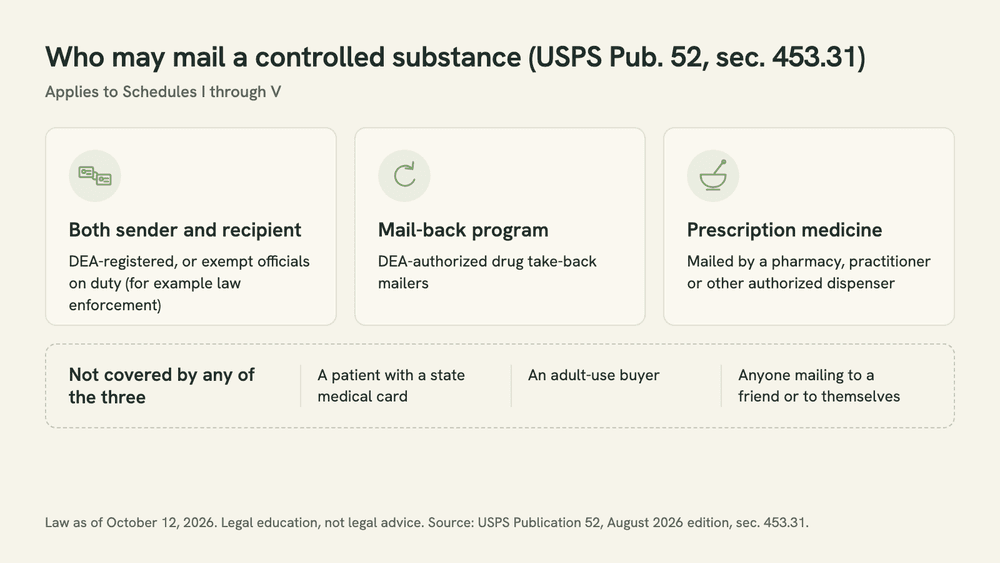
Three things follow from that sentence and the sections around it. First, the rule reaches every schedule. Section 453.11 defines controlled substances as drugs "identified in Schedules I through V of the Controlled Substances Act", so moving a substance to Schedule III does not take it outside the rule. Second, section 453.31 then lists the only conditions under which a controlled substance is "acceptable in the domestic mail": "Both the mailer and addressee" must be registered with DEA or exempt from registration (the examples are military, civil defense and law enforcement personnel "in performing official duties"); or the item travels through a DEA-authorized mail-back program; or it is a prescription medicine mailed by "drug manufacturers or their registered agents, pharmacies, medical practitioners, or other authorized dispensers". A patient mailing to a friend fits none of them. Third, federal postal law calls such an item "nonmailable", and under 39 U.S.C. 3001 nonmailable matter that "may be seized or detained for violation of law" is disposed of as the Postal Service directs. (We read the August 2026 edition of Publication 52, which supersedes the February 2026 edition, on October 12, 2026.)
Why is mailing weed "distribution" at all, even as a gift? Because of how the Controlled Substances Act (CSA) defines its verbs. Under 21 U.S.C. 802, to "deliver" means "the actual, constructive, or attempted transfer of a controlled substance", and to "distribute" means to deliver it. Handing weed to someone, or trying to, is a delivery. A stamp does not change the verb. The same section also says marijuana does not include hemp, which is why hemp gets a different answer later on this page. USPS ties the mailing itself to 18 U.S.C. 1716, a statute whose text is about poisons and injurious articles; the link to controlled substances is USPS's reading in Publication 52. The criminal drug statutes beside it each carry their own maximums: 21 U.S.C. 841 for distribution, 21 U.S.C. 843(b) for using "any communication facility", a term the statute says "includes mail", to commit or facilitate a federal drug felony, and 21 U.S.C. 844 for possession on the receiving end.
| Statute | What it covers | Maximum set by the statute | Note |
|---|---|---|---|
| 18 U.S.C. 1716(j)(1) | Knowingly mailing anything declared nonmailable | A fine, up to 1 year in prison, or both | The statute USPS cites in section 453.31 |
| 21 U.S.C. 841(b)(1)(D) | Distributing less than 50 kilograms of marijuana | Up to 5 years; a fine up to the greater of the title 18 amount or $250,000 for an individual | The source of the "5 years and $250,000" figure repeated online |
| 21 U.S.C. 841(b)(4) | Distributing a small amount of marijuana for no remuneration | Treated as simple possession under section 844 | The statute does not define "small amount" |
| 21 U.S.C. 843(b) and (d)(1) | Using the mail or another communication facility to commit or facilitate a federal drug felony | Up to 4 years per use; up to 8 years after a prior conviction | "Each separate use" is a separate offense |
| 21 U.S.C. 844 | Possessing a controlled substance without a valid prescription or other CSA authorization | First offense: up to 1 year and a minimum $1,000 fine | The receiving end; applies to any schedule |
Read the table for what it is: the outer limits Congress wrote, not what happens in a typical case. Federal charges depend on the facts, and states have their own drug and mail-related laws with their own penalties, which this page does not try to quantify. Enforcement is real, though the public numbers are blunt. The Postal Inspection Service's most recent annual report, for fiscal 2024 and published in January 2026, counts 2,299 prohibited-mail narcotics cases initiated, 2,034 arrests and 1,920 convictions, and says inspectors seized more than 36,454 kilograms of illegal narcotics. It does not break out marijuana, so those figures cover all drugs and are not a measure of marijuana enforcement.
Does Schedule III change it? The April 28 order and the registrant rule
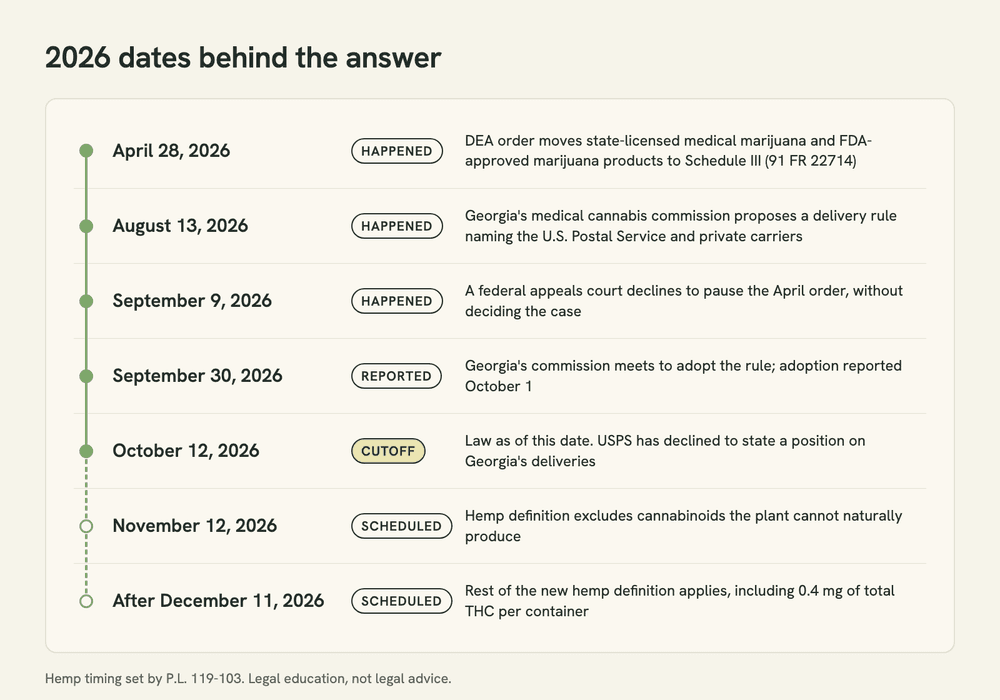
This is the question the top search results we read on October 12, 2026 do not answer, mostly because they predate the order. As of April 28, 2026, a DEA final rule (91 FR 22714) moved two narrow categories of marijuana from Schedule I to Schedule III: marijuana in an FDA-approved drug product, and marijuana "subject to a state medical marijuana license". Everything else stays where it was. In the rule's words, "any form of marijuana other than in an FDA-approved drug product or marijuana subject to a state medical marijuana license remains a schedule I controlled substance." The order legalizes nothing, and adult-use marijuana is untouched.
The order also says nothing about the mail. We searched its full text on October 12, 2026: it contains no use of "mail", "postal", "interstate" or "courier". That silence is not a prohibition, but it means the postal answer still comes from Publication 52, and section 453.31 does not care which schedule a substance sits in. It asks whether both the mailer and the addressee are DEA registrants or exempt officials, or whether the item is a prescription mailed by a pharmacy or other authorized dispenser. A state medical card does not make you a DEA registrant. So for a patient, Schedule III changes nothing: you still cannot mail it to a friend, to another patient or to yourself. Schedule III is not new territory for cannabinoid medicine, either. FDA-approved dronabinol capsules have sat in Schedule III for years, and the prescription pathway in Publication 52 runs from the pharmacy, not from the patient.
What about crossing state lines? The order creates a DEA registration for state medical licensees, and its limits are explicit. A registered dispenser may dispense "to individuals authorized by state law to possess marijuana ... for medical purposes, subject to the limitations of its state license", registrations do not cover non-medical use, and a registration "shall not exceed the scope of the holder's state medical marijuana license." A state license stops at the state line, so on our reading nothing in the order authorizes shipping medical marijuana to another state. The order is in force while legal challenges proceed: a federal appeals court declined to pause it on September 9, 2026 without deciding the case, as covered in our explainer on the Schedule III ruling and the court fight over it. A separate proceeding on moving all marijuana to Schedule III remains a proposal, and NORML reported on October 1 that the administrative law judge had paused it.
The Georgia test case: a state rule that names the Postal Service
If a patient cannot mail medical marijuana, can a DEA-registered dispensary mail it to a patient? One state has written a rule that assumes yes. On August 13, 2026, the Georgia Access to Medical Cannabis Commission gave notice of proposed Rule 351-6-.11, "Delivery", posted on the commission's rules page. It lets a licensed dispensary deliver to a registered patient, caregiver or healthcare institution, after first submitting a delivery plan to the commission, and only "to the Georgia address listed on the patient's or caregiver's valid, state-issued photographic identification." Then it names the carriers:
“Delivery shall be performed only by: (a) The U.S. Postal Service; (b) A private carrier (e.g., FedEx, United Parcel Service, DHL, etc.); or (c) The Commission. ... certified mail, or a carrier service providing equivalent tracking and proof of delivery, with delivery restricted to, and the signature required of, the patient, caregiver, or healthcare institution employee.”
The commission's agenda for a special-called meeting on September 30, 2026 lists a vote on adopting the proposed rule, and Marijuana Moment reported on October 1 that the commission adopted it as part of a broader package. We could not find the adopted text, approved minutes or an effective date on the commission's site as of October 12, 2026, so the quote above is the proposed version. The same report asked the Postal Service where it stands. A spokesperson pointed to the general rules on mailing controlled substances and, pressed, said "we have nothing additional to offer at this time." DHL said it was monitoring the situation and would comply with applicable law; UPS and FedEx did not reply. UPS's own published policy, quoted in the carrier section below, still prohibits medical marijuana.
Here is how to read it. A state can authorize its own licensees to use a carrier, but a state rule cannot change federal postal law or make USPS accept a package. Whether a dispensary holding a DEA registration under the April order can mail to a patient turns on Publication 52. The both-registered pathway does not fit on its face, because the patient is not a registrant. The prescription pathway names "other authorized dispensers", but we found no USPS statement, as of October 12, 2026, on whether a dispensary registered under the April order counts as one; asked about Georgia's rule, the agency pointed only to its general controlled-substances rules. The rule is also intrastate by its own terms: a Georgia address only. So the honest status is an open question with three facts attached: one state has written a rule assuming yes, the agency that would carry the packages has declined to say, and UPS's published terms say no. We do not forecast how it resolves.
Both states are legal: why in-state and state-to-state mail are still federal
The most common follow-up is "can you mail weed in a legal state?" The answer is still no, and the reason is structural. The mail is a federal system. Section 453.31 asks only whether distribution is lawful under the federal CSA, and 21 U.S.C. 841 does not ask about state law at all. State legalization changes what state police and prosecutors do; it does not authorize distribution under federal law, and adult-use marijuana "remains a schedule I controlled substance" in the April order's own words. A package that starts and ends inside one legal state is still mail, so it is still governed by the federal rule.
Mailing between two legal states adds nothing helpful: you have the same federal rule plus a state line, and the medical registration created in April is capped at the scope of a state license. The same split explains two other questions people ask. Flying is another federal space layered over state law, which we walk through in whether you can fly with weed. Banking is a third, and it is why so many stores still take only cash, as explained in why dispensaries are cash only. In each case, a state's permission ends where a federal system begins.
What can go in the mail: a matrix
Here is the whole picture in one place. Each row is a different legal category, and each cell names the rule that decides it. UPS appears as the private-carrier example because its terms were readable; FedEx's were not (see the carrier section).
| Item | Federal status | USPS rule | UPS (archived July 4, 2026) | Source |
|---|---|---|---|---|
| Hemp CBD oil, 0.3% delta-9 THC or less | Not a controlled substance; hemp is excluded from the CSA definition of marijuana | Mailable domestically under section 453.37 if the mailer complies with applicable law and keeps records for 3 years; no international mail | Accepted only with a dedicated UPS hemp account, licenses and a signed UPS agreement | Pub. 52 sec. 453.37; 21 U.S.C. 802(16) |
| Hemp-derived THC (delta-8, gummies, drinks), today | Depends on meeting the current federal hemp definition | Section 453.37 if it meets the definition; otherwise section 453.31 | Hemp account terms apply, and UPS prohibits "any synthetic or lab-made cannabinoid compound" | Pub. 52 sec. 453.37; UPS policy |
| Same items from November 12, 2026 and after December 11, 2026 (scheduled) | New hemp definition, timing set by P.L. 119-103: cannabinoids the plant cannot naturally produce excluded first; total-THC test and 0.4 mg of total THC per container after December 11 | Anything outside the new definition falls under section 453.31 and is nonmailable | Same as above | P.L. 119-37 sec. 781; P.L. 119-103 sec. 2019 |
| State-licensed medical marijuana | Schedule III since April 28, 2026 (91 FR 22714) | Section 453.31: a patient cannot mail it (not a registrant); registrant to registrant on its face; registrant to patient unresolved | Prohibited "even when marijuana is for medicinal purposes" | 91 FR 22714; Pub. 52 sec. 453.31; UPS policy |
| Adult-use marijuana: flower, edibles, concentrates, vapes | Schedule I | Section 453.31: nonmailable | Prohibited "under any circumstances" | 91 FR 22714; Pub. 52 sec. 453.31 |
| Cannabis seeds | Covered in our seeds guide; the federal test is scheduled to change after December 11, 2026 | USPS's hemp rule never mentions seeds; section 453.37 follows the statutory hemp definition | Not separately named | Pub. 52 sec. 453.37; 7 U.S.C. 1639o |
| FDA-approved THC drug (dronabinol capsules) | Schedule III (21 CFR 1308.13(g)(1)) | Prescription pathway in section 453.31: mailed by a pharmacy or authorized dispenser, not re-mailed by the patient | Not applicable | 21 CFR 1308.13; Pub. 52 sec. 453.31 |
Hemp is the exception because federal law says so twice: the CSA's marijuana definition excludes hemp, and Publication 52 gives hemp its own section, 453.37. That section's conditions (compliance with all applicable law, records kept for at least 3 years, domestic only) are covered in full in our step-by-step guide to the USPS hemp rule, and the line between the two plants is explained in hemp vs marijuana. The important 2026 point is that section 453.37 defines hemp by the statute "or any successor provision", so mailability follows whatever definition is in force. That definition is about to change. On November 12, 2026 it is scheduled to exclude cannabinoids a plant cannot naturally produce, and after December 11, 2026 the rest of the new definition is scheduled to apply, including a cap of 0.4 milligrams of total THC per container for finished goods, with the timing set by P.L. 119-103. Our guide to the 2026 hemp ban covers the substance, and our news explainer on the December 11 delay covers the dates. Anything that falls outside the new definition stops being hemp, and section 453.37 stops applying to it. Seeds have their own analysis in are weed seeds legal.
UPS, FedEx and what legal delivery actually is
Can you ship weed with UPS or FedEx instead of the Postal Service? Private carriers are not bound by Publication 52, but they are bound by federal drug law, and 21 U.S.C. 841 is not carrier-specific: distribution is distribution whoever drives the truck. They also write their own contracts. UPS's published policy, in a July 4, 2026 archived copy of the page at ups.com, says: "The shipment of marijuana, as defined in 21 U.S.C §802(16), is prohibited under any circumstances, even when marijuana is for medicinal purposes or is otherwise legal under a state's law." The same page says UPS prohibits "any synthetic or lab-made cannabinoid compound and their derivatives" and reserves the right to dispose of shipments it prohibits.
FedEx publishes its restrictions in its own service guide. We could not read that page on October 12, 2026 (it returned an access-denied notice to our automated request), so we do not characterize it here. The general point holds either way: a private carrier's terms are a contract, only the carrier's current terms bind you, and they can change without notice. One more difference matters. The Fourth Amendment limits the government, not companies. In United States v. Jacobsen (1984), the Supreme Court held that its protection is "wholly inapplicable" to a search by a private party not acting for the government. The package in that case was opened by Federal Express employees under the company's own insurance policy.
So what is the weed delivery you see in legal states? It is a licensed courier system, and the mail has no part in it. California is a clear example. Under the state's cannabis regulations, in the edition in effect as of January 1, 2026, legal delivery works like this:
- Every delivery is made by "a delivery employee who is directly employed by a licensed retailer" (4 CCR 15415(a)), and that employee must be at least 21.
- Deliveries "shall be made in person", and never by an unstaffed vehicle (4 CCR 15415(c)).
- A licensee may not sell or transfer cannabis goods through an unlicensed third party (4 CCR 15415.1(a)).
- Goods may be delivered only to a physical address in California, and the driver "shall not leave the State of California while possessing cannabis goods" (4 CCR 15416).
- A delivery vehicle may carry no more than $10,000 of cannabis goods at any time (4 CCR 15418(a)).
That is one state, dated, not a 50-state survey, and other states write their own delivery rules. But the shape is typical: a state license, a named employee, an in-person handoff and a hard stop at the state border. Legal delivery is a courier license, not a stamp.
Can the post office open my package?
This is where many answers online turn the law into reassurance. Here it is as law. Since Ex parte Jackson (1878), the Supreme Court has treated sealed mail like papers kept at home: letters and sealed packages are "as fully guarded from examination and inspection, except as to their outward form and weight, as if they were retained by the parties forwarding them in their own domiciles", and they can be opened only under a warrant. Notice the carve-out in the middle of that sentence: outward form and weight are not protected. Congress wrote a version of the rule into postal law. 39 U.S.C. 404(c) bars opening sealed first-class mail without a search warrant, except by a postal employee "for the sole purpose of determining an address at which the letter can be delivered", or with the addressee's permission.
A warrant to open is not the same as protection from being held. In United States v. Van Leeuwen (1970), the Court said "even first-class mail is not beyond the reach of all inspection" and held that packages can be detained without a warrant while investigators decide whether to seek one; opening them still required a magistrate's warrant. The Court also said detention can become unreasonable if it runs too long. Private carriers are a different case altogether, because, as Jacobsen held, the Fourth Amendment does not bind them. How detection works, including odor and dogs, is covered in whether the smell of weed is probable cause, and we do not repeat it here. The point that matters is simpler: a warrant requirement governs how the government may open a package. It does not make the contents lawful.

What this page cannot tell you
- Your state's penalties and prosecution policies. States have their own drug laws, and charges, penalties and priorities vary widely. This page covers federal law and one dated state example.
- Whether USPS will accept Georgia's dispensary deliveries. As of October 12, 2026, the agency has declined to say, and we could not find the adopted rule text or an effective date.
- How the court challenge to the April order ends. The order is in force; a federal appeals court declined to pause it on September 9, 2026 without ruling on the merits.
- Whether all marijuana will be rescheduled. That broader proceeding is still a proposal, and press reports say it is paused.
- Whether the hemp dates hold. November 12, 2026 and after December 11, 2026 are set by statute, and Congress can change them.
Frequently asked questions
Yes. The mail is a federal system, and USPS Publication 52 section 453.31 asks only whether distribution is lawful under the federal Controlled Substances Act. State legalization does not make it lawful under that act, and adult-use marijuana is still Schedule I. Mailing within your own state is still mailing, so the federal rule applies.
Not as a patient. Publication 52 lets a controlled substance travel by mail only when both sender and recipient are DEA-registered or exempt officials, through a DEA mail-back program, or as a prescription mailed by a pharmacy or other authorized dispenser. A state medical card does not make you a DEA registrant. Whether a DEA-registered dispensary may mail to a patient is unresolved: Georgia has written a rule assuming it can, and USPS has not said.
Marijuana edibles are marijuana, so the same rule applies and they are nonmailable. Hemp-derived edibles are a separate question under section 453.37, and they are mailable only while they meet the federal hemp definition. That definition is scheduled to change on November 12, 2026 and again after December 11, 2026.
No. UPS's published policy, archived July 4, 2026, prohibits marijuana under any circumstances, including for medicinal purposes. We could not read FedEx's terms on October 12, 2026. Either way, federal drug law is not carrier-specific, and the Fourth Amendment does not limit a private carrier's own inspection of a package.
Federal statutes set the maximums. 21 U.S.C. 841(b)(1)(D) allows up to 5 years and a fine up to $250,000 for an individual distributing under 50 kilograms; 841(b)(4) treats a small amount given away for nothing as simple possession under section 844; and 843(b) adds up to 4 years for each use of the mail to facilitate a drug felony. These are ceilings, not predictions, and state charges are separate. A lawyer in your state can tell you what applies.
Sealed first-class mail can be opened only with a search warrant, under Ex parte Jackson and 39 U.S.C. 404(c), with narrow exceptions such as finding a deliverable address. But a package's outward form and weight are not protected, and under United States v. Van Leeuwen a package can be held without a warrant while investigators decide whether to seek one. A warrant requirement does not make the contents lawful.
Hemp CBD at or under 0.3% delta-9 THC can be mailed domestically under Publication 52 section 453.37 if the mailer meets that section's conditions, including keeping records for 3 years. USPS's hemp rule never mentions seeds; it follows the statutory hemp definition, which is scheduled to change for seeds after December 11, 2026. Our CBD mailing guide and seeds guide cover both in detail.
If your real question is about hemp, the rules are different: start with our full guide to mailing CBD and hemp through USPS. For the wider legal picture, including what changes state by state, read our hub on whether CBD is legal.
Writing about hemp, wellness and the small rituals that keep us balanced.