Marijuana and Immigration: Why Federal Law Still Says No, and Where Hemp-Derived CBD Sits
Immigration law reads the federal drug list, not your state's. How an admission can count like a conviction, why the 30-gram rule is narrower than it sounds, and where federal hemp CBD sits before the November and December 2026 changes.

Can marijuana affect your immigration status if your state made it legal? Yes. On marijuana and immigration, the law asks a federal question: did you violate a law relating to a substance on the federal controlled-substance list? Marijuana is on that list in every state, and for a visa, a green card or citizenship, an admission can count as much as a conviction. Hemp-derived CBD is different, because federal law says hemp is not marijuana. That difference comes with conditions, and the federal hemp line moves on November 12 and December 11, 2026.
Two places to start. The American Immigration Lawyers Association runs AILA's Immigration Lawyer Search, which lets you filter attorneys by case type, including naturalization, waivers, removal and consular processing, and by language. The Immigrant Legal Resource Center (ILRC), a nonprofit that trains immigration lawyers, publishes a plain-language resource on what every noncitizen should know about cannabis and immigration, dated May 5, 2026. We do not endorse any lawyer. We sell hemp products ourselves, which is exactly why this page names none of them and spells out where the hemp position breaks down.
Three different legal tests, not one
Most confusion comes from treating "immigration" as one rule. It is at least three, written in different sections of the Immigration and Nationality Act, with different triggers. Which one applies depends on where you are in the process. The inadmissibility section, 8 U.S.C. 1182, governs anyone asking to be let in: a visa applicant at a consulate, a traveler at a port of entry, or someone applying for a green card from inside the US. The deportability section, 8 U.S.C. 1227, governs someone who has already been admitted, including green-card holders. And the good moral character rules in 8 U.S.C. 1101(f) govern naturalization. The same history can be treated differently under each, which is why a sentence that is true about one test is often false about another.
| Test | Statute | Who it applies to | What triggers it | Conviction needed? | 30 g marijuana carve-out |
|---|---|---|---|---|---|
| Inadmissibility | 8 U.S.C. 1182(a)(2)(A)(i)(II) | Visa applicants, travelers seeking admission, green-card applicants | A conviction for, or an admission of, violating a law relating to a federally controlled substance | No. An admission is enough | None in the ground itself. Green-card applicants have a narrow, discretionary waiver at 8 U.S.C. 1182(h) |
| Deportability | 8 U.S.C. 1227(a)(2)(B) | People already admitted, including green-card holders | A controlled-substance conviction; separately, being or having been a drug abuser or addict after admission | Yes for the conviction ground; no for the drug abuser or addict ground | Yes: one offense of possession for your own use of 30 grams or less |
| Good moral character | 8 U.S.C. 1101(f)(3) and 8 CFR 316.10 | Naturalization applicants | A conviction for, or an admitted, controlled-substance offense committed during the statutory period | No. An admission is enough | Yes: one offense of simple possession of 30 grams or less |
There is also a medical track. The inadmissibility statute separately covers anyone found to be a "drug abuser or addict" (8 U.S.C. 1182(a)(1)(A)(iv)). For green-card applicants, that finding is made by a civil surgeon during the immigration medical exam. USCIS's Policy Manual chapter on this health ground says the civil surgeon "must now make this determination according to the DSM as specified in the Technical Instructions", and that remission is now defined by DSM criteria rather than by a set timeframe. That is a clinical judgment made by a doctor, and we do not offer a self-check for it.
Why your state's law does not change the answer
The most common assumption is that legal in your state means legal for immigration. The agencies that decide immigration cases say the opposite, in writing. The State Department's consular manual, 9 FAM 302.4, which tells visa officers how to apply the controlled-substance grounds, puts it in one line.
“Whether a controlled substance is legal under a state law is not relevant to its illegality under federal law.”
USCIS, which decides green-card and citizenship applications, wrote the same rule down in an April 19, 2019 policy alert, PA-2019-02: a violation of federal controlled-substance law, "including for marijuana, remains a conditional bar to establishing good moral character (GMC) for naturalization even where that conduct would not be an offense under state law." The current USCIS Policy Manual chapter on conditional bars to good moral character goes further. It names "possession of marijuana for recreational or medical purposes or employment in the marijuana industry" as conduct that "may constitute conduct that violates federal controlled substance laws." As written, medical use under a state card is inside that sentence. The page was marked current as of September 23, 2026 when we read it.
At the border the message is the same. CBP's reminder to travelers from Canada that marijuana remains illegal in the United States says that "arriving at a U.S. port of entry with marijuana may result in seizure, fines, and/or arrest, and may impact admissibility." None of the CBP statements on this that we have read mention hemp or CBD. How federal and state law divide the civilian question of CBD is covered in our guide to whether CBD is legal. This page stays on the immigration side.
No arrest, no charge, no conviction: the admission problem
This is the part most people do not expect. The inadmissibility statute applies to anyone "convicted of, or who admits having committed" a violation of a controlled-substance law of a state, the United States or a foreign country. It does not require an arrest, a charge or a conviction. The naturalization regulation says the same for good moral character. 8 CFR 316.10 reaches an applicant who "admits committing any criminal act" covered by the drug rules "for which there was never a formal charge, indictment, arrest, or conviction, whether committed in the United States or any other country". The regulation has not been amended since 2016.
"Admission" here is a legal term with a defined shape. A separate chapter of the USCIS Policy Manual says that for a statement to count, the officer "must provide the applicant the text of the specific law" and "an explanation of the offense and its essential elements in 'ordinary' language", and the applicant "must voluntarily admit to having committed the particular elements of the offense under oath". The manual traces the standard to a 1957 Board of Immigration Appeals decision, Matter of K-, 7 I&N Dec. 594. Read that as a definition, not a way out. The USCIS manual also warns that "even if an alien does not have a conviction or make a valid admission to a marijuana-related offense, he or she may be unable to meet the burden of proof to show that he or she has not committed such an offense." And the statute separately denies good moral character to anyone who "has given false testimony for the purpose of obtaining any benefits" (8 U.S.C. 1101(f)(6)). Whether anything you have said or written meets the admission standard is a question for an attorney who has seen your file.
The forms ask directly. Form I-485, the green-card application (edition 09/18/26), asks at Part 9, Item 26: "Have you EVER violated (or attempted or conspired to violate) any controlled substance law or regulation of a state, the United States, or a foreign country?" Form N-400, the naturalization application (edition 01/20/25), asks at Part 9, Item 17.b whether you have ever manufactured, cultivated, produced, distributed, dispensed, sold or smuggled controlled substances in violation of any law. Both forms are signed under penalty of perjury.
One more statute matters for green-card holders. Permanent residents coming home from abroad are normally not treated as applicants for admission. The statute makes an exception for someone who "has committed an offense identified in section 1182(a)(2)", the paragraph that holds the controlled-substance ground (8 U.S.C. 1101(a)(13)(C)(v)). What that means for you is a question to raise with an attorney, including before any trip abroad.
The 30-gram exception is narrower than it sounds
You will read that there is a "30-gram exception" for marijuana. There is, but it sits in different places in each test, and in the test that matters most for anyone outside the US or applying for a green card, it is not an exception at all. Here is where it applies and where it does not.
- Deportability: one conviction for possession for your own use of 30 grams or less of marijuana is carved out of the conviction ground (8 U.S.C. 1227(a)(2)(B)(i)). It does not touch the separate drug abuser or addict ground.
- Good moral character: a single offense of simple possession of 30 grams or less of marijuana is excepted from the bar (8 U.S.C. 1101(f)(3) and 8 CFR 316.10(b)(2)(iii)).
- Inadmissibility: the ground itself has no 30-gram exception. A conviction for, or an admission of, any amount triggers it.
- For a green card, the inadmissibility waiver (8 U.S.C. 1182(h)) covers only a single offense of simple possession of 30 grams or less of marijuana, and only when one of three further conditions is met.
- Condition one: the conduct was more than 15 years before the application, admitting the person would not be contrary to the national welfare, safety or security, and the person has been rehabilitated.
- Condition two: the person is the spouse, parent, son or daughter of a US citizen or green-card holder who would suffer extreme hardship if the person were refused.
- Condition three: the person is a VAWA self-petitioner.
- The waiver is discretionary, and the statute says no court has jurisdiction to review a decision to grant or deny it.
- Temporary visas work differently: 8 U.S.C. 1182(d)(3)(A) gives a separate, discretionary waiver for nonimmigrant visa applicants. Whether it fits a given case is a question for counsel.
- For naturalization, expungement does not erase a drug conviction. Under 8 CFR 316.10(c)(3)(i), an applicant whose drug record was expunged "shall be considered as having been 'convicted'" for this purpose.
Two more limits. For most applicants, the good moral character period is the five years before filing, tied to the continuous-residence requirement in 8 U.S.C. 1427. But the same section says the government "shall not be limited to the applicant's conduct during the five years preceding the filing of the application" and may consider "the applicant's conduct and acts at any time prior to that period." And none of these conditions tells you whether you qualify for anything. That is a fact-by-fact question for counsel.
Working in the cannabis industry
Jobs are one of the places where state-legal cannabis collides with immigration. As quoted above, USCIS's manual names "employment in the marijuana industry" alongside possession as conduct that may violate federal law. A separate inadmissibility ground, 8 U.S.C. 1182(a)(2)(C), reaches anyone a consular officer or the Attorney General "knows or has reason to believe" is or has been an illicit trafficker, with no conviction required. The State Department's manual says "reason to believe" "might be established by a conviction, an admission, a long record of arrests with an unexplained failure to prosecute by the local government, or several reliable and corroborative reports", and that "there must exist a probability, supported by evidence" that the person is or has been trafficking. The same ground can reach a spouse, son or daughter who obtained a financial or other benefit from the trafficking within the previous five years and knew or reasonably should have known where it came from. The Congressional Research Service, in a legal sidebar on the consequences of rescheduling marijuana updated December 22, 2025, put it plainly: "For individuals, participation in the state-legal marijuana industry may have adverse immigration consequences."
A business handling only federally compliant hemp is not, under the statutes in the next section, handling a controlled substance. That is not the same as saying any hemp or CBD job is free of immigration risk. The conditions below apply to businesses as much as to consumers, and any cannabis-sector job, hemp included, belongs on the list you bring to a lawyer. The ordinary workplace side, such as testing and firing, is covered in our guide to whether you can be fired for failing a drug test.
Where hemp-derived CBD sits, and what breaks it
This is the distinction most of the first page of search results skips. One detailed law-firm page on this question lists CBD gummies, edibles, tinctures, lotions and oils alongside marijuana, and others simply advise avoiding CBD. Federal law does not lump them together. The Controlled Substances Act's definition of marijuana, at 21 U.S.C. 802(16), says the term does "not include" hemp "as defined in section 1639o of title 7". And 7 U.S.C. 1639o, the definition written by the 2018 Farm Bill, defines hemp as Cannabis sativa L. and its derivatives "with a delta-9 tetrahydrocannabinol concentration of not more than 0.3 percent on a dry weight basis." The immigration statute uses that same section 802 for its meaning of "controlled substance", and the Supreme Court held in Mellouli v. Lynch (2015) that, to trigger removal on the drug ground, the government must connect an element of the conviction to a drug on the federal list. USCIS's manual says the same about admissions: "The substance underlying the alien's state law conviction or admission must be listed in the CSA." The test is federal.
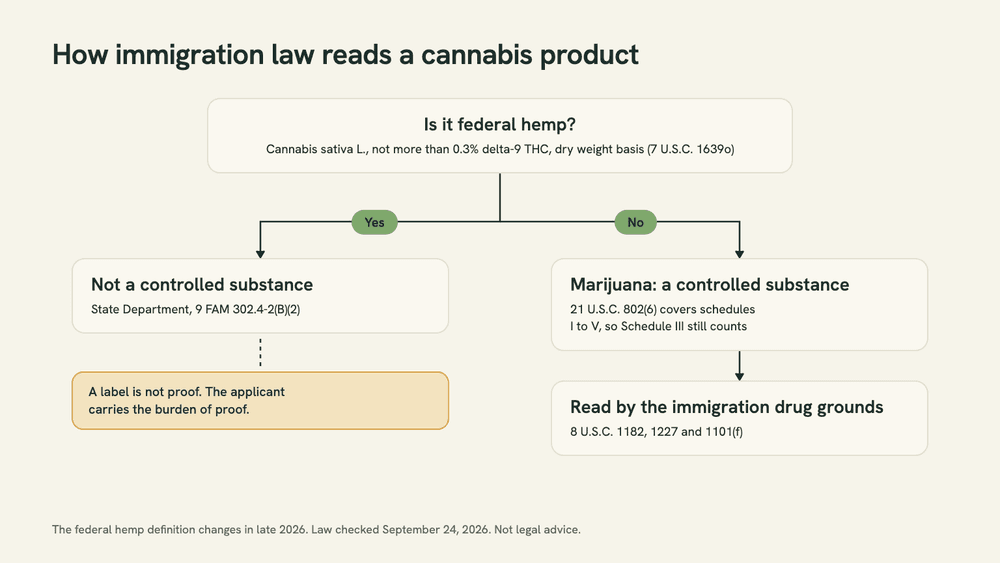
The State Department's own manual says it plainly: "Hemp is not a controlled substance so long as its delta-9 tetrahydrocannabinol concentration is not more than 0.3 percent on a dry weight basis." The April 2026 federal scheduling order says the same from the other side: it "does not affect the status of hemp (as defined in 7 U.S.C. 1639o), because hemp is excluded from the definition of marijuana." That sentence describes a substance. It does not tell you what an officer will conclude about the product you used. The hemp position breaks, or becomes hard to show, in these situations.
- The CBD was made from marijuana, not hemp, as a dispensary product can be. Marijuana-derived CBD is marijuana under federal law, whatever its THC number.
- The product held more THC than its label said. A label is a claim, not proof.
- The product contained lab-made cannabinoids. Products with cannabinoids the plant cannot naturally produce leave the hemp definition on November 12, 2026; lab-made versions of natural ones follow on December 11.
- Your state treats the product as marijuana and you cannot show it was federal hemp. The immigration test reads the federal list, but showing which side a product fell on is an evidence problem.
- The product was flower. Hemp flower and marijuana look and smell alike, and an officer cannot tell them apart by sight.
- You cannot show what you used at all. USCIS's manual puts the burden of proof on the applicant, and a remembered brand name is thin evidence.
- A drug test came back positive. A test detects THC, not whether it came from hemp or marijuana.
Labels deserve the skepticism. A 2017 JAMA analysis of 84 CBD products sold online detected THC in 18 of them. That was a 2017 online sample, not today's whole market, and "detected" does not mean "over 0.3%". Lab numbers vary too: in the first exercise of NIST's cannabis laboratory quality assurance program, 37 of the 65 labs reporting delta-9 THC on one hemp oil (57%) landed outside NIST's strict range of tolerance for that same oil. Why the 0.3% figure is easy to misread is explained in our breakdown of hemp-derived THC. Why flower is its own problem is in our guide to whether CBD flower is legal. What a test does and does not detect is in our CBD drug test guide, and the botanical and legal taxonomy is in hemp versus marijuana, explained.
What changes on November 12 and December 11, 2026
The hemp line in that manual sentence is about to move. Public Law 119-37, enacted November 12, 2025, rewrites the federal hemp definition. Under the new text, hemp will be measured by total THC, including THCA, rather than delta-9 THC alone; products with cannabinoids the plant cannot naturally produce, or that were synthesized outside the plant, will be excluded; and a finished consumer product will be excluded if it contains more than 0.4 milligrams of combined total THC per container. A later law, P.L. 119-103, the Continuing Appropriations and Extensions Act, 2027, approved September 2, 2026, split the timing. From November 12, 2026, only the exclusion of products containing cannabinoids "not capable of being naturally produced by a Cannabis sativa L. plant" applies. The rest, including the total-THC standard and the 0.4 mg per container ceiling, arrives December 11, 2026. The full detail is in our explainer on the 2026 hemp ban and our report on the delay to December 11.
Why this matters here: the Congressional Research Service says some products "that were previously legally classified as hemp will no longer fit that definition and will instead be classified as marijuana or CSA-regulated THC" (CRS Legal Sidebar LSB11381, December 22, 2025), and that if such products stay on the market, "it is possible they could be subject to the same criminal and collateral issues as marijuana" (CRS Insight IN12620, December 3, 2025). CRS does not discuss immigration in either piece. The next step is our reading, not theirs: because the immigration statute reads the federal controlled-substance list, a product that crosses out of the hemp definition crosses into the territory this page describes. The same bottle can sit on different sides of the line depending on the date, and which definition applies to conduct on a given day is itself a question for counsel. Two limits. FDA has not yet published the cannabinoid lists the new law requires (a Federal Register search on September 24, 2026 found none). And we make no forecast about further delays or about how any of this will be enforced.
Schedule III does not fix this
Headlines about rescheduling lead many people to assume the immigration problem is going away. The statute says otherwise. 21 U.S.C. 802(6) defines a controlled substance as anything "included in schedule I, II, III, IV, or V" of the Act. Moving marijuana from Schedule I to Schedule III moves it inside the same definition. The April 2026 scheduling order, effective April 28, 2026, is also narrow. It moved marijuana in FDA-approved drug products and marijuana subject to a state medical marijuana license to Schedule III, and it says "any form of marijuana other than" those "remains a schedule I controlled substance". The word "immigration" does not appear in it. Whether a state medical patient's possession is now lawful under federal law is a question the order does not answer, and we do not guess.
As of September 24, 2026, the Federal Register showed no final rule on broader rescheduling, and the USCIS manual chapter still says marijuana "remains classified as a 'Schedule I' controlled substance under the federal CSA." Its text has not been revised since the April order. The Congressional Research Service noted before the order that moving marijuana to Schedule III, "without other legal changes, would not bring the state-legal medical or recreational marijuana industry into compliance with federal controlled substances law." Where the court challenge to the order stands is covered in our report on the Schedule III ruling.
What this page cannot tell you, and where to go
This page cannot tell you whether you are inadmissible, deportable or eligible to naturalize, whether a waiver is available to you, or what to say to anyone. It describes statutes, regulations and agency manuals as we read them on September 24, 2026, and those change. It does not cover criminal defense, state expungement or vacatur law, pardons, or the shorter naturalization periods that apply to some applicants. An attorney will usually want to know facts like the ones below, so it can help to gather them first. This is a list of documents and history, not a script.
- Any arrest, citation, charge or court record, anywhere in the world, including anything sealed, expunged or dismissed.
- Any job, contract or income connected to a cannabis business, hemp or marijuana, with dates.
- The products you used, where you bought them, and any lab reports (certificates of analysis) you still have.
- Every immigration form you have signed, and copies of what you submitted.
- Any drug test results tied to immigration, employment or a court.
Then take it to someone licensed to advise you. AILA's Immigration Lawyer Search, linked at the top of this page, filters by case type and language. Attorneys who want the technical background can start with the ILRC practice advisory, Immigrants and Marijuana, dated May 2021. It predates both the April 2026 order and the hemp rewrite, so it is a starting point, not the current picture. Once more, because it matters: this is general information, not legal advice.

Marijuana and immigration: questions people ask, including about CBD
State legality does not decide it. The inadmissibility ground reaches anyone convicted of, or who admits having committed, a violation of a controlled-substance law, and marijuana is federally controlled. The State Department's manual says state legality is not relevant. The waiver open to green-card applicants is narrow: one offense of simple possession of 30 grams or less, plus 15 years' distance, a qualifying relative's extreme hardship or VAWA self-petitioner status, and it is discretionary. Whether any of this applies to your history is a question for a licensed immigration attorney.
The deportability ground generally requires a controlled-substance conviction, and one conviction for possessing 30 grams or less of marijuana for your own use is carved out. A separate ground covers anyone who is, or at any time after admission has been, a drug abuser or addict, and that one needs no conviction. A different statute governs when a green-card holder returning from abroad is treated as seeking admission. Both are questions for counsel.
It can, through the good moral character requirement. A controlled-substance offense committed during the statutory period, generally the five years before you file, is a bar whether it led to a conviction or is admitted with no charge ever filed, except a single offense of simple possession of 30 grams or less. USCIS may also consider conduct from before that period, and it confirmed in a 2019 policy alert that state legality does not change this.
It depends on what the CBD was. The State Department's manual says hemp is not a controlled substance so long as its delta-9 THC concentration is not more than 0.3% on a dry weight basis. Marijuana-derived CBD is marijuana under federal law. The hemp position weakens if a product held more THC than its label said, contained synthesized cannabinoids, was flower, or if you cannot show what it was. Nothing on this page makes any product safe for an immigration case.
It can. USCIS's manual names employment in the marijuana industry as conduct that may violate federal law, and a separate inadmissibility ground lets a consular officer act on reason to believe someone is or was an illicit trafficker, with no conviction. The Congressional Research Service says participation in the state-legal industry may have adverse immigration consequences. Bring any cannabis-sector job, including a hemp one, to an attorney.
Not as the law reads on September 24, 2026. The immigration statute uses the federal definition of a controlled substance, which covers Schedules I through V. The April 2026 order moved only two narrow categories to Schedule III, does not mention immigration, and left all other marijuana in Schedule I. Broader rescheduling had no final rule as of that date.
For naturalization, the regulation at 8 CFR 316.10(c)(3)(i) says an applicant whose drug record was expunged is considered as having been convicted. Expungement, vacatur and sealing are different things, and which one you have matters, so this is a question for an attorney with your court records in hand.
The forms ask directly. The green-card application asks whether you have ever violated any controlled-substance law of a state, the United States or a foreign country, and the naturalization application asks about drug trafficking activity. Both are signed under penalty of perjury, and giving false testimony to obtain an immigration benefit is itself a bar to good moral character. What to say is a question only your attorney should answer, after reviewing your facts. This page does not offer guidance on it.
If you want to understand where hemp CBD stands for everyone else under federal and state law, our overview of CBD's legal status in the US is the next page to read. If this page described your own situation, the next step is not another article. It is a licensed immigration attorney.
Writing about hemp, wellness and the small rituals that keep us balanced.